×

Equatorial Guinea🇬🇶 | national parksParque Nacional de Monte AlénGorilla and chimp forest, Monte Alén summit, multi-day stays, Bata permits | things to do and best time to go

Explore Gran Caldera de Luba Scientific ReserveExplore Pico Basilé National Park

Backpacking in Parque Nacional de Monte Alén
🏆 Top picknational park ranked #1
By Johan Kruseman 🇳🇱 | Updated October 22, 2026

Most travelers have to decide between a short permit-and-guide visit from Bata and a multi-day stay inside the forest, and the second option is the only one that makes the trip worthwhile. Parque Nacional de Monte Alén lies inland from the coast, in the mainland region of Río Muni in Equatorial Guinea, east of Bata. It protects roughly 2,000 square kilometers of dense rainforest with low mountains, rivers and very few people. Western lowland gorillas, chimpanzees, forest elephants and mandrills live here, but sightings are never guaranteed, and the thick canopy hides most animals. Walking is hard, humid and muddy, so expect slow progress. You will have the trails nearly to yourself, which is the main attraction. Facilities are basic and organization is thin. Arrange your permit, guide and transport in Bata or Malabo before you head inland, since turning up unannounced can cost a day or end the trip. Carry enough cash in the local currency, because there are no machines near the park.

Discover everything you want to know in the 📖 Equatorial Guinea Travel Guide.


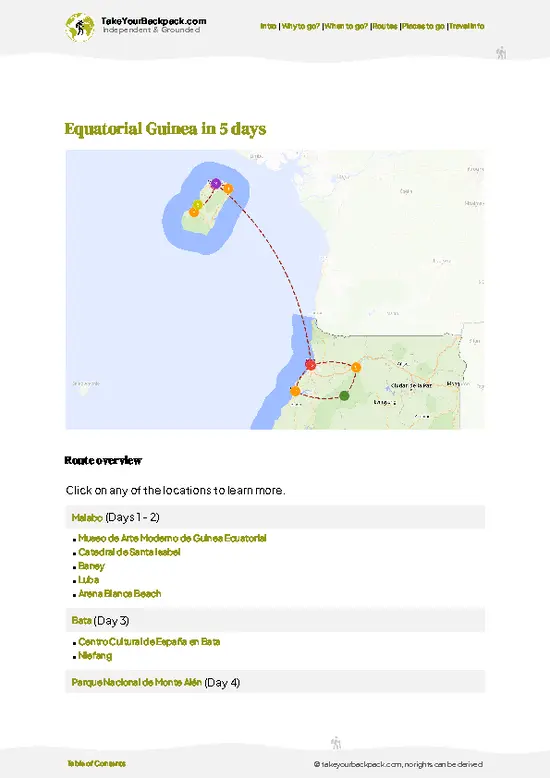
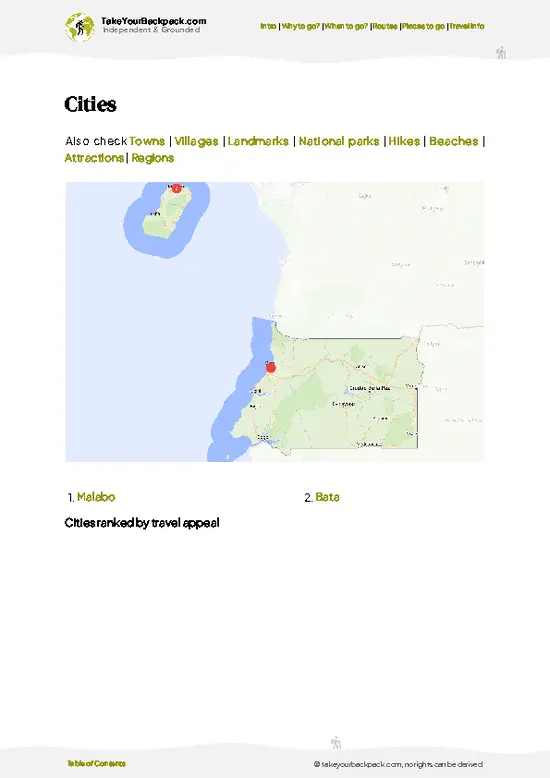
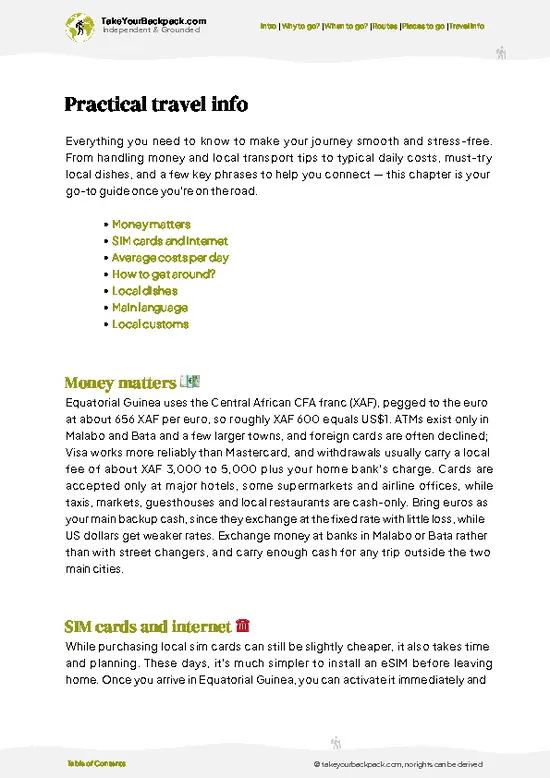
example page 0 from our offline Travel Guide for Equatorial Guinea
example page 1 from our offline Travel Guide for Equatorial Guinea
example page 2 from our offline Travel Guide for Equatorial Guinea
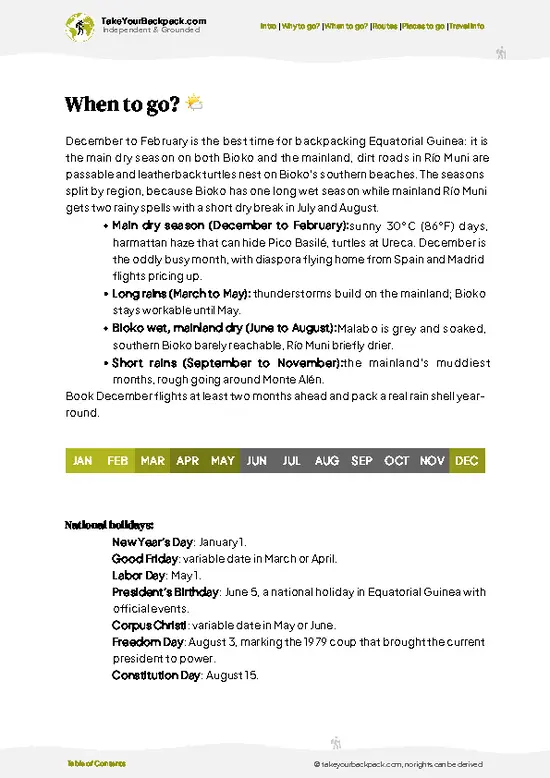
example page 3 from our offline Travel Guide for Equatorial Guinea
example page 4 from our offline Travel Guide for Equatorial Guinea
example page 5 from our offline Travel Guide for Equatorial Guinea
example page 6 from our offline Travel Guide for Equatorial Guinea
example page 7 from our offline Travel Guide for Equatorial Guinea
Loading the map 🌍
CLICK TO FILTER
cities
towns
villages
landmarks
national parks
hikes
beaches
attractions
regions
SHOW COUNTRY’S BESTSHOW ALL

✨ Why go?
Ranked #1 national park in Equatorial Guinea
Reasons people choose to explore here

Parque Nacional de Monte Alén suits backpackers who prefer forest to ticking off sights. There is no crowd, no tour-bus schedule and no queue, and that changes how the trip feels. You walk with a ranger, listen for primates before you see them, and decide your own pace. The park is not set up for casual day-trippers, which keeps it quiet and makes the days you spend there feel earned.

The terrain adds variety. The Monte Alén massif, rising to about 1,250 meters, gives the forest a real slope to climb, with changing vegetation and cooler air on the higher ground. Rivers cut through the lowlands, and the sound of water follows you for long stretches. Birdwatchers will find African grey parrots and hornbills overhead, and the insect life on the forest floor is constant.

It also suits travelers … read more 👉
Parque Nacional de Monte Alén suits backpackers who prefer forest to ticking off sights. There is no crowd, no tour-bus schedule and no queue, and that changes how the trip feels. You walk with a ranger, listen for primates before you see them, and decide your own pace. The park is not set up for casual day-trippers, which keeps it quiet and makes the days you spend there feel earned.

The terrain adds variety. The Monte Alén massif, rising to about 1,250 meters, gives the forest a real slope to climb, with changing vegetation and cooler air on the higher ground. Rivers cut through the lowlands, and the sound of water follows you for long stretches. Birdwatchers will find African grey parrots and hornbills overhead, and the insect life on the forest floor is constant.

It also suits travelers who like going without a fixed itinerary. A little Spanish helps a great deal with rangers and villagers, and rewards the effort you put into organizing the visit yourself. Come ready for simple conditions and long, wet walks, and the forest will give you something rare in Central Africa: space and silence.

💡 HighlightsEssential experiences to have while exploring Parque Nacional de Monte Alén

  1. Western lowland gorillas: The park shelters wild groups of this critically endangered primate. They live deep in the forest and are shy, so a sighting is a bonus and you should treat tracks, nests and feeding signs as a successful day.
  2. Monte Alén summit and upper slopes: The massif tops out around 1,250 meters. The climb passes through forest that changes with altitude, and the cooler, thinner air on top is a welcome break from the lowlands.
  3. Chimpanzees and other primates: Chimpanzees share the canopy with mandrills and several monkey species. Calls carry far through the trees, so mornings with a guide are the best time to catch them.
  4. Forest elephants: These smaller elephants of the Congo Basin move through the park along their own paths. You are far more likely to see dung, trampled vegetation
… read more 👉
  1. Western lowland gorillas: The park shelters wild groups of this critically endangered primate. They live deep in the forest and are shy, so a sighting is a bonus and you should treat tracks, nests and feeding signs as a successful day.
  2. Monte Alén summit and upper slopes: The massif tops out around 1,250 meters. The climb passes through forest that changes with altitude, and the cooler, thinner air on top is a welcome break from the lowlands.
  3. Chimpanzees and other primates: Chimpanzees share the canopy with mandrills and several monkey species. Calls carry far through the trees, so mornings with a guide are the best time to catch them.
  4. Forest elephants: These smaller elephants of the Congo Basin move through the park along their own paths. You are far more likely to see dung, trampled vegetation and cleared tracks than the animals themselves.
  5. Birdlife of the canopy: African grey parrots, hornbills and many forest species can be heard before they are seen. Bring binoculars, as the leaves hide almost everything from the ground.
  6. Rivers and forest streams: Water runs through the park in clear, tea-colored channels. Crossings and rest stops on the banks are the coolest parts of a day on foot.
  7. Giant trees and the forest floor: Huge buttressed trunks, hanging lianas, fungi, colorful butterflies and army ants make even a slow, short walk interesting, since the details are close at hand.
Parque Nacional de Monte Alén requires a permit and a ranger or guide, which should be arranged ahead through the forestry authorities in Bata or Malabo, and the gorilla and chimpanzee searches need the most advance planning.
Spotted a mistake or missing something? Contact us.

Things to do near Parque Nacional de Monte Alén

Ratings based on Tripadvisor reviews. When you book through this link, you support our work at no extra cost to you.

🌤️ When to go?Seasonal considerations and timing

  • Main Dry Season (December to February): Monte Alén is at its easiest from December to February, with the least rain, firmer trails and daytime highs of 27 to 30°C (81 to 86°F). Nights cool to about 20 to 22°C (68 to 72°F). Gorilla and elephant tracks are drivable and walkable, and this is the busiest window, which in Equatorial Guinea still means a handful of visitors.
  • Short Dry Spell (June to August): Rain eases and skies are often overcast, with temperatures of 24 to 28°C (75 to 82°F). Trails are muddy in patches but manageable. Fruiting trees can draw wildlife, and it is quieter than December.
  • Wet Seasons (March to May, September to November): Heavy downpours turn tracks to slick clay and swell streams, with 23 to 29°C (73 to 84°F) and humidity near saturation. Hiking is harder, though the
… read more 👉
  • Main Dry Season (December to February): Monte Alén is at its easiest from December to February, with the least rain, firmer trails and daytime highs of 27 to 30°C (81 to 86°F). Nights cool to about 20 to 22°C (68 to 72°F). Gorilla and elephant tracks are drivable and walkable, and this is the busiest window, which in Equatorial Guinea still means a handful of visitors.
  • Short Dry Spell (June to August): Rain eases and skies are often overcast, with temperatures of 24 to 28°C (75 to 82°F). Trails are muddy in patches but manageable. Fruiting trees can draw wildlife, and it is quieter than December.
  • Wet Seasons (March to May, September to November): Heavy downpours turn tracks to slick clay and swell streams, with 23 to 29°C (73 to 84°F) and humidity near saturation. Hiking is harder, though the forest is lush and you may have the place to yourself.
  • Daylight: Day length barely changes, with roughly 12 hours of light, so start walks early.
Prices for guides and lodging rarely swing with the seasons, so book transport and a guide a week ahead in December and January.


source: climatestotravel.comJANJanuary: fair for travelingFEBFebruary: fair for travelingMARMarch: fair for travelingAPRApril: fair for travelingMAYMay: good for travelingJUNJune: excellent for travelingJULJuly: excellent for travelingAUGAugust: excellent for travelingSEPSeptember: excellent for travelingOCTOctober: good for travelingNOVNovember: fair for travelingDECDecember: fair for traveling
when-to-go

✈️ The backpacker research shortcutEquatorial Guinea Travel Guide

An offline-friendly backpacking guide with optimized travel routes, ranked highlights, transport advice, and the best areas to stay.
example page 0 from our offline Travel Guide for Equatorial Guinea
example page 1 from our offline Travel Guide for Equatorial Guinea
example page 2 from our offline Travel Guide for Equatorial Guinea
example page 3 from our offline Travel Guide for Equatorial Guinea
example page 4 from our offline Travel Guide for Equatorial Guinea
example page 5 from our offline Travel Guide for Equatorial Guinea
example page 6 from our offline Travel Guide for Equatorial Guinea
example page 7 from our offline Travel Guide for Equatorial Guinea
The digital guide (174 pages) contains:
✅ 36 highlights, ranked by travel appeal
✅ Optimized 2, 3 & 5-day travel routes
✅ Cities, national parks, landmarks, beaches
✅ How to get around
✅ Offline-friendly for travel without Wi-Fi
👉 Click to see all 30+ guide features

📅 Plan smarter in minutes, not weeks
✅ Month by month travel advice
✅ Festivals & national holidays
✅ Budget expectations

🗺️ Go to the right places, skip the overrated ones
✅ Honest pros & cons of destinations
✅ Top hikes, parks & viewpoints
✅ Lesser-known places most travelers miss
✅ Clear “worth it vs skip it” guidance

🛏️ Travel smoothly without rookie mistakes
✅ Best areas to stay
✅ Transport systems explained simply
✅ Common scams & safety advice
✅ SIM cards, money & practical tips

🌍 Understand the country, not just visit it
✅ Culture & traditions
✅ 52 Essential phrases & customs
✅ Festivals worth planning around
✅ Traveler-friendly historical context
✅ Insights that make places more meaningful

📱 Built for real travel conditions
✅ Fully downloadable PDF
✅ Works completely offline
✅ Optimized for phone use
✅ Useful in remote areas & buses
✅ Everything in one place
Stop searching, start planning
Get instant access to your full guide. 30‑day money-back guarantee.
+ Add another guide for just

By proceeding you agree to our terms.
Sent to your inbox immediately after payment • 100% Secure Checkout
Best Backpacking Travel Advisor 2025 tourism awardBest Backpacking
Travel Advisor
2025
What others say about Take Your Backpack Guides:
⭐⭐⭐⭐⭐
Fantastic, amazing amount of information!
⭐⭐⭐⭐⭐
My goodness this is amazing, it's what I've been looking for hats off too you!
⭐⭐⭐⭐⭐
I think this is absolutely BRILLIANT
⭐⭐⭐⭐
Very complete and informative. It's still missing places, but I gotta to commend you
⭐⭐⭐⭐⭐
This is truly amazing, thank you, can't wait to explore it with my kids!
⭐⭐⭐⭐⭐
Awesome resource, thank you!
⭐⭐⭐⭐⭐
This is amazing! Can't wait to explore the ones I haven't seen
⭐⭐⭐⭐
I love this! Well done, great idea.
⭐⭐⭐⭐⭐
Thanks for taking the time to make this gem!
⭐⭐⭐⭐⭐
This might be the best website I've ever seen.
⭐⭐⭐⭐⭐
Congratulations, and thank you so much for your work; it's incredibly valuable.
⭐⭐⭐⭐
In all seriousness I think you did a great job pointing out the important spots
⭐⭐⭐⭐⭐
10/10 very good
⭐⭐⭐⭐⭐
As someone who's only just starting to visit regularly this is awesome, thank you.
⭐⭐⭐⭐
Thank you very much! I'm going to visit my dad, it's going to be very useful!
⭐⭐⭐⭐⭐
This is really cool! We'll be travelling for the first time and this definitely come in handy.
⭐⭐⭐⭐⭐
You are now our minister of culture, congratulations 👨‍💼
⭐⭐⭐⭐⭐
Just wanted to tell you that this is a pearl! Going to follow your recommendations.
⭐⭐⭐⭐⭐
This is so cool. I'll definitely be using the resource for my travels soon.
⭐⭐⭐⭐⭐
This is very impressive! Good work.
⭐⭐⭐⭐⭐
This is an amazing and informative site. Very well done!

🛏️ Where to stay?Best areas and accommodation options

The easiest base for Monte Alén is the park’s own lodging at Escuela de Mongomo-style forest camps near the Etomekoh entrance area, but the most reliable option is to sleep in Bata or the town of Niefang and arrange the park visit from there. Inside the park, accommodation is basic: a small ecotourism lodge and simple cabins near the park headquarters at Nkué-Ntoum area, plus rustic camping for those carrying gear. Facilities are limited, electricity can be patchy and meals are simple, so bring snacks, water treatment and a headlamp. Book through the park administration or a Bata tour operator, … read more 👉
The easiest base for Monte Alén is the park’s own lodging at Escuela de Mongomo-style forest camps near the Etomekoh entrance area, but the most reliable option is to sleep in Bata or the town of Niefang and arrange the park visit from there. Inside the park, accommodation is basic: a small ecotourism lodge and simple cabins near the park headquarters at Nkué-Ntoum area, plus rustic camping for those carrying gear. Facilities are limited, electricity can be patchy and meals are simple, so bring snacks, water treatment and a headlamp. Book through the park administration or a Bata tour operator, because walk-ins are not guaranteed a bed.
Bata, the country’s main mainland city, is the practical choice. It has the widest range of hotels, from simple guesthouses at about €25 to 45 a night to comfortable business hotels at €80 to 140, along with restaurants, ATMs and the airport. It lies roughly 2 to 3 hours from the park by road, depending on conditions.
Niefang and Mbini are smaller towns closer to the park edge, with a few basic guesthouses around €15 to 30. They suit travelers who want an early start on the trails. Evinayong is a further inland option with modest lodging. Carry cash in euros-equivalent local currency, as cards are rarely accepted outside Bata.

👛 Costs (as of 22 October 2026)What things cost and how to budget

A realistic budget for Parque Nacional de Monte Alén is about €95 to 150 per day, and the table uses a total of €125. Costs are higher than in most of Africa because the park is remote, visitor services are few and everything must be arranged in advance. Travelers pay in Central African CFA francs, and cash is essential away from Bata.
CategoryBudget RangeLocal Reality
Entrance and permits€5 to 15Park access is arranged through the park authority or an operator, and fees can change.
Guide and ranger€15 to 30A guide is strongly advised for forest walks and is often bundled into the booking.
Accommodation (high season)€25 to 45Basic park cabins or camping cost less, while Bata guesthouses cost more.
Local transport€20 to 35Shared taxis run to Niefang, but reaching the park usually needs a hired vehicle
… read more 👉
A realistic budget for Parque Nacional de Monte Alén is about €95 to 150 per day, and the table uses a total of €125. Costs are higher than in most of Africa because the park is remote, visitor services are few and everything must be arranged in advance. Travelers pay in Central African CFA francs, and cash is essential away from Bata.
CategoryBudget RangeLocal Reality
Entrance and permits€5 to 15Park access is arranged through the park authority or an operator, and fees can change.
Guide and ranger€15 to 30A guide is strongly advised for forest walks and is often bundled into the booking.
Accommodation (high season)€25 to 45Basic park cabins or camping cost less, while Bata guesthouses cost more.
Local transport€20 to 35Shared taxis run to Niefang, but reaching the park usually needs a hired vehicle with a driver.
Food and supplies€10 to 20Meals at lodges are simple, so buy snacks and water in Bata.
Total Daily Budget€125Costs fall if you share a vehicle and guide with others.
⚠️ Prices can change and everyone travels differently, so take this as a rough guide. Hope it helps you plan your adventure!

🥾 TrailsBest hikes in Parque Nacional de Monte Alén national park

Parque Nacional de Monte Alén is a walking park with a network of forest paths rather than a signed trail system with published distances, so most routes are agreed with the rangers on arrival. Plan on guided walks of a few hours up to full days, and longer treks with camping if you have organized supplies in advance. The terrain is a mix of flat lowland forest, river valleys and steep, slippery climbs on the Monte Alén massif.

  • Lowland forest walks: Easy to moderate, usually a half day from a ranger base. Flat paths pass big trees, streams, and signs of elephants and other wildlife. Boots with
… read more 👉
Parque Nacional de Monte Alén is a walking park with a network of forest paths rather than a signed trail system with published distances, so most routes are agreed with the rangers on arrival. Plan on guided walks of a few hours up to full days, and longer treks with camping if you have organized supplies in advance. The terrain is a mix of flat lowland forest, river valleys and steep, slippery climbs on the Monte Alén massif.

  • Lowland forest walks: Easy to moderate, usually a half day from a ranger base. Flat paths pass big trees, streams, and signs of elephants and other wildlife. Boots with good grip help, because the ground stays wet.
  • Monte Alén climb: Moderate to hard, a full day or more depending on the route. The path rises steadily through changing forest to the upper slopes, with muddy sections and fallen trunks across the path.
  • Primate tracking: Moderate to hard, from early morning with a guide. You follow calls, tracks and feeding signs toward chimpanzees, mandrills and gorillas. Patience matters more than fitness, and sightings are not promised.
  • River walks: Easy to moderate, often a few hours. Paths follow streams and cross shallow water, so waterproof footwear or sandals you can walk in are useful.
  • Birdwatching walks: Easy, early morning or late afternoon. Parrots and hornbills are most active at these hours, and slow, quiet movement helps.
Wildlife is present throughout, though dense growth makes viewing difficult. Insects, leeches and sudden rain are normal, so carry a light rain jacket, repellent and a dry bag for electronics.

Getting there is possible by road from Bata, usually with a hired car or shared transport and a final stretch on rougher roads, and there is no regular public transport that runs directly to the park. Visitors are few, so the park is almost never crowded. A permit is required and should be arranged beforehand with the forestry authorities, who can advise on the current fee, which is paid in local currency in cash. Hire a guide and bring food, water and cash from Bata.
⚠️ Hiking info can sometimes be outdated or inaccurate. Before you hit the trail, check the latest conditions with locals. If you do spot anything that's off, I'd love to hear from you, so I can update it for fellow travelers.

🛡️ SafetySafety Tips and Common Scams in Parque Nacional de Monte Alén

Monte Alén is a remote rainforest park where the main risks are ordinary ones: heat, mud, dehydration and getting separated on unmarked trails. Hire a park guide or ranger for any walk, as paths branch and fade in dense forest and navigation without local knowledge is unreliable. Wear boots with good grip, since clay slopes and wet roots cause most slips, and carry at least 2 to 3 liters of water per person plus a rain layer. Streams rise quickly after storms, so cross them cautiously and delay if the water turns brown and fast. Forest elephants, gorillas, chimpanzees and buffalo live here, but meetings are rare and guides handle them. If you see animals, keep your distance, stay quiet and follow instructions. Insects are a bigger nuisance: use repellent, cover up at dusk and take malaria … read more 👉
Monte Alén is a remote rainforest park where the main risks are ordinary ones: heat, mud, dehydration and getting separated on unmarked trails. Hire a park guide or ranger for any walk, as paths branch and fade in dense forest and navigation without local knowledge is unreliable. Wear boots with good grip, since clay slopes and wet roots cause most slips, and carry at least 2 to 3 liters of water per person plus a rain layer. Streams rise quickly after storms, so cross them cautiously and delay if the water turns brown and fast. Forest elephants, gorillas, chimpanzees and buffalo live here, but meetings are rare and guides handle them. If you see animals, keep your distance, stay quiet and follow instructions. Insects are a bigger nuisance: use repellent, cover up at dusk and take malaria prevention seriously, after speaking with a travel clinic. Bring a basic first-aid kit, because medical help is far away. Carry your passport copy and permits for checkpoints on the road to the park.

FAQFrequently asked questions about Parque Nacional de Monte Alén

Plan on 2 to 3 days at Parque Nacional de Monte Alén, which gives you at least one full day of guided forest walking. Add another half day each way for the road from Bata, which takes roughly 2 to 3 hours. Wildlife viewing improves with a second morning, especially for primates and birds.
Reaching Parque Nacional de Monte Alén without a car is difficult but possible. Shared taxis and minibuses run from Bata to Niefang, but the last leg to the park usually needs a hired vehicle or a ride arranged through the park office. Budget about €20 to 35 a day for a driver, and book it before you leave Bata.
Yes, Parque Nacional de Monte Alén requires an access fee and permission from the park authority, normally arranged through an operator or the park office in Bata. Expect to pay roughly €5 to 15, plus €15 to 30 for a guide. Bring your passport and visa documents, as checkpoints on the road are common.
⚠️ Things can change over time, so always validate details locally before you go.

Other Equatoguinean national parks near Parque Nacional de Monte Alén

Explore more nearby:


💡 Not sure where to go next?
Create a personalized itinerary for Equatorial Guinea including Parque Nacional de Monte Alén and the places that fit your trip.

Generate my itinerary

👉 Discover all national parks

Or checkout all Equatorial Guinea has to offer (think cities, towns, villages, national parks, hikes, beaches, festivals)
Country photo of Equatorial Guinea

We 💚 feedbackWhat to keep in mind

Parque Nacional de Monte Alén pairs best with a few days in Bata, which gives you the transport links, supplies and permit offices you need on the way in. From there, the forest is a natural counterpart to the coast, and the beaches near Mbini make a good, quiet end to the route. I would bring a headlamp, waterproof socks and more cash than you expect to spend.

✍️ Help improve this page!
The information on this page is based on in-depth research, insights shared by experienced travelers, and feedback from the local travel community in Equatorial Guinea. While every effort is made to keep the information accurate and current, conditions can change — so if you spot anything incorrect or outdated, please get in touch.


🙋‍♂️ Give feedback

👋 Meet the founderWho’s Behind Take Your Backpack?

Johan, backpacker and founder of TakeYourBackpackHi, I’m Johan (Netherlands 🇳🇱), the creator of TakeYourBackpack. Over the past 3 decades, I’ve backpacked through 90+ countries across six continents, gaining extensive experience with independent travel, long-term trips, and overland routes.

This site is built on a combination of firsthand travel experience and carefully curated insights from other backpackers. Many guides are based on places I’ve personally visited, while others bring together tips, observations, and practical advice shared by trusted travelers I’ve met along the way.

The goal is to provide realistic, experience-driven guidance — not generic itineraries — so you can explore destinations with better context, clearer expectations, and more confidence.