Trip Planning
The TakeYourBackpack guidebooks are your all-in-one travel companion, featuring the best cities, national parks, hikes, beaches, and unique sites, along with essential tips on when to go, how to get around, exchanging money, and even local phrases to get you started — everything you need for a smooth, unforgettable backpacking adventure.
Stop researching. Start exploring.Discover all 26 highlights,ranked
and organized into practical routes.
Get instant access
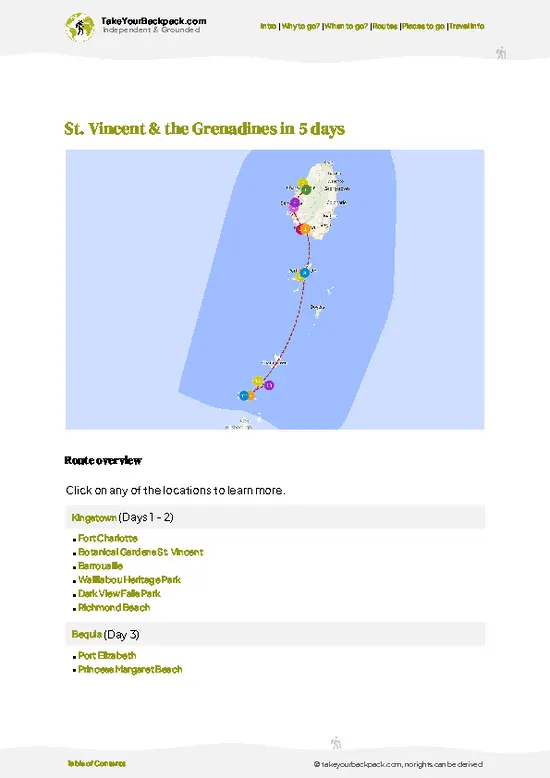
Planning a backpacking route through St. Vincent & the Grenadines can be tricky — you need to balance must-see places, travel times, budget, and how long to stay in each destination. Our free personalized St. Vincent & the Grenadines itinerary planner creates a route based on your travel style, trip duration, and interests, so you can spend less time researching and more time exploring.
Personal tip: I normally search on good rating for atmosphere (for meeting people) and location (for easy exploring). Cleanliness as a bonus.
Travel Essentials
No vaccinations are mandatory for most travelers to Saint Vincent and the Grenadines. The exception is a yellow fever certificate, which is required if you arrive from, or have transited through, a country with yellow fever risk. Make sure your routine vaccines, including MMR and tetanus, are up to date. Hepatitis A and typhoid are commonly recommended, and hepatitis B is advised for longer stays. There is no malaria, but dengue and chikungunya are spread by daytime mosquitoes, so use repellent with DEET or picaridin.
vaccination requirementsWhen I first started traveling, I often spent part of my first day in a new country hunting for a local SIM card. While this can still be slightly cheaper, it also takes time and planning.
These days, it's much simpler to install an eSIM before leaving home. Once you arrive in St. Vincent & the Grenadines, you can activate it immediately and have mobile data from the moment you land — which is especially useful for ordering transport or navigating away from busy airports.
There are many providers nowadays, and price differences are usually small. I personally go with
Holafly, as it offers excellent network coverage throughout the country and strong global coverage, so you can manage multiple countries from a single app.
HolaFly eSimCulture & Customs
Vincentians are friendly but fairly conservative. Keep swimwear for the beach and cover up with a shirt and shorts or a skirt when walking through Kingstown, villages or shops. Wearing camouflage clothing is illegal for civilians in Saint Vincent and the Grenadines, and it can be confiscated. Ask before photographing people, especially market vendors and fishermen, and accept a polite refusal. Sundays are for church and family, so expect closed shops and dress neatly if you join a service. Do take your time, because rushing a conversation or a queue comes across as rude. Don’t haggle hard over market produce, since prices are usually already fair. Women may get extra attention, and modest clothing in town keeps it to a minimum. Same-sex couples should avoid public displays of affection, as attitudes are traditional and the law is unfavorable.
Trying traditional food is always a great way to experience the culture. Here are some must-try dishes for St. Vincent & the Grenadines.
- Roasted Breadfruit and Fried Jackfish: This is the official national dish. Breadfruit is charred whole over coals until smoky and soft, then served with crisp fried jackfish. Breadfruit has a special place here because Captain Bligh brought it on HMS Providence in 1793 to the island, and the Botanic Gardens still grow a descendant of the original tree.
- Callaloo Soup: A thick green soup of dasheen leaves, okra, coconut milk and often crab or salted meat. It is a Sunday staple and a common lunch at local cookshops.
- Buljol: Shredded saltfish tossed with tomato, onion, peppers and oil. It is eaten for breakfast or alongside roasted breadfruit, and it dates back to the days when salted cod was a staple import.
- Ducana: Grated sweet potato and coconut, spiced and boiled in banana leaves, served with stewed saltfish. It is especially popular around Easter.
- Souse: Pork, often trotters, pickled in a tangy broth of lime, cucumber and hot pepper. It is a classic Saturday morning dish and a well-known hangover remedy.
- Pelau: A one-pot dish of rice, pigeon peas and caramelized chicken. It is the standard at beach limes, family gatherings and fetes.
Tap water on the main island of Saint Vincent and the Grenadines comes from treated mountain sources, and most locals there drink it without issue, so it is generally fine for travelers too. On Bequia, Union and the other Grenadines, water mostly comes from rainwater cisterns and desalination, so stick to bottled water or use a filter. A filter bottle also helps after heavy rains, when supplies can turn cloudy, and it cuts down on plastic waste.
English is the official language of Saint Vincent and the Grenadines, and you will have no trouble in Kingstown, on Bequia or at any guesthouse, dive shop or ferry office. Younger Vincentians switch easily between standard English and Vincentian Creole. In rural villages on the windward coast and the north of the main island, fast Creole among locals can be hard to follow at first. Everyone will slow down for you, though. Learn a few phrases such as “wha’ happenin’” (how are you) and “jus’ now” (soon, which can mean hours), and you will follow conversations much more easily.
Money & Payments
The local currency of St. Vincent & the Grenadines is XCD ($).
Saint Vincent and the Grenadines uses the Eastern Caribbean dollar, pegged at about EC$2.70 to US$1, and ATMs are easy to find in Kingstown, Calliaqua, Port Elizabeth on Bequia, Clifton on Union Island and Canouan. Mayreau and the smaller islands have none, so withdraw before heading south. Local ATMs typically charge EC$5 to 10 (US$2 to 4) per withdrawal on top of your home bank’s fees, so fewer, larger withdrawals save money. Visa and Mastercard work at hotels, dive shops, supermarkets and most sit-down restaurants. Minibuses, ferries, rum shops, market stalls and water taxis are cash only. US dollars are widely accepted, but change usually comes back in EC dollars at a slightly worse rate of around 2.60, while euros are hard to use outside banks. Exchange money at banks or your hotel rather than with people on the street.
Tipping in Saint Vincent and the Grenadines is appreciated but rarely obligatory. Many restaurants and hotels add a 10% service charge on top of VAT, so check your bill before leaving more. Where no charge is added, 10 to 15% is standard. Taxi drivers don’t expect tips, but rounding up is welcome, and guides on hikes or boat trips usually get EC$10 to 20 (US$4 to 7) per person for a good day.
v2.webp)

 Best Backpacking
.jpg) Over the years, I've learned the importance of packing minimally. It's so much easier to jump on the back of a truck or squeeze yourself into the last spot of a minibus without that supersized backpack. If you're headed to a warm destination, leave your winter jacket at home; for colder regions, opt for thin thermal underlayers. Instead of packing your entire wardrobe, bring just three sets of clothes, as laundry facilities are available everywhere.
Over the years, I've learned the importance of packing minimally. It's so much easier to jump on the back of a truck or squeeze yourself into the last spot of a minibus without that supersized backpack. If you're headed to a warm destination, leave your winter jacket at home; for colder regions, opt for thin thermal underlayers. Instead of packing your entire wardrobe, bring just three sets of clothes, as laundry facilities are available everywhere.


.jpg) Hi, I’m Johan (Netherlands 🇳🇱), the creator of TakeYourBackpack. Over the past 3 decades, I’ve backpacked through 90+ countries across six continents, gaining extensive experience with independent travel, long-term trips, and overland routes.
Hi, I’m Johan (Netherlands 🇳🇱), the creator of TakeYourBackpack. Over the past 3 decades, I’ve backpacked through 90+ countries across six continents, gaining extensive experience with independent travel, long-term trips, and overland routes.