×
Denmark 🇩🇰

backpacking Europe Denmark 🇩🇰Pedal calmly through cities built for balance and livability.

Explore CzechiaExplore Estonia

Backpacking Denmark in 2026

A complete guide including when and where to go, costs, transport, itineraries, and practical travel advice.
A practical introduction for travelers

Backpacking Denmark
By Johan Kruseman 🇳🇱 | Updated June 19, 2026

I chose a bike over the metro in a Danish drizzle—saved cash, gained time, lost dry socks. That’s Denmark: efficient, fair, and built for people who move. You pay for quality here, but the system rewards smart choices.

You come for coastlines you actually use—Jutland’s dunes, Bornholm’s lanes, clean harbors where locals swim before work. Cities run on common sense: design you can sit on, New Nordic plates that taste like sea and garden, museums that explain Vikings without cosplay. The rhythm is humane: long summer light, candles and conversation when it’s dark, bikes humming past brick streets in any weather. Prices bite and winds cut, but you get frictionless transport, safe streets, and a culture that meets you halfway. Pack layers, lean into the bike, and the first hot cinnamon bun or harbor dip feels earned.

Compared with Sweden’s distances and Norway’s cliffs, Denmark is human-scale and easy—ideal for first-timers, families, cyclists, and food lovers.

👉 Get the 📖 Travel Guide of Denmark

Copenhagen & North Zealand

If you want Denmark’s brain and wallet in one place, start here. Metro from the airport to the center in about 15 minutes, S-trains north to Kronborg and the Louisiana Museum, bikes everywhere. You’ll pay more than anywhere else in the country—think a noticeable markup on beds and meals—but you waste almost zero time. Best for first-timers, night owls, cyclists, and anyone who values density over savings.

Aarhus & the East Jutland Rail Spine

Aarhus, then up to Aalborg, sits on a clean intercity rail line from Copenhagen in roughly three hours. It’s student-heavy, social, and museum-rich without the capital’s price burn. Hostels are easier, cafés cheaper, and the harbor has room to breathe. You trade some icon sites for smoother daily costs and quick day trips to beaches and forests by bus.

Funen & the South Funen Archipelago

Odense is an easy 1.5-hour train from Copenhagen, then it’s ferries and short hops to Svendborg and Ærø. Low gears and low stress: bike lanes, manor-house lanes, island time. Ferries add clock-watching and occasional waits, and nightlife thins fast, but cabins and simple camp spots keep costs down. Ideal for riders and slow travelers who don’t mind schedules ruling the day.

West Jutland & the Wadden Sea

Esbjerg and Ribe are rail-reachable; beyond that, buses thin and wind becomes your daily opponent. Big skies, tidal flats, bird seasons, and long walks on Fanø if you commit to the ferry shuffle. Cheaper than Copenhagen, but connections eat hours and beds spike in summer. Suits hikers, photographers, and anyone who prefers weather to conversation.

Bornholm

High effort, high return. Overnight ferry from Køge or the day route via Ystad; once on the island, cycling feels designed, with cliffs, forests, and quiet villages strung together. Beds book early and cost a bit more, and storms can pin you. Go if you’ll trade time and certainty for miles of empty coastal road.
Geography and where places are located
Loading the map 🌍
CLICK TO FILTER
cities
towns
villages
landmarks
national parks
hikes
beaches
attractions
festivals
regions
SHOW COUNTRY’S BESTSHOW ALL

⭐ HighlightsUnmissable destinations

💡 Not sure where to go?
Get a personalized backpacking itinerary for Denmark generated in under 10 seconds.

Generate my itinerary
  • Louisiana Museum of Modern Art, Humlebæk: Glass, light, and sea air wrap around you as the sculpture garden spills toward the Øresund; the floorboards give a soft creak and you can taste salt on your lips if the wind’s up. It’s a 35-45 minute train from Copenhagen plus a short walk, ticket prices are high by Danish standards, and weekends queue—but go midweek, linger late, and the coast does half the curating.
  • Møns Klint: White chalk cliffs drop like a broken tooth into green water, beech forest whispering above; chalk dust sticks to your palms and shoes, and the wind slaps your jacket flat. It’s a long day trip (2.5-3 hours from Copenhagen each way), stairs are steep (count on a sweaty climb), buses are sparse, and the GeoCenter isn’t cheap—yet on a clear day, the view writes its own justification.
  • ARoS Aarhus Art Museum: The rainbow panorama bends over the city so the streets below hum in tinted silence, and the colored glass warms your skin as you walk the loop. Entry isn’t pocket change,
read more 👉
  • Louisiana Museum of Modern Art, Humlebæk: Glass, light, and sea air wrap around you as the sculpture garden spills toward the Øresund; the floorboards give a soft creak and you can taste salt on your lips if the wind’s up. It’s a 35-45 minute train from Copenhagen plus a short walk, ticket prices are high by Danish standards, and weekends queue—but go midweek, linger late, and the coast does half the curating.
  • Møns Klint: White chalk cliffs drop like a broken tooth into green water, beech forest whispering above; chalk dust sticks to your palms and shoes, and the wind slaps your jacket flat. It’s a long day trip (2.5-3 hours from Copenhagen each way), stairs are steep (count on a sweaty climb), buses are sparse, and the GeoCenter isn’t cheap—yet on a clear day, the view writes its own justification.
  • ARoS Aarhus Art Museum: The rainbow panorama bends over the city so the streets below hum in tinted silence, and the colored glass warms your skin as you walk the loop. Entry isn’t pocket change, lockers are mandatory, and Aarhus is a 3+ hour train from Copenhagen—pair it with the Latin Quarter cafes and you’ve earned the fare.
  • Skagen’s Grenen: Sand slides underfoot as the two seas crosshatch in front of you; icy spray needles your shins and the wind tastes clean and metallic. It’s a long haul to Denmark’s tip, summer beds spike in price, and you may need the Sandormen tractor to keep your shoes dry—but shoulder season light and painter-country dunes pay you back.
  • Ribe & the Wadden Sea: Cobblestones and a sober cathedral tower meet wide tidal flats where the mud sucks at your boots and raw oysters taste cold and iron-rich; geese honk like traffic. Trains reach Ribe easily, but safe tidal walks need a guide, weather is brutal when it turns, and layers matter—catch low tide right and you’ll remember the stillness for years. Off the map: Råbjerg Mile’s moving dune, the island of Ærø’s bike lanes and beach huts, and Thy’s heathland; personal favorite: sunset in Louisiana’s sculpture park when the Øresund goes mirror-quiet.
Spotted a mistake or missing a highlight? Contact us.

But Denmark offers more...

Discover and compare all of its highlights per category

🧭 RoutesPlanning a route that makes sense

The 5-Day Copenhagen & Coast Taster

The vibe: A relaxed city-and-sea intro to Denmark built around Copenhagen’s icons, easy day trips, and plenty of café time instead of constant packing. You get royal history, classic canals, and a soft landing into Danish everyday life with zero need for a rental car.
The highlights:
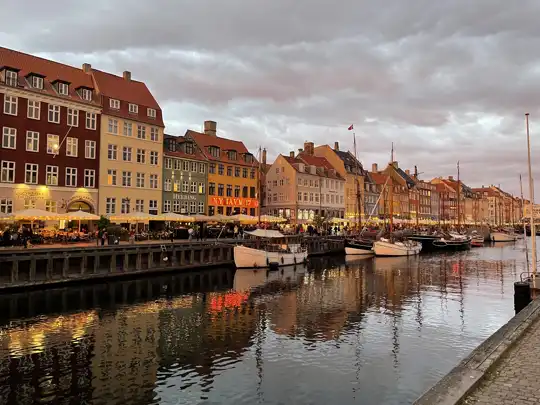
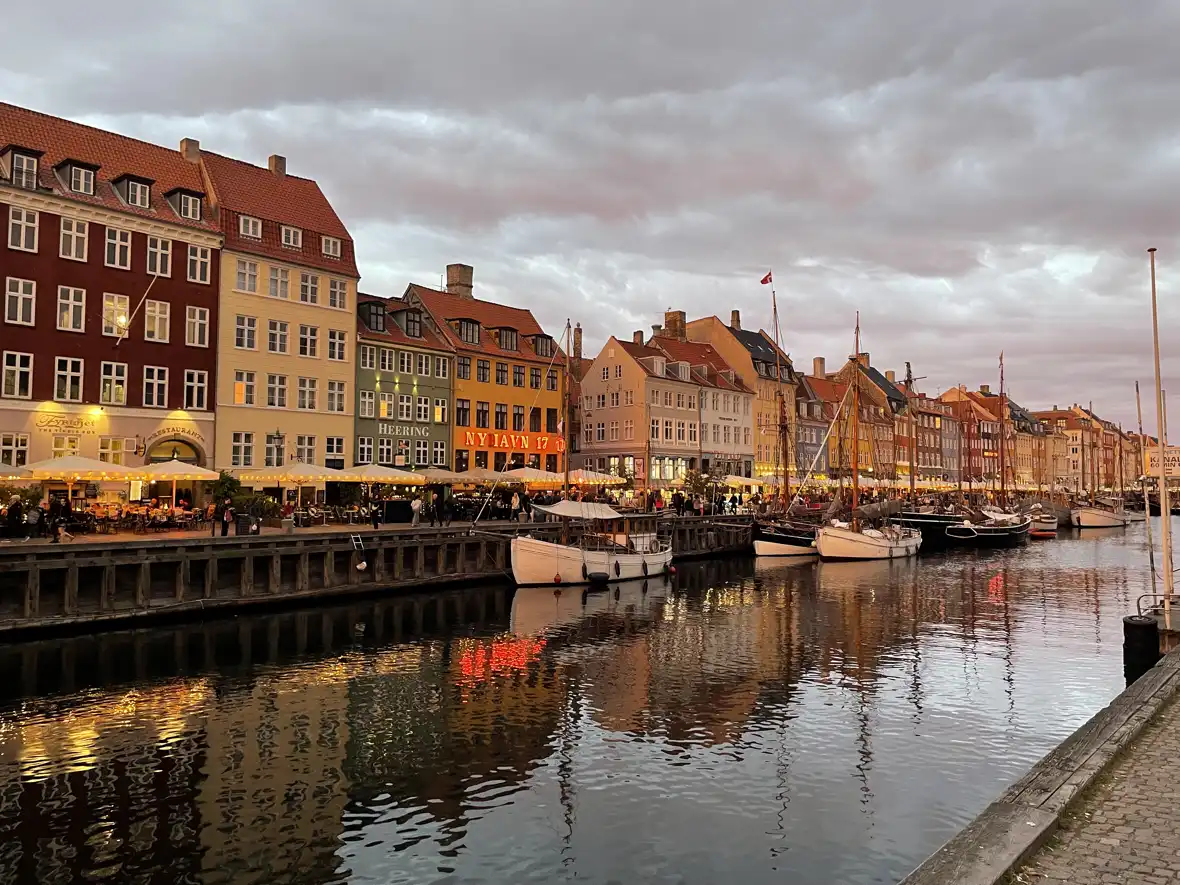
  • Copenhagen’s historic core with Tivoli Gardens and Nyhavn Canal District
  • Royal and cultural heavy-hitters like Rosenborg Castle or the National Museum of Denmark
  • A coastal art escape to the Louisiana Museum of Modern Art
  • Urban beach time at Amager Strand with optional nature walks in Vestamager or Amager Nature Park

The 10-Day Denmark Culture & Coast Loop

The vibe: A balanced loop that links Copenhagen, the art-and-food scene of Aarhus, and the tidal west coast, mixing museums, castles, and old towns with fjords and mudflats. You’ll move often enough to feel the country’s variety, but with multi-night stays so you’re not living out of your daypack.
The highlights:
  • Copenhagen’s canal
read more 👉

The 5-Day Copenhagen & Coast Taster

The vibe: A relaxed city-and-sea intro to Denmark built around Copenhagen’s icons, easy day trips, and plenty of café time instead of constant packing. You get royal history, classic canals, and a soft landing into Danish everyday life with zero need for a rental car.
The highlights:
  • Copenhagen’s historic core with Tivoli Gardens and Nyhavn Canal District
  • Royal and cultural heavy-hitters like Rosenborg Castle or the National Museum of Denmark
  • A coastal art escape to the Louisiana Museum of Modern Art
  • Urban beach time at Amager Strand with optional nature walks in Vestamager or Amager Nature Park

The 10-Day Denmark Culture & Coast Loop

The vibe: A balanced loop that links Copenhagen, the art-and-food scene of Aarhus, and the tidal west coast, mixing museums, castles, and old towns with fjords and mudflats. You’ll move often enough to feel the country’s variety, but with multi-night stays so you’re not living out of your daypack.
The highlights:
  • Copenhagen’s canal life, Tivoli Gardens, and royal or national museums
  • Coastal culture with Louisiana Museum of Modern Art and Kronborg Castle
  • Aarhus with ARoS Aarhus Art Museum and Den Gamle By
  • Jutland’s historic core around Vejle and Ribe, including the Jelling Stones and National Park Vadehavet

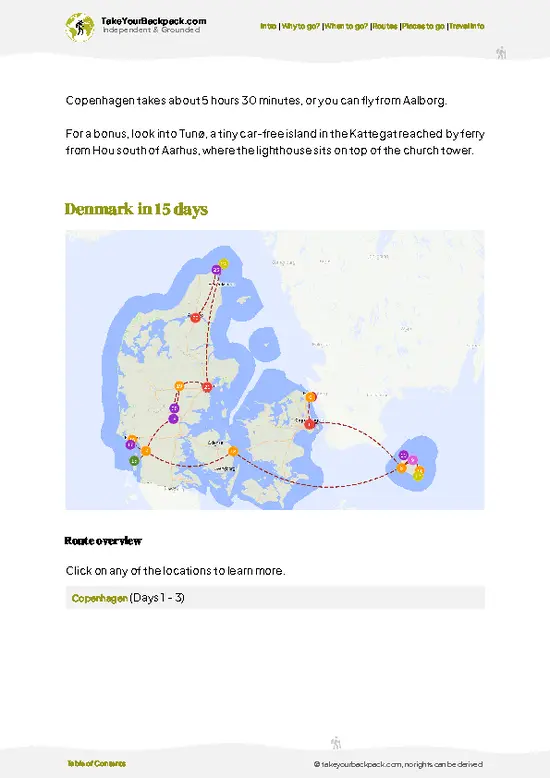
The 15-Day Denmark Islands, Coasts & Culture Journey

The vibe: A slow, immersive circuit that threads together Copenhagen, Roskilde, island cliffs, Aarhus, and the wild north and west coasts, using trains, buses, and ferries to see how small but varied Denmark really is. It’s for travelers who want both headline sights and quieter corners, from chalk cliffs to moving dunes and tidal flats.
The highlights:
  • Copenhagen’s palaces, museums, and urban nature at Amager Strand and nearby nature parks
  • Historic Roskilde paired with Skjoldungernes Land National Park
  • Møns Klint and a taste of the Camønoen island trail network
  • Aarhus with ARoS, Den Gamle By, and nearby Mols Bjerge National Park
  • North Jutland’s Skagen Beach and Råbjerg Mile plus the Wadden Sea landscapes near Esbjerg and Ribe
🧭 Looking for a route that fits your  trip?
Get a personalized Denmark backpacking itinerary based on your trip length, interests, and start location—in under 10 seconds.

Generate my itinerary

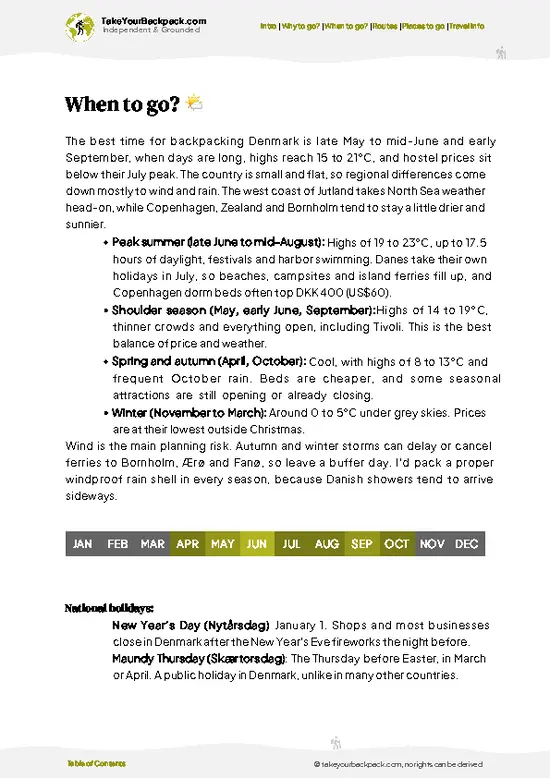
🌤️ When to go?When to go for the best experience

Late May to mid-June and late August to mid-September are the sweet spots. Daylight runs long, temperatures sit in the “hike all day, hoodie at night” zone, and almost all summer services (island ferries, harbor baths, late museum hours) are fully switched on. Danish school holidays either haven’t hit or have just eased, so dorm beds and intercity tickets pull back from peak pricing without slipping into winter closures. Trails are dry enough for bikepacking the gravel backroads, coastal winds keep the midges honest, and you still get that golden, slow evening light that makes a cheap picnic feel like a proper meal.
  • Peak Summer (July-early August): Prices jump, hostel kitchens get elbow-to-elbow, and every train to the coast feels full. The payoff is raw summer: diving platforms in Copenhagen’s harbor, music spilling into courtyards, island ferries on max frequency. Watch for post-storm bacteria spikes that temporarily close harbor baths.
  • Shoulder Shift (late May-mid June, early September): Cafés roll out tables, ferries extend timetables, fields green up, and crowds thin by the day. You move faster—museum lines vanish, bike lanes breathe, campgrounds have choice pitches—while the country quietly ramps up (or winds down) behind you.
  • Deep Off-Peak (November-March): Low sky, empty dunes, rooms priced to move. Denmark turns inward: candles, galleries, hot soup. Ride the solitude if you can hack wind and sleet; survival hack: a tight windproof shell over wool beats bulk, and plan ferries—North Sea storms cancel sailings.

Tactical tip: For July, book dorms and long-distance trains about a month out; otherwise pack a windproof shell and let the shoulder season’s flexibility save you money.

source: climatestotravel.comJANJanuary: fair for travelingFEBFebruary: fair for travelingMARMarch: fair for travelingAPRApril: good for travelingMAYMay: highly recommended for travelingJUNJune: excellent for travelingJULJuly: good for travelingAUGAugust: good for travelingSEPSeptember: highly recommended for travelingOCTOctober: good for travelingNOVNovember: fair for travelingDECDecember: fair for traveling
📅 Traveling in a specific month?
Get a full month-by-month breakdown of weather, crowds, costs, festivals, and seasonal highlights in the complete travel guide.

Get full details when to go 👉

Get the Travel Guide -
2025-08-27 20.09.04

💰 Costs (as of 2026)What things cost day to day

Plan on 500-700 DKK per day if you sleep in dorms, cook most meals, and choose one paid sight every other day.
  • dorm accommodation: 200-350 DKK in most towns; 300-450 DKK in Copenhagen at summer peak. Many hostels add 60-90 DKK for linens and forbid sleeping bags (bedbug policy), so either bring proper sheets or budget the fee. Kitchens are common and the real money-saver; I’ve cooked pasta while folks blew their day’s budget at Nyhavn. System tip: the Danhostel/HI “membership” or non-member surcharge works across a network—if you’ll use hostels 3-4 nights, the discount/surcharge avoidance usually pays back. Compared with Germany, beds run 20-40% higher; Sweden is similar; Norway is worse.
  • meals: Supermarket Survival: 80-150 DKK/day if you self-cater two meals (Rema 1000/Netto/Lidl), grab skyr and rugbrød for breakfast, and cook a simple dinner. Street food reality: Danish hot dog 35-45 DKK; kebab 60-80; smørrebrød 60-100 per piece; food-market bowls and burgers 90-140; sit-down mains 140-220. Coffee 35-45; bakery pastry 15-25. Germany is clearly cheaper for eating out; Sweden’s groceries feel similar but restaurants can be a touch lower; Norway tops Denmark for price pain. Tip: tap water
read more 👉
Plan on 500-700 DKK per day if you sleep in dorms, cook most meals, and choose one paid sight every other day.
  • dorm accommodation: 200-350 DKK in most towns; 300-450 DKK in Copenhagen at summer peak. Many hostels add 60-90 DKK for linens and forbid sleeping bags (bedbug policy), so either bring proper sheets or budget the fee. Kitchens are common and the real money-saver; I’ve cooked pasta while folks blew their day’s budget at Nyhavn. System tip: the Danhostel/HI “membership” or non-member surcharge works across a network—if you’ll use hostels 3-4 nights, the discount/surcharge avoidance usually pays back. Compared with Germany, beds run 20-40% higher; Sweden is similar; Norway is worse.
  • meals: Supermarket Survival: 80-150 DKK/day if you self-cater two meals (Rema 1000/Netto/Lidl), grab skyr and rugbrød for breakfast, and cook a simple dinner. Street food reality: Danish hot dog 35-45 DKK; kebab 60-80; smørrebrød 60-100 per piece; food-market bowls and burgers 90-140; sit-down mains 140-220. Coffee 35-45; bakery pastry 15-25. Germany is clearly cheaper for eating out; Sweden’s groceries feel similar but restaurants can be a touch lower; Norway tops Denmark for price pain. Tip: tap water is excellent—don’t buy bottles.
  • local transport: The Rejsekort (80 DKK deposit) is the cheapest way to unlock cities and regions: tap on/off, get roughly 20-30% off singles, and transfer seamlessly. Expect 16-30 DKK for typical city hops instead of higher cash fares. Between cities, hunt DSB “Orange” advance tickets (often 99-199 DKK vs 250-400 standard) or use intercity buses for time-rich, cash-poor days. In towns, a bike share or day rental (100-150 DKK) replaces multiple transit rides. Trains generally run to the minute; you’re paying for that reliability. Germany’s regional deals can be cheaper overall; Sweden is comparable if you book ahead.
  • activities: Big costs are castles, design/art museums, and Tivoli: plan 100-200 DKK per major site, with Tivoli entrance plus rides pushing higher if you buy a wristband. Church towers, Viking ships, and modern art add up fast. City passes only win if you stack 3-5 sights per day; otherwise, pay as you go and mix in the free stuff—harbor baths, beaches, dunes, forests, and street architecture. Germany’s museums trend cheaper; Sweden is close; Norway often pricier. I skip one museum and spend the savings on a bike—better value per hour.
  • miscellaneous: Budget leaks: craft beer 60-80 DKK in bars (10-15 DKK in supermarkets), 7-Eleven markups, laundry 60-100 per wash/dry, luggage storage 20-50, and “forgot to tap” fines on metro—750 DKK; I watched it happen to a guy who missed the validator by two meters. Always pay in DKK on card terminals to dodge bad exchange rates. Tipping is minimal. Compared with neighbors, booze punishes like Sweden/Norway; snacks and toiletries are mid-Nordic. Avoid waterfront menus; take your picnic two blocks back and keep your kroner.
⚠️ Prices can change and everyone travels differently, so take this as a rough guide. Hope it helps you plan your adventure!

✈️ The backpacker research shortcutDenmark Travel Guide

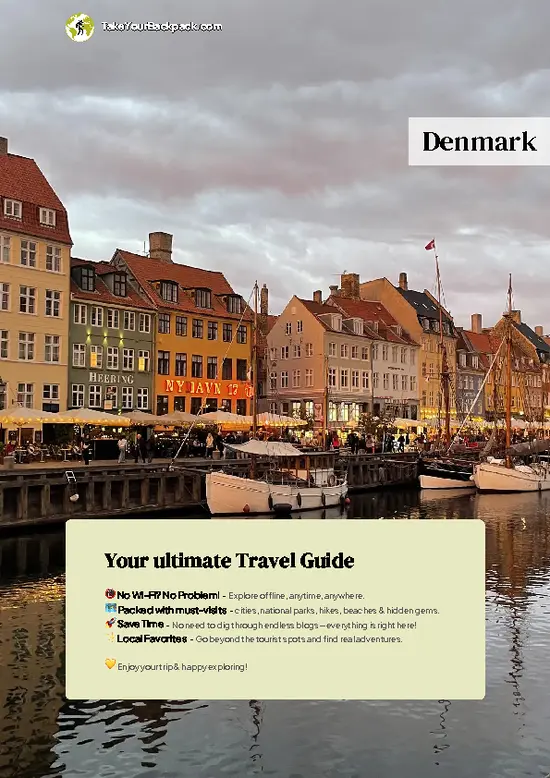
An offline-friendly backpacking guide with optimized travel routes, ranked highlights, transport advice, and the best areas to stay.
example page 0 from our offline Travel Guide for Denmarkexample page 1 from our offline Travel Guide for Denmarkexample page 2 from our offline Travel Guide for Denmarkexample page 3 from our offline Travel Guide for Denmarkexample page 4 from our offline Travel Guide for Denmarkexample page 5 from our offline Travel Guide for Denmarkexample page 6 from our offline Travel Guide for Denmarkexample page 7 from our offline Travel Guide for Denmark
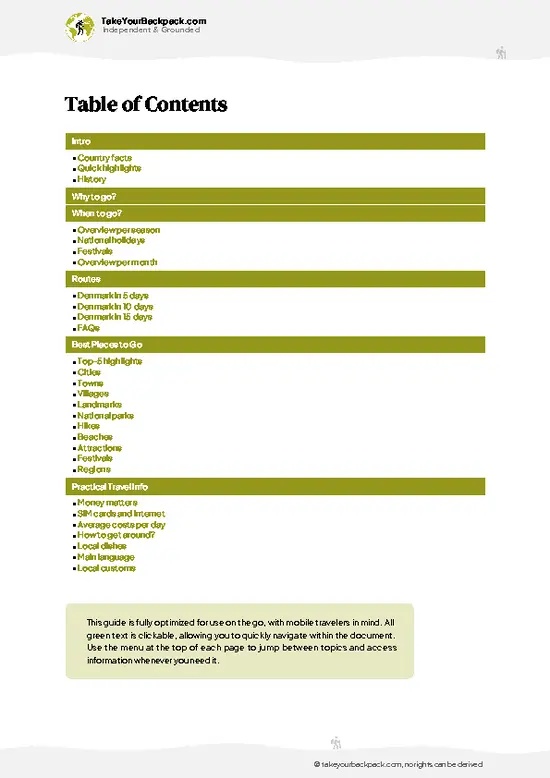
The digital guide (385 pages) contains:
106 highlights, ranked by travel appeal
Optimized 5, 10 & 15-day travel routes
Cities, national parks, landmarks, beaches
How to get around
Offline-friendly for travel without Wi-Fi
👉 Click to see all 30+ guide features

📅 Plan smarter in minutes, not weeks
Month by month travel advice
Festivals & national holidays
Budget expectations

🗺️ Go to the right places, skip the overrated ones
Honest pros & cons of destinations
Top hikes, parks & viewpoints
Lesser-known places most travelers miss
Clear “worth it vs skip it” guidance

🛏️ Travel smoothly without rookie mistakes
Best areas to stay
Transport systems explained simply
Common scams & safety advice
SIM cards, money & practical tips

🌍 Understand the country, not just visit it
Culture & traditions
52 Essential phrases & customs
Festivals worth planning around
Traveler-friendly historical context
Insights that make places more meaningful

📱 Built for real travel conditions
Fully downloadable PDF
Works completely offline
Optimized for phone use
Useful in remote areas & buses
Everything in one place
Save weeks of stressful planning
Get instant access to your full guide. 30‑day money-back guarantee.


By proceeding you agree to our terms.
Sent to your inbox immediately after payment • 100% Secure Checkout
Best Backpacking Travel Advisor 2025 tourism awardBest Backpacking
Travel Advisor
2025
What others say about Take Your Backpack Guides:
⭐⭐⭐⭐⭐
Fantastic, amazing amount of information!
⭐⭐⭐⭐⭐
My goodness this is amazing, it's what I've been looking for hats off too you!
⭐⭐⭐⭐⭐
I think this is absolutely BRILLIANT
⭐⭐⭐⭐
Very complete and informative. It's still missing places, but I gotta to commend you
⭐⭐⭐⭐⭐
This is truly amazing, thank you, can't wait to explore it with my kids!
⭐⭐⭐⭐⭐
Awesome resource, thank you!
⭐⭐⭐⭐⭐
This is amazing! Can't wait to explore the ones I haven't seen
⭐⭐⭐⭐
I love this! Well done, great idea.
⭐⭐⭐⭐⭐
Thanks for taking the time to make this gem!
⭐⭐⭐⭐⭐
This might be the best website I've ever seen.
⭐⭐⭐⭐⭐
Congratulations, and thank you so much for your work; it's incredibly valuable.
⭐⭐⭐⭐
In all seriousness I think you did a great job pointing out the important spots
⭐⭐⭐⭐⭐
10/10 very good
⭐⭐⭐⭐⭐
As someone who's only just starting to visit regularly this is awesome, thank you.
⭐⭐⭐⭐
Thank you very much! I'm going to visit my dad, it's going to be very useful!
⭐⭐⭐⭐⭐
This is really cool! We'll be travelling for the first time and this definitely come in handy.
⭐⭐⭐⭐⭐
You are now our minister of culture, congratulations 👨‍💼
⭐⭐⭐⭐⭐
Just wanted to tell you that this is a pearl! Going to follow your recommendations.
⭐⭐⭐⭐⭐
This is so cool. I'll definitely be using the resource for my travels soon.
⭐⭐⭐⭐⭐
This is very impressive! Good work.
⭐⭐⭐⭐⭐
This is an amazing and informative site. Very well done!

🛏️ Where to stay?Accommodation types and options

Denmark has hostels and budget accommodation across its main cities — choices are densest in Copenhagen and also available in Aarhus and Odense.

In Copenhagen focus on Indre By for immediate access to landmarks (more expensive and busy), Vesterbro for nightlife and transport links (can be noisy), Nørrebro for cheaper, diverse options and stronger nightlife (variable street noise), and Østerbro for quieter, family-friendly stays near parks and museums; in Aarhus aim for the city centre/Latin Quarter or Frederiksbjerg for walkable museum access and calmer nights, while Odense has fewer budget beds … read more 👉
Denmark has hostels and budget accommodation across its main cities — choices are densest in Copenhagen and also available in Aarhus and Odense.

In Copenhagen focus on Indre By for immediate access to landmarks (more expensive and busy), Vesterbro for nightlife and transport links (can be noisy), Nørrebro for cheaper, diverse options and stronger nightlife (variable street noise), and Østerbro for quieter, family-friendly stays near parks and museums; in Aarhus aim for the city centre/Latin Quarter or Frederiksbjerg for walkable museum access and calmer nights, while Odense has fewer budget beds concentrated near the central station.

Book ahead in summer and around festivals because low-cost beds fill fast, choose central neighborhoods to save on transit costs, and prefer quieter districts if sleep and safety matter more than being in the thick of nightlife.

If you enjoy meeting fellow travelers, consider choosing hostels with high ratings for atmosphere. On the other hand, if you prefer having your own space, a hotel might be a better option.

🚌 Getting aroundWhat moving around is really like

Denmark moves on quiet precision. Trains drift in when the clock says they will, buses don’t lurch or improvise, and cyclists stream like a tide that obeys lights. If disruption hits, it’s weather on a bridge or weekend works, handled with a calm announcement and a replacement “Togbus.” The system rewards you for reading signs, tapping correctly, leaving space, and planning one step ahead.
  • DSB Intercity and Regional Trains The fast spine between Copenhagen, Funen, and Jutland; price punishes spontaneity.
read more 👉
Denmark moves on quiet precision. Trains drift in when the clock says they will, buses don’t lurch or improvise, and cyclists stream like a tide that obeys lights. If disruption hits, it’s weather on a bridge or weekend works, handled with a calm announcement and a replacement “Togbus.” The system rewards you for reading signs, tapping correctly, leaving space, and planning one step ahead.
  • DSB Intercity and Regional Trains The fast spine between Copenhagen, Funen, and Jutland; price punishes spontaneity. Walk-up fares bite, while advance “Orange” tickets can slash costs if you commit to a specific departure and accept no-refund rigidity. Intercity trains are quick and comfortable; regionals are cheaper but add minutes that stack up over long distances. Peak Sundays fill; a cheap seat can turn into a floor picnic without a reservation. Track works trigger Togbus segments that add 20-60 minutes—still workable if you budget margin.
  • Copenhagen Metro, S-tog, and Local Buses The social rulebook is simple: let people off first, move down the carriage, keep voices low, and don’t block bike doors. Tap in and out cleanly (Rejsekort or mobile ticket); inspectors are polite but fines are not. Press the stop bell early and exit briskly. Quiet zones are genuinely quiet. Food smells are frowned on. Strollers and wheelchairs get priority—step aside without theatrics. Night services are safe and subdued; you match the tone.
  • Bicycle Network Bikes reach what rail skims past: dune paths, fjord loops, forest gravel, and ferry slips to small islands. Lanes are wide, signed, and usually cleared before car lanes in winter. Wind is the tax—plan routes with it, not against it. Lights at night and hand signals aren’t optional. Stations have secure racks and bike carriages; peak-hour restrictions and bike tickets vary by line, so follow the pictograms and platform staff. A cheap day’s rental unlocks far more than a bus day-pass.
  • Long-Distance Buses and Rideshares FlixBus, Kombardo (bus + ferry), and GoMore rideshares undercut trains, especially same-week travel. Expect half the rail fare on common corridors, with time penalties from ferries or detours. Pick stops carefully—some are curbside, not central stations. Drivers run tight on breaks, so bring water and snacks. Seats are fine; Wi-Fi and toilets are unreliable bonuses, not guarantees. For Copenhagen-Aarhus, Kombardo’s ferry stretch is a warm cabin and a cheap coffee instead of an expensive bridge crossing.

Master tip: Buy Orange tickets for your long jumps 2-3 weeks out, then keep a topped-up Rejsekort for local hops and timing slip-ups—that combo beats both cost and stress.
Copenhagen Airport (CPH, Kastrup) sits about 8 km (5 miles) from the city center, so getting in is quick and painless.

Main options and what they cost/time:
  • Metro (M2) - Direct from “Lufthavnen” station in Terminal 3 to Kongens Nytorv/Nørreport.
    Time: about 13-15 minutes to the center, running 24/7 (every 3-6 minutes by day, less often late night).
    Cost: single adult ticket to the center is typically around 30-40 DKK.
    Good for: staying near the old town, Nørreport, or switching to other metro lines.
  • Train (DSB/Øresundståg) - From the airport station under Terminal 3 to København H (Central Station).
    Time: about 13-15 minutes; departures roughly every 10 minutes in the day, 10-20 minutes evenings.
    Cost: about 30-40 DKK (same fare system as the metro).
    Good for: heading to Central Station, Vesterbro, or onward regional/IC trains.
  • City bus (5C) - From the airport to the city via Amager to Nørreport and beyond.
    Time: roughly 35-50 minutes depending on traffic; runs frequently all day and all night (reduced late night).
    Cost: about 30-40 DKK (same as metro/train).
    Good for: addresses along the 5C route if you don’t want to change.
  • Taxi - Ranks right outside Terminals 2-3.
    Time: about 20-30 minutes to the center (longer in rush hour).
    Cost: generally 250-350 DKK to City Hall Square/Central Station; late-night, weekend, or heavy traffic can push it closer to 400+ DKK.
    All licensed taxis take cards.

Tickets and small tips:
- The same single ticket covers metro, train, and bus for this airport-to-center trip within its time window. Buy from the blue DOT/DSB machines in Terminal 3 or via the official DOT Billetter app.
- If you plan lots of rides, a City Pass Small (zones 1-4, includes the airport) for 24 hours is usually better value than multiple singles. Prices change occasionally, but expect it to be roughly the cost of three singles.
- Metro is your best bet for Kongens Nytorv/Nørreport; the train is best for Central Station. Both are fast and easy with luggage.
⚠️ Prices and routes can change, so take this as a rough guide and ask for local advice when you arrive.
🚀 Don’t waste time on the road.
We’ll generate a route that minimizes unnecessary travel and fits your available days.

Generate my itinerary

🔒 Safety (risk Level: low)What first-time visitors should know

Safety for solo travelers, including women and LGBTQ+ individuals
Denmark is one of the safest countries for solo travelers, including women and LGBTQ+ individuals. Danish cities like Copenhagen and Aarhus are known for their inclusive and welcoming atmosphere. Public transport is reliable and safe, even at night, but like anywhere, stay aware of your surroundings. Always trust your instincts, keep an eye on your belongings, and enjoy the vibrant culture and hospitality.


Full official government travel advisory (live updates)
View details 👉

✈️ VisaWhat travelers should know about visas

It depends on your nationality. EU/EEA citizens can enter Denmark without a visa, while many other nationalities, like U.S. citizens, can visit for up to 90 days without one. If you need a visa, apply through the nearest Danish embassy or consulate, and check the official Danish Immigration website for specific requirements.

source: denmark.dk
⚠️ Visa requirements can change over time, so always check the latest visa requirements with the official embassy or government website before you travel.

🎒 What to pack?What you'll need while traveling

Denmark’s weather can be a bit of a rollercoaster, so pack for layers. Summers are mild, but rain can surprise you anytime, so a light waterproof jacket is a smart choice. Winters can be cold and windy, especially in coastal areas, so don’t skimp on warm clothes. The terrain is mostly flat, making it great for cycling, but the wind can be strong, so a windbreaker is handy. The Danish are casual dressers, so you can keep it simple and comfy without worrying about fashion police.

Apart from this country specific advice, I have also crafted a general packing list that should help on any trip. authorOver the years, I've learned the importance of packing minimally. It's so much easier to jump on the back of a truck or squeeze yourself into the last spot of a minibus without that supersized backpack. If you're headed to a warm destination, leave your winter jacket at home; for colder regions, opt for thin thermal underlayers. Instead of packing your entire wardrobe, bring just three sets of clothes, as laundry facilities are available everywhere.

View the full list 👉
🎒 Planning the practical side of your trip?
Get detailed information on transport, daily budgets, internet access, local customs, food, language, and other essentials in the complete Travel Guide.

Get detailed practical information 👉

Get the Travel Guide -

🙋 FAQTravel questions about Denmark

Trip Planning

Planning a backpacking route through Denmark can be tricky — you need to balance must-see places, travel times, budget, and how long to stay in each destination. Our personalized Denmark itinerary planner creates a route based on your travel style, trip duration, and interests, so you can spend less time researching and more time exploring.


Personal tip: I normally search on good rating for atmosphere (for meeting people) and location (for easy exploring). Cleanliness as a bonus.


Travel Essentials

It’s generally recommended to be up-to-date on routine vaccines like measles-mumps-rubella (MMR) and diphtheria-tetanus-pertussis (DTP) when visiting Denmark. Consider getting the seasonal flu shot if traveling during flu season. Hepatitis B is also suggested if you might have medical procedures or contact with healthcare settings. No special vaccines are typically required. Always check the latest health advisories and consult your healthcare provider.


vaccination requirements
When I first started traveling, I often spent part of my first day in a new country hunting for a local SIM card. While this can still be slightly cheaper, it also takes time and planning.

These days, it's much simpler to install an eSIM before leaving home. Once you arrive in Denmark, you can activate it immediately and have mobile data from the moment you land — which is especially useful for ordering transport or navigating away from busy airports.

There are many providers nowadays, and price differences are usually small. I personally go with Airalo, as it offers excellent network coverage throughout the country and strong global coverage, so you can manage multiple countries from a single app.


Get your e-sim for Denmark

Culture & Customs

Respect personal space; Danes value their privacy. Punctuality is key, so always be on time. When entering homes, remove your shoes. Say ”tak” (thanks) often; it’s appreciated. For meals, wait for the host to begin eating. **Avoid discussing religion or personal finances** unless invited. Dress neatly; casual but not too sloppy. Public displays of affection are common and accepted across all orientations. Women generally feel safe, but stay aware of your surroundings, like everywhere. LGBTQ+ travelers should feel comfortable; Denmark is progressive.
Trying traditional food is always a great way to experience the culture. Here are some must-try dishes for Denmark.
  • Smørrebrød: These are open-faced sandwiches, usually on rye bread, loaded with toppings like pickled herring, boiled eggs, shrimp, or liver pâté. It’s a staple of Danish cuisine and a lunchtime favorite.
  • Frikadeller: These are Danish meatballs, typically made from pork or a mix of pork and veal, served with potatoes and gravy. They’re a common comfort food and often found in home-cooked meals.
  • Stegt flæsk med persillesovs: Crispy pork belly slices served with boiled potatoes and a creamy parsley sauce. It’s considered Denmark’s national dish and embodies traditional, hearty Danish cooking.
  • Rødgrød med fløde: A dessert made from red berries like strawberries and raspberries, thickened with potato starch and topped with cream. It’s a classic summer treat and a bit of a tongue-twister for non-Danish speakers.
  • Æbleskiver: Round, fluffy pancakes often served with powdered sugar and jam. They’re especially popular during the Christmas season and a festive snack you shouldn’t miss.
Yes, the tap water in Denmark is safe to drink and locals drink it regularly. It’s recommended for tourists as well, so no need to buy bottled water unless you prefer it for taste or convenience. Bringing a reusable water bottle might be handy for refills.
The main language in Denmark is Danish. Backpacking is way more rewarding if you know a bit of the local language, so I'd suggest brushing up on the basics just in case your Danish skills have become a bit rusty.

Want to understand locals better?
The complete Travel Guide for Denmark includes 52 essential words and phrases — greetings, thank-yous, ordering food, transport, numbers, and common local expressions you'll actually hear.

Get your local basic phrases 👉

Get the Travel Guide -


English is widely spoken in Denmark, making it easy for travelers to communicate. Approximately 86% of Danes are proficient in English, with many speaking it fluently. This high level of English proficiency is attributed to the country’s educational system, where English is taught from an early age. In urban areas, such as Copenhagen, you’ll find that most people, especially younger generations and those in the service industry, can converse comfortably in English.

Signs, menus, and public information are often available in English, enhancing the travel experience. While you may encounter some older individuals who may have limited English skills, the majority of the population can assist you in navigating your journey. Overall, English serves as a common language, allowing for smooth interactions and a welcoming atmosphere for international visitors.

Money & Payments

The local currency of Denmark is DKK (kr).

When backpacking in Denmark, you might want to rely mostly on cards. Denmark is pretty much a card-friendly paradise. Major credit and debit cards are widely accepted, even for small purchases. Just make sure your card doesn’t charge foreign transaction fees. If you’re a cash fanatic, no worries—ATMs are readily available, and they usually offer decent exchange rates. Stick to withdrawing Danish Krone (DKK) as dollars or euros won’t get you far in local shops.

Carrying a small amount of cash is a good backup plan, especially for markets or small-town spots where they might be a bit old school. As for exchanging money, avoid airport kiosks like the plague, as they usually have terrible rates. Instead, look for a bank or a currency exchange service in the city center.

Tipping in Denmark isn’t typically expected as service charges are included in the bill, but rounding up the bill or leaving a small tip for exceptional service is appreciated. In restaurants and taxis, rounding up to the nearest 10 or 20 DKK is a common practice. Always check the bill first, as tipping is less common than in other countries.

🧩 Nearby countriesNearby backpacking alternatives

📸 PhotosMoments captured along the way

Take your backpack - Denmark - 0
Take your backpack - Denmark - 1
Photographed by: Johan Kruseman

We 💚 feedbackWhat to know before planning your trip

Denmark pays you back if you play the trade-offs. Spend on trains when you’re crossing the country; save by biking city-to-city on the well-marked routes and accept the wind tax. Sleep in hostels when you need a reset; use free forest shelters otherwise. Eat bakery lunches and supermarket dinners; tap water is perfect, beer is not cheap. You don’t need a car—the bike lanes and rail mesh well. Don’t fear the weather: a light shell and you’re fine in drizzle.

✈️ When did I visit Denmark?
Denmark, being close to my home country, I have been visiting a couple of times in the years 1999 to 2025. Originally written after my visit, this guide has been kept up to date with input from locals and recent travelers (last update: 24 June 2026)

✍️ Help improve this page!
The information on this page is based on my own backpacking experience in Denmark, supplemented with up-to-date research and feedback from other travelers. Travel details can change, so if you notice anything outdated or incomplete, feel free to let me know.


🙋‍♂️ Give feedback

👋 Meet the founderWho’s Behind Take Your Backpack?

Johan, backpacker and founder of TakeYourBackpackHi, I’m Johan (Netherlands 🇳🇱), the creator of TakeYourBackpack. Over the past decade, I’ve backpacked through 80+ countries across six continents, gaining extensive experience with independent travel, long-term trips, and overland routes.

This site is built on a combination of firsthand travel experience and carefully curated insights from other backpackers. Many guides are based on places I’ve personally visited, while others bring together tips, observations, and practical advice shared by trusted travelers I’ve met along the way.

The goal is to provide realistic, experience-driven guidance — not generic itineraries — so you can explore destinations with better context, clearer expectations, and more confidence.

Get full Denmark guide •
Instant download • 106 highlights • Full Offline guide