×
Albania 🇦🇱

backpacking Europe Albania 🇦🇱Walk from Valbona to Theth, then ride a ferry through limestone walls.

Explore YemenExplore Andorra

Backpacking Albania in 2027

A complete guide including when and where to go, costs, transport, itineraries, and practical travel advice.
What a trip here is really like

Backpacking Albania
By Johan Kruseman 🇳🇱 | Updated October 18, 2026

About 70 percent of Albania’s land is mountainous, and peaks in the northern Alps rise above 2,600 meters, a few hours’ drive from the Adriatic.

That terrain is what makes the trip. You get the slate-roofed lanes of Gjirokastër, the trail from Valbona to Theth over a pass of nearly 1,800 meters, and grilled lamb with tomatoes swimming in local olive oil. I still remember the guesthouse raki in Theth: homemade, poured from a plastic bottle, smelling of plums and woodsmoke, and burning all the way down after six hours of walking. The hard parts come with it. Minibuses leave when they fill up, mountain roads are slow, and the southern coast in August is packed shoulder to shoulder.

Next to Montenegro, Albania runs cheaper and rougher around the edges. Greece, visible across the water from Sarandë, is tidier and costs more. The country suits travelers who enjoy improvising and talking to strangers. If you need fixed timetables and smooth logistics, it will test your patience.

👉 Get the 📖 Travel Guide of Albania

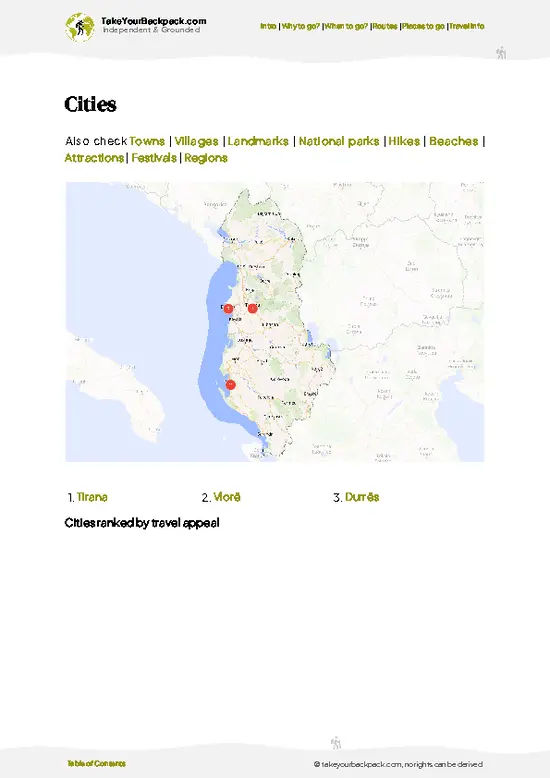
Tirana and Central Albania (Tirana, Krujë, Durrës)

Tirana smells of roasting coffee and diesel, and its Communist-era apartment blocks wear stripes of orange, lime and purple paint. Mornings run on espresso in Blloku, the old party elite’s compound turned bar district. Afternoons go underground at Bunk’Art, a nuclear bunker turned museum. Krujë’s castle and creaky old bazaar sit about 45 minutes away by furgon, and Durrës beach is roughly 40 minutes by bus. City lovers and first-timers get an easy landing and late, loud nights.

Shkodër and the Albanian Alps (Shkodër, Theth, Valbonë, Lake Komani)

Everyone in Shkodër cycles, grandmothers included, rattling past Rozafa Castle toward the lakeshore. Two hours north of Tirana by bus, it’s the launch point for Theth, a 2 to 3 hour furgon ride up hairpin bends, where guesthouse dinners come with homemade raki. The Theth to Valbonë pass is 6 to 8 sweaty hours of scree and beech forest, and the Komani Lake ferry glides back through a narrow green gorge. Hikers who accept steep days and basic rooms get mountain silence.

Berat and the Osum Valley (Berat, Osum Canyon, Çorovodë)

Berat stacks white Ottoman houses up a hillside, their rows of windows facing the Gorica quarter across the Osum River. Up in the Kala, families still live inside the castle walls, hanging laundry beside Byzantine churches, and the cobbles are polished slick, so wear grippy shoes. Buses from Tirana take about 2 to 2.5 hours. In spring, rafts run the Osum Canyon between sheer limestone walls. Slow travelers and photographers will savor the evening xhiro stroll along the river.

Gjirokastër and the Vjosa Valley (Gjirokastër, Përmet, Blue Eye)

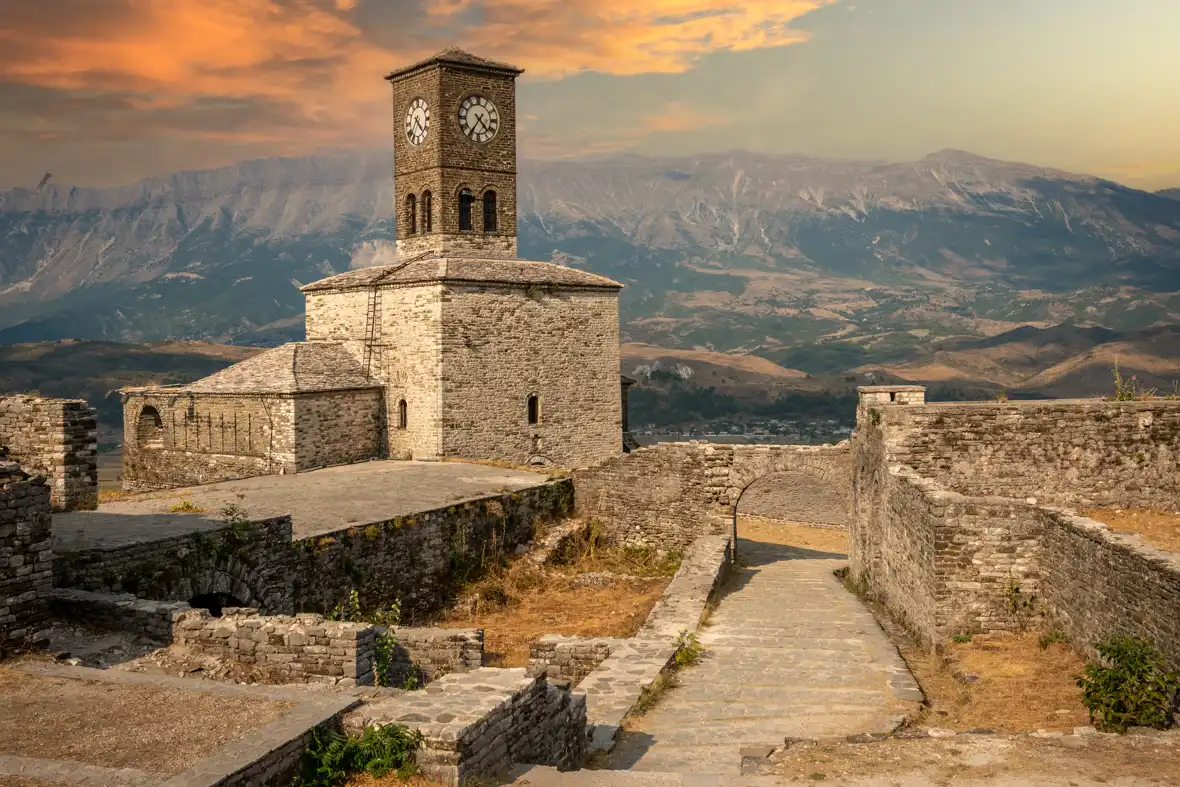
Gjirokastër is gray stone and slate roofs, and the climb from the bus stop to the old bazaar is a genuine calf workout. The castle shelters old artillery and a US Air Force jet forced down near Tirana in 1957. Buses from Tirana take around 4 hours. Përmet, east along the Vjosa, one of Europe’s last free-flowing rivers, has the Bënjë hot springs under an Ottoman bridge. History buffs and food lovers leave full of qifqi rice balls and fruit preserves.

Albanian Riviera (Sarandë, Himarë, Ksamil, Butrint)

The road over the Llogara Pass drops from pine-scented air to water clear enough to count pebbles meters down. Himarë keeps a slow village pace; Sarandë is concrete and promenade; Ksamil is wall-to-wall sunbeds in August. Butrint’s Greek theater and Roman ruins sit in reedy marshland about 20 minutes south of Sarandë. Buses from Tirana take 5 to 6 hours. Swimmers get cheap grilled fish and long sunsets, best in June or September.
Map of Albania
Loading the map 🌍
CLICK TO FILTER
cities
towns
villages
landmarks
national parks
hikes
beaches
attractions
festivals
regions
SHOW COUNTRY’S BESTSHOW ALL

Why go?Why Albania is worth visiting

Food

Albanian cooking is built on what grows within sight of the kitchen: sheep’s cheese, wild herbs, olive … read more 👉
Albanian cooking is built on what grows within sight of the kitchen: sheep’s cheese, wild herbs, olive oil pressed down the road. Byrek comes out of bakery ovens in flaky, greasy coils at dawn. Tavë kosi, lamb baked under a tangy yogurt crust, arrives bubbling in a clay dish, and fërgesë mixes peppers, tomato and cottage cheese into something you mop up with bread. Portions are big and menus often absent. I would book a long lunch at Mrizi i Zanave near Lezhë, the country’s best-known Slow Food farm restaurant, and let the kitchen decide.

Low cost

Backpacking Albania on a budget is easy: most travelers spend around 3,000 to 4,500 lek (€30 to €45) … read more 👉
Backpacking Albania on a budget is easy: most travelers spend around 3,000 to 4,500 lek (€30 to €45) a day, covering a hostel dorm, street food, a sit-down dinner and a bus ride. A skewer of qofte with bread and onions from a smoky grill fills you for very little, and a strong espresso on a plastic chair costs pocket change. Guesthouses in the mountains usually include dinner and breakfast, which stretches your money further. Carry cash in lek, since small places rarely take cards, and visit outside July and August, when coastal rooms can double.

Scenery

Albania packs Ionian cliffs, glacial valleys and limestone canyons into a country slightly smaller than … read more 👉
Albania packs Ionian cliffs, glacial valleys and limestone canyons into a country slightly smaller than Belgium. Within a day you can go from the hot, resin-scented coast to river gorges where the air turns cool and damp. The Vjosa, protected as a wild river national park, runs undammed for its whole length, braided across gravel beds in shades of milky blue. The Osum Canyon near Berat cuts walls tens of meters high. Raft it in spring, from March to May, when snowmelt fills the river; by late summer it shrinks to a trickle.

Mountains

The Albanian Alps give you serious terrain without the crowds or prices of the Dolomites. Trails climb … read more 👉
The Albanian Alps give you serious terrain without the crowds or prices of the Dolomites. Trails climb through beech forest onto bare karst, past shepherd huts where you might be offered a glass of milk still warm. The Peaks of the Balkans route, roughly 190 kilometers, loops through Albania, Kosovo and Montenegro, with nights in family guesthouses. Down south, the Nemërçka ridge above Përmet is steeper and emptier. Hike from mid-June to September, when passes are snow-free, and register for the cross-border permits in advance if your route crosses into Montenegro or Kosovo.

Backpackers

Albania’s backpacker scene runs on family hostels where the owner pours homemade raki on arrival and … read more 👉
Albania’s backpacker scene runs on family hostels where the owner pours homemade raki on arrival and cooks a group dinner for whoever shows up. Shkodër is the social hub: courtyards full of muddy boots, travelers swapping trail notes and splitting rides to Theth. Tirana’s hostels lean toward rooftop beers and late nights in Blloku, while Berat and Himarë are quieter, with hammocks and long lunches. Hitchhiking is widely practiced and drivers are generally welcoming. Stop in Shkodër for two nights before the mountains; it is the easiest place to find hiking partners.

Beach life

The Ionian side of Albania has pebble coves with water so clear your shadow shows on the seabed several … read more 👉
The Ionian side of Albania has pebble coves with water so clear your shadow shows on the seabed several meters down. Snorkeling around the rocky points near Himarë turns up octopus and shoals of bream. Dhërmi and Drymades handle the nightlife, with beach clubs thumping until sunrise and the Kala electronic music festival in early summer. For quieter swimming, walk the 20 to 30 minutes down the canyon path to Gjipe, where cliffs wall in the beach and there are no roads. Bring water shoes; the pebbles burn by noon and slide underfoot.

⭐ HighlightsHighlights of Albania

  • Valbona to Theth trail: A full day on foot between two valleys, starting on river gravel and ending in beech forest. The pass is a rocky saddle where the wind cuts through a sweaty shirt, and on the descent you hear goat bells long before you see a single roof in Theth.
  • Komani Lake ferry: Roughly two and a half hours on a reservoir squeezed between limestone walls, the water a milky jade. The deck smells of diesel and cigarette smoke, and locals step off at invisible landings with sacks of flour on their shoulders.
  • Butrint: Greek, Roman and Venetian ruins spread through woodland on a lagoon near the Greek border. In spring the lower rows of the ancient theater sit in shallow water, and frogs croak from the stage while you sit on stone seats two thousand years old.
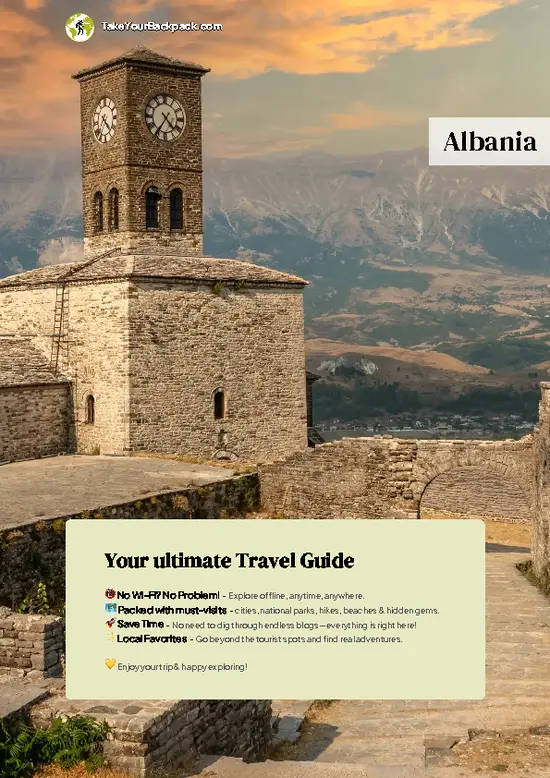
  • Gjirokastër Castle: A huge fortress above the old town, its dark vaulted galleries lined with rusting artillery. Out on the ramparts sits a US jet that landed in Albania during the Cold War, and the slate roofs below glow orange
… read more 👉
  • Valbona to Theth trail: A full day on foot between two valleys, starting on river gravel and ending in beech forest. The pass is a rocky saddle where the wind cuts through a sweaty shirt, and on the descent you hear goat bells long before you see a single roof in Theth.
  • Komani Lake ferry: Roughly two and a half hours on a reservoir squeezed between limestone walls, the water a milky jade. The deck smells of diesel and cigarette smoke, and locals step off at invisible landings with sacks of flour on their shoulders.
  • Butrint: Greek, Roman and Venetian ruins spread through woodland on a lagoon near the Greek border. In spring the lower rows of the ancient theater sit in shallow water, and frogs croak from the stage while you sit on stone seats two thousand years old.
  • Gjirokastër Castle: A huge fortress above the old town, its dark vaulted galleries lined with rusting artillery. Out on the ramparts sits a US jet that landed in Albania during the Cold War, and the slate roofs below glow orange when the sun drops behind the mountains.
  • Blue Eye (Syri i Kaltër): A karst spring between Sarandë and Gjirokastër, where water wells up from a depth divers have never fully mapped. The color shifts from ink blue at the center to bright turquoise at the edges, and the air around it stays cool even on a 35°C afternoon.
For less-visited corners, look at the Benja thermal pools near Përmet, the lakeside villages of Prespa and the high valley of Vermosh, and I would go to Benja first for a warm soak under an Ottoman stone bridge.
Spotted a mistake or missing a highlight? Contact us.

But Albania offers more...

Discover and compare all of its highlights per category

🧭 RoutesLogical itineraries covering the highlights

The 5-Day Southern Stone and Sea Route


Five unhurried days in the south of Albania, split between a hillside stone town and the warm Ionian coast. Expect short transfers, ancient ruins in lagoon wetlands and swims in impossibly clear water.
  • Gjirokastër’s slate roofs and hilltop castle
  • The deep blue pool of the Blue Eye Spring
  • Greek and Venetian layers at Butrint
  • Island-hopping swims off Ksamil Beach

👉 explore this 5-day route

The 10-Day Ottoman Towns and Riviera Route


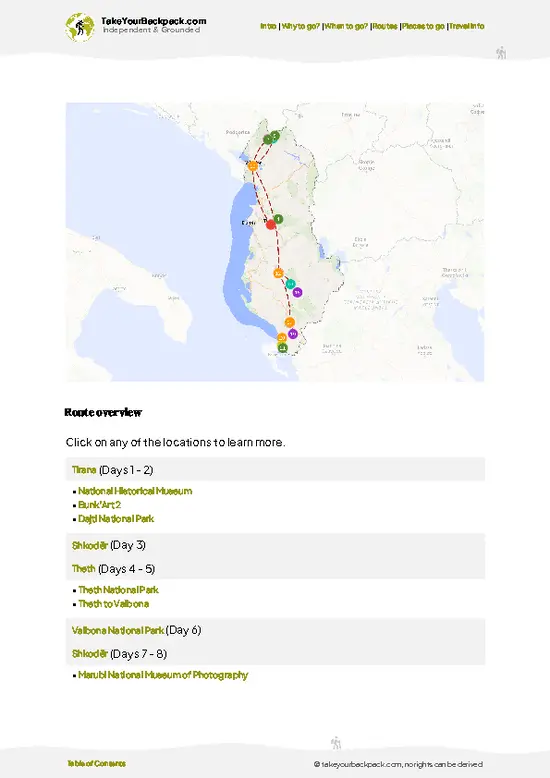
Ten days that pair the capital’s Cold War history with whitewashed Ottoman towns and a long stretch of beach time on the Riviera. The highlight is the road over a mountain pass that drops straight to the sea.
  • Hoxha’s nuclear bunker outside Tirana
  • Berat’s hillside windows and lived-in castle
  • The coastal climb over Llogara Pass
  • The canyon-mouth cove of Gjipe Beach

👉 explore this 10-day route

The 15-Day Mountains to Ionian Route


Two weeks that run the full length of the country, from high alpine valleys to the southern coast. You’ll cross … read more 👉

The 5-Day Southern Stone and Sea Route


Five unhurried days in the south of Albania, split between a hillside stone town and the warm Ionian coast. Expect short transfers, ancient ruins in lagoon wetlands and swims in impossibly clear water.
  • Gjirokastër’s slate roofs and hilltop castle
  • The deep blue pool of the Blue Eye Spring
  • Greek and Venetian layers at Butrint
  • Island-hopping swims off Ksamil Beach

👉 explore this 5-day route

The 10-Day Ottoman Towns and Riviera Route


Ten days that pair the capital’s Cold War history with whitewashed Ottoman towns and a long stretch of beach time on the Riviera. The highlight is the road over a mountain pass that drops straight to the sea.
  • Hoxha’s nuclear bunker outside Tirana
  • Berat’s hillside windows and lived-in castle
  • The coastal climb over Llogara Pass
  • The canyon-mouth cove of Gjipe Beach

👉 explore this 10-day route

The 15-Day Mountains to Ionian Route


Two weeks that run the full length of the country, from high alpine valleys to the southern coast. You’ll cross a mountain pass on foot, ride a ferry through a flooded gorge and end at ancient ruins by the sea.
  • The Theth to Valbona crossing
  • The lake ferry through the Drin gorge
  • The Osum canyon and Bogova waterfalls
  • Butrint and the Ksamil shore

👉 explore this 15-day route

🌤️ When to go?A month-by-month overview

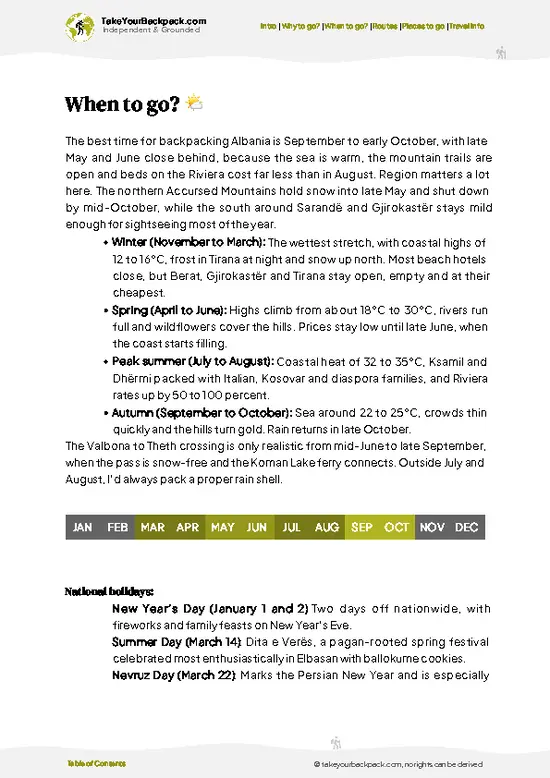
The best time for backpacking Albania is September to early October, with late May and June close behind, because the sea is warm, the mountain trails are open and beds on the Riviera cost far less than in August. Region matters a lot here. The northern Accursed Mountains hold snow into late May and shut down by mid-October, while the south around Sarandë and Gjirokastër stays mild enough for sightseeing most of the year.
  • Winter (November to March): The wettest stretch, with coastal highs of 12 to 16°C, frost in Tirana at night and snow up north. Most beach hotels close, but Berat, Gjirokastër and Tirana stay open, empty and at their cheapest.
  • Spring (April to June): Highs climb from about 18°C to 30°C, rivers run full and wildflowers cover the hills. Prices stay low until late June, when the coast starts filling.
  • Peak summer (July to August): Coastal heat of 32 to 35°C, Ksamil and Dhërmi packed with Italian, Kosovar and diaspora families, and Riviera rates up by 50 to 100 percent.
  • Autumn (September to October): Sea around 22 to 25°C, crowds thin quickly and the hills turn gold. Rain returns in late October.
The Valbona to Theth crossing is only realistic from mid-June to late September, when the pass is snow-free and the Koman Lake ferry connects. Outside July and August, I’d always pack a proper rain shell.

source: climatestotravel.comJANJanuary: fair for travelingFEBFebruary: fair for travelingMARMarch: good for travelingAPRApril: good for travelingMAYMay: highly recommended for travelingJUNJune: highly recommended for travelingJULJuly: good for travelingAUGAugust: good for travelingSEPSeptember: excellent for travelingOCTOctober: excellent for travelingNOVNovember: fair for travelingDECDecember: fair for traveling
!!istockphoto Albania main photo

💰 Costs (as of 2026)What things cost day to day

Backpacking Albania costs most budget travelers about €30 to 45 a day for a dorm bed, street food, buses and a paid sight or two. That is noticeably cheaper than Greece or Montenegro, and close to what you’ll spend in North Macedonia or Kosovo. Travelers pay in Albanian lek, and €1 gets you roughly 97 to 100 lek. Cash is still how most small purchases get paid.
CategoryBudget RangeLocal Reality
Dorm accommodation€9 to 20 per nightA bed in a Tirana hostel costs €10 to 16, and Berat and Gjirokastër usually run €9 to 14. In July and August, Ksamil and Sarandë go up to €18 to 25, which is close to Montenegrin coast prices. For less, book Ksamil for May, June or September. Staying a week often gets you a discount if you ask the owner directly.
Meals€8 to 15 per dayA byrek from a bakery is €0.50 to 1, and a sufllaqe (gyros wrap) is €1.50 to 3. A plate of tavë kosi or grilled qofte at a family-run place in Berat or Shkodër costs €5 to 8. For self-catering, Spar and Conad have bread, cheese, tomatoes and 1.5 liters of water for €3 to 5. You’ll pay about half what a similar meal costs in Greece.
Local transport€3 to 15 per dayIntercity buses and furgons are the cheapest way to get around. Tirana
… read more 👉
Backpacking Albania costs most budget travelers about €30 to 45 a day for a dorm bed, street food, buses and a paid sight or two. That is noticeably cheaper than Greece or Montenegro, and close to what you’ll spend in North Macedonia or Kosovo. Travelers pay in Albanian lek, and €1 gets you roughly 97 to 100 lek. Cash is still how most small purchases get paid.
CategoryBudget RangeLocal Reality
Dorm accommodation€9 to 20 per nightA bed in a Tirana hostel costs €10 to 16, and Berat and Gjirokastër usually run €9 to 14. In July and August, Ksamil and Sarandë go up to €18 to 25, which is close to Montenegrin coast prices. For less, book Ksamil for May, June or September. Staying a week often gets you a discount if you ask the owner directly.
Meals€8 to 15 per dayA byrek from a bakery is €0.50 to 1, and a sufllaqe (gyros wrap) is €1.50 to 3. A plate of tavë kosi or grilled qofte at a family-run place in Berat or Shkodër costs €5 to 8. For self-catering, Spar and Conad have bread, cheese, tomatoes and 1.5 liters of water for €3 to 5. You’ll pay about half what a similar meal costs in Greece.
Local transport€3 to 15 per dayIntercity buses and furgons are the cheapest way to get around. Tirana to Berat is €4 to 5, Tirana to Shkodër is €4 to 5, and Tirana to Sarandë is €15 to 18. A Tirana city bus ride costs €0.40. A one-way Komani Lake ferry is usually €10 to 15.
Activities€0 to 15 per dayEntrance tickets are your biggest cost here. Butrint is about €10, Bunk’Art in Tirana is €5 to 10, and Berat Castle is €2 to 3. Hiking from Theth to Valbona is free, but a guide or transfer adds €15 to 30. If I were saving money, I’d skip the paid beach loungers in Ksamil (€10 to 30 a set) and put that money toward the Komani ferry instead.
Miscellaneous€2 to 6 per dayAn espresso costs €0.80 to 1.20, and a bottle of Korça beer in a bar is €1.50 to 3. A tourist SIM from One or Vodafone with plenty of data costs €10 to 15. ATM fees often add €4 to 7 per withdrawal, so take out bigger amounts less often.
Total Daily Budget€30 to 45 per dayStaying inland in Berat, Gjirokastër or Shkodër, you can manage on €30 to 35. A summer day on the Riviera is closer to €45. For comparison, the same kind of trip in Montenegro costs €45 to 60 a day, and in Greece €55 or more.
⚠️ Prices can change and everyone travels differently, so take this as a rough guide. Hope it helps you plan your adventure!

✈️ The backpacker research shortcutAlbania Travel Guide

An offline-friendly backpacking guide with optimized travel routes, ranked highlights, transport advice, and the best areas to stay.
example page 0 from our offline Travel Guide for Albania
example page 1 from our offline Travel Guide for Albania
example page 2 from our offline Travel Guide for Albania
example page 3 from our offline Travel Guide for Albania
example page 4 from our offline Travel Guide for Albania
example page 5 from our offline Travel Guide for Albania
example page 6 from our offline Travel Guide for Albania
example page 7 from our offline Travel Guide for Albania
The digital guide (305 pages) contains:
✅ 78 highlights, ranked by travel appeal
✅ Optimized 5, 10 & 15-day travel routes
✅ Cities, national parks, landmarks, beaches
✅ How to get around
✅ Offline-friendly for travel without Wi-Fi
👉 Click to see all 30+ guide features

📅 Plan smarter in minutes, not weeks
✅ Month by month travel advice
✅ Festivals & national holidays
✅ Budget expectations

🗺️ Go to the right places, skip the overrated ones
✅ Honest pros & cons of destinations
✅ Top hikes, parks & viewpoints
✅ Lesser-known places most travelers miss
✅ Clear “worth it vs skip it” guidance

🛏️ Travel smoothly without rookie mistakes
✅ Best areas to stay
✅ Transport systems explained simply
✅ Common scams & safety advice
✅ SIM cards, money & practical tips

🌍 Understand the country, not just visit it
✅ Culture & traditions
✅ 52 Essential phrases & customs
✅ Festivals worth planning around
✅ Traveler-friendly historical context
✅ Insights that make places more meaningful

📱 Built for real travel conditions
✅ Fully downloadable PDF
✅ Works completely offline
✅ Optimized for phone use
✅ Useful in remote areas & buses
✅ Everything in one place
Stop searching, start planning
Get instant access to your full guide. 30‑day money-back guarantee.
+ Add another guide for just

By proceeding you agree to our terms.
Sent to your inbox immediately after payment • 100% Secure Checkout
Best Backpacking Travel Advisor 2025 tourism awardBest Backpacking
Travel Advisor
2025
What others say about Take Your Backpack Guides:
⭐⭐⭐⭐⭐
Fantastic, amazing amount of information!
⭐⭐⭐⭐⭐
My goodness this is amazing, it's what I've been looking for hats off too you!
⭐⭐⭐⭐⭐
I think this is absolutely BRILLIANT
⭐⭐⭐⭐
Very complete and informative. It's still missing places, but I gotta to commend you
⭐⭐⭐⭐⭐
This is truly amazing, thank you, can't wait to explore it with my kids!
⭐⭐⭐⭐⭐
Awesome resource, thank you!
⭐⭐⭐⭐⭐
This is amazing! Can't wait to explore the ones I haven't seen
⭐⭐⭐⭐
I love this! Well done, great idea.
⭐⭐⭐⭐⭐
Thanks for taking the time to make this gem!
⭐⭐⭐⭐⭐
This might be the best website I've ever seen.
⭐⭐⭐⭐⭐
Congratulations, and thank you so much for your work; it's incredibly valuable.
⭐⭐⭐⭐
In all seriousness I think you did a great job pointing out the important spots
⭐⭐⭐⭐⭐
10/10 very good
⭐⭐⭐⭐⭐
As someone who's only just starting to visit regularly this is awesome, thank you.
⭐⭐⭐⭐
Thank you very much! I'm going to visit my dad, it's going to be very useful!
⭐⭐⭐⭐⭐
This is really cool! We'll be travelling for the first time and this definitely come in handy.
⭐⭐⭐⭐⭐
You are now our minister of culture, congratulations 👨‍💼
⭐⭐⭐⭐⭐
Just wanted to tell you that this is a pearl! Going to follow your recommendations.
⭐⭐⭐⭐⭐
This is so cool. I'll definitely be using the resource for my travels soon.
⭐⭐⭐⭐⭐
This is very impressive! Good work.
⭐⭐⭐⭐⭐
This is an amazing and informative site. Very well done!

🛏️ Where to stay?Accommodation types and options

Albania has a dense, cheap hostel scene, with dorm beds typically running 1,200 to 2,000 lek (about US$13 to 22) and private guesthouse rooms not far above that. In Tirana, the streets around Skanderbeg Square put you within walking distance of the main sights and bus connections, while Blloku has the best bars and cafés but louder nights and higher prices. Down south, Saranda packs hostels near the seafront promenade for beach access and summer nightlife, whereas the old quarters of Berat (Mangalem) and Gjirokastër (around the Old Bazaar) are quiet and atmospheric but involve steep cobbled climbs … read more 👉
Albania has a dense, cheap hostel scene, with dorm beds typically running 1,200 to 2,000 lek (about US$13 to 22) and private guesthouse rooms not far above that. In Tirana, the streets around Skanderbeg Square put you within walking distance of the main sights and bus connections, while Blloku has the best bars and cafés but louder nights and higher prices. Down south, Saranda packs hostels near the seafront promenade for beach access and summer nightlife, whereas the old quarters of Berat (Mangalem) and Gjirokastër (around the Old Bazaar) are quiet and atmospheric but involve steep cobbled climbs with a backpack.

If you enjoy meeting fellow travelers, consider choosing hostels with high ratings for atmosphere. On the other hand, if you prefer having your own space, a hotel might be a better option.

🚌 Getting aroundHow to travel within the country

Backpacking Albania, a typical travel day means a white minibus or a sun-faded coach leaving a dusty roadside terminal, 2 to 5 hours on winding two-lane roads, and 400 to 1,800 lek (about US$4.50 to 20) paid in cash to the driver or his assistant. Printed timetables barely exist, so you ask around, look for your town written on a card propped in the windshield, and climb aboard with a byrek in hand.
  • Furgon (minibus): The workhorse of the country, usually 300 to 800 lek for 1 to 3 hours, such as Tirana
… read more 👉
Backpacking Albania, a typical travel day means a white minibus or a sun-faded coach leaving a dusty roadside terminal, 2 to 5 hours on winding two-lane roads, and 400 to 1,800 lek (about US$4.50 to 20) paid in cash to the driver or his assistant. Printed timetables barely exist, so you ask around, look for your town written on a card propped in the windshield, and climb aboard with a byrek in hand.
  • Furgon (minibus): The workhorse of the country, usually 300 to 800 lek for 1 to 3 hours, such as Tirana to Shkodër (about 2 hours) or Tirana to Berat (about 2.5 hours). Most leave when full rather than on schedule, seats are tight, bags ride in the back or on the roof, and you pay on board at the end. You can flag one down on any main road and shout “ndal” (stop) when you want out. The upside is reach: furgons go to villages no coach bothers with.
  • Intercity bus: Bigger, slightly roomier, and the better pick for long hauls like Tirana to Sarandë (5 to 6 hours, about 1,500 to 1,800 lek) or Tirana to Gjirokastër (4 to 5 hours, about 1,300 to 1,500 lek). Most Tirana departures use the North-South Bus Terminal on the western edge of the city. Pay the conductor or a kiosk, expect air conditioning that may or may not work, and a coffee stop at a roadside café where the espresso costs 100 lek and the view over the Vjosa or the Drino valley comes free.
  • Lake Koman ferry: About 2.5 to 3 hours between Koman and Fierzë on a dammed river gorge with green water and cliffs close enough to hear goat bells echo off them. Expect roughly 1,000 to 1,500 lek for the boat, or 2,500 to 3,500 lek for a package with the morning transfer from Shkodër, booked through any guesthouse there. Boats leave around 9 a.m., so the pickup is early.
  • City buses and taxis: Tirana city buses cost 40 lek, paid to the conductor who squeezes down the aisle. Taxis outside the capital rarely use meters, so agree on the price before the door closes.
  • Hitchhiking: Common and widely accepted, especially in the south and the mountains, where drivers often pull over unasked. It gets you to trailheads and beaches furgons skip.
I’d run the country in one north-to-south line (Shkodër and the Koman ferry first, then Berat, Gjirokastër and finally Sarandë), because nearly every route funnels through Tirana and each backtrack burns a full day.
Tirana International Airport Nënë Tereza (TIA), at Rinas, sits about 17 km (11 miles) northwest of central Tirana, and the cheapest reliable way into the Albanian capital is the Rinas Express airport bus for around 400 lek (about US$4.30).
  • Rinas Express airport bus (25 to 40 minutes, about 400 lek / US$4.30): Catch it just outside the arrivals exit, pay the conductor in cash lek on board, and expect roughly hourly departures from early morning until about 11 pm, dropping you near the National History Museum by Skanderbeg Square.
  • Airport taxi (20 to 30 minutes, about 2,500 lek / US$27): Licensed taxis wait in a rank right outside arrivals and run around the clock, so agree on the fixed fare to the center before you get in and have lek cash ready.
  • Local taxi apps (20 to 30 minutes, about 1,800 to 2,500 lek / US$20 to 27): Uber does not operate in Albania, but local taxi apps can send a car to the arrivals area, and you usually settle the fare in cash with the driver.
If you land after the last bus, skip the haggling, take a licensed taxi from the official rank and pull some lek from the arrivals ATM first, since many drivers prefer cash.
⚠️ Prices and routes can change, so take this as a rough guide and ask for local advice when you arrive.
🚀 Don’t waste time on the road.
We’ll generate a route that minimizes unnecessary travel and fits your available days.

Generate my itinerary

🔒 Safety (risk Level: low)Staying safe while traveling

Safety for solo travelers, including women and LGBTQ+ individuals
Albania is one of the safer countries in the Balkans for solo travelers, with low violent crime and a strong tradition of hospitality toward guests, so the main dangers are reckless driving and hairpin mountain roads rather than people. Women traveling alone generally report few problems, though staring and the occasional unwanted comment happen in rural areas and male-dominated cafés, and dressing modestly outside beach towns reduces attention. Same-sex relationships are legal and anti-discrimination laws exist, and Tirana has a small LGBTQ+ scene and an annual Pride event, but attitudes remain conservative, so most LGBTQ+ travelers keep public affection discreet, especially outside the capital. Watch for pickpockets on crowded Tirana buses and in summer beach crowds in Sarandë and Ksamil.


Full official government travel advisory (live updates)
View details 👉

✈️ VisaUnderstanding entry rules

Citizens of the EU, UK, US, Canada, Australia, New Zealand and many other countries can enter Albania visa-free for up to 90 days within a 180-day period, and US citizens are permitted to stay up to one year. Travelers who do need a visa apply online through the official e-Albania portal before departure, then present the approved visa at the border. Requirements change, so confirm your nationality’s status with Albania’s Ministry for Europe and Foreign Affairs before you travel.

source: punetejashtme.gov.al
⚠️ Visa requirements can change over time, so always check the latest visa requirements with the official embassy or government website before you travel.

🎒 What to pack?A practical packing list

Albania swings between extremes, so pack for two climates: the coast and southern valleys hit 30 to 38°C in July and August, while Theth and Valbona can drop near freezing at night even in early summer. Sturdy, broken-in hiking shoes earn their space for the Valbona to Theth trail and for the polished, slippery cobblestones of Berat and Gjirokastër. Keep a lightweight layer that covers shoulders and knees for mosques, churches and conservative villages, even though beach towns are relaxed. Plan on carrying cash for most daily costs and bring a European Type C/F plug adapter, plus a refillable bottle with a filter to cut down on plastic.

Apart from this country specific advice, I have also crafted a general packing list that should help on any trip. authorOver the years, I've learned the importance of packing minimally. It's so much easier to jump on the back of a truck or squeeze yourself into the last spot of a minibus without that supersized backpack. If you're headed to a warm destination, leave your winter jacket at home; for colder regions, opt for thin thermal underlayers. Instead of packing your entire wardrobe, bring just three sets of clothes, as laundry facilities are available everywhere.

View the full list 👉

🙋 FAQQuick answers to practical concerns

Trip Planning

Planning a backpacking route through Albania can be tricky — you need to balance must-see places, travel times, budget, and how long to stay in each destination. Our free personalized Albania itinerary planner creates a route based on your travel style, trip duration, and interests, so you can spend less time researching and more time exploring.


Personal tip: I normally search on good rating for atmosphere (for meeting people) and location (for easy exploring). Cleanliness as a bonus.


Travel Essentials

No vaccinations are required to enter Albania unless you arrive from a country with yellow fever risk. Make sure routine shots (MMR, tetanus-diphtheria, polio and the flu) are up to date, and Hepatitis A is recommended for most travelers since it spreads through food and water. Hepatitis B and typhoid are worth considering for longer stays or adventurous eating, and rabies pre-exposure shots make sense if you plan to hike remote areas, as stray and shepherd dogs are common in the mountains.


vaccination requirements
When I first started traveling, I often spent part of my first day in a new country hunting for a local SIM card. While this can still be slightly cheaper, it also takes time and planning.

These days, it's much simpler to install an eSIM before leaving home. Once you arrive in Albania, you can activate it immediately and have mobile data from the moment you land — which is especially useful for ordering transport or navigating away from busy airports.

There are many providers nowadays, and price differences are usually small. I personally go with Holafly, as it offers excellent network coverage throughout the country and strong global coverage, so you can manage multiple countries from a single app.


HolaFly eSim

Culture & Customs

In Albania, a shake of the head often means yes and a nod can mean no, so confirm with words before assuming anything. Accept offered coffee, raki or sweets when visiting a home, since refusing hospitality can come across as rude, and take your shoes off at the door. Dress modestly in mosques, churches and mountain villages (women may be given a scarf at mosques), and save swimwear for the beach. Join the evening xhiro, the town-wide stroll along the main boulevard, rather than treating it as background noise. Avoid casually debating Kosovo, Greek border issues or the communist era unless locals bring it up, and don’t photograph military sites or people without asking. Women may find some rural cafés are almost entirely male spaces, and same-sex couples will draw less attention keeping affection private outside Tirana.
Trying traditional food is always a great way to experience the culture. Here are some must-try dishes for Albania.
  1. Tavë Kosi: Lamb and rice baked under a thick layer of yogurt and eggs until the top turns golden and slightly tangy. Originally from Elbasan, it is widely treated as Albania’s national dish and shows up at family gatherings and traditional restaurants alike.
  2. Byrek: Flaky layered pastry filled with spinach, cheese, minced meat or tomato and onion. Sold warm from bakeries for 100 to 200 lek a slice, it is the country’s go-to breakfast and the cheapest filling meal on the road.
  3. Fërgesë: A rich bake of peppers, tomatoes and salty gjizë curd cheese (sometimes with liver or meat), served bubbling in a clay dish. It is a Tirana specialty and a favorite way to scoop up bread at lunch.
  4. Qofte: Grilled or fried meatballs, often seasoned with mint and onion, served with bread, salad and yogurt. Grill houses across the country make them, and they are the default quick dinner for locals.
  5. Flija: A layered crêpe-like dish built slowly over embers, one batter layer at a time, brushed with cream or butter. A northern mountain tradition that takes hours to make, it is often cooked for special occasions and in guesthouses around Theth and Valbona.
  6. Qifqi: Rice balls bound with egg and fresh herbs, pan-fried in a special round-dimpled pan. Unique to Gjirokastër, they are a point of local pride and hard to find elsewhere.
  7. Trileçe: A sponge cake soaked in three kinds of milk and topped with caramel, adopted from Latin America and now on nearly every Albanian dessert menu.
Tap water in Albania is treated in larger cities like Tirana, but supply can be intermittent, pipes are often old, and many locals prefer to drink bottled or filtered water. Travelers are advised to stick to bottled water, which is cheap at around 50 to 100 lek for 1.5 liters, or use a filter bottle. Using tap water to brush your teeth is generally fine, and mountain springs are widely used by hikers, though filtering them is the safer choice.
The main language in Albania is Albanian. Backpacking is way more rewarding if you know a bit of the local language, so I'd suggest brushing up on the basics just in case your Albanian skills have become a bit rusty.

Want to understand locals better?
The complete Travel Guide for Albania includes 52 essential words and phrases — greetings, thank-yous, ordering food, transport, numbers, and common local expressions you'll actually hear.

Get your local basic phrases 👉

Get the Travel Guide -


English is widely spoken in Albania among people under about 35, in Tirana, and in hostels, cafés and tour offices across Berat, Gjirokastër, Shkodër and the southern coast. Older people and anyone in rural mountain villages are far less likely to speak it. Italian is the most useful second language nationwide thanks to decades of Italian TV, and Greek helps in the far south around Sarandë and Gjirokastër. Download Albanian for offline use in Google Translate and learn “faleminderit” (thank you) and “sa kushton?” (how much is it?), which earn real smiles.

Money & Payments

The local currency of Albania is ALL (L).
Cash rules daily life in Albania, where the currency is the lek, and ATMs are easy to find in Tirana, Shkodër, Berat, Gjirokastër and coastal towns, though scarce in mountain areas like Theth and Valbona, so withdraw before heading up. Most Albanian bank ATMs charge a fee of roughly 500 to 1,000 lek per withdrawal on foreign cards, so taking out larger amounts less often saves money, and you should always decline the machine’s offer to convert the transaction into your home currency. Cards work at supermarkets, hotels, larger restaurants and many Tirana cafés, but furgons, buses, small guesthouses, bakeries and village restaurants expect cash. Euros are widely accepted in tourist areas, often at a poor rounded rate, so they make a useful backup while paying in lek is cheaper; US dollars are less handy. Exchange money at licensed exchange offices (marked “Këmbim Valutor”), which usually beat bank rates, and avoid street money changers.
Tipping in Albania is appreciated but not obligatory, and service charges are rarely included on the bill. In restaurants, leaving around 10% for good service is common in Tirana and tourist areas, while locals in casual cafés and byrek shops usually just round up or leave small change. Rounding up taxi fares and giving 200 to 500 lek to guides or guesthouse hosts who go out of their way is a kind gesture.

🧩 Nearby countriesSimilar backpacking destinations

📸 PhotosScenes from around the country

Take your backpack - Albania - 0
Take your backpack - Albania - 1
Take your backpack - Albania - 2
Take your backpack - Albania - 3
Take your backpack - Albania - 4
Take your backpack - Albania - 5
Take your backpack - Albania - 6
Take your backpack - Albania - 7
Take your backpack - Albania - 8
Take your backpack - Albania - 9
Take your backpack - Albania - 10
Take your backpack - Albania - 11
Take your backpack - Albania - 12
Take your backpack - Albania - 13
Take your backpack - Albania - 14
Take your backpack - Albania - 15
Take your backpack - Albania - 16
Take your backpack - Albania - 17
Take your backpack - Albania - 18
Take your backpack - Albania - 19
Take your backpack - Albania - 20
Take your backpack - Albania - 21
Take your backpack - Albania - 22
Take your backpack - Albania - 23
Take your backpack - Albania - 24
Take your backpack - Albania - 25
Take your backpack - Albania - 26
Photographed by: Johan Kruseman

Memorable moments from the road

Hiking the Peaks of the Balkan (Albania, Montenegro, Kosovo)

Hiking the Peaks of the Balkan (Albania, Montenegro, Kosovo)

Albania | The Peaks of the Balkans trail runs through Albania, Kosovo, and Montenegro — a spectacular loop of mountain passes, remote villages, and unpredictable weather. It’s also a place where the clouds have opinions, the roads test your patience, and every meal feels like a small victory. This is not the story of how long it took or where we stayed, but ...
Read more
More stories

We 💚 feedbackThe bottom line on traveling here

Albania feels like a country in a hurry: cranes over Tirana, new asphalt reaching valleys that had dirt tracks a decade ago, and EU membership talks underway. The best surprise is how fast strangers turn into hosts. The warning is the coast in August, when prices and crowds spike. I would skip the Riviera in peak summer, go in June or September, and spend the saved days in the north. Come soon, while family guesthouses still outnumber resorts.

✈️ When did I visit Albania?
Albania I’ve visited twice, first from Tirana down along the coast in July 2017 and later hiking the Peaks of the Balkans in October 2025. While my visit dates back, this guide is continuously refined using feedback from locals and current backpackers (last update: 18 October 2026)

✍️ Help improve this page!
The information on this page is based on my own backpacking experience in Albania, supplemented with up-to-date research and feedback from other travelers. Travel details can change, so if you notice anything outdated or incomplete, feel free to let me know.


🙋‍♂️ Give feedback

👋 Meet the founderWho’s Behind Take Your Backpack?

Johan, backpacker and founder of TakeYourBackpackHi, I’m Johan (Netherlands 🇳🇱), the creator of TakeYourBackpack. Over the past 3 decades, I’ve backpacked through 90+ countries across six continents, gaining extensive experience with independent travel, long-term trips, and overland routes.

This site is built on a combination of firsthand travel experience and carefully curated insights from other backpackers. Many guides are based on places I’ve personally visited, while others bring together tips, observations, and practical advice shared by trusted travelers I’ve met along the way.

The goal is to provide realistic, experience-driven guidance — not generic itineraries — so you can explore destinations with better context, clearer expectations, and more confidence.