×
Democratic Republic of the Congo 🇨🇩

backpacking Africa Democratic Republic of the Congo 🇨🇩Travel deep where rivers remain the primary highways.

Explore Côte d’IvoireExplore Djibouti

Backpacking DR Congo in 2026

A complete guide including when and where to go, costs, transport, itineraries, and practical travel advice.
A first look at the country

Backpacking DR Congo
By Johan Kruseman 🇳🇱 | Updated May 21, 2026

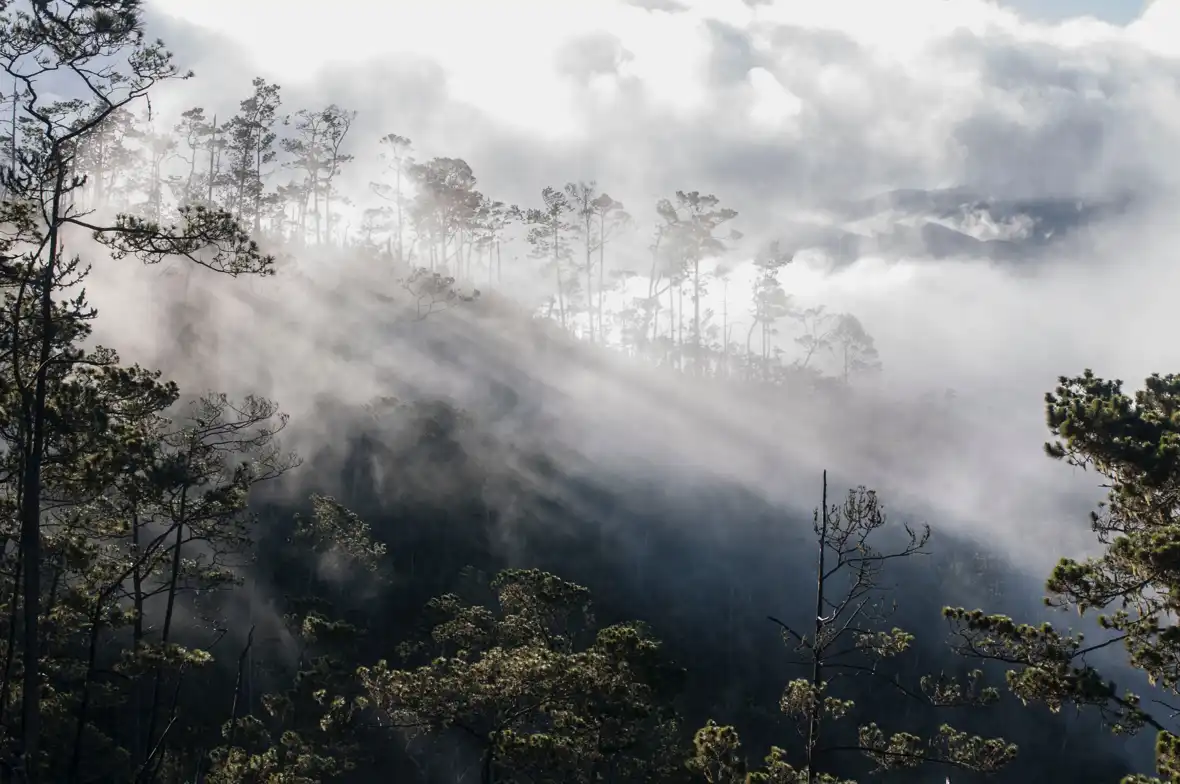
No, DR Congo (the Democratic Republic of the Congo) isn’t off-limits to travelers. Parts are complex, but with planning and strong local support you can move safely and on-purpose. What you meet is a country of thunderous rivers, endless forest, and music that vibrates in your chest.

DR Congo rewards the traveler who chases pulse and scale: rumba rolling out of Kinshasa clubs; sun glinting off the Congo River’s broad shoulders; rainforest so dense your breath slows to match it. Track rare eastern lowland gorillas in Kahuzi‑Biega, watch okapi flicker through the Ituri, feel the Kivus breathe at dawn, and, when conditions allow, stand on the rim of a live volcano and feel the heat in your teeth. Markets are loud and generous, riverboats are floating neighborhoods, and conversations run hot with pride, humor, and invention. Challenges exist—permits and escorts add cost, distances and road reality eat time, schedules flex, cash beats cards, and you’ll skip night travel and keep cameras down at checkpoints—but these are logistics, not the story. Handling them cleanly protects your energy and budget for the big moments, and those moments land harder because you earned them.

Compared with Rwanda or Uganda, DR Congo is less polished and more elemental; compared with Congo‑Brazzaville’s lodge circuits, it’s wilder and less packaged. It’s the right country for travelers who want presence over convenience, who can pay for proper logistics, move with patience, and value encounters that leave a mark long after the dust washes off.

👉 Get the 📖 Travel Guide of DR Congo

Kinshasa & Kongo Central

If you want a hard handshake with DR Congo, start here. Big-city grit, music that rattles your ribs, river power you feel in your feet. It’s the easiest entry: international flights, decent hotels, and working ATMs that still shouldn’t be trusted as your only plan. Bring crisp USD (small bills), sort your visa and invitation letter before you land, and pay for an airport pickup to dodge the gauntlet. Move in daylight, base near your meetings, and time trips to Zongo Falls or Matadi to avoid traffic and checkpoints. Rewards urbanists and culture hunters who can handle noise and negotiate with a smile.

Lake Kivu Spine: Goma – Idjwi – Bukavu – Kahuzi-Biega

Frontier energy in Goma, slow-breath island life on Idjwi, crumpled hills into Bukavu, then lowland gorillas if Kahuzi-Biega permits line up. The lake boat between Goma and Bukavu is the backbone when operating; it saves your nerves and your suspension. Enter via Goma or overland from Rwanda if that route is open to you, and work with established operators for gorilla tracking and road moves—this is not a DIY hero trip. Expect checkpoints, occasional curfews, and last‑minute changes. Rewards wildlife‑driven travelers who follow briefings and keep days flexible.

Katanga Copperbelt & Plateau: Lubumbashi – Kolwezi – Kundelungu/Upemba

This is DR Congo’s business spine: long, paved hauls, mining towns, and big skies. Fly into Lubumbashi or cross from Zambia if you have patience for a busy border. SNCC trains exist; schedules are suggestions. Good self-drive territory if you respect distances and fuel realities—fill up early, carry range, and bring cash for stations outside cities. Hotels skew pricey thanks to mining demand, so book the decent ones ahead. Side trips to Kundelungu’s cliffs and Lofoi Falls are effort-heavy but worth your sweat. Rewards overlanders and photographers who like industry mixed with wild plateaus.

Congo River Run: Kisangani to Kinshasa

The romantic idea is true and brutal: barges, hammocks, smoke, endless water. You’ll buy manioc on deck, trade stories, and move at the river’s will. Fly to Kisangani, then use a fixer for port papers and space on a barge. This is weeks, not days. Bring a hammock, water filter, stove, and a stash of small notes for official “fees”—be polite, public, and firm. Food onboard is scarce and overpriced; self-cater to protect your budget. Rewards time‑rich purists who want the country under their fingernails.

Tanganyika Shore: Uvira – Baraka – Kalemie

Lake life with a working rhythm: fishing towns, sunrise paddles, and a thin rail that limps to Kalemie when it feels like it. Access is via Lubumbashi by plane or irregular train; boats hop the shore when the lake is cooperative. Schedules drift, so build buffers and stick to daylight moves. Third‑class rail saves cash; guard your bag with a padlock and spend on a clean lakeside room at the end. Security can shift—use known guesthouses and local transport tips. Rewards water people who prefer routine over rush.
Safety warning

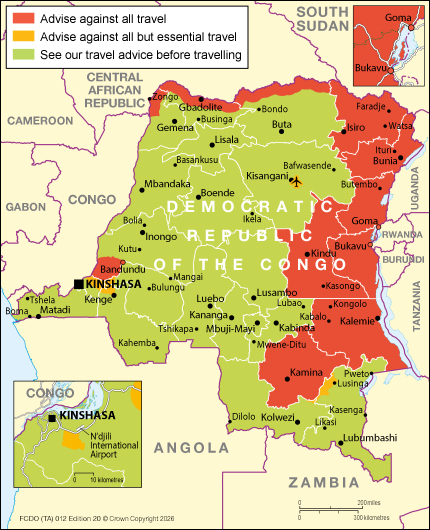
The current risk level for DR Congo is high. Check the advice before going.
Get your DR Congo guide
96 ranked highlights, routes & tips, works offline (378 pages)
Map of DR Congo
Loading the map 🌍
CLICK TO FILTER
cities
towns
landmarks
national parks
hikes
beaches
attractions
festivals
regions
SHOW COUNTRY’S BESTSHOW ALL

Why go?Why DR Congo is worth visiting

Wildlife

DR Congo is where Central Africa still feels unscripted. You go for animals that only exist here and you meet them on their terms: mountain gorillas in … read more 👉
DR Congo is where Central Africa still feels unscripted. You go for animals that only exist here and you meet them on their terms: mountain gorillas in Virunga, eastern lowland gorillas in Kahuzi‑Biega, bonobos deep in Salonga, and okapi in the Ituri forests. There aren’t safari parades or polished viewing platforms. There’s mud, sweat, and then a silverback stepping out of vines ten meters away. That trade is worth it. Fewer crowds mean quieter hours and better behavior from the wildlife. The forests hold forest elephants, bongos, and birdlife that keeps even experts quiet. DR Congo isn’t easy or cheap relative to Uganda or Rwanda, but the payoff is raw, rare encounters that still feel wild. Go prepared, go patient, and you’ll get the good stuff.

Uniqueness

DR Congo isn’t a quick win; it makes you earn every mile. Jungle that eats roads. Lava-scarred skylines in Goma. River barges that move at the speed of … read more 👉
DR Congo isn’t a quick win; it makes you earn every mile. Jungle that eats roads. Lava-scarred skylines in Goma. River barges that move at the speed of gossip. When it clicks, it’s raw and personal—lowland gorillas near Bukavu, bonobo rehab outside Kinshasa, fishermen pushing pirogues through mirror-flat backwaters at dawn.

The trick is avoiding the energy leaks. Visas and permits sorted before you fly. Cash in crisp USD, small bills, because ATMs outside big cities are theater. Photocopies of your passport for checkpoints; keep the original buried. Pay official fees at offices, not at car windows. Move at first light; night travel multiplies risks and costs. Build buffer days—rain and politics rewrite timetables. Local SIM, rubber boots, and a yellow fever card save you hours.

Do this, and you spend your budget on real encounters, not on delays and apologies.

Scenery

DR Congo makes you work for its views, and that’s the point. Rift lakes like Kivu and Tanganyika sit under serrated ridges, mornings starting with mist … read more 👉
DR Congo makes you work for its views, and that’s the point. Rift lakes like Kivu and Tanganyika sit under serrated ridges, mornings starting with mist and wooden pirogues cutting silent tracks. In Virunga, black lava fields and the brooding cones of Nyiragongo and Nyamuragira turn a simple hike into geology class with ash under your boots. The Ituri forest hums—towering hardwoods, clear creeks, okapi sign if you’re patient. Swing south and the savannahs of Kundelungu and Upemba open—wide skies, elephant grass, and Lofoi Falls dropping clean off a plateau. Kongo Central cools you down with limestone caves and the crash of Zongo Falls. DR Congo isn’t easy, but when the clouds lift and the land shows its bones, you get scale and texture you won’t find on a postcard.
Want the complete picture of DR Congo?
The offline Travel Guide brings everything together — routes, highlights & planning.

See what's included in the guide 👉

Get the Travel Guide -

⭐ HighlightsStandout locations across the country

  • Virunga National Park: Thick mist, steep ridges, and the quiet thud of boots—this place works for its magic and makes you earn every view. The must-do here is a mountain gorilla trek with ICCN trackers; when you lock eyes with a silverback at arm’s length, the cost, sweat, and nerves all make sense. Insider tip: buy permits through the park, carry crisp USD, and build a buffer day for the Goma border—nothing in this corner of DR Congo moves on your schedule, and that’s exactly why it still feels wild.
  • Kahuzi-Biega National Park: East of Bukavu the rainforest rises in wet, layered greens, home to the heavier, longer-limbed eastern lowland gorillas—less celebrity, more muscle. Make the trek to a habituated family and you’ll watch them bulldoze through ferns like tanks in slow motion. Insider tip: take the morning Lake Kivu speedboat from Goma to Bukavu, rent gumboots at HQ, and hire a porter; the trails are honest mud and the road out is a spine-rattler after rain.
  • Lola ya Bonobo (Kinshasa):
read more 👉
  • Virunga National Park: Thick mist, steep ridges, and the quiet thud of boots—this place works for its magic and makes you earn every view. The must-do here is a mountain gorilla trek with ICCN trackers; when you lock eyes with a silverback at arm’s length, the cost, sweat, and nerves all make sense. Insider tip: buy permits through the park, carry crisp USD, and build a buffer day for the Goma border—nothing in this corner of DR Congo moves on your schedule, and that’s exactly why it still feels wild.
  • Kahuzi-Biega National Park: East of Bukavu the rainforest rises in wet, layered greens, home to the heavier, longer-limbed eastern lowland gorillas—less celebrity, more muscle. Make the trek to a habituated family and you’ll watch them bulldoze through ferns like tanks in slow motion. Insider tip: take the morning Lake Kivu speedboat from Goma to Bukavu, rent gumboots at HQ, and hire a porter; the trails are honest mud and the road out is a spine-rattler after rain.
  • Lola ya Bonobo (Kinshasa): A quick escape from Kinshasa’s honking chaos, this sanctuary hums with whistles and leaf-rustle as rescued bonobos lounge, squabble, and solve problems you didn’t know apes had. Be there for feeding time—the elevated walkway gives you clean sightlines and the best behavior show. Insider tip: go on a weekday morning, bring your passport for the gate, and tell your driver to wait; getting a return ride at the wrong hour can waste more energy than any trek in DR Congo.
  • Tchegera Island (Lake Kivu): A crescent of black sand in a drowned volcanic caldera, calm water on one side, whitecaps on the other—quiet until night, when the volcanoes fume on the horizon. Kayak the shoreline in the afternoon and stay for the campfire glow; when the sky clears, you’ll understand the shape of this lake. Insider tip: nights get cold and damp, so pack a warm layer and dry bag, settle your bar bill in cash, and accept boat delays when the wind kicks up—safety boats don’t argue with Kivu.
  • Zongo Falls (Kongo Central): Jungle breathes around a thunderous drop, and the spray soaks you before you see the water; it’s the rare day trip that actually earns the hours from Kinshasa. Walk the steps to the base—legs will burn, camera will fog, grin will last. Insider tip: bring exact cash for the gate, shoes you don’t mind ruining, and a high-clearance vehicle; the track is pocked, and the best pools sit behind slick boulders. Off the map, aim for Boyoma Falls near Kisangani to watch Wagenia fishermen work their tripod nets, the birdy savannas around Upemba’s Lusinga station, or slow-rolling farm tracks on Idjwi Island in Lake Kivu.
Spotted a mistake or missing a highlight? Contact us.

But DR Congo offers more...

Discover and compare all of its highlights per category

🧭 RoutesHow travelers typically move through the country

The 7-Day Virunga & Lake Kivu Circuit

The vibe: A focused, high-impact week built around Goma, Virunga’s gorillas, and Nyiragongo’s lava lake, with just enough lake time to keep it from feeling like an expedition race. You get the eastern DRC’s greatest hits in one concentrated burst, using Goma as your launchpad.
The highlights:
  • Base days in Goma with time at the Marché d’Art de Goma and Lake Kivu shoreline.
  • Gorilla encounters and conservation insight in Virunga National Park and the Senkwekwe Gorilla Orphanage Centre.
  • Overnight trek to the crater rim of Nyiragongo Volcano.
  • A slow final day on Idjwi Island to decompress before departure.

The 14-Day Kinshasa-to-Kivu Culture & Wildlands Route

The vibe: Two weeks that stitch together Kinshasa’s cultural energy with eastern Congo’s forests and lakes, balancing museums and art spaces with gorillas, volcanoes, and waterfalls. The pace is steady, with domestic flights doing the heavy lifting so you can spend more time exploring than commuting.
The highlights:
  • Capital
read more 👉

The 7-Day Virunga & Lake Kivu Circuit

The vibe: A focused, high-impact week built around Goma, Virunga’s gorillas, and Nyiragongo’s lava lake, with just enough lake time to keep it from feeling like an expedition race. You get the eastern DRC’s greatest hits in one concentrated burst, using Goma as your launchpad.
The highlights:
  • Base days in Goma with time at the Marché d’Art de Goma and Lake Kivu shoreline.
  • Gorilla encounters and conservation insight in Virunga National Park and the Senkwekwe Gorilla Orphanage Centre.
  • Overnight trek to the crater rim of Nyiragongo Volcano.
  • A slow final day on Idjwi Island to decompress before departure.

The 14-Day Kinshasa-to-Kivu Culture & Wildlands Route

The vibe: Two weeks that stitch together Kinshasa’s cultural energy with eastern Congo’s forests and lakes, balancing museums and art spaces with gorillas, volcanoes, and waterfalls. The pace is steady, with domestic flights doing the heavy lifting so you can spend more time exploring than commuting.
The highlights:
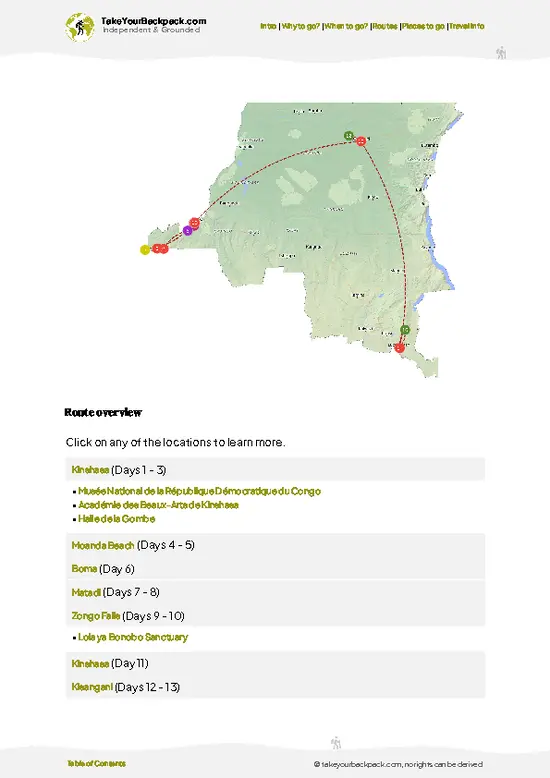
  • Capital immersion in Kinshasa, from the Musée National to the Académie des Beaux-Arts and riverfront life.
  • Road escape to Zongo Falls and the Bombo Lumene Game Reserve.
  • Gorilla tracking and lava-lake camping around Virunga National Park and Nyiragongo Volcano.
  • Lake Kivu crossings linking Goma, Bukavu, Kahuzi-Biega National Park, and Idjwi Island.

The 21-Day Cross-Congo Explorer

The vibe: A three-week deep dive that connects Kinshasa, the Copperbelt, and the eastern highlands into one big arc, ideal for travelers who want both iconic wildlife and a feel for everyday urban and rural life. The pace is exploratory rather than rushed, with time built in for side trips and recovery days.
The highlights:
  • Extended Kinshasa stay with cultural institutions, river escapes to Zongo Falls, and Bombo Lumene savanna.
  • Copperbelt days in Lubumbashi with museum visits and forays toward Kundelungu National Park and the Kundelungu Plateau Trail.
  • Eastern lake corridor linking Lake Tanganyika, Uvira, Bukavu, Kahuzi-Biega National Park, and Ile de la Lwiro.
  • Final stretch around Goma with Virunga National Park, the Senkwekwe Gorilla Orphanage Centre, Nyiragongo Volcano, and slow time on Idjwi Island.
🌍 Want a ready-to-use travel plan for DR Congo?
The overview above compares different route options based on your travel time and style. The complete Travel Guide breaks each itinerary down in detail, including maps, stops, highlights, and transport information.

Explore all route details 👉

Get the Travel Guide -

🌤️ When to go?Best time to visit DR Congo

Aim for late June into early July and again in September. You’re catching DR Congo when the long dry has firmed the roads and drained the worst mud, but before or after the tightest scramble for permits and beds. Trails hold shape for gorilla tracking, river traffic is still workable, and skies clear enough for the rift’s highlands without the furnace-like haze of August. Prices aren’t “cheap” in any global sense, but they come off their mid-dry spike; guides answer their phones; shared vehicles run on schedule because they’re not wrestling axle-deep clay.
  • Dry Peak (June-August): You pay in dust, heat, and scarcity. Drivers tack on premiums, rooms vanish near Kivu, and every seat to the forests goes to someone who decided early. But the payoff is hard to beat: firm trails to Grauer’s gorillas, clean river crossings, and night air that actually cools your skin. Expect slower boats late in the stretch when water drops; barge captains wait or reroute, and your “overnight” becomes two.
  • Shoulder (Late June + September): The country shifts gears. Markets reopen after harvest runs, checkpoints wave you through, and guides start slotting last-minute trekkers. Rains tease on the horizon, tamping the dust just enough while leaving the roads passable. Prices relax a notch, permits reappear, and you move faster with less bargaining fatigue.
  • Rains/Off-Peak (October-May; heaviest March-April): The forest breathes. Thunder rolls all afternoon, hills turn emerald, and you’ll have viewpoints to yourself. Survival hack: buy knee-high rubber boots in a local market and line your pack with a contractor bag; ride the first vehicle of the day before storms stall transport. Hidden risk most travelers ignore: after big cells, landslides close feeder roads and ferries stop for days, even if the sun’s out by noon.

Tactical tip: For that shoulder window, lock in gorilla permits about a month in advance and build your route around them, not the other way around.

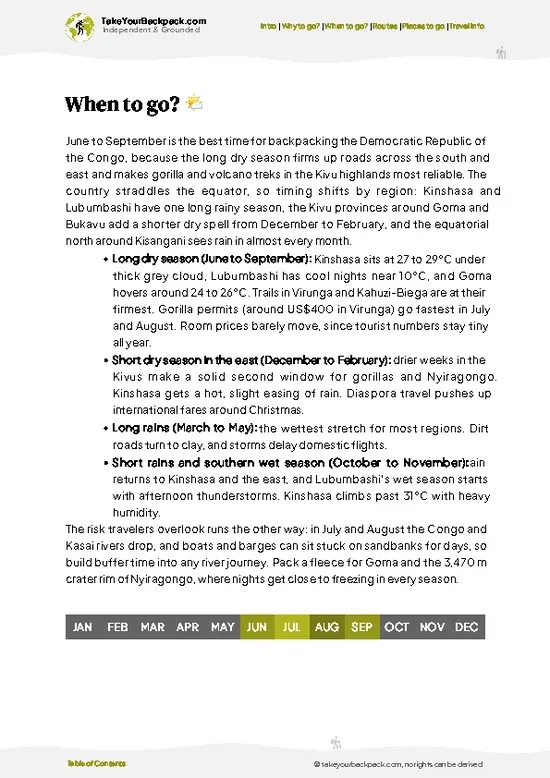
source: climatestotravel.comJANJanuary: fair for travelingFEBFebruary: fair for travelingMARMarch: below average for travelingAPRApril: below average for travelingMAYMay: fair for travelingJUNJune: highly recommended for travelingJULJuly: excellent for travelingAUGAugust: good for travelingSEPSeptember: highly recommended for travelingOCTOctober: fair for travelingNOVNovember: fair for travelingDECDecember: fair for traveling
📅 Traveling in a specific month?
Get a full month-by-month breakdown of weather, crowds, costs, festivals, and seasonal highlights in the complete travel guide.

Get full details when to go 👉

Get the Travel Guide -
democratic republic of congo - juan-fernandez-W7oPDwcqccQ-unsplash2

💰 Costs (as of 2026)Typical budget expectations

Plan on $45-70 per day in DR Congo if you move slowly, eat local, and dodge permit-heavy parks; push your pace or base in big cities and it can double.
  • dorm accommodation: $18-35 in Kinshasa/Goma, $12-25 in border towns (Goma/Bukavu/Uvira); dorms are scarce outside hubs, so expect simple guesthouse rooms at $20-40. System tip: message church/mission “centres d’accueil” and NGO guesthouses a day ahead, ask for “chambre économique” or a dorm, pay cash in clean USD, and negotiate a weekly rate (often 20-30% off). Compared to Rwanda/Uganda, beds are fewer and pricier for the quality.
  • meals: Supermarket Survival: imports are punishing—cheese/cereal $8-15, peanut butter $5-7, decent bread $1-2; self-catering only works if your lodging has a kitchen. Street food reality: breakfast beignets/omelettes $0.50-1.50, lunch plates of rice/beans/fufu with saka-saka $2-3, brochettes or fish $1-2 each; a basic local restaurant meal $3-5, expat cafés $7-12. Street eats are similar to Uganda and cheaper than Rwanda; supermarkets are worse value than both.
  • local transport: In cities, motos are king: $0.50-2 for short hops; shared taxis/minibuses $0.30-1 if you’re patient. Intercity, agency buses where they
read more 👉
Plan on $45-70 per day in DR Congo if you move slowly, eat local, and dodge permit-heavy parks; push your pace or base in big cities and it can double.
  • dorm accommodation: $18-35 in Kinshasa/Goma, $12-25 in border towns (Goma/Bukavu/Uvira); dorms are scarce outside hubs, so expect simple guesthouse rooms at $20-40. System tip: message church/mission “centres d’accueil” and NGO guesthouses a day ahead, ask for “chambre économique” or a dorm, pay cash in clean USD, and negotiate a weekly rate (often 20-30% off). Compared to Rwanda/Uganda, beds are fewer and pricier for the quality.
  • meals: Supermarket Survival: imports are punishing—cheese/cereal $8-15, peanut butter $5-7, decent bread $1-2; self-catering only works if your lodging has a kitchen. Street food reality: breakfast beignets/omelettes $0.50-1.50, lunch plates of rice/beans/fufu with saka-saka $2-3, brochettes or fish $1-2 each; a basic local restaurant meal $3-5, expat cafés $7-12. Street eats are similar to Uganda and cheaper than Rwanda; supermarkets are worse value than both.
  • local transport: In cities, motos are king: $0.50-2 for short hops; shared taxis/minibuses $0.30-1 if you’re patient. Intercity, agency buses where they exist run $10-25 per 200-400 km; when the road collapses into mud, camion-brousse is cheaper ($5-15) but costs you a day and your spine. Riverboats are deck-cheap but time-expensive. The real unlock: keep your radius tight (Goma-Bukavu corridor), use motos to link towns, and avoid private taxis. Compared to Rwanda/Uganda, price per kilometer is similar but speed and reliability are worse—budget extra days, not extra cash.
  • activities: This is where budgets explode. Virunga gorilla permits historically ~$400-450 (a deal next to Rwanda’s $1500 and under Uganda’s $700), Nyiragongo treks ~$300-400, plus park fees and mandatory guides/rangers. Domestic flights $150-300 one-way. River trips with a cabin add $30-60 above deck. City museums/monuments are pocket change. DR Congo can be a relative bargain for gorillas—when open and safe—but security logistics and transport erase savings fast.
  • miscellaneous: Budget Leaks: visas $105-200 plus LOI/agent fees $50-150; ATM fees $5-10 and weak rates; cash is king and torn USD notes get rejected. Expect to buy water ($0.50-1 for 1.5L), pay for laundry ($2-4), and sometimes for Wi-Fi or generator power. SIM $1-3, data $3-5/week for a few GB. Keep small bills for checkpoints and petty “fines”; stay polite, carry photocopies, and avoid paying. Relative to neighbors, the leaks are harsher and more frequent—tight admin saves real money.
⚠️ Prices can change and everyone travels differently, so take this as a rough guide. Hope it helps you plan your adventure!

✈️ The backpacker research shortcutDR Congo Travel Guide

An offline-friendly backpacking guide with optimized travel routes, ranked highlights, transport advice, and the best areas to stay.
example page 0 from our offline Travel Guide for Democratic Republic of the Congoexample page 1 from our offline Travel Guide for Democratic Republic of the Congoexample page 2 from our offline Travel Guide for Democratic Republic of the Congoexample page 3 from our offline Travel Guide for Democratic Republic of the Congoexample page 4 from our offline Travel Guide for Democratic Republic of the Congoexample page 5 from our offline Travel Guide for Democratic Republic of the Congoexample page 6 from our offline Travel Guide for Democratic Republic of the Congoexample page 7 from our offline Travel Guide for Democratic Republic of the Congo
The digital guide (378 pages) contains:
96 highlights, ranked by travel appeal
Optimized 7, 14 & 21-day travel routes
Cities, national parks, beaches, historical sites, ...
How to get around
Offline-friendly for travel without Wi-Fi
👉 Click to see all 30+ guide features

📅 Plan smarter in minutes, not weeks
Month by month travel advice
Festivals & national holidays
Budget expectations

🗺️ Go to the right places, skip the overrated ones
Honest pros & cons of destinations
Top hikes, parks & viewpoints
Lesser-known places most travelers miss
Clear “worth it vs skip it” guidance

🛏️ Travel smoothly without rookie mistakes
Best areas to stay
Transport systems explained simply
Common scams & safety advice
SIM cards, money & practical tips

🌍 Understand the country, not just visit it
Culture & traditions
52 Essential phrases & customs
Festivals worth planning around
Traveler-friendly historical context
Insights that make places more meaningful

📱 Built for real travel conditions
Fully downloadable PDF
Works completely offline
Optimized for phone use
Useful in remote areas & buses
Everything in one place
Save weeks of stressful planning
Get instant access to the full guide directly. 30-day money-back guarantee.


Sent to your inbox immediately after payment • 100% Secure Checkout
Best Backpacking Travel Advisor 2025 tourism awardBest Backpacking
Travel Advisor
2025
What others say about Take Your Backpack Guides:
⭐⭐⭐⭐⭐
Fantastic, amazing amount of information!
⭐⭐⭐⭐⭐
My goodness this is amazing, it's what I've been looking for hats off too you!
⭐⭐⭐⭐⭐
I think this is absolutely BRILLIANT
⭐⭐⭐⭐
Very complete and informative. It's still missing places, but I gotta to commend you
⭐⭐⭐⭐⭐
This is truly amazing, thank you, can't wait to explore it with my kids!
⭐⭐⭐⭐⭐
Awesome resource, thank you!
⭐⭐⭐⭐⭐
This is amazing! Can't wait to explore the ones I haven't seen
⭐⭐⭐⭐
I love this! Well done, great idea.
⭐⭐⭐⭐⭐
Thanks for taking the time to make this gem!
⭐⭐⭐⭐⭐
This might be the best website I've ever seen.
⭐⭐⭐⭐⭐
Congratulations, and thank you so much for your work; it's incredibly valuable.
⭐⭐⭐⭐
In all seriousness I think you did a great job pointing out the important spots
⭐⭐⭐⭐⭐
10/10 very good
⭐⭐⭐⭐⭐
As someone who's only just starting to visit regularly this is awesome, thank you.
⭐⭐⭐⭐
Thank you very much! I'm going to visit my dad, it's going to be very useful!
⭐⭐⭐⭐⭐
This is really cool! We'll be travelling for the first time and this definitely come in handy.
⭐⭐⭐⭐⭐
You are now our minister of culture, congratulations 👨‍💼
⭐⭐⭐⭐⭐
Just wanted to tell you that this is a pearl! Going to follow your recommendations.
⭐⭐⭐⭐⭐
This is so cool. I'll definitely be using the resource for my travels soon.
⭐⭐⭐⭐⭐
This is very impressive! Good work.
⭐⭐⭐⭐⭐
This is an amazing and informative site. Very well done!

🛏️ Where to stay?Choosing the right base for your trip

Yes — conventional hostels are scarce, but budget guesthouses and basic dorm-style accommodation exist in DR Congo’s main cities; expect rudimentary facilities, intermittent power and water, limited booking options, and bring cash, insect repellent and a power bank.

Goma: many budget guesthouses near Lake Kivu and the Nyiragongo trek — excellent for nature access and an active traveler community but security can be unpredictable and services basic; Bukavu: quieter lakeside guesthouses, good for boat trips and calmer nights but limited nightlife; Kinshasa — Gombe: safest, best nightlife and services … read more 👉
Yes — conventional hostels are scarce, but budget guesthouses and basic dorm-style accommodation exist in DR Congo’s main cities; expect rudimentary facilities, intermittent power and water, limited booking options, and bring cash, insect repellent and a power bank.

Goma: many budget guesthouses near Lake Kivu and the Nyiragongo trek — excellent for nature access and an active traveler community but security can be unpredictable and services basic; Bukavu: quieter lakeside guesthouses, good for boat trips and calmer nights but limited nightlife; Kinshasa — Gombe: safest, best nightlife and services but few cheap hostels and higher prices, while Kinshasa — Centre‑Ville has more low-cost options but higher risk after dark; Lubumbashi (Centre‑Ville): several inexpensive hotels with some nightlife but variable standards; Kisangani: very basic, cheap guesthouses that are practical for transit but offer few amenities.

If you enjoy meeting fellow travelers, consider choosing hostels with high ratings for atmosphere. On the other hand, if you prefer having your own space, a hotel might be a better option.

🚌 Getting aroundTransportation options and logistics

DR Congo runs on momentum, not timetables. Vehicles leave when they’re full, boats push off when the cargo is stacked high enough to scare your mother, and roadblocks melt only after the right person nods. You don’t “book” a day here; you negotiate it. If you can make peace with the drift, the country opens up. If you fight it, it will drain your wallet and your patience before lunch.
  • Domestic flights The efficiency tax you pay to skip weeks of potholes. A one-hour hop can erase a 5-10 day grind
read more 👉
DR Congo runs on momentum, not timetables. Vehicles leave when they’re full, boats push off when the cargo is stacked high enough to scare your mother, and roadblocks melt only after the right person nods. You don’t “book” a day here; you negotiate it. If you can make peace with the drift, the country opens up. If you fight it, it will drain your wallet and your patience before lunch.
  • Domestic flights The efficiency tax you pay to skip weeks of potholes. A one-hour hop can erase a 5-10 day grind by bus-boat-truck, and that’s worth real money when your time and energy are finite. Prices bite compared to East Africa, but weigh them against extra nights, food, “fees,” and breakdowns. Book earlier, fly midweek, keep your bag light to dodge overweight charges, and expect schedule shuffles. Print your ticket, carry small USD for airport taxes, and pad a full spare day at each end so a cancellation doesn’t nuke your plans.
  • Shared taxis and minibuses This is the social bloodstream. You squeeze, you greet, you pay the same as everyone unless you want that front-seat premium. Money travels hand-to-hand; say your stop clearly, tap the ceiling, don’t wait for change immediately—it circulates eventually. Backpacks on your lap, phone in a deep pocket, shoulders relaxed. Prices rise with rain and traffic; nobody owes you a meter. Don’t bark; you’ll get iced out. Do help pass fares; you’ll get a seat when it matters. After dark, routes thin and tempers thicken—plan to arrive earlier.
  • River barges and pirogues Water redraws the map; where roads dissolve, rivers stitch the country together. The Congo, Kasai, Ubangi—names that mean movement when wheels fail. Barges leave when loaded, not when you wish. You claim deck space with a tarp and rope, rig a mosquito net, cook your own food, and watch the stars while the jungle hums. It’s slow, but it reaches towns the highway forgot. Keep documents handy for inspections, lash your bag at night, and bring a filter, headlamp, and patience measured in days, not hours.
  • Freight trucks (camions) The budget jailbreak when buses won’t go. Show up at the truck park before dawn, ask around, and negotiate a ride on the load. It’s cheap per kilometer and brutally honest: dust in your teeth, naps on sacks, sudden layovers when a bridge gives up. Carry a tarp, bungees, water, and extra food. Expect “priority” charges from loaders and checkpoint theatrics; stay polite and keep copies of documents. Never ride at night on problem stretches—if the driver pushes on, you don’t.

Master tactical tip: Think in legs, not routes—buy one strategic flight to collapse the biggest distance, then stitch the rest by river and road, always starting before sunrise with cash for small fees and a 24-hour buffer so delays don’t break your trip.
Distance: N’Djili International Airport (FIH) sits about 25 km (16 mi) east of central Kinshasa (Gombe/Gare Centrale).

Main ways to get into the city
  • Pre-booked private transfer or hotel pickup — The least hassle, with a driver meeting you in arrivals.

    Time: 45-90+ minutes, depending on traffic.

    Cost: roughly US$35-70 one way (higher for large vehicles or late-night pickups).
  • Airport taxi (licensed, no meter) — Taxis queue outside arrivals; confirm the fare before you get in.

    Time: 45-90+ minutes.

    Cost: about US$25-40 in daytime; US$30-50 late at night or in heavy traffic. Pay cash; USD is widely accepted.
  • Shared taxi/minibus (“taxi-bus”) or public bus — Cheapest but slowest and crowded. These usually don’t enter the terminal; you’ll likely walk out to the main road (Boulevard Lumumba) by the airport gate and flag one, then change once en route for Gombe.

    Time: 60-120 minutes, more at rush hour.

    Cost: about 2,000-5,000 CDF per leg (roughly US$1-2). Have small CDF notes; not ideal with big luggage.
  • Ride-hailing apps — Availability at FIH is hit-or-miss. If you do snag one, pricing is similar to a taxi.

    Time: 45-90+ minutes.

    Cost: typically US$20-35, but expect surge pricing and possible driver cancellations at the airport.
  • Train — There is no regular passenger rail link to the terminal as of 2025.

Taxi quick facts: Licensed airport taxis are the most common choice for visitors. Expect US$25-40 by day and US$30-50 late at night; agree the fare before departure, keep bags inside the vehicle, and ignore touts who push for “special” prices.

Good to know: Traffic can be brutal at peak times (roughly 07:00-10:00 and 16:00-20:00). Build in extra time, carry small USD and CDF notes, and if you want the smoothest arrival, pre-arrange a pickup with your hotel.
⚠️ Prices and routes can change, so take this as a rough guide and ask for local advice when you arrive.

🔒 Safety (risk Level: high)Safety considerations for travelers

Safety for solo travelers, including women and LGBTQ+ individuals
The Democratic Republic of the Congo poses significant safety challenges for solo travelers, especially women and LGBTQ+ individuals. Political instability, civil unrest, and high crime rates are prevalent, making it essential to stay informed and cautious. Women and LGBTQ+ travelers may face additional societal challenges and should exercise increased caution. Always check the latest travel advisories and consider traveling with a group or local guide for added security.


Full official government travel advisory (live updates)
View details 👉
safety image

source: www.gov.uk

✈️ VisaVisa requirements for DR Congo

Most travelers need a visa to visit the Democratic Republic of the Congo. You can apply for a visa at a Congolese embassy or consulate in your country. Ensure your passport is valid for at least six months and check for specific requirements which may vary by nationality.

source: diplomatie.gouv.cd
⚠️ Visa requirements can change over time, so always check the latest visa requirements with the official embassy or government website before you travel.

🎒 What to pack?What you'll need while traveling

Packing for the Democratic Republic of the Congo requires some strategy due to its diverse climate and terrain. You’ll face plenty of heat and humidity, especially in the jungles, so think lightweight and breathable clothing. The rainy season can drench you quickly, so a solid rain jacket is your friend. If you’re planning on hitting the highlands, like the Virunga Mountains, prepare for cooler temps. Culturally, modest clothing is appreciated, especially in rural areas, so keep those shorts and tank tops for the beach and stick to longer, looser attire elsewhere.

Apart from this country specific advice, I have also crafted a general packing list that should help on any trip. authorOver the years, I've learned the importance of packing minimally. It's so much easier to jump on the back of a truck or squeeze yourself into the last spot of a minibus without that supersized backpack. If you're headed to a warm destination, leave your winter jacket at home; for colder regions, opt for thin thermal underlayers. Instead of packing your entire wardrobe, bring just three sets of clothes, as laundry facilities are available everywhere.
View the full list 👉
🎒 Planning the practical side of your trip?
Get detailed information on transport, daily budgets, internet access, local customs, food, language, and other essentials in the complete Travel Guide.

Get detailed practical information 👉

Get the Travel Guide -

🙋 FAQCommon questions before visiting

Trip Planning


Personal tip: I normally search on good rating for atmosphere (for meeting people) and location (for easy exploring). Cleanliness as a bonus.


Travel Essentials

Yellow fever vaccination is mandatory for entry into the Democratic Republic of the Congo. Recommended vaccinations include hepatitis A, hepatitis B, typhoid, cholera, rabies, and meningococcal disease. Ensure your routine vaccinations like MMR (measles, mumps, rubella) and tetanus-diphtheria are up to date. Consult a healthcare provider for personalized advice.


vaccination requirements
When I first started traveling, I often spent part of my first day in a new country hunting for a local SIM card. While this can still be slightly cheaper, it also takes time and planning.

These days, it's much simpler to install an eSIM before leaving home. Once you arrive in DR Congo, you can activate it immediately and have mobile data from the moment you land — which is especially useful for ordering transport or navigating away from busy airports.

There are many providers nowadays, and price differences are usually small. I personally go with Airalo, as it offers excellent network coverage throughout the country and strong global coverage, so you can manage multiple countries from a single app.


Get your e-sim for DR Congo

Culture & Customs

Avoid taking photos of people without permission; it’s considered disrespectful. A simple smile and a polite request often work wonders. Handshakes are common, but a soft grip is preferred. When greeting, use titles and last names until invited to use first names.

Dress modestly, especially in rural areas. Women should cover their shoulders and knees. Public displays of affection are frowned upon, so keep it low-key. Homosexuality is illegal, and LGBTQ+ travelers should exercise caution and discretion.

For women travelers, consider traveling in groups and avoid isolated areas after dark. Always negotiate taxi fares before getting in to avoid misunderstandings.
Trying traditional food is always a great way to experience the culture. Here are some must-try dishes for DR Congo.
  • Pondu: Also known as cassava leaves stew, this dish is a staple in Congolese households. It’s made by simmering cassava leaves with peanuts, palm oil, and spices. It’s popular for its rich flavor and is often served with rice or fufu.
  • Fumbwa: This dish features wild spinach cooked with ground nuts, palm oil, and sometimes fish or meat. It’s a favorite for its earthy taste and is a great example of the Congolese love for leafy greens.
  • Moambe Chicken: Often considered the national dish, this chicken stew is cooked with palm butter and a mix of spices. It’s called moambe because of the palm nut sauce, which gives the dish its unique flavor.
  • Saka-Saka: Another dish based on cassava leaves, but this one is usually cooked with ground peanuts and fish. It’s a must-try for anyone wanting to experience the hearty side of Congolese cuisine.
  • Liboke de Poisson: Fish marinated with spices and wrapped in banana leaves before being grilled. This method of cooking keeps the fish juicy and is a popular street food, especially near rivers.
Tap water in the Democratic Republic of the Congo isn’t safe for tourists to drink, even if locals sometimes do. It’s strongly recommended to stick to bottled or properly filtered water to avoid health issues. Always ensure the bottle seal is intact before purchasing.
The main language in Democratic Republic of the Congo is French. Backpacking is way more rewarding if you know a bit of the local language, so I'd suggest brushing up on the basics just in case your French skills have become a bit rusty.

Want to understand locals better?
The complete Travel Guide for DR Congo includes 52 essential words and phrases — greetings, thank-yous, ordering food, transport, numbers, and common local expressions you'll actually hear.

Get your local basic phrases 👉

Get the Travel Guide -


In the Democratic Republic of the Congo (DRC), English is not widely spoken. The official language is French, which is used in government, education, and media. While some urban areas and tourist destinations may have individuals who speak English, particularly in hospitality sectors, the majority of the population communicates in local languages such as Lingala, Swahili, Kikongo, and Tshiluba.

Travelers should be prepared for language barriers, especially in rural regions where English proficiency is minimal. It’s advisable to learn a few basic phrases in French or a local language to enhance communication and cultural exchange.

For those planning to visit, hiring a local guide who speaks English can greatly facilitate interactions and enrich the travel experience. Overall, while you may encounter some English speakers in the DRC, proficiency is limited, making it essential to approach communication with flexibility and an open mind.

Money & Payments

The local currency of DR Congo is CDF (₵).

ATMs: In the Democratic Republic of the Congo, ATMs are scarce outside major cities like Kinshasa or Lubumbashi. Even in cities, they can be unreliable or out of service, so don’t rely solely on them for cash.

Cash: Always carry a mix of cash in USD and the local currency, Congolese Franc (CDF). USD is often accepted for larger transactions and hotel payments, but you’ll need CDF for local markets and smaller purchases.

Currency Exchange: Exchange money in banks or official exchange bureaus to avoid getting ripped off. Avoid street money changers unless you’re experienced; they can be tricky with rates and sometimes give you old or fake bills.

Euros: While USD is more commonly accepted, having some Euros can be useful in certain places. However, prioritize USD if you have to choose.

Card Acceptance: Credit cards are not widely accepted outside upscale hotels or restaurants in major cities. Always double-check if they accept cards before assuming you can pay that way.

Keep an eye on your cash and avoid flashing it around. The DRC is a cash-centric place, so plan ahead to ensure you always have enough on hand.

Tipping in the Democratic Republic of the Congo is not as formalized as in Western countries, but it is appreciated. In restaurants, leaving a tip of around 10% is a nice gesture if the service was good. For taxis and other services, rounding up the fare or adding a small amount is a common practice.

🧩 Nearby countriesSimilar backpacking destinations

We 💚 feedbackFinal notes for travelers

DR Congo rewards patience; it punishes bravado. Build slack days. Buses miss departures, boats drift into tomorrow. Pay for the confirmed seat or the earlier flight; it’s cheaper than a busted plan. Get your visa before you land. Carry crisp USD and small francs; ATMs hiccup and small “fees” appear at checkpoints. Two photocopies of your passport save arguments—and your morning. Daylight only. Registered taxis. Ask before photos, and never at offices or bridges. Yellow fever card on top of your bag. Small upside: SIM data is cheap and actually fast in big cities; download maps and keep moving. Fear to retire: it isn’t war everywhere. Stick to known corridors and you’ll find normal life humming, and people who help you get there.

✍️ Help improve this page!
The information on this page is based on in-depth research, insights shared by experienced travelers, and feedback from the local travel community in DR Congo. While every effort is made to keep the information accurate and current, conditions can change — so if you spot anything incorrect or outdated, please get in touch.


🙋‍♂️ Give feedback

👋 Meet the founderWho’s Behind Take Your Backpack?

Johan, backpacker and founder of TakeYourBackpackHi, I’m Johan (Netherlands 🇳🇱), the creator of TakeYourBackpack. Over the past decade, I’ve backpacked through 80+ countries across six continents, gaining extensive experience with independent travel, long-term trips, and overland routes.

This site is built on a combination of firsthand travel experience and carefully curated insights from other backpackers. Many guides are based on places I’ve personally visited, while others bring together tips, observations, and practical advice shared by trusted travelers I’ve met along the way.

The goal is to provide realistic, experience-driven guidance — not generic itineraries — so you can explore destinations with better context, clearer expectations, and more confidence.

Get full DR Congo guide •
Instant download • 96 highlights • Full Offline guide