Trip Planning
The TakeYourBackpack guidebooks are your all-in-one travel companion, featuring the best cities, national parks, hikes, beaches, and unique sites, along with essential tips on when to go, how to get around, exchanging money, and even local phrases to get you started — everything you need for a smooth, unforgettable backpacking adventure.
Stop researching. Start exploring.Discover all 62 highlights,ranked
and organized into practical routes.
Get instant access
Planning a backpacking route through Sudan can be tricky — you need to balance must-see places, travel times, budget, and how long to stay in each destination. Our free personalized Sudan itinerary planner creates a route based on your travel style, trip duration, and interests, so you can spend less time researching and more time exploring.
Personal tip: I normally search on good rating for atmosphere (for meeting people) and location (for easy exploring). Cleanliness as a bonus.
Travel Essentials
For Sudan, make sure routine vaccines (MMR, tetanus-diphtheria, polio) are current, and get hepatitis A and typhoid shots. A yellow fever certificate is required if you arrive from a yellow fever country and is recommended for travel south of the Sahara desert regions. Meningococcal vaccination is advised because Sudan lies in the African meningitis belt, and rabies, hepatitis B and oral cholera vaccines are worth discussing given recent cholera outbreaks. Malaria is present across the country, so ask a travel clinic about antimalarial tablets.
vaccination requirementsWhen I first started traveling, I often spent part of my first day in a new country hunting for a local SIM card. While this can still be slightly cheaper, it also takes time and planning.
These days, it's much simpler to install an eSIM before leaving home. Once you arrive in Sudan, you can activate it immediately and have mobile data from the moment you land — which is especially useful for ordering transport or navigating away from busy airports.
There are many providers nowadays, and price differences are usually small. I personally go with
Holafly, as it offers excellent network coverage throughout the country and strong global coverage, so you can manage multiple countries from a single app.
HolaFly eSimCulture & Customs
Sudan is a conservative Muslim country, so dress modestly: long trousers for men, and loose clothing covering arms and legs for women, with a headscarf handy for mosques and rural areas. Eat, pass items and shake hands with your right hand, and accept tea or coffee when offered, since hospitality is a point of pride and refusing outright can offend. Alcohol is illegal, and during Ramadan you should not eat, drink or smoke in public during daylight. Photography requires a permit, and you must never photograph military sites, bridges, government buildings, checkpoints or people without asking. Men should wait for a woman to offer her hand before shaking it, and women travelers will often be seated with other women at gatherings. Public displays of affection are frowned upon for everyone, and same-sex relationships are illegal, so discretion is essential.
Trying traditional food is always a great way to experience the culture. Here are some must-try dishes for Sudan.
- Ful medames: slow-stewed fava beans mashed with oil, cumin, salt and sometimes feta, tomato or egg, scooped up with bread. It is the national breakfast, eaten from shared bowls at roadside stalls before work, and it costs very little.
- Kisra with mullah: a thin, slightly sour sorghum crepe served with a stew (mullah) of meat, okra or dried vegetables. Kisra is the everyday staple of northern and central Sudan and appears at almost every home meal.
- Asida: a firm porridge of sorghum or millet flour shaped into a dome and topped with a stew such as mullah waika (dried okra). It is the communal dish of family gatherings and Ramadan evenings.
- Gurasa: a thick, pancake-like wheat bread, eaten with stews or with sugar and butter. It is the comfort food of central Sudan and features at celebrations.
- Tamia: Sudan’s falafel, often made with chickpeas and spiced generously, stuffed into bread with salad and peanut sauce. It is the cheapest filling lunch on the street.
- Shaiya: grilled or pan-fried lamb pieces with onion and chili, a favorite for Eid and weekend feasts, best eaten fresh from the butcher-grill shops.
- Salata aswad: a smoky eggplant salad with peanut butter and lime, a common side dish that shows the peanut’s big role in Sudanese cooking.
Tap water in Sudan comes largely from the Nile and is not safe for travelers to drink. Locals do drink it, often from clay jars called zeer that cool the water, but outbreaks of cholera and other waterborne illnesses are common, especially since the war damaged treatment plants. Drink sealed bottled water, which is sold everywhere, or use a filter bottle with purification tablets.
The main language in Sudan is
Arabic. Backpacking is way more rewarding if you know a bit of the local language, so I'd suggest brushing up on the basics just in case your Arabic skills have become a bit rusty.
Want to understand locals better?The complete Travel Guide for Sudan includes 52 essential words and phrases — greetings, thank-yous, ordering food, transport, numbers, and common local expressions you'll actually hear.
Get your local basic phrases 👉
Get the Travel Guide - in Sudan is mostly limited to educated urban people: doctors, engineers, university students and some hotel staff in Port Sudan and other larger towns. Younger Sudanese often know some English from school and are eager to practice it. In rural areas and small markets, you will rarely find any. Sudanese Arabic is the language that matters, and downloading Google Translate’s offline Arabic pack plus learning numbers and “bikam” (how much) will cover most daily exchanges.
Money & Payments
The local currency of Sudan is SDG (س.ج).
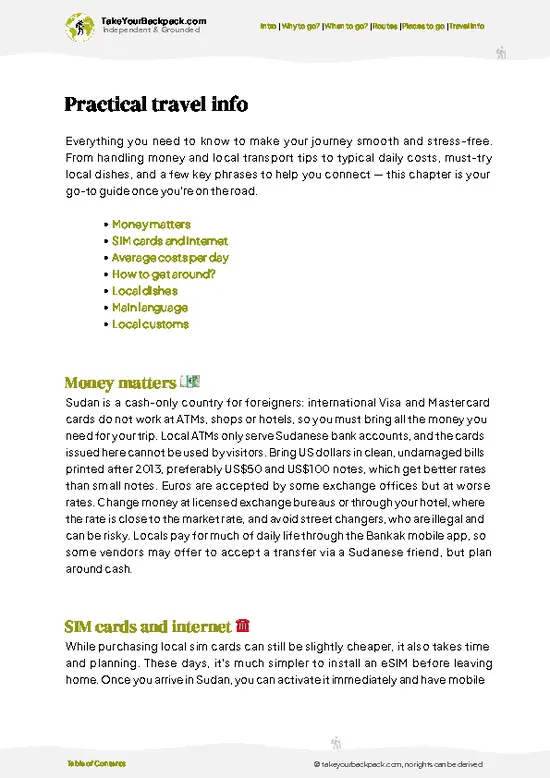
Sudan is a cash-only country for foreigners: international Visa and Mastercard cards do not work at ATMs, shops or hotels, so you must bring all the money you need for your trip. Local ATMs only serve Sudanese bank accounts, and the cards issued here cannot be used by visitors. Bring US dollars in clean, undamaged bills printed after 2013, preferably US$50 and US$100 notes, which get better rates than small notes. Euros are accepted by some exchange offices but at worse rates. Change money at licensed exchange bureaus or through your hotel, where the rate is close to the market rate, and avoid street changers, who are illegal and can be risky. Locals pay for much of daily life through the Bankak mobile app, so some vendors may offer to accept a transfer via a Sudanese friend, but plan around cash.
Tipping in Sudan is not expected, and restaurants do not add service charges. Rounding up a taxi or rickshaw fare, or leaving 5 to 10 percent at a sit-down restaurant, is appreciated. Drivers and guides on multi-day trips usually receive a tip of around US$5 to 10 a day, paid in Sudanese pounds.
v2.webp)
 Best Backpacking
.jpg) Over the years, I've learned the importance of packing minimally. It's so much easier to jump on the back of a truck or squeeze yourself into the last spot of a minibus without that supersized backpack. If you're headed to a warm destination, leave your winter jacket at home; for colder regions, opt for thin thermal underlayers. Instead of packing your entire wardrobe, bring just three sets of clothes, as laundry facilities are available everywhere.
Over the years, I've learned the importance of packing minimally. It's so much easier to jump on the back of a truck or squeeze yourself into the last spot of a minibus without that supersized backpack. If you're headed to a warm destination, leave your winter jacket at home; for colder regions, opt for thin thermal underlayers. Instead of packing your entire wardrobe, bring just three sets of clothes, as laundry facilities are available everywhere.






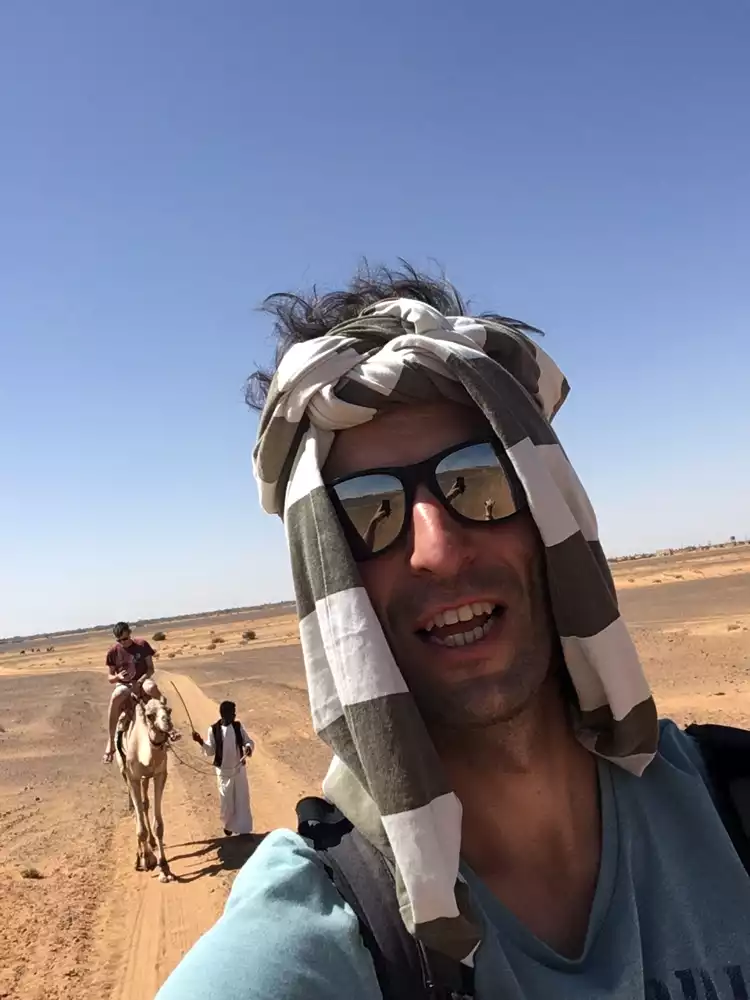


.jpg) Hi, I’m Johan (Netherlands 🇳🇱), the creator of TakeYourBackpack. Over the past 3 decades, I’ve backpacked through 90+ countries across six continents, gaining extensive experience with independent travel, long-term trips, and overland routes.
Hi, I’m Johan (Netherlands 🇳🇱), the creator of TakeYourBackpack. Over the past 3 decades, I’ve backpacked through 90+ countries across six continents, gaining extensive experience with independent travel, long-term trips, and overland routes.