×
Guam 🇬🇺

backpacking Oceania Guam 🇬🇺
Walk island loops shaped continuously by ocean views.

Explore French PolynesiaExplore Kiribati

Backpacking Guam in 2026

A complete guide including when and where to go, costs, transport, itineraries, and practical travel advice.
Traveling in Guam: what to expect

Backpacking Guam
By Johan Kruseman 🇳🇱 | Updated June 8, 2026

Guam isn’t just a military base and duty‑free stopover. It’s a Chamorro homeland where latte stones, fiesta tables, and war‑scarred cliffs shape daily life. US‑easy, Micronesian at heart.

Come for Ritidian’s reef and jungle, sunrise snorkeling in Tumon Bay before the buses, the WWI‑WWII twin‑wreck in Apra Harbor, Mount Lamlam’s ridge, and village fiestas that go late. Expect fierce sun, surprise squalls, seasonal jellyfish, scarce buses, and import prices. Start early, rent a car, carry water and reef shoes, and those frictions flip into wins—empty coves, quiet lookouts, and stories over red rice.

Versus Saipan, Guam is bigger and busier; versus Palau or Chuuk, the dives are easier but uniquely storied; versus Okinawa or Hawai‘i, it’s smaller and more local. Ideal for first‑timers who want US simplicity with island soul, plus divers, history fans, and food‑curious travelers.

👉 Get the 📖 Travel Guide of Guam

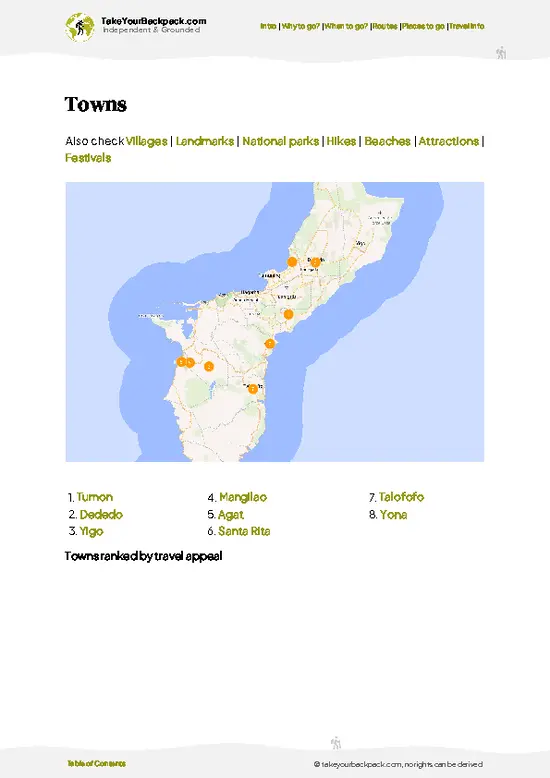
Tumon & Tamuning (Central Strip)

This is Guam’s main hotel and nightlife spine, so base here if you want easy airport access, buses, and walkable food options. It’s busy, commercial, and perfect if you like to drop your bag, grab a plate lunch, and be in the water 10 minutes later. Great for first-timers, short layovers, or anyone without a rental car. You trade quiet for convenience, but you gain cheap shuttles, late-night convenience stores, and fast access to tours that pick up right at the curb.

Hagåtña & Agana Bay

Government center, low-rise, slower pace. Come here if you care about history, WWII sites, and seeing actual local life instead of just resort bubbles. It’s central for driving the whole island in loops, and traffic is calmer than Tumon. Good for travelers who want to walk between churches, plazas, and shoreline parks, then eat where office workers eat. Less nightlife, more “get things done and understand the island” energy.

South Coast: Umatac, Merizo, Inarajan

This is your “I rented a car for a reason” zone. The south is hilly, more traditional, and rewards people who don’t mind winding roads and sweating a bit. You stop at lookouts, jump into natural pools, and hit tiny stores for cold drinks. It’s not built for pedestrians, so it suits confident drivers and hikers who want viewpoints, village fiestas (if you’re lucky with timing), and fewer tour buses.

North & Northwest: Dededo, Yigo, Ritidian

Up north you get big local neighborhoods, military presence, and access to some of the island’s best beaches and jungle drives. Dededo is practical: markets, food stands, and cheap eats. Push farther to Ritidian and it shifts to “plan ahead” mode: limited facilities, strong sun, and you’re responsible for your own water, timing, and exit. Ideal for people who like early starts, quiet sand, and don’t need a bar within walking distance.

Central Interior: Barrigada & Route 10/15 Corridor

You don’t come here for postcard views; you come for positioning. Staying or passing through central interior makes airport runs painless and keeps both north and south within easy striking distance. It’s suburban, with local bakeries, hardware stores, and schools instead of attractions. This area rewards long-stay travelers, digital nomads, or family visitors who want normal life, quick commutes, and the freedom to pivot each day’s plan based on weather and energy.
Seeing the layout at a glance
Loading the map 🌍
CLICK TO FILTER
town
village
unique site
national park
hike
beach
attraction
festival
region
SHOW COUNTRY’S BESTSHOW ALL
film
0
0
0a
Chamorro Village Night Market
film
1
1
1a
Latte Stone Park
film
2
2
2a
Pacific War Museum
film
3
3
3a
Guam Museum
film
4
4
4a
Tumon Beach
Hilton Guam Resort & Spa
film
5
5
5a
Gun Beach
Mr. Shadow
film
6
6
6a
Fai Fai Beach
Jonathan Taaffe
film
7
7
7a
Inarajan Beach
괌여행 길찾기는윤상의 로드맵
film
8
8
8a
Mount Lamlam Trail
C.h Hung
film
9
9
9a
Tarzan Falls Trail
Nathan Mahan
film
10
10
10a
Ritidian Point Trail
김대환
film
11
11
11a
War in the Pacific National Historical Park
Stephen Arlaud
film
12
12
12a
Guam National Wildlife Refuge
Mayalou Flowers
film
13
13
13a
Tumon Bay Marine Preserve
Cyk Aoyama
film
14
14
14a
Talofofo Falls
Steve D
film
15
15
15a
Tamuning
Romy G
film
16
16
16a
Yigo
film
17
17
17a
Yona
film
18
18
18a
Two Lovers Point
Jim Smith
film
19
19
19a
Inarajan Natural Pool
괌여행 길찾기는윤상의 로드맵

Why go?What makes this country worth the trip

Beach life

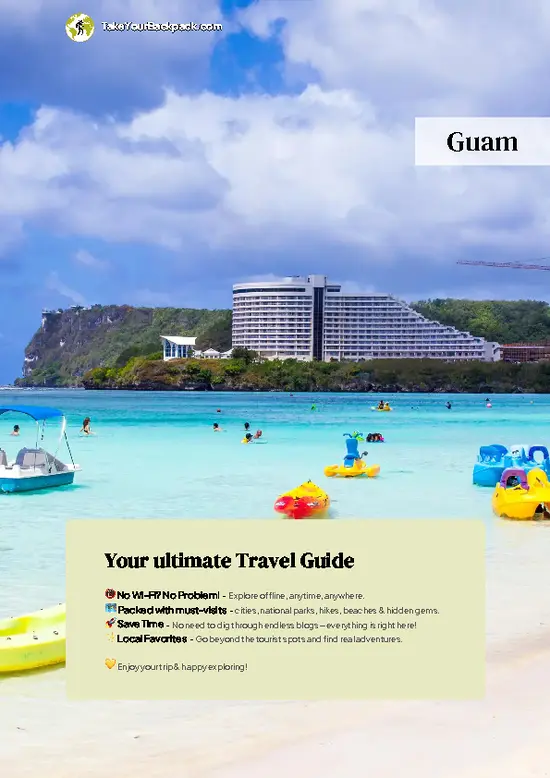
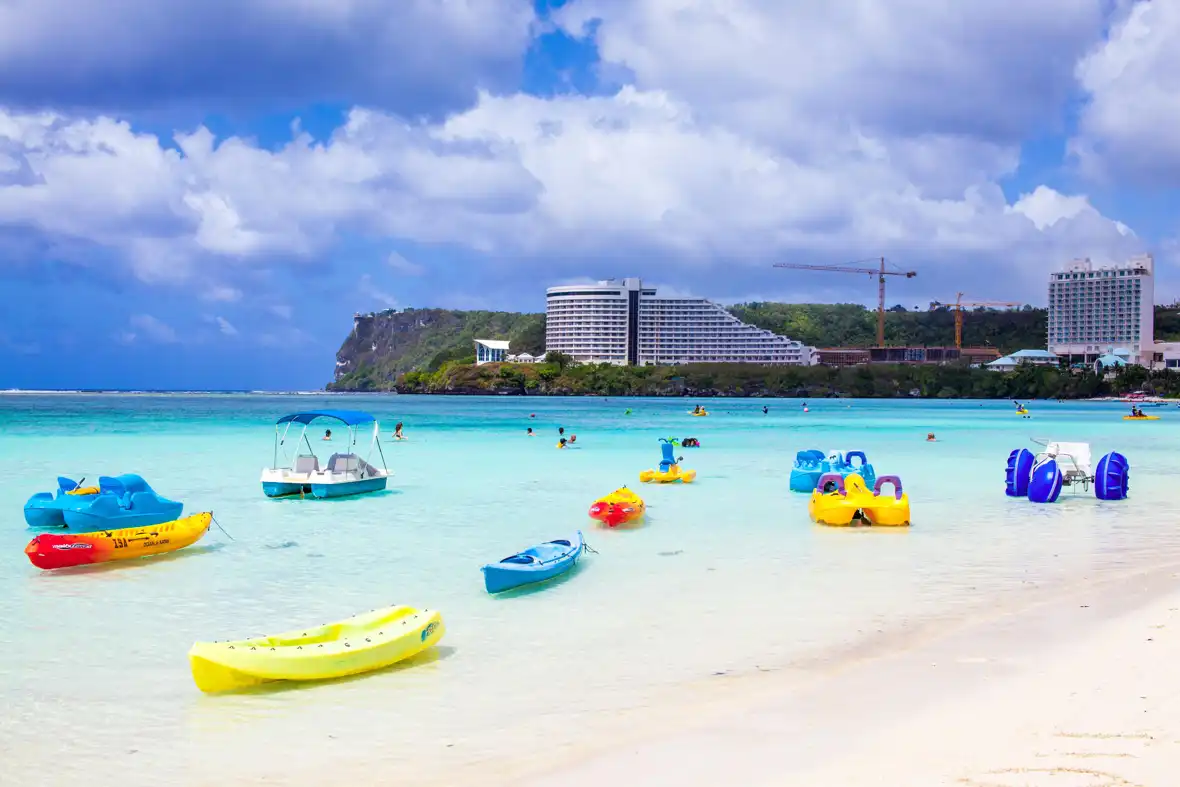
Guam rewards beach people who time it right: reef-sheltered west coast, bath-warm 28°C water, and marine preserves you can fin to from shore. Snorkel Tumon Bay or Piti at dawn for glassy water and 20–30 m viz; afternoons get trade-wind chop. Dive Apra Harbor’s twin wrecks, then slide into Tumon’s beach bars at sunset. Dry season Jan–Jun; west side for sunsets.
Want the complete picture of Guam?
The offline Travel Guide brings everything together — routes, highlights & planning.

See what's included in the guide 👉

Get the Travel Guide -

⭐ HighlightsHighlights of Guam

  • Ritidian Point (Guam National Wildlife Refuge): White sand squeaks underfoot and the trade wind sandblasts your calves, so hug the tree line between noon and 3. The last stretch of road is pothole roulette; crawl it. Come at morning slack tide for glassy, turtle-shadow water, but stay out past the reef—rip currents here don’t negotiate.
  • Mount Lamlam: Be on trail by 6 a.m.; the sun cooks this ridge and the red laterite mud will tattoo your socks after any rain. Short, steep, scratchy with sword grass, then it opens and you get both coasts at once and Cocos Island winking south. Proof you were there: iron-rich clay under your nails and wind-bent shrubs tugging your sleeves at the summit cross.
  • Piti Bomb Holes Marine Preserve (by Fish Eye): Park by the pier, skip the observatory, and kick in just north at slack tide for aquarium-clear pits. Reef booties save you from urchins; the parrotfish crunch is audible like someone chewing ice next to your ear. If swell’s up, don’t fight the channel;
read more 👉
  • Ritidian Point (Guam National Wildlife Refuge): White sand squeaks underfoot and the trade wind sandblasts your calves, so hug the tree line between noon and 3. The last stretch of road is pothole roulette; crawl it. Come at morning slack tide for glassy, turtle-shadow water, but stay out past the reef—rip currents here don’t negotiate.
  • Mount Lamlam: Be on trail by 6 a.m.; the sun cooks this ridge and the red laterite mud will tattoo your socks after any rain. Short, steep, scratchy with sword grass, then it opens and you get both coasts at once and Cocos Island winking south. Proof you were there: iron-rich clay under your nails and wind-bent shrubs tugging your sleeves at the summit cross.
  • Piti Bomb Holes Marine Preserve (by Fish Eye): Park by the pier, skip the observatory, and kick in just north at slack tide for aquarium-clear pits. Reef booties save you from urchins; the parrotfish crunch is audible like someone chewing ice next to your ear. If swell’s up, don’t fight the channel; wait it out.
  • Two Lovers Point (Puntan Dos Amantes): Pay the small fee or use the free viewpoints just shy of the platform—it’s the same cliff drop without the crowd. Late afternoon paints Tumon gold and the wind salts your lips 120 meters above the sea; secure your hat or donate it to the abyss.
  • Pagat Cave: Hot, rooty jungle in, cold freshwater pool out—bring a headlamp and expect a rope-assist down limestone slick as soap. The air flips from humid to mineral-cool and you’ll smell bat musk before you see the pool glow. For quiet detours: Priest’s Pools above Umatac at dusk, Sella Bay’s old Spanish foundations after the downhill scramble, and muddy, guide-only Sigua Falls.
Spotted a mistake or missing a highlight? Contact us.

But Guam offers more...

Discover and compare all of its highlights per category

🧭 RoutesHow to structure a trip

The 2-Day Tumon & Hagatna Taster

The vibe: A quick-hit island intro that keeps you based around Tumon and Hagatna, mixing easy beaches with just enough culture to feel like you’ve really been to Guam. You’ll move at a relaxed pace on foot and by short taxi rides, trading long drives for more time in the water and at the night market.
  • Swim and stroll along Tumon Beach and Gun Beach.
  • Take in clifftop views from Two Lovers Point.
  • Walk through history at Latte Stone Park and the Guam Museum.
  • Eat your way through the Chamorro Village Night Market.

The 3-Day Coast & Culture Loop

The vibe: A balanced long weekend that links Tumon’s resort strip with WWII history and quieter southern villages, best with a rental car and a curiosity for both beaches and backroads. Expect one foot in the water and one in Guam’s past, without feeling rushed from stop to stop.
  • Beach-hop between Tumon Beach and Gun Beach with evenings on Pale San Vitores.
  • Stand in the WWII landscapes of War in the Pacific National Historical
read more 👉

The 2-Day Tumon & Hagatna Taster

The vibe: A quick-hit island intro that keeps you based around Tumon and Hagatna, mixing easy beaches with just enough culture to feel like you’ve really been to Guam. You’ll move at a relaxed pace on foot and by short taxi rides, trading long drives for more time in the water and at the night market.
  • Swim and stroll along Tumon Beach and Gun Beach.
  • Take in clifftop views from Two Lovers Point.
  • Walk through history at Latte Stone Park and the Guam Museum.
  • Eat your way through the Chamorro Village Night Market.

The 3-Day Coast & Culture Loop

The vibe: A balanced long weekend that links Tumon’s resort strip with WWII history and quieter southern villages, best with a rental car and a curiosity for both beaches and backroads. Expect one foot in the water and one in Guam’s past, without feeling rushed from stop to stop.
  • Beach-hop between Tumon Beach and Gun Beach with evenings on Pale San Vitores.
  • Stand in the WWII landscapes of War in the Pacific National Historical Park and Asan Beach.
  • Sample local life in Agat and Talofofo Village.
  • Catch big-sky views from Two Lovers Point.

The 5-Day Full-Island Explorer

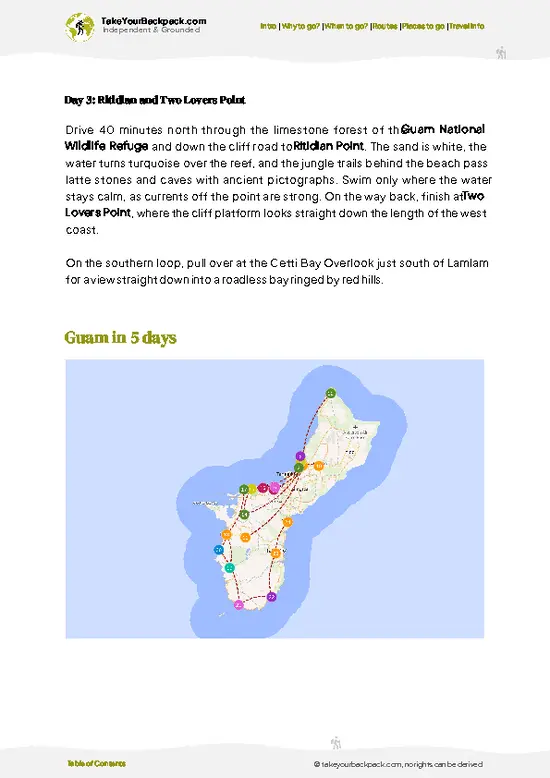
The vibe: A slow, satisfying loop that uses Tumon as a launchpad before circling south and north into villages, natural pools, and wildlife refuges, ideal for travelers who want to see more than the resort strip. With a rental car and flexible days, you’ll trade some driving for access to Guam’s quieter corners and coastal trails.
  • Settle into Tumon with time on Tumon Beach, Matapang Beach, and the Pale San Vitores strip.
  • Trace WWII history at War in the Pacific National Historical Park and Asan Beach.
  • Drift through southern bays and villages like Sella Bay, Umatac Bay, Merizo, and Talofofo Village.
  • Finish on the wild north coast at Ritidian Point and the Guam National Wildlife Refuge, with a soak at the Inarajan Natural Pool along the way.
🌍 Want a ready-to-use travel plan for Guam?
The overview above compares different route options based on your travel time and style. The complete Travel Guide breaks each itinerary down in detail, including maps, stops, highlights, and transport information.

Explore all route details 👉

Get the Travel Guide -

🌤️ When to go?A month-by-month overview

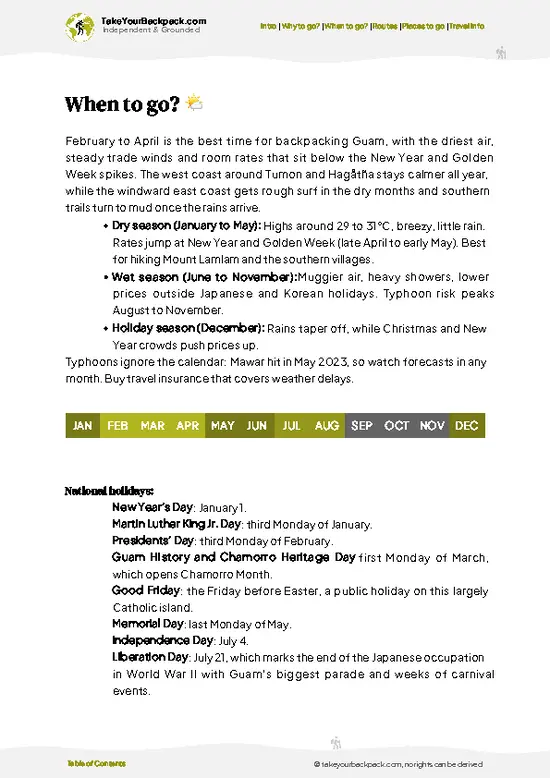
Late February to early April is the sweet spot. Dry trades settle the air, the rain backs off, and the typhoon roulette is at its quietest. New Year crowds have flown home, Golden Week and summer charters haven’t landed yet, so beds and cars drop to sane prices. Trails like Lamlam firm up, reef visibility improves, and the humidity is pushy but workable if you move early and nap through the noon furnace.
  • Peak Dry/Heat: Late Dec-early Jan, and Jul-Aug. Prices bite and Tumon packs out, but dawn dives at Blue Hole/Gab Gab deliver glassy water, and Lamlam’s ridge gives you ocean-to-ocean horizons. Watch for king-tide rips on east coasts in winter.
  • Shoulder (Sweet Spot): Feb-Apr. Winds clean the sky, showers blink and vanish, shops and boats run on rhythm, and beaches breathe again. You move, the island moves with you.
  • Off-Peak Wet/Typhoon: Sep-Nov. Trails go quiet and the jungle hums. Start hikes at first light, wear lugged shoes for Guam’s red-clay slick, stash a dry bag, and never commit to stream crossings after bursts.

Tactical tip: lock a rental car with free cancellation 4-6 weeks out; buses won’t save a tight itinerary.

source: climatestotravel.comJANJanuary: good for travelingFEBFebruary: excellent for travelingMARMarch: excellent for travelingAPRApril: excellent for travelingMAYMay: good for travelingJUNJune: good for travelingJULJuly: highly recommended for travelingAUGAugust: highly recommended for travelingSEPSeptember: fair for travelingOCTOctober: fair for travelingNOVNovember: fair for travelingDECDecember: good for traveling
📅 Traveling in a specific month?
Get a full month-by-month breakdown of weather, crowds, costs, festivals, and seasonal highlights in the complete travel guide.

Get full details when to go 👉

Get the Travel Guide -
guam-pixabay-beach-6025997

💰 Costs (as of 2026)Typical budget expectations

Expect $80-110/day if you split a rental car; $120-160 if you don’t.
  • dorm accommodation: $30-50 per night when you can find it (Guam’s hostel scene is thin), basic guesthouse bunk or worker dorm in Tamuning beats Tumon resort prices; add ~11% hotel/occupancy tax. System tip: message properties directly for weekly rates and “contractor” discounts, avoid Fri-Sun in Tumon, and be flexible—one-night gaps get snapped up by flight crews.
  • meals: Supermarket Survival: groceries cost US-plus-island markups; think $6-8 rotisserie chicken, $2-3 for rice, $1.50-2 for eggs—cheaper than resort food, pricier than the Philippines. Street food reality: the scene is limited; best value is plate lunches (Filipino/Chamorro BBQ) at $8-14, 7-Eleven bentos $4-6, food trucks on Wed at Chamorro Village. Restaurant mains in Tumon run $18-35; tap water is safe—carry a bottle.
  • local transport: Cheapest way to unlock the island is a compact car split 3-4 ways: $35-50/day (weekly $200-300), insurance +$10-15, fuel roughly $3.75-4.50/gal; airport concession fees bite, so pick up in-town if possible. GRTA buses are $1-3/ride but sparse and slow; tourist shuttles in Tumon cost ~$10-15/day and don’t reach the good beaches.
read more 👉
Expect $80-110/day if you split a rental car; $120-160 if you don’t.
  • dorm accommodation: $30-50 per night when you can find it (Guam’s hostel scene is thin), basic guesthouse bunk or worker dorm in Tamuning beats Tumon resort prices; add ~11% hotel/occupancy tax. System tip: message properties directly for weekly rates and “contractor” discounts, avoid Fri-Sun in Tumon, and be flexible—one-night gaps get snapped up by flight crews.
  • meals: Supermarket Survival: groceries cost US-plus-island markups; think $6-8 rotisserie chicken, $2-3 for rice, $1.50-2 for eggs—cheaper than resort food, pricier than the Philippines. Street food reality: the scene is limited; best value is plate lunches (Filipino/Chamorro BBQ) at $8-14, 7-Eleven bentos $4-6, food trucks on Wed at Chamorro Village. Restaurant mains in Tumon run $18-35; tap water is safe—carry a bottle.
  • local transport: Cheapest way to unlock the island is a compact car split 3-4 ways: $35-50/day (weekly $200-300), insurance +$10-15, fuel roughly $3.75-4.50/gal; airport concession fees bite, so pick up in-town if possible. GRTA buses are $1-3/ride but sparse and slow; tourist shuttles in Tumon cost ~$10-15/day and don’t reach the good beaches. Compared to Japan/Taiwan rail, Guam mobility is the tax you pay.
  • activities: Beaches, WWII sites, and hikes are free; snorkel rental $8-15/day (buy a set at K-mart-style stores for $20-30 if here a week). Diving is the wallet punch: $100-150 for a 2-tank + gear. Kayaks/SUPs $15-25/hr. Cultural shows $40-60. Versus Palau, diving is cheaper; versus the Philippines, everything else costs more.
  • miscellaneous: Budget leaks: resort/“facility” fees ($10-25/day), ATM hits ($5-8), sunscreen/snacks in Tumon marked up 30-50%, car add-ons (extra driver, toll-free “roadside”), laundry ($3-5/wash). Alcohol: store beers $2-3, bar pours $7-10. US dollars only—no FX loss, but international card surcharges show up at small shops.
⚠️ Prices can change and everyone travels differently, so take this as a rough guide. Hope it helps you plan your adventure!

✈️ The backpacker research shortcutGuam Travel Guide

An offline-friendly backpacking guide with optimized travel routes, ranked highlights, transport advice, and the best areas to stay.
example page 0 from our offline Travel Guide for Guamexample page 1 from our offline Travel Guide for Guamexample page 2 from our offline Travel Guide for Guamexample page 3 from our offline Travel Guide for Guamexample page 4 from our offline Travel Guide for Guamexample page 5 from our offline Travel Guide for Guamexample page 6 from our offline Travel Guide for Guamexample page 7 from our offline Travel Guide for Guam
The digital guide (180 pages) contains:
43 highlights, ranked by travel appeal
Optimized 2, 3 & 5-day travel routes
Cities, national parks, beaches, historical sites, ...
How to get around
Offline-friendly for travel without Wi-Fi
👉 Click to see all 30+ guide features

📅 Plan smarter in minutes, not weeks
Month by month travel advice
Festivals & national holidays
Budget expectations

🗺️ Go to the right places, skip the overrated ones
Honest pros & cons of destinations
Top hikes, parks & viewpoints
Lesser-known places most travelers miss
Clear “worth it vs skip it” guidance

🛏️ Travel smoothly without rookie mistakes
Best areas to stay
Transport systems explained simply
Common scams & safety advice
SIM cards, money & practical tips

🌍 Understand the country, not just visit it
Culture & traditions
52 Essential phrases & customs
Festivals worth planning around
Traveler-friendly historical context
Insights that make places more meaningful

📱 Built for real travel conditions
Fully downloadable PDF
Works completely offline
Optimized for phone use
Useful in remote areas & buses
Everything in one place
Save weeks of stressful planning
Get instant access to the full guide directly. 30-day money-back guarantee.


Sent to your inbox immediately after payment • 100% Secure Checkout
Best Backpacking Travel Advisor 2025 tourism awardBest Backpacking
Travel Advisor
2025
What others say about Take Your Backpack Guides:
⭐⭐⭐⭐⭐
Fantastic, amazing amount of information!
⭐⭐⭐⭐⭐
My goodness this is amazing, it's what I've been looking for hats off too you!
⭐⭐⭐⭐⭐
I think this is absolutely BRILLIANT
⭐⭐⭐⭐
Very complete and informative. It's still missing places, but I gotta to commend you
⭐⭐⭐⭐⭐
This is truly amazing, thank you, can't wait to explore it with my kids!
⭐⭐⭐⭐⭐
Awesome resource, thank you!
⭐⭐⭐⭐⭐
This is amazing! Can't wait to explore the ones I haven't seen
⭐⭐⭐⭐
I love this! Well done, great idea.
⭐⭐⭐⭐⭐
Thanks for taking the time to make this gem!
⭐⭐⭐⭐⭐
This might be the best website I've ever seen.
⭐⭐⭐⭐⭐
Congratulations, and thank you so much for your work; it's incredibly valuable.
⭐⭐⭐⭐
In all seriousness I think you did a great job pointing out the important spots
⭐⭐⭐⭐⭐
10/10 very good
⭐⭐⭐⭐⭐
As someone who's only just starting to visit regularly this is awesome, thank you.
⭐⭐⭐⭐
Thank you very much! I'm going to visit my dad, it's going to be very useful!
⭐⭐⭐⭐⭐
This is really cool! We'll be travelling for the first time and this definitely come in handy.
⭐⭐⭐⭐⭐
You are now our minister of culture, congratulations 👨‍💼
⭐⭐⭐⭐⭐
Just wanted to tell you that this is a pearl! Going to follow your recommendations.
⭐⭐⭐⭐⭐
This is so cool. I'll definitely be using the resource for my travels soon.
⭐⭐⭐⭐⭐
This is very impressive! Good work.
⭐⭐⭐⭐⭐
This is an amazing and informative site. Very well done!

🛏️ Where to stay?Areas travelers tend to prefer

Yes. Guam has a small number of hostels and more budget guesthouses/motels, concentrated mainly in Tumon and neighboring Tamuning, with a handful of cheaper options in Hagatna and parts of Dededo/Yigo.
Tumon/Tamuning: closest to beaches, shopping and nightlife so walkable and convenient for tourists but busier and often pricier than other areas.
Hagatna: cheaper and near cultural sites with a quieter evening scene but fewer tourist services and limited transit; Dededo/Yigo: lowest-cost, more local feel and good for extended stays but farther from highlights and best accessed by car.

If you … read more 👉
Yes. Guam has a small number of hostels and more budget guesthouses/motels, concentrated mainly in Tumon and neighboring Tamuning, with a handful of cheaper options in Hagatna and parts of Dededo/Yigo.
Tumon/Tamuning: closest to beaches, shopping and nightlife so walkable and convenient for tourists but busier and often pricier than other areas.
Hagatna: cheaper and near cultural sites with a quieter evening scene but fewer tourist services and limited transit; Dededo/Yigo: lowest-cost, more local feel and good for extended stays but farther from highlights and best accessed by car.

If you enjoy meeting fellow travelers, consider choosing hostels with high ratings for atmosphere. On the other hand, if you prefer having your own space, a hotel might be a better option.

🚌 Getting aroundWhat moving around is really like

Guam moves on Marine Corps Drive and patience. Schedules exist, but rain squalls and school traffic bend them. If you start early and ride the system’s two hubs—Micronesia Mall and GPO—you’ll make distance. Miss a last run and you’re hoofing a humid shoulder in flip-flops, learning the island the hard way.
  • GRTA Island Buses The Efficiency Trade-off: Cheapest way end-to-end—low single-digit fares, day pass under 10—at the price of time. Headways run 60-90 minutes. North-south spine on Route 1 with
read more 👉
Guam moves on Marine Corps Drive and patience. Schedules exist, but rain squalls and school traffic bend them. If you start early and ride the system’s two hubs—Micronesia Mall and GPO—you’ll make distance. Miss a last run and you’re hoofing a humid shoulder in flip-flops, learning the island the hard way.
  • GRTA Island Buses The Efficiency Trade-off: Cheapest way end-to-end—low single-digit fares, day pass under 10—at the price of time. Headways run 60-90 minutes. North-south spine on Route 1 with transfers at Micronesia Mall and GPO. Last departures hit early evening; Sundays are skeletal. Exact cash. Screenshot stop timetables. Plan a 20-minute buffer and enjoy the meat-locker A/C.
  • Tumon Shuttle/Trolley The Social Fabric: It’s the rolling living room of hotel workers, beach kids, and shoppers. Queue politely, bag wet gear, shirts on, packs off the aisle. Drivers actually help—tell them your mall or beach and ring early. Small bills keep everyone happy. It’s slower than a cab but constant, and you get local kindness with the breeze.
  • Bicycle The Geometric Unlock: A dawn roll threads beaches and villages buses breeze past—Ypao to Asan to Piti with detours down tiny coastal lanes. Shoulders appear, vanish, then reappear. Heat bites by 10:00, dogs bark, squalls pop. Lights, a good lock, and salt tabs turn “impossible” gaps into your morning warm-up.
  • Hitchhiking The Budget Disruptor: Daytime, short hops, and visible pull-outs. Stand near village stores, hand low, offer a couple dollars for gas, and bail at the next hub. Truck beds are common; hold on and keep it under 10 minutes. Avoid base gates and blind curves. Reliable when the timetable quits.
Master tip: Catch the first north-south GRTA run, transfer at Micronesia Mall, and use the Tumon trolley or a short hitch for the last mile—after 18:30, assume you’re on your own.
Distance: A.B. Won Pat International Airport (GUM) to Hagåtña (Agana) city center is about 7 km (4.3 miles) by road.
  • Taxi — 10-15 minutes. Typically USD 15-25 one way (metered; expect a small airport or baggage surcharge). Taxis usually queue outside arrivals whenever flights are in.
  • Ride-hailing (Stroll Guam) — 10-15 minutes. Usually USD 12-20. Book through the Stroll Guam app; follow airport signs to the designated pickup area. Note: as of 2025, Uber/Lyft do not operate on Guam.
  • Public bus (GRTA) — There’s no GRTA bus that enters the terminal. If you’re traveling light, you can walk about 10-20 minutes to the nearest stop in Tiyan/Tamuning and catch a bus toward Hagåtña along Marine Corps Drive. Total time 30-50 minutes including waiting; fare is USD 1 per ride or USD 3 for a day pass. Service is limited (roughly 06:00-20:00 Mon-Sat; very limited or none on Sundays/holidays) and frequency can be 30-60 minutes.
  • Hotel/shared shuttle — Many hotels and operators (e.g., Lam Lam Tours/Red Guahan Shuttle) run pre-booked airport transfers. 15-25 minutes. About USD 10-20 per person for shared shuttles; private transfers to Hagåtña are typically USD 25-40. Reserve in advance, especially for late-night arrivals.
  • Car rental — 10-15 minutes’ drive. Good if you plan to explore the island. Typical daily rates are USD 40-70 plus insurance/fuel; desks are in-terminal or nearby.

Quick taxi note: Fastest door-to-door option; expect USD 15-25 and around 10-15 minutes, depending on traffic on Marine Corps Drive. For very late-night arrivals, buses are not practical—plan on a taxi, ride-hail, or pre-booked shuttle.
⚠️ Prices and routes can change, so take this as a rough guide and ask for local advice when you arrive.

🔒 Safety (risk Level: low)Safety considerations for travelers

Safety for solo travelers, including women and LGBTQ+ individuals
Guam is generally considered safe for solo travelers, including women and LGBTQ+ individuals. The island has a laid-back vibe, and violent crime is rare, but it’s wise to stay aware of your surroundings, especially at night. The local community is welcoming, though LGBTQ+ travelers might want to be discreet in more rural areas. Always follow standard travel precautions and use common sense to ensure a safe visit.


Full official government travel advisory (live updates)
View details 👉

✈️ VisaEntry requirements and paperwork

If you’re a U.S. citizen, you don’t need a visa to visit Guam. For travelers from other countries, you might need a visa or may qualify for the Guam-CNMI Visa Waiver Program, which allows citizens of certain countries to visit without a visa for up to 45 days. Check the U.S. State Department’s website for specific visa requirements, and apply through the U.S. Department of State’s Consular Electronic Application Center if needed.

source: guamvisitorsbureau.com
⚠️ Visa requirements can change over time, so always check the latest visa requirements with the official embassy or government website before you travel.

🎒 What to pack?What to pack for Guam

Guam’s climate is a steamy combo of hot and humid, with a side of tropical rain, so think in layers you can easily shed. Expect some rugged terrain if you’re venturing beyond the beaches—there are some lush jungles and hills to explore. When it comes to cultural norms, keep it respectful: modest clothing is appreciated, especially in villages and religious sites. For beach days, swimwear is fine, but you’ll want a cover-up handy when you’re off the sand. Keep in mind, air conditioning can be cranked up indoors, so a light sweater might save you from an unexpected chill.

Apart from this country specific advice, I have also crafted a general packing list that should help on any trip. authorOver the years, I've learned the importance of packing minimally. It's so much easier to jump on the back of a truck or squeeze yourself into the last spot of a minibus without that supersized backpack. If you're headed to a warm destination, leave your winter jacket at home; for colder regions, opt for thin thermal underlayers. Instead of packing your entire wardrobe, bring just three sets of clothes, as laundry facilities are available everywhere.
View the full list 👉
🎒 Planning the practical side of your trip?
Get detailed information on transport, daily budgets, internet access, local customs, food, language, and other essentials in the complete Travel Guide.

Get detailed practical information 👉

Get the Travel Guide -

🙋 FAQCommon questions before visiting

Trip Planning


Personal tip: I normally search on good rating for atmosphere (for meeting people) and location (for easy exploring). Cleanliness as a bonus.


Travel Essentials

You don’t need any special vaccinations for Guam if you’re up-to-date with routine vaccines like MMR, DTP, and flu shots. Consider Hepatitis A and B, especially if you’re planning adventurous activities or if it’s your first time to the Pacific region. Always check the latest health advisories before traveling.


vaccination requirements
When I first started traveling, I often spent part of my first day in a new country hunting for a local SIM card. While this can still be slightly cheaper, it also takes time and planning.

These days, it's much simpler to install an eSIM before leaving home. Once you arrive in Guam, you can activate it immediately and have mobile data from the moment you land — which is especially useful for ordering transport or navigating away from busy airports.

There are many providers nowadays, and price differences are usually small. I personally go with Airalo, as it offers excellent network coverage throughout the country and strong global coverage, so you can manage multiple countries from a single app.


Get your e-sim for Guam

Culture & Customs

Respect the local Chamorro culture by showing appreciation for their customs and traditions. Always ask for permission before taking photos of people or inside villages. Dress modestly, especially in rural areas or when visiting cultural sites.

While Guam is generally LGBTQ+ friendly, public displays of affection should be kept to a minimum to avoid any discomfort or misunderstanding. Women travelers should feel safe but remain cautious, as you would anywhere else.

Do greet with ”Håfa Adai” (hello) and be polite. Don’t interrupt someone who is speaking or be overly loud in public places. Remember that Sundays are often reserved for family and church, so expect some businesses to be closed.
Trying traditional food is always a great way to experience the culture. Here are some must-try dishes for Guam.
  • Kelaguen: A tangy and refreshing dish often made with chicken, although versions with seafood or beef exist. It’s marinated in lemon juice, coconut, and hot peppers. It’s popular because it’s a staple at any Guam fiesta, showcasing the island’s love for bold and fresh flavors.
  • Red Rice: A must at any Chamorro gathering, this dish gets its vibrant color from annatto seeds. It’s more than just a side dish; it’s a symbol of hospitality and celebration in Guam.
  • Finadene: This spicy and sour condiment, made with soy sauce, vinegar, chili peppers, and onions, is drizzled over almost anything. It’s a staple that reflects the island’s love for strong, punchy flavors and is crucial for experiencing the true taste of Guam’s cuisine.
  • Barbecued Short Ribs: These are marinated in a sweet and savory soy sauce mixture and then grilled to perfection. A popular choice at local BBQs, they emphasize the island’s communal dining culture and love for grilling.
  • Chamorro Sausage: A spicy, flavor-packed sausage that embodies the fusion of Spanish influence with local tastes. It’s often enjoyed during breakfast or as a snack, and it’s a nod to the island’s colonial history and diverse culinary influences.
Locals in Guam generally drink tap water, but it might taste a bit chlorinated. Tourists are usually advised to stick with bottled or filtered water to avoid any potential stomach issues. If you’re staying for a while, consider getting a filter to save money and reduce plastic waste.
The main language in Guam is Chamorro. Backpacking is way more rewarding if you know a bit of the local language, so I'd suggest brushing up on the basics just in case your Chamorro skills have become a bit rusty.

Want to understand locals better?
The complete Travel Guide for Guam includes 52 essential words and phrases — greetings, thank-yous, ordering food, transport, numbers, and common local expressions you'll actually hear.

Get your local basic phrases 👉

Get the Travel Guide -


English is widely spoken in Guam, making it an accessible destination for English-speaking travelers. As a U.S. territory, English is one of the official languages alongside Chamorro, the indigenous language. Most residents, especially in urban areas and tourist spots, are fluent in English, and you will find it used in government, education, and business.

In restaurants, hotels, and shops, staff typically communicate effectively in English, and signage is predominantly in English as well. While some locals may also speak Chamorro or other languages, English proficiency is generally high across different age groups.

Travelers can expect to navigate the island comfortably without language barriers. However, learning a few basic phrases in Chamorro can enhance your experience and show respect for the local culture. Overall, English communication in Guam is straightforward, allowing visitors to enjoy the island’s attractions and hospitality with ease.

Money & Payments

The local currency of Guam is USD ($).

Guam uses the US dollar, so if you’ve got USD, you’re already set. ATMs are pretty widespread in touristy areas like Tumon Bay and Hagatna, but fees can add up. If you’re island-hopping or heading off the beaten path, grab some cash before you go. Most places accept credit cards, but smaller, local spots might be cash-only, so having some bills on you is smart. Euros aren’t accepted, and exchanging them can be a hassle, so leave those at home. If you need to exchange currency, check out the airport or major hotels for hassle-free service, though rates might not be the best.

In Guam, tipping isn’t mandatory, but it’s appreciated. Restaurants usually expect around 10-15% if the service is good, and for services like taxis or bellhops, rounding up or giving a couple of extra dollars is common. Always check if a service charge is included in your bill to avoid double tipping.

🧩 Nearby countriesOther countries to combine with Guam

We 💚 feedbackFinal notes for travelers

Guam feels like a beach town welded onto a base town—BBQ smoke, reef glare, and uniforms at the grocery. The surprise: jungle ridges and WWII caves five minutes from latte stones and bubble-tea. Rent a car; buses won’t save you. Hit Ritidian at gate open, leave before tides turn; rips at Gun Beach are real. Lock beach parking. Sun is angry; reef cuts infect fast. Don’t overthink passports—US citizens fly domestic. It’s relaxed, not sleepy; locals feed you if you show up hungry and polite.

✍️ Help improve this page!
The information on this page is based on in-depth research, insights shared by experienced travelers, and feedback from the local travel community in Guam. While every effort is made to keep the information accurate and current, conditions can change — so if you spot anything incorrect or outdated, please get in touch.


🙋‍♂️ Give feedback

👋 Meet the founderWho’s Behind Take Your Backpack?

Johan, backpacker and founder of TakeYourBackpackHi, I’m Johan (Netherlands 🇳🇱), the creator of TakeYourBackpack. Over the past decade, I’ve backpacked through 80+ countries across six continents, gaining extensive experience with independent travel, long-term trips, and overland routes.

This site is built on a combination of firsthand travel experience and carefully curated insights from other backpackers. Many guides are based on places I’ve personally visited, while others bring together tips, observations, and practical advice shared by trusted travelers I’ve met along the way.

The goal is to provide realistic, experience-driven guidance — not generic itineraries — so you can explore destinations with better context, clearer expectations, and more confidence.

Get full Guam guide •
Instant download • 43 highlights • Full Offline guide