×
Angola 🇦🇴

backpacking Africa Angola 🇦🇴Travel from dusty highlands to surprisingly empty Atlantic beaches.

Explore AlgeriaExplore Benin

Backpacking Angola in 2026

A complete guide including when and where to go, costs, transport, itineraries, and practical travel advice.
A practical introduction for travelers

Backpacking Angola
By Johan Kruseman 🇳🇱 | Updated June 6, 2026

Angola is far more backpackable than its oil‑city prices suggest. Outside Luanda, buses are cheap, street grills keep you fed for coins, and a streamlined e‑visa opened the door for many nationalities. That split—steep in the capital, welcoming in the interior—matches a country that rewards effort with outsized moments.

You’ll climb past the switchbacks of Serra da Leba and feel the air cool on your skin before Tundavala’s cliff edge kicks the horizon open. You’ll rinse red dust from your calves in the Atlantic at Cabo Ledo, then hear kizomba and kuduro roll out of neighborhood bars while Cuca bottles sweat in your hand. Kalandula Falls thunders so hard you taste mist; the black towers of Pungo Andongo glow after late light; Iona’s dunes fade into wild sea with no one around to share it but oryx tracks. In Benguela and M’banza Kongo, history isn’t a plaque—it’s lived memory, from kingdom stones to faded port colonnades. Trains sometimes run along the Benguela corridor, but count on minibuses and shared taxis; Portuguese opens doors; checkpoints are common; ATMs can be fickle; Luanda eats budgets; and you never stray off established paths in rural areas because mines still exist. Those frictions sharpen the payoff: the first cold beer after a hot ride, a plate of funge and moamba in a family canteen, and a view so wide it quiets you.

Compared to Namibia’s polished desert circuits and Zambia’s tidy safari grid, Angola is rougher, prouder, and set to a Portuguese beat; it’s safer and steadier than the DRC, but far less curated. Go if you want big landscapes, real music nights, and the satisfaction of earning your way into them.

👉 Get the 📖 Travel Guide of Angola

Luanda & Ilha do Cabo

Luanda hits first: heat off the asphalt, horns stacked in rush-hour jams, diesel mixing with sea salt. It’s the best entry point because everything runs through here—airport, money, SIMs, drivers—but you earn every kilometer with traffic that can swallow half a day. Work early mornings. Ride legit taxis or hire a driver; keep your phone buried street-side. The payoff is simple: grilled fish on Ilha do Cabo, feet in sand, cold Cuca sweating on the table while kizomba drifts over the bay and the city glows behind you.

Kalandula Falls & Pungo Andongo (Malanje)

This is a proper road day from Luanda—long, pothole roulette, and sticky in the rains—but worth it when the noise builds and the spray cools your face. Aim for sunrise on the west bank; the path down is slick clay, so wear real soles. Local kids will guide you to safer footholds for small cash. Pair it with the black monoliths of Pungo Andongo: wind in the grass, goat bells, and the sense you walked into a story older than asphalt. Basic lodgings, better if you bring snacks and your own torch.

Benguela–Lobito Coast (One Rail-and-Road Spine)

Port towns with salt in the air and work in their shoulders. Trains roll inland when they roll; don’t bet a schedule, just treat it as a bonus. The rest is easygoing: candongueiro minibuses, cheap peixe grelhado, and evenings on Lobito’s Restinga where the lagoon goes glass. You come here to slow down. It rewards people who like long walks on cracked sidewalks, faded facades, and the feeling of a place that makes things rather than performing for you.

Lubango to Namibe & Iona (Escarpment-to-Desert Spine)

Cool air in Lubango, pine smell, then a dramatic drop via the Leba hairpins to a coast wrapped in fog. Tundavala’s rim is a quick detour—gusts strong enough to push your stance—and then it’s south toward Namibe’s sleepy streets and farther into Iona. This is 4x4 country: spares, fuel range, a real jack, and a buddy vehicle if you’re smart. The reward is silence that hums, welwitschia like fossils, and a night sky that makes you forget the clock.

Kwanza River & Quiçama (Kissama) Corridor

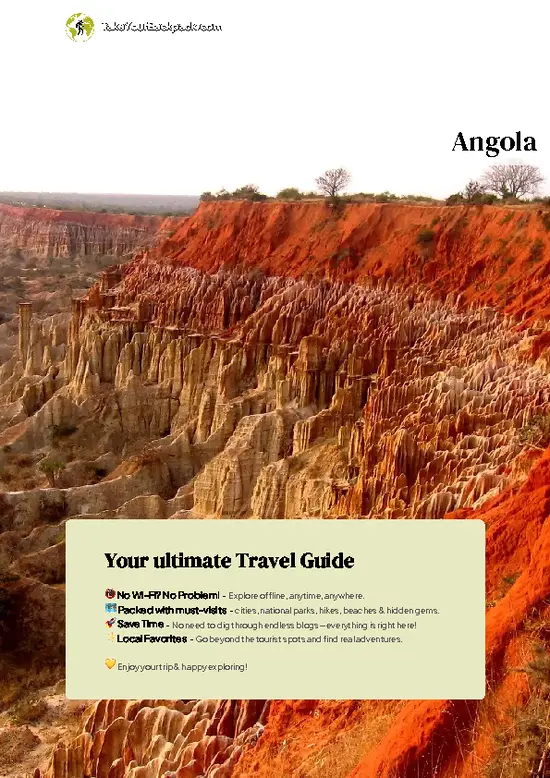
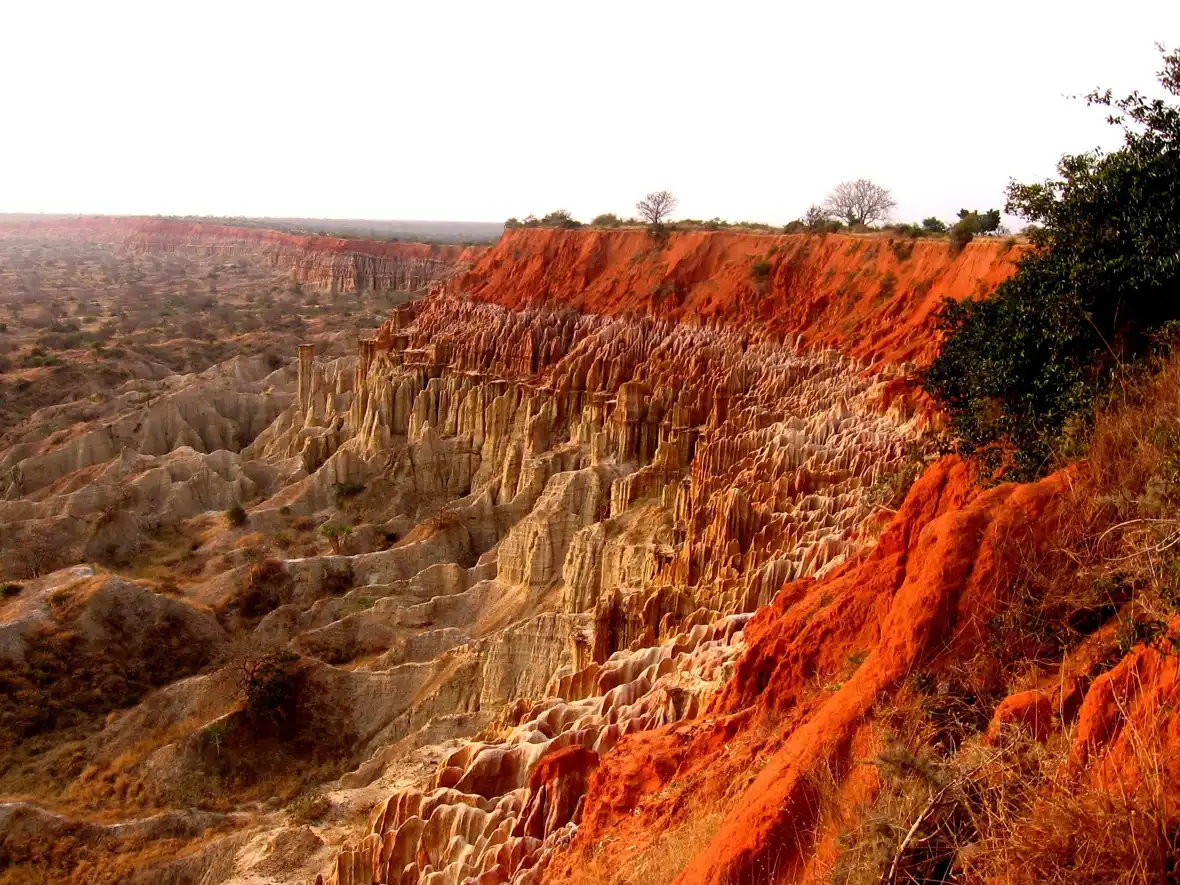
South of Luanda, the EN100 shakes you past the red ribs of Miradouro da Lua and down to the river mouth. Boats nose through mangroves; crocs show as ripples and log shapes. Quiçama isn’t about volume of wildlife; it’s about space—dust, baobabs, and sudden antelope when you’d written the day off. Go early, 4x4 if it’s rainy, and keep expectations realistic. Lunch is grilled fish near Barra do Kwanza and a nap under a lazy fan.
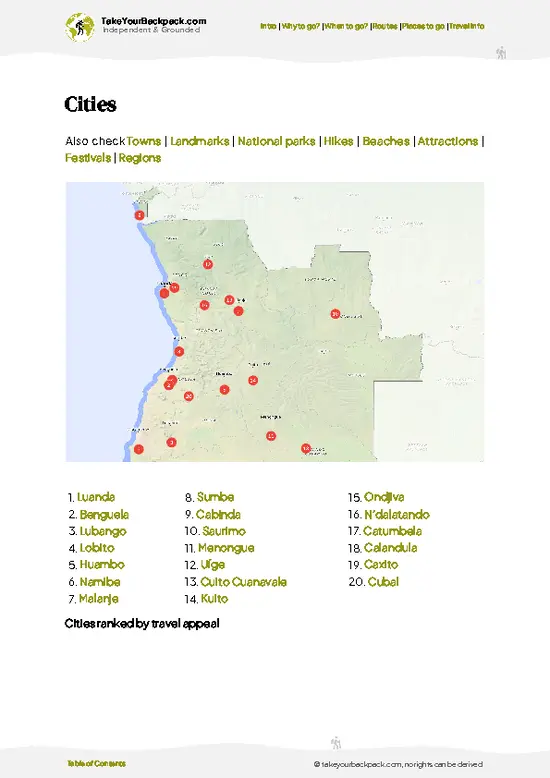
Geography and where places are located
Loading the map 🌍
CLICK TO FILTER
city
town
unique site
national park
hike
beach
attraction
festival
region
SHOW COUNTRY’S BESTSHOW ALL
film
0
0
0a
Fortaleza de São Miguel
film
1
1
1a
Complexo Turístico da Ilha do Mussulo
film
2
2
2a
Museu Nacional da Escravatura
film
3
3
3a
Miradouro da Lua Viewpoint Complex
film
4
4
4a
Museu Nacional de Antropologia
film
5
5
5a
Memorial Dr. António Agostinho Neto
film
6
6
6a
Museu da Moeda
film
7
7
7a
Praia do Mussulo
film
8
8
8a
Praia de Cabo Ledo
film
9
9
9a
Praia de Sangano
film
10
10
10a
Praia da Caotinha
film
11
11
11a
Cabo de Santa Maria
film
12
12
12a
Calandula
film
13
13
13a
Luanda
film
14
14
14a
Lubango
film
15
15
15a
Huambo
film
16
16
16a
Menongue
film
17
17
17a
Waku Kungo
film
18
18
18a
Tundavala Gap
film
19
19
19a
Serra da Leba Pass
film
20
20
20a
Pedras Negras de Pungo Andongo
film
21
21
21a
Quiçama
film
22
22
22a
Iona
film
23
23
23a
Luengue-Luiana
film
24
24
24a
Bicuar
film
25
25
25a
Cameia
film
26
26
26a
Mavinga
film
27
27
27a
Mupa
film
28
28
28a
Namibe Desert
film
29
29
29a
Kwanza River
film
30
30
30a
Gabela
film
31
31
31a
Tundavala Fissure
film
32
32
32a
M’banza-Kongo
film
33
33
33a
Bela Vista

Why go?What makes this country worth the trip

People

Heat wobbles off the street and diesel hangs in the lungs. A man catches your eye, chin lift, then the first true key: bom dia. Say it before the ask, … read more 👉
Heat wobbles off the street and diesel hangs in the lungs. A man catches your eye, chin lift, then the first true key: bom dia. Say it before the ask, and doors open. If you’re turned around, someone will walk you to the corner, not just point. In a candongueiro you’ll get squeezed, then mocked with affection until you laugh too. Vendors press grilled peixe and cassava with piri-piri; take a bite, praise it. At checkpoints and markets, humor outruns impatience—keep papers handy, smile, desculpa when needed. Offer your name; people return theirs and the ice melts fast. Accept the plastic chair and the Cuca; refusal reads cold. Don’t shoot faces without a nod—say ”posso” first and wait for a smile. Night drops semba and kizomba from open doors, and hands pull you in. Sweat leaves. Belonging sticks.

Beach life

Angola’s coast rewards effort. You fight Luanda traffic to the Ilha do Cabo, step onto sand still warm, sea salt, low bass from kizomba bars; first Cuca … read more 👉
Angola’s coast rewards effort. You fight Luanda traffic to the Ilha do Cabo, step onto sand still warm, sea salt, low bass from kizomba bars; first Cuca goes down crisp while fishing skiffs tug at their moorings. Mussulo’s lagoon is a boat hop away—flat water for snorkeling and SUP, grilled prawns delivered off a passing canoe. South, the asphalt frays into sand and potholes; endure it and Cabo Ledo hands you a long left-hand wave and a sunset that sets the cliffs on fire. Benguela and Lobito bring wide, workaday beaches, smoky fish grills, and easy wreck dives; in Namibe the desert slides straight into a cold, glassy Atlantic, fog at dawn, stars at night. It isn’t sanitized. It’s salt, sun, music, and the payoff is immediate and repeatable.

Low cost

Angola doesn’t bleed you dry if you move like a local. Skip the expat bubble in Luanda and ride the blue‑and‑white candongueiros; the conductor’s coins … read more 👉
Angola doesn’t bleed you dry if you move like a local. Skip the expat bubble in Luanda and ride the blue‑and‑white candongueiros; the conductor’s coins clink, diesel stings your nose, and your wallet stays shut. Barracas fry fish over charcoal, funge hits the belly, mangoes drip down your wrist—cheap, filling fuel. Sleep in simple pensões or roll out a tent on wind‑swept beaches with fishermen’s nod; the ocean hums you to sleep. Mototaxis handle the short hops, buses the long ones, both friendly to a backpacker’s purse. I averaged low‑thirties USD per day playing it this way, with a cold Cuca at sunset as the day’s dividend. Pay in kwanzas, bargain with a smile, pick a fan over air‑con, and the meters stop while the miles keep stacking.
Want the complete picture of Angola?
The offline Travel Guide brings everything together — routes, highlights & planning.

See what's included in the guide 👉

Get the Travel Guide -

⭐ HighlightsHighlights of Angola

  • Ilha do Cabo, Luanda: Salt spray sticks to your skin as you walk the thin sandbar, horns from the port mixing with kizomba leaking from beach bars; grab charcoal-grilled fish with lime and a cold Cuca, then wait—sunset turns the bay copper and the skyline glows like hot metal. Swim where locals swim and keep an eye on the rips; taxis will try to overcharge at night, so set your price before you open the door. If you’ve got wheels, detour to Miradouro da Lua, Praia dos Navios’ rusting hulls, and the craft stalls at Benfica.
  • Kalandula Falls, Malanje: The thunder comes first, a low drum through laterite dust, then the curtain of water appears—white, heavy, and throwing spray that smells like wet stone; hike the goat path down to the base and feel the cooling shock as mist soaks your shirt. Roads get slick in the rains and a poncho beats an umbrella, while sandals are a bad idea on the clay. If you’re pushing further, swing by Pedras Negras de Pungo Andongo and the quiet miombo tracks of Cangandala
read more 👉
  • Ilha do Cabo, Luanda: Salt spray sticks to your skin as you walk the thin sandbar, horns from the port mixing with kizomba leaking from beach bars; grab charcoal-grilled fish with lime and a cold Cuca, then wait—sunset turns the bay copper and the skyline glows like hot metal. Swim where locals swim and keep an eye on the rips; taxis will try to overcharge at night, so set your price before you open the door. If you’ve got wheels, detour to Miradouro da Lua, Praia dos Navios’ rusting hulls, and the craft stalls at Benfica.
  • Kalandula Falls, Malanje: The thunder comes first, a low drum through laterite dust, then the curtain of water appears—white, heavy, and throwing spray that smells like wet stone; hike the goat path down to the base and feel the cooling shock as mist soaks your shirt. Roads get slick in the rains and a poncho beats an umbrella, while sandals are a bad idea on the clay. If you’re pushing further, swing by Pedras Negras de Pungo Andongo and the quiet miombo tracks of Cangandala National Park.
  • Tundavala Gap, Lubango: Morning chill bites at 2,200 meters and the plateau falls away in a clean vertical drop, clouds snagging on the escarpment like wool; stand quietly and you’ll hear swifts cut the air below your feet, then drive back for coffee beneath Lubango’s Cristo Rei. Arrive at first light for calm air and less haze, carry a windbreaker, and don’t trust the cliff edges after rain—rock breaks without warning. When the sky clears, add the hairpins of Serra da Leba and the sleepy farm lanes around Humpata.
  • Iona National Park, Namibe: Heat shimmers on gravel plains and welwitschia plants curl like old parchment, while granite inselbergs throw hard shadows across silent, wind-scoured valleys; a proper 4x4 with deflated tires turns the sand seas from trap to playground, and sunset on a dry riverbed makes the world feel newly made. Carry extra water and fuel from Namibe, go with a local guide for tracks and community gates, and keep speeds low—sand hides rocks. For deeper quiet, aim for the Arco oasis, Baía dos Tigres, and the Cunene River mouth.
  • Kissama National Park and the Kwanza: An hour past Luanda the road loosens, dust reddens, and early light shows elephant tracks stitched into the savanna; take a first-light game drive, then a flat-bottom boat on the Kwanza where fish eagles call and crocodiles slide off mud banks without a ripple. Book your vehicle in advance, bring binoculars, and carry cash for park fees—no one has change and card machines sleep. If you’re making a day of it, pair it with Muxima’s hilltop fort and the clean lefts at Cabo Ledo.
Spotted a mistake or missing a highlight? Contact us.

But Angola offers more...

Discover and compare all of its highlights per category

🧭 RoutesHow to structure a trip

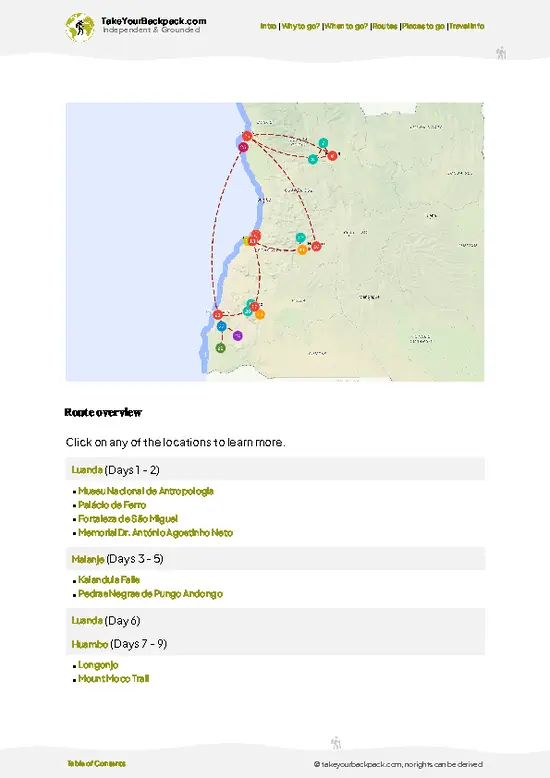
The 7-Day Luanda & Coast Sampler

The Vibe: A relaxed first-timer’s dive into Angola, balancing Luanda’s history with easy-going beach time and short coastal drives. You stay mostly near the capital, trading long road days for slow sunsets and a couple of big cultural hits.
The Highlights:
  • Colonial-era views and history at Fortaleza de São Miguel.
  • Sober reflection at the Museu Nacional da Escravatura.
  • Lazy lagoon days at Praia do Mussulo and the Mussulo tourist complex.
  • Otherworldly cliffs at Miradouro da Lua within easy reach of Luanda.

The 14-Day Coast, Savanna & Highlands Circuit

The Vibe: A balanced two-week loop for curious travelers who want more than just beaches—mixing Luanda’s museums, a taste of safari, and cooler highland cities without turning every day into a transit slog. You’ll use a blend of road trips and at least one internal flight to keep the pace comfortable.
The Highlights:
  • Luanda’s core museums and bayfront for a deep historical context.
  • Wildlife and river scenery in Quiçama
read more 👉

The 7-Day Luanda & Coast Sampler

The Vibe: A relaxed first-timer’s dive into Angola, balancing Luanda’s history with easy-going beach time and short coastal drives. You stay mostly near the capital, trading long road days for slow sunsets and a couple of big cultural hits.
The Highlights:
  • Colonial-era views and history at Fortaleza de São Miguel.
  • Sober reflection at the Museu Nacional da Escravatura.
  • Lazy lagoon days at Praia do Mussulo and the Mussulo tourist complex.
  • Otherworldly cliffs at Miradouro da Lua within easy reach of Luanda.

The 14-Day Coast, Savanna & Highlands Circuit

The Vibe: A balanced two-week loop for curious travelers who want more than just beaches—mixing Luanda’s museums, a taste of safari, and cooler highland cities without turning every day into a transit slog. You’ll use a blend of road trips and at least one internal flight to keep the pace comfortable.
The Highlights:
  • Luanda’s core museums and bayfront for a deep historical context.
  • Wildlife and river scenery in Quiçama National Park and along the Kwanza River.
  • Atlantic charm in Benguela, Catumbela, and Lobito’s long peninsula.
  • Highland culture and cooler air in Huambo’s central plateau city.

The 21-Day Angola Grand Traverse

The Vibe: A three-week, all-in journey for travelers who want to see Angola’s big landscapes—from savanna to desert to high plateau—while still building in rest days and repeat nights. You’ll string together flights and long but spaced-out drives to connect coast, mountains, and remote parks.
The Highlights:
  • Extended time in Luanda to really absorb its history, museums, and bayfront life.
  • Multi-day wildlife and river experiences in Quiçama National Park.
  • Coastal living in Benguela and Lobito plus a side trip to Praia de Cabo Ledo.
  • Highland drama around Lubango, Tundavala Gap, Serra da Leba, and the Namibe Desert-Iona National Park combo.
🌍 Want a ready-to-use travel plan for Angola?
The overview above compares different route options based on your travel time and style. The complete Travel Guide breaks each itinerary down in detail, including maps, stops, highlights, and transport information.

Explore all route details 👉

Get the Travel Guide -

🌤️ When to go?A month-by-month overview

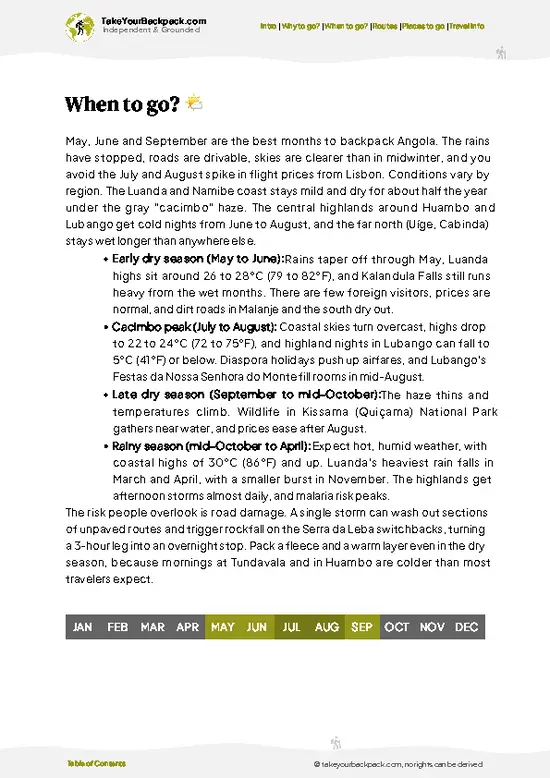
The sweet spot for Angola backpacking lands in May-June and again late August-September. The rains have lifted, but the land hasn’t yet turned brittle. Dirt roads firm up, river levels drop to fordable, and buses stop dying in red mud. Nights in the highlands are cool enough to sleep without sweating through your liner, while the coast rides the Benguela current—mornings grey and salty, afternoons clear. Prices ease between local holiday spikes, and what crowd exists tends to cluster in Luanda; inland beds remain findable without begging. Waterfalls like Kalandula still throw spray from the last of the wet, the hills around Lubango glow green, and malaria risk dips with the mosquitoes. You pay with early starts and dusty clothes, and you get paid back by that first cold Cuca under a tin roof as thunderheads stay on the horizon.
  • Peak Dry (Jul-Aug): Beds vanish in Lubango and along the coast, drivers raise fares, and every viewpoint has a selfie stick. But the sky is razor-clear, humpbacks roll offshore, and Tundavala Gap at sunrise feels like an edge-of-the-world ticket. Expect cool nights, busy transport, and higher rates—worth it if you chase big views and whales.
  • Shoulder Rebound (May-June): Roads reopen, shop shutters lift, and routes breathe again. Serra da Leba’s switchbacks go from slippery to grippy, markets swell with fresh greens, and Kalandula roars without the daily drench. You move earlier, cover more, and spend less because the city suits haven’t started holidaying yet.
  • Build-Up Heat/Smoke (Sept-Oct): The land dries and the air pulses; bush-burn season can haze the sky and sting the throat by afternoon. Desert edges around Namibe turn oven-hot at midday, then cool fast at night. Carry saline drops and hike dawn/late—smoke and heat thin crowds, and beaches near Benguela go quiet.
  • Rains Proper (Nov-Apr): Heavy, warm downpours drum corrugated roofs, wash clay into rivers, and strand chapas. The country turns lush and solitary; waterfalls are monstrous, and the air smells of wet earth. Survival hack: line your pack with heavy-duty trash bags, walk in rubber sandals between rides, and start pre-dawn before storms build. Risk people ignore: bridge closures after lunchtime squalls can wipe a whole day.

Tactical tip: For the May-June and late Aug-Sept window, grab domestic flight seats and long-haul bus tickets 10-14 days ahead; everything else you can buy on the ground.

source: climatestotravel.comJANJanuary: below average for travelingFEBFebruary: below average for travelingMARMarch: below average for travelingAPRApril: fair for travelingMAYMay: highly recommended for travelingJUNJune: highly recommended for travelingJULJuly: good for travelingAUGAugust: good for travelingSEPSeptember: highly recommended for travelingOCTOctober: fair for travelingNOVNovember: below average for travelingDECDecember: below average for traveling
📅 Traveling in a specific month?
Get a full month-by-month breakdown of weather, crowds, costs, festivals, and seasonal highlights in the complete travel guide.

Get full details when to go 👉

Get the Travel Guide -
pixabay-angola-83975

💰 Costs (as of 2025)Typical budget expectations

$45-65 per day if you move like a local; Angola is pricier than Namibia or Zambia for beds and distance, but cheap enough for calories, beer, and city hops if you use the system.
  • dorm accommodation: $15-25 outside Luanda; $20-35 in the capital, where the oil economy keeps prices punchy. True hostels are rare; think basic pensão/residencial rooms with a fan, thin sheets, and a shared bathroom. System tip: skip booking sites. Ask for “residencial” near bus stations, show cash, and negotiate down from the “foreigner rate.” Weeknights are cheaper. Compared with Namibia/Zambia, you’ll pay more for less polish, but you can still land a safe, clean room if you arrive before dark.
  • meals: Supermarket Survival: imported goods are overpriced; a bread-cheese-tomato routine runs $6-10/day, worse value than in Namibia. Street food reality: smoky churrasqueira chicken, funge, beans, fried fish, and bananas keep you full for $3-6 per meal in Luanda, $2-4 up-country. A cold Cuca from a kiosk is $1-1.50, bars double that. Water $0.50-1. Street food wins on price-to-calories and taste; it’s the budget backbone here, and more generous portions than Zambia’s standard plate.
  • local transport: Candongueiro vans
read more 👉
$45-65 per day if you move like a local; Angola is pricier than Namibia or Zambia for beds and distance, but cheap enough for calories, beer, and city hops if you use the system.
  • dorm accommodation: $15-25 outside Luanda; $20-35 in the capital, where the oil economy keeps prices punchy. True hostels are rare; think basic pensão/residencial rooms with a fan, thin sheets, and a shared bathroom. System tip: skip booking sites. Ask for “residencial” near bus stations, show cash, and negotiate down from the “foreigner rate.” Weeknights are cheaper. Compared with Namibia/Zambia, you’ll pay more for less polish, but you can still land a safe, clean room if you arrive before dark.
  • meals: Supermarket Survival: imported goods are overpriced; a bread-cheese-tomato routine runs $6-10/day, worse value than in Namibia. Street food reality: smoky churrasqueira chicken, funge, beans, fried fish, and bananas keep you full for $3-6 per meal in Luanda, $2-4 up-country. A cold Cuca from a kiosk is $1-1.50, bars double that. Water $0.50-1. Street food wins on price-to-calories and taste; it’s the budget backbone here, and more generous portions than Zambia’s standard plate.
  • local transport: Candongueiro vans are the key—$0.30-1 per hop, dusty, crowded, and everywhere; moto-taxis cost 30-60% more but cut time in traffic. Intercity, Macon and similar coaches run $10-30 for big jumps; slower, cheaper minibuses exist if you’ve got patience. Rail (Benguela/Moçâmedes lines) is the true unlock when schedules align—hundreds of kilometers for a few dollars. Per kilometer, Angola can beat Namibia’s coaches, but expect longer waits and rougher rides. Book early, leave at dawn, and sit near a window.
  • activities: Fees aren’t the killer—logistics are. Museums run $1-3. Big-ticket costs come from scarce operators: Quiçama safaris, Iona or Namibe 4x4 days, and boat trips on the Kwanza—think $80-150+ per person once vehicle, guide, and fuel are split, often more than equivalent outings in Namibia where there’s competition. The budget wins are free: Tundavala Gap at golden hour, Miradouro da Lua, Kalandula Falls (small guide tip), shipwreck beaches—your money goes to getting there.
  • miscellaneous: Budget leaks: visa fees (often $100+; neighbors can be cheaper), ATM limits and 2-5% fees, exchange rate spread, night taxis ($4-10 per ride), laundry ($2-4), and constant bottled water. Sunscreen and repellent cost more than in Namibia—bring them. Keep small bills to dodge “no change” tax. Stay calm at checkpoints; carry photocopies to avoid “fine” theater. Relative value: beer is similar or cheaper than Zambia, but admin friction and distance make little mistakes add up fast.
⚠️ Prices can change and everyone travels differently, so take this as a rough guide. Hope it helps you plan your adventure!

✈️ The backpacker research shortcutAngola Travel Guide

An offline-friendly backpacking guide with optimized travel routes, ranked highlights, transport advice, and the best areas to stay.
example page 0 from our offline Travel Guide for Angolaexample page 1 from our offline Travel Guide for Angolaexample page 2 from our offline Travel Guide for Angolaexample page 3 from our offline Travel Guide for Angolaexample page 4 from our offline Travel Guide for Angolaexample page 5 from our offline Travel Guide for Angolaexample page 6 from our offline Travel Guide for Angolaexample page 7 from our offline Travel Guide for Angola
The digital guide (347 pages) contains:
91 highlights, ranked by travel appeal
Optimized 7, 14 & 21-day travel routes
Cities, national parks, beaches, historical sites, ...
How to get around
Offline-friendly for travel without Wi-Fi
👉 Click to see all 30+ guide features

📅 Plan smarter in minutes, not weeks
Month by month travel advice
Festivals & national holidays
Budget expectations

🗺️ Go to the right places, skip the overrated ones
Honest pros & cons of destinations
Top hikes, parks & viewpoints
Lesser-known places most travelers miss
Clear “worth it vs skip it” guidance

🛏️ Travel smoothly without rookie mistakes
Best areas to stay
Transport systems explained simply
Common scams & safety advice
SIM cards, money & practical tips

🌍 Understand the country, not just visit it
Culture & traditions
52 Essential phrases & customs
Festivals worth planning around
Traveler-friendly historical context
Insights that make places more meaningful

📱 Built for real travel conditions
Fully downloadable PDF
Works completely offline
Optimized for phone use
Useful in remote areas & buses
Everything in one place
Save weeks of stressful planning
Get instant access to the full guide directly. 30-day money-back guarantee.


Sent to your inbox immediately after payment • 100% Secure Checkout
Best Backpacking Travel Advisor 2025 tourism awardBest Backpacking
Travel Advisor
2025
What others say about Take Your Backpack Guides:
⭐⭐⭐⭐⭐
Fantastic, amazing amount of information!
⭐⭐⭐⭐⭐
My goodness this is amazing, it's what I've been looking for hats off too you!
⭐⭐⭐⭐⭐
I think this is absolutely BRILLIANT
⭐⭐⭐⭐
Very complete and informative. It's still missing places, but I gotta to commend you
⭐⭐⭐⭐⭐
This is truly amazing, thank you, can't wait to explore it with my kids!
⭐⭐⭐⭐⭐
Awesome resource, thank you!
⭐⭐⭐⭐⭐
This is amazing! Can't wait to explore the ones I haven't seen
⭐⭐⭐⭐
I love this! Well done, great idea.
⭐⭐⭐⭐⭐
Thanks for taking the time to make this gem!
⭐⭐⭐⭐⭐
This might be the best website I've ever seen.
⭐⭐⭐⭐⭐
Congratulations, and thank you so much for your work; it's incredibly valuable.
⭐⭐⭐⭐
In all seriousness I think you did a great job pointing out the important spots
⭐⭐⭐⭐⭐
10/10 very good
⭐⭐⭐⭐⭐
As someone who's only just starting to visit regularly this is awesome, thank you.
⭐⭐⭐⭐
Thank you very much! I'm going to visit my dad, it's going to be very useful!
⭐⭐⭐⭐⭐
This is really cool! We'll be travelling for the first time and this definitely come in handy.
⭐⭐⭐⭐⭐
You are now our minister of culture, congratulations 👨‍💼
⭐⭐⭐⭐⭐
Just wanted to tell you that this is a pearl! Going to follow your recommendations.
⭐⭐⭐⭐⭐
This is so cool. I'll definitely be using the resource for my travels soon.
⭐⭐⭐⭐⭐
This is very impressive! Good work.
⭐⭐⭐⭐⭐
This is an amazing and informative site. Very well done!

🛏️ Where to stay?Accommodation types and options

Yes — Angola has some hostels and budget accommodation but options are limited and concentrated in a few cities; expect more guesthouse-style budget hotels than classic dorm hostels, higher prices in major centers, and variable service standards.

Most choices cluster in Luanda (central districts and business suburbs), and coastal towns such as Benguela/Lobito and Namibe (Moçâmedes); central Luanda gives easy access to sights and nightlife but brings heavy traffic and higher rates, business suburbs are quieter and safer but farther from attractions, and coastal towns are cheaper and better for … read more 👉
Yes — Angola has some hostels and budget accommodation but options are limited and concentrated in a few cities; expect more guesthouse-style budget hotels than classic dorm hostels, higher prices in major centers, and variable service standards.

Most choices cluster in Luanda (central districts and business suburbs), and coastal towns such as Benguela/Lobito and Namibe (Moçâmedes); central Luanda gives easy access to sights and nightlife but brings heavy traffic and higher rates, business suburbs are quieter and safer but farther from attractions, and coastal towns are cheaper and better for beaches but have fewer evening services and limited transport links.

Carry cash, book ahead because availability is sparse, and expect occasional basic-utility interruptions and tighter safety awareness in budget areas.

If you enjoy meeting fellow travelers, consider choosing hostels with high ratings for atmosphere. On the other hand, if you prefer having your own space, a hotel might be a better option.

🚌 Getting aroundHow to travel within the country

Angola moves on heat and instinct. In Luanda the air smells of diesel, sea salt, and roasted chicken skin; horns sketch a rhythm that only drivers seem to understand. Schedules exist on paper, but the real clock is bodies-in-seats. A bus doesn’t roll until it’s heavy; a train leaves when the station master decides the track is clear. The reward for surrendering to this pulse: a seat by a window, red dust in the light, and a long coastal sunset that feels earned.
  • Long-distance buses (Macon, AngoReal)
read more 👉
Angola moves on heat and instinct. In Luanda the air smells of diesel, sea salt, and roasted chicken skin; horns sketch a rhythm that only drivers seem to understand. Schedules exist on paper, but the real clock is bodies-in-seats. A bus doesn’t roll until it’s heavy; a train leaves when the station master decides the track is clear. The reward for surrendering to this pulse: a seat by a window, red dust in the light, and a long coastal sunset that feels earned.
  • Long-distance buses (Macon, AngoReal) The cheap way to cross big chunks. You trade time for money. Think 8-12 hours Luanda-Benguela or Luanda-Lubango for roughly a fifth the price of flying, and a fraction of the fuel cost of renting a 4x4. They leave early—pre-dawn queues, ID check, tagged bags, and the driver’s assistant hustling cargo underneath for a small tip. Air-con can be heroic or theatrical. Police checkpoints, roadworks, and cratered asphalt add an hour you didn’t plan for. But you get a real seat, semi-predictable rest stops (grilled chicken, cassava, lukewarm Cokes), and you arrive with cash left for tomorrow’s ride.
  • Candongueiro minibuses This is the social web of the cities. You don’t hail; you align yourself with a swarm and the cobrador whistles you in. Pay with small bills, pass money forward with a “duas” or “Luanda Sul,” and your change will surf back on open palms. Music rattles the tin—kizomba, kuduro—and someone’s groceries breathe next to your knee. They don’t leave until full, and then they still find room. Tap the roof or call “parar!” right before your junction. Offer your seat to elders, keep your bag on your lap, and let the collective logic carry you where maps stumble.
  • Kupapata moto-taxis The geometry hack. When the bus dumps you two townships short or the road turns to ribbed clay, these bikes thread the gap. They climb the last kilometers to Tundavala’s cliff rim before sunrise, slip the bottleneck at Serra da Leba’s hairpins, and zigzag markets where vans refuse. Agree the fare first, demand a helmet (bring a buff if the visor is a suggestion), hang your pack tight, and ride loose over potholes you can’t see until they’re there. In rain, wait; in dust, close your mouth and trust the throttle.
  • Benguela Railway (CFB) The budget disruptor when it’s running. Lobito to Huambo and beyond is slow, cheap, and oddly serene—hard benches, windows stuck half-open, and a moving film of highland farms and red earth scars of old tracks. Tickets are local-price low—think street-meal money for serious distance—and you skip the highway police tango. Trains can vanish from schedules without apology, so you buy at the station, bring snacks and a layer, and accept that arrival is a concept, not a minute.

Master tactical tip: move at first light between hubs (Luanda, Benguela/Lobito, Lubango), then fan out with candongueiros or motos; that combo keeps you ahead of heat, checkpoints, and daylight, which is the only timetable that actually matters.
Distance: About 5 km (3 miles) from Quatro de Fevereiro International Airport (LAD) to central Luanda (Mutamba/Marginal).

Main ways to reach the city center
  • TCUL city bus — Public buses stop on the main road just outside the airport area (you may need a short walk to the roadside stops).
    Cost: roughly 300-500 AOA (about US$0.30-0.60).
    Time: 30-60 minutes depending on traffic.
    Notes: Pay cash on board; limited luggage space; signage can be sparse.
  • Shared minibuses (candongueiros) — Frequent blue-and-white vans running into town via main arteries.
    Cost: about 300-700 AOA (around US$0.30-0.80) per seat.
    Time: 25-50 minutes, variable with stops and traffic.
    Notes: Very common and cheap, but crowded and not ideal with big bags; pay cash.
  • Ride-hailing apps (no Uber) — Services like Yango, T’Leva and Kubinga work well in Luanda.
    Cost: typically 3,500-8,000 AOA (about US$3-9) to the Mutamba/Marginal area.
    Time: 20-40 minutes.
    Notes: Easiest with luggage; fares fluctuate with demand and traffic.
  • Meterless taxis (airport/streets) — Available at the arrivals rank; agree the fare before you get in.
    Cost: usually 8,000-15,000 AOA (about US$9-17) to the center.
    Time: 20-40 minutes.
    Notes: Cash is standard; ask for the official airport taxis or book via your hotel.
  • Hotel shuttles — Some mid-range and upscale hotels offer free or paid pickups.
    Cost: free to about 10,000 AOA, depending on the property.
    Time: 20-40 minutes.
    Notes: Pre-arrange with your hotel for smooth pickup.

Timing tip: Peak traffic (roughly 07:00-09:00 and 16:30-19:30) can double the times above.

Currency note: Prices are in Angolan kwanza (AOA) and can change with fuel costs and exchange rates; treat these as ballpark figures for 2025.

About the “new” Luanda airport: If your ticket shows Dr. António Agostinho Neto International (AIAAN, Bom Jesus), it’s much farther — about 40 km (25 miles) from downtown. Expect 50-90 minutes by car; ride-hail around 12,000-25,000 AOA, airport taxis roughly 20,000-35,000 AOA. Public transport there is still limited; most travelers use pre-booked cars, ride-hailing, or hotel shuttles.
⚠️ Prices and routes can change, so take this as a rough guide and ask for local advice when you arrive.

🔒 Safety (risk Level: medium)Is Angola safe to visit?

Safety for solo travelers, including women and LGBTQ+ individuals
Safety in Angola can be a concern due to higher crime rates, particularly in urban areas like Luanda. Solo travelers, especially women and LGBTQ+ individuals, should exercise caution, stay informed about local laws, and avoid isolated areas after dark. It’s recommended to connect with trusted locals or expat communities for advice. Always have a plan for emergencies and keep important contacts handy.


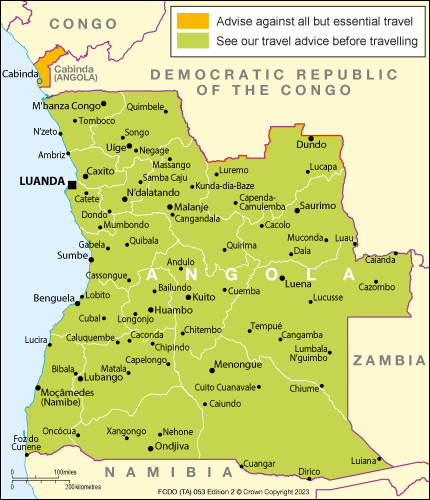
Full official government travel advisory (live updates)
View details 👉
safety image

source: www.gov.uk

✈️ VisaVisa requirements for Angola

Most travelers need a visa to visit Angola. You can apply for an e-visa online through the official Angola immigration website. Ensure you have a passport valid for at least six months, a return ticket, and proof of accommodation.
⚠️ Visa requirements can change over time, so always check the latest visa requirements with the official embassy or government website before you travel.

🎒 What to pack?What to pack for Angola

Angola is a mix of climates and terrains, so pack for variety. It’s humid in the north with rainforests, while the south is more arid. Luanda and other coastal areas are hot and humid, so breathable clothing is key. If you’re heading inland or to the highlands, like Huambo, be ready for cooler nights. Culturally, Angolans appreciate modest dressing, especially in rural areas, so think loose-fitting clothes that cover shoulders and knees. Beaches are casual, but remember some places frown on swimwear away from the sand.

Apart from this country specific advice, I have also crafted a general packing list that should help on any trip. authorOver the years, I've learned the importance of packing minimally. It's so much easier to jump on the back of a truck or squeeze yourself into the last spot of a minibus without that supersized backpack. If you're headed to a warm destination, leave your winter jacket at home; for colder regions, opt for thin thermal underlayers. Instead of packing your entire wardrobe, bring just three sets of clothes, as laundry facilities are available everywhere.
View the full list 👉
🎒 Planning the practical side of your trip?
Get detailed information on transport, daily budgets, internet access, local customs, food, language, and other essentials in the complete Travel Guide.

Get detailed practical information 👉

Get the Travel Guide -

🙋 FAQFrequently asked questions

Trip Planning


Personal tip: I normally search on good rating for atmosphere (for meeting people) and location (for easy exploring). Cleanliness as a bonus.


Travel Essentials

You might need vaccinations for Angola to stay safe. Essential ones include:

- Hepatitis A and B
- Typhoid
- Yellow Fever (required)
- Meningococcal Meningitis
- Rabies (if you plan on animal encounters or rural stays)

Consider routine vaccines like MMR, Diphtheria-Tetanus-Pertussis, and Polio. Always consult a healthcare professional for personalized advice and current recommendations.


vaccination requirements
When I first started traveling, I often spent part of my first day in a new country hunting for a local SIM card. While this can still be slightly cheaper, it also takes time and planning.

These days, it's much simpler to install an eSIM before leaving home. Once you arrive in Angola, you can activate it immediately and have mobile data from the moment you land — which is especially useful for ordering transport or navigating away from busy airports.

There are many providers nowadays, and price differences are usually small. I personally go with Airalo, as it offers excellent network coverage throughout the country and strong global coverage, so you can manage multiple countries from a single app.


Get your e-sim for Angola

Culture & Customs

Respect elders by addressing them with titles like ”Senhor” or ”Senhora” followed by their surname. **Avoid discussing politics** or the civil war casually. When greeting, a handshake is common, often with both hands; for women, a kiss on each cheek is customary.

**Dress modestly**; women should avoid short skirts and revealing tops. Public displays of affection are generally frowned upon, especially in rural areas. For LGBTQ+ travelers, discretion is advised as attitudes can be conservative.

**Photography:** Always ask for permission before taking photos of people or their property. In some areas, it’s best to avoid photography altogether.

Be patient and flexible with time; punctuality is not a strong point, and events often start later than scheduled.
Trying traditional food is always a great way to experience the culture. Here are some must-try dishes for Angola.
  • Muamba de Galinha: This is a spicy chicken stew made with palm oil, garlic, and okra. It’s a staple at family gatherings and reflects the blend of African and Portuguese influences in Angolan cuisine.
  • Calulu: A hearty fish or meat stew mixed with vegetables like sweet potato leaves and okra. It’s a favorite for its rich, comforting flavors and is traditionally served with funge, a type of porridge.
  • Funge: Made from cassava or corn flour, this thick porridge is a daily staple for many Angolans. It’s often served with stews and is crucial for scooping up all the delicious sauces.
  • Feijão de Óleo de Palma: This dish features beans cooked in palm oil, often with a kick of chili. It’s popular for its simplicity and the way it highlights the rich flavors of Angolan palm oil.
  • Moamba de Ginguba: A variation of muamba, this version incorporates peanuts, adding a creamy texture and nutty flavor. It’s loved for its unique taste and comforting qualities.
Locals in Angola often boil or filter tap water before drinking, but it’s generally not recommended for tourists to drink it directly. To be safe, stick with bottled or properly filtered water. It’s easy to find bottled water in most urban areas.
The main language in Angola is Portuguese. Backpacking is way more rewarding if you know a bit of the local language, so I'd suggest brushing up on the basics just in case your Portuguese skills have become a bit rusty.

Want to understand locals better?
The complete Travel Guide for Angola includes 52 essential words and phrases — greetings, thank-yous, ordering food, transport, numbers, and common local expressions you'll actually hear.

Get your local basic phrases 👉

Get the Travel Guide -


In Angola, English is not widely spoken, as the official language is Portuguese, a remnant of its colonial past. While Portuguese is used in government, education, and media, English is increasingly taught in schools and is becoming more common in urban areas, particularly among the younger population and professionals in sectors like tourism, business, and technology.

In major cities like Luanda, you may find English speakers in hotels, restaurants, and tourist attractions, but outside urban centers, English proficiency diminishes significantly. Travelers should be prepared for language barriers, especially in rural areas where Portuguese is the primary means of communication.

To enhance your experience, learning a few basic Portuguese phrases can be beneficial. This not only helps in navigating daily interactions but also shows respect for the local culture. Overall, while English is gaining traction, it is advisable to rely primarily on Portuguese when traveling through Angola.

Money & Payments

The local currency of Angola is AOA (Kwanza).

If you’re heading to Angola, here’s the lowdown on handling your cash: ATMs are available in larger cities like Luanda, but don’t rely on them entirely. They can be finicky, and your card might not always work. It’s wise to carry some cash, preferably in U.S. dollars, as they’re more widely accepted than euros and can get you a better exchange rate. Local currency is the kwanza, and you’ll find exchange bureaus in major cities and airports. Just make sure you count your cash before leaving the counter.

Credit cards are becoming more accepted, especially in hotels and restaurants in urban areas, but don’t expect them to work everywhere. A mix of cash and cards is your best bet. When exchanging money, try to avoid doing so on the street. It’s better to stick to banks or official exchange offices for a safer transaction. Always keep an eye on the exchange rates to get the most bang for your buck!

In Angola, tipping isn’t widely expected, but it’s appreciated. If you feel like rewarding good service, 5-10% of the bill for restaurants is a nice gesture. For porters or hotel staff, small tips in local currency (Kwanzas) or USD are well-received.

🧩 Nearby countriesOther countries to combine with Angola

We 💚 feedbackFinal notes for travelers

Angola pays you back, but it makes you earn it. Red dust in your socks, diesel in the air, salt drying on your skin by lunchtime. Expect early starts, long gaps between towns, and checkpoint small talk; smile, hand over photocopies, and you roll on. It isn’t a war zone anymore—mines linger off-track, but if you stick to paved roads and obvious paths you won’t meet them. Carry cash, fill up when you can, and learn ten words of Portuguese. Luanda stings the wallet; coastal canteens don’t. Then the reward: Serra da Leba’s switchbacks unwinding at dawn, the Tundavala drop roaring with wind, grilled fish and funge, a bottle of Cuca so cold it sweats in your hand.

✍️ Help improve this page!
The information on this page is based on in-depth research, insights shared by experienced travelers, and feedback from the local travel community in Angola. While every effort is made to keep the information accurate and current, conditions can change — so if you spot anything incorrect or outdated, please get in touch.


🙋‍♂️ Give feedback

👋 Meet the founderWho’s Behind Take Your Backpack?

Johan, backpacker and founder of TakeYourBackpackHi, I’m Johan (Netherlands 🇳🇱), the creator of TakeYourBackpack. Over the past decade, I’ve backpacked through 80+ countries across six continents, gaining extensive experience with independent travel, long-term trips, and overland routes.

This site is built on a combination of firsthand travel experience and carefully curated insights from other backpackers. Many guides are based on places I’ve personally visited, while others bring together tips, observations, and practical advice shared by trusted travelers I’ve met along the way.

The goal is to provide realistic, experience-driven guidance — not generic itineraries — so you can explore destinations with better context, clearer expectations, and more confidence.

Get full Angola guide •
Instant download • 91 highlights • Full Offline guide