×
Germany 🇩🇪

backpacking Europe Germany 🇩🇪Travel efficiently while landscapes subtly transform along the way.

Explore FranceExplore Gibraltar

Backpacking Germany in 2026

A complete guide including when and where to go, costs, transport, itineraries, and practical travel advice.
A practical introduction for travelers

Backpacking Germany
By Johan Kruseman 🇳🇱 | Updated June 5, 2026

In Germany, the system runs on punctuality and rules you’re expected to intuit. Trains hit their marks; shops sleep on Sundays; quiet hours actually mean quiet. Master that cadence and the country becomes insanely easy to move through.

That predictability frees you to chase what Germany does best: layered history, precise craft, and landscapes that reset your brain. Ride the Rhine past castle ridges and vine-striped slopes, duck into Cologne’s Gothic vaults, then swap to Alpine blue around Garmisch and Königssee. Climb Saxon Switzerland’s sandstone, wander Bamberg’s half-timber with a smoky lager, then chase ideas in Berlin—from the Wall’s seams to night-long clubs. Winter means glowing markets; warmer months mean chestnut-shaded beer gardens, Black Forest trails, and Baltic breezes. English thins outside big cities, cash-only signs linger, and a missed stamp on a paper ticket can bite—I paid that fine once so you won’t. Book seats on long-haul ICEs, validate every ticket, use Länder-Tickets for regional hops, and plan around Sundays; the rules turn into shortcuts.

Compared with Austria’s alpine polish or Switzerland’s perfection-with-a-price, Germany delivers big scenery with better value and a deeper city mix. Versus France’s romance and the Netherlands’ easy canals, it runs on ideas, engineering, and medieval heft. Go if you like turning structure into freedom—first-timers seeking smooth logistics, hikers and rail nerds, history and design fans, and anyone who wants substance and a fresh roll each morning.

👉 Get the 📖 Travel Guide of Germany

Berlin–Leipzig ICE corridor

Urban, student-heavy, late hours. This axis rewards curiosity and stamina more than cash. Berlin eats days with big museums and tight neighborhood scenes, then Leipzig resets the pace with cheaper bars, lakes, and a compact core you can cross on foot. The hack is the single ICE spine: 1 hour, frequent, predictable. Sleep near Berlin’s Ringbahn to pivot fast, reserve seats on Friday afternoons, and use regional trains to plug side missions (Dessau/Bauhaus, Wittenberg) without touching a car.

Upper Bavaria and the Alps (Munich–Garmisch–Füssen–Berchtesgaden)

Athletic days, beer-garden nights, early alarms. The payoff is ridge walks, hut lunches, and cold lakes, but crowds move on bus schedules. Use Munich as the switchboard: hourly regional trains fan to trailheads. Leave at dawn, beat the tour coaches to Füssen, slide to Garmisch for a hike, or Berchtesgaden for a lake circuit. Buy a Länder-Ticket on weekdays after 09:00 or weekends all day to chain legs cheaply, stash luggage in Munich Hbf lockers, and keep a weather buffer to swap peaks for breweries when clouds sit low.

Rhine–Moselle valleys (Cologne–Koblenz–Trier)

Slow travel that still runs on rails. Vineyards, castle steps, ferry crossings. The trick is picking one bank of the Rhine and staying loyal; trains run both sides and boats give a scenic bailout. Base in Koblenz to pivot: Moselle to Cochem/Trier one way, Middle Rhine to Bacharach/Boppard the other. Bike rentals and towpaths make one-way rides easy—return by train. Day-pack only; towns are vertical and cobbled. When boats run thin, the regional trains keep time well enough to stack tastings without a watch.

The Ruhr (Essen–Duisburg–Dortmund)

Industrial bones, football pulse, big immigrant food scene. Zero romance, maximum access. It’s a mesh of S-Bahn lines where 10-minute mistakes don’t matter because another train arrives. Base by an S-Bahn knot (Essen Hbf works), string Zeche Zollverein, Landschaftspark, and a match or stadium tour into one day with an NRW day ticket. Museums close Mondays, kebab shops never sleep. This region rewards urbanists who like repurposed spaces and travelers who value time saved over postcard views.

Black Forest rail spine (Freiburg–Titisee–Donaueschingen)

Forest trails without car stress. The Höllentalbahn climbs straight into hiking country, and that single rail spine is the cheat code. Sleep in Freiburg for food and trams, ride up early, loop Feldberg or the ridge paths, then drop to lakes for a swim and a pastry. Many towns issue guest cards that include local transit; if not, a Baden-Württemberg day ticket covers the whole loop. Cable cars close in wind; trains don’t, so keep your route rail-anchored and you’ll always have a clean exit.
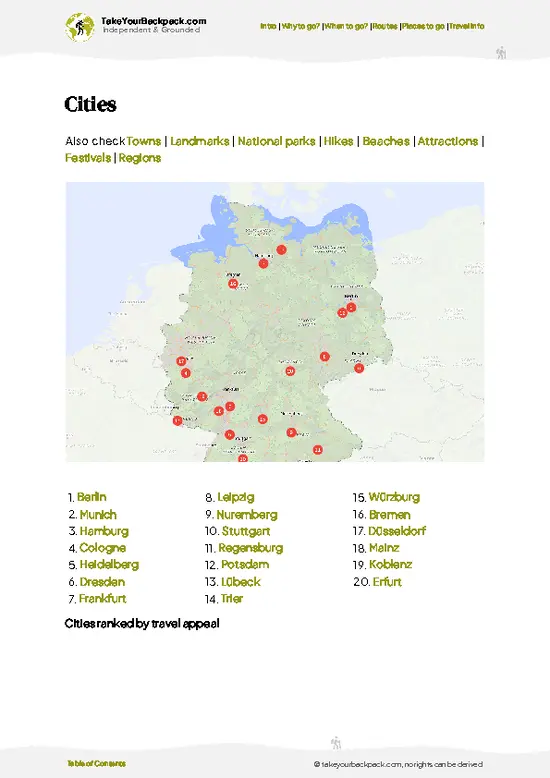
Geography and where places are located
Loading the map 🌍
CLICK TO FILTER
city
town
unique site
national park
hike
beach
attraction
festival
region
SHOW COUNTRY’S BESTSHOW ALL
film
0
0
0a
Pergamon Museum
Pixabay
film
1
1
1a
Cologne Cathedral Treasury and Tower
film
2
2
2a
Heidelberg Castle
film
3
3
3a
Sanssouci Palace and Park
film
4
4
4a
Miniatur Wunderland
film
5
5
5a
Deutsches Museum
film
6
6
6a
BMW Museum and BMW Welt
film
7
7
7a
Europa-Park
Pixabay
film
8
8
8a
Phantasialand
film
9
9
9a
Berlin Zoological Garden
Pixabay
film
10
10
10a
Sylt
Markus Lesch
film
11
11
11a
Baltic Coast in Schleswig-Holstein
film
12
12
12a
Berlin
Pixabay
film
13
13
13a
Munich
Pixabay
film
14
14
14a
Hamburg
Jassim Anwar
film
15
15
15a
Cologne
Jassim Anwar
film
16
16
16a
Dresden
Johann G
film
17
17
17a
Leipzig
film
18
18
18a
Frankfurt
Arianit Sahiti
film
19
19
19a
Nürnberg
Jo Mo
film
20
20
20a
Regensburg
film
21
21
21a
Lübeck
Hans-günther Meyer
film
22
22
22a
Würzburg
Constantin Cilibiu
film
23
23
23a
Aachen
Alby Set
film
24
24
24a
Bremen
Jassim Anwar
film
25
25
25a
Trier
Randolfo Santos
film
26
26
26a
Wiesbaden
Winfried Paltian
film
27
27
27a
Malerweg
film
28
28
28a
Rennsteig Trail
Michael Herrmann
film
29
29
29a
Moselsteig Trail
Tamara Van Gerwen
film
30
30
30a
Harz Witches’ Trail
Enrico
film
31
31
31a
Goldsteig
film
32
32
32a
Saar-Hunsrück-Steig
film
33
33
33a
Fränkischer Gebirgsweg
film
34
34
34a
Berchtesgaden
F. Herre (ragnar L.)
film
35
35
35a
Black Forest
Claudia Veitinger
film
36
36
36a
Saxon Switzerland
Pixabay
film
37
37
37a
Bavarian Forest
Nationalpark Bayerischer Wald
film
38
38
38a
Hainich
Nationalpark Hainich
film
39
39
39a
Nationalpark Wattenmeer
film
40
40
40a
Vorpommersche Boddenlandschaft
Brigitte Schade
film
41
41
41a
Spreewald
film
42
42
42a
Harz
Marcel Henkel
film
43
43
43a
Eifel
Nationalpark Eifel
film
44
44
44a
Lüneburger Heide
film
45
45
45a
Teutoburg Forest
film
46
46
46a
Rhine Valley
Norbert Rettenmaier
film
47
47
47a
Bodensee
Pierre Jope
film
48
48
48a
Moselle Valley
Arkadiusz Gowik
film
49
49
49a
Wadden Sea
film
50
50
50a
Heligoland
film
51
51
51a
Borkum
Holger Pyrkatz
film
52
52
52a
Bamberg
Julio Fernandez Casanova
film
53
53
53a
Garmisch-Partenkirchen
Balázs Bősze
film
54
54
54a
Quedlinburg
Eugen Maurer
film
55
55
55a
Meersburg
Stephanie Schaefer
film
56
56
56a
Dinkelsbühl
Александр _
film
57
57
57a
Wernigerode
Birgit Koch
film
58
58
58a
Goslar
film
59
59
59a
Weimar
film
60
60
60a
Schwerin
Venula Tharusha
film
61
61
61a
Konstanz
film
62
62
62a
Tübingen
Стоимена Ташева
film
63
63
63a
Lüneburg
film
64
64
64a
Marburg
Reiner Weber
film
65
65
65a
Görlitz
Kali
film
66
66
66a
Neuschwanstein Castle
Pixabay
film
67
67
67a
Cologne Cathedral
Hans Berger
film
68
68
68a
Zugspitze
Hao Yu
film
69
69
69a
Rhine Gorge
Norbert Rettenmaier
film
70
70
70a
Wartburg Castle
Philip Schollain
film
71
71
71a
Bergpark Wilhelmshöhe
film
72
72
72a
Maulbronn Monastery Complex
Nick P
film
73
73
73a
Naumburg Cathedral
Naumburger Dom
film
74
74
74a
Schwerin Residence Ensemble
Daniel Zoppa

Why go?What draws travelers here

Architecture

Germany is built like a syllabus you can ride by train. Centuries stack in plain sight—Roman gates in Trier, Gothic in Cologne, timber-frame grids in Quedlinburg, sober Bauhaus in Dessau, glass-and-steel edges in Frankfurt—mapped … read more 👉
Germany is built like a syllabus you can ride by train. Centuries stack in plain sight—Roman gates in Trier, Gothic in Cologne, timber-frame grids in Quedlinburg, sober Bauhaus in Dessau, glass-and-steel edges in Frankfurt—mapped to regional lines you can chain in a day. The “why” becomes a “how”: pick intact medieval towns for depth (Bamberg, Regensburg), hit postwar-rebuilt cities for modern experiments (Berlin, Hannover), and use Länder-Tickets to cap costs while day-hopping. Heritage laws keep rooflines coherent; reconstruction shows its seams; both are instructive. Pro tip: Sunday morning around 8, Germany pauses—empty squares, clean light, no delivery vans blocking façades. I’ve had Görlitz’s arcades to myself, then hopped an RE to Bautzen before lunch. For castles, dodge Neuschwanstein at noon; Burg Eltz at dawn pays you back.

Mountains

Germany is built for mountain travel, not just blessed with peaks. Trails are waymarked to a common logic, huts sit a day’s walk apart, and trains slot neatly into the start and end of routes. That means you can play the elevation … read more 👉
Germany is built for mountain travel, not just blessed with peaks. Trails are waymarked to a common logic, huts sit a day’s walk apart, and trains slot neatly into the start and end of routes. That means you can play the elevation game: gain height fast on a cable car, spend your legs on a ridge, descend on soft forest to a station. Pro tip: the Bayern Ticket makes dawn runs to Garmisch, Tegernsee, or Mittenwald cheap and simple; be at the trailhead by 8. Thunderstorms often hit after lunch—start early, think ridges before noon, valleys after. The DAV hut system is the backbone: book, bring cash and a liner, eat the half‑board, sleep, repeat. I like Tegernsee to Risserkogel at first light, stew at Neureuth, train home by dinner—clean, efficient, satisfying.
Want the complete picture of Germany?
The offline Travel Guide brings everything together — routes, highlights & planning.

See what's included in the guide 👉

Get the Travel Guide -

⭐ HighlightsUnmissable destinations

  • Berlin Wall—East Side Gallery & Bernauer Straße: The city’s fracture line is still legible if you read it in sequence: sunrise at the East Side Gallery for clean frames and wet paint smell from last night’s tag, then M10 to Bernauer Straße to see the death strip layout in 3D. Buy a BVG day ticket (AB) and stitch S- and U-Bahn hops; mapping the border becomes a game you can win. The cold bite of rebar under your palm says it’s not cosplay. Off the map: Tempelhof airfield, Teufelsberg’s listening domes, Soviet Memorial in Treptow—my favorite is Tempelhof at golden hour.
  • Neuschwanstein Castle: Fairy-tale crowds break if you attack the clock: reserve the earliest or last tour, ride bus 73/78 from Füssen, and hike the shaded service path to Marienbrücke while the shuttle queue eats itself. Afternoons after 15:00 thin as day-trippers bail for Munich; winter may close the bridge, so build a Plan B viewpoint. The bridge flexes in the wind and you can smell pine resin from the gorge. Off the map:
read more 👉
  • Berlin Wall—East Side Gallery & Bernauer Straße: The city’s fracture line is still legible if you read it in sequence: sunrise at the East Side Gallery for clean frames and wet paint smell from last night’s tag, then M10 to Bernauer Straße to see the death strip layout in 3D. Buy a BVG day ticket (AB) and stitch S- and U-Bahn hops; mapping the border becomes a game you can win. The cold bite of rebar under your palm says it’s not cosplay. Off the map: Tempelhof airfield, Teufelsberg’s listening domes, Soviet Memorial in Treptow—my favorite is Tempelhof at golden hour.
  • Neuschwanstein Castle: Fairy-tale crowds break if you attack the clock: reserve the earliest or last tour, ride bus 73/78 from Füssen, and hike the shaded service path to Marienbrücke while the shuttle queue eats itself. Afternoons after 15:00 thin as day-trippers bail for Munich; winter may close the bridge, so build a Plan B viewpoint. The bridge flexes in the wind and you can smell pine resin from the gorge. Off the map: Alpsee loop path, Tegelberg ridge walk, Wieskirche—my favorite is the Alpsee loop before breakfast.
  • Cologne Cathedral (Kölner Dom): Germany’s rail system gifts you drama-on-arrival—the nave erupts the moment you exit the station. The better play is vertical: pay for the south-tower stair and climb before 10:00 or after 17:00 when tour groups thin; the spiral’s stone is greasy from centuries of hands, so keep right and steady. Time it with bell ringing and feel the sound thump your sternum. Off the map: Melaten Cemetery, St. Gereon’s oval dome, St. Ursula’s Golden Chamber—my favorite is Melaten’s quiet avenues.
  • Saxon Switzerland—Bastei & Schrammsteine: The system clicks: S-Bahn S1 from Dresden threads the Elbe; a Sachsen regional day ticket buys you freedom, plus the little ferries and the Kirnitzschtal tram into trailheads. Start pre-dawn for the Bastei Bridge, then push to Schrammsteine ladders while the coaches unload; light gloves make the iron rungs friendly. Sandstone grit sticks to your palms and the air smells like warm pine. Off the map: Pfaffenstein with the Barbarine, Fortress Königstein’s ramparts, Affensteine arches—my favorite is Pfaffenstein at sunset.
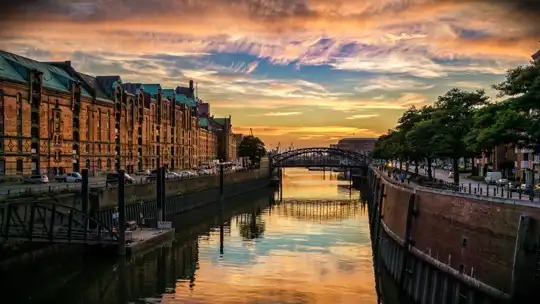
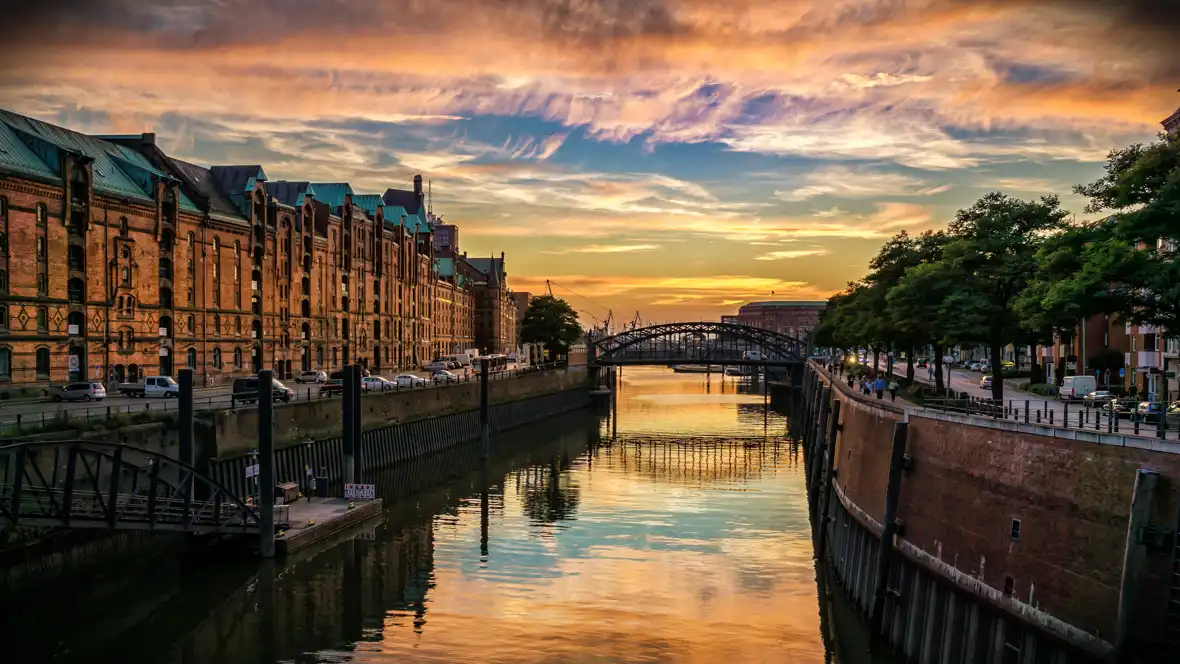
  • Hamburg Speicherstadt & Elbphilharmonie Plaza: Ports run on tides and timetables; use an HVV day ticket and ride Ferry 62 for a cheap harbor loop, hopping piers like a local instead of paying for a tour. Book a free Elbphilharmonie Plaza slot and hit blue hour when cranes click and the river turns to polished steel. In the brick canyons, you catch diesel on the wind and fresh coffee roasting from a warehouse. Off the map: Wilhelmsburg’s canals, Alte Elbpark tunnels, Sunday Fish Market at dawn—my favorite is the ferry at first light.
Spotted a mistake or missing a highlight? Contact us.

But Germany offers more...

Discover and compare all of its highlights per category

🧭 RoutesLogical itineraries covering the highlights

The 7-Day Bavarian Alps & Castles Loop

The Vibe: A one-region deep dive built around Munich and the Bavarian Alps, with a relaxed pace that trades cross-country sprints for mountain air, lakes, and storybook castles. Expect short train rides, long walks, and evenings in compact old towns rather than big-city nightlife.
The Highlights:
  • Munich’s cultural core, including the Deutsches Museum and BMW Museum and BMW Welt
  • Füssen as a base for Neuschwanstein Castle and alpine foothill walks
  • Garmisch-Partenkirchen’s mountain-town feel and a day trip up to Zugspitze

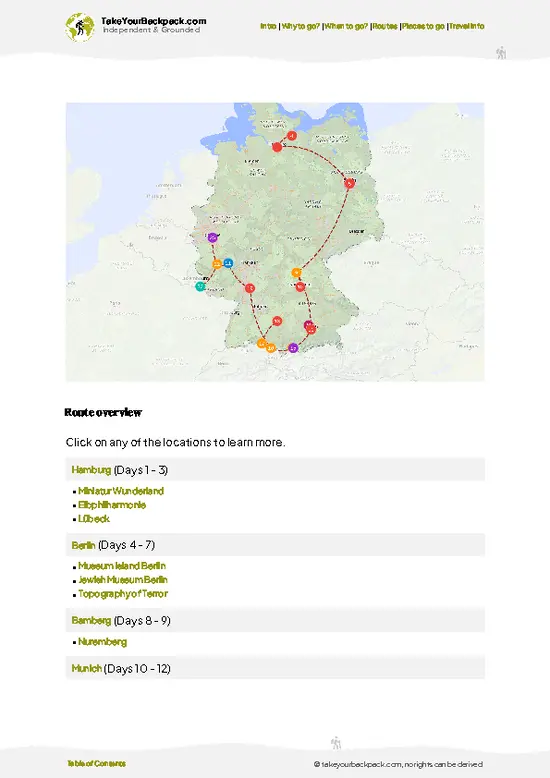
The 14-Day Berlin, Elbe Cliffs & Rhine-Moselle Route

The Vibe: A balanced two-week sweep from Berlin’s museums and memorials to Saxon sandstone cliffs and the castle-lined Rhine and Moselle valleys. You’ll mix high-speed trains with scenic regional rides, keeping a medium pace that still leaves room for riverside evenings and café time.
The Highlights:
  • Berlin’s Museum Island Berlin, Pergamon Museum, and key historical sites like the Topography
read more 👉

The 7-Day Bavarian Alps & Castles Loop

The Vibe: A one-region deep dive built around Munich and the Bavarian Alps, with a relaxed pace that trades cross-country sprints for mountain air, lakes, and storybook castles. Expect short train rides, long walks, and evenings in compact old towns rather than big-city nightlife.
The Highlights:
  • Munich’s cultural core, including the Deutsches Museum and BMW Museum and BMW Welt
  • Füssen as a base for Neuschwanstein Castle and alpine foothill walks
  • Garmisch-Partenkirchen’s mountain-town feel and a day trip up to Zugspitze

The 14-Day Berlin, Elbe Cliffs & Rhine-Moselle Route

The Vibe: A balanced two-week sweep from Berlin’s museums and memorials to Saxon sandstone cliffs and the castle-lined Rhine and Moselle valleys. You’ll mix high-speed trains with scenic regional rides, keeping a medium pace that still leaves room for riverside evenings and café time.
The Highlights:
  • Berlin’s Museum Island Berlin, Pergamon Museum, and key historical sites like the Topography of Terror Documentation Center and Jewish Museum Berlin
  • Dresden paired with a hiking day in Saxon Switzerland and a taste of the Malerweg
  • Slow travel through the Rhine Valley and Rhine Gorge, then on to Cochem in the Moselle Valley
  • Big-city finales in Cologne and Heidelberg with Cologne Cathedral and Heidelberg Castle

The 21-Day Grand Germany: Capitals, Trails & River Valleys

The Vibe: A three-week, full-bodied journey that stitches together Berlin, Saxon Switzerland, Munich, the Bavarian Alps, Bodensee, and the Rhine-Moselle wine country into one continuous arc. It’s designed for travelers who want variety—city culture, long-distance trail sections, lakeside downtime, and castle-studded river bends—without turning every day into a race.
The Highlights:
  • Deep time in Berlin with Museum Island Berlin, Pergamon Museum, Topography of Terror Documentation Center, Jewish Museum Berlin, plus a day in Potsdam’s Sanssouci Palace and Park
  • Multi-day hiking focus around Saxon Switzerland and the Malerweg
  • Munich’s museums, a visit to Dachau Concentration Camp Memorial Site, and alpine days in Garmisch-Partenkirchen with Zugspitze
  • Lakeside living around Bodensee in Meersburg, Konstanz, and Lindau, followed by a castle-and-vineyard finale in the Rhine Valley, Rhine Gorge, Cochem, and Cologne Cathedral
🌍 Want a ready-to-use travel plan for Germany?
The overview above compares different route options based on your travel time and style. The complete Travel Guide breaks each itinerary down in detail, including maps, stops, highlights, and transport information.

Explore all route details 👉

Get the Travel Guide -

🌤️ When to go?Weather, seasons, and timing

Late May to mid-June, then again mid-September (skipping Munich during its beer weeks) is the sweet spot. Here’s the logic: daylight runs long, mid-elevation Alpine trails and huts open as snow retreats, and beer gardens switch to daily hours—yet German school holidays haven’t fully detonated train loads or hostel prices. Storms pop, but less violently than July’s convective fireworks, so you keep mileage without sprinting for shelter every afternoon. By mid-September, schools are back, the air turns crisp, and harvest towns hum without tour-bus choke points. Long-distance fares and beds drift back toward shoulder rates, campsites still accept late walk-ins, and you’re not playing standing-room roulette on the fast trains.
  • Peak Summer: It’s a grind—school breaks pack the ICE corridors, beds can double compared to May, and city stone radiates heat into the night. But the payoff is real: full hut-to-hut access and the longest trail days of the year. River swims wash off the sweat, lifts run, kiosks are open on passes, and the alpine is fully “on.” Narrow window: high routes like the Heilbronner Weg usually go snow-free only in July-August.
  • Early Autumn Shoulder: The country downshifts; grape bins roll out, day-tripper volume relaxes, and you move faster—shorter queues, easier train seating, cheaper walk-up beds. Trails dry, wasps fade, and the light gets sharp without killing warmth. Ferries on the lakes still run regular schedules, and you can string valley towns without timetable gymnastics. For a few weeks, Federweißer stalls appear along the Rhine and Mosel—hike, then sip the cloudy new wine with onion tart the locals inhale while it lasts.
  • Winter Off-Peak: Germany turns inward. Forests go quiet, half-empty hostels become reading rooms, and city museums are yours. Cold tests your systems more than your legs; plan short daylight, bundle windproof over wool, and aim for sauna hostels when you can. Survival hack: pack microspikes—thaw-freeze cycles glaze cobbles and castle steps even when streets look cleared.

Personal tip: I book July-August long-distance trains and any Alpine huts early, then carry a compressible down layer year-round so I can pivot into September’s chill without rebuying gear.

source: climatestotravel.comJANJanuary: fair for travelingFEBFebruary: fair for travelingMARMarch: good for travelingAPRApril: good for travelingMAYMay: highly recommended for travelingJUNJune: excellent for travelingJULJuly: good for travelingAUGAugust: good for travelingSEPSeptember: excellent for travelingOCTOctober: highly recommended for travelingNOVNovember: fair for travelingDECDecember: fair for traveling
📅 Traveling in a specific month?
Get a full month-by-month breakdown of weather, crowds, costs, festivals, and seasonal highlights in the complete travel guide.

Get full details when to go 👉

Get the Travel Guide -
!germany - pixabay - hamburg-3846525

💰 Costs (as of 2026)Travel costs in Germany

€60-80 per day if you sleep in dorms, eat supermarket-heavy, and ride regional trains/buses; cheaper than France/Netherlands and Scandinavia, pricier than Poland/Czech.
  • dorm accommodation: €20-35 in smaller cities and the east; €30-45 in Berlin/Hamburg/Cologne; Munich jumps to €60-90+ during Oktoberfest or trade fairs. System tip: check city events (Messe weeks send prices vertical) and target Sun-Thu. Many hostels add €2-5 for sheets or city tax—factor it in. Relative value: beds run a bit less than Paris/Amsterdam, more than Prague/Kraków. I’ve saved real money by booking cancellable beds, then rechecking a week out as business travel softens midweek.
  • meals: Supermarket Survival: €6-10/day buys bakery breakfast (pretzel or belegtes Brötchen €1-3), picnic lunch, and a discount-brand dinner from Aldi/Lidl/Rewe. Street food reality: döner €4-7, currywurst €3-5, bakery lunch deals €4-6; a sit-down Mittagsangebot is often €7-12. Beer: €0.80-1.20 from a supermarket vs €4-6 in a bar; coffee is €1.50 at a bakery vs €3-4 to-go stands. Tap water is safe but not a default at restaurants; bottled “Tafelwasser” adds €2.50-5 to the bill. Cheaper than France/Netherlands to eat casually; more than
read more 👉
€60-80 per day if you sleep in dorms, eat supermarket-heavy, and ride regional trains/buses; cheaper than France/Netherlands and Scandinavia, pricier than Poland/Czech.
  • dorm accommodation: €20-35 in smaller cities and the east; €30-45 in Berlin/Hamburg/Cologne; Munich jumps to €60-90+ during Oktoberfest or trade fairs. System tip: check city events (Messe weeks send prices vertical) and target Sun-Thu. Many hostels add €2-5 for sheets or city tax—factor it in. Relative value: beds run a bit less than Paris/Amsterdam, more than Prague/Kraków. I’ve saved real money by booking cancellable beds, then rechecking a week out as business travel softens midweek.
  • meals: Supermarket Survival: €6-10/day buys bakery breakfast (pretzel or belegtes Brötchen €1-3), picnic lunch, and a discount-brand dinner from Aldi/Lidl/Rewe. Street food reality: döner €4-7, currywurst €3-5, bakery lunch deals €4-6; a sit-down Mittagsangebot is often €7-12. Beer: €0.80-1.20 from a supermarket vs €4-6 in a bar; coffee is €1.50 at a bakery vs €3-4 to-go stands. Tap water is safe but not a default at restaurants; bottled “Tafelwasser” adds €2.50-5 to the bill. Cheaper than France/Netherlands to eat casually; more than Czech/Poland. I once planned a Sunday shop and ate dry muesli instead—most supermarkets close Sundays; stock up Saturday.
  • local transport: Cheapest unlock: the Deutschlandticket (~€49/month) covers all local/regional trains, trams, and buses nationwide (no ICE/IC/FlixTrain). Break-even if you’re in cities plus 2-3 regional day trips. For day blitzing, Ländertickets (state day passes) crush costs for pairs/groups: valid after 9:00 on weekdays, all day weekends; price per person drops to single digits when five share. Long hops on the cheap: FlixBus or Sparpreis ICE booked early; otherwise stick to regional chains. Relative value: far better deal than France/Netherlands without railcards, less dirt-cheap than Poland’s buses.
  • activities: Cost drivers: castles (e.g., Neuschwanstein ~€18 plus shuttle), cable cars in the Alps (€25-60), thermal spas (€20-40 for 2-4 hours), stadium tours (€15-25), river cruises on the Rhine (€15-25 short legs), museum clusters (Berlin day pass ~€19). Free/low-cost: memorials (Dachau free; audio guide small fee), city parks, lake swims, church towers €3-6. Compared to Austria/Switzerland, lifts and spas feel reasonable; compared to Prague/Kraków, museums sting more.
  • miscellaneous: Budget Leaks: paid toilets (€0.50-1), lockers at stations (€4-8), laundry (€4-6 wash, €3-4 dry), Christmas market mug deposits (€2-4 Pfand), bottle deposits (€0.25 single-use—return them), and “dynamic currency conversion” on cards—always decline it. Cash-only holdouts are fading, but small bakeries may balk at micro-payments. Tourist taxes add €1-5/night. Spätis charge convenience markups. Relative value: leaks are gentler than Scandinavia, harsher than Poland. I’ve “found” €6 in a day just by returning bottles and skipping station coffee.
⚠️ Prices can change and everyone travels differently, so take this as a rough guide. Hope it helps you plan your adventure!

✈️ The backpacker research shortcutGermany Travel Guide

An offline-friendly backpacking guide with optimized travel routes, ranked highlights, transport advice, and the best areas to stay.
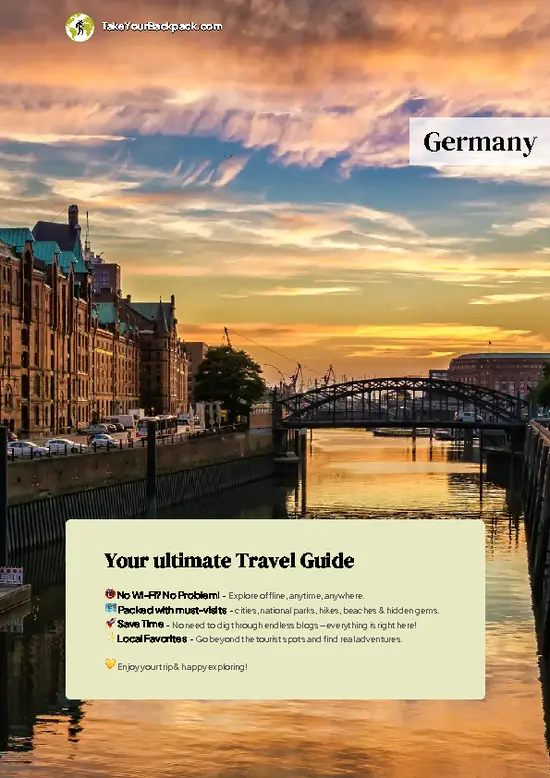
example page 0 from our offline Travel Guide for Germanyexample page 1 from our offline Travel Guide for Germanyexample page 2 from our offline Travel Guide for Germanyexample page 3 from our offline Travel Guide for Germanyexample page 4 from our offline Travel Guide for Germanyexample page 5 from our offline Travel Guide for Germanyexample page 6 from our offline Travel Guide for Germanyexample page 7 from our offline Travel Guide for Germany
The digital guide (531 pages) contains:
142 highlights, ranked by travel appeal
Optimized 7, 14 & 21-day travel routes
Cities, national parks, beaches, historical sites, ...
How to get around
Offline-friendly for travel without Wi-Fi
👉 Click to see all 30+ guide features

📅 Plan smarter in minutes, not weeks
Month by month travel advice
Festivals & national holidays
Budget expectations

🗺️ Go to the right places, skip the overrated ones
Honest pros & cons of destinations
Top hikes, parks & viewpoints
Lesser-known places most travelers miss
Clear “worth it vs skip it” guidance

🛏️ Travel smoothly without rookie mistakes
Best areas to stay
Transport systems explained simply
Common scams & safety advice
SIM cards, money & practical tips

🌍 Understand the country, not just visit it
Culture & traditions
52 Essential phrases & customs
Festivals worth planning around
Traveler-friendly historical context
Insights that make places more meaningful

📱 Built for real travel conditions
Fully downloadable PDF
Works completely offline
Optimized for phone use
Useful in remote areas & buses
Everything in one place
Save weeks of stressful planning
Get instant access to the full guide directly. 30-day money-back guarantee.


Sent to your inbox immediately after payment • 100% Secure Checkout
Best Backpacking Travel Advisor 2025 tourism awardBest Backpacking
Travel Advisor
2025
What others say about Take Your Backpack Guides:
⭐⭐⭐⭐⭐
Fantastic, amazing amount of information!
⭐⭐⭐⭐⭐
My goodness this is amazing, it's what I've been looking for hats off too you!
⭐⭐⭐⭐⭐
I think this is absolutely BRILLIANT
⭐⭐⭐⭐
Very complete and informative. It's still missing places, but I gotta to commend you
⭐⭐⭐⭐⭐
This is truly amazing, thank you, can't wait to explore it with my kids!
⭐⭐⭐⭐⭐
Awesome resource, thank you!
⭐⭐⭐⭐⭐
This is amazing! Can't wait to explore the ones I haven't seen
⭐⭐⭐⭐
I love this! Well done, great idea.
⭐⭐⭐⭐⭐
Thanks for taking the time to make this gem!
⭐⭐⭐⭐⭐
This might be the best website I've ever seen.
⭐⭐⭐⭐⭐
Congratulations, and thank you so much for your work; it's incredibly valuable.
⭐⭐⭐⭐
In all seriousness I think you did a great job pointing out the important spots
⭐⭐⭐⭐⭐
10/10 very good
⭐⭐⭐⭐⭐
As someone who's only just starting to visit regularly this is awesome, thank you.
⭐⭐⭐⭐
Thank you very much! I'm going to visit my dad, it's going to be very useful!
⭐⭐⭐⭐⭐
This is really cool! We'll be travelling for the first time and this definitely come in handy.
⭐⭐⭐⭐⭐
You are now our minister of culture, congratulations 👨‍💼
⭐⭐⭐⭐⭐
Just wanted to tell you that this is a pearl! Going to follow your recommendations.
⭐⭐⭐⭐⭐
This is so cool. I'll definitely be using the resource for my travels soon.
⭐⭐⭐⭐⭐
This is very impressive! Good work.
⭐⭐⭐⭐⭐
This is an amazing and informative site. Very well done!

🛏️ Where to stay?Best areas to base yourself

Yes — Germany has abundant hostels or budget accommodation in every major city, concentrated in central and nightlife neighborhoods.

Top clusters are central districts and creative quarters: Berlin (Mitte, Kreuzberg, Friedrichshain) and Hamburg (St. Pauli, St. Georg) give the best mix of cheap beds, late‑night bars, and direct access to sights; Munich (Altstadt, Maxvorstadt, Schwabing), Cologne (Altstadt, Ehrenfeld) and Frankfurt (Bahnhofsviertel, Sachsenhausen) concentrate options near transport hubs and attractions but can be pricier and noisier.

Choose central neighborhoods for shortest transit … read more 👉
Yes — Germany has abundant hostels or budget accommodation in every major city, concentrated in central and nightlife neighborhoods.

Top clusters are central districts and creative quarters: Berlin (Mitte, Kreuzberg, Friedrichshain) and Hamburg (St. Pauli, St. Georg) give the best mix of cheap beds, late‑night bars, and direct access to sights; Munich (Altstadt, Maxvorstadt, Schwabing), Cologne (Altstadt, Ehrenfeld) and Frankfurt (Bahnhofsviertel, Sachsenhausen) concentrate options near transport hubs and attractions but can be pricier and noisier.

Choose central neighborhoods for shortest transit to highlights at the cost of noise and higher rates; pick edge or creative districts for lower prices, more local character and better nightlife, but expect longer tram rides and variable quietness and safety after midnight.

If you enjoy meeting fellow travelers, consider choosing hostels with high ratings for atmosphere. On the other hand, if you prefer having your own space, a hotel might be a better option.

🚌 Getting aroundWhat moving around is really like

Germany moves like a timetable with a heartbeat. The clock matters, but so does instinct. Platforms flip at the last second, doors only open if you ask them to, and the fastest line is not always the winning play. Treat the network like a layered grid: high-speed spines for distance, regional arteries for price, local capillaries for precision. Once you see the pattern, transfers stop feeling risky and start feeling like leverage.
  • ICE (InterCity Express) The Efficiency Trade-off: This is the spine.
read more 👉
Germany moves like a timetable with a heartbeat. The clock matters, but so does instinct. Platforms flip at the last second, doors only open if you ask them to, and the fastest line is not always the winning play. Treat the network like a layered grid: high-speed spines for distance, regional arteries for price, local capillaries for precision. Once you see the pattern, transfers stop feeling risky and start feeling like leverage.
  • ICE (InterCity Express) The Efficiency Trade-off: This is the spine. 250-300 km/h when the rails are clear, city-center to city-center. You pay for speed and certainty, especially same-day. Book weeks out for sub-€25 Super Sparpreis and accept rigidity; buy late and you’re funding the engine oil. Seat reservations cost a few euros and are worth it on Fridays or holidays unless you enjoy sitting on the floor by the vestibule. Sprinter runs skip more stops but leave you fewer bailout points. Build 15-20 minutes of buffer for connections; Germany is punctual by culture, not by guarantee.
  • U-Bahn, S-Bahn, and Trams The Social Fabric: No turnstiles, but inspectors appear like ninjas. Validate paper tickets where stampers exist; a QR on your phone is already timestamped. Step right on escalators, let riders exit before you board, and tap the door button or the train waits like a stubborn cat. Keep voices low, no speakerphone, backpack off your back in crowded cars, and feet off seats. Bikes ride off-peak only and in marked cars. Priority seats are not decorative. If you flow with these norms, the city melts open for you.
  • Long-Distance Buses The Budget Disruptor: When the rails price you out, buses undercut hard. FlixBus and friends stitch second-tier cities with direct runs for pocket change on off-hours. The trade: autobahn traffic, odd stations on the edge of town, Wi-Fi that lies, and luggage fees if you get cute. Night routes can replace a hostel night and dump you downtown at dawn. Choose departures that avoid rush-hour ring roads and pad arrivals if you’ve got a train to catch afterwards.
  • Bicycle + Train Combo The Geometric Unlock: Bikes reach what schedules ignore—river campsites, vineyard lanes, Baltic beaches, Black Forest huts. Germany’s Radwege are real infrastructure, not aspirational paint. Pair them with regional trains and you stitch rural gaps without renting a car. Buy a Fahrradkarte where required; IC/ICE usually need a bike reservation, RE/RB is first-come space in marked wagons. Avoid city tram tracks, ride off-peak, and strap bags so they don’t rocket on braking. This is how you turn maps into terrain.

Master tip: Take the earliest departure for your longest leg and protect it with a single 20-minute buffer at a mid-size hub—delays snowball after lunch, and that one early anchor makes the whole country run in your favor.
Berlin Brandenburg Airport (BER) sits about 20 km (12 mi) southeast of central Berlin (think Alexanderplatz/Mitte). Getting into town is easy and cheap.

Main public transport options
  • Airport/Regional trains (FEX and RE lines) - Trains run from the station beneath Terminal 1-2 to key central stations such as Gesundbrunnen, Berlin Hbf (main station), and Ostkreuz. Frequency every 10-20 minutes. Approx. travel time: 25-35 minutes to the city center. Typical cost: Berlin ABC single ticket €4.40 (2025 prices).
  • S-Bahn S9 (urban rail) - Direct from BER to Ostkreuz, then through Ostbahnhof, Alexanderplatz, Friedrichstraße, and Hauptbahnhof. Frequency every 10 minutes most of the day. Approx. travel time: 35-45 minutes to Alexanderplatz/Hbf. Typical cost: ABC single €4.40.
  • Bus + U-Bahn - Take X7 or X71 from the terminal to U Rudow (U7), then continue by U-Bahn toward Neukölln/Kreuzberg/Charlottenburg or transfer onward. Frequency every 5-10 minutes. Approx. travel time: 45-60 minutes to central areas. Typical cost: ABC single €4.40.

Tickets and payment
One ABC ticket covers all these options (train, S-Bahn, U-Bahn, bus). Buy at the airport station ticket machines or in the BVG app; validate paper tickets before boarding S-/U-Bahn. A 24-hour ABC ticket is good value if you’ll ride more that day. Children under 6 travel free.

Taxi and ride-hailing
Taxis queue outside Terminal 1-2. To Mitte/Alexanderplatz expect roughly 35-50 minutes depending on traffic. Typical fare: €45-€65. Card payment is widely accepted. Ride-hailing apps (Uber, Bolt, FREE NOW) are available and can be similar or a bit cheaper off-peak.
⚠️ Prices and routes can change, so take this as a rough guide and ask for local advice when you arrive.

🔒 Safety (risk Level: low)Common concerns and things to watch out for

Safety for solo travelers, including women and LGBTQ+ individuals
Germany is generally safe for solo travelers, including women and LGBTQ+ individuals. Cities like Berlin and Munich are known for their welcoming and inclusive atmospheres. While public transport is reliable, stay aware of your surroundings, especially at night. Always trust your instincts and avoid poorly lit or deserted areas.


Full official government travel advisory (live updates)
View details 👉

✈️ VisaVisa requirements for Germany

If you’re a citizen of the EU, US, Canada, Australia, New Zealand, or Japan, you can enter Germany without a visa for up to 90 days. For other nationalities, check the German embassy website for specific requirements and apply for a Schengen visa if necessary. Applications usually involve submitting a form, passport photos, and proof of travel insurance.

source: germany.info
⚠️ Visa requirements can change over time, so always check the latest visa requirements with the official embassy or government website before you travel.

🎒 What to pack?What you'll need while traveling

Germany’s climate can be a mixed bag, especially if you’re hopping from the breezy North Sea coast to the snow-kissed Bavarian Alps. Think layers—you’re going to want to be ready for anything from a chilly drizzle in Berlin to the crisp, sunny days in Munich. Cities are super walkable, so comfy shoes are a must; but leave the flip-flops for the hostel showers unless you’re hitting a lake. While Germans are pretty laid-back about clothing, remember that some churches and traditional events might call for a bit more coverage, so a modest option in your pack isn’t a bad idea. Oh, and don’t underestimate the power of a good rain jacket—weather forecasts here can be optimistic at best!

Apart from this country specific advice, I have also crafted a general packing list that should help on any trip. authorOver the years, I've learned the importance of packing minimally. It's so much easier to jump on the back of a truck or squeeze yourself into the last spot of a minibus without that supersized backpack. If you're headed to a warm destination, leave your winter jacket at home; for colder regions, opt for thin thermal underlayers. Instead of packing your entire wardrobe, bring just three sets of clothes, as laundry facilities are available everywhere.
View the full list 👉
🎒 Planning the practical side of your trip?
Get detailed information on transport, daily budgets, internet access, local customs, food, language, and other essentials in the complete Travel Guide.

Get detailed practical information 👉

Get the Travel Guide -

🙋 FAQFrequently asked questions

Trip Planning


Personal tip: I normally search on good rating for atmosphere (for meeting people) and location (for easy exploring). Cleanliness as a bonus.


Travel Essentials

Routine vaccinations are typically sufficient for Germany. Ensure you’re up-to-date on:

- MMR (Measles, Mumps, Rubella)
- Diphtheria, Tetanus, and Pertussis (DTaP)
- Varicella (Chickenpox)
- Polio
- Annual flu shot

Consider Hepatitis B if you might get a tattoo or piercing. Tick-borne encephalitis (TBE) is recommended if you plan to hike or camp in rural areas. Always check recent health advisories before you travel.


vaccination requirements
When I first started traveling, I often spent part of my first day in a new country hunting for a local SIM card. While this can still be slightly cheaper, it also takes time and planning.

These days, it's much simpler to install an eSIM before leaving home. Once you arrive in Germany, you can activate it immediately and have mobile data from the moment you land — which is especially useful for ordering transport or navigating away from busy airports.

There are many providers nowadays, and price differences are usually small. I personally go with Airalo, as it offers excellent network coverage throughout the country and strong global coverage, so you can manage multiple countries from a single app.


Get your e-sim for Germany

Culture & Customs

Punctuality is key in Germany. Always arrive on time for meetings or social gatherings. A firm handshake with eye contact is the standard greeting. Use formal titles and last names unless invited to use first names.

In restaurants, tipping around 5-10% is customary. Cash is often preferred, so carry some with you.

For LGBTQ+ travelers, Germany is generally accepting, but discretion is advised in smaller towns. Women should feel safe traveling solo, though standard travel precautions apply, especially at night.

Avoid discussing World War II unless it’s brought up by locals. Refrain from jaywalking, as it’s frowned upon and can result in fines.
Trying traditional food is always a great way to experience the culture. Here are some must-try dishes for Germany.
  • Sauerbraten: A pot roast usually made with beef, marinated in a mixture of vinegar or wine, water, and a variety of seasonings before being slow-cooked. It’s a hearty dish that’s a staple in German home cooking and showcases the country’s love for robust flavors.
  • Bratwurst: These grilled sausages are a street food favorite and come in several regional varieties, each with its unique spices and herbs. They’re typically served with mustard and a bread roll, making them a quick and satisfying bite.
  • Schnitzel: A breaded and fried meat cutlet, usually made with pork or veal. While originally Austrian, schnitzel is a beloved dish in Germany and often served with potato salad or fries, reflecting the country’s penchant for simple but flavorful meals.
  • Rouladen: Thinly sliced beef wrapped around fillings like onions, bacon, pickles, and mustard, then braised. This dish is traditionally served on Sundays or special occasions, highlighting its role in family gatherings and festive meals.
  • Spätzle: A type of soft egg noodle found in the Swabian region, often served as a side dish or topped with cheese and onions for a comforting main course. It’s a great example of how German cuisine excels at hearty, satisfying carbs.
Tap water in Germany is very safe to drink, and locals consume it regularly. It’s perfectly fine for tourists to drink straight from the tap. No need for bottled or filtered water unless you prefer a specific taste.
The main language in Germany is German. Backpacking is way more rewarding if you know a bit of the local language, so I'd suggest brushing up on the basics just in case your German skills have become a bit rusty.

Want to understand locals better?
The complete Travel Guide for Germany includes 52 essential words and phrases — greetings, thank-yous, ordering food, transport, numbers, and common local expressions you'll actually hear.

Get your local basic phrases 👉

Get the Travel Guide -


In Germany, English is widely spoken, particularly in urban areas, tourist destinations, and among younger generations. Most Germans, especially those under 40, have learned English in school and are comfortable using it in conversation. Major cities like Berlin, Munich, and Frankfurt have a high concentration of English speakers, and many restaurants, hotels, and shops cater to international visitors with English menus and signage.

In contrast, rural areas may have fewer English speakers, and communication can be more challenging. Nonetheless, Germans are generally accommodating and often willing to help, even if their English is limited. It’s also common for people to switch to English if they notice a visitor struggling with German.

While English proficiency is high, learning a few basic German phrases can enhance your travel experience and is appreciated by locals. Overall, travelers should find navigating Germany relatively easy thanks to the widespread use of English, but being open to using German can enrich interactions.

Money & Payments

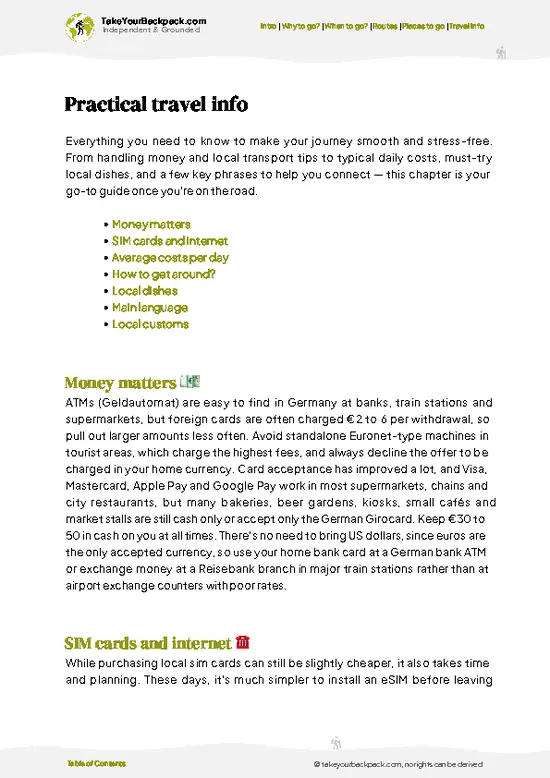
The local currency of Germany is EUR (€).

ATMs: Germany is well-equipped with ATMs, and you’ll find them in most towns and cities. They’re your best bet for getting euros at a decent rate. Just make sure your bank doesn’t charge hefty foreign transaction fees.

Cash vs. Card: While major cities are quite card-friendly, smaller towns and traditional eateries prefer cash. Always have some euros on hand for small purchases or emergencies.

Currency: Forget about dollars; bring euros or withdraw from an ATM. Exchanging cash is becoming a rarity, and exchange booths often offer poor rates.

Card Acceptance: Germany loves its ”EC Karten” (debit cards), but don’t stress—Visa and Mastercard are usually accepted at hotels, restaurants, and larger shops. American Express? Not so much.

Exchanging Money: If you must exchange cash, do it at a bank rather than airport kiosks. Rates are typically better, though ATMs usually give you the best deal.

In Germany, tipping is less obligatory than in the U.S., but rounding up the bill or adding about 5-10% is appreciated for good service. Hand the tip directly to your server instead of leaving it on the table. Always check if a ”Bedienung” (service charge) is already included in the bill.

🧩 Nearby countriesSimilar backpacking destinations

📸 PhotosTravel photos from Germany

Take your backpack - Germany - 0
Take your backpack - Germany - 1
Take your backpack - Germany - 2
Take your backpack - Germany - 3
Take your backpack - Germany - 4
Take your backpack - Germany - 5
Take your backpack - Germany - 6
Take your backpack - Germany - 7
Take your backpack - Germany - 8
Take your backpack - Germany - 9
Photographed by: Johan Kruseman

We 💚 feedbackFinal notes for travelers

Go for the network. Germany links big museums, half-timber towns, and trailheads into one grid, so you can pivot from Roman ruins to a Black Forest ridgewalk on a single day ticket and a short bus hop. The catch is rail reliability: delays and weekend engineering are common. Win the system by padding transfers 20–30 minutes, traveling early, defaulting to regional trains on the nationwide pass, and watching platform changes in the DB app like a hawk; I’ve salvaged tight days doing exactly that. The arc is positive: more unified ticketing, expanding bike space on trains, and a revived night-train map are all rolling forward, making it easier to stitch longer, cleaner routes without renting a car.

✈️ When did I visit Germany?
Being a neighbouring country of my home base, I visited Germany many times. Since then, this guide is regularly updated based on feedback from locals and recent backpackers (last update: 6 February 2026)

✍️ Help improve this page!
The information on this page is based on my own backpacking experience in Germany, supplemented with up-to-date research and feedback from other travelers. Travel details can change, so if you notice anything outdated or incomplete, feel free to let me know.


🙋‍♂️ Give feedback

👋 Meet the founderWho’s Behind Take Your Backpack?

Johan, backpacker and founder of TakeYourBackpackHi, I’m Johan (Netherlands 🇳🇱), the creator of TakeYourBackpack. Over the past decade, I’ve backpacked through 80+ countries across six continents, gaining extensive experience with independent travel, long-term trips, and overland routes.

This site is built on a combination of firsthand travel experience and carefully curated insights from other backpackers. Many guides are based on places I’ve personally visited, while others bring together tips, observations, and practical advice shared by trusted travelers I’ve met along the way.

The goal is to provide realistic, experience-driven guidance — not generic itineraries — so you can explore destinations with better context, clearer expectations, and more confidence.

Get full Germany guide •
Instant download • 142 highlights • Full Offline guide