Trip Planning
The TakeYourBackpack guidebooks are your all-in-one travel companion, featuring the best cities, national parks, hikes, beaches, and unique sites, along with essential tips on when to go, how to get around, exchanging money, and even local phrases to get you started — everything you need for a smooth, unforgettable backpacking adventure.
Stop researching. Start exploring.Discover all 103 highlights,ranked
and organized into practical routes.
Get instant access
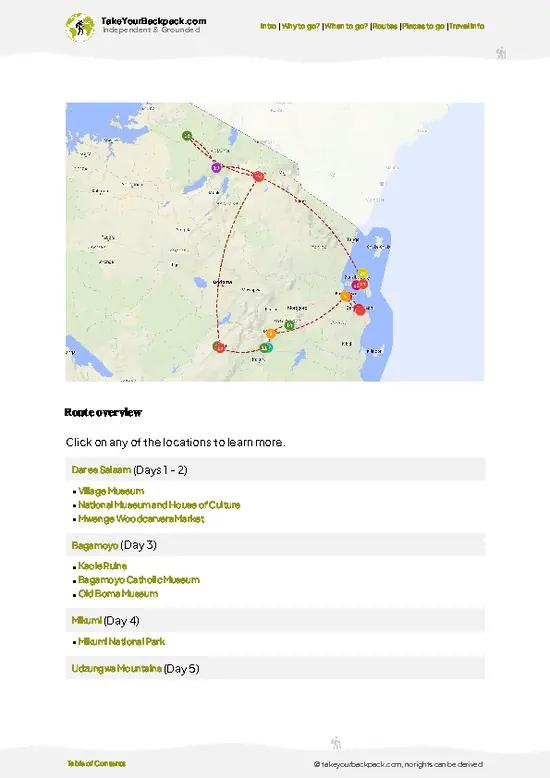
Planning a backpacking route through Tanzania can be tricky — you need to balance must-see places, travel times, budget, and how long to stay in each destination. Our free personalized Tanzania itinerary planner creates a route based on your travel style, trip duration, and interests, so you can spend less time researching and more time exploring.
Personal tip: I normally search on good rating for atmosphere (for meeting people) and location (for easy exploring). Cleanliness as a bonus.
Travel Essentials
For Tanzania, a yellow fever vaccination certificate is required if you arrive from, or have transited for more than 12 hours through, a country with yellow fever risk, and it may be requested when traveling on to Zanzibar. Make sure routine vaccines (measles, tetanus, diphtheria, polio) are up to date, and get hepatitis A and typhoid shots, which are recommended for nearly all travelers. Hepatitis B, rabies and cholera vaccines are worth considering for longer trips, rural travel or contact with animals. Malaria is present in most of the country below about 1,800 meters, including Zanzibar, so ask a travel clinic about antimalarial tablets 4 to 6 weeks before you go.
vaccination requirementsWhen I first started traveling, I often spent part of my first day in a new country hunting for a local SIM card. While this can still be slightly cheaper, it also takes time and planning.
These days, it's much simpler to install an eSIM before leaving home. Once you arrive in Tanzania, you can activate it immediately and have mobile data from the moment you land — which is especially useful for ordering transport or navigating away from busy airports.
There are many providers nowadays, and price differences are usually small. I personally go with
Holafly, as it offers excellent network coverage throughout the country and strong global coverage, so you can manage multiple countries from a single app.
HolaFly eSimCulture & Customs
In Tanzania, modest dress is expected, and on Zanzibar and the Swahili coast that means covering shoulders and knees away from the beach; swimwear belongs only at resorts and beaches. Use your right hand to eat, give money or pass objects, since the left hand is considered unclean. Always ask before photographing people, particularly Maasai, who may request a small fee, and never photograph police, military sites, government buildings or the president’s motorcade. Public displays of affection are frowned upon for everyone, and same-sex affection can attract serious trouble, so LGBTQ+ travelers should keep things discreet. During Ramadan, avoid eating, drinking or smoking in public in Muslim areas during daylight. Respect elders by letting them speak first and be patient, because rushing people or showing anger in public causes loss of face. Women should dress conservatively in rural villages.
Trying traditional food is always a great way to experience the culture. Here are some must-try dishes for Tanzania.
- Ugali: A stiff, white maize porridge shaped by hand into balls and used to scoop up stews and greens. It is the everyday staple across the country, and most Tanzanians would say a meal without it hasn’t really been dinner.
- Nyama Choma: Goat or beef grilled slowly over charcoal, served with salt, chili and kachumbari (tomato and onion salad). It is the social food of weekends and celebrations, eaten with friends over cold beers.
- Chipsi Mayai: French fries cooked into an omelet, finished with tomato sauce or chili. This cheap, filling street food appears at roadside stalls nationwide and is the classic late-night meal.
- Pilau: Rice cooked in broth with cumin, cardamom, cloves and cinnamon, often with beef or chicken. It reflects centuries of Swahili coast trade with Arabia and India and is a fixture at weddings and Eid feasts.
- Mishkaki: Marinated beef or chicken skewers grilled over coals at evening street stalls. They are a favorite snack at night markets and sold everywhere for small change.
- Zanzibar Pizza: A thin dough wrapped around minced meat, onion, egg and cheese (or banana and chocolate) and fried on a griddle. It is the signature dish of Stone Town’s Forodhani Gardens night market.
- Mtori: A creamy soup of green bananas mashed with beef. It comes from the Chagga people around Kilimanjaro and is a comforting staple in the northern highlands.
- Wali na Maharage: Rice with beans simmered in coconut milk. This cheap, hearty plate turns up at local canteens all over Tanzania and is the go-to lunch for workers and students.
Tap water in Tanzania is not safe to drink, and most locals boil or filter it or buy bottled water themselves. Travelers should stick to sealed bottled water, which costs around TSh 1,000 to 1,500 (US$0.40 to 0.60) for a 1.5-liter bottle, or use a filter bottle or purification tablets. Brush your teeth with treated water and skip ice at street stalls.
The main language in Tanzania is
Swahili. Backpacking is way more rewarding if you know a bit of the local language, so I'd suggest brushing up on the basics just in case your Swahili skills have become a bit rusty.
Want to understand locals better?The complete Travel Guide for Tanzania includes 52 essential words and phrases — greetings, thank-yous, ordering food, transport, numbers, and common local expressions you'll actually hear.
Get your local basic phrases 👉
Get the Travel Guide - is one of Tanzania’s official languages alongside Swahili, and you can get by with it in Dar es Salaam, Arusha, Moshi and Zanzibar’s Stone Town, where hotel staff, safari guides and tour operators speak it well. Younger, educated Tanzanians and hostel staff usually handle conversation comfortably. In rural villages and on local dala-dalas, English thins out fast and Swahili does all the work. Learn a handful of Swahili phrases such as “asante” (thank you), “bei gani” (how much) and “pole pole” (slowly), and download Swahili for offline use in Google Translate.
Money & Payments
The local currency of Tanzania is TZS (Tanzanian Shilling).
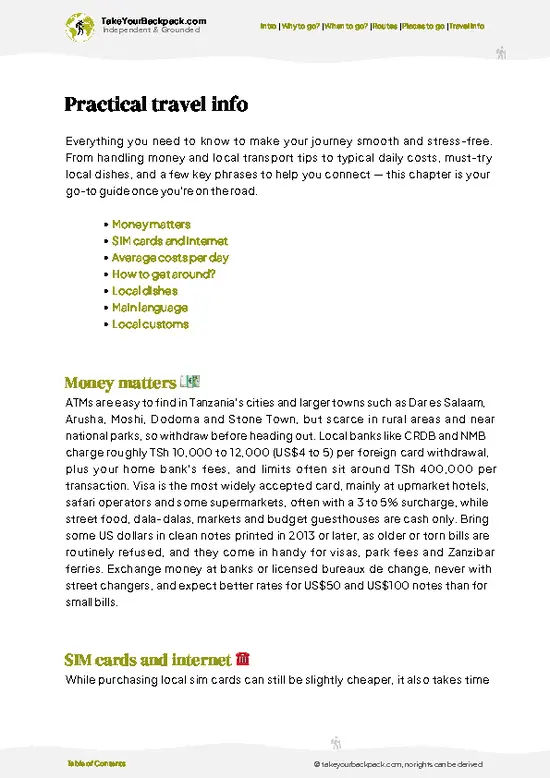
ATMs are easy to find in Tanzania’s cities and larger towns such as Dar es Salaam, Arusha, Moshi, Dodoma and Stone Town, but scarce in rural areas and near national parks, so withdraw before heading out. Local banks like CRDB and NMB charge roughly TSh 10,000 to 12,000 (US$4 to 5) per foreign card withdrawal, plus your home bank’s fees, and limits often sit around TSh 400,000 per transaction. Visa is the most widely accepted card, mainly at upmarket hotels, safari operators and some supermarkets, often with a 3 to 5% surcharge, while street food, dala-dalas, markets and budget guesthouses are cash only. Bring some US dollars in clean notes printed in 2013 or later, as older or torn bills are routinely refused, and they come in handy for visas, park fees and Zanzibar ferries. Exchange money at banks or licensed bureaux de change, never with street changers, and expect better rates for US$50 and US$100 notes than for small bills.
Tipping in Tanzania is not mandatory in local eateries, but 10% is appreciated in tourist restaurants and rounding up works in casual spots. Tips matter most in the safari and trekking industry, where guides typically receive around US$20 to 30 per group per day, cooks about US$10 to 15, and Kilimanjaro porters roughly US$6 to 10 per day each. Hand tips directly to the person, ideally in an envelope at the end of the trip, and in dollars or shillings.
v2.webp)

 Best Backpacking
.jpg) Over the years, I've learned the importance of packing minimally. It's so much easier to jump on the back of a truck or squeeze yourself into the last spot of a minibus without that supersized backpack. If you're headed to a warm destination, leave your winter jacket at home; for colder regions, opt for thin thermal underlayers. Instead of packing your entire wardrobe, bring just three sets of clothes, as laundry facilities are available everywhere.
Over the years, I've learned the importance of packing minimally. It's so much easier to jump on the back of a truck or squeeze yourself into the last spot of a minibus without that supersized backpack. If you're headed to a warm destination, leave your winter jacket at home; for colder regions, opt for thin thermal underlayers. Instead of packing your entire wardrobe, bring just three sets of clothes, as laundry facilities are available everywhere.


.jpg) Hi, I’m Johan (Netherlands 🇳🇱), the creator of TakeYourBackpack. Over the past 3 decades, I’ve backpacked through 90+ countries across six continents, gaining extensive experience with independent travel, long-term trips, and overland routes.
Hi, I’m Johan (Netherlands 🇳🇱), the creator of TakeYourBackpack. Over the past 3 decades, I’ve backpacked through 90+ countries across six continents, gaining extensive experience with independent travel, long-term trips, and overland routes.