×
Qatar 🇶🇦

backpacking Asia Qatar 🇶🇦Doha’s souq, striking museums and sand dunes meeting a tidal inlet.

Explore PhilippinesExplore Saudi Arabia

Backpacking Qatar in 2027

A complete guide including when and where to go, costs, transport, itineraries, and practical travel advice.
A practical introduction for travelers

Backpacking Qatar
By Johan Kruseman 🇳🇱 | Updated October 19, 2026

At 9 p.m. in Souq Waqif the heat finally lets go, and Doha comes out to eat. Families take the terrace tables, men sip cardamom coffee outside the falcon shops, and the alleys stay busy past midnight. Summer afternoons in Qatar regularly hit 40 to 45°C, so locals shift their social lives into the evening, and you should too.

Qatar is small, but it has real substance: I.M. Pei’s Museum of Islamic Art on the Corniche, the dunes that roll straight into the sea at Khor Al Adaid, and the UNESCO-listed ruins of Al Zubarah on the northwest coast. The friction is just as plain. Costs run high, buses barely reach beyond the capital, and the desert needs a 4x4 and someone who knows how to drive it.

Compared with Dubai, Qatar is quieter and less flashy. Compared with Bahrain, it’s stricter about alcohol and nightlife. It suits curious, culture-first travelers and transit stopovers. Party seekers and shoestring hitchhikers will struggle.

👉 Get the 📖 Travel Guide of Qatar

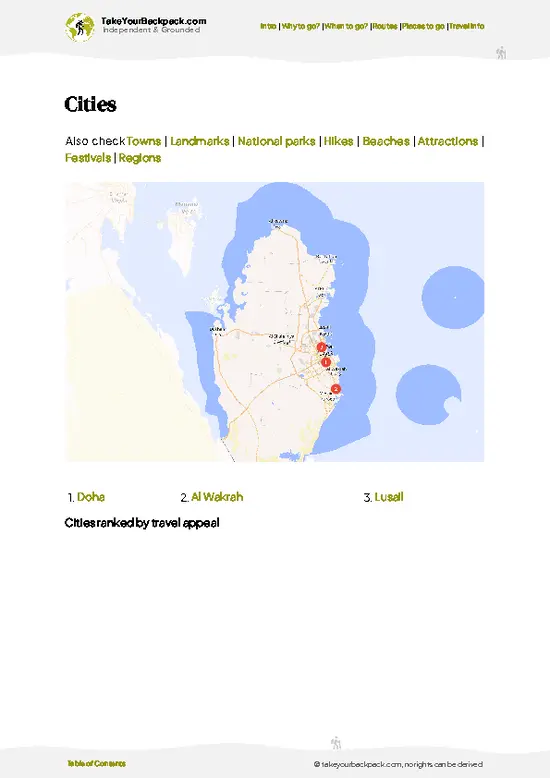
Doha (Souq Waqif, Museum of Islamic Art, West Bay)

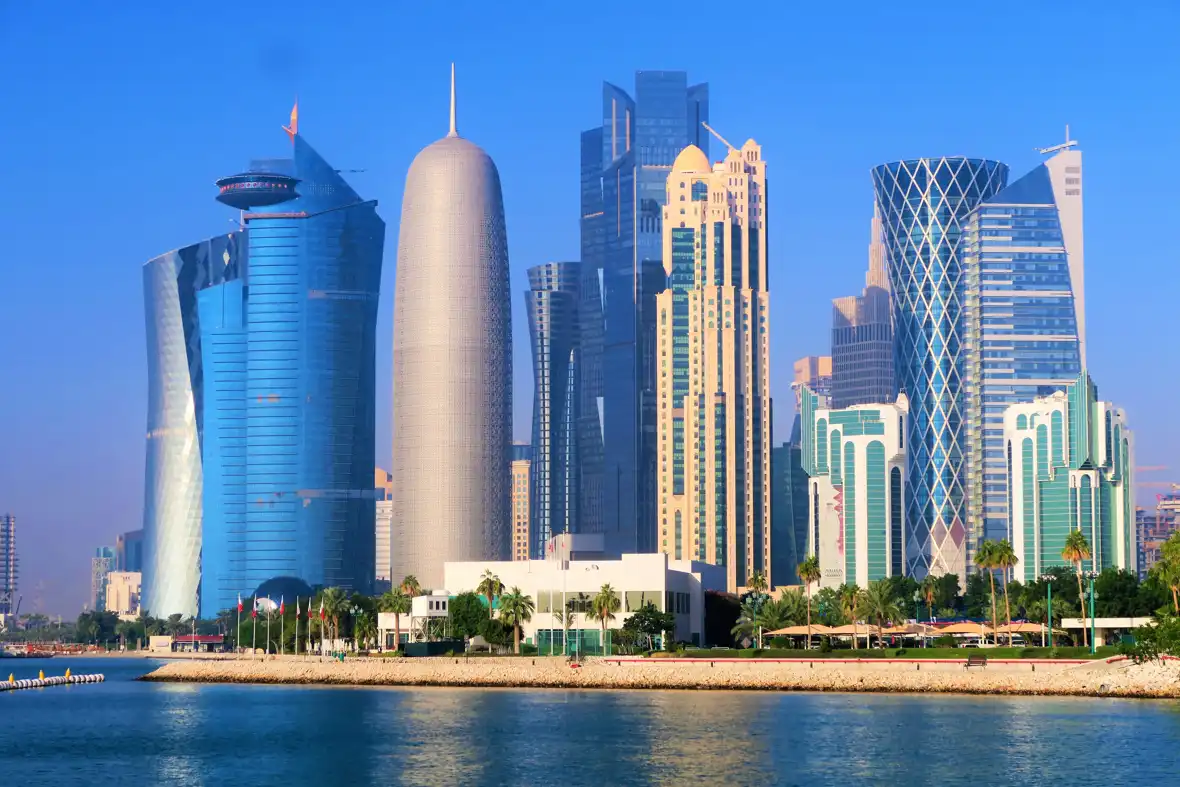
Most of backpacking Qatar happens in Doha, and the driverless metro links the airport to the center in about 20 minutes. Walk the Corniche to the Museum of Islamic Art in late afternoon, then drift into Souq Waqif after sunset prayer, when families fill the lanes, falcon shops stay open and the cafés hum past midnight. West Bay’s towers look best from the Corniche at dusk. It suits first-timers and city people.

The North (Al Khor, Purple Island, Al Zubarah Fort)

The north is flat, quiet and slow-paced. Al Khor is about 50 minutes up the coast road by car, with Purple Island’s mangroves just beyond, where you wade past crabs and herons at high tide. Drive another 45 minutes west to Al Zubarah, the UNESCO-listed ruins of an 18th-century pearling town, and its squat restored fort. Buses won’t get you there, so rent a car. It suits self-drivers who like history.

The South (Mesaieed, Sealine, Khor Al Adaid)

This is dune country. Sealine Beach sits roughly an hour south of Doha past the industrial port of Mesaieed, and from there sand tracks lead to Khor Al Adaid, the Inland Sea, where dunes drop straight into tidal water near the Saudi border. Book a 4x4 tour instead of driving yourself, since deflated tires and local know-how matter. Leave mid-afternoon to catch sunset on the crests. It suits groups and thrill seekers.

The West Coast (Zekreet, Brouq Nature Reserve, Dukhan)

The west is raw and empty. About 75 minutes from Doha by car, the Zekreet peninsula holds Richard Serra’s East-West/West-East, four steel plates rising from the desert floor, plus the mushroom-shaped limestone outcrops of Brouq Nature Reserve and the abandoned Film City set. Dukhan has the nearest fuel and food, so stock up there first. It suits photographers and campers who are comfortable driving on soft sand.
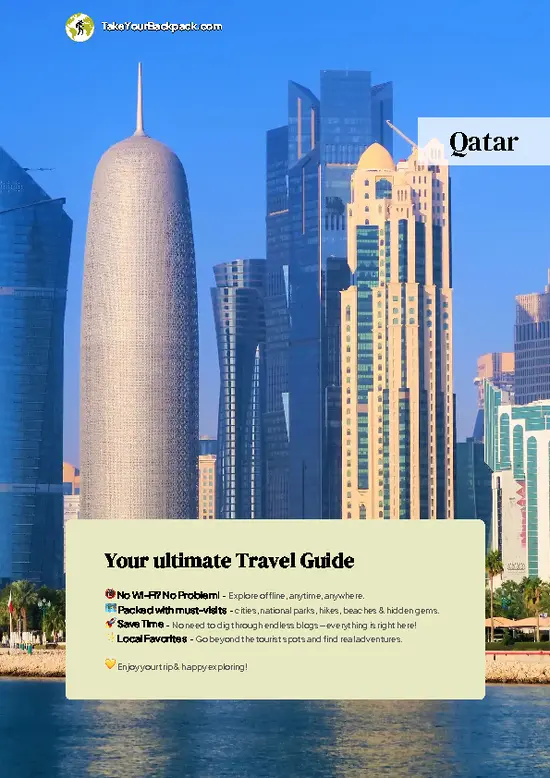
example page 0 from our offline Travel Guide for Qatar
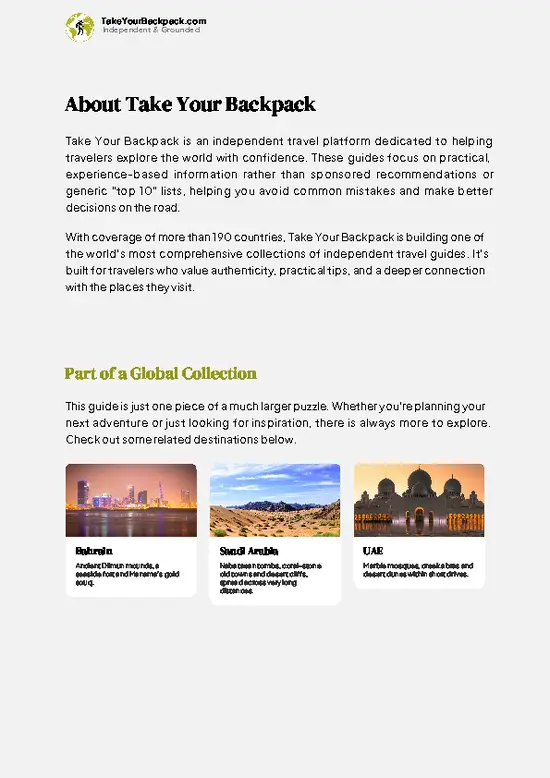
example page 1 from our offline Travel Guide for Qatar
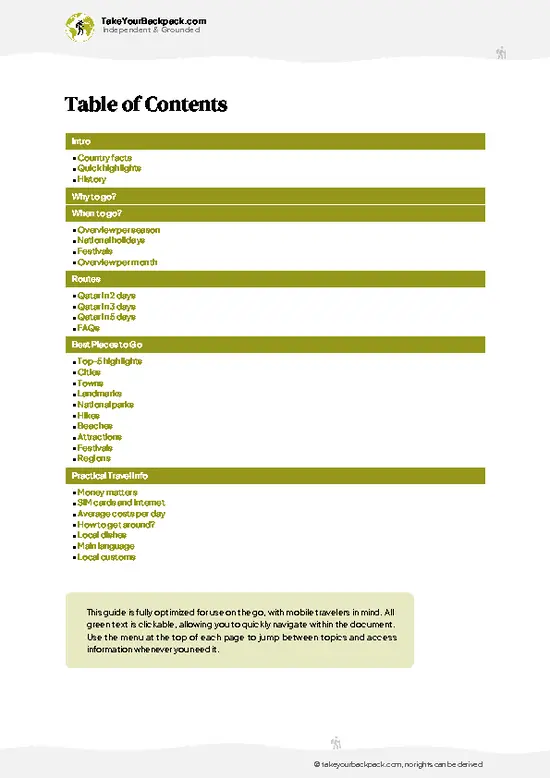
example page 2 from our offline Travel Guide for Qatar
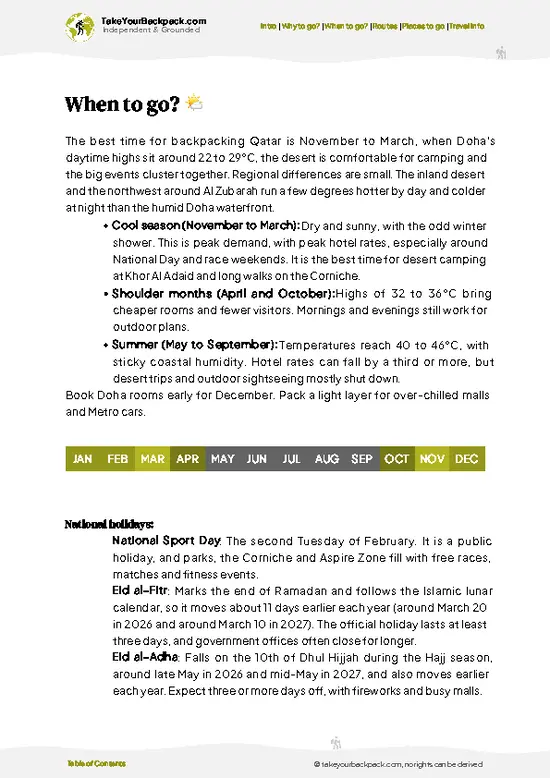
example page 3 from our offline Travel Guide for Qatar
example page 4 from our offline Travel Guide for Qatar
example page 5 from our offline Travel Guide for Qatar
example page 6 from our offline Travel Guide for Qatar
example page 7 from our offline Travel Guide for Qatar
Geography and where places are located
Loading the map 🌍
CLICK TO FILTER
cities
towns
landmarks
national parks
hikes
beaches
attractions
festivals
regions
SHOW COUNTRY’S BESTSHOW ALL

⭐ HighlightsUnmissable destinations

  • Souq Waqif: Rebuilt in mud-and-straw style over an old trading market, it smells of oud smoke, saffron and grilled meat. Spice sellers scoop turmeric from open sacks, and the falcon hospital nearby treats birds worth more than cars.
  • Museum of Islamic Art: Pei’s pale stone block stands on its own island off the Corniche. Inside it’s hushed and cool, and the five-story window frames dhows bobbing against the West Bay skyline.
  • National Museum of Qatar: Jean Nouvel shaped it like a desert rose crystal, all interlocking discs. The galleries move from pearling boats to oil rigs, with films projected across curved walls, and the original palace of Sheikh Abdullah bin Jassim sits in the courtyard.
  • Khor Al Adaid: Here dunes slide straight into a tidal inlet, with Saudi hills faintly visible across the water. The sand squeaks underfoot, and after dark the silence is total.
  • Al Zubarah Fort: A square, buttressed fort guards a ruined 18th-century pearling town. Wind whistles through the courtyard, and
… read more 👉
  • Souq Waqif: Rebuilt in mud-and-straw style over an old trading market, it smells of oud smoke, saffron and grilled meat. Spice sellers scoop turmeric from open sacks, and the falcon hospital nearby treats birds worth more than cars.
  • Museum of Islamic Art: Pei’s pale stone block stands on its own island off the Corniche. Inside it’s hushed and cool, and the five-story window frames dhows bobbing against the West Bay skyline.
  • National Museum of Qatar: Jean Nouvel shaped it like a desert rose crystal, all interlocking discs. The galleries move from pearling boats to oil rigs, with films projected across curved walls, and the original palace of Sheikh Abdullah bin Jassim sits in the courtyard.
  • Khor Al Adaid: Here dunes slide straight into a tidal inlet, with Saudi hills faintly visible across the water. The sand squeaks underfoot, and after dark the silence is total.
  • Al Zubarah Fort: A square, buttressed fort guards a ruined 18th-century pearling town. Wind whistles through the courtyard, and the excavated streets nearby show house plans in low coral-stone walls.
Off the map, look for the rock carvings at Al Jassasiya, the mangrove channels of Purple Island near Al Khor, and the restored watchtowers at Umm Salal Mohammed.
Spotted a mistake or missing a highlight? Contact us.

But Qatar offers more...

Discover and compare all of its highlights per category

🧭 RoutesPlanning a route that makes sense

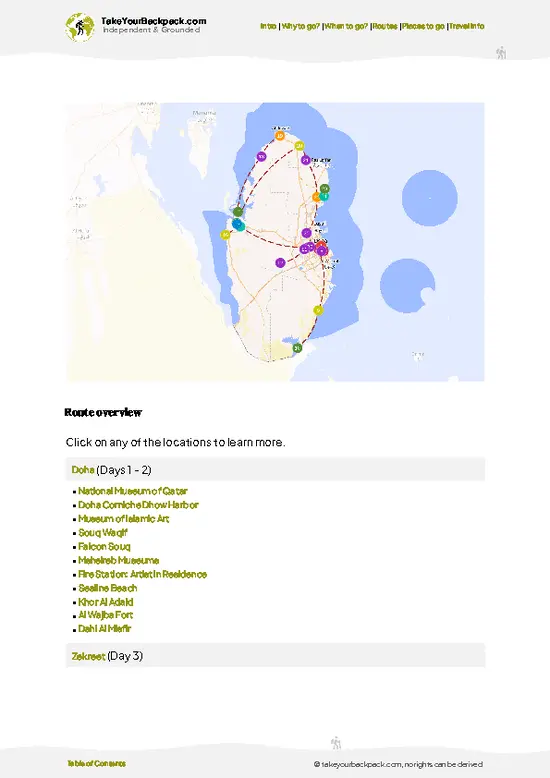
The 2-Day Doha Museums Route

Two world-class museums, a waterfront of wooden dhows and an evening souq fill this car-free weekend in Qatar’s capital. It suits a stopover traveler who wants the city’s architecture and history at an easy, heat-friendly pace.
  • Museum of Islamic Art
  • National Museum of Qatar
  • Souq Waqif and the Falcon Souq
  • Sunset at Katara Cultural Village

👉 explore this 2-day route

The 3-Day Mangroves and Dunes Route

This trip runs north to calm kayaking channels and a fishing-town overnight, then south to the dunes where the desert meets the sea. It balances one strong city day with two days of open landscapes and salt air.
  • Kayaking Al Thakira Mangroves
  • Purple Island causeway walk
  • A night in Al Khor
  • 4x4 run to the Inland Sea

👉 explore this 3-day route

The 5-Day Full Peninsula Route

Five days in Qatar take you from Doha’s museums to the desert, a camping night among wind-carved rocks on the west coast and a loop through the north’s ruins and carvings. Expect long horizons, empty roads … read more 👉

The 2-Day Doha Museums Route

Two world-class museums, a waterfront of wooden dhows and an evening souq fill this car-free weekend in Qatar’s capital. It suits a stopover traveler who wants the city’s architecture and history at an easy, heat-friendly pace.
  • Museum of Islamic Art
  • National Museum of Qatar
  • Souq Waqif and the Falcon Souq
  • Sunset at Katara Cultural Village

👉 explore this 2-day route

The 3-Day Mangroves and Dunes Route

This trip runs north to calm kayaking channels and a fishing-town overnight, then south to the dunes where the desert meets the sea. It balances one strong city day with two days of open landscapes and salt air.
  • Kayaking Al Thakira Mangroves
  • Purple Island causeway walk
  • A night in Al Khor
  • 4x4 run to the Inland Sea

👉 explore this 3-day route

The 5-Day Full Peninsula Route

Five days in Qatar take you from Doha’s museums to the desert, a camping night among wind-carved rocks on the west coast and a loop through the north’s ruins and carvings. Expect long horizons, empty roads and a far richer picture of the country than its skyline suggests.
  • Camping at Zekreet
  • UNESCO-listed Al Zubarah
  • Al Jassasiya Rock Carvings
  • Sunset over the Inland Sea

👉 explore this 5-day route

🌤️ When to go?Weather, seasons, and timing

The best time for backpacking Qatar is November to March, when Doha’s daytime highs sit around 22 to 29°C, the desert is comfortable for camping and the big events cluster together. Regional differences are small. The inland desert and the northwest around Al Zubarah run a few degrees hotter by day and colder at night than the humid Doha waterfront.
  • Cool season (November to March): Dry and sunny, with the odd winter shower. This is peak demand, with peak hotel rates, especially around National Day and race weekends. It is the best time for desert camping at Khor Al Adaid and long walks on the Corniche.
  • Shoulder months (April and October): Highs of 32 to 36°C bring cheaper rooms and fewer visitors. Mornings and evenings still work for outdoor plans.
  • Summer (May to September): Temperatures reach 40 to 46°C, with sticky coastal humidity. Hotel rates can fall by a third or more, but desert trips and outdoor sightseeing mostly shut down.
Book Doha rooms early for December. Pack a light layer for over-chilled malls and Metro cars.

source: climatestotravel.comJANJanuary: highly recommended for travelingFEBFebruary: highly recommended for travelingMARMarch: excellent for travelingAPRApril: good for travelingMAYMay: fair for travelingJUNJune: below average for travelingJULJuly: below average for travelingAUGAugust: below average for travelingSEPSeptember: fair for travelingOCTOctober: good for travelingNOVNovember: excellent for travelingDECDecember: highly recommended for traveling
pixabay - qatar - skyscrapers-3850732

💰 Costs (as of 2026)Travel costs in Qatar

Backpacking Qatar on a tight budget costs about US$50 to 80 a day. Beds take up most of that, while transport and cafeteria food cost very little. Travelers pay in Qatari riyals, which are pegged to the dollar at roughly 3.64 to US$1, so prices barely move. Doha costs about the same as Dubai, a bit more than Muscat for food and beds, and is in the same range as Manama.
CategoryBudget RangeLocal Reality
Dorm accommodationUS$20 to 35 per bed; US$40 to 65 for a budget doubleDorm beds are scarce in Doha, so book early, especially from November to March. If no dorm is free, look at older budget hotels around Al Najada and Bin Mahmoud, at roughly US$40 to 60 a room. Split between two people, that matches a bed in a Dubai hostel. Summer rates (June to August) can drop by a third.
MealsUS$10 to 20 per dayIndian and Pakistani cafeterias in Al Mansoura and Najma serve biryani for US$3 to 5.50 and a chapati wrap for US$1 to 1.50. A cup of karak tea costs US$0.50 to 0.80. Shawarma runs US$1.50 to 3. At Lulu or Carrefour, a bag of Arabic bread is about US$0.50 and 1.5 liters of water about US$0.40. A sit-down meal in Souq Waqif costs US$11 to 22.
Local transportUS$2 to 6 per dayA Standard-class Doha
… read more 👉
Backpacking Qatar on a tight budget costs about US$50 to 80 a day. Beds take up most of that, while transport and cafeteria food cost very little. Travelers pay in Qatari riyals, which are pegged to the dollar at roughly 3.64 to US$1, so prices barely move. Doha costs about the same as Dubai, a bit more than Muscat for food and beds, and is in the same range as Manama.
CategoryBudget RangeLocal Reality
Dorm accommodationUS$20 to 35 per bed; US$40 to 65 for a budget doubleDorm beds are scarce in Doha, so book early, especially from November to March. If no dorm is free, look at older budget hotels around Al Najada and Bin Mahmoud, at roughly US$40 to 60 a room. Split between two people, that matches a bed in a Dubai hostel. Summer rates (June to August) can drop by a third.
MealsUS$10 to 20 per dayIndian and Pakistani cafeterias in Al Mansoura and Najma serve biryani for US$3 to 5.50 and a chapati wrap for US$1 to 1.50. A cup of karak tea costs US$0.50 to 0.80. Shawarma runs US$1.50 to 3. At Lulu or Carrefour, a bag of Arabic bread is about US$0.50 and 1.5 liters of water about US$0.40. A sit-down meal in Souq Waqif costs US$11 to 22.
Local transportUS$2 to 6 per dayA Standard-class Doha Metro ride costs US$0.55 and a day pass US$1.65. The Travel Card itself costs about US$2.75. Metrolink feeder buses are free. A short Uber or Karwa taxi ride across central Doha runs US$5 to 10, and the airport taxi starts at around US$7 before the meter even runs.
ActivitiesUS$0 to 25 per dayThe big costs are museums and the desert. Non-residents pay about US$14 each for the Museum of Islamic Art and the National Museum of Qatar. A shared trip to the Inland Sea with dune bashing costs US$60 to 100. The Corniche, Souq Waqif, Msheireb and Katara’s lanes are free.
MiscellaneousUS$3 to 15 per dayA tourist SIM with data costs US$10 to 15. Beer is sold only in licensed hotel bars, at US$11 to 15 a pint, which is close to Dubai and well above Bahrain. Bottled water in the heat adds US$1 to 2 a day.
Total Daily BudgetUS$50 to 80For example, a US$30 bed, US$15 of cafeteria meals, a US$1.65 metro day pass and one paid museum at US$14 come to about US$60. Add a desert trip and that day goes past US$120.
If you want to spend less, plan your days around free sights and cafeteria lunches, then pay once for the desert trip. Taxis cost the most per kilometer here, so take the metro as far as you can.
⚠️ Prices can change and everyone travels differently, so take this as a rough guide. Hope it helps you plan your adventure!

✈️ The backpacker research shortcutQatar Travel Guide

An offline-friendly backpacking guide with optimized travel routes, ranked highlights, transport advice, and the best areas to stay.
example page 0 from our offline Travel Guide for Qatar
example page 1 from our offline Travel Guide for Qatar
example page 2 from our offline Travel Guide for Qatar
example page 3 from our offline Travel Guide for Qatar
example page 4 from our offline Travel Guide for Qatar
example page 5 from our offline Travel Guide for Qatar
example page 6 from our offline Travel Guide for Qatar
example page 7 from our offline Travel Guide for Qatar
The digital guide (174 pages) contains:
✅ 44 highlights, ranked by travel appeal
✅ Optimized 2, 3 & 5-day travel routes
✅ Cities, national parks, landmarks, beaches
✅ How to get around
✅ Offline-friendly for travel without Wi-Fi
👉 Click to see all 30+ guide features

📅 Plan smarter in minutes, not weeks
✅ Month by month travel advice
✅ Festivals & national holidays
✅ Budget expectations

🗺️ Go to the right places, skip the overrated ones
✅ Honest pros & cons of destinations
✅ Top hikes, parks & viewpoints
✅ Lesser-known places most travelers miss
✅ Clear “worth it vs skip it” guidance

🛏️ Travel smoothly without rookie mistakes
✅ Best areas to stay
✅ Transport systems explained simply
✅ Common scams & safety advice
✅ SIM cards, money & practical tips

🌍 Understand the country, not just visit it
✅ Culture & traditions
✅ 52 Essential phrases & customs
✅ Festivals worth planning around
✅ Traveler-friendly historical context
✅ Insights that make places more meaningful

📱 Built for real travel conditions
✅ Fully downloadable PDF
✅ Works completely offline
✅ Optimized for phone use
✅ Useful in remote areas & buses
✅ Everything in one place
Stop searching, start planning
Get instant access to your full guide. 30‑day money-back guarantee.
+ Add another guide for just

By proceeding you agree to our terms.
Sent to your inbox immediately after payment • 100% Secure Checkout
Best Backpacking Travel Advisor 2025 tourism awardBest Backpacking
Travel Advisor
2025
What others say about Take Your Backpack Guides:
⭐⭐⭐⭐⭐
Fantastic, amazing amount of information!
⭐⭐⭐⭐⭐
My goodness this is amazing, it's what I've been looking for hats off too you!
⭐⭐⭐⭐⭐
I think this is absolutely BRILLIANT
⭐⭐⭐⭐
Very complete and informative. It's still missing places, but I gotta to commend you
⭐⭐⭐⭐⭐
This is truly amazing, thank you, can't wait to explore it with my kids!
⭐⭐⭐⭐⭐
Awesome resource, thank you!
⭐⭐⭐⭐⭐
This is amazing! Can't wait to explore the ones I haven't seen
⭐⭐⭐⭐
I love this! Well done, great idea.
⭐⭐⭐⭐⭐
Thanks for taking the time to make this gem!
⭐⭐⭐⭐⭐
This might be the best website I've ever seen.
⭐⭐⭐⭐⭐
Congratulations, and thank you so much for your work; it's incredibly valuable.
⭐⭐⭐⭐
In all seriousness I think you did a great job pointing out the important spots
⭐⭐⭐⭐⭐
10/10 very good
⭐⭐⭐⭐⭐
As someone who's only just starting to visit regularly this is awesome, thank you.
⭐⭐⭐⭐
Thank you very much! I'm going to visit my dad, it's going to be very useful!
⭐⭐⭐⭐⭐
This is really cool! We'll be travelling for the first time and this definitely come in handy.
⭐⭐⭐⭐⭐
You are now our minister of culture, congratulations 👨‍💼
⭐⭐⭐⭐⭐
Just wanted to tell you that this is a pearl! Going to follow your recommendations.
⭐⭐⭐⭐⭐
This is so cool. I'll definitely be using the resource for my travels soon.
⭐⭐⭐⭐⭐
This is very impressive! Good work.
⭐⭐⭐⭐⭐
This is an amazing and informative site. Very well done!

🛏️ Where to stay?Best areas to base yourself

Qatar has only a handful of true hostels with dorm beds, so most backpackers end up in budget hotels or small serviced apartments at roughly QAR 200 to 350 (US$55 to 95) a night in Doha. Al Souq and neighboring Bin Mahmoud and Najma hold the cheapest rooms within walking distance or a short metro hop of Souq Waqif and the Corniche, though streets can be noisy and rooms dated, while Msheireb is newer, quieter and slightly pricier. West Bay puts you near the towers and the hotel bars that make up most of the country’s nightlife, but budget options are scarce there; safety is excellent in every area. … read more 👉
Qatar has only a handful of true hostels with dorm beds, so most backpackers end up in budget hotels or small serviced apartments at roughly QAR 200 to 350 (US$55 to 95) a night in Doha. Al Souq and neighboring Bin Mahmoud and Najma hold the cheapest rooms within walking distance or a short metro hop of Souq Waqif and the Corniche, though streets can be noisy and rooms dated, while Msheireb is newer, quieter and slightly pricier. West Bay puts you near the towers and the hotel bars that make up most of the country’s nightlife, but budget options are scarce there; safety is excellent in every area.

If you enjoy meeting fellow travelers, consider choosing hostels with high ratings for atmosphere. On the other hand, if you prefer having your own space, a hotel might be a better option.

🚌 Getting aroundPublic transport and other ways to get around

Buy a rechargeable Standard Travel Card (QR10, about US$2.75) on your first day and make the Doha Metro your default in Qatar: a QR6 (US$1.65) day pass covers unlimited standard rides, and the feeder buses from stations are free. On Fridays the metro only starts running in the early afternoon, so book any morning beach or desert plans by car.
  • Doha Metro: Red, Green and Gold lines, QR2 (US$0.55) per standard trip or QR10 in Gold Club. The airport to Msheireb takes about 20 minutes, and Msheireb to
… read more 👉
Buy a rechargeable Standard Travel Card (QR10, about US$2.75) on your first day and make the Doha Metro your default in Qatar: a QR6 (US$1.65) day pass covers unlimited standard rides, and the feeder buses from stations are free. On Fridays the metro only starts running in the early afternoon, so book any morning beach or desert plans by car.
  • Doha Metro: Red, Green and Gold lines, QR2 (US$0.55) per standard trip or QR10 in Gold Club. The airport to Msheireb takes about 20 minutes, and Msheireb to Lusail about 25. Carriages are spotless and cold. Tap your card in and out, and leave the family and women’s sections to them.
  • Metrolink and trams: Metrolink buses are free and loop roughly 2 to 5 km out from stations. The Msheireb tram is free too. The Lusail tram uses the same travel card, so you rarely need a taxi for the last stretch.
  • Karwa buses: About QR3 to 10 (US$0.80 to 2.75) depending on distance. They reach Al Wakrah and Al Khor, though a trip takes 1 to 1.5 hours with stops. You pay with a Karwa smartcard, not cash.
  • Uber, Careem and the Karwa app: Souq Waqif to The Pearl costs about QR25 to 40 (US$7 to 11) and takes 20 to 30 minutes. After midnight they are the easiest option, and fares surge at rush hour.
  • Rental car: About QR100 to 180 (US$27 to 50) a day, with fuel at around QR2 per liter. Speed cameras are everywhere.
To see the north, rent a car for one day and loop from Doha to Al Zubarah (about 105 km, 1.5 hours) and back through Al Khor. Reaching Khor Al Adaid requires a 4x4 tour.
Hamad International Airport (DOH) sits about 15 km (9 miles) southeast of central Doha, and the cheapest reliable ride into the center of Qatar’s capital is the Doha Metro Red Line.
  • Doha Metro Red Line (about 20 minutes to Msheireb, QAR 2 / US$0.55 per standard trip plus a reloadable travel card) runs from the station linked to the arrivals hall, and it generally operates from about 5am to 1am Saturday to Thursday and from 9am to 1am on Friday.
  • Karwa taxi (20 to 30 minutes, about QAR 50 to 75 / US$14 to 21) leaves from the official rank outside arrivals, runs on a meter with a higher airport starting fare, and operates 24 hours with card payment usually accepted.
  • Uber or Careem (20 to 30 minutes, about QAR 35 to 60 / US$10 to 16) picks up at the marked ride-hailing area outside arrivals, charges your card through the app, and works around the clock.
If you land after the metro closes or before 9am on a Friday, book an Uber or Careem from the arrivals Wi-Fi or head straight to the official taxi rank, and ignore anyone offering rides inside the terminal.
⚠️ Prices and routes can change, so take this as a rough guide and ask for local advice when you arrive.
🚀 Don’t waste time on the road.
We’ll generate a route that minimizes unnecessary travel and fits your available days.

Generate my itinerary

🔒 Safety (risk Level: medium)Safety considerations for travelers

Safety for solo travelers, including women and LGBTQ+ individuals
Qatar is one of the safest countries in the world for solo travelers, with very low rates of violent crime and street theft, and metro stations and public areas are well lit and heavily monitored. Women traveling alone generally feel safe. Staring or unwanted attention happens occasionally, and dressing modestly and using the women and family sections on the metro helps. For LGBTQ+ travelers the risk is legal rather than physical: same-sex relations are criminalized with penalties of up to seven years in prison, so discretion is essential, including on dating apps and in public displays of affection. Report problems to the police on 999.


Full official government travel advisory (live updates)
View details 👉
safety image

source: www.gov.uk

✈️ VisaUnderstanding entry rules

Citizens of around 100 countries, including the US, UK, Canada, Australia and EU states, can enter Qatar visa-free on arrival for 30 to 90 days with a passport valid for at least six months and an onward ticket. Other nationalities apply online for a tourist visa (A1) through the official Hayya platform before travel, usually with a confirmed hotel booking, health insurance and passport scans. Rules differ by nationality, so check the official portal before you book.

source: visitqatar.com
⚠️ Visa requirements can change over time, so always check the latest visa requirements with the official embassy or government website before you travel.

🎒 What to pack?What to wear and bring

Packing for Qatar means planning for two extremes. From May to September, daytime highs pass 40°C with heavy humidity, yet malls, the metro and museums are kept so cold that you will want a light layer indoors. Breathable, loose clothing that covers your shoulders and knees solves both the heat and the local dress expectations, and it keeps you comfortable in souqs, mosques and government buildings. From December to February, evenings by the sea or in the desert can drop to around 15°C, so bring something warm if you plan a dune trip or a night at a desert camp. Closed shoes or sturdy sandals handle hot pavement and sand, and serious sun protection is a must year-round.

Apart from this country specific advice, I have also crafted a general packing list that should help on any trip. authorOver the years, I've learned the importance of packing minimally. It's so much easier to jump on the back of a truck or squeeze yourself into the last spot of a minibus without that supersized backpack. If you're headed to a warm destination, leave your winter jacket at home; for colder regions, opt for thin thermal underlayers. Instead of packing your entire wardrobe, bring just three sets of clothes, as laundry facilities are available everywhere.

View the full list 👉

🙋 FAQCommon questions before visiting

Trip Planning

Planning a backpacking route through Qatar can be tricky — you need to balance must-see places, travel times, budget, and how long to stay in each destination. Our free personalized Qatar itinerary planner creates a route based on your travel style, trip duration, and interests, so you can spend less time researching and more time exploring.


Personal tip: I normally search on good rating for atmosphere (for meeting people) and location (for easy exploring). Cleanliness as a bonus.


Travel Essentials

Qatar requires no special vaccinations for most travelers. Make sure your routine vaccines are up to date, including measles-mumps-rubella, tetanus-diphtheria and COVID-19. Hepatitis A and typhoid are often advised, and hepatitis B is recommended for longer stays. If you arrive from a country with yellow fever risk, you may need to show a yellow fever certificate. See a travel clinic 4 to 8 weeks before departure.


vaccination requirements
When I first started traveling, I often spent part of my first day in a new country hunting for a local SIM card. While this can still be slightly cheaper, it also takes time and planning.

These days, it's much simpler to install an eSIM before leaving home. Once you arrive in Qatar, you can activate it immediately and have mobile data from the moment you land — which is especially useful for ordering transport or navigating away from busy airports.

There are many providers nowadays, and price differences are usually small. I personally go with Holafly, as it offers excellent network coverage throughout the country and strong global coverage, so you can manage multiple countries from a single app.


HolaFly eSim

Culture & Customs

Qatar is a conservative Muslim country, and visitors are expected to cover their shoulders and knees in malls, souqs, museums and government buildings. Women should bring a headscarf for mosque visits. Hold hands at most in public, since kissing and hugging can draw complaints. Drinking alcohol is legal only in licensed hotel bars and restaurants, and being drunk in public can lead to arrest. During Ramadan, avoid eating, drinking or smoking in public during daylight, and expect shorter opening hours. Use your right hand to eat, pass items and accept coffee, and shake the cup gently when you have had enough. Never photograph people, especially women, without asking first, and avoid filming government sites or police. Offensive gestures and swearing, including online, are prosecutable. Unmarried couples rarely face issues in hotels, but same-sex couples should keep things discreet.
Trying traditional food is always a great way to experience the culture. Here are some must-try dishes for Qatar.
  1. Machboos: Qatar’s national dish. Long-grain rice is cooked in a spiced broth with chicken, lamb or fish, loomi (dried black lime), cardamom and saffron. Families serve it on huge shared platters at Friday lunches and weddings.
  2. Harees: Cracked wheat and meat slow-cooked into a smooth, porridge-like paste and topped with ghee. It is a Ramadan and Eid staple with Bedouin roots.
  3. Thareed: Thin regag bread layered under a tomato-based meat and vegetable stew that soaks into it. Many Qatari families break the Ramadan fast with it.
  4. Madrouba: Rice, chicken and spices beaten until creamy, finished with ghee and cumin. It is Gulf comfort food and is found on most traditional menus.
  5. Balaleet: Sweet vermicelli flavored with saffron, cardamom and rosewater, topped with a thin omelet. It is a classic breakfast for Eid mornings.
  6. Luqaimat: Crisp fried dough balls drenched in date syrup and sometimes sprinkled with sesame. They are the street snack of Souq Waqif evenings and Ramadan nights.
Tap water in Qatar comes from desalination plants and meets international safety standards, so it is technically safe to drink. Most residents still drink bottled or filtered water because of the taste and the condition of older building pipes, and tourists are advised to do the same. A 1.5-liter bottle costs about QR1 to 2 (US$0.30 to 0.55) in any supermarket, and many hotels and offices have filtered refill dispensers.
The main language in Qatar is Arabic. Backpacking is way more rewarding if you know a bit of the local language, so I'd suggest brushing up on the basics just in case your Arabic skills have become a bit rusty.

Want to understand locals better?
The complete Travel Guide for Qatar includes 52 essential words and phrases — greetings, thank-yous, ordering food, transport, numbers, and common local expressions you'll actually hear.

Get your local basic phrases 👉

Get the Travel Guide -


English works almost everywhere you will go in Qatar. Doha’s metro, malls, hotels and restaurants run on it, largely because most service staff are expats from South Asia, the Philippines and Africa. Younger Qataris and hostel or hotel staff speak it fluently. Outside Doha, in small towns and at desert camps, English gets simpler, but you can still get by. Arabic is the official language and the one that earns the warmest reaction, so learn shukran (thank you) and download Google Translate’s offline Arabic pack for menus and signs.

Money & Payments

The local currency of Qatar is QAR (ر.ق).
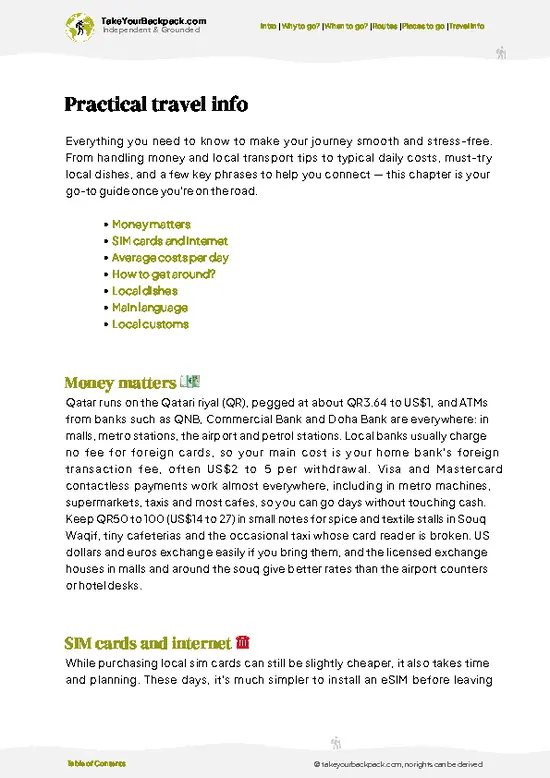
Qatar runs on the Qatari riyal (QR), pegged at about QR3.64 to US$1, and ATMs from banks such as QNB, Commercial Bank and Doha Bank are everywhere: in malls, metro stations, the airport and petrol stations. Local banks usually charge no fee for foreign cards, so your main cost is your home bank’s foreign transaction fee, often US$2 to 5 per withdrawal. Visa and Mastercard contactless payments work almost everywhere, including in metro machines, supermarkets, taxis and most cafes, so you can go days without touching cash. Keep QR50 to 100 (US$14 to 27) in small notes for spice and textile stalls in Souq Waqif, tiny cafeterias and the occasional taxi whose card reader is broken. US dollars and euros exchange easily if you bring them, and the licensed exchange houses in malls and around the souq give better rates than the airport counters or hotel desks.
Tipping in Qatar is appreciated but never compulsory, and many restaurants already add a 10% service charge, so check your bill first. If no service charge appears, leave around 10% in sit-down restaurants. Round up taxi fares or tip QR5 to 10 (US$1.40 to 2.75) for porters and delivery riders, most of whom are low-paid migrant workers for whom it makes a real difference.

🧩 Nearby countriesNearby backpacking alternatives

We 💚 feedbackIs Qatar worth visiting?

Backpacking Qatar works best as a short, focused trip built around world-class museums and a desert that meets the sea, all within a couple of hours of each other. The drawback is cost and car-dependence: once you leave Doha, independent travel gets expensive and awkward fast. Plan your days around the heat. Spend midday in air-conditioned galleries, hit souqs and the Corniche after dark, and team up with other travelers to split a single desert trip.

✍️ Help improve this page!
The information on this page is based on in-depth research, insights shared by experienced travelers, and feedback from the local travel community in Qatar. While every effort is made to keep the information accurate and current, conditions can change — so if you spot anything incorrect or outdated, please get in touch.


🙋‍♂️ Give feedback

👋 Meet the founderWho’s Behind Take Your Backpack?

Johan, backpacker and founder of TakeYourBackpackHi, I’m Johan (Netherlands 🇳🇱), the creator of TakeYourBackpack. Over the past 3 decades, I’ve backpacked through 90+ countries across six continents, gaining extensive experience with independent travel, long-term trips, and overland routes.

This site is built on a combination of firsthand travel experience and carefully curated insights from other backpackers. Many guides are based on places I’ve personally visited, while others bring together tips, observations, and practical advice shared by trusted travelers I’ve met along the way.

The goal is to provide realistic, experience-driven guidance — not generic itineraries — so you can explore destinations with better context, clearer expectations, and more confidence.