×
Palestine 🇵🇸

backpacking Asia Palestine 🇵🇸Walk historic streets layered with meaning and resilience.

Explore PakistanExplore Philippines

Backpacking Palestine in 2026

A complete guide including when and where to go, costs, transport, itineraries, and practical travel advice.
The big picture before you go

Backpacking Palestine
By Johan Kruseman 🇳🇱 | Updated August 5, 2026

Palestine isn’t off-limits to travelers. You can visit on a standard tourist visa and ride shared taxis between hill towns. What you meet first isn’t conflict; it’s coffee, conversation, and a fierce pride in place.

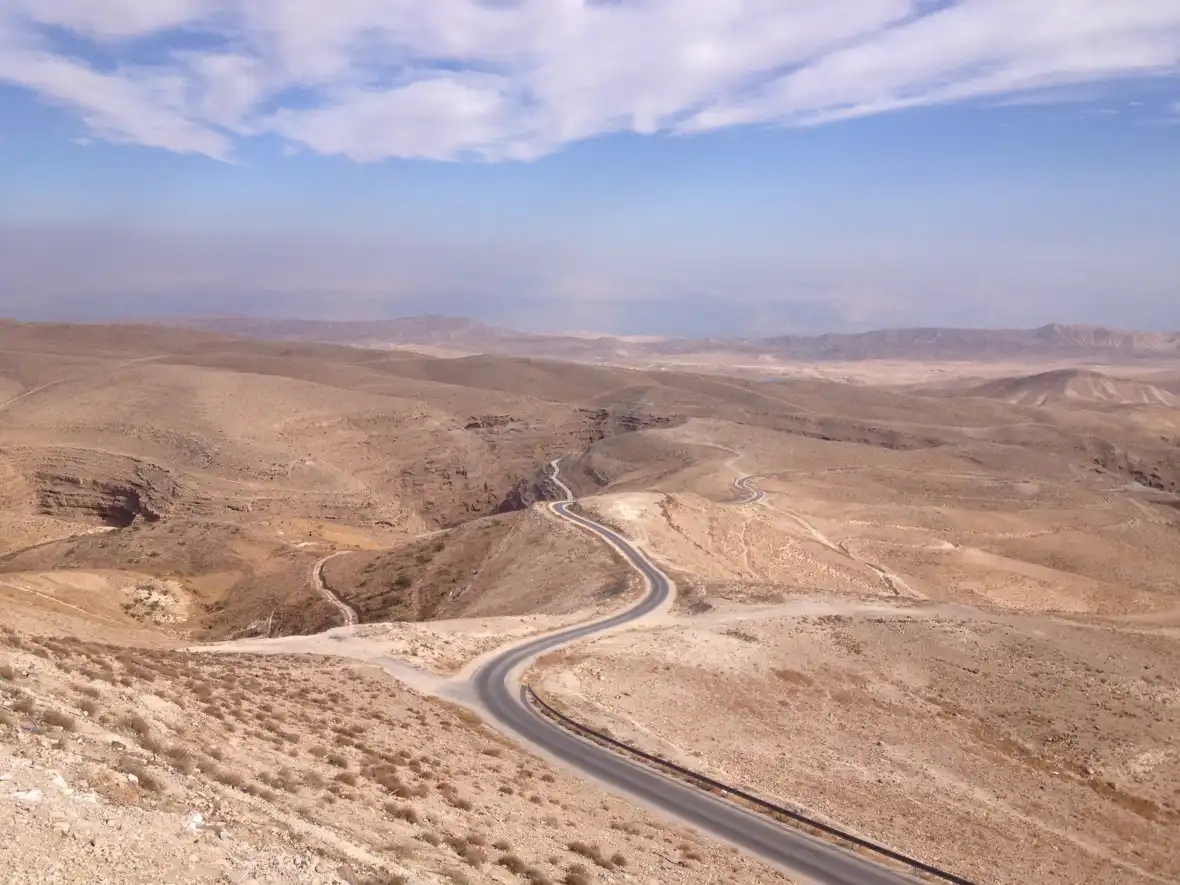
Come for the layers: Bethlehem’s limestone lanes and the Nativity, Jericho’s desert light along the Dead Sea edge, and Nablus where hot knafeh follows a soap factory tour. Hike Wadi Qelt—dust on your calves, goat bells in the canyon—then the cliff-hung monastery makes everything quiet; later, a cold Taybeh beer in Ramallah tastes earned. Checkpoints and odd hours can slow you; carry ID, plan slack. I’ve had delays end with free tea and a new contact. The friction only sharpens the welcomes and the views.

Next to Israel’s polished museum-cities and Jordan’s blockbuster deserts, Palestine is intimate and unscripted. It’s for travelers who chase people over postcards—maqluba at a kitchen table, day hikes with history underfoot, stories poured with strong coffee.

👉 Get the 📖 Travel Guide of Palestine

Ramallah & Birzeit

Connected and student-heavy. Servis (shared taxis) run to every West Bank city, so base here if you want day trips without drama. Cafés hum late, conversations run hotter than the coffee, and prices sit mid-range for Palestine. You’re rewarded with talkative nights, mint lemonade or a cold Taybeh, and easy logistics on foot.

Bethlehem & the South Hills

Cross Checkpoint 300, walk 15 minutes, and you’re in Manger Square. Quick wins for first-timers: the Wall’s street art, Old City lanes, and a dawn walk to Herodium or Shepherds’ Fields. Cheap taxis, heavy holiday crowds. The payoff is hot ka‘ak bread and wide, terraced hills under soft light.

Hebron (Al-Khalil) Old City

The hardest day, and maybe the one you’ll remember. Checkpoints, soldiers, shuttered lanes with protective mesh overhead. Go with a local guide, keep it respectful. Glassblowers work through the tension. Servis from Bethlehem is simple. Tea on a rooftop near the Ibrahimi Mosque repays the weight.

Nablus & Sebastia

Gritty, proud, and cheaper than Ramallah by a notch. Soap factories, brutal traffic, phenomenal kanafeh. Servis up Route 60; add Sebastia for hilltop ruins and village lunches. For food and history hunters who don’t mind elbowing through tight alleys to earn that syrup-dripping slice.

Jericho & Wadi Qelt

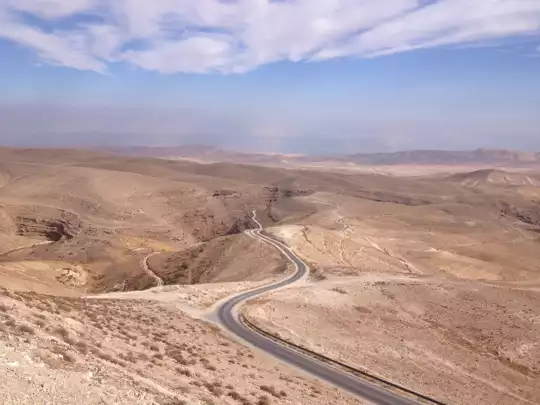
Low, hot, and fast to reach via Highway 1/90. Start at dawn. Skip the cable car if you want sweat: hike Wadi Qelt to St. George, goats clattering on canyon ledges. Carry 3L water. Reward is feet in Ein al-Sultan spring and shade with a cold Taybeh.
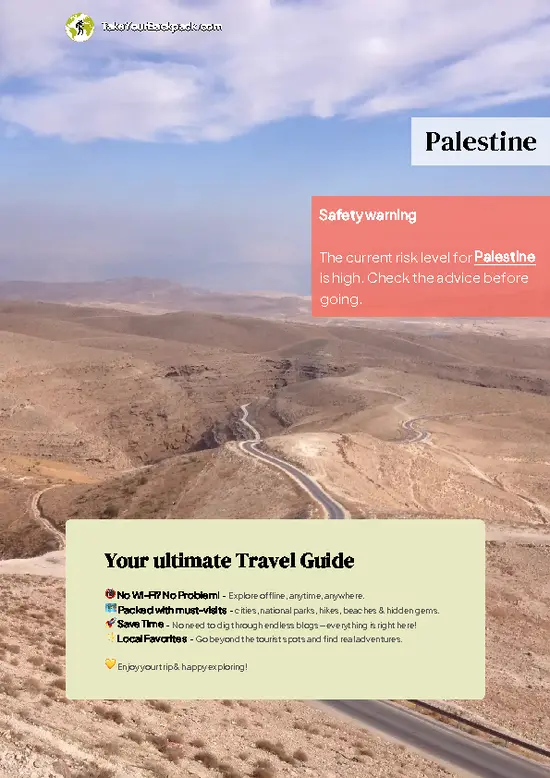
Safety warning

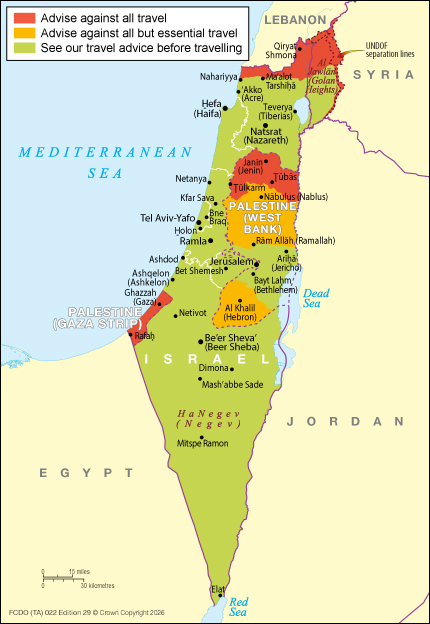
The current risk level for Palestine is high. Check the advice before going.
Get your Palestine guide
69 ranked highlights, routes & tips, works offline (273 pages)
A visual overview of the country
Loading the map 🌍
CLICK TO FILTER
cities
towns
villages
landmarks
national parks
hikes
attractions
festivals
regions
SHOW COUNTRY’S BESTSHOW ALL

Why go?What draws travelers here

People

Palestinians don’t let you drift anonymous. A shopkeeper presses dates into your palm, an old man insists … read more 👉
Palestinians don’t let you drift anonymous. A shopkeeper presses dates into your palm, an old man insists on cardamom coffee, and somebody cracks a joke to cut the dust and heat. Say “shukran,” accept once, refuse twice, and you’ve got family. Pro tip: carry small sweets to reciprocate. Best night: plastic chairs in Ramallah, Taybeh beers, strangers trading stories till midnight.

Uniqueness

Palestine runs on grit: heat off the stone, checkpoints that slow you, shared taxis that rattle. Then … read more 👉
Palestine runs on grit: heat off the stone, checkpoints that slow you, shared taxis that rattle. Then it pays out. Wadi Qelt drops to a cliff-hugging monastery; Nablus fires syrup over hot kanafeh. I earned a cold Taybeh on a Bethlehem rooftop as church bells and the adhan braided the air. Pro tip: carry your passport and start hikes at dawn.

Architecture

Palestine rewards the walker: Bronze Age Jericho tells you where cities began, Herodion’s man‑made volcano … read more 👉
Palestine rewards the walker: Bronze Age Jericho tells you where cities began, Herodion’s man‑made volcano shows royal ego, Hebron’s Mamluk arches and Nablus’s soap factories are still working architecture. Hisham’s Palace mosaics glow at first light; Mar Saba hangs off a cliff. Pro tip: hit Sebastia at sunset, then a cold Taybeh in Birzeit.

Low cost

Palestine treats a tight budget kindly. Street falafel, manaqeesh, and kettles of mint tea keep you … read more 👉
Palestine treats a tight budget kindly. Street falafel, manaqeesh, and kettles of mint tea keep you fed; servees vans connect cities for pocket change; family-run guesthouses undercut big-hostel prices. I average roughly $30/day without trying. Pro tip: eat where the workers queue—Nablus’ knafeh after the souq, then a rooftop in Bethlehem for cheap tea and a skyline of minarets and bells.
Want the complete picture of Palestine?
The offline Travel Guide brings everything together — routes, highlights & planning.

See what's included in the guide 👉

Get the Travel Guide -

⭐ HighlightsUnmissable destinations

💡 Not sure where to go?
Get a personalized backpacking itinerary for Palestine generated in under 10 seconds.

Generate my itinerary
  • Bethlehem, Church of the Nativity & the Wall: The Grotto air hangs with incense and candle soot; you duck the low door, palm flat on cool limestone while the crowd breathes behind you. Step out to paint-streaked concrete and the hiss of spray cans, then kill the dust with a cold Taybeh by Manger Square.
  • Nablus Old City: Copper pans spit syrup as kanafeh is sliced hot, cheese squeaking between your teeth while sugar runs down your thumb. In the soap factories the air is sharp with olive and lye, and your fingertips come away faintly oily and clean.
  • Hebron, Old City & Ibrahimi Mosque: You move through metal detectors into alleys strung with netting, coppersmiths pounding a steady heartbeat while glassblowers’ torches hiss. Inside, the mosque’s carpet brushes your knees; outside, pomegranate juice stains your wrist a bright red that doesn’t wash off quick.
  • Wadi Qelt to St George Monastery: The desert trail bites—grit in your teeth, calves hot, goat bells echoing off chalk walls. The monastery
read more 👉
  • Bethlehem, Church of the Nativity & the Wall: The Grotto air hangs with incense and candle soot; you duck the low door, palm flat on cool limestone while the crowd breathes behind you. Step out to paint-streaked concrete and the hiss of spray cans, then kill the dust with a cold Taybeh by Manger Square.
  • Nablus Old City: Copper pans spit syrup as kanafeh is sliced hot, cheese squeaking between your teeth while sugar runs down your thumb. In the soap factories the air is sharp with olive and lye, and your fingertips come away faintly oily and clean.
  • Hebron, Old City & Ibrahimi Mosque: You move through metal detectors into alleys strung with netting, coppersmiths pounding a steady heartbeat while glassblowers’ torches hiss. Inside, the mosque’s carpet brushes your knees; outside, pomegranate juice stains your wrist a bright red that doesn’t wash off quick.
  • Wadi Qelt to St George Monastery: The desert trail bites—grit in your teeth, calves hot, goat bells echoing off chalk walls. The monastery clings to the cliff like a dare; dunk your wrists in Ein Qelt’s cold spring and tear into warm flatbread with za’atar at the first shade.
  • Jericho: Temptation Monastery & Hisham’s Palace: Heat hits like a hair dryer, the cable car hums over the valley, and the stones at the palace hold a fine powder that coats your sandals. Bite a fresh date—sticky, honeyed—then crush a lemon-mint juice in town; for quieter corners hit Battir’s terraces at sunrise, swim Wadi Auja’s pools, and the desert khan at Nabi Musa—my personal fix is the Mar Saba ridge at dusk.
Spotted a mistake or missing a highlight? Contact us.

But Palestine offers more...

Discover and compare all of its highlights per category

🧭 RoutesHow to structure a trip

The 2-Day Bethlehem & Jerusalem Focus

The vibe: A compact, soulful hit of Palestine built around Bethlehem and Jerusalem, ideal if you want depth over distance and prefer walking and short hops by bus or shared taxi. You’ll move slowly through old streets and sacred courtyards rather than racing across the map.
  • Pray, reflect, or simply observe at the Church of the Nativity in Bethlehem.
  • Experience the Al-Aqsa Mosque Compound and the Dome of the Rock on Jerusalem’s sacred plateau.
  • See political art up close at Banksy’s Walled Off Hotel Museum and Gallery.
  • Soak up evening street life in Bethlehem’s old city and nearby Beit Sahour.

The 3-Day Desert & Holy Cities Circuit

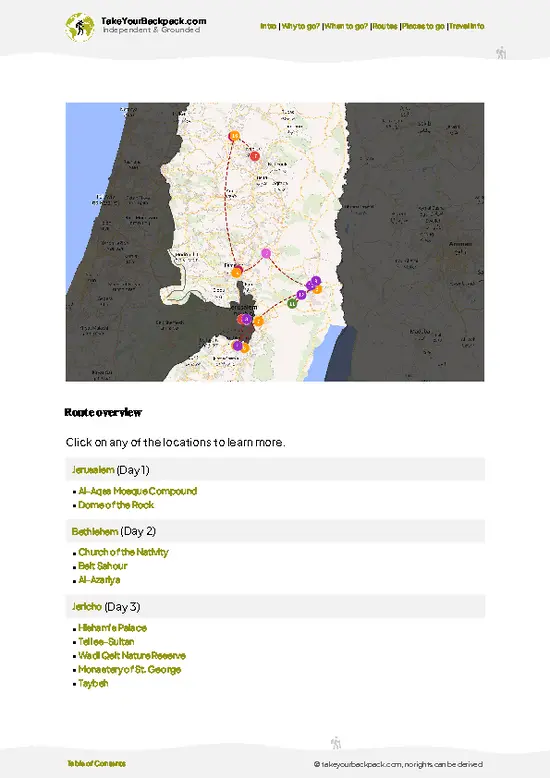
The vibe: A balanced loop that links Bethlehem’s holy sites with the desert canyons and ancient ruins around Jericho, using shared taxis and local buses with one base change. Expect a mix of churches, ruins, and big landscapes without sacrificing downtime for long lunches and slow walks.
  • Explore the Church of the Nativity and Bethlehem’s
read more 👉

The 2-Day Bethlehem & Jerusalem Focus

The vibe: A compact, soulful hit of Palestine built around Bethlehem and Jerusalem, ideal if you want depth over distance and prefer walking and short hops by bus or shared taxi. You’ll move slowly through old streets and sacred courtyards rather than racing across the map.
  • Pray, reflect, or simply observe at the Church of the Nativity in Bethlehem.
  • Experience the Al-Aqsa Mosque Compound and the Dome of the Rock on Jerusalem’s sacred plateau.
  • See political art up close at Banksy’s Walled Off Hotel Museum and Gallery.
  • Soak up evening street life in Bethlehem’s old city and nearby Beit Sahour.

The 3-Day Desert & Holy Cities Circuit

The vibe: A balanced loop that links Bethlehem’s holy sites with the desert canyons and ancient ruins around Jericho, using shared taxis and local buses with one base change. Expect a mix of churches, ruins, and big landscapes without sacrificing downtime for long lunches and slow walks.
  • Explore the Church of the Nativity and Bethlehem’s historic core.
  • Hike and take in views in and around Wadi Qelt Nature Reserve.
  • Wander the Ruins of the ancient city of Jericho and Tell es-Sultan.
  • Admire mosaics and ruins at Hisham’s Palace and Qasr Hisham.

The 5-Day Cross-Palestine Highlights Journey

The vibe: A fuller, five-day sweep through Palestine’s spiritual centers, desert canyons, and political heartlands, using shared taxis and buses with a couple of gentle walks and plenty of time on foot in old towns. It’s for travelers who want both the big-name sites and the everyday café-and-street-corner moments that tie them together.
  • Spend unhurried time in Bethlehem’s Church of the Nativity and heritage streets.
  • Walk the courtyards of the Al-Aqsa Mosque Compound and gaze up at the Dome of the Rock.
  • Hike through Wadi Qelt Nature Reserve and look out toward the Monastery of St. George.
  • Trace history from ancient Jericho and Hisham’s Palace to modern politics in Ramallah at the Yasser Arafat Museum and Arafat’s Mausoleum.
🧭 Looking for a route that fits your  trip?
Get a personalized Palestine backpacking itinerary based on your trip length, interests, and start location—in under 10 seconds.

Generate my itinerary

🌤️ When to go?Choosing the right months to travel

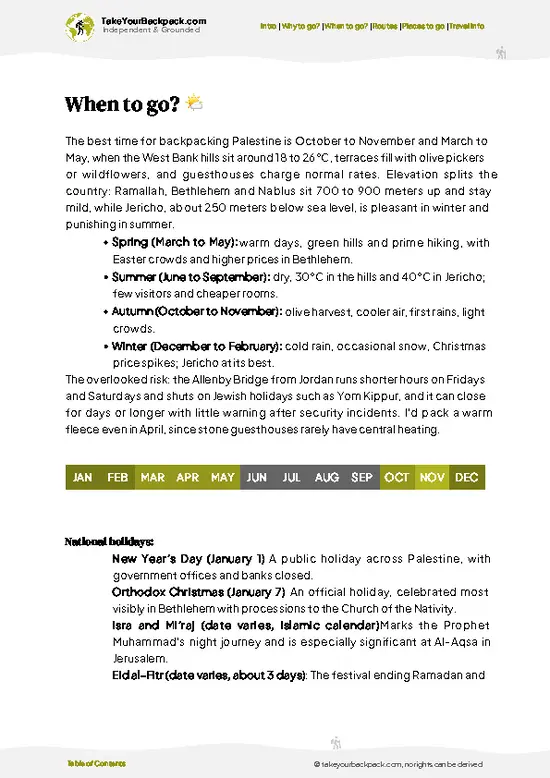
Late October through mid-November is the clean hit. Heat finally bleeds from the Jordan Valley; Jerusalem stays warm by day, hoodie-cool at night. Early rains tamp the dust without bogging trails. Tour buses fade before the Christmas surge, nudging room and taxi prices down. Olive presses whirr, daylight holds, and border crossings feel sane.
  • Heat/Crowd Peak: Jun-Sep + holiday weeks. It’s the grind—prices jump, heat pounds the valley, queues knot at holy sites. Start at dawn; payoff: a quiet Dead Sea float and a breeze-cooled rooftop later.
  • Shoulder Transition: Mar-May & Oct-Nov. Shifts—spring flowers, autumn olives; shutters lift, buses breathe again. You link hill towns on foot and finish with hot flatbread.
  • Winter Off-Peak: Dec-Feb. Rain polishes stone; lanes fall quiet; beds go cheap. Base in Jericho for warmth, carry a shell, and respect flash-flood warnings in wadis that halt taxis.

For Oct-Nov, book Jerusalem/Bethlehem weekends a week ahead; elsewhere you can wing it.

source: climatestotravel.comJANJanuary: good for travelingFEBFebruary: good for travelingMARMarch: highly recommended for travelingAPRApril: highly recommended for travelingMAYMay: highly recommended for travelingJUNJune: fair for travelingJULJuly: below average for travelingAUGAugust: below average for travelingSEPSeptember: fair for travelingOCTOctober: highly recommended for travelingNOVNovember: excellent for travelingDECDecember: good for traveling
📅 Traveling in a specific month?
Get a full month-by-month breakdown of weather, crowds, costs, festivals, and seasonal highlights in the complete travel guide.

Get full details when to go 👉

Get the Travel Guide -
!2016-10-25 15.04.10

💰 Costs (as of 2026)What things cost day to day

35-55 USD (120-190 NIS) a day if you sleep in dorms, ride servees, and don’t panic-book taxis at checkpoints.
  • dorm accommodation: 60-100 NIS per night in Bethlehem, Ramallah, Nablus; cheaper than Israel by a mile, a touch cheaper than Amman, pricier than Egypt. Heat can be weak in winter—ask for an extra blanket. System tip: base in the West Bank and daytrip to Jerusalem; message hostels directly (WhatsApp is normal) to dodge third-party markups and last-minute “no beds” surprises.
  • meals: Supermarket Survival: 20-35 NIS/day on flatbread, hummus, olives, tomatoes, street fruit. Street food reality: falafel 5-8 NIS, shawarma 12-20 NIS, manaqeesh 6-12 NIS, Arabic coffee 5-7 NIS. Half the price of Israel, roughly on par with Jordan. Tourist lanes in Bethlehem can double prices—walk one block and it normalizes.
  • local transport: The unlock is servees (shared taxis) and East Jerusalem Arab buses. In-city 4-6 NIS; intercity 8-25 NIS (Damascus Gate 231 to Bethlehem, 218 to Ramallah). No Uber. Metered taxis are rare—agree the fare first. Pro move: walk Checkpoint 300, then hop the local bus on each side; it beats a 70-120 NIS cross-checkpoint taxi every time.
  • activities: Major cost drivers are guided
read more 👉
35-55 USD (120-190 NIS) a day if you sleep in dorms, ride servees, and don’t panic-book taxis at checkpoints.
  • dorm accommodation: 60-100 NIS per night in Bethlehem, Ramallah, Nablus; cheaper than Israel by a mile, a touch cheaper than Amman, pricier than Egypt. Heat can be weak in winter—ask for an extra blanket. System tip: base in the West Bank and daytrip to Jerusalem; message hostels directly (WhatsApp is normal) to dodge third-party markups and last-minute “no beds” surprises.
  • meals: Supermarket Survival: 20-35 NIS/day on flatbread, hummus, olives, tomatoes, street fruit. Street food reality: falafel 5-8 NIS, shawarma 12-20 NIS, manaqeesh 6-12 NIS, Arabic coffee 5-7 NIS. Half the price of Israel, roughly on par with Jordan. Tourist lanes in Bethlehem can double prices—walk one block and it normalizes.
  • local transport: The unlock is servees (shared taxis) and East Jerusalem Arab buses. In-city 4-6 NIS; intercity 8-25 NIS (Damascus Gate 231 to Bethlehem, 218 to Ramallah). No Uber. Metered taxis are rare—agree the fare first. Pro move: walk Checkpoint 300, then hop the local bus on each side; it beats a 70-120 NIS cross-checkpoint taxi every time.
  • activities: Major cost drivers are guided political/history walks (80-150 NIS), Jericho cable car and Dead Sea day passes (60-100 NIS), and private rides to trailheads like Wadi Qelt if you miss a servees. Most holy sites are free; small museums/ruins run 5-20 NIS. Compared to Israel, activities are cheaper unless you rope in private transport.
  • miscellaneous: Budget leaks: ATM fees (15-20 NIS a hit), bottled water in summer, coffee creep, checkpoint delays that push you into taxis. Local SIM (Jawwal/Ooredoo) 35-50 NIS for ~10GB—worth it to coordinate servees. Carry small change. I once burned 50 NIS on a Hebron taxi after missing the last shared car; leaving 30 minutes earlier would’ve cost 6 NIS.
⚠️ Prices can change and everyone travels differently, so take this as a rough guide. Hope it helps you plan your adventure!

✈️ The backpacker research shortcutPalestine Travel Guide

An offline-friendly backpacking guide with optimized travel routes, ranked highlights, transport advice, and the best areas to stay.
example page 0 from our offline Travel Guide for Palestine
example page 1 from our offline Travel Guide for Palestine
example page 2 from our offline Travel Guide for Palestine
example page 3 from our offline Travel Guide for Palestine
example page 4 from our offline Travel Guide for Palestine
example page 5 from our offline Travel Guide for Palestine
example page 6 from our offline Travel Guide for Palestine
example page 7 from our offline Travel Guide for Palestine
The digital guide (273 pages) contains:
69 highlights, ranked by travel appeal
Optimized 2, 3 & 5-day travel routes
Cities, national parks, landmarks, beaches
How to get around
Offline-friendly for travel without Wi-Fi
👉 Click to see all 30+ guide features

📅 Plan smarter in minutes, not weeks
Month by month travel advice
Festivals & national holidays
Budget expectations

🗺️ Go to the right places, skip the overrated ones
Honest pros & cons of destinations
Top hikes, parks & viewpoints
Lesser-known places most travelers miss
Clear “worth it vs skip it” guidance

🛏️ Travel smoothly without rookie mistakes
Best areas to stay
Transport systems explained simply
Common scams & safety advice
SIM cards, money & practical tips

🌍 Understand the country, not just visit it
Culture & traditions
52 Essential phrases & customs
Festivals worth planning around
Traveler-friendly historical context
Insights that make places more meaningful

📱 Built for real travel conditions
Fully downloadable PDF
Works completely offline
Optimized for phone use
Useful in remote areas & buses
Everything in one place
Save weeks of stressful planning
Get instant access to your full guide. 30‑day money-back guarantee.


By proceeding you agree to our terms.
Sent to your inbox immediately after payment • 100% Secure Checkout
Best Backpacking Travel Advisor 2025 tourism awardBest Backpacking
Travel Advisor
2025
What others say about Take Your Backpack Guides:
⭐⭐⭐⭐⭐
Fantastic, amazing amount of information!
⭐⭐⭐⭐⭐
My goodness this is amazing, it's what I've been looking for hats off too you!
⭐⭐⭐⭐⭐
I think this is absolutely BRILLIANT
⭐⭐⭐⭐
Very complete and informative. It's still missing places, but I gotta to commend you
⭐⭐⭐⭐⭐
This is truly amazing, thank you, can't wait to explore it with my kids!
⭐⭐⭐⭐⭐
Awesome resource, thank you!
⭐⭐⭐⭐⭐
This is amazing! Can't wait to explore the ones I haven't seen
⭐⭐⭐⭐
I love this! Well done, great idea.
⭐⭐⭐⭐⭐
Thanks for taking the time to make this gem!
⭐⭐⭐⭐⭐
This might be the best website I've ever seen.
⭐⭐⭐⭐⭐
Congratulations, and thank you so much for your work; it's incredibly valuable.
⭐⭐⭐⭐
In all seriousness I think you did a great job pointing out the important spots
⭐⭐⭐⭐⭐
10/10 very good
⭐⭐⭐⭐⭐
As someone who's only just starting to visit regularly this is awesome, thank you.
⭐⭐⭐⭐
Thank you very much! I'm going to visit my dad, it's going to be very useful!
⭐⭐⭐⭐⭐
This is really cool! We'll be travelling for the first time and this definitely come in handy.
⭐⭐⭐⭐⭐
You are now our minister of culture, congratulations 👨‍💼
⭐⭐⭐⭐⭐
Just wanted to tell you that this is a pearl! Going to follow your recommendations.
⭐⭐⭐⭐⭐
This is so cool. I'll definitely be using the resource for my travels soon.
⭐⭐⭐⭐⭐
This is very impressive! Good work.
⭐⭐⭐⭐⭐
This is an amazing and informative site. Very well done!

🛏️ Where to stay?Best areas to base yourself

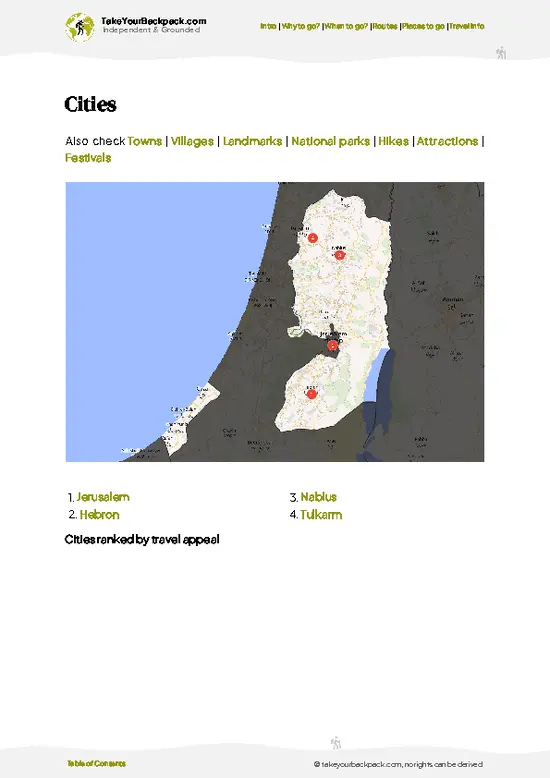
There are hostels and basic budget accommodation in Palestine, concentrated in West Bank cities (Ramallah, Bethlehem, Nablus, Jericho); Gaza has very few options and access is heavily restricted.
Ramallah city centre offers the most selection and nightlife but is pricier; Bethlehem’s Old Town and Manger area put you next to major religious sites and tourist services but feel crowded and touristy; Nablus’s Old City and market areas are cheaper and more authentic yet quieter at night and subject to checkpoints; Jericho near the archaeological sites is peaceful with limited services and fewer budget … read more 👉
There are hostels and basic budget accommodation in Palestine, concentrated in West Bank cities (Ramallah, Bethlehem, Nablus, Jericho); Gaza has very few options and access is heavily restricted.
Ramallah city centre offers the most selection and nightlife but is pricier; Bethlehem’s Old Town and Manger area put you next to major religious sites and tourist services but feel crowded and touristy; Nablus’s Old City and market areas are cheaper and more authentic yet quieter at night and subject to checkpoints; Jericho near the archaeological sites is peaceful with limited services and fewer budget beds.
Expect simple guesthouse standards rather than large dorm-style hostels, book ahead for peak periods, carry ID and cash, and plan routes around checkpoints and variable transport to avoid getting stuck.

If you enjoy meeting fellow travelers, consider choosing hostels with high ratings for atmosphere. On the other hand, if you prefer having your own space, a hotel might be a better option.

🚌 Getting aroundHow to travel within the country

Palestine moves on elastic time. Lines are real, schedules are not. A station is a chorus of shouted cities, cigarette smoke, and drivers reading the room for that last seat. Checkpoints act like tides—sometimes slack, sometimes grinding. You learn to feel the push. When it breaks your way, you roll into a sun-baked square and the first cold Taybeh wipes the dust from your mouth.
  • Servees (shared taxis) The social fabric. Say salaam, state your city, slide in. Pay forward, don’t slam the door, and
read more 👉
Palestine moves on elastic time. Lines are real, schedules are not. A station is a chorus of shouted cities, cigarette smoke, and drivers reading the room for that last seat. Checkpoints act like tides—sometimes slack, sometimes grinding. You learn to feel the push. When it breaks your way, you roll into a sun-baked square and the first cold Taybeh wipes the dust from your mouth.
  • Servees (shared taxis) The social fabric. Say salaam, state your city, slide in. Pay forward, don’t slam the door, and don’t climb over anyone’s knees. They leave when full; if you’re in a hurry, quietly buy the empty seats. Half the price of a private taxi, twice the humanity.
  • Palestinian Buses The efficiency trade-off. Cheapest thing on wheels, but they stop often and yield to the day’s realities—market crowds, school let-outs, prayer times. When they click, they’re great. When they don’t, a servees will beat them point-to-point every time.
  • East Jerusalem-West Bank Buses The budget disruptor. From Damascus Gate area to Bethlehem or Ramallah for the cost of lunch, no tour markup, no taxi theater. You’ll walk a bit, pass through a checkpoint like everyone else, and land right in the center where the real food is.
  • Servees + Footpaths The geometric unlock. Get dropped at a junction and hike the last kilometer to places buses won’t touch—Wadi Qelt’s canyon, Mar Saba’s ridge lines, village terraces above Battir. Bring water, sun cover, and don’t expect shade or signage to save you.

Master tip: be at the main servees station at first light and, if the queue is slow, buy the last one or two seats—beating the checkpoint build-up is the difference between a slog and a glide across the West Bank.
Quick reality check: There’s no functioning airport in Ramallah or the West Bank. Most travelers reach Ramallah via Ben Gurion Airport (TLV) in Israel or via Jordan’s Queen Alia (AMM) with a land crossing at Allenby/King Hussein Bridge. For context: Ramallah city center is about 47 km (29 mi) by road from TLV, and about 40 km (25 mi) from the Allenby/King Hussein Bridge. The former Atarot/Jerusalem Airport near Ramallah has been closed since 2000.

From Ben Gurion Airport (TLV) to Ramallah — 47 km (29 mi)
  • Train to Jerusalem + East Jerusalem bus/servees

    Time: 60-90 min total (train 23-30 min; tram/walk 10-15 min; bus/servees 25-45 min, checkpoint-dependent)

    Cost: Train 20-25 NIS; Jerusalem Light Rail 6 NIS (or walk ~10-15 min) to Damascus Gate area; East Jerusalem Arab bus 6-8 NIS or shared taxi (servees) 10-15 NIS

    How: TLV airport train to Jerusalem-Yitzhak Navon. From there, walk or take the tram to Damascus Gate bus station (East Jerusalem). Frequent buses/servees to Ramallah.
  • Sherut (shared taxi) to Jerusalem + bus/servees

    Time: 75-120 min total

    Cost: Sherut TLV→Jerusalem 70-85 NIS; then 6-15 NIS for bus/servees to Ramallah

    How: Nesher-style shared taxis run 24/7 from TLV to Jerusalem. Ask to be dropped near Damascus Gate, then hop a bus/servees to Ramallah.
  • Prebooked door-to-door transfer

    Time: ~90-120 min

    Cost: 350-600 NIS per vehicle (roughly US$95-160), varies by hour/group size

    Notes: Usually involves a vehicle change near Qalandiya checkpoint due to entry restrictions for Israeli-plated cars into Area A (Ramallah).

Taxis (short overview)
  • Israeli taxi TLV→Qalandiya checkpoint: 250-400 NIS, 45-70 min; then switch to a Palestinian taxi to Ramallah center (25-50 NIS, 15-25 min).
  • Private taxi Jerusalem (East)→Ramallah: 100-150 NIS, 30-50 min depending on traffic and checkpoint queues.

From Queen Alia Airport (AMM, Jordan) via Allenby/King Hussein Bridge — ~115 km (71 mi) total to Ramallah
  • AMM→Bridge: 45-60 min. JETT bus about 10 JOD; taxi 25-35 JOD.
  • Crossing formalities and shuttles: 1.5-3 hours typical. Expect exit tax on the Jordanian side (about 10 JOD) and mandatory shuttle/bus tickets on both sides (budget roughly 20-50 NIS + 3-7 JOD combined). Check current fees/hours before travel.
  • Bridge (Palestinian side)→Ramallah: 30-45 min. Shared taxi (servees) 15-25 NIS; private taxi 80-120 NIS.
  • Total: 2.5-5 hours door-to-door; roughly 25-40 JOD + 40-60 NIS per person, plus any visa/permit fees if applicable.

Good to know
  • Checkpoint traffic can add 10-40 minutes at busy times. Fridays and holidays can be slower.
  • Most Israeli taxis and rental cars won’t enter Area A (Ramallah). Plan on switching vehicles near Qalandiya if coming from the Israeli side.
  • Carry cash (NIS) for East Jerusalem/Ramallah buses and servees; cards aren’t always accepted.
⚠️ Prices and routes can change, so take this as a rough guide and ask for local advice when you arrive.
🚀 Don’t waste time on the road.
We’ll generate a route that minimizes unnecessary travel and fits your available days.

Generate my itinerary

🔒 Safety (risk Level: high)Safety considerations for travelers

Safety for solo travelers, including women and LGBTQ+ individuals
Safety in Palestine for solo travelers, including women and LGBTQ+ individuals, varies by location and current events. Urban areas like Ramallah and Bethlehem are generally safer, but cultural norms can be conservative. Women should dress modestly and LGBTQ+ travelers should be discreet. Always stay updated on local news and be prepared for checkpoints and travel restrictions.


Full official government travel advisory (live updates)
View details 👉
safety image

source: www.gov.uk

✈️ VisaVisa requirements for Palestine

Entering Palestine typically involves passing through Israel, as it controls all border entry points. Most tourists can enter Israel visa-free for up to 90 days, but always check the latest requirements before traveling. Applying for an Israeli visa, if needed, can be done through the nearest Israeli consulate or embassy.
⚠️ Visa requirements can change over time, so always check the latest visa requirements with the official embassy or government website before you travel.

🎒 What to pack?A practical packing list

When packing for Palestine, think layers and modesty. Summers can be scorching, especially in the West Bank, while winters get surprisingly chilly, particularly around Jerusalem. The terrain varies from coastal plains to rugged hills, so sturdy footwear is a must. Respect the local culture by dressing modestly—long sleeves and pants are generally a good call, especially when visiting religious sites. A hat and sunglasses are lifesavers under the intense sun, and a light scarf is versatile for both shade and modesty.

Apart from this country specific advice, I have also crafted a general packing list that should help on any trip. authorOver the years, I've learned the importance of packing minimally. It's so much easier to jump on the back of a truck or squeeze yourself into the last spot of a minibus without that supersized backpack. If you're headed to a warm destination, leave your winter jacket at home; for colder regions, opt for thin thermal underlayers. Instead of packing your entire wardrobe, bring just three sets of clothes, as laundry facilities are available everywhere.

View the full list 👉
🎒 Planning the practical side of your trip?
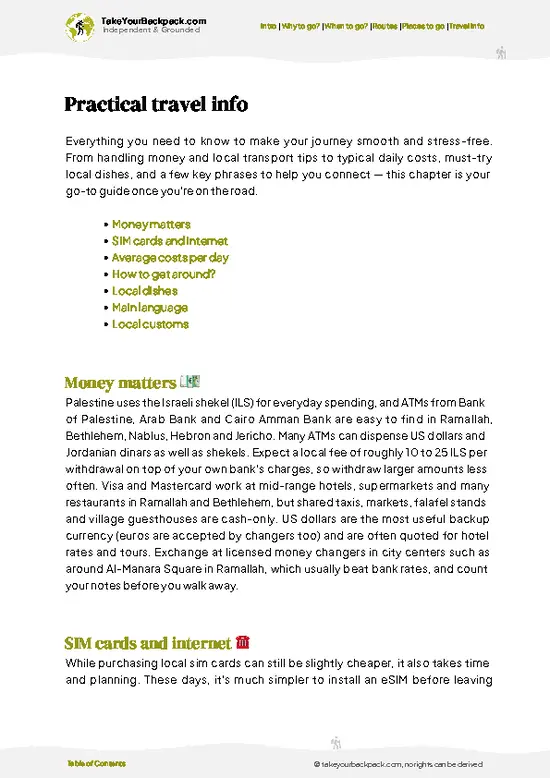
Get detailed information on transport, daily budgets, internet access, local customs, food, language, and other essentials in the complete Travel Guide.

Get detailed practical information 👉

Get the Travel Guide -

🙋 FAQQuick answers to practical concerns

Trip Planning

Planning a backpacking route through Palestine can be tricky — you need to balance must-see places, travel times, budget, and how long to stay in each destination. Our personalized Palestine itinerary planner creates a route based on your travel style, trip duration, and interests, so you can spend less time researching and more time exploring.


Personal tip: I normally search on good rating for atmosphere (for meeting people) and location (for easy exploring). Cleanliness as a bonus.


Travel Essentials

It’s recommended to have routine vaccines up to date, such as MMR (measles, mumps, rubella), DTP (diphtheria, tetanus, pertussis), and the yearly flu shot. Consider getting vaccinated for hepatitis A, as it’s possible to contract through contaminated food or water. Hepatitis B is advisable if you might be exposed to blood or bodily fluids. Typhoid vaccine is recommended, especially if visiting rural areas. Rabies vaccination is optional but can be considered if you plan on interacting with animals or spending extended time outdoors. Always check for any updated advisories from health authorities.


vaccination requirements
When I first started traveling, I often spent part of my first day in a new country hunting for a local SIM card. While this can still be slightly cheaper, it also takes time and planning.

These days, it's much simpler to install an eSIM before leaving home. Once you arrive in Palestine, you can activate it immediately and have mobile data from the moment you land — which is especially useful for ordering transport or navigating away from busy airports.

There are many providers nowadays, and price differences are usually small. I personally go with Holafly, as it offers excellent network coverage throughout the country and strong global coverage, so you can manage multiple countries from a single app.


HolaFly eSim

Culture & Customs

Be respectful when visiting mosques or churches; dress modestly, covering shoulders and knees. Ask for permission before taking photos, especially of people. Fridays are holy days, so many shops may be closed.

Do shake hands with men; women should wait to see if a handshake is offered. Public displays of affection are frowned upon, even for heterosexual couples.

LGBTQ+ travelers should exercise discretion, as same-sex relations can be culturally sensitive. Women should consider wearing a headscarf in conservative areas for added comfort.

Avoid discussing sensitive political topics unless invited to do so. Always accept offered refreshments as a sign of respect.
Trying traditional food is always a great way to experience the culture. Here are some must-try dishes for Palestine.
  • Musakhan: A quintessential Palestinian dish, musakhan features sumac-seasoned chicken roasted atop taboon bread with a generous spread of caramelized onions and pine nuts. It’s often hailed as the national dish and is a staple at family gatherings.
  • Maqluba: Translating to ”upside-down,” maqluba is a hearty casserole of rice, vegetables, and meat (often lamb or chicken) that’s flipped over before serving. It’s a comfort food deeply rooted in Palestinian culture, perfect for sharing.
  • Knafeh: This sweet treat is made of thin noodle-like pastry soaked in syrup, layered with cheese, and sometimes topped with crushed pistachios. It’s a staple at celebrations and is often enjoyed with a cup of strong coffee.
  • Hummus: While hummus is popular across the Middle East, the Palestinian version is known for its creamy consistency and vibrant flavors. Made from blended chickpeas, tahini, lemon juice, and garlic, it’s a great accompaniment to many meals.
  • Mansaf: Though often associated with Jordan, Palestinians make a version of mansaf featuring lamb cooked in a fermented dried yogurt sauce served over rice. It’s a dish of hospitality and honor, often served on special occasions.
In Palestine, locals often drink tap water, but it’s generally not recommended for tourists due to possible contamination issues. Opt for bottled or filtered water to be safe. If you’re staying long-term, investing in a good water filter might be a wise choice.
The main language in Palestine is Arabic. Backpacking is way more rewarding if you know a bit of the local language, so I'd suggest brushing up on the basics just in case your Arabic skills have become a bit rusty.

Want to understand locals better?
The complete Travel Guide for Palestine includes 52 essential words and phrases — greetings, thank-yous, ordering food, transport, numbers, and common local expressions you'll actually hear.

Get your local basic phrases 👉

Get the Travel Guide -


In Palestine, English is spoken to varying degrees, primarily in urban areas and among younger generations. In cities like Ramallah, Bethlehem, and Nablus, you’ll find many people, especially those in the hospitality industry, who speak English fluently. English is also taught in schools, so many young Palestinians have a basic understanding of the language.

However, in more rural areas, English proficiency may be limited, with many residents speaking primarily Arabic. While signs in tourist areas are often bilingual, outside these zones, you might encounter challenges communicating in English.

Overall, while you can navigate most urban settings with English, having some knowledge of Arabic phrases can enhance your experience and interactions with locals.

Money & Payments

The local currency of Palestine is NIS (₪).

When backpacking in Palestine, it’s worth knowing that ATMs are widely available in cities like Ramallah, Bethlehem, and Hebron, but they might be scarce in rural areas. Most ATMs dispense shekels, and some might offer USD. Always have some cash on you, as not every place takes cards, especially small shops and local eateries.

While dollars are sometimes accepted, it’s generally better to use shekels for small transactions, as you’ll likely get a better rate. Euros aren’t as commonly accepted, so stick to dollars if you want a backup currency.

Card acceptance is growing but still not universal, so don’t rely solely on plastic. Visa and MasterCard are the most widely accepted, but it’s always safer to ask before you order that extra falafel.

For exchanging money, stick to banks or official exchange offices in larger towns. Avoid doing it at the airport or near tourist hotspots where rates can be less favorable. A quick tip: keep an eye on your notes, as worn or torn bills might not be accepted.

Tipping in Palestine is appreciated but not mandatory. In restaurants, leaving around 10% is a kind gesture, while for taxi drivers, rounding up the fare is common. Hotel staff and guides will also appreciate a small tip for their services.

🧩 Nearby countriesOther countries to combine with Palestine

📸 PhotosScenes from around the country

Take your backpack - Palestine - 0
Take your backpack - Palestine - 1
Take your backpack - Palestine - 2
Take your backpack - Palestine - 3
Take your backpack - Palestine - 4
Take your backpack - Palestine - 5
Take your backpack - Palestine - 6
Take your backpack - Palestine - 7
Take your backpack - Palestine - 8
Take your backpack - Palestine - 9
Take your backpack - Palestine - 10
Take your backpack - Palestine - 11
Take your backpack - Palestine - 12
Take your backpack - Palestine - 13
Take your backpack - Palestine - 14
Take your backpack - Palestine - 15
Photographed by: Johan Kruseman

Memorable moments from the road

Something else than your average holiday destination

Something else than your average holiday destination

Palestine | Palestine is something else than the average holiday destination. And I think I can say it’s the country which has made the most impact on me ever, even more than North Korea. In North Korea the situation may be worse but there they only show you what they want to show whereas in Palestina you are free to move around and explore. And the situation ...
Read more
More stories

We 💚 feedbackIs Palestine worth visiting?

Palestine hits with texture: diesel taxis, cardamom coffee, calls to prayer bouncing off stone alleys. Ramallah moves fast; Hebron is heavier; Nablus feeds you knafeh and jokes, then sends you on your way. The burn is real—hot climbs in Wadi Qelt, dust in your teeth—but the pay-off is the canyon hush and a cold Taybeh back in town. It’s not a war zone every minute. Most days are normal, then a checkpoint stalls you. Small warning: carry your passport, don’t film soldiers, dress modestly. Best surprise: relentless hospitality.

✈️ When did I visit Palestine?
I visited Palestine (Westbank) in October 2013 in the same trip as I backpacked through Israel. While my visit dates back, this guide is continuously refined using feedback from locals and current backpackers (last update: 1 May 2026)

✍️ Help improve this page!
The information on this page is based on my own backpacking experience in Palestine, supplemented with up-to-date research and feedback from other travelers. Travel details can change, so if you notice anything outdated or incomplete, feel free to let me know.


🙋‍♂️ Give feedback

👋 Meet the founderWho’s Behind Take Your Backpack?

Johan, backpacker and founder of TakeYourBackpackHi, I’m Johan (Netherlands 🇳🇱), the creator of TakeYourBackpack. Over the past decade, I’ve backpacked through 80+ countries across six continents, gaining extensive experience with independent travel, long-term trips, and overland routes.

This site is built on a combination of firsthand travel experience and carefully curated insights from other backpackers. Many guides are based on places I’ve personally visited, while others bring together tips, observations, and practical advice shared by trusted travelers I’ve met along the way.

The goal is to provide realistic, experience-driven guidance — not generic itineraries — so you can explore destinations with better context, clearer expectations, and more confidence.

Get full Palestine guide •
Instant download • 69 highlights • Full Offline guide