Trip Planning
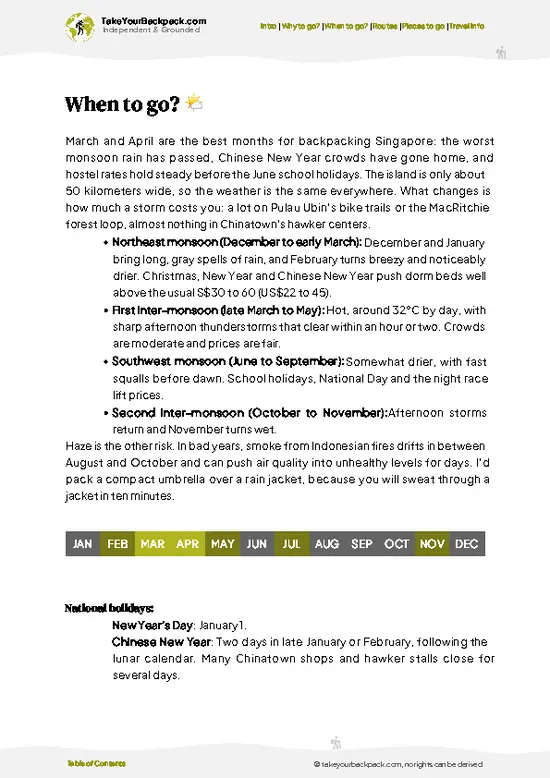
The TakeYourBackpack guidebooks are your all-in-one travel companion, featuring the best cities, national parks, hikes, beaches, and unique sites, along with essential tips on when to go, how to get around, exchanging money, and even local phrases to get you started — everything you need for a smooth, unforgettable backpacking adventure.
Stop researching. Start exploring.Discover all 63 highlights,ranked
and organized into practical routes.
Get instant access
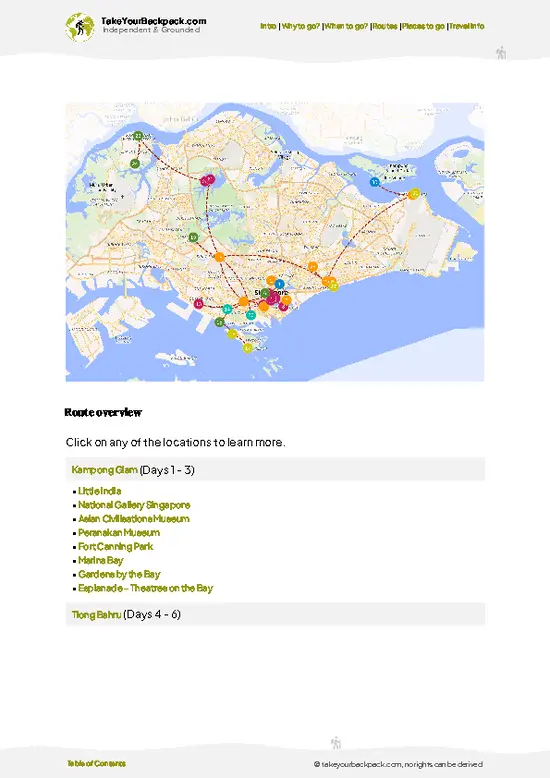
Planning a backpacking route through Singapore can be tricky — you need to balance must-see places, travel times, budget, and how long to stay in each destination. Our free personalized Singapore itinerary planner creates a route based on your travel style, trip duration, and interests, so you can spend less time researching and more time exploring.
Personal tip: I normally search on good rating for atmosphere (for meeting people) and location (for easy exploring). Cleanliness as a bonus.
Travel Essentials
No vaccinations are required to enter Singapore unless you arrive from a country with yellow fever risk, in which case you need a yellow fever certificate (for travelers aged one and over). Make sure routine vaccines such as MMR, tetanus and influenza are up to date, and consider hepatitis A. Dengue fever circulates year-round, so mosquito repellent is more useful than any jab.
vaccination requirementsWhen I first started traveling, I often spent part of my first day in a new country hunting for a local SIM card. While this can still be slightly cheaper, it also takes time and planning.
These days, it's much simpler to install an eSIM before leaving home. Once you arrive in Singapore, you can activate it immediately and have mobile data from the moment you land — which is especially useful for ordering transport or navigating away from busy airports.
There are many providers nowadays, and price differences are usually small. I personally go with
Holafly, as it offers excellent network coverage throughout the country and strong global coverage, so you can manage multiple countries from a single app.
HolaFly eSimCulture & Customs
Singapore runs on rules that are actually enforced. Littering, jaywalking within 50 meters of a crossing and smoking outside marked zones can all bring on-the-spot fines. At hawker centers, a packet of tissues on a table means the seat is “choped” (reserved), so don’t sit there. Return your tray afterward, because tray return is now enforced. Take your shoes off before entering homes, Hindu and Buddhist temples and mosques, and dress modestly in places of worship, with women sometimes offered a robe at mosque entrances. Don’t point with your finger at people or touch anyone’s head, and pass money or business cards with both hands. Avoid loud public criticism of the government, race or religion, which are treated as sensitive topics. Public displays of affection are kept restrained by everyone, and same-sex couples tend to be extra discreet.
Trying traditional food is always a great way to experience the culture. Here are some must-try dishes for Singapore.
- Hainanese Chicken Rice: Poached chicken served at room temperature over rice cooked in chicken fat and stock, with chili-garlic sauce and dark soy. It’s the unofficial national dish and costs S$4 to 6 at a hawker stall.
- Chili Crab: Mud crab stir-fried in a sweet, tangy tomato-chili gravy, eaten with fried mantou buns for mopping up the sauce. It’s a celebratory seafood dinner and a splurge at S$80 to 120 per kilogram.
- Laksa: Thick rice noodles in a spicy coconut-curry broth with prawns, cockles and fishcake. The Katong version comes with cut-short noodles, so you eat it with a spoon only. It’s a signature of Peranakan cooking.
- Char Kway Teow: Flat rice noodles and yellow noodles wok-fried with dark soy, lard, Chinese sausage, cockles and bean sprouts. The smoky “wok hei” char is what regulars judge stalls by.
- Bak Kut Teh: Pork ribs simmered in a peppery, garlicky broth in the Teochew style, with free refills of the soup and fried dough sticks for dipping. It’s a classic breakfast or late-night meal.
- Roti Prata: Flaky, griddle-fried flatbread from Indian-Muslim stalls, dipped in fish or mutton curry. It sells for around S$1.50 to 2 a piece and is a 24-hour comfort food.
- Kaya Toast: Charcoal-grilled toast with coconut-pandan jam and slabs of cold butter, served with soft-boiled eggs and strong kopi. It’s the standard local breakfast at old-school coffee shops.
- Satay: Skewers of marinated chicken, beef or mutton grilled over charcoal and served with peanut sauce, cucumber and rice cakes. They’re best eaten at night in the hawker centers that UNESCO recognized as Intangible Cultural Heritage in 2020.
Tap water in Singapore is safe to drink straight from the tap, treated by the national water agency PUB to standards above WHO guidelines, and locals drink it without a second thought. Tourists don’t need bottled or filtered water. Bring a refillable bottle and top it up at the drinking fountains in parks, MRT stations and the airport.
English is the main working language of Singapore, used on every sign and menu and in government, business and schools, so you’ll have no trouble anywhere. Younger people and hostel staff speak it fluently. Some older hawkers and taxi drivers mix in Singlish, a fast local English laced with Malay and Hokkien words, and there isn’t really a rural area where English disappears. Mandarin helps most with elderly stallholders, and learning that “lah” softens a sentence and “can” means yes will get you a long way at the food centers.
Money & Payments
The local currency of Singapore is SGD (S$).
ATMs are everywhere in Singapore, at every MRT station, mall and most hawker centers, run mainly by DBS/POSB, OCBC and UOB. Local banks usually add no or only a small withdrawal fee, so the real cost is your home bank’s foreign fee of roughly 1 to 3%. Contactless cards and phone wallets work almost everywhere, including the MRT, buses, supermarkets and most restaurants. Many hawker stalls and older shops are still cash-only or take only local QR payments, so carry S$20 to 50 in small notes. US dollars and euros are easy to exchange, but you won’t need to bring much cash. The licensed money changers in Mustafa Centre, People’s Park Complex in Chinatown and the Raffles Place arcades usually beat both airport and hotel rates.
Tipping isn’t expected in Singapore, and many restaurants already add a 10% service charge plus 9% GST, shown on menus as “++”. Hawker stalls, food courts and coffee shops never expect a tip. Rounding up a taxi fare or leaving a few dollars for exceptional hotel or tour service is appreciated but entirely optional.
v2.webp)

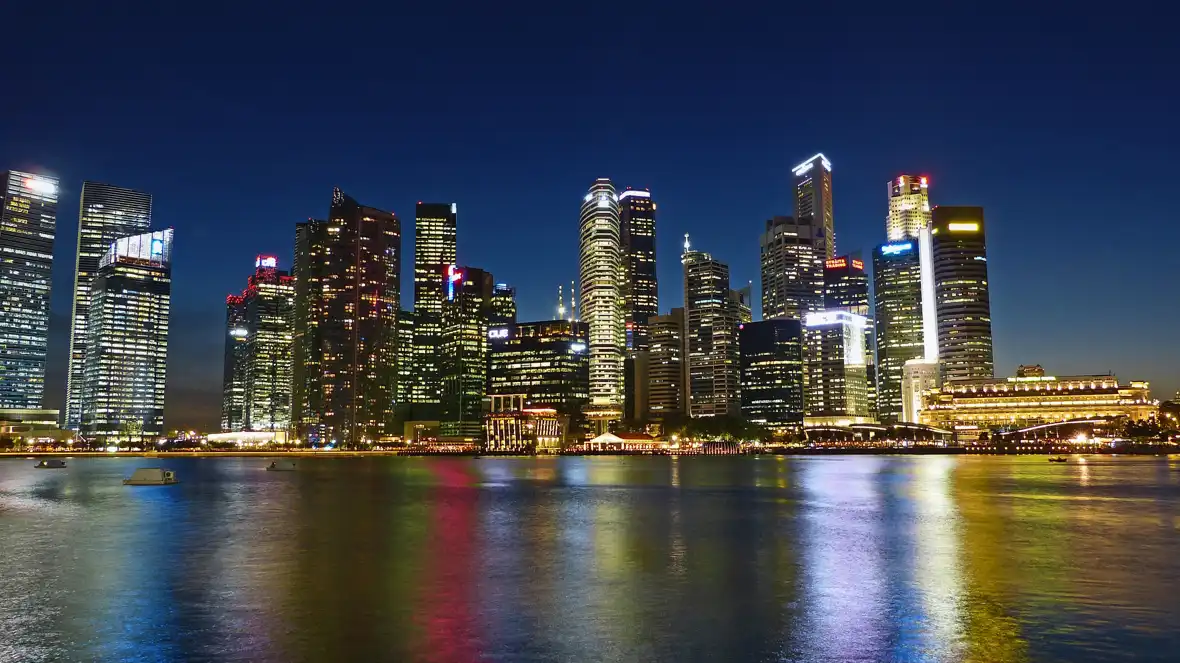
 Best Backpacking
.jpg) Over the years, I've learned the importance of packing minimally. It's so much easier to jump on the back of a truck or squeeze yourself into the last spot of a minibus without that supersized backpack. If you're headed to a warm destination, leave your winter jacket at home; for colder regions, opt for thin thermal underlayers. Instead of packing your entire wardrobe, bring just three sets of clothes, as laundry facilities are available everywhere.
Over the years, I've learned the importance of packing minimally. It's so much easier to jump on the back of a truck or squeeze yourself into the last spot of a minibus without that supersized backpack. If you're headed to a warm destination, leave your winter jacket at home; for colder regions, opt for thin thermal underlayers. Instead of packing your entire wardrobe, bring just three sets of clothes, as laundry facilities are available everywhere.




.jpg) Hi, I’m Johan (Netherlands 🇳🇱), the creator of TakeYourBackpack. Over the past 3 decades, I’ve backpacked through 90+ countries across six continents, gaining extensive experience with independent travel, long-term trips, and overland routes.
Hi, I’m Johan (Netherlands 🇳🇱), the creator of TakeYourBackpack. Over the past 3 decades, I’ve backpacked through 90+ countries across six continents, gaining extensive experience with independent travel, long-term trips, and overland routes.