×
Estonia 🇪🇪

backpacking Europe Estonia 🇪🇪
Transition from medieval lanes into deep northern forests.

Explore DenmarkExplore Faroe Islands

Backpacking Estonia in 2026

A complete guide including when and where to go, costs, transport, itineraries, and practical travel advice.
An overview of visiting Estonia

Backpacking Estonia
By Johan Kruseman 🇳🇱 | Updated June 1, 2026

Decide early whether you’ll stick to Tallinn with public transport or rent a car to stitch together coasts, bogs, and islands—this single choice sets your pace, costs, and payoff. Buses and trains are cheap and punctual on main corridors, but rural routes are thin and ferries set island timing. With a car, Estonia’s quiet, space-rich character clicks into place.

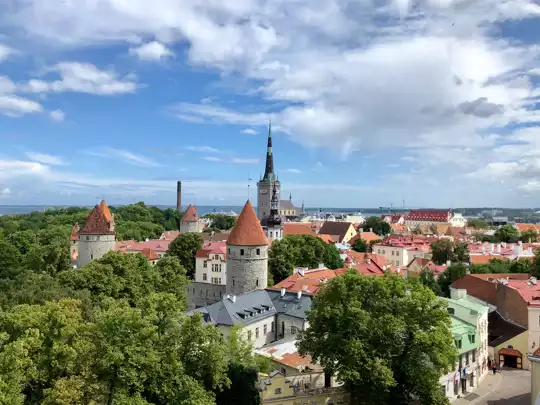
This is a compact, forested country where medieval walls meet a digital state, where choir culture and smoke saunas share space with bird-rich wetlands. Start in Tallinn’s stone lanes, then swap cobbles for boardwalks over peat pools in Lahemaa or Soomaa at sunrise, cranes calling and mist lifting. Saaremaa and Hiiumaa slow you down with lighthouses, windmills, and juniper; Setomaa and Lake Peipus add onion fields, Old Believer villages, and sturdy traditions. Matsalu draws migration on a grand scale, manors dot the countryside, and the sauna culture resets your bearings. Challenges are practical, not dramatic: mosquitoes in July, Baltic wind in winter, limited hours beyond Tallinn, and cashless systems that assume you’re online. Plan around them—layers, early ferries, offline maps—and the low-crowd rhythm becomes the reward.

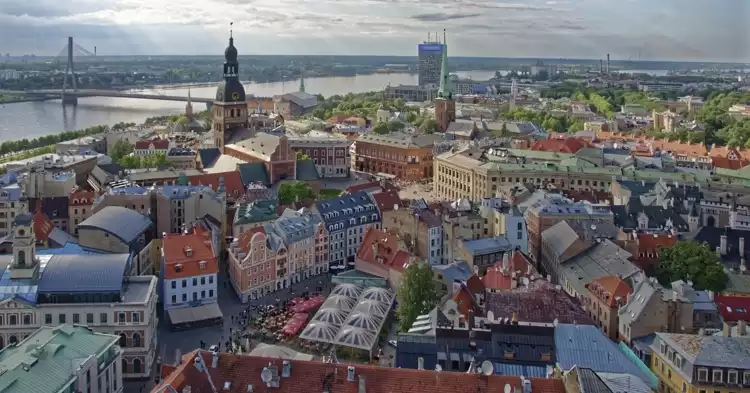
Compared with Latvia, Estonia trades grand facades for bogs and boulders; compared with Lithuania, less baroque, more pine and coast; compared with Finland, similar Nordic logic at lower prices with medieval texture. Go if you love clean design, wild silence, a small capital, and self-drive freedom that pays back curiosity.

👉 Get the 📖 Travel Guide of Estonia

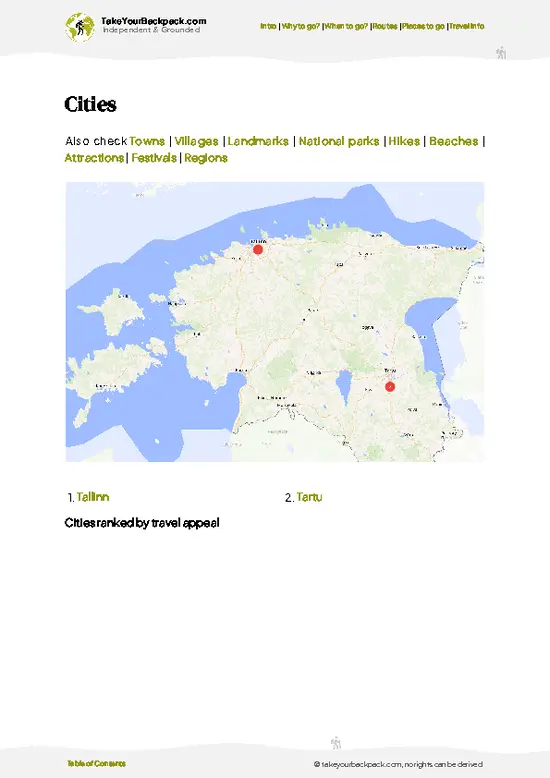
Tallinn

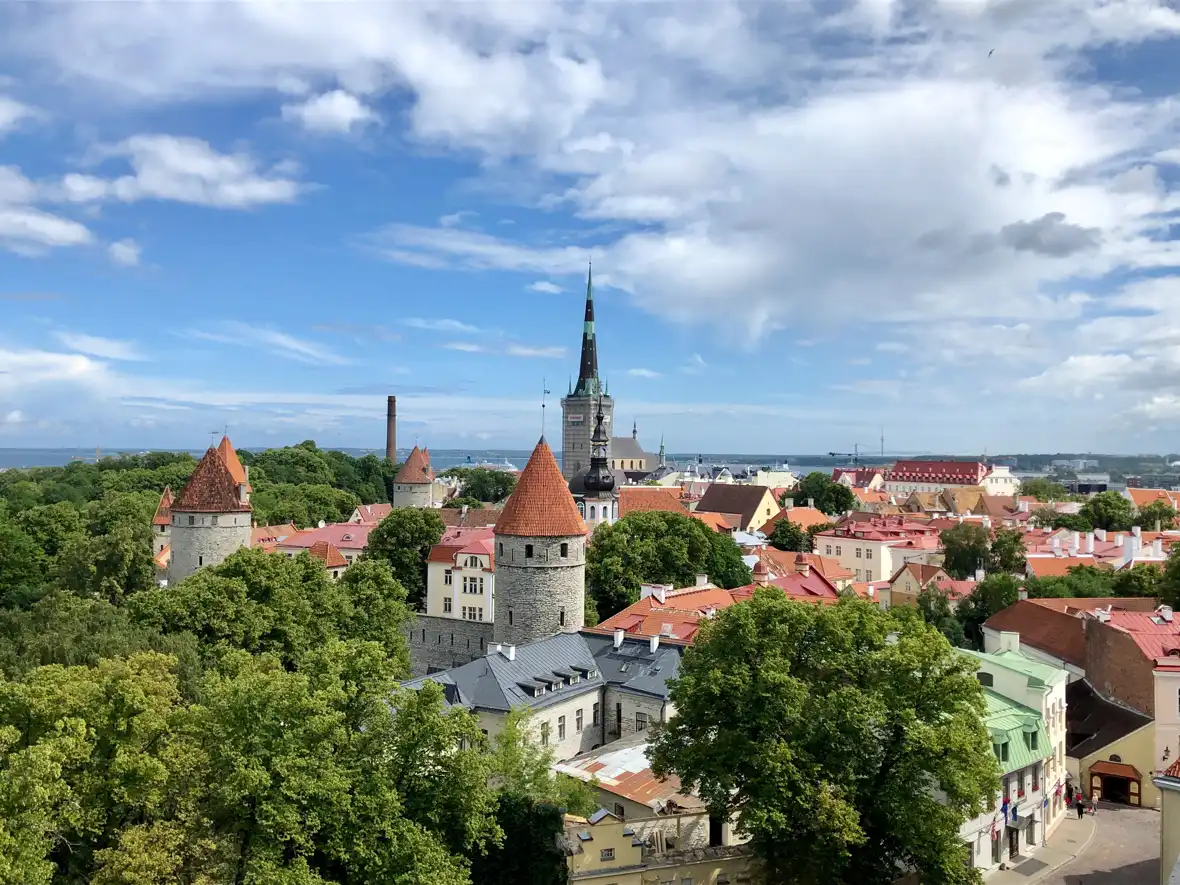
Compact capital that works as basecamp. Airport–center tram 4 stops. Bolt rides are low‑cost by EU standards. Sleep inside the walls only if you’ll wake early; cruise waves clog lanes. Reserve dinners. Ferries and trains radiate; day‑trip.

North Coast & Lahemaa

On the Tallinn–Narva spine. Car unlocks manors, rocky coves, Viru bog boardwalk in one loop; buses hit Palmse/Võsu but sparse off‑peak. Stop at Jägala on the way. Wind‑bitten villages. Best for hikers and slow planners.

West Islands: Saaremaa, Muhu, Hiiumaa

Saaremaa, Muhu, Hiiumaa run on ferry schedules. Book car deck on summer weekends or go bus–ferry–bus and rent bikes. Flat roads, lighthouses, smoke saunas. Base in Kuressaare. Expect short opening hours outside July; nights go quiet.

Tartu & South Estonia

Tartu runs on student energy, trains from Tallinn ~2 hours, frequent. Use it as hub for Lake Peipus onion villages, Setomaa culture in Värska, and Otepää trails. Buses are workable but slow; a car compresses time.

Ida‑Viru & Narva

Borderland with oil‑shale pits, Kreenholm, fortress face‑off across the river. Tallinn–Narva trains run multiple times daily with reserved seats. Carry passport near the river. Walk Ontika cliffs. Rewards history hunters and photographers.
Seeing the layout at a glance
Loading the map 🌍
CLICK TO FILTER
city
town
village
unique site
national park
hike
beach
attraction
festival
region
SHOW COUNTRY‘S BESTSHOW ALL
film
0
0
0a
Lennusadam Seaplane Harbour
film
1
1
1a
Kadriorg Palace and Park Ensemble
film
2
2
2a
Kumu Art Museum
film
3
3
3a
Estonian National Museum
film
4
4
4a
Estonian Open Air Museum
film
5
5
5a
Alexander Nevsky Cathedral
film
6
6
6a
A. H. Tammsaare Museum in Vargamäe
film
7
7
7a
Pärnu Museum
film
8
8
8a
Pärnu Beach
Anna Sirotkina
film
9
9
9a
Narva-Jõesuu Beach
Andrei Grigorjev
film
10
10
10a
Haapsalu Beach
Jyrki Vähäniitty
film
11
11
11a
Kuressaare Beach
Yerlan Akhmetov
film
12
12
12a
Tallin Beach
Victorious Everest
film
13
13
13a
Tallinn
Andrei Grigorjev
film
14
14
14a
Oandu-Ikla Hiking Route
film
15
15
15a
Viru Bog Trail
Karel Chromý
film
16
16
16a
Taevaskoja Nature Trail
Karel Chromý
film
17
17
17a
Panga Cliff Trail
Darius Nt
film
18
18
18a
Lahemaa
Aleksei Budolin
film
19
19
19a
Soomaa
Nikolajs V.
film
20
20
20a
Vilsandi
Renna Reinsoo
film
21
21
21a
Karula
Liia Beljajeva
film
22
22
22a
Kõrvemaa Nature Reserve
film
23
23
23a
Kihnu island
Virve Pihelgas
film
24
24
24a
Osmussaar Island
Urmas Lekk
film
25
25
25a
Tartu
Evgeny Nelzikov
film
26
26
26a
Sillamäe
film
27
27
27a
Jägala Waterfall
Jägala Waterfall
film
28
28
28a
Valaste Waterfall
Tauno Elmik
film
29
29
29a
Tartu Old Observatory
Farnaz Baksh
film
30
30
30a
Kolga Manor
Krista Roolaid
film
31
31
31a
Pöide Church
Avo Kiisk
film
32
32
32a
Ruhnu Island

Why go?What sets this destination apart

Architecture

Estonia rewards architecture hunters with clear layers: Hanseatic limestone, Teutonic castles, wooden towns, Soviet concrete, sharp post‑independence glass. You can read it fast, because distances are short and access is easy. … read more 👉
Estonia rewards architecture hunters with clear layers: Hanseatic limestone, Teutonic castles, wooden towns, Soviet concrete, sharp post‑independence glass. You can read it fast, because distances are short and access is easy. Tallinn’s UNESCO Old Town, Kuressaare and Haapsalu castles, Tartu’s timber streets, Linnahall’s brute mass, and the Kumu and Rotermann rebuilds show the arc from frontier outpost to digital Nordic.

Low cost

Estonia rewards a smart backpacker: tap water is safe, cards work almost everywhere, and grocery chains (Rimi/Maxima) keep meal costs down. Eat at sööklad or the päevapraad lunch. Intercity buses (Lux Express) are frequent—book … read more 👉
Estonia rewards a smart backpacker: tap water is safe, cards work almost everywhere, and grocery chains (Rimi/Maxima) keep meal costs down. Eat at sööklad or the päevapraad lunch. Intercity buses (Lux Express) are frequent—book early; ferries to the islands don’t sting. Camp free at RMK sites with shelters and firewood. Avoid Tallinn Old Town markups; sleep outside the walls. Daily average: €40–55.
Want the complete picture of Estonia?
The offline Travel Guide brings everything together — routes, highlights & planning.

See what's included in the guide 👉

Get the Travel Guide -

⭐ HighlightsWhat not to miss along the way

  • Tallinn Old Town: Stone lanes twist under towers built to keep secrets and taxes in line; walk them at dawn and you’ll hear only your own soles on slick cobbles and church bells testing the air. Beat the cruise surge by hitting Toompea first, then slide to Kohtuotsa terrace before 9.
  • Lahemaa National Park: Pine forests give way to the Viru bog boardwalk, where the wood springs underfoot and peat-stained pools mirror a low sky. Bus from Tallinn drops near the trailhead; carry mosquito repellent in June and push on to Käsmu’s wave-rounded boulders for quiet lunch rocks.
  • Soomaa National Park: In spring’s “fifth season,” water rules—canoes drift over meadows and alder roots, and the air smells like wet wool and leaf tannin. Rent in Tõramaa, lash dry bags tight, and use Riisa’s boardwalk when roads disappear under brown glass.
  • Tartu: Brains and brick: bicycles tick over cobbles on Toome Hill, chalk hangs in lecture-hall air, and the Emajõgi slides past benches where students unwrap pastries. Trains
read more 👉
  • Tallinn Old Town: Stone lanes twist under towers built to keep secrets and taxes in line; walk them at dawn and you’ll hear only your own soles on slick cobbles and church bells testing the air. Beat the cruise surge by hitting Toompea first, then slide to Kohtuotsa terrace before 9.
  • Lahemaa National Park: Pine forests give way to the Viru bog boardwalk, where the wood springs underfoot and peat-stained pools mirror a low sky. Bus from Tallinn drops near the trailhead; carry mosquito repellent in June and push on to Käsmu’s wave-rounded boulders for quiet lunch rocks.
  • Soomaa National Park: In spring’s “fifth season,” water rules—canoes drift over meadows and alder roots, and the air smells like wet wool and leaf tannin. Rent in Tõramaa, lash dry bags tight, and use Riisa’s boardwalk when roads disappear under brown glass.
  • Tartu: Brains and brick: bicycles tick over cobbles on Toome Hill, chalk hangs in lecture-hall air, and the Emajõgi slides past benches where students unwrap pastries. Trains from Tallinn take about two hours; cut through Aparaaditehas for street art, coffee, and cheap canteen-style lunches.
  • Saaremaa Island: The Virtsu-Kuivastu ferry is short and orderly; on the far side, juniper and limestone rule, and Kuressaare Castle sits with a moat that smells faintly of seaweed. Prebook summer weekend crossings, detour to Angla’s windmills and the Kaali meteorite crater, and watch for elk at dusk on empty roads. Off-the-map: Kihnu’s boat-knit culture and lighthouse, Rummu Quarry’s pale-blue pit lake, and Haanja’s Suur Munamägi tower when the morning fog burns off.
Spotted a mistake or missing a highlight? Contact us.

But Estonia offers more...

Discover and compare all of its highlights per category

🧭 RoutesHow travelers typically move through the country

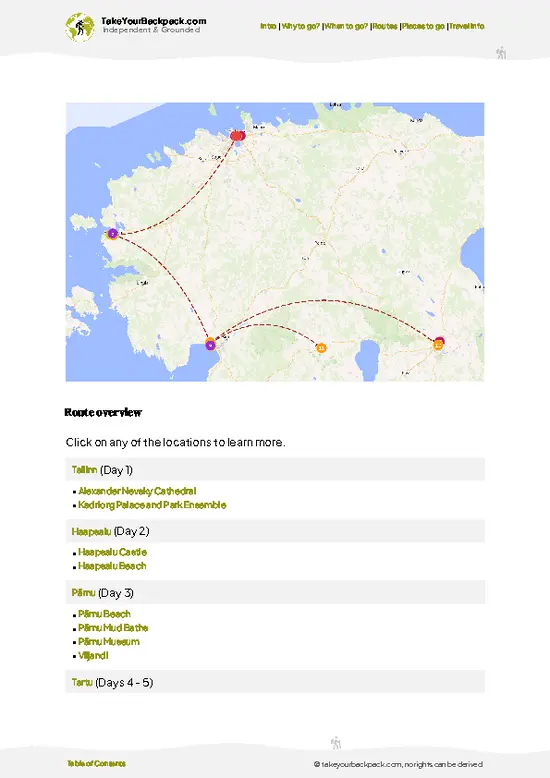
The 2-Day Tallinn & Lahemaa Taster

The Vibe: A relaxed city-and-nature sampler that keeps you based in Tallinn while giving you one big day out in the forests and coast of Lahemaa. Ideal if you want maximum impact with minimal logistics and zero hotel changes.
The Highlights:
  • Medieval streets and viewpoints in Tallinn
  • Maritime history at the Lennusadam Seaplane Harbour
  • Imperial gardens at Kadriorg Palace and Park Ensemble
  • Coastal forests and villages in Lahemaa National Park

The 3-Day West Coast Loop

The Vibe: A coastal hop that strings together small towns, beaches, and one national park for travelers who like a mix of culture, sea air, and easy bus rides. You’ll change bases a couple of times but still have long, slow afternoons in each stop.
The Highlights:
  • Forest and manor landscapes in Lahemaa National Park
  • Seaside calm and medieval walls in Haapsalu and Haapsalu Castle
  • Classic resort-town atmosphere in Pärnu
  • Wide Baltic sands at Pärnu Beach

The 5-Day Estonia Essentials & Beyond

The Vibe: A deeper, … read more 👉

The 2-Day Tallinn & Lahemaa Taster

The Vibe: A relaxed city-and-nature sampler that keeps you based in Tallinn while giving you one big day out in the forests and coast of Lahemaa. Ideal if you want maximum impact with minimal logistics and zero hotel changes.
The Highlights:
  • Medieval streets and viewpoints in Tallinn
  • Maritime history at the Lennusadam Seaplane Harbour
  • Imperial gardens at Kadriorg Palace and Park Ensemble
  • Coastal forests and villages in Lahemaa National Park

The 3-Day West Coast Loop

The Vibe: A coastal hop that strings together small towns, beaches, and one national park for travelers who like a mix of culture, sea air, and easy bus rides. You’ll change bases a couple of times but still have long, slow afternoons in each stop.
The Highlights:
  • Forest and manor landscapes in Lahemaa National Park
  • Seaside calm and medieval walls in Haapsalu and Haapsalu Castle
  • Classic resort-town atmosphere in Pärnu
  • Wide Baltic sands at Pärnu Beach

The 5-Day Estonia Essentials & Beyond

The Vibe: A deeper, cross-country route that links the capital, a major national park, the university city of Tartu, and a spa-town finale on the coast. Perfect if you want Estonia’s big cultural anchors plus a few quieter corners without racing every day.
The Highlights:
  • Old Town charm and museums in Tallinn, including Lennusadam Seaplane Harbour and Kadriorg Palace and Park Ensemble
  • Coastal forests and captain’s heritage in Lahemaa National Park and Käsmu Village
  • Student energy and cultural depth in Tartu and the Estonian National Museum
  • Beachfront downtime and spa history in Pärnu and at the Pärnu Mud Baths
🌍 Want a ready-to-use travel plan for Estonia?
The overview above compares different route options based on your travel time and style. The complete Travel Guide breaks each itinerary down in detail, including maps, stops, highlights, and transport information.

Explore all route details 👉

Get the Travel Guide -

🌤️ When to go?Best time to visit Estonia

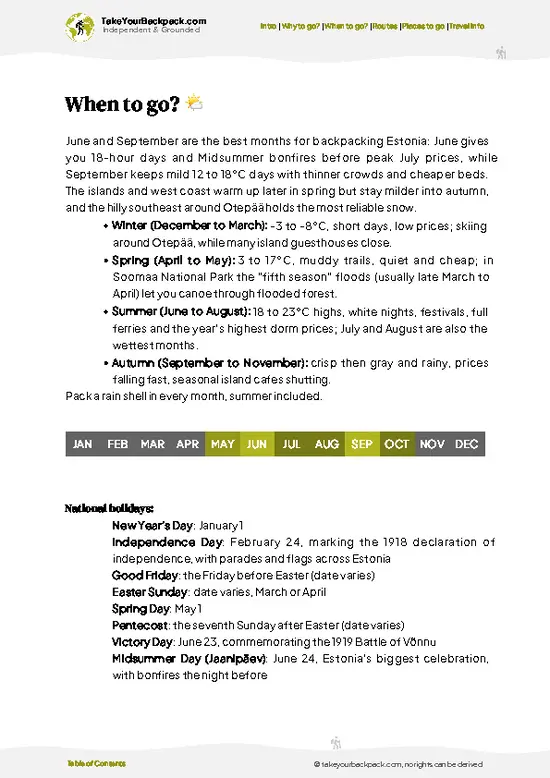
Sweet spot: early June and early September. Long light, dry boardwalks, frequent ferries, and buses without the July cruise surge. Hostel rates ease, mosquitoes back off, water still tolerable for quick dips. You sidestep winter ice and the brief March flood chaos.
  • Peak Summer: July-August packs ferries and Old Town; prices jump. Payoff: white nights—Viru Bog at 11 pm, seawater swimmable.
  • Shoulder: Late May-June and early September click into gear: cafes reopen, trails dry. You move faster—thin lines, softer rates, empty seats.
  • Winter Off-Peak: December-February turns inward: muffled forests, quiet lanes, long nights. Survival hack: microspikes, merino + wind shell, and a reflector clip.
  • Fifth Season (Flood): March-April floods Soomaa’s meadows. Canoe hayfields—an annual, blink-and-gone window; wear rubber boots for exits.

Tactical tip: For July-August, book island ferries and Tallinn weekends 2-3 weeks ahead to avoid standby purgatory.

source: climatestotravel.comJANJanuary: fair for travelingFEBFebruary: fair for travelingMARMarch: fair for travelingAPRApril: fair for travelingMAYMay: highly recommended for travelingJUNJune: excellent for travelingJULJuly: good for travelingAUGAugust: good for travelingSEPSeptember: excellent for travelingOCTOctober: good for travelingNOVNovember: fair for travelingDECDecember: fair for traveling
📅 Traveling in a specific month?
Get a full month-by-month breakdown of weather, crowds, costs, festivals, and seasonal highlights in the complete travel guide.

Get full details when to go 👉

Get the Travel Guide -
karson-NyIBNMueUQI-unsplash

💰 Costs (as of 2025)Prices, expenses, and money tips

Plan on €45-60/day if you sleep in dorms, cook or cherry-pick cheap eats, ride buses/trains, and limit paid sights; Tallinn drives you toward the top, the rest of the country toward the bottom.
  • dorm accommodation: Tallinn €18-30; Tartu/Pärnu/elsewhere €12-20 (winter promos dip lower). System tip: avoid Old Town and cruise-ship days; pick hostels with kitchens and laundry, and book Sun-Thu for calmer beds and steadier prices. Estonia is pricier than Latvia/Lithuania, but still half of Finland’s hostel costs.
  • meals: Supermarket Survival: Lidl/Prisma/Rimi get you breakfast + dinner for €4-7/day (bread, cheese, veggies, kefir, rotisserie chicken). Street food reality: kebab/pies €5-8, canteens (söökla) and “päevapraad” lunch deals €5-8 outside the Old Town, €8-12 inside. Tap water is safe—ask for it and skip €2-3 bottles. Cheaper than Finland, a touch more than Latvia/Lithuania.
  • local transport: Tallinn’s reloadable Ühiskaart unlocks lower fares and daily caps; validate every ride. Between cities, Elron trains and Lux Express/GoBus compete—book online early for €5-15 legs (Tallinn-Tartu/Narva). To “unlock” islands cheaply: bus to port + foot-passenger ferry + local bus. Overall cheaper than
read more 👉
Plan on €45-60/day if you sleep in dorms, cook or cherry-pick cheap eats, ride buses/trains, and limit paid sights; Tallinn drives you toward the top, the rest of the country toward the bottom.
  • dorm accommodation: Tallinn €18-30; Tartu/Pärnu/elsewhere €12-20 (winter promos dip lower). System tip: avoid Old Town and cruise-ship days; pick hostels with kitchens and laundry, and book Sun-Thu for calmer beds and steadier prices. Estonia is pricier than Latvia/Lithuania, but still half of Finland’s hostel costs.
  • meals: Supermarket Survival: Lidl/Prisma/Rimi get you breakfast + dinner for €4-7/day (bread, cheese, veggies, kefir, rotisserie chicken). Street food reality: kebab/pies €5-8, canteens (söökla) and “päevapraad” lunch deals €5-8 outside the Old Town, €8-12 inside. Tap water is safe—ask for it and skip €2-3 bottles. Cheaper than Finland, a touch more than Latvia/Lithuania.
  • local transport: Tallinn’s reloadable Ühiskaart unlocks lower fares and daily caps; validate every ride. Between cities, Elron trains and Lux Express/GoBus compete—book online early for €5-15 legs (Tallinn-Tartu/Narva). To “unlock” islands cheaply: bus to port + foot-passenger ferry + local bus. Overall cheaper than Finland, similar or a bit higher than Latvia/Lithuania.
  • activities: Museums/towers €6-12; spa/sauna €10-20; bike rentals €10-15/day; guided bog-shoe walks €20-40. National parks and coastal trails are free—your time is the cost. Huge driver: day-trip ferries to Helsinki (budget-breaker compared to everything else in Estonia).
  • miscellaneous: Budget Leaks: craft beer bars (€5-7 pints), café habit (€3-4 lattes), Old Town “service” or bread fees, ATM withdrawal charges, club entry + cloakroom, late-night taxis (use Bolt, don’t hail). SIM with data is cheap (€5-10); bottled water is a needless spend. Estonia’s leaks are milder than Finland, slightly harsher than Latvia/Lithuania.
⚠️ Prices can change and everyone travels differently, so take this as a rough guide. Hope it helps you plan your adventure!

✈️ The backpacker research shortcutEstonia Travel Guide

An offline-friendly backpacking guide with optimized travel routes, ranked highlights, transport advice, and the best areas to stay.
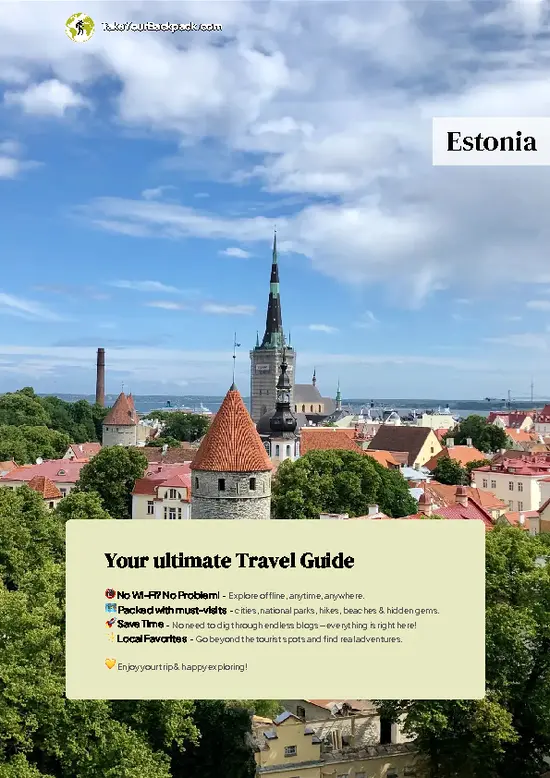
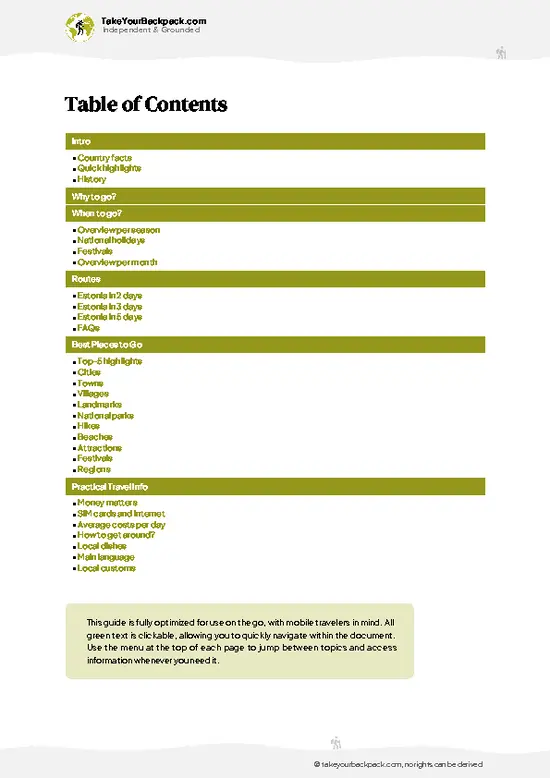
example page 0 from our offline Travel Guide for Estoniaexample page 1 from our offline Travel Guide for Estoniaexample page 2 from our offline Travel Guide for Estoniaexample page 3 from our offline Travel Guide for Estoniaexample page 4 from our offline Travel Guide for Estoniaexample page 5 from our offline Travel Guide for Estoniaexample page 6 from our offline Travel Guide for Estoniaexample page 7 from our offline Travel Guide for Estonia
The digital guide (281 pages) contains:
73 highlights, ranked by travel appeal
Optimized 2, 3 & 5-day travel routes
Best neighborhoods to stay
How to get around
Offline-friendly for travel without Wi-Fi
👉 See all 30+ guide features

📅 Plan smarter in minutes, not weeks
Month by month travel advice
Festivals & national holidays
Budget expectations

🗺️ Go to the right places, skip the overrated ones
Honest pros & cons of destinations
Top hikes, parks & viewpoints
Lesser-known places most travelers miss
Clear “worth it vs skip it” guidance

🛏️ Travel smoothly without rookie mistakes
Best areas to stay
Transport systems explained simply
Common scams & safety advice
SIM cards, money & practical tips

🌍 Understand the country, not just visit it
Culture & traditions
52 Essential phrases & customs
Festivals worth planning around
Traveler-friendly historical context
Insights that make places more meaningful

📱 Built for real travel conditions
Fully downloadable PDF
Works completely offline
Optimized for phone use
Useful in remote areas & buses
Everything in one place
Save weeks of stressful planning
Get instant access to the full guide directly. 30-day money-back guarantee.


Sent to your inbox immediately after payment • 100% Secure Checkout
Best Backpacking Travel Advisor 2025 tourism awardBest Backpacking
Travel Advisor
2025
What others say about Take Your Backpack Guides:
⭐⭐⭐⭐⭐
Fantastic, amazing amount of information!
⭐⭐⭐⭐⭐
My goodness this is amazing, it's what I've been looking for hats off too you!
⭐⭐⭐⭐⭐
I think this is absolutely BRILLIANT
⭐⭐⭐⭐
Very complete and informative. It's still missing places, but I gotta to commend you
⭐⭐⭐⭐⭐
This is truly amazing, thank you, can't wait to explore it with my kids!
⭐⭐⭐⭐⭐
Awesome resource, thank you!
⭐⭐⭐⭐⭐
This is amazing! Can't wait to explore the ones I haven't seen
⭐⭐⭐⭐
I love this! Well done, great idea.
⭐⭐⭐⭐⭐
Thanks for taking the time to make this gem!
⭐⭐⭐⭐⭐
This might be the best website I've ever seen.
⭐⭐⭐⭐⭐
Congratulations, and thank you so much for your work; it's incredibly valuable.
⭐⭐⭐⭐
In all seriousness I think you did a great job pointing out the important spots
⭐⭐⭐⭐⭐
10/10 very good
⭐⭐⭐⭐⭐
As someone who's only just starting to visit regularly this is awesome, thank you.
⭐⭐⭐⭐
Thank you very much! I'm going to visit my dad, it's going to be very useful!
⭐⭐⭐⭐⭐
This is really cool! We'll be travelling for the first time and this definitely come in handy.
⭐⭐⭐⭐⭐
You are now our minister of culture, congratulations 👨‍💼
⭐⭐⭐⭐⭐
Just wanted to tell you that this is a pearl! Going to follow your recommendations.
⭐⭐⭐⭐⭐
This is so cool. I'll definitely be using the resource for my travels soon.
⭐⭐⭐⭐⭐
This is very impressive! Good work.
⭐⭐⭐⭐⭐
This is an amazing and informative site. Very well done!

🛏️ Where to stay?Where to stay in Estonia

Yes, Estonia has plenty of hostels and budget guesthouses concentrated in Tallinn, Tartu and Pärnu, so budgeting travellers can find cheap beds and simple private rooms in all three cities.
Tallinn’s options cluster in Old Town (steps from sights but touristy, noisier and often pricier) and Kalamaja/Telliskivi (cheaper, hipper, good cafés and transport, calmer at night); Tartu’s city centre suits students and nightlife but fills up during term time; Pärnu’s beach centre is seasonal—excellent and busy in summer but services and choice drop off in the off-season.

If you enjoy meeting fellow travelers, … read more 👉
Yes, Estonia has plenty of hostels and budget guesthouses concentrated in Tallinn, Tartu and Pärnu, so budgeting travellers can find cheap beds and simple private rooms in all three cities.
Tallinn’s options cluster in Old Town (steps from sights but touristy, noisier and often pricier) and Kalamaja/Telliskivi (cheaper, hipper, good cafés and transport, calmer at night); Tartu’s city centre suits students and nightlife but fills up during term time; Pärnu’s beach centre is seasonal—excellent and busy in summer but services and choice drop off in the off-season.

If you enjoy meeting fellow travelers, consider choosing hostels with high ratings for atmosphere. On the other hand, if you prefer having your own space, a hotel might be a better option.

🚌 Getting aroundWhat moving around is really like

Estonia flows on quiet precision. Timetables are promises, not guesses. Apps replace ticket windows. People queue, doors open, engines leave on the dot. Drift off and you’ll miss your stop; blink and you’ll make your transfer. Rural legs thin out early, weekends crowd the island routes, winter adds a buffer—plan like a chess player and you’ll glide.
  • Long-Distance Buses The Efficiency Trade-off: This is the spine. Dynamic pricing means early buys are often half the walk-up cost; same road, same coach.
read more 👉
Estonia flows on quiet precision. Timetables are promises, not guesses. Apps replace ticket windows. People queue, doors open, engines leave on the dot. Drift off and you’ll miss your stop; blink and you’ll make your transfer. Rural legs thin out early, weekends crowd the island routes, winter adds a buffer—plan like a chess player and you’ll glide.
  • Long-Distance Buses The Efficiency Trade-off: This is the spine. Dynamic pricing means early buys are often half the walk-up cost; same road, same coach. On the Pärnu and Saaremaa corridors buses beat trains because there is no train. They’re punctual, with assigned seats and Wi-Fi, but winter roads can slip your ETA—pad 10-15 minutes if you have a ferry to catch.
  • Tallinn (and city) Public Transport The Social Fabric: Tap a contactless card on the green validator and move in without chatter. It’s quiet; phone calls are short, bags off shoulders, seats yielded fast. Inspectors work in plain clothes. Press the button early; drivers don’t guess. Eating is frowned on, snow means slick floors—hold a rail or you’ll learn the hard way.
  • Island Ferries The Geometric Unlock: Water is the gatekeeper. Foot passengers slide on easily even when the car queue snakes for kilometers, but wind can pause sailings. Buses to Saaremaa and Hiiumaa drive onto the boat—take your daypack upstairs, note the bay number, and be back before the ramp drops or your ride rolls away.
  • Hitchhiking & Carpools The Budget Disruptor: Works best on the E263 (Tartu), E67 (Pärnu/Riga), and E20 (Narva). Thumb at petrol stations after city limits with a neat sign. Daylight only in winter, short hops, reflective strap helps. Offer fuel money; most drivers refuse but appreciate the gesture.

Master tip: Work backward from the last hard node (ferry or final bus), pick bus on Pärnu/saaremaa corridors and train on Tartu/Narva, and schedule yourself one full earlier departure than you think you need.
Tallinn Airport sits very close to town — about 4 km (2.5 miles) from the Old Town/Viru area — so getting in is quick and cheap.
  • Tram no. 4 (stop “Lennujaam” at the terminal)

    Time: about 15-20 minutes to the city center (Hobujaama/Viru area).

    Cost: roughly €2 for a 60-minute ticket (free transfers within that hour). Pay by tapping a contactless bank card on the onboard validator, or use an Ühiskaart (transit card) or a QR ticket.

    Frequency: every ~7-10 minutes in the day, less often late evening.
  • Bus no. 2 (stop “Lennujaam”)

    Time: about 15-25 minutes to the center; continues to the passenger port (Reisisadam).

    Cost: roughly €2 for a 60-minute ticket, same payment options as the tram.

    Frequency: typically every 15-20 minutes; traffic can affect timing.
  • Taxi and ride-hailing

    Time: 10-15 minutes to most central addresses.

    Cost: about €8-15 to the center in normal conditions; late night or bad weather can push it closer to €18-20.

    Notes: Official taxis wait outside arrivals; prices per km must be displayed on the rear door. Bolt and Uber work well and are often a bit cheaper. Card payment is standard.

Tip: If you expect to use public transport more than once, you can pick up an Ühiskaart and load credit at the airport (e.g., R-Kiosk), but for most visitors tapping a contactless bank card on board is the simplest option.
⚠️ Prices and routes can change, so take this as a rough guide and ask for local advice when you arrive.

🔒 Safety (risk Level: low)Is Estonia safe to visit?

Safety for solo travelers, including women and LGBTQ+ individuals
Estonia is generally very safe for solo travelers, including women and LGBTQ+ individuals. The crime rate is low, and the local culture is quite progressive, especially in cities like Tallinn and Tartu. Public transport is reliable, and most people speak English, making navigation easier. Just use common sense, like avoiding poorly lit areas at night, and you’ll likely have a smooth trip.


Full official government travel advisory (live updates)
View details 👉

✈️ VisaUnderstanding entry rules

Visa requirements for Estonia depend on your nationality. If you’re from the EU, USA, Canada, Australia, or New Zealand, you can enter visa-free for up to 90 days within a 180-day period. If a visa is needed, apply for a Schengen visa through the nearest Estonian embassy or consulate.

source: vm.ee
⚠️ Visa requirements can change over time, so always check the latest visa requirements with the official embassy or government website before you travel.

🎒 What to pack?What to wear and bring

Estonia’s weather can be all over the place, so pack for unpredictability. Summers are mild but can get surprisingly warm, while winters are cold with snow being a common guest. Layering is your best friend here. Estonia’s terrain is a mix of forests and coastline, so sturdy shoes will serve you well. Estonians dress pretty casually, but if you’re planning to hit up some churches or old-fashioned events, having a set of modest clothes is a good idea.

Apart from this country specific advice, I have also crafted a general packing list that should help on any trip. authorOver the years, I've learned the importance of packing minimally. It's so much easier to jump on the back of a truck or squeeze yourself into the last spot of a minibus without that supersized backpack. If you're headed to a warm destination, leave your winter jacket at home; for colder regions, opt for thin thermal underlayers. Instead of packing your entire wardrobe, bring just three sets of clothes, as laundry facilities are available everywhere.
View the full list 👉
🎒 Planning the practical side of your trip?
Get detailed information on transport, daily budgets, internet access, local customs, food, language, and other essentials in the complete Travel Guide.

Get detailed practical information 👉

Get the Travel Guide -

🙋 FAQQuick answers to practical concerns

Trip Planning


Personal tip: I normally search on good rating for atmosphere (for meeting people) and location (for easy exploring). Cleanliness as a bonus.


Travel Essentials

Routine vaccinations are usually sufficient when visiting Estonia. Make sure you’re up to date on the following:

- Measles
- Mumps
- Rubella (MMR)
- Diphtheria
- Tetanus
- Pertussis
- Varicella (chickenpox)
- Polio
- Annual flu shot

If you’re planning outdoor activities, consider a tick-borne encephalitis vaccine, especially in forested areas. Always check the latest health advisories.


vaccination requirements
When I first started traveling, I often spent part of my first day in a new country hunting for a local SIM card. While this can still be slightly cheaper, it also takes time and planning.

These days, it's much simpler to install an eSIM before leaving home. Once you arrive in Estonia, you can activate it immediately and have mobile data from the moment you land — which is especially useful for ordering transport or navigating away from busy airports.

There are many providers nowadays, and price differences are usually small. I personally go with Airalo, as it offers excellent network coverage throughout the country and strong global coverage, so you can manage multiple countries from a single app.


Get your e-sim for Estonia

Culture & Customs

Estonians value personal space, so keep a respectful distance and avoid physical contact unless it’s a handshake. Punctuality is important; being late is considered disrespectful. Dress modestly when visiting cultural sites. Tipping isn’t mandatory but appreciated; 10% is standard.

For LGBTQ+ travelers, Estonia is relatively progressive, but discretion is advised in rural areas. Women generally travel safely, though solo travelers should exercise usual caution, especially at night. Avoid discussing politics unless you know the person well, especially topics related to Russia.
Trying traditional food is always a great way to experience the culture. Here are some must-try dishes for Estonia.
  • Kartulipuder: This is Estonia’s version of mashed potatoes, often served with a rich gravy or fried onions. It’s comfort food at its finest and a staple at many Estonian family gatherings.
  • Mulgikapsad: A hearty dish of sauerkraut and barley, often accompanied by pork. It’s a traditional winter warmer that speaks to the country’s agricultural roots.
  • Verivorst: Estonian blood sausage, typically served with lingonberry jam. A must during the Christmas season, it reflects the country’s love for hearty, flavorful sausages.
  • Räim: Baltic herring, usually pickled or smoked. Given Estonia’s long coastline, fish dishes like this are a huge part of the diet and culture.
  • Leivasupp: A sweet bread soup made from rye bread, sugar, and spices. It’s a unique dessert that highlights the ubiquitous use of rye in Estonian cuisine.
Tap water in Estonia is generally safe to drink, and locals do consume it. Most tourists will be fine with it, but if you’re sensitive or cautious, consider using a filter or opt for bottled water. Always check for any local advisories during your visit.
The main language in Estonia is Estonian. Backpacking is way more rewarding if you know a bit of the local language, so I'd suggest brushing up on the basics just in case your Estonian skills have become a bit rusty.

Want to understand locals better?
The complete Travel Guide for Estonia includes 52 essential words and phrases — greetings, thank-yous, ordering food, transport, numbers, and common local expressions you'll actually hear.

Get your local basic phrases 👉

Get the Travel Guide -


In Estonia, English is widely spoken, especially among younger generations and in urban areas like Tallinn. The country has a high proficiency in English, ranking among the top non-native English-speaking countries in Europe. Most Estonians learn English from an early age, and it is commonly used in schools, universities, and workplaces.

In tourist areas, restaurants, hotels, and shops, you will find that staff often speak English fluently. Additionally, many signs and information materials are available in English, making navigation easier for travelers. While older generations may have varying levels of English proficiency, they are often eager to help and communicate.

Overall, English is a practical language for travelers in Estonia, allowing for smooth interactions and a more enjoyable experience. Whether you’re exploring cultural sites, dining, or seeking assistance, you’re likely to find English speakers readily available.

Money & Payments

The local currency of Estonia is EUR (€).

When backpacking in Estonia, you’ll find ATMs readily available in cities and larger towns. They dispense euros, which is the only currency you’ll need. While it’s handy to carry some cash for small purchases in rural areas or markets, most places accept cards, even for small amounts. Visa and MasterCard are widely accepted. If you need to exchange money, opt for banks or official exchange offices for better rates, avoiding airport exchanges due to higher fees. Forget about carrying dollars; stick to euros to keep it simple.

Tipping in Estonia isn’t mandatory, but it’s appreciated. Locals typically round up the bill or leave a 5-10% tip for good service, especially in restaurants and cafes. In taxis, rounding up to the nearest euro is common.

🧩 Nearby countriesNearby backpacking alternatives

We 💚 feedbackKey takeaways from the trip

Estonia rewards travelers who play to its strengths: digital and outdoors. Preload Tpilet and the RMK map; buses run clean and on-time, and free forest shelters make your budget stretch if you carry a filter. Tap to pay almost everywhere. Tallinn costs spike inside the Old Town walls—eat two blocks out. Alcohol sales stop at 22:00, plan ahead. Summer bogs mean mosquitoes; bring a headnet. Watch Rail Baltica: when it opens, Tallinn–Riga–Vilnius will switch from bus slog to fast rail hop.

✍️ Help improve this page!
The information on this page is based on in-depth research, insights shared by experienced travelers, and feedback from the local travel community in Estonia. While every effort is made to keep the information accurate and current, conditions can change — so if you spot anything incorrect or outdated, please get in touch.


🙋‍♂️ Give feedback

👋 Meet the founderWho’s Behind Take Your Backpack?

Johan, backpacker and founder of TakeYourBackpackHi, I’m Johan (Netherlands 🇳🇱), the creator of TakeYourBackpack. Over the past decade, I’ve backpacked through 80+ countries across six continents, gaining extensive experience with independent travel, long-term trips, and overland routes.

This site is built on a combination of firsthand travel experience and carefully curated insights from other backpackers. Many guides are based on places I’ve personally visited, while others bring together tips, observations, and practical advice shared by trusted travelers I’ve met along the way.

The goal is to provide realistic, experience-driven guidance — not generic itineraries — so you can explore destinations with better context, clearer expectations, and more confidence.

Get Full Country Guide |
Instant download • 73 highlights • Full Offline guide