×
Central African Republic 🇨🇫

backpacking Africa Central African Republic 🇨🇫Journey slowly through remote landscapes few outsiders ever reach.

Explore CameroonExplore Chad

Backpacking Central African Republic in 2026

A complete guide including when and where to go, costs, transport, itineraries, and practical travel advice.
A practical introduction for travelers

Backpacking Central African Republic
By Johan Kruseman 🇳🇱 | Updated May 19, 2026

Your bush taxi leaves only when it’s full, crawls for hours, and still stops twice to tie the exhaust back on with rope. That’s the Central African Republic: patience is currency and improvisation is a national skill. Lean into that rhythm, and the country lets you in.

What it gives back is wild and intimate: forest elephants and lowland gorillas in Dzanga‑Sangha, stepping into the open at Dzanga Bai like a living amphitheater; BaAka trackers sharing polyphonic songs and forest knowledge that humbles your gear list; the Oubangui River sliding past pirogues and palm‑wine chatter; Boali Falls roaring after rain; granite outcrops and ancient megaliths near Bouar hinting at deep-time heritage. Yes, roads break, checkpoints drain minutes, cash is king, and permits plus a solid local fixer are non‑negotiable outside Bangui. But those frictions strip away noise, and when you’re watching red dust settle on a gorilla’s shoulder at dusk, the effort feels like the price of meaning.

Compared to Cameroon’s smoother circuits or Congo’s polished, high-budget lodges, CAR is raw, less packaged, and more personal; Chad trades gorillas for Sahara scale. Come if you value rare wildlife, real human exchange, and rewards earned the hard way—not if your trip needs a timetable to behave.

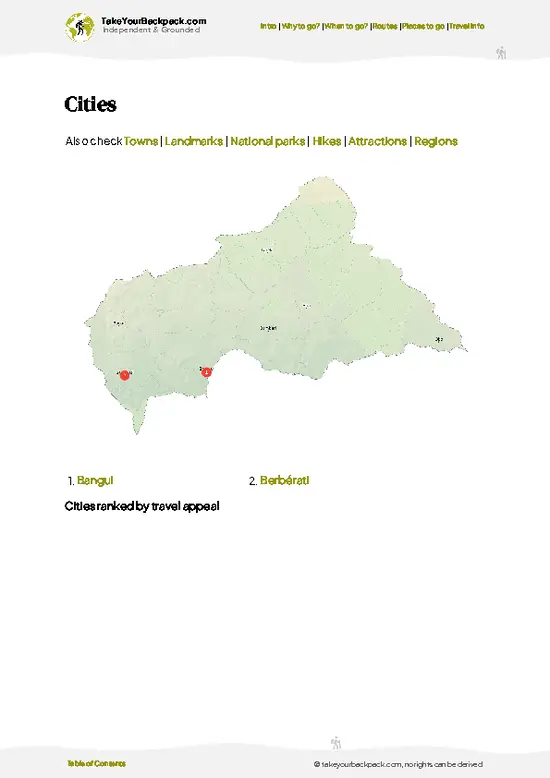
Bangui

Start here, period. Bangui is the paperwork, cash, and SIM card hub, and the only place you can reliably fix problems before they get expensive. Daylight moves only. Negotiate moto-taxis up front, carry small CFA notes, and avoid bridges, ministries, and military sites with your camera. The vibe is scrappy but workable if you keep your head down. Rewards pragmatic travelers who can handle inconsistent power, short-notice curfews, and checkpoint theater without losing their cool.

Dzanga–Sangha (Bayanga, Dzanga Bai, Bai Hokou)

Rugged rainforest with real payoff: hours watching forest elephants at Dzanga Bai and tracking habituated western lowland gorillas. Access is the crux. Either a pricey charter or a punishing multi-day 4x4 via Mbaïki–Boda–Nola to Bayanga; Cameroon’s Libongo route is often smoother. Park fees, guides, and logistics add up, so bring crisp euros and patience. Humid, muddy, leechy—worth it if you’re wildlife-first and fine with early starts, wet boots, and long sits.

Boali to Bouar (the Western Road)

One hard spine northwest of Bangui: waterfalls at Boali for a half-day stretch, then on through Carnot to Bouar’s megaliths. Asphalt comes and goes; in rains it’s axle-deep. Multiple checkpoints mean slow progress—smiles and photocopies beat bravado. Rewards road trippers who value roadside bowls of pepe-soup over comfort. No night driving, ever.

Berbérati and the Southwest Towns

Sleepier, businesslike, and more manageable than Bangui, with coffee-cocoa towns and basic guesthouses that actually have a fan that works. Good for regrouping, fixing vehicles, and staging south. Fuel can vanish without warning; stock up when you can. Social vibe is watchful but polite. Best for travelers who pace themselves and budget by the jerrycan.

Chinko (Eastern Savannah Reserve)

Fly-in only, expedition-level. Wildlife is wild, logistics tighter than a drum. If you don’t have a credible operator, satellite comms, and the budget for charters and controlled movement, skip it and save thousands. For deep-pocketed conservation diehards who prefer radios and field briefs to cocktails and infinity pools.
Safety warning

The current risk level for Central African Republic is high. Check the advice before going.
Get your Central African Republic guide
51 ranked highlights, routes & tips, works offline (231 pages)
A visual overview of the country
Loading the map 🌍
CLICK TO FILTER
city
town
unique site
national park
hike
attraction
festival
region
SHOW COUNTRY’S BESTSHOW ALL
film
0
0
0a
Notre-Dame of Bangui Cathedral
film
1
1
1a
Bangui Central Market
film
2
2
2a
Dzanga Bai Trail
film
3
3
3a
Boali Waterfalls Trail
film
4
4
4a
Mount Ngaoui Trail
film
5
5
5a
Dzanga-Sangha
film
6
6
6a
Chinko Nature Reserve
film
7
7
7a
Lobaye Region
film
8
8
8a
Boali Waterfalls

Why go?What draws travelers here

Wildlife

Central African Republic is not an easy wildlife trip. Roads punish, services are thin, and you earn every sighting. But the payoff is raw Africa you can still hear breathing. Dzanga-Sangha’s bai clearings pull forest elephants, bongos, sitatungas, and flocks of green pigeons into the open—hours of behavior at 30–50 meters, no safari traffic, just you on a platform. Track western lowland gorillas with BaAka guides who read the forest like a book. … read more 👉
Central African Republic is not an easy wildlife trip. Roads punish, services are thin, and you earn every sighting. But the payoff is raw Africa you can still hear breathing. Dzanga-Sangha’s bai clearings pull forest elephants, bongos, sitatungas, and flocks of green pigeons into the open—hours of behavior at 30–50 meters, no safari traffic, just you on a platform. Track western lowland gorillas with BaAka guides who read the forest like a book. Night walks can turn up pangolins, galagos, and civets. If you want spectacle without the safari circus, this is it.
Want the complete picture of Central African Republic?
The offline Travel Guide brings everything together — routes, highlights & planning.

See what's included in the guide 👉

Get the Travel Guide -

⭐ HighlightsStandout locations across the country

  • Dzanga-Sangha (Bayanga): The forest here feels like a damp cathedral, and the clearing at Dzanga Bai is the altar—elephants rumble in, bongos slip out, and hornbills argue over everything. Spend a full day on the viewing platform; I learned the hard way that stillness brings the best show. Bring rubber boots and a packable rain shell, carry bai fees in CFA cash, and buffer a spare day for post-storm road delays.
  • Boali Falls: You hear it before you see it—spray on your face, basalt slick as soap, and a curtain of water you can feel in your ribs. Pick the descent to the lower viewpoint when flow allows, then climb back before the sun cooks the rocks. Go in the rains, wear real shoes (not sandals), keep electronics in a dry bag, and agree the local guide’s fee in CFA upfront.
  • Bangui Riverfront: At sunset the Ubangi glows copper as pirogues drift past and music threads through the dust. Take a supervised pirogue hop to a sandbar or nurse a cold beer riverside, then hit the Boganda Museum early
read more 👉
  • Dzanga-Sangha (Bayanga): The forest here feels like a damp cathedral, and the clearing at Dzanga Bai is the altar—elephants rumble in, bongos slip out, and hornbills argue over everything. Spend a full day on the viewing platform; I learned the hard way that stillness brings the best show. Bring rubber boots and a packable rain shell, carry bai fees in CFA cash, and buffer a spare day for post-storm road delays.
  • Boali Falls: You hear it before you see it—spray on your face, basalt slick as soap, and a curtain of water you can feel in your ribs. Pick the descent to the lower viewpoint when flow allows, then climb back before the sun cooks the rocks. Go in the rains, wear real shoes (not sandals), keep electronics in a dry bag, and agree the local guide’s fee in CFA upfront.
  • Bangui Riverfront: At sunset the Ubangi glows copper as pirogues drift past and music threads through the dust. Take a supervised pirogue hop to a sandbar or nurse a cold beer riverside, then hit the Boganda Museum early while it’s quiet and cool. Move only in daylight, keep one vetted taxi on a day rate, carry a passport photocopy and small bills, and keep cameras low near checkpoints.
  • Zinga Island: Time slows among creaking wooden galleries and palm-shaded lanes, a river island where carpenters still coax life from old colonial timber. Walk the verandas, then drift back through backchannels while fish eagles scold you. Go early before winds rise, insist on life vests and a licensed piroguier, bring your own water, pay the town’s small visitor fee with exact change, and trust the captain’s line in strong current.
  • Lobaye Forest (M’Baïki & Ngotto): The air smells like wet earth and cocoa; trucks throw red dust that turns to grease with one storm. Do a guided walk under buttress roots, and only join Aka tracker visits arranged ethically through a reliable fixer. Confirm contributions with the community lead beforehand, tuck pants into socks for ants, use a high-clearance 4x4, and start at dawn to beat logging traffic; if you’re straying farther, consider Kembé Falls on the Kotto, the fly-in wilds of Chinko, or Ndélé’s granite inselbergs—only with solid local support.
Spotted a mistake or missing a highlight? Contact us.

But Central African Republic offers more...

Discover and compare all of its highlights per category

🧭 RoutesHow to structure a trip

The 5-Day Bangui & Boali Taster

The Vibe: A gentle first step into Central African Republic, splitting your time between riverfront city life and one big waterfall hit, with minimal overland stress. You’ll stay close to Bangui, travel by road with local drivers, and actually have time to sit, watch, and absorb instead of sprinting.
The Highlights:
  • Slow walks along the Bangui Riverfront and Oubangui River Embankment
  • Cultural context at Boganda National Museum
  • City landmarks from Notre-Dame of Bangui Cathedral to St. Paul des Rapides
  • A full day at Boali Waterfalls and its viewpoints

The 10-Day Capital-to-Highlands Circuit

The Vibe: A balanced loop for travelers who want more than a teaser but less than an expedition, mixing capital culture, waterfalls, and western highland town life. You’ll travel mostly by 4x4 along main roads, with enough two-night stops to keep the pace comfortable.
The Highlights:
  • Deeper exploration of Bangui’s riverfront, markets, and cathedral
  • Time to linger at Boali Waterfalls
read more 👉

The 5-Day Bangui & Boali Taster

The Vibe: A gentle first step into Central African Republic, splitting your time between riverfront city life and one big waterfall hit, with minimal overland stress. You’ll stay close to Bangui, travel by road with local drivers, and actually have time to sit, watch, and absorb instead of sprinting.
The Highlights:
  • Slow walks along the Bangui Riverfront and Oubangui River Embankment
  • Cultural context at Boganda National Museum
  • City landmarks from Notre-Dame of Bangui Cathedral to St. Paul des Rapides
  • A full day at Boali Waterfalls and its viewpoints

The 10-Day Capital-to-Highlands Circuit

The Vibe: A balanced loop for travelers who want more than a teaser but less than an expedition, mixing capital culture, waterfalls, and western highland town life. You’ll travel mostly by 4x4 along main roads, with enough two-night stops to keep the pace comfortable.
The Highlights:
  • Deeper exploration of Bangui’s riverfront, markets, and cathedral
  • Time to linger at Boali Waterfalls and walk the surrounding trail
  • A westward push to Bouar and the highland atmosphere
  • A final cultural wind-down back in Bangui

The 15-Day Forests, Parks & Towns Expedition

The Vibe: A full-on overland adventure for travelers ready to trade comfort for depth, linking the capital, forest regions, and one of Central Africa’s great wildlife areas. Expect long 4x4 days, river crossings, and real immersion in both small-town life and remote national parks.
The Highlights:
  • Multi-day deep dive into Bangui’s riverfront, markets, and PK5 district
  • Forest and river time in the Lobaye Region
  • Wildlife-focused days in Dzanga-Sangha National Park and at Dzanga Bai
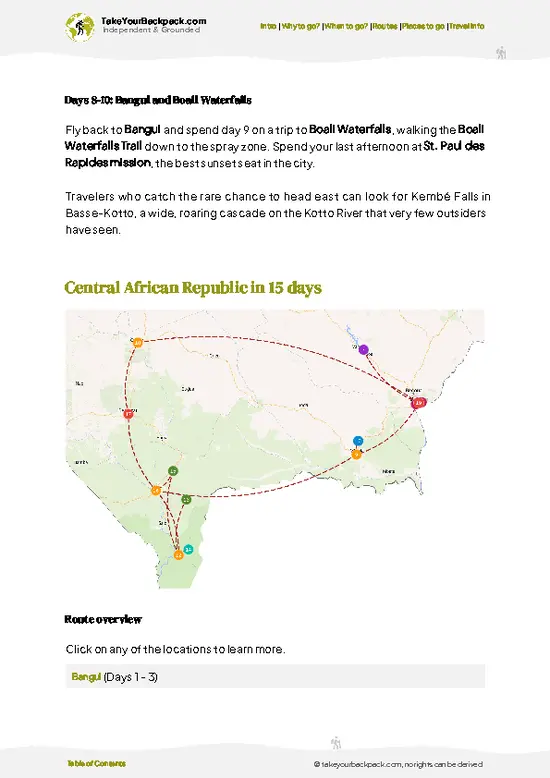
  • A westward loop through Bayanga, Carnot, and Boali Waterfalls before returning to Bangui
🌍 Want a ready-to-use travel plan for Central African Republic?
The overview above compares different route options based on your travel time and style. The complete Travel Guide breaks each itinerary down in detail, including maps, stops, highlights, and transport information.

Explore all route details 👉

Get the Travel Guide -

🌤️ When to go?Choosing the right months to travel

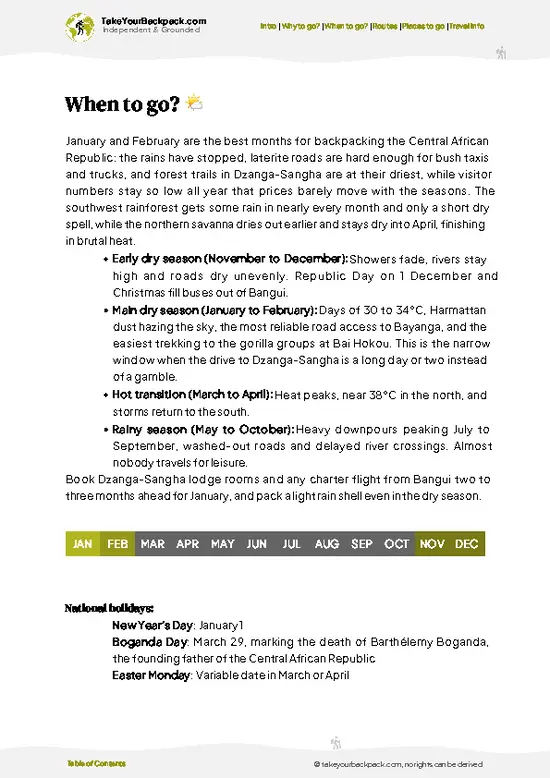
January to early February is the sweet spot. The rains have stepped off, laterite tracks are firm, and the furnace of March hasn’t lit yet. Nights cool under the harmattan, so you actually sleep. Dzanga-Sangha logistics run smoother because vehicles aren’t digging out of clay every afternoon, but the Sangha River hasn’t dropped to ankle-biting shallows. Post-holiday, prices ease from their December bump and the handful of park trackers aren’t overbooked. You spend less on recovery days and fuel burns, and more time where it counts: on the bai platforms and in the forest.
  • Peak Dry/Heat: Mid-December brings the only “rush” (holiday trips, NGO leave) and a markup you’ll feel; March-April bring blast-furnace heat and dust that dries your throat. The payoff is real: bone-dry roads let you reach Bai Hokou without drama, and Dzanga Bai piles up forest elephants and red river hogs all afternoon while you sit still and let the forest come to you.
  • Early Dry Shoulder: November moves—puddles shrink, trucks roll, market shelves refill, and pirogues run clean lines. This is the window for a multi-day Sangha River run into Bayanga: water high enough to glide past sandbars, storms mostly done, mosquitoes thinned by the first dry winds.
  • Rainy Off-Peak: May to October slows the world to a green hush. Roads slough away, villages hunker, and time stretches. Wear knee-high rubber boots, line your pack with a contractor bag, and start forest walks at dawn before the daily deluge; add buffer days or the mud will tax your budget for you.

Book Dzanga-Sangha permits and a Bayanga 4x4 a few weeks ahead for Jan-Feb; otherwise spend that prep money on proper gumboots and a real pack liner, because dry feet beat any rescue.

source: climatestotravel.comJANJanuary: excellent for travelingFEBFebruary: highly recommended for travelingMARMarch: fair for travelingAPRApril: fair for travelingMAYMay: below average for travelingJUNJune: below average for travelingJULJuly: below average for travelingAUGAugust: below average for travelingSEPSeptember: below average for travelingOCTOctober: below average for travelingNOVNovember: good for travelingDECDecember: good for traveling
📅 Traveling in a specific month?
Get a full month-by-month breakdown of weather, crowds, costs, festivals, and seasonal highlights in the complete travel guide.

Get full details when to go 👉

Get the Travel Guide -
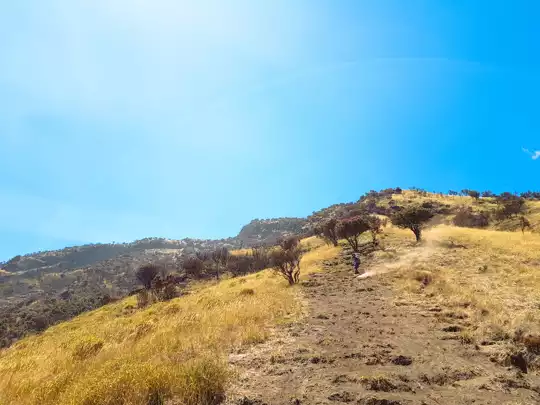
central african republic - bayu-syaits-5VKFr dYf7Y-unsplash

💰 Costs (as of 2025)Travel costs in Central African Republic

Expect 30-45 USD (≈18,000-27,000 XAF) per day if you stick to towns and keep it lean; anything involving parks or long overland hops will punch well past 100 USD.
  • dorm accommodation: 6,000-12,000 XAF per bed (Bangui skews 8,000-15,000). Dorms are often church/mission or NGO overflow, not “hostels.” System tip: ask for a “chambre simple” or “lit en dortoir,” pay cash upfront, and confirm generator hours; you don’t want to pay for AC you won’t get. Bring a sheet, padlock, and expect cold bucket showers. Compared to Cameroon, you’ll pay more for rougher rooms; it’s closer to Chad pricing.
  • meals: Supermarket Survival: imported tins, cereal, and UHT milk run 30-60% higher than in Cameroon; expect 3,000-6,000 XAF/day to self-cater bland but safe calories. Street food reality: brochettes, boule (cassava), fried fish, plantains, and market stews are 500-1,500 XAF per plate and the best value—hit busy stalls and you’ll eat well for half the supermarket spend. Water: 1.5L bottles 500-1,000 XAF; sachets cheaper but variable quality—carry a filter and stop buying plastic after day two.
  • local transport: The cheapest unlock is moto-taxis in towns (300-700 XAF daylight, double at night) and bush taxis/pickups
read more 👉
Expect 30-45 USD (≈18,000-27,000 XAF) per day if you stick to towns and keep it lean; anything involving parks or long overland hops will punch well past 100 USD.
  • dorm accommodation: 6,000-12,000 XAF per bed (Bangui skews 8,000-15,000). Dorms are often church/mission or NGO overflow, not “hostels.” System tip: ask for a “chambre simple” or “lit en dortoir,” pay cash upfront, and confirm generator hours; you don’t want to pay for AC you won’t get. Bring a sheet, padlock, and expect cold bucket showers. Compared to Cameroon, you’ll pay more for rougher rooms; it’s closer to Chad pricing.
  • meals: Supermarket Survival: imported tins, cereal, and UHT milk run 30-60% higher than in Cameroon; expect 3,000-6,000 XAF/day to self-cater bland but safe calories. Street food reality: brochettes, boule (cassava), fried fish, plantains, and market stews are 500-1,500 XAF per plate and the best value—hit busy stalls and you’ll eat well for half the supermarket spend. Water: 1.5L bottles 500-1,000 XAF; sachets cheaper but variable quality—carry a filter and stop buying plastic after day two.
  • local transport: The cheapest unlock is moto-taxis in towns (300-700 XAF daylight, double at night) and bush taxis/pickups for intercity. Figure 4,000-8,000 XAF per 100 km plus 1,000-2,000 XAF for your pack; pay early to lock the front seat or suffer in the back with goats. Fuel shortages spike fares; black-market liters can run 1.5x pump price. Checkpoints add “soft costs”—carry multiple passport copies and stay polite to avoid paying. Compared to Cameroon, rides are slower and pricier for the distance.
  • activities: Dzanga-Sangha is the wallet-burner: permits, compulsory guides/trackers, and bai/gorilla activities stack to hundreds of dollars per day once you add vehicle hire (120,000-200,000 XAF/day), fuel, and community fees. It’s cheaper than Rwanda’s gorilla scene but brutal against your daily budget. In Bangui, museum entries (1,000-3,000 XAF) and shared pirogue rides on the Oubangui (5,000-15,000 XAF if you join locals) are the rare bargains.
  • miscellaneous: Budget Leaks: visas (60-150 USD), ATM fees and frequent failures (carry cash; spread is ugly outside Bangui), SIM + 2-3 GB data 3,000-6,000 XAF, laundry 1,000-2,000 XAF/kg, “service” charges on generator nights, and expat bars (beer 2,000-2,500 XAF vs 600-800 at kiosks). Photocopies at checkpoints (50-100 XAF) add up. Relative value: food is fair, transport is poor value, and rooms are overpriced for quality; still cheaper than Gabon/Equatorial Guinea but costlier than Cameroon. The real economy move: travel at first light, eat where the pots empty fast, and buy seats—not status.
⚠️ Prices can change and everyone travels differently, so take this as a rough guide. Hope it helps you plan your adventure!

✈️ The backpacker research shortcutCentral African Republic Travel Guide

An offline-friendly backpacking guide with optimized travel routes, ranked highlights, transport advice, and the best areas to stay.
example page 0 from our offline Travel Guide for Central African Republicexample page 1 from our offline Travel Guide for Central African Republicexample page 2 from our offline Travel Guide for Central African Republicexample page 3 from our offline Travel Guide for Central African Republicexample page 4 from our offline Travel Guide for Central African Republicexample page 5 from our offline Travel Guide for Central African Republicexample page 6 from our offline Travel Guide for Central African Republicexample page 7 from our offline Travel Guide for Central African Republic
The digital guide (231 pages) contains:
51 highlights, ranked by travel appeal
Optimized 5, 10 & 15-day travel routes
Cities, national parks, beaches, historical sites, ...
How to get around
Offline-friendly for travel without Wi-Fi
👉 Click to see all 30+ guide features

📅 Plan smarter in minutes, not weeks
Month by month travel advice
Festivals & national holidays
Budget expectations

🗺️ Go to the right places, skip the overrated ones
Honest pros & cons of destinations
Top hikes, parks & viewpoints
Lesser-known places most travelers miss
Clear “worth it vs skip it” guidance

🛏️ Travel smoothly without rookie mistakes
Best areas to stay
Transport systems explained simply
Common scams & safety advice
SIM cards, money & practical tips

🌍 Understand the country, not just visit it
Culture & traditions
52 Essential phrases & customs
Festivals worth planning around
Traveler-friendly historical context
Insights that make places more meaningful

📱 Built for real travel conditions
Fully downloadable PDF
Works completely offline
Optimized for phone use
Useful in remote areas & buses
Everything in one place
Save weeks of stressful planning
Get instant access to the full guide directly. 30-day money-back guarantee.


Sent to your inbox immediately after payment • 100% Secure Checkout
Best Backpacking Travel Advisor 2025 tourism awardBest Backpacking
Travel Advisor
2025
What others say about Take Your Backpack Guides:
⭐⭐⭐⭐⭐
Fantastic, amazing amount of information!
⭐⭐⭐⭐⭐
My goodness this is amazing, it's what I've been looking for hats off too you!
⭐⭐⭐⭐⭐
I think this is absolutely BRILLIANT
⭐⭐⭐⭐
Very complete and informative. It's still missing places, but I gotta to commend you
⭐⭐⭐⭐⭐
This is truly amazing, thank you, can't wait to explore it with my kids!
⭐⭐⭐⭐⭐
Awesome resource, thank you!
⭐⭐⭐⭐⭐
This is amazing! Can't wait to explore the ones I haven't seen
⭐⭐⭐⭐
I love this! Well done, great idea.
⭐⭐⭐⭐⭐
Thanks for taking the time to make this gem!
⭐⭐⭐⭐⭐
This might be the best website I've ever seen.
⭐⭐⭐⭐⭐
Congratulations, and thank you so much for your work; it's incredibly valuable.
⭐⭐⭐⭐
In all seriousness I think you did a great job pointing out the important spots
⭐⭐⭐⭐⭐
10/10 very good
⭐⭐⭐⭐⭐
As someone who's only just starting to visit regularly this is awesome, thank you.
⭐⭐⭐⭐
Thank you very much! I'm going to visit my dad, it's going to be very useful!
⭐⭐⭐⭐⭐
This is really cool! We'll be travelling for the first time and this definitely come in handy.
⭐⭐⭐⭐⭐
You are now our minister of culture, congratulations 👨‍💼
⭐⭐⭐⭐⭐
Just wanted to tell you that this is a pearl! Going to follow your recommendations.
⭐⭐⭐⭐⭐
This is so cool. I'll definitely be using the resource for my travels soon.
⭐⭐⭐⭐⭐
This is very impressive! Good work.
⭐⭐⭐⭐⭐
This is an amazing and informative site. Very well done!

🛏️ Where to stay?Where to stay in Central African Republic

Central African Republic has very limited hostels and budget accommodation; most low-cost stays are guesthouses or basic budget hotels concentrated in the capital Bangui, with few options elsewhere and often unreliable services (power, water and variable security).
Within Bangui, Bastos and the central administrative area offer the best mix of safety, access to services and quieter streets but are pricier; the PK5/market districts are cheaper and livelier with local amenities yet busier and have greater security concerns; the Boali area gives closest access to waterfall highlights but lodging … read more 👉
Central African Republic has very limited hostels and budget accommodation; most low-cost stays are guesthouses or basic budget hotels concentrated in the capital Bangui, with few options elsewhere and often unreliable services (power, water and variable security).
Within Bangui, Bastos and the central administrative area offer the best mix of safety, access to services and quieter streets but are pricier; the PK5/market districts are cheaper and livelier with local amenities yet busier and have greater security concerns; the Boali area gives closest access to waterfall highlights but lodging is sparse and very basic.

If you enjoy meeting fellow travelers, consider choosing hostels with high ratings for atmosphere. On the other hand, if you prefer having your own space, a hotel might be a better option.

🚌 Getting aroundTransportation options and logistics

Central African Republic runs on dawn, rumors, and road dust. Schedules are a suggestion. Departures happen when the last sack is lashed and the driver has found fuel. You measure distance in axle-killing potholes and rain cells, not kilometers. When it clicks, it’s because you leaned into the flow—showed up early, stayed patient, and grabbed the first moving thing with a competent driver.
  • Taxi-brousse (shared vans and pickups) The Efficiency Trade-off. This is the spine of intercity travel. It’s
read more 👉
Central African Republic runs on dawn, rumors, and road dust. Schedules are a suggestion. Departures happen when the last sack is lashed and the driver has found fuel. You measure distance in axle-killing potholes and rain cells, not kilometers. When it clicks, it’s because you leaned into the flow—showed up early, stayed patient, and grabbed the first moving thing with a competent driver.
  • Taxi-brousse (shared vans and pickups) The Efficiency Trade-off. This is the spine of intercity travel. It’s cheap compared to hiring a car and often half the price of a private taxi, but you pay in time. Vehicles leave at first light or when every plank and wheel arch has a human on it. Dry season means bone-rattle speed and dust; rainy season doubles the clock and tests the suspension. Pay a little extra for the front seat if offered—it saves your knees and buys a seatbelt that sometimes works. Never count on an “afternoon departure.” If it’s not rolling by 9 a.m., it’s probably not rolling.
  • Moto-taxi The Social Fabric. In towns, the motorbike is how everything actually gets done. Greet the rider, state destination and price before you swing a leg. Helmets are rare; bring a bandana for dust and a thin rain shell. Sit steady, knees in, no sudden moves. Side-saddle is normal if wearing a long skirt. Keep small bills; payment happens on arrival, not mid-ride. At checkpoints, let the rider do the talking, stay neutral, and keep documents handy without waving them around. You can move three times faster than a car in traffic, at a fraction of the cost.
  • River pirogue and barges (Oubangui and tributaries) The Geometric Unlock. When roads are sludge or bridges are rumors, the river still goes. Motorized pirogues reach river towns cars can’t touch, and big barges carry cargo with room for you if you’re patient. Dry season means sandbars and long days; rainy season is faster but wetter. Sleep is a tarp on deck and a lifejacket is on you, not provided. Prices are negotiated by plank space and load, not by route map. Border formalities happen at the landing, slowly.
  • Cargo trucks and convoys The Budget Disruptor. Find them at depots, weigh stations, or outside markets. Pay the chef de bord for a spot on the load—it’s cheaper than a bush taxi over long distances, but there’s zero comfort and less predictability. Departures hinge on repairs, fuel, and paperwork. Bring a sit pad, headlamp, and patience. Dust will own you; cover your bag and lungs. When they move, they eat distance others can’t afford.

Master tip: Move at first light, hop hub to hub, and always buy your next seat before you arrive—ask your current driver to reserve it with a friend, which beats both the queue and the rumor mill.
Bangui M’Poko International Airport (BGF) is about 7 km (4.3 miles) northwest of the city center. The drive usually takes 15-30 minutes depending on traffic, checkpoints, and time of day. There’s no official airport shuttle or rideshare service.

Main ways to get into town
  • Taxi (individual hire) — 15-30 minutes. Expect roughly 3,000-7,000 XAF in daytime, 5,000-10,000 XAF at night or in heavy traffic. Always agree the fare before you get in; cash only.
  • Hotel/NGO pickup — 15-30 minutes. Many hotels and organizations offer prearranged transfers. Prices vary widely (often 5,000-15,000 XAF) or may be included with your booking. Arrange in advance so the driver can meet you at arrivals.
  • Shared minibuses (“bus”/minivan) — 25-45 minutes total. There’s no direct service inside the airport: you’ll need to walk out to the main road and flag one going toward central Bangui. Budget about 150-300 XAF per seat; add a bit more if you have bulky luggage. It’s crowded and not ideal right after a flight.
  • Moto-taxi — 10-20 minutes. Generally 500-1,500 XAF depending on distance and bargaining. Cheapest and quickest in traffic, but not great with large bags, and helmets are rarely provided.

Quick tips
  • Carry small CFA notes; drivers often can’t make change.
  • At night, prebook a hotel transfer or use a taxi from the terminal rank rather than walking to the road.
  • Expect occasional police or gendarmerie checkpoints on the way into town; keep ID handy.
⚠️ Prices and routes can change, so take this as a rough guide and ask for local advice when you arrive.

🔒 Safety (risk Level: high)What first-time visitors should know

Safety for solo travelers, including women and LGBTQ+ individuals
The Central African Republic is generally not considered safe for solo travelers, including women and LGBTQ+ individuals. The country has ongoing security issues, including armed conflict and crime, which can make travel risky. Women may face gender-based violence, and LGBTQ+ rights are not widely recognized or protected, posing additional challenges. If travel is necessary, it’s crucial to stay updated on local conditions and prioritize safety measures.


Full official government travel advisory (live updates)
View details 👉
safety image

source: www.gov.uk

✈️ VisaVisa requirements for Central African Republic

Most travelers need a visa to enter the Central African Republic. You can apply for a visa at a CAR embassy or consulate before your trip. Make sure your passport is valid for at least six months and check for any additional entry requirements.
⚠️ Visa requirements can change over time, so always check the latest visa requirements with the official embassy or government website before you travel.

🎒 What to pack?A practical packing list

Central African Republic is mostly hot and humid, so pack light, breathable clothes but also be ready for rain, especially during the wet season from May to October. The terrain is a mix of savannas, forests, and some mountainous regions, so sturdy footwear is a must if you’re planning on trekking. Culturally, modesty is appreciated, so steer clear of anything too revealing—long skirts or pants and shirts with sleeves are safe bets. Be mindful of the local etiquette and cover up appropriately when visiting villages or religious sites. Stay practical and adaptable, and you’ll have a smoother experience.

Apart from this country specific advice, I have also crafted a general packing list that should help on any trip. authorOver the years, I've learned the importance of packing minimally. It's so much easier to jump on the back of a truck or squeeze yourself into the last spot of a minibus without that supersized backpack. If you're headed to a warm destination, leave your winter jacket at home; for colder regions, opt for thin thermal underlayers. Instead of packing your entire wardrobe, bring just three sets of clothes, as laundry facilities are available everywhere.
View the full list 👉
🎒 Planning the practical side of your trip?
Get detailed information on transport, daily budgets, internet access, local customs, food, language, and other essentials in the complete Travel Guide.

Get detailed practical information 👉

Get the Travel Guide -

🙋 FAQFrequently asked questions

Trip Planning


Personal tip: I normally search on good rating for atmosphere (for meeting people) and location (for easy exploring). Cleanliness as a bonus.


Travel Essentials

Yellow fever vaccination is mandatory for entry into the Central African Republic. Other recommended vaccinations include Hepatitis A, Hepatitis B, Typhoid, Cholera, and Rabies. Make sure your routine vaccines (like MMR, DTP) are up to date. Consider Malaria prophylaxis, as it’s prevalent. Always consult with a healthcare provider for personalized advice before you travel.


vaccination requirements
When I first started traveling, I often spent part of my first day in a new country hunting for a local SIM card. While this can still be slightly cheaper, it also takes time and planning.

These days, it's much simpler to install an eSIM before leaving home. Once you arrive in Central African Republic, you can activate it immediately and have mobile data from the moment you land — which is especially useful for ordering transport or navigating away from busy airports.

There are many providers nowadays, and price differences are usually small. I personally go with Airalo, as it offers excellent network coverage throughout the country and strong global coverage, so you can manage multiple countries from a single app.


Get your e-sim for Central African Republic

Culture & Customs

Respect local customs by dressing modestly; long skirts or pants and covered shoulders are advisable, especially in rural areas. Greetings are important; a handshake with eye contact shows respect. Avoid discussing politics; it’s a sensitive topic. Photography can be sensitive; always ask permission, especially in rural communities or near military sites.

For LGBTQ+ travelers, discretion is advised due to conservative views. Women should be cautious; traveling with a companion is safer, and avoiding isolated areas after dark is wise.

Bring small gifts like pens or notebooks when visiting villages; they’re appreciated. Stay aware of your surroundings and respect local traditions to ensure a positive experience.
Trying traditional food is always a great way to experience the culture. Here are some must-try dishes for Central African Republic.
  • Sauce Graine: A rich palm nut soup that’s a staple in many households. It’s often enjoyed with rice or fufu, and its earthy, nutty flavor is a real treat. Palm nuts are abundant in the region, making this dish both popular and meaningful.
  • Kanda: These are meatballs made from ground peanuts and meat, typically beef or goat. Peanut is a key ingredient in many Central African dishes, and kanda offers a tasty mix of protein and local flavor.
  • Gozo: A type of fufu made from cassava, it’s a dense, starchy side that pairs perfectly with stews or sauces. It’s a dietary cornerstone, often served daily, and provides sustenance and energy.
  • Maboké: Fish or meat wrapped in banana leaves and steamed. This dish showcases the use of local ingredients and traditional cooking methods, and the banana leaves impart a unique flavor to the food.
  • Saka Saka: Made from cassava leaves cooked with peanut paste and palm oil, this dish is beloved for its rich, slightly bitter taste. It reflects the use of every part of the cassava plant, making it both economical and sustainable.
Tap water in the Central African Republic is generally not safe for tourists to drink. While some locals may drink it, it’s best for travelers to stick to bottled or filtered water to avoid any health issues. Always check seals on bottled water to ensure they’re intact.
The main language in Central African Republic is Sango. Backpacking is way more rewarding if you know a bit of the local language, so I'd suggest brushing up on the basics just in case your Sango skills have become a bit rusty.

Want to understand locals better?
The complete Travel Guide for Central African Republic includes 52 essential words and phrases — greetings, thank-yous, ordering food, transport, numbers, and common local expressions you'll actually hear.

Get your local basic phrases 👉

Get the Travel Guide -


In the Central African Republic (CAR), English is not widely spoken. The official language is French, a remnant of colonial rule, and it serves as the primary means of communication in government, education, and media. Additionally, Sango, a national language, is commonly used in everyday interactions among locals.

While some individuals, particularly in urban areas or those involved in tourism and international business, may have a basic understanding of English, proficiency levels are generally low. Travelers may encounter English speakers in hotels, restaurants, and among younger generations who have studied the language. However, outside of these contexts, communication in English can be challenging.

For a smoother experience, it is advisable for travelers to learn a few basic phrases in French or Sango, or to use translation apps. Engaging a local guide can also enhance communication and provide deeper insights into the culture. Overall, while you may find some English speakers, relying solely on English in CAR may not be practical.

Money & Payments

The local currency of Central African Republic is XAF (FCFA).

In the Central African Republic, ATMs are pretty scarce, especially outside Bangui. Even in the capital, they can be unreliable, so it’s smart to carry enough cash for your travels. The local currency is the Central African CFA franc, and you’ll find that euros are more widely accepted than dollars for exchange.

Exchange your money at banks or authorized exchange offices in Bangui. Avoid street money changers as the rates can be dodgy, and scams are not uncommon. Keep in mind that while some upscale hotels and restaurants in Bangui might accept credit cards, it’s generally a cash economy, so don’t rely on cards for everyday expenses.

Plan to budget carefully and carry cash securely to avoid any sticky situations when you’re off the beaten path. And remember, having a few extra euros stashed away can be a lifesaver if you run into ATM issues.

Tipping in the Central African Republic is not obligatory but appreciated. In restaurants, leaving a 5-10% tip for good service is common. For taxi drivers and hotel staff, rounding up the fare or giving a small gratuity is a nice gesture.

🧩 Nearby countriesOther countries to combine with Central African Republic

We 💚 feedbackThe bottom line on traveling here

CAR isn’t a casual trip; it’s a slow-burn that pays out in Dzanga Bai’s elephant congress and Ba’Aka songs by firelight. The vibe is raw but warm if you move humbly and keep your camera down in towns. Budget for checkpoints, park permits, and fuel—those are the real costs, not the hotel. Carry crisp USD and small CFA; ATMs cough. Yellow fever cards get checked. Roads eat time; pad your schedule. The hopeful shift: better ranger coverage and trained local guides are tightening security and smoothing park access.

✍️ Help improve this page!
The information on this page is based on in-depth research, insights shared by experienced travelers, and feedback from the local travel community in Central African Republic. While every effort is made to keep the information accurate and current, conditions can change — so if you spot anything incorrect or outdated, please get in touch.


🙋‍♂️ Give feedback

👋 Meet the founderWho’s Behind Take Your Backpack?

Johan, backpacker and founder of TakeYourBackpackHi, I’m Johan (Netherlands 🇳🇱), the creator of TakeYourBackpack. Over the past decade, I’ve backpacked through 80+ countries across six continents, gaining extensive experience with independent travel, long-term trips, and overland routes.

This site is built on a combination of firsthand travel experience and carefully curated insights from other backpackers. Many guides are based on places I’ve personally visited, while others bring together tips, observations, and practical advice shared by trusted travelers I’ve met along the way.

The goal is to provide realistic, experience-driven guidance — not generic itineraries — so you can explore destinations with better context, clearer expectations, and more confidence.

Get full country guide •
Instant download • 51 highlights • Full Offline guide