×
Cameroon 🇨🇲

backpacking Africa Cameroon 🇨🇲Travel through landscapes changing faster than cultures themselves.

Explore Cabo VerdeExplore Central African Republic

Backpacking Cameroon in 2026

A complete guide including when and where to go, costs, transport, itineraries, and practical travel advice.
Traveling in Cameroon: what to expect

Backpacking Cameroon
By Johan Kruseman 🇳🇱 | Updated June 4, 2026

You might picture a quick stop between West and Central Africa; on the ground, Cameroon feels like a whole continent folded into one country. Black-sand surf, an active volcano, rainforest older than memory, and lion country share borders here. French and English scrape against dozens of local languages, and the soundtrack is makossa and bikutsi turned up in beer gardens.

This place wins with contrasts you can feel in your bones. You sweat up Mount Cameroon through ash-black lava fields and cloud-forest, legs burning, then watch the Gulf of Guinea flash silver under a thin sunrise. At Kribi, the Lobé River pours straight into the ocean and the air smells like salt, woodsmoke, and grilled fish rubbed with pepper that prickles your lips. Limbe’s palms rattle in the sea wind, while up on the Bamenda Ring Road the air thins, masks and bronze castings glow in Foumban courtyards, and drummers test your heartbeat. North, the soil turns to dust and acacias; elephants move like shadows in Waza at dusk, and you taste the day’s grit in your teeth until the first cold 33 Export cuts through it. Yes, roads break apart, checkpoints stall momentum, rains drown timetables, and regional tensions close certain routes, but that friction squeezes the trip into sharper focus—the smiles when you finally roll in, the tea poured high, the way a shared plate of ndolé and plantains feels earned.

Neighboring Nigeria is louder and heavier on chaos; Gabon delivers rainforest polish at twice the price; Chad and the CAR tilt toward hardcore expedition; Equatorial Guinea shuts doors. Cameroon is the cross-section—range, rhythm, and character—for travelers who want maximum variety per mile and are happy to trade comfort for real texture.

👉 Get the 📖 Travel Guide of Cameroon

Mount Cameroon & Limbe (Southwest)

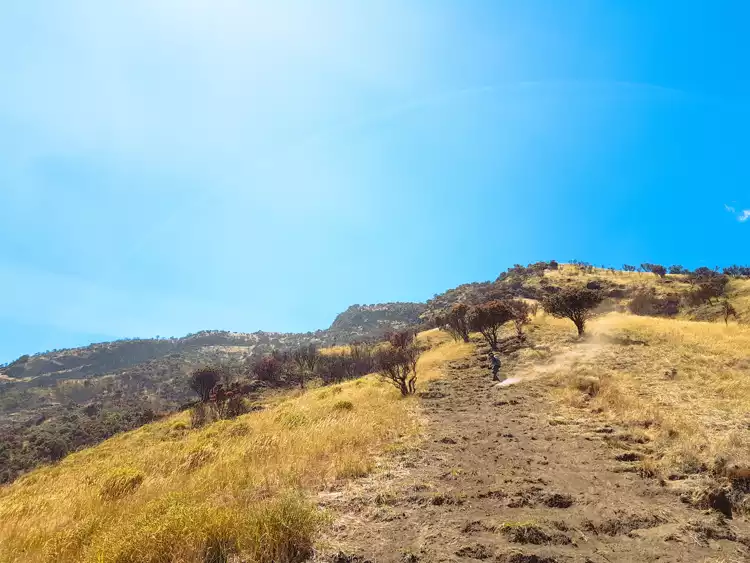
You earn this one with your legs. The ash slope above Hut 2 is a calf grinder and the wind bites on the saddle, but the first step onto warm lava gravel near the summit feels like another planet. Base yourself in Buea; shared cars and agency buses from Douala make it straightforward when movement is normal. Mondays can be shut down; plan around that. Carry your passport for checkpoints and don’t wave a camera there. Fit hikers who like early starts and simple huts get the best of it; everyone else can roll downhill to Limbe for smoky grilled fish at Down Beach and a beer cold enough to sting your teeth.

Kribi & Campo Ma’an (South)

South of Douala the air turns salty and heavy; rain hammers the red laterite until it becomes slick soap. Kribi is easy on a paved run; beyond town, tracks toward Campo and the forest edge punish low-clearance cars. Go in the dry if you can, or pay for a 4x4 and accept mud on your shins. Cash rules once you leave Kribi’s ATMs. This is for unhurried travelers who don’t mind power cuts and long evenings. Payoff looks like a pirogue gliding under Lobe Falls, then a plate of charred barracuda, lime, and pepper on a plastic table right in the spray.

Western Highlands: Bafoussam–Foumban–Dschang

Cool air, steep farmed hills, and long agency-bus rides that weave through potholes and tolls. Motos grind the last climbs to chiefdoms where courtyard drums thump and a guide unlocks workshops stacked with masks. Foumban’s palace museum is worn at the edges but honest; Ekom Nkam thunders after rain and coats you in mist and leaf rot. Nights get chilly; bucket showers are normal. Go if you like living culture and markets more than checklisted sights. The reward is a calabash of palm wine at dusk while the hills go blue and the charcoal braziers start hissing pepper soup.

Yaoundé to Adamawa by Rail

Buy a couchette, chain your bag, and accept that the train leaves when it leaves. The rhythm is steel-on-steel and roasted peanuts in the aisle. Dawn near Ngaoundéré comes cool and pale; tea steams from roadside kettles and the plateau opens in long cattle trails and volcanic humps. Motos are the taxis; days stretch. Hike to crater rims around town, visit the lamidat respectfully, and move slow. This run rewards patient travelers who like the journey more than the headline. Payoff is simple: first light over the savanna and fresh beignets still oily in your fingers.

Far North: Maroua, Rhumsiki, Waza

It’s hot, dry, and honest. Sand gets into your teeth and the Harmattan scours the skin. Maroua’s craft markets run on handshakes; motos are quick but rough. Travel in daylight, stick to main corridors, and use experienced local drivers for park runs; tracks in Waza are corrugated and brutal after noon heat. Dry season only. Rhumsiki’s basalt plugs flare orange at sunset if the haze lifts. This corridor is for seasoned travelers who manage risk and pace themselves. The moment it pays off is an elephant crossing a pale road at dusk and a calabash of bilbil shared under a thorn tree.
Geography and where places are located
Loading the map 🌍
CLICK TO FILTER
city
town
unique site
national park
hike
beach
attraction
festival
region
SHOW COUNTRY’S BESTSHOW ALL
film
0
0
0a
Limbe Wildlife Centre
film
1
1
1a
Limbe Botanic Garden
film
2
2
2a
National Museum of Cameroon
film
3
3
3a
Bimbia Slave Trade Site
film
4
4
4a
Musée des Civilisations
film
5
5
5a
Reunification Monument
film
6
6
6a
Bandjoun Station Art Center
film
7
7
7a
Doual’art Contemporary Art Center
film
8
8
8a
Batouri
film
9
9
9a
Nkongsamba
film
10
10
10a
Dja Faunal Reserve
film
11
11
11a
Korup
film
12
12
12a
Mokolo
film
13
13
13a
Melong
film
14
14
14a
Meiganga

Why go?What draws travelers here

Uniqueness

Cameroon makes you earn every mile. Buses crawl through red mud, moto-taxis weave around axle-deep potholes, … read more 👉
Cameroon makes you earn every mile. Buses crawl through red mud, moto-taxis weave around axle-deep potholes, and police checkpoints slow the day. Sweat, diesel, roasted plantain smoke—then the land opens up and pays you back. Mount Cameroon climbs from farms into dripping forest and out onto bare ash where the Atlantic glints beyond a black-sand coast. Limbe means grilled fish with piment and a cold Mutzig beading on a plastic table. Kribi’s Lobé Falls dumps straight into the sea; a pirogue takes you close enough to taste the mist. The Grassfields ring road brings palace courtyards, calabashes of palm wine, and brass workshops in Foumban. Push north and the Sahel light thins, giraffes move like a mirage. Few travelers, little hand-holding—more real conversations. It’s off-track because infrastructure argues. It’s worth it because the country answers.

Low cost

Cameroon stretches your coins. Shared yellow taxis cram four across, the window down, diesel in your … read more 👉
Cameroon stretches your coins. Shared yellow taxis cram four across, the window down, diesel in your nose, and the fare barely blips your budget. Moto-taxis and battered minibuses stitch towns together for pocket change; you pay in sweat and time, not money. Breakfast is beignets and beans on a tin plate, lunch a mound of rice and ndolé or grilled fish dusted with pepper—market food keeps you full and solvent. Rooms run basic—fan, bucket shower, intermittent power—but that’s where you save; bring a headlamp and sleep fine. Negotiate before you sit, carry small bills for checkpoints, and don’t chase private rides. A big cold 33 Export at dusk is the reward. Figure roughly $25–35 a day if you stick to towns; treks up Mount Cameroon or park safaris blow that quickly with guides, permits, and 4x4s.

Scenery

Cameroon rewards sweat. Dawn on Mount Cameroon smells like wet fern and sulfur, boots sinking into ash … read more 👉
Cameroon rewards sweat. Dawn on Mount Cameroon smells like wet fern and sulfur, boots sinking into ash as the Gulf of Guinea brightens under you. In the west, crater lakes sit like polished coins in the Bamenda highlands; climb past red laterite and eucalyptus smoke and the wind drops, the water goes glass-still. The Far North is grit and heat—Rhumsiki’s rock spires glow as Sahel dust lifts, cattle bells ticking. The forest is another world: Korup’s buttress roots slick with moss, cicadas screaming, then a flash of monkey tail. You’ll duck into cool limestone caves that taste of bat and chalk, then finish at Kribi where Lobé Falls meets the surf and the air turns salty. That first 33 Export in the shade is rightful.

Wildlife

Cameroon makes you earn the sightings. You rattle north on red-laterite roads, dust in your teeth and … read more 👉
Cameroon makes you earn the sightings. You rattle north on red-laterite roads, dust in your teeth and the harmattan biting your lips, and hit Waza or Bénoué at first light. The grass still holds the night’s cool, kob stamp and scatter, patas monkeys streak rust-red across the track, and elephants loom out of the thorn like moving stones. Two days later you’re sliding a pirogue into Lobéké or the Dja, shirts glued to your back, cicadas drilling your skull. You wait in a swamp hide until the bai opens: forest elephants ankle-deep in mud, bongos striped like shadows, a gorilla’s chestbeat rolling the air. Korup’s root mazes and rope bridges chew your calves; grey parrots flash like ash. Then a cold 33 Export in Mundemba tastes like a small miracle.
Want the complete picture of Cameroon?
The offline Travel Guide brings everything together — routes, highlights & planning.

See what's included in the guide 👉

Get the Travel Guide -

⭐ HighlightsThe places that define a trip here

  • Mount Cameroon: The trail out of Buea climbs from wet palm shade into black ash fields, then alpine grass where the wind snaps your jacket like a flag; keep going and the air thins until the Atlantic and endless forest tilt into view from the crater rim. Make the push at dawn via the Hut 1-2-3 “Guinness” route to catch the summit in cold, hard light. Hire a porter at the ecotourism office and carry gaiters—volcanic grit chews ankles—and buy your victory beer back in Molyko while your legs hum.
  • Kribi & Lobé Falls: Salt in the air, palms leaning toward a brown river that drops straight into the sea, and smoke from beach grills curling up with the tide; this is where you paddle a dugout to the foot of Lobé and feel spray cool your sunburn. Negotiate a short pirogue ride with small bills, then eat grilled prawns and cassava on the sand as the light goes amber. The rocks are slick—wear sandals with grip—and respect the current near the river mouth.
  • Korup National Park: The rainforest here is
read more 👉
  • Mount Cameroon: The trail out of Buea climbs from wet palm shade into black ash fields, then alpine grass where the wind snaps your jacket like a flag; keep going and the air thins until the Atlantic and endless forest tilt into view from the crater rim. Make the push at dawn via the Hut 1-2-3 “Guinness” route to catch the summit in cold, hard light. Hire a porter at the ecotourism office and carry gaiters—volcanic grit chews ankles—and buy your victory beer back in Molyko while your legs hum.
  • Kribi & Lobé Falls: Salt in the air, palms leaning toward a brown river that drops straight into the sea, and smoke from beach grills curling up with the tide; this is where you paddle a dugout to the foot of Lobé and feel spray cool your sunburn. Negotiate a short pirogue ride with small bills, then eat grilled prawns and cassava on the sand as the light goes amber. The rocks are slick—wear sandals with grip—and respect the current near the river mouth.
  • Korup National Park: The rainforest here is heavy with sap and cicadas, and the Mana suspension bridge sways over black water like something from an older world; step off it and each footfall pops palm nuts and stirs blue butterflies. Day-hike to a simple forest camp and let a guide show you liana “ladders” and primate calls you’ll feel in your ribs. Rubber boots beat sneakers in the mud, leech socks help in the wet months, and arrange permits, guide, and food in Mundemba before the first light truck rumbles in.
  • Bamenda Ring Road: Thin mountain air, wood smoke, and the thud of mortars pounding fufu mark the loop through the Grassfields, where clay palaces hold masks that look older than the road. Visit Bafut Palace in the morning, then climb through cloud forest toward Lake Oku and drink tea while goats pick at the verge. In the rains the road slumps—motos handle it best—so stash clothes in a dry bag, greet palace staff politely, and budget a small museum donation before you drift into a night of corn beer and njama-njama.
  • Rhumsiki & the Mandara Spires: Dust lifts off the valley floor and basalt needles rise sharp against a bruised sunset; hike before heat to a ridge, then watch the Kapsiki peaks turn purple while a kid brings calabashes of millet beer. If you see the crab diviner, set a price first—the show is part theater, part tradition—and keep your water and hat handy because the dry wind scours. For off-the-map days, aim for Ekom Nkam Falls near Melong, Campo-Ma’an’s deep forest south of Kribi, or quiet canoe hours at Ebogo on the Nyong.
Spotted a mistake or missing a highlight? Contact us.

But Cameroon offers more...

Discover and compare all of its highlights per category

🧭 RoutesSuggested travel routes through Cameroon

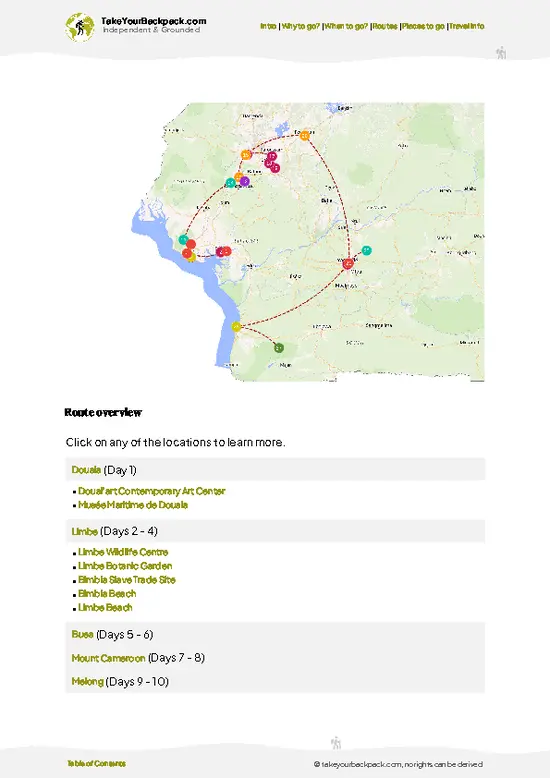
The 7-Day Southwest Coast & Volcano Loop

The vibe: A relaxed, one-region deep dive built around the Atlantic coast, black-sand beaches, and the foothills of Mount Cameroon, with enough structure to feel adventurous but not rushed. You get wildlife, history, and a taste of hiking without spending half your trip on buses.
The highlights:
  • Soft landing in Douala with contemporary art and maritime history.
  • Slow days in Limbe with the Limbe Wildlife Centre, Limbe Botanic Garden, and black-sand beaches.
  • A reflective visit to the Bimbia Slave Trade Site on the forested coast.
  • Day hiking on the lower slopes of Mount Cameroon from Buea.

The 14-Day Coast, Highlands & Palace Circuit

The vibe: A balanced two-week loop that stitches together the Atlantic coast, Mount Cameroon, and the western highlands, mixing easy beach time with palace history and contemporary art. The pace is medium: a few longer travel days, but plenty of two- and three-night stops to actually sink into each place.
The highlights:
  • Douala’s
read more 👉

The 7-Day Southwest Coast & Volcano Loop

The vibe: A relaxed, one-region deep dive built around the Atlantic coast, black-sand beaches, and the foothills of Mount Cameroon, with enough structure to feel adventurous but not rushed. You get wildlife, history, and a taste of hiking without spending half your trip on buses.
The highlights:
  • Soft landing in Douala with contemporary art and maritime history.
  • Slow days in Limbe with the Limbe Wildlife Centre, Limbe Botanic Garden, and black-sand beaches.
  • A reflective visit to the Bimbia Slave Trade Site on the forested coast.
  • Day hiking on the lower slopes of Mount Cameroon from Buea.

The 14-Day Coast, Highlands & Palace Circuit

The vibe: A balanced two-week loop that stitches together the Atlantic coast, Mount Cameroon, and the western highlands, mixing easy beach time with palace history and contemporary art. The pace is medium: a few longer travel days, but plenty of two- and three-night stops to actually sink into each place.
The highlights:
  • Douala’s creative side at Doual’art and the maritime story at Musée Maritime de Douala.
  • Kribi Beach and Limbe’s wildlife, botanic garden, and black-sand shoreline.
  • Mount Cameroon hiking from Buea plus the dramatic Ekom-Nkam Waterfalls near Melong.
  • Highland culture in Bafoussam and Bamenda, including Musée des Civilisations and Bafut Palace.

The 21-Day Cameroon Grand Traverse

The vibe: A full-country adventure that runs from palm-fringed beaches to volcanic slopes, highland kingdoms, deep waterfalls, and up into the northern savannas for safari, with enough time to breathe between the big moves. It’s for travelers who want the “greatest hits” plus a few corners that most visitors never reach.
The highlights:
  • Coastal days in Douala and Kribi Beach, then black-sand shores and conservation work in Limbe.
  • Mount Cameroon trekking from Buea and the cinematic Ekom-Nkam Waterfalls near Melong.
  • Art and culture in Bafoussam and Bamenda Highlands, including Bandjoun Station Art Center and Bafut Palace.
  • Classic savanna wildlife in Waza National Park and a taste of far-north life around Mokolo.
🌍 Want a ready-to-use travel plan for Cameroon?
The overview above compares different route options based on your travel time and style. The complete Travel Guide breaks each itinerary down in detail, including maps, stops, highlights, and transport information.

Explore all route details 👉

Get the Travel Guide -

🌤️ When to go?Choosing the right months to travel

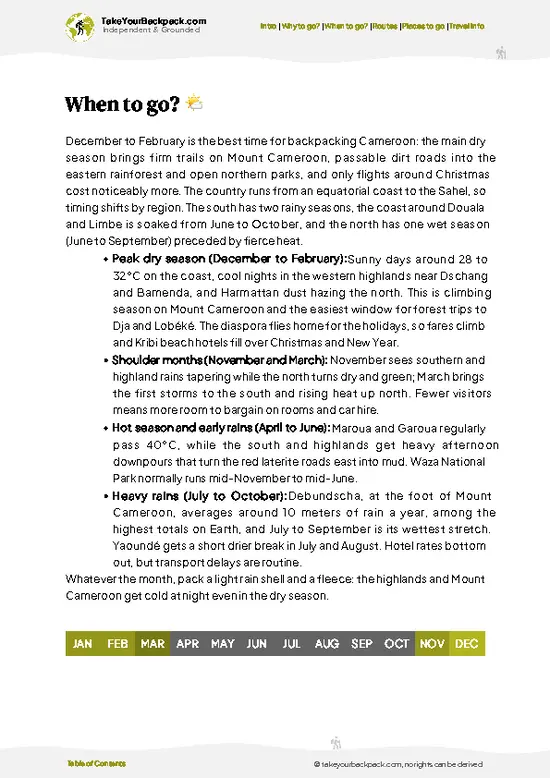
Mid-November to mid-December is the sweet spot. The rains have backed off, the laterite firms under your boots, and the harmattan hasn’t yet turned the sky to chalk. Roads reopen without the Christmas price pop, bus stations breathe, and park tracks in the north are passable before the furnace of March. On Mount Cameroon you get clearer mornings and cooler nights; along the coast the air smells of wet soil and charcoal fish, not mildew. Wildlife starts to concentrate around water in Benoué and Waza, but you still pay pre-holiday rates. You sweat, sure, but you can earn a ridge-top breeze without the crowd, then kill the dust with a cold Castel in Limbe while the surf hammers the black sand.
  • Dry-Season Peak (Dec-Feb): You queue longer, pay more around Christmas/New Year and during the Mount Cameroon race week, and every seat from Yaoundé to Buea is spoken for by dawn. But dawn on the summit delivers knife-edge light over the forest and lava fields, and up north elephants ghost to shrinking pools while the air smells like hot grass and diesel. Prices climb, but the payoff is roads that hold, trails that bite less, and nights cool enough to sleep without a fan.
  • Early Dry Shoulder (mid-Nov-mid-Dec): The country exhales. Puddles shrink to cracked mirrors, shutters clap open earlier, and moto taxis reclaim tracks that were rivers last month. Markets restock, guides answer phones again, and you move—bus to bush taxi to foot—without the holiday squeeze. It’s lean, cheap, and quick underfoot, and the light stays clean.
  • Rains/Monsoon (May-Oct; worst Jul-Sep): The mood turns interior: slate sky, warm rain that drums plantain leaves, villages wrapped in woodsmoke and hibiscus. Trails liquefy, bridges sulk, and drivers shrug at timetables. Survival hack: buy a clear plastic market sheet (500 CFA), wrap your pack tight; it doubles as a dry seat in leaking taxis and beats any fancy cover. Lodges cut rates, beaches are yours, but some parks close and every mile demands patience.

Tactical tip: For the mid-Nov-mid-Dec window, reserve Buea beds and a Mount Cameroon climb 7-10 days ahead; buy intercity bus tickets the evening before and carry a simple pack liner—dry season still throws surprise squalls.

source: climatestotravel.comJANJanuary: highly recommended for travelingFEBFebruary: highly recommended for travelingMARMarch: good for travelingAPRApril: fair for travelingMAYMay: fair for travelingJUNJune: fair for travelingJULJuly: below average for travelingAUGAugust: below average for travelingSEPSeptember: below average for travelingOCTOctober: fair for travelingNOVNovember: highly recommended for travelingDECDecember: excellent for traveling
📅 Traveling in a specific month?
Get a full month-by-month breakdown of weather, crowds, costs, festivals, and seasonal highlights in the complete travel guide.

Get full details when to go 👉

Get the Travel Guide -
pixabay-hut-7109228

💰 Costs (as of 2025)How expensive it really is

Plan on 20,000-35,000 XAF ($32-56) per day if you sleep cheap, eat on the street, and ride shared taxis, with Douala/Yaoundé and national parks pushing you toward 45,000 XAF.
  • dorm accommodation: 4,000-8,000 XAF where they exist; more often you’ll land a basic “chambre simple” for 6,000-12,000 XAF. Beds are firm, fans rattle, water cuts out, and the first cold shower after a dusty bus day is its own reward. System tip: ask for the “nuitée” price (not hourly), check the sheet and mosquito net before paying, and register on the fiche without surrendering your passport—photocopy works. Relative value: cheaper than Gabon/Equatorial Guinea, similar to provincial Nigeria, pricier than rural Congo.
  • meals: Supermarket Survival: bread, sardines, Laughing Cow, bananas—1,500-3,000 XAF/day if you skip imports; European items double or triple local prices. Street food reality: puff-puff and beans for 300-500 XAF, soya brochettes 100-200 XAF each, heaped rice-and-sauce 1,000-1,500 XAF, grilled fish with plantains 1,500-3,000 XAF, 650 ml beer 600-900 XAF, bottled water 500-700 XAF. You’ll eat better and cheaper curbside than in mid-tier restaurants. Relative value: slightly pricier than Nigeria’s roadside
read more 👉
Plan on 20,000-35,000 XAF ($32-56) per day if you sleep cheap, eat on the street, and ride shared taxis, with Douala/Yaoundé and national parks pushing you toward 45,000 XAF.
  • dorm accommodation: 4,000-8,000 XAF where they exist; more often you’ll land a basic “chambre simple” for 6,000-12,000 XAF. Beds are firm, fans rattle, water cuts out, and the first cold shower after a dusty bus day is its own reward. System tip: ask for the “nuitée” price (not hourly), check the sheet and mosquito net before paying, and register on the fiche without surrendering your passport—photocopy works. Relative value: cheaper than Gabon/Equatorial Guinea, similar to provincial Nigeria, pricier than rural Congo.
  • meals: Supermarket Survival: bread, sardines, Laughing Cow, bananas—1,500-3,000 XAF/day if you skip imports; European items double or triple local prices. Street food reality: puff-puff and beans for 300-500 XAF, soya brochettes 100-200 XAF each, heaped rice-and-sauce 1,000-1,500 XAF, grilled fish with plantains 1,500-3,000 XAF, 650 ml beer 600-900 XAF, bottled water 500-700 XAF. You’ll eat better and cheaper curbside than in mid-tier restaurants. Relative value: slightly pricier than Nigeria’s roadside fare, far cheaper than Gabon/EG, on par with CAR/Chad markets when supply is good.
  • local transport: Cheapest unlock: shared yellow taxis in cities (200-400 XAF per seat by distance/time), moto-taxis for short hops (100-300 XAF), agency buses for intercity runs (3,500-7,000 XAF for 200-350 km). The Douala-Yaoundé train or night train north is good value if it’s running; second class saves the most. Pay per seat, leave early, and expect diesel, red dust, and Christian pop at high volume. Relative value: cheaper than Gabon’s limited routes, similar to Nigeria per kilometer, much cheaper than CAR/Chad where scarcity spikes prices.
  • activities: Cost drivers are guides, permits, and vehicles. Mount Cameroon climb: 60,000-120,000 XAF all-in with guide/porters/park fees; day hikes 10,000-20,000. Waza or Bénoué safaris need a 4x4—150,000-250,000 XAF per vehicle per day split among you. Korup/Campo Ma’an entries 5,000-10,000 XAF plus mandatory guide 10,000-20,000/day. Waterfalls and palaces are pocket change (500-2,000 XAF). Relative value: rainforest trekking is a bargain against Gabon; wildlife is cheaper than Chad/CAR but logistics still bite.
  • miscellaneous: Budget leaks: ATM fees (3-5%), hotel “AC surcharge,” baggage fees on buses, paying for two seats to protect your pack, copies for checkpoints, Sunday closures forcing hotel meals, and late-night taxi “special hires.” SIMs (MTN/Orange) are cheap; data bundles 1,000-3,000 XAF keep maps running. A casual “dash” at a checkpoint can appear—receipts and patience cost less than arguing. Beer is a morale saver and still value here compared with Gabon. Relative value: everyday leaks lower than oil-rich neighbors, higher than rule-tight Rwanda or Ghana.
⚠️ Prices can change and everyone travels differently, so take this as a rough guide. Hope it helps you plan your adventure!

✈️ The backpacker research shortcutCameroon Travel Guide

An offline-friendly backpacking guide with optimized travel routes, ranked highlights, transport advice, and the best areas to stay.
example page 0 from our offline Travel Guide for Cameroonexample page 1 from our offline Travel Guide for Cameroonexample page 2 from our offline Travel Guide for Cameroonexample page 3 from our offline Travel Guide for Cameroonexample page 4 from our offline Travel Guide for Cameroonexample page 5 from our offline Travel Guide for Cameroonexample page 6 from our offline Travel Guide for Cameroonexample page 7 from our offline Travel Guide for Cameroon
The digital guide (383 pages) contains:
95 highlights, ranked by travel appeal
Optimized 7, 14 & 21-day travel routes
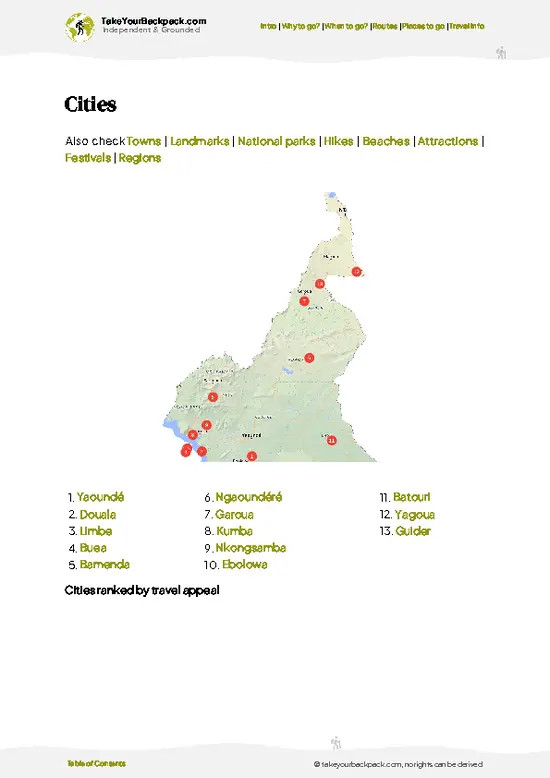
Cities, national parks, beaches, historical sites, ...
How to get around
Offline-friendly for travel without Wi-Fi
👉 Click to see all 30+ guide features

📅 Plan smarter in minutes, not weeks
Month by month travel advice
Festivals & national holidays
Budget expectations

🗺️ Go to the right places, skip the overrated ones
Honest pros & cons of destinations
Top hikes, parks & viewpoints
Lesser-known places most travelers miss
Clear “worth it vs skip it” guidance

🛏️ Travel smoothly without rookie mistakes
Best areas to stay
Transport systems explained simply
Common scams & safety advice
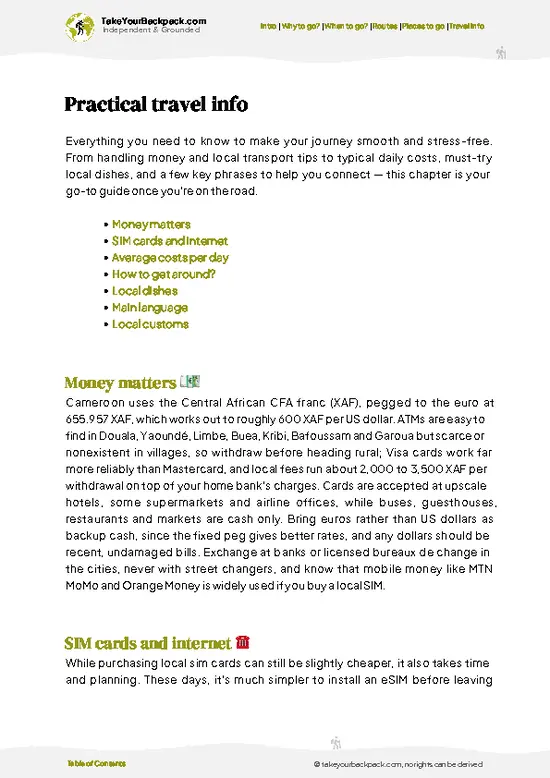
SIM cards, money & practical tips

🌍 Understand the country, not just visit it
Culture & traditions
52 Essential phrases & customs
Festivals worth planning around
Traveler-friendly historical context
Insights that make places more meaningful

📱 Built for real travel conditions
Fully downloadable PDF
Works completely offline
Optimized for phone use
Useful in remote areas & buses
Everything in one place
Save weeks of stressful planning
Get instant access to the full guide directly. 30-day money-back guarantee.


Sent to your inbox immediately after payment • 100% Secure Checkout
Best Backpacking Travel Advisor 2025 tourism awardBest Backpacking
Travel Advisor
2025
What others say about Take Your Backpack Guides:
⭐⭐⭐⭐⭐
Fantastic, amazing amount of information!
⭐⭐⭐⭐⭐
My goodness this is amazing, it's what I've been looking for hats off too you!
⭐⭐⭐⭐⭐
I think this is absolutely BRILLIANT
⭐⭐⭐⭐
Very complete and informative. It's still missing places, but I gotta to commend you
⭐⭐⭐⭐⭐
This is truly amazing, thank you, can't wait to explore it with my kids!
⭐⭐⭐⭐⭐
Awesome resource, thank you!
⭐⭐⭐⭐⭐
This is amazing! Can't wait to explore the ones I haven't seen
⭐⭐⭐⭐
I love this! Well done, great idea.
⭐⭐⭐⭐⭐
Thanks for taking the time to make this gem!
⭐⭐⭐⭐⭐
This might be the best website I've ever seen.
⭐⭐⭐⭐⭐
Congratulations, and thank you so much for your work; it's incredibly valuable.
⭐⭐⭐⭐
In all seriousness I think you did a great job pointing out the important spots
⭐⭐⭐⭐⭐
10/10 very good
⭐⭐⭐⭐⭐
As someone who's only just starting to visit regularly this is awesome, thank you.
⭐⭐⭐⭐
Thank you very much! I'm going to visit my dad, it's going to be very useful!
⭐⭐⭐⭐⭐
This is really cool! We'll be travelling for the first time and this definitely come in handy.
⭐⭐⭐⭐⭐
You are now our minister of culture, congratulations 👨‍💼
⭐⭐⭐⭐⭐
Just wanted to tell you that this is a pearl! Going to follow your recommendations.
⭐⭐⭐⭐⭐
This is so cool. I'll definitely be using the resource for my travels soon.
⭐⭐⭐⭐⭐
This is very impressive! Good work.
⭐⭐⭐⭐⭐
This is an amazing and informative site. Very well done!

🛏️ Where to stay?Best areas to base yourself

Yes — hostels, budget guesthouses and low‑cost hotels are available in Cameroon’s main cities and tourist hubs for backpackers, but they concentrate in Douala, Yaoundé and a few regional towns so expect far fewer options in rural or highland areas and plan accordingly.
In Douala, Akwa offers the widest choice and nightlife with good transport links but only moderate nighttime security; Deïdo is cheapest and closest to markets and bus hubs yet busy and basic with lower safety after dark; Bonapriso gives quieter, safer stays at higher prices.
In Yaoundé, Bastos has safer, quieter expat‑style … read more 👉
Yes — hostels, budget guesthouses and low‑cost hotels are available in Cameroon’s main cities and tourist hubs for backpackers, but they concentrate in Douala, Yaoundé and a few regional towns so expect far fewer options in rural or highland areas and plan accordingly.
In Douala, Akwa offers the widest choice and nightlife with good transport links but only moderate nighttime security; Deïdo is cheapest and closest to markets and bus hubs yet busy and basic with lower safety after dark; Bonapriso gives quieter, safer stays at higher prices.
In Yaoundé, Bastos has safer, quieter expat‑style lodgings that cost more; Mokolo is the cheapest and most central near markets and buses but noisy and spartan; university areas (Ngoa‑Eké/Melen) host wallet‑friendly guesthouses and lively street food while being noisy and occasionally inconsistent on services.

If you enjoy meeting fellow travelers, consider choosing hostels with high ratings for atmosphere. On the other hand, if you prefer having your own space, a hotel might be a better option.

🚌 Getting aroundPublic transport and other ways to get around

Cameroon moves on elastic time. Engines don’t growl until seats are full, rain turns timetables to smears, and the road decides who’s in charge. Dawn is your ally: cool air, fewer checkpoints, drivers still fresh. By midday, heat shimmers off cracked tarmac and hawkers thump peanuts and warm Coke against your window. At night you trade distance for risk: cattle, potholes, and drivers racing darkness. It’s a country of improvisation that still rewards the stubborn; stay light, stay ready, and the … read more 👉
Cameroon moves on elastic time. Engines don’t growl until seats are full, rain turns timetables to smears, and the road decides who’s in charge. Dawn is your ally: cool air, fewer checkpoints, drivers still fresh. By midday, heat shimmers off cracked tarmac and hawkers thump peanuts and warm Coke against your window. At night you trade distance for risk: cattle, potholes, and drivers racing darkness. It’s a country of improvisation that still rewards the stubborn; stay light, stay ready, and the payoff is real—dusty boots on a new street, plantain smoke in your clothes, and the first cold beer tasting like a small victory.
  • Agency Buses & Bush Taxis The efficiency trade-off is simple: agency buses (Finex, Garanti, Touristique, Général Express) are cheaper and safer-feeling, but slower; bush taxis are faster, pricier, and pack you tighter. Douala-Yaoundé runs about 4-6 hours by bus (roughly 5,000-8,000 CFA), an hour less by bush taxi (7,000-12,000 CFA). First departures win. Agencies leave when full, tag your bag, and sometimes charge for overweight. Front-row seats are gold for knees and visibility; rain or a football match will blow any schedule.
  • Shared Urban Taxis This is the social fabric on wheels. You flag with a downward palm, state your destination through the window, and the driver grunts yes or rolls on. You share with strangers; front seat might hold two, three across the back is standard. Day fares hover around 300-500 CFA per segment, rising after dark or in rain. Say “course” for a private hire, “bonjour” before bargaining, and never present a big bill—coin change oils the ride. Tap the roof to stop. Don’t slam doors. Seatbelts are aspirational; pick a car that at least pretends to have them.
  • Camrail Train The geometric unlock: steel beats mud. The Douala-Yaoundé-Ngaoundéré line stitches forest to savannah overnight, bypassing landslides, drunk headlights, and the Adamaoua hills that chew suspensions for breakfast. Second class is cheap, crowded, and fine if you guard your bag; first class buys AC and a doze. Tickets go on sale at stations, bring ID, and expect a scrum at boarding. Carriages are cold; pack a layer. Food vendors hop on at stops with greasy plantains and grilled meat while your phone loses signal and the country just slides by.
  • Moto-taxis (Benskin) The budget disruptor. When traffic locks or the trailhead hides beyond the last minibus, a benskin threads the gap. In towns, 200-500 CFA gets you across a neighborhood; to a village or waterfall track, expect 1,000-3,000 CFA depending on distance and mud. Agree the fare first, say “doucement” if the driver’s showing off, and insist on a helmet if one exists. Keep your pack tight—bungees (“sandow”) help—avoid fresh laterite after rain, and never ride drunk drivers at night.

Master tactical tip: Move at first light—moto to the agency, take the day’s first departure, and you’ll bank distance before heat, rain, and checkpoints slow the country to a crawl.
Distance: Yaoundé Nsimalen International Airport (NSI) is about 22 km (14 miles) south of the city center. In light traffic it’s a straightforward run up the N3.

Is there an airport bus? No dedicated airport shuttle bus as of 2025.

Main ways to get into town:
  • Airport taxis (private hire) — 30-60 minutes depending on traffic. Expect 8,000-12,000 XAF in daytime, 10,000-15,000 XAF late night or in heavy rain/peak hours. You’ll find them just outside arrivals; agree the fare before you get in.
  • Ride-hailing (e.g., Yango) — 30-60 minutes. Typically 5,000-10,000 XAF to central neighborhoods (Poste Centrale, Bastos, Mvog-Mbi), with occasional surge pricing at peak times. Works well if you have mobile data.
  • Shared city taxis (“collectif”) — 45-90 minutes. Cheapest but least comfortable with luggage. From the airport gate, flag a shared taxi toward Mvan or Poste Centrale, often with one change. 500-1,500 XAF per person depending on distance and bargaining.
  • Minibuses — 45-90 minutes. Local minibuses run along the N3 between Nsimalen and city hubs like Mvan. 300-600 XAF per person. Crowded and not great with big bags, but very cheap.
  • Hotel shuttle/transfer — 30-60 minutes. Many mid-range and upscale hotels can arrange pickups if booked in advance. Free to about 15,000-25,000 XAF depending on the property.

Quick taxi note: Regular private taxis are the most common door-to-door option from NSI. Budget 8,000-12,000 XAF by day and a bit more at night; always confirm the total price for your exact destination before departure.

Timing tips: Rush hour (roughly 07:00-10:00 and 16:00-20:00) can add a lot of time, and heavy rain slows things down. Plan a buffer if you’re heading to a connection.

Payment: Cash (XAF) is standard for taxis, shared taxis, and minibuses. There are ATMs in the terminal, but it’s wise to carry small bills for drivers.
⚠️ Prices and routes can change, so take this as a rough guide and ask for local advice when you arrive.

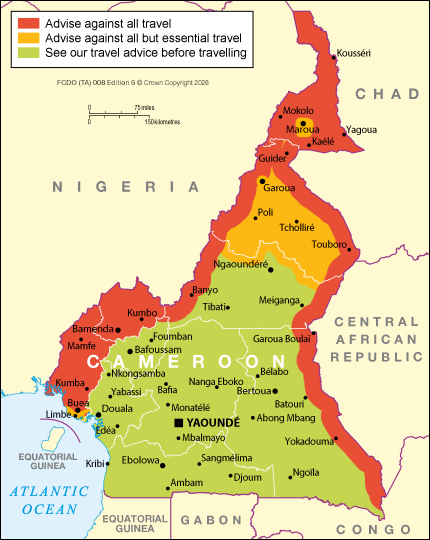
🔒 Safety (risk Level: medium)Staying safe while traveling

Safety for solo travelers, including women and LGBTQ+ individuals
Safety in Cameroon can be a mixed bag. For solo travelers, especially women and LGBTQ+ individuals, it’s essential to stay aware of your surroundings and avoid isolated areas, particularly at night. While larger cities like Douala and Yaoundé have more resources and services, they also come with typical urban safety concerns. LGBTQ+ travelers should exercise caution due to conservative views in some areas; consider connecting with local LGBTQ+ groups for support and advice.


Full official government travel advisory (live updates)
View details 👉
safety image

source: www.gov.uk

✈️ VisaDo you need a visa to visit?

Most travelers need a visa to visit Cameroon, which you can apply for at a Cameroonian embassy or consulate. Check if your country has specific requirements, but generally, you’ll need a completed application form, passport photos, and proof of travel plans. Always verify the latest entry requirements as they can change.
⚠️ Visa requirements can change over time, so always check the latest visa requirements with the official embassy or government website before you travel.

🎒 What to pack?A practical packing list

Cameroon’s diverse landscape means you’re jumping between hot, humid jungles and cooler mountain regions, so think layers and lightweight, breathable fabrics. The wet season can get pretty intense, so waterproof gear will be your best friend. Respect local customs with modest clothing, especially in rural and Muslim areas—covering knees and shoulders is a good rule of thumb. If you’re hitting the beaches, remember they’re more for fishing than sunbathing, so keep swimwear for hotel pools.

Apart from this country specific advice, I have also crafted a general packing list that should help on any trip. authorOver the years, I've learned the importance of packing minimally. It's so much easier to jump on the back of a truck or squeeze yourself into the last spot of a minibus without that supersized backpack. If you're headed to a warm destination, leave your winter jacket at home; for colder regions, opt for thin thermal underlayers. Instead of packing your entire wardrobe, bring just three sets of clothes, as laundry facilities are available everywhere.

View the full list 👉
🎒 Planning the practical side of your trip?
Get detailed information on transport, daily budgets, internet access, local customs, food, language, and other essentials in the complete Travel Guide.

Get detailed practical information 👉

Get the Travel Guide -

🙋 FAQTravel questions about Cameroon

Trip Planning


Personal tip: I normally search on good rating for atmosphere (for meeting people) and location (for easy exploring). Cleanliness as a bonus.


Travel Essentials

Yellow fever vaccination is mandatory for entry into Cameroon. The CDC also recommends vaccinations for hepatitis A, hepatitis B, typhoid, cholera, and rabies, especially if you’ll be in rural areas or in contact with animals. Malaria is a risk, so take antimalarial medication—consult your healthcare provider for the best options. Always check the latest travel health advice before your trip.


vaccination requirements
When I first started traveling, I often spent part of my first day in a new country hunting for a local SIM card. While this can still be slightly cheaper, it also takes time and planning.

These days, it's much simpler to install an eSIM before leaving home. Once you arrive in Cameroon, you can activate it immediately and have mobile data from the moment you land — which is especially useful for ordering transport or navigating away from busy airports.

There are many providers nowadays, and price differences are usually small. I personally go with Airalo, as it offers excellent network coverage throughout the country and strong global coverage, so you can manage multiple countries from a single app.


Get your e-sim for Cameroon

Culture & Customs

Handshake greetings are common in Cameroon; use the right hand or both hands for respect. *Do* dress modestly, especially in rural areas; women should cover shoulders and knees. *Don’t* use your left hand for eating or passing objects, as it’s considered unclean. LGBT travelers should be cautious, as same-sex relations are illegal and socially frowned upon. *Do* ask for permission before taking photos of people or cultural sites. Public displays of affection are generally frowned upon, so *don’t* engage in them. *Do* be polite and patient, as punctuality is more relaxed.
Trying traditional food is always a great way to experience the culture. Here are some must-try dishes for Cameroon.
  • Ndolé: This is a rich, flavorful stew made with bitter leaves, peanuts, and often shrimp or beef. It’s a staple at Cameroonian celebrations and is beloved for its unique blend of flavors and hearty texture.
  • Eru: A dish native to the Bayangi people, Eru is a green vegetable soup cooked with waterleaf and the leaves of the eru plant. Often mixed with smoked fish or meat, it offers a deep, earthy taste and is highly nutritious.
  • Koki: Made from ground black-eyed peas and palm oil, this dish is wrapped in banana leaves and steamed. It’s a popular street food and party dish, known for its smooth, melt-in-the-mouth texture and rich flavor.
  • Poulet DG: Literally translating to ”Director General’s Chicken,” this dish is a luxurious blend of fried chicken, plantains, and vegetables. It’s regarded as a symbol of Cameroonian hospitality and is often served at special occasions.
  • Achu Soup: Known for its bright yellow color from palm oil, this soup is typically served with pounded cocoyams. It’s a central element in the traditional meals of the Western Grassfields and is a must-try for its spicy, savory taste.
Locals in Cameroon often drink tap water, but it’s not recommended for tourists due to potential contamination. Stick to bottled or filtered water to avoid any stomach issues. Always ensure bottled water is sealed before purchasing.
The main language in Cameroon is French. Backpacking is way more rewarding if you know a bit of the local language, so I'd suggest brushing up on the basics just in case your French skills have become a bit rusty.

Want to understand locals better?
The complete Travel Guide for Cameroon includes 52 essential words and phrases — greetings, thank-yous, ordering food, transport, numbers, and common local expressions you'll actually hear.

Get your local basic phrases 👉

Get the Travel Guide -


In Cameroon, English is one of the two official languages, alongside French. The country is bilingual, with the English-speaking regions primarily located in the Northwest and Southwest regions. In these areas, English is commonly spoken, and you’ll find that many people, especially in urban centers and among the younger population, are proficient in it.

However, in predominantly French-speaking regions, English proficiency may be limited. Many Cameroonians are bilingual or multilingual, often speaking local dialects alongside English and French. In urban areas, such as Douala and Yaoundé, English is more widely understood, particularly in business and tourism contexts.

While English speakers can generally navigate through the country, it’s beneficial to learn a few basic phrases in French or local languages, as this can enhance communication and foster goodwill with locals. Overall, while English is spoken in Cameroon, the level of proficiency varies by region and demographic.

Money & Payments

The local currency of Cameroon is XAF (FCFA).

In Cameroon, ATMs are mostly found in larger cities, so plan to withdraw cash when you’re there. Not all ATMs accept international cards, so look for ones linked to major networks like Visa or MasterCard. It’s smart to carry cash for rural areas and small towns where ATMs are scarce.

While the CFA franc is the local currency, carrying some euros or US dollars can be handy for emergencies or when exchanging in bigger cities. Remember, euros might have a slightly better exchange rate than dollars. Keep an eye on rates before you go.

When it comes to card acceptance, most transactions are cash-based, especially outside cities like Yaoundé or Douala. Credit cards are generally only accepted at international hotels and upscale restaurants.

For exchanging money, stick to banks or official exchange bureaus to avoid scams. Black market rates might be tempting, but they carry risks. Keep small bills and change on hand for local transactions, as breaking larger notes can be tough in small shops or for street vendors.

Tipping in Cameroon is appreciated but not mandatory. In restaurants, leaving around 5-10% for good service is common. For taxi drivers and hotel staff, rounding up the fare or offering a small gratuity is a nice gesture.

🧩 Nearby countriesSimilar backpacking destinations

We 💚 feedbackFinal notes for travelers

Cameroon pays off when you grind up from Buea into Mount Cameroon’s cloud forest: wet basalt chewing your soles, heather scraping your shins, the air thinning until the ash plains open and the Atlantic turns flat and metallic. Drop to Limbe and the first cold Castel with grilled fish and pepper at Down Beach makes the lactic acid worth it. The hard part is between the highs: slow, battered roads, police and gendarme checkpoints that eat daylight, and in the Northwest/Southwest, a conflict that can close routes without warning. Fix it with one move: buy an Orange or MTN SIM on day one and pre-arrange dawn rides by WhatsApp; you’ll beat heat, storms, and checkpoint theater.

✍️ Help improve this page!
The information on this page is based on in-depth research, insights shared by experienced travelers, and feedback from the local travel community in Cameroon. While every effort is made to keep the information accurate and current, conditions can change — so if you spot anything incorrect or outdated, please get in touch.


🙋‍♂️ Give feedback

👋 Meet the founderWho’s Behind Take Your Backpack?

Johan, backpacker and founder of TakeYourBackpackHi, I’m Johan (Netherlands 🇳🇱), the creator of TakeYourBackpack. Over the past decade, I’ve backpacked through 80+ countries across six continents, gaining extensive experience with independent travel, long-term trips, and overland routes.

This site is built on a combination of firsthand travel experience and carefully curated insights from other backpackers. Many guides are based on places I’ve personally visited, while others bring together tips, observations, and practical advice shared by trusted travelers I’ve met along the way.

The goal is to provide realistic, experience-driven guidance — not generic itineraries — so you can explore destinations with better context, clearer expectations, and more confidence.

Get full Cameroon guide •
Instant download • 95 highlights • Full Offline guide