×
Suriname 🇸🇷

backpacking South America Suriname 🇸🇷Move riverbound into dense Amazonian rainforest.

Explore PeruExplore Uruguay

Backpacking Suriname in 2026

A complete guide including when and where to go, costs, transport, itineraries, and practical travel advice.
A practical introduction for travelers

Backpacking Suriname
By Johan Kruseman 🇳🇱 | Updated June 12, 2026

I gave up a washed-out road for a skinny korjaal, and the delay bought me drums under a mango tree. In Suriname, rivers beat timetables. Trade time and sweat for access—forest villages, wildlife, and hospitality that starts with ginger soda and ends in a hammock.

Paramaribo wears weathered wood with pride: Dutch gables, a synagogue and a mosque sharing Keizerstraat, roti mornings, Javanese warungs, and Parbo beers sweating on the Waterkant. Then the interior swallows you—endless canopy, blackwater creeks, Voltzberg’s granite, harpy eagles, giant otters, and leatherbacks hauling sand at Galibi. Boat spray tastes metallic, humidity clings, transport is slow, cash is king, and mosquitoes love dusk, but it all shrinks when kaseko lifts a Maroon village or you spot fresh jaguar tracks; that first beer back in town tastes like a win.

Guyana speaks English and shouts with Kaieteur; French Guiana is orderly and pricey; Suriname is the easygoing, multilingual river country. Go if you want rich culture with your rainforest and you’re willing to earn it, slow and satisfied.

👉 Get the 📖 Travel Guide of Suriname

Paramaribo + Commewijne

Wooden facades creak in the heat, and the river carries diesel and spice on the air. Base in the capital if you want culture without a car: roti shops, Javanese warungs, mosque and synagogue side by side, nighttime drums drifting from side streets. Rent a bike early, cross to Commewijne’s plantation belt by bridge, and ride the dike past rusting sugar works and canals. It’s flat but punishing in midday sun; carry water and accept you’ll sweat through your shirt. Reward is simple: a cold Parbo at Waterkant while the light goes copper.

Upper Suriname River (Atjoni to Pikin Slee)

Road to Atjoni, then the country shifts under you. Wooden korjaal boats shoot the brown water, and luggage stays dry only if you bring a proper dry bag. Power runs on generators after dark; showers are river-bucket cold; Saramaccan villages keep their own rhythms, so dress modestly and ask before photos. This is for patient travelers who don’t mind damp clothes and early nights. The payoff hits at dusk when the heat drops, you float in the current, and drumbeats and laughter travel down the water.

Brownsberg & Brokopondo Lake

The Afobaka road turns to red grit, and a 4x4 saves your nerves. Trails to Ireneval and Leoval fall straight down through slick roots; leafcutter ants own the path and howlers start at dawn. You climb back to a ridge and look over a drowned forest of bleached trunks in Brokopondo Lake. Short, sweaty hits for hikers who like effort packed into a day. Thunder can roll in fast; bring a dry layer. Sunset over the lake is the moment you came for.

Raleighvallen & Voltzberg (Central Suriname)

You reach it by small plane or a long river push, both honest ways to earn the place. The Voltzberg climb bakes you on open granite; three hours up with hand-over-hand scrambles and a guide who knows where the grip holds are. Guianan cock-of-the-rock if you’re lucky, spider monkeys if you’re quieter. Sleep in a basic lodge or a hammock shed, fall asleep to the Coppename. This rewards strong legs and people comfortable being remote.

Nickerie & Bigi Pan

Follow the East–West Highway west until the road frays and rice fields take over. Boats skim across shallow water into Bigi Pan’s mangroves; dusk mosquitoes are relentless, so long sleeves aren’t optional. Birders will grin first, but even cynics go quiet when scarlet ibis lift as a red sheet at sunset. Nights are on stilt lodges with fried fish, plantain, and salt air. Low effort once you arrive; the long drive is the tax.
Seeing the layout at a glance
Loading the map 🌍
CLICK TO FILTER
cities
towns
villages
landmarks
national parks
hikes
beaches
attractions
festivals
regions
SHOW COUNTRY’S BESTSHOW ALL

Why go?What makes this country worth the trip

Low cost

Suriname treats a backpacker’s wallet kindly. In Paramaribo, the air smells like peanut sauce and diesel, and you eat well from roti shops and Javanese stalls without flinching. Minibuses clatter past the market; a conductor’s whistle gets you across town for pocket change. Simple guesthouses are plain but clean, with fans that actually move air. Cold Parbo beer cools down river heat. Figure a backpacker daily average around the low 30s to low 40s … read more 👉
Suriname treats a backpacker’s wallet kindly. In Paramaribo, the air smells like peanut sauce and diesel, and you eat well from roti shops and Javanese stalls without flinching. Minibuses clatter past the market; a conductor’s whistle gets you across town for pocket change. Simple guesthouses are plain but clean, with fans that actually move air. Cold Parbo beer cools down river heat. Figure a backpacker daily average around the low 30s to low 40s in USD, more if you add interior jungle trips; city days and riverboat hops stay pleasantly lean.
Want the complete picture of Suriname?
The offline Travel Guide brings everything together — routes, highlights & planning.

See what's included in the guide 👉

Get the Travel Guide -

⭐ HighlightsThe places that define a trip here

  • Paramaribo’s Waterkant and Wooden Core: Heat shimmers off the Suriname River while smoke from saté grills threads between weathered Dutch gables and creaking balconies. Dominoes clack under mango trees; a mosque and synagogue share a quiet block. Sweat runs down your back until the first Parbo sweats harder in your hand and the river breeze finally cuts the glare.
  • Commewijne by Bicycle to Peperpot: Roll off the bridge at dawn, the asphalt still cool, then onto dike roads where cacao shade smells faintly of ferment and rusted boilers sit like sleeping animals. Peperpot’s boardwalks rattle under your tires; squirrel monkeys scatter. You earn your roti and ice-cold cola from a corner winkel with your shirt salted white.
  • Brownsberg Nature Park: Red laterite grabs your boots and the air is wet as a greenhouse; howlers start up like distant diesel at first light. Irene and Leo Falls blast sweat and clay from your skin; leafcutter lanes cross the trail like highways. At Mazaroni’s edge, Brokopondo
read more 👉
  • Paramaribo’s Waterkant and Wooden Core: Heat shimmers off the Suriname River while smoke from saté grills threads between weathered Dutch gables and creaking balconies. Dominoes clack under mango trees; a mosque and synagogue share a quiet block. Sweat runs down your back until the first Parbo sweats harder in your hand and the river breeze finally cuts the glare.
  • Commewijne by Bicycle to Peperpot: Roll off the bridge at dawn, the asphalt still cool, then onto dike roads where cacao shade smells faintly of ferment and rusted boilers sit like sleeping animals. Peperpot’s boardwalks rattle under your tires; squirrel monkeys scatter. You earn your roti and ice-cold cola from a corner winkel with your shirt salted white.
  • Brownsberg Nature Park: Red laterite grabs your boots and the air is wet as a greenhouse; howlers start up like distant diesel at first light. Irene and Leo Falls blast sweat and clay from your skin; leafcutter lanes cross the trail like highways. At Mazaroni’s edge, Brokopondo Lake breaks the forest in a scatter of islands and drowned trees.
  • Raleighvallen & Voltzberg: A long dugout push up the Coppename—brown water hissing off the bow, engine whining, kingfishers flicking ahead—drops you at granite. The dome is hot under your palms, lichen crunching as you climb. Cock-of-the-rock whirr in a shaded gully; at the top, canopy to every horizon, then a river-cold plunge at Fungu rapids seals the day.
  • Galibi Turtle Beaches: The boat runs the Atlantic edge from Albina, spray salting your lips and the coast sliding by in green and sand. At night, leatherbacks heave up like armored boats; guides whisper, red lights low, sand fleas nip ankles. You sleep under a net in a Carib village and wake to nets slapping boats and coffee bitter as river mud. For off-the-map days, look to Kasikasima’s granite spine near Palumeu, the Werehpai petroglyphs by Kwamalasamutu, or a weather gamble on Tafelberg’s tabletop.
Spotted a mistake or missing a highlight? Contact us.

But Suriname offers more...

Discover and compare all of its highlights per category

🧭 RoutesSuggested travel routes through Suriname

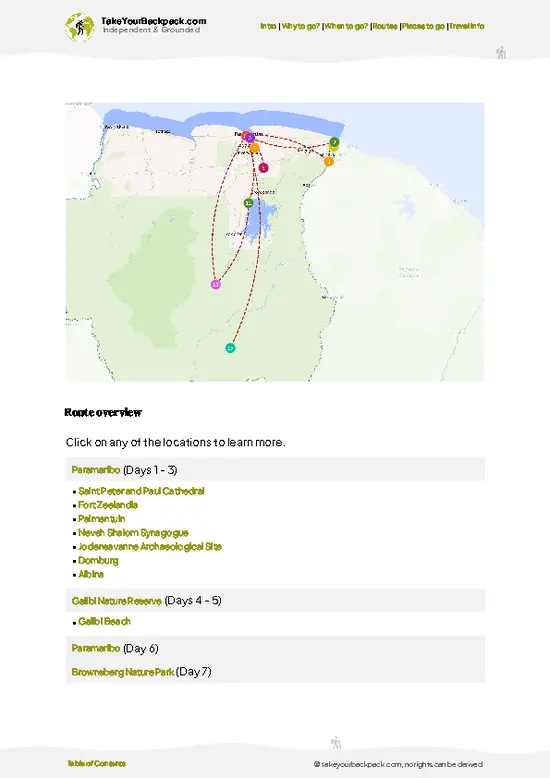
The 5-Day Paramaribo & Jungle Taster

The Vibe: A relaxed, city-based escape that mixes wooden architecture, riverside history, and an easy dip into nearby rainforest without long travel days. You sleep mostly in one place, using short road hops to trade traffic for trail time.
The Highlights:
  • Historic streets and religious landmarks of Paramaribo
  • Colonial-era stories at Fort Zeelandia and the Surinaams Museum
  • Palm-shaded downtime in Palmentuin
  • Rainforest viewpoints and waterfalls in Brownsberg Nature Park

The 10-Day Coast, Culture & Canopy Route

The Vibe: A balanced journey that links the capital’s culture with riverside towns, plantation history, and accessible rainforest, giving you variety without hardcore expedition logistics. Expect a mix of road trips, short boat rides, and plenty of hammock time.
The Highlights:
  • Multi-day exploration of Paramaribo and its layered communities
  • Birding and plantation trails in Peperpot Nature Park
  • Forest hikes and lake views in Brownsberg Nature Park
  • Wetland boat
read more 👉

The 5-Day Paramaribo & Jungle Taster

The Vibe: A relaxed, city-based escape that mixes wooden architecture, riverside history, and an easy dip into nearby rainforest without long travel days. You sleep mostly in one place, using short road hops to trade traffic for trail time.
The Highlights:
  • Historic streets and religious landmarks of Paramaribo
  • Colonial-era stories at Fort Zeelandia and the Surinaams Museum
  • Palm-shaded downtime in Palmentuin
  • Rainforest viewpoints and waterfalls in Brownsberg Nature Park

The 10-Day Coast, Culture & Canopy Route

The Vibe: A balanced journey that links the capital’s culture with riverside towns, plantation history, and accessible rainforest, giving you variety without hardcore expedition logistics. Expect a mix of road trips, short boat rides, and plenty of hammock time.
The Highlights:
  • Multi-day exploration of Paramaribo and its layered communities
  • Birding and plantation trails in Peperpot Nature Park
  • Forest hikes and lake views in Brownsberg Nature Park
  • Wetland boat safaris from Nieuw Nickerie into Bigi Pan

The 15-Day Rivers, Rainforest & Remote Coasts Expedition

The Vibe: A full-country adventure that threads together capital culture, interior river life, and both eastern and western coasts at a steady, immersive pace. You’ll mix a few long travel days with generous stays in each region, trading comfort for character when it counts.
The Highlights:
  • Deep dive into Paramaribo’s history, faiths, and food
  • Jungle trails and lake panoramas in Brownsberg Nature Park
  • Riverboat access to Maroon communities around Awarradam
  • Coastal contrasts between turtle-friendly Galibi Beach and wetland-rich Bigi Pan from Nieuw Nickerie
🌍 Want a ready-to-use travel plan for Suriname?
The overview above compares different route options based on your travel time and style. The complete Travel Guide breaks each itinerary down in detail, including maps, stops, highlights, and transport information.

Explore all route details 👉

Get the Travel Guide -

🌤️ When to go?When to go for the best experience

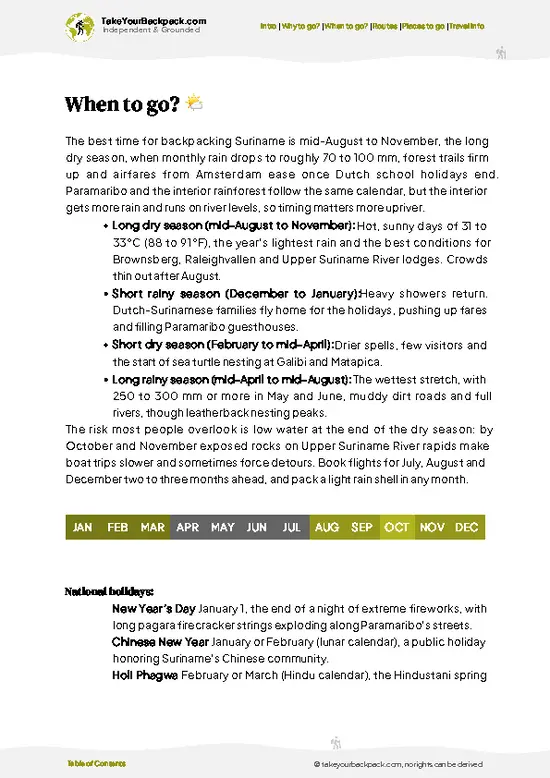
Late September through early November is the sweet spot. The long dry has firmed laterite roads and jungle trails, mosquitoes thin, and river levels still carry dugouts without portages. After the August rush, lodges loosen rates and guides pick up. You get blue mornings in Brownsberg, waterfalls still muscled from the rains, and humid afternoons that pop with short rumbles instead of all-day soakings. Paramaribo calms after school holidays; you can find a dorm bed and a seat on the small planes upriver. It feels earned, not punished.
  • Peak (Holiday Dry): August and late December hit hard: higher lodge rates, full boats, and a sun that cooks corrugated bus stops. Push through and the payoff lands at dusk—cool river breeze, a cold Djogo bottle sweating in your hand, howlers firing across dark jungle.
  • Shoulder (Late Sep-Nov): The country exhales. Mud hardens to dust, workshop doors roll open, drivers pick up speed, and prices slide. Trails bite but hold. Rivers still run clean. Watch late November: Independence week books rooms and clogs transport more than you expect.
  • Rains (Apr-Jul): The interior goes quiet, green, and heavy; you get lodges to yourself and a drumbeat on the roof. Move at first light between squalls, line your pack with a compactor bag, and wear quick-dry shoes. Expect washouts and boat cancellations.

For the late Sep-Nov window, lock an interior seat and first-night room 3-5 weeks out; arrange the rest face to face.

source: climatestotravel.comJANJanuary: good for travelingFEBFebruary: good for travelingMARMarch: good for travelingAPRApril: fair for travelingMAYMay: fair for travelingJUNJune: fair for travelingJULJuly: fair for travelingAUGAugust: highly recommended for travelingSEPSeptember: highly recommended for travelingOCTOctober: excellent for travelingNOVNovember: highly recommended for travelingDECDecember: highly recommended for traveling
📅 Traveling in a specific month?
Get a full month-by-month breakdown of weather, crowds, costs, festivals, and seasonal highlights in the complete travel guide.

Get full details when to go 👉

Get the Travel Guide -
Suriname-pixabay-body-of-water-3237144

💰 Costs (as of 2026)What things cost day to day

Most budget travelers land around $40-60 per day in Paramaribo and coastal towns, $60-90 when you push inland independently, and $120-200+ on fully organized jungle days.
  • dorm accommodation: $10-20 for a bunk in Paramaribo, $12-25 in small coastal towns; in the interior, hammock spots run $6-12 and simple rooms $20-35 if you’re not on a package. Expect fan rooms and the low hum of a generator after dark; AC bumps the price. System tip: message guesthouses directly (WhatsApp/Facebook-era “front desk”), ask for a weekly rate, and pay cash; bring a hammock with a bug net to access cheap “hammock decks” at river lodges. Cheaper than French Guiana by a lot, similar to Guyana.
  • meals: “Supermarket Survival”: Chinese-run shops sell bread, eggs, instant noodles, tinned fish, cucumbers, and boxed juice—$5-8/day if you self-cater and don’t crave cheese or chocolate (imports sting). Street food reality: Javanese warungs and roti shops feed you hard—nasi/bami, roti with curry, saoto soup, BBQ skewers—for $2-5 a plate; a cold Parbo beer is $1.50-2 from a shop, more in a bar. Portions are big, spices are honest, and it’s distinctly cheaper than across the river in French Guiana; on par with Guyana.
read more 👉
Most budget travelers land around $40-60 per day in Paramaribo and coastal towns, $60-90 when you push inland independently, and $120-200+ on fully organized jungle days.
  • dorm accommodation: $10-20 for a bunk in Paramaribo, $12-25 in small coastal towns; in the interior, hammock spots run $6-12 and simple rooms $20-35 if you’re not on a package. Expect fan rooms and the low hum of a generator after dark; AC bumps the price. System tip: message guesthouses directly (WhatsApp/Facebook-era “front desk”), ask for a weekly rate, and pay cash; bring a hammock with a bug net to access cheap “hammock decks” at river lodges. Cheaper than French Guiana by a lot, similar to Guyana.
  • meals: “Supermarket Survival”: Chinese-run shops sell bread, eggs, instant noodles, tinned fish, cucumbers, and boxed juice—$5-8/day if you self-cater and don’t crave cheese or chocolate (imports sting). Street food reality: Javanese warungs and roti shops feed you hard—nasi/bami, roti with curry, saoto soup, BBQ skewers—for $2-5 a plate; a cold Parbo beer is $1.50-2 from a shop, more in a bar. Portions are big, spices are honest, and it’s distinctly cheaper than across the river in French Guiana; on par with Guyana.
  • local transport: The cheapest unlock is the network of shared minibuses and river pirogues. City rides run about $0.50-1.50; Paramaribo-Albina/Nickerie corridors $4-10. River boats to villages are priced by distance and fuel—think $5-25 if you’re on a scheduled/shared run. Show up early (pre-7am) at car parks, pay in small bills, and expect waits in the diesel heat until seats fill; last departures often mid-afternoon. Night taxis add up but are usually necessary. Far cheaper than French Guiana’s car-dependent reality; similar to Guyana’s minibuses.
  • activities: Cost drivers are boats, fuel, guides, and meal plans. Brownsberg is the cheap win—low entry fee and DIY hiking if you sort your own ride. Turtle season at Galibi spikes costs because you need a boat, guide, and community fee. Multi-day upriver lodge trips are typically $80-150/day all-in if you join a group; private or low-headcount trips push higher because fuel is the meter. Generally cheaper than French Guiana tours, roughly level with Guyana’s interior for similar remoteness.
  • miscellaneous: Budget leaks: ATM fees and spreads, AC surcharges, laundry (sweat-soaked clothes don’t dry—by-bucket charges add up), mosquito repellent, sunscreen, and extra night taxis when distances look walkable on a map but feel sketchy in the dark. Tap water is fine in Paramaribo; upriver you’ll buy or boil. SIM + data is affordable and worth it for hailing buses and boats. Border days cost more—ferries, pirogue crossings, and “small fees” nibble at your wallet. Beer is good value (Parbo); imported labels are not.
⚠️ Prices can change and everyone travels differently, so take this as a rough guide. Hope it helps you plan your adventure!

✈️ The backpacker research shortcutSuriname Travel Guide

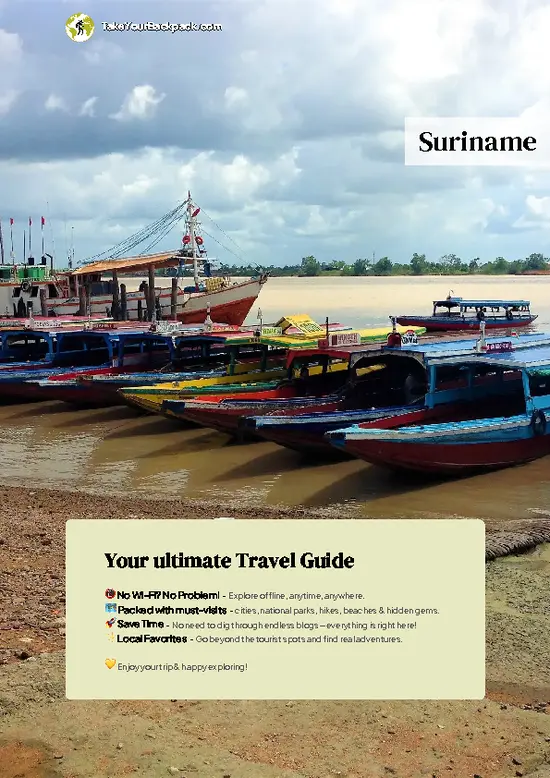
An offline-friendly backpacking guide with optimized travel routes, ranked highlights, transport advice, and the best areas to stay.
example page 0 from our offline Travel Guide for Surinameexample page 1 from our offline Travel Guide for Surinameexample page 2 from our offline Travel Guide for Surinameexample page 3 from our offline Travel Guide for Surinameexample page 4 from our offline Travel Guide for Surinameexample page 5 from our offline Travel Guide for Surinameexample page 6 from our offline Travel Guide for Surinameexample page 7 from our offline Travel Guide for Suriname
The digital guide (206 pages) contains:
48 highlights, ranked by travel appeal
Optimized 5, 10 & 15-day travel routes
Cities, national parks, beaches, historical sites, ...
How to get around
Offline-friendly for travel without Wi-Fi
👉 Click to see all 30+ guide features

📅 Plan smarter in minutes, not weeks
Month by month travel advice
Festivals & national holidays
Budget expectations

🗺️ Go to the right places, skip the overrated ones
Honest pros & cons of destinations
Top hikes, parks & viewpoints
Lesser-known places most travelers miss
Clear “worth it vs skip it” guidance

🛏️ Travel smoothly without rookie mistakes
Best areas to stay
Transport systems explained simply
Common scams & safety advice
SIM cards, money & practical tips

🌍 Understand the country, not just visit it
Culture & traditions
52 Essential phrases & customs
Festivals worth planning around
Traveler-friendly historical context
Insights that make places more meaningful

📱 Built for real travel conditions
Fully downloadable PDF
Works completely offline
Optimized for phone use
Useful in remote areas & buses
Everything in one place
Save weeks of stressful planning
Get instant access to the full guide directly. 30-day money-back guarantee.


Sent to your inbox immediately after payment • 100% Secure Checkout
Best Backpacking Travel Advisor 2025 tourism awardBest Backpacking
Travel Advisor
2025
What others say about Take Your Backpack Guides:
⭐⭐⭐⭐⭐
Fantastic, amazing amount of information!
⭐⭐⭐⭐⭐
My goodness this is amazing, it's what I've been looking for hats off too you!
⭐⭐⭐⭐⭐
I think this is absolutely BRILLIANT
⭐⭐⭐⭐
Very complete and informative. It's still missing places, but I gotta to commend you
⭐⭐⭐⭐⭐
This is truly amazing, thank you, can't wait to explore it with my kids!
⭐⭐⭐⭐⭐
Awesome resource, thank you!
⭐⭐⭐⭐⭐
This is amazing! Can't wait to explore the ones I haven't seen
⭐⭐⭐⭐
I love this! Well done, great idea.
⭐⭐⭐⭐⭐
Thanks for taking the time to make this gem!
⭐⭐⭐⭐⭐
This might be the best website I've ever seen.
⭐⭐⭐⭐⭐
Congratulations, and thank you so much for your work; it's incredibly valuable.
⭐⭐⭐⭐
In all seriousness I think you did a great job pointing out the important spots
⭐⭐⭐⭐⭐
10/10 very good
⭐⭐⭐⭐⭐
As someone who's only just starting to visit regularly this is awesome, thank you.
⭐⭐⭐⭐
Thank you very much! I'm going to visit my dad, it's going to be very useful!
⭐⭐⭐⭐⭐
This is really cool! We'll be travelling for the first time and this definitely come in handy.
⭐⭐⭐⭐⭐
You are now our minister of culture, congratulations 👨‍💼
⭐⭐⭐⭐⭐
Just wanted to tell you that this is a pearl! Going to follow your recommendations.
⭐⭐⭐⭐⭐
This is so cool. I'll definitely be using the resource for my travels soon.
⭐⭐⭐⭐⭐
This is very impressive! Good work.
⭐⭐⭐⭐⭐
This is an amazing and informative site. Very well done!

🛏️ Where to stay?Areas travelers tend to prefer

Yes — Suriname has hostels and budget accommodation, concentrated in Paramaribo (the capital) with a handful of basic guesthouses and eco-lodges near major nature sites.
Base in Central Paramaribo or the Waterkant for the most hostels and easy access to historic sites, restaurants and nightlife but expect noise and take standard petty‑theft precautions; choose the Palmentuin/park area for quieter streets and nearby museums with fewer budget options; Meerzorg/Lelydorp gives lower prices and commuter links across the river but limited evening amenities; remote eco-lodges near Brownsberg or Galibi … read more 👉
Yes — Suriname has hostels and budget accommodation, concentrated in Paramaribo (the capital) with a handful of basic guesthouses and eco-lodges near major nature sites.
Base in Central Paramaribo or the Waterkant for the most hostels and easy access to historic sites, restaurants and nightlife but expect noise and take standard petty‑theft precautions; choose the Palmentuin/park area for quieter streets and nearby museums with fewer budget options; Meerzorg/Lelydorp gives lower prices and commuter links across the river but limited evening amenities; remote eco-lodges near Brownsberg or Galibi are ideal for wildlife yet need advance booking, costly transport and very basic facilities.

If you enjoy meeting fellow travelers, consider choosing hostels with high ratings for atmosphere. On the other hand, if you prefer having your own space, a hotel might be a better option.

🚌 Getting aroundWhat moving around is really like

Suriname runs on early light and word-of-mouth. Timetables sit in the shade while engines decide the moment. In Paramaribo a conductor’s knuckles rap the door, a route name flies, and you hustle; upriver, captains watch the color of the current more than the clock. You read clouds, queue-length, and the tilt of a driver’s cap. When it works, it really works: river wind in your face at Waterkant, diesel on your hands, and a cold Parbo sweating on the table.
  • Intercity minibuses (East-West corridor)
read more 👉
Suriname runs on early light and word-of-mouth. Timetables sit in the shade while engines decide the moment. In Paramaribo a conductor’s knuckles rap the door, a route name flies, and you hustle; upriver, captains watch the color of the current more than the clock. You read clouds, queue-length, and the tilt of a driver’s cap. When it works, it really works: river wind in your face at Waterkant, diesel on your hands, and a cold Parbo sweating on the table.
  • Intercity minibuses (East-West corridor) Cheap wins, time pays. These vans stitch Paramaribo to Albina, Nieuw Nickerie, and Atjoni for a fraction of a private hire, but they leave when full, not when you wish. First runs load at dawn; miss that and you inherit the day’s delays—bridge bottlenecks, rain-slowed traffic, a roadside fuel stop because the gauge lies. Front seat buys knee room and less motion. Expect an extra hour beyond car timing after rain or checkpoints. Cash up front, small notes, bag on your lap unless you want it buried under market sacks.
  • City minibuses (Paramaribo) This is the social fabric on wheels. Routes get shouted—Latour, Kwatta, Leonsberg—and you climb fast. Greet the driver, pass your fare forward, and don’t wedge your pack into the aisle. AC is a rumor; windows and soca do the cooling. Tap a coin on the rail or say stop before your corner; the van will nose over without ceremony. Elders and kids get the easy seats. No eating smelly food, no door-slamming, and always carry change so the conductor doesn’t have to break your day’s budget.
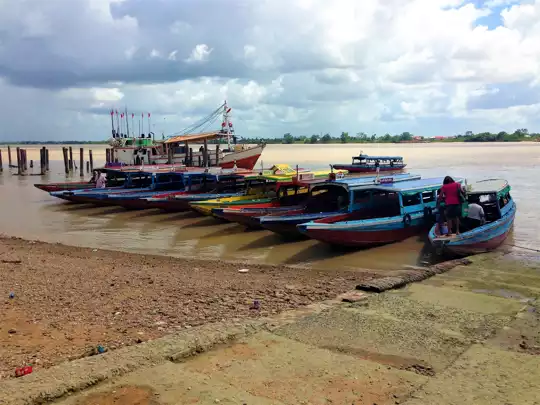
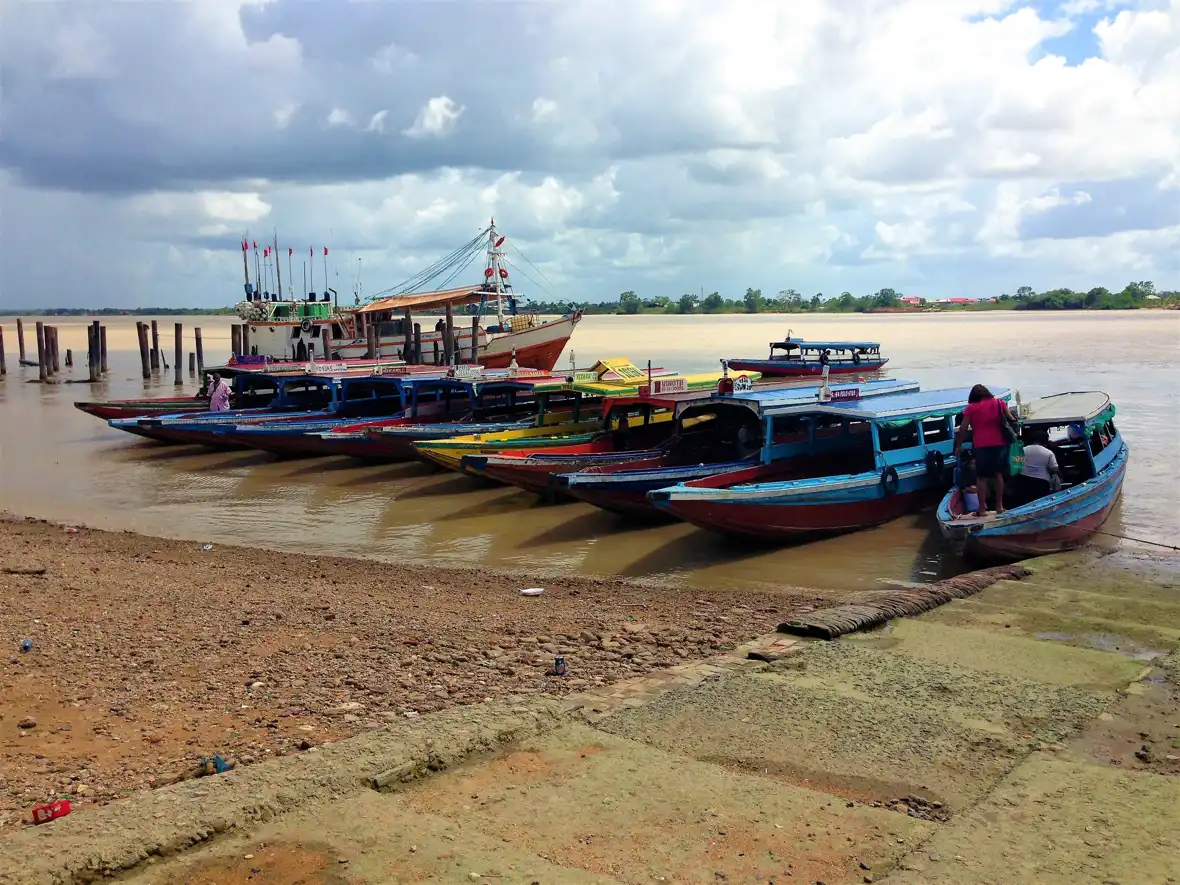
  • River boats (korjaal) Water unlocks where roads tap out. From Atjoni you shoot brown water into Saamaka country; from Albina you skim mangroves toward Galibi. Long wooden canoes, tarps slapped over bags, Yamaha thrumming, spray salty-sweet on your face. Boats leave when the benches fill or someone pays the difference. Morning is safer—higher water, fewer storms. Dry-bag everything, sit center to dodge spray, and don’t count on life jackets. Pay a bit more for a quicker run or a direct drop at a creek mouth no road ever sees.
  • Bicycle The budget disruptor in a flat, compact capital. Rent a sturdy beater and roll at dawn when the air still has edges. Paramaribo’s grid yields fast: markets, wooden houses, then over the big bridge to Commewijne for plantation ruins and riverbank villages without a tour fee. Shoulders are narrow and the sun punishes by 10:00, so go early or on a sleepy Sunday. Lights, lock, and two liters of water; duck into Chinese groceries to refill and ride the shade lines back.

Master tip: Build every long move around the day’s first departure from the main stand (Saramaccastraat for buses, Atjoni and Albina for boats), arrive 30-45 minutes early with small bills, and you’ll ride the country’s natural rhythm instead of chasing it.
Distance
Johan Adolf Pengel International Airport (PBM, “Zanderij”) sits about 45 km (28 miles) south of Paramaribo’s center.

How to get into the city
  • Airport taxi (official stand) - Easiest door-to-door option, available for all flights. Expect 45-70 minutes depending on traffic. Typical fare is US$40-60 (usually a posted fixed rate; night surcharges can add a bit). Pay in cash (SRD or USD); cards are uncommon. There’s no Uber/Bolt in Suriname.
  • Shared shuttle/van - A few local operators and some hotels run shared vans timed to major flights. Prebook if you can. Journey takes about 60-90 minutes (drop-offs add time). Typical price is US$10-20 per person.
  • Public minibus (“lijnbus”) - Cheapest, but irregular and not reliable late at night. Minibuses run between Paramaribo and Zanderij village; some enter the airport when flights land, otherwise you may need to reach the main road to flag one. Figure 60-100 minutes depending on waits and stops. Typical fare is roughly SRD 150-300 (about US$4-8), but prices can shift with fuel and exchange rates.

Good to know (2025)
- If you arrive late, assume taxi or a prebooked shuttle; public minibuses are sparse after dark.
- Exchange rates move around; operators often quote both SRD and USD.
- If you prefer a set price, look for the official airport taxi desk in arrivals and confirm the fare before you ride.
⚠️ Prices and routes can change, so take this as a rough guide and ask for local advice when you arrive.

🔒 Safety (risk Level: low)Common concerns and things to watch out for

Safety for solo travelers, including women and LGBTQ+ individuals
Suriname is generally safe for solo travelers, including women, but exercising caution is always wise. Stick to well-lit areas in the evenings, and it’s best to dress modestly to respect local customs. LGBTQ+ travelers may face some social conservatism, so discretion is advised, especially outside Paramaribo. Stay updated on local advice, as conditions can change.

✈️ VisaEntry requirements and paperwork

Visitors to Suriname generally need a visa, but many nationalities can apply for an e-visa online. Check the official Suriname e-visa website, upload necessary documents, and pay the fee for a seamless application process. Always double-check current entry requirements, as they can change.

source: gov.sr
⚠️ Visa requirements can change over time, so always check the latest visa requirements with the official embassy or government website before you travel.

🎒 What to pack?What to pack for Suriname

Suriname’s climate is a mix of hot and humid, with a good splash of rain, so light, breathable fabrics are your best friend. Be prepared for some muddy adventures, especially if you’re heading into the jungle or exploring the savannas. While the vibe is generally laid-back, remember that Suriname is culturally diverse, so pack a few modest clothing options for visiting religious or local communities. Mosquitoes are your uninvited travel buddies here, so gear up to keep them at bay. Be ready for a wild mix of terrains, from rivers and rainforests to lively towns, so keep flexibility in mind.

Apart from this country specific advice, I have also crafted a general packing list that should help on any trip. authorOver the years, I've learned the importance of packing minimally. It's so much easier to jump on the back of a truck or squeeze yourself into the last spot of a minibus without that supersized backpack. If you're headed to a warm destination, leave your winter jacket at home; for colder regions, opt for thin thermal underlayers. Instead of packing your entire wardrobe, bring just three sets of clothes, as laundry facilities are available everywhere.

View the full list 👉
🎒 Planning the practical side of your trip?
Get detailed information on transport, daily budgets, internet access, local customs, food, language, and other essentials in the complete Travel Guide.

Get detailed practical information 👉

Get the Travel Guide -

🙋 FAQTravel questions about Suriname

Trip Planning


Personal tip: I normally search on good rating for atmosphere (for meeting people) and location (for easy exploring). Cleanliness as a bonus.


Travel Essentials

Hepatitis A and Typhoid vaccines are recommended for most travelers to Suriname. Consider Hepatitis B if you plan on having intimate contact or medical procedures. Yellow Fever vaccination is required if you’re arriving from a country with risk of Yellow Fever. Check if your routine vaccines (like MMR, DPT, Varicella, Polio) are up-to-date. Always consult a travel health professional for personalized advice.


vaccination requirements
When I first started traveling, I often spent part of my first day in a new country hunting for a local SIM card. While this can still be slightly cheaper, it also takes time and planning.

These days, it's much simpler to install an eSIM before leaving home. Once you arrive in Suriname, you can activate it immediately and have mobile data from the moment you land — which is especially useful for ordering transport or navigating away from busy airports.

There are many providers nowadays, and price differences are usually small. I personally go with Airalo, as it offers excellent network coverage throughout the country and strong global coverage, so you can manage multiple countries from a single app.


Get your e-sim for Suriname

Culture & Customs

Respect cultural diversity; Suriname is a mix of ethnic groups. Dress modestly, particularly in religious sites—cover shoulders and knees. Always ask before taking photos of people. Greetings often involve a handshake; a smile goes a long way.

Do: Try local dishes, they’re a fusion of cultures. Use your right hand for giving and receiving items.

Don’t: Discuss politics or criticize cultural practices openly. Avoid public displays of affection, especially same-sex couples; attitudes are conservative. Women should be cautious when traveling alone at night.
Trying traditional food is always a great way to experience the culture. Here are some must-try dishes for Suriname.
  • Moksi Meti: A savory mix of grilled or roasted meats, often including chicken, pork, and beef, served with rice. It’s a favorite for its flavor-packed variety and embodies Suriname’s multicultural culinary influences.
  • Pom: A hearty casserole dish made with chicken and pomtajer (a type of root vegetable), often enjoyed during family gatherings and celebrations. Its rich taste and cultural significance make it a staple in Surinamese homes.
  • Roti: A dish of Indian origin, featuring flatbread served with curried meat (like chicken or lamb) and vegetables. It’s widely loved for its comforting spices and reflects the Indo-Surinamese community’s influence on the national cuisine.
  • Sate: Skewered and grilled meat, usually served with a spicy peanut sauce. This dish is a quick, flavorful street food option that showcases the country’s Indonesian culinary ties.
  • Saoto Soup: A fragrant chicken soup with noodles, eggs, and bean sprouts, seasoned with aromatic herbs and spices. Popular as a warming meal, it highlights Surinamese-Javanese fusion.
Tap water in Suriname is generally considered safe to drink, especially in Paramaribo where locals drink it without issues. However, travelers might notice a difference in taste, and those with sensitive stomachs might prefer bottled or filtered water to be cautious. Bottled water is widely available and affordable, so it’s a convenient option if you’re unsure.
The main language in Suriname is Dutch. Backpacking is way more rewarding if you know a bit of the local language, so I'd suggest brushing up on the basics just in case your Dutch skills have become a bit rusty.

Want to understand locals better?
The complete Travel Guide for Suriname includes 52 essential words and phrases — greetings, thank-yous, ordering food, transport, numbers, and common local expressions you'll actually hear.

Get your local basic phrases 👉

Get the Travel Guide -


In Suriname, English is not the primary language; the official language is Dutch. However, English is widely understood, especially in urban areas and among younger generations. Many Surinamese people, particularly those involved in tourism, hospitality, and business, speak English fluently. In addition, English is taught in schools, contributing to its prevalence.

In rural areas, English proficiency may vary, and local languages such as Sranan Tongo, Hindi, and Javanese are more commonly spoken. While you can generally communicate in English in major cities like Paramaribo, it’s advisable to learn a few basic phrases in Dutch or Sranan Tongo to enhance your experience and connect with locals.

Overall, travelers will find that English is spoken sufficiently to navigate most situations, though knowing some local expressions can enrich interactions and show respect for the culture.

Money & Payments

The local currency of Suriname is SRD (Srd).

When backpacking in Suriname, you’ll want to be aware of a few money matters to keep things smooth. First off, ATMs are mostly available in Paramaribo and a few other larger towns. They usually accept international cards, but it’s wise to carry some cash as backup since ATMs can sometimes be out of service or out of cash.

While Suriname accepts both US dollars and euros, you’ll find that US dollars are more widely used and easier to exchange. Carry a mix of Surinamese dollars (SRD) and some small USD bills for flexibility. Euros are fine too, but often come with a less favorable exchange rate.

Credit card acceptance is hit or miss outside of the capital. Many smaller establishments and street vendors still prefer cash, so don’t rely solely on plastic. When it comes to exchanging money, your best bet is at banks or authorized exchange offices in Paramaribo. Avoid exchanging on the street to steer clear of scams. Keep your transactions smart and you’ll cruise through without a hitch!

Tipping in Suriname isn’t obligatory, but it’s appreciated. In restaurants, a 10% tip for good service is common, though some places might include a service charge in the bill. For taxis and other services, rounding up or small tips are sufficient.

🧩 Nearby countriesNearby backpacking alternatives

📸 PhotosScenes from around the country

Take your backpack - Suriname - 0
Photographed by: Johan Kruseman

We 💚 feedbackFinal notes for travelers

You come for the river: brown water corridors, dugout boats, diesel, spray, bauxite-red banks. Dawn in a hammock as howlers start up; first Parbo beer pulled cold from the creek after a sweat-soaked hike to Brownsberg falls. That’s the reason to visit. Drawback: getting anywhere takes time and money—boats run when full, roads churn to mud, ATMs are fickle outside Paramaribo. Misconception: it isn’t chaos or hostile; it’s measured, friendly, and safer than its reputation if you use city sense after dark.

✍️ Help improve this page!
The information on this page is based on in-depth research, insights shared by experienced travelers, and feedback from the local travel community in Suriname. While every effort is made to keep the information accurate and current, conditions can change — so if you spot anything incorrect or outdated, please get in touch.


🙋‍♂️ Give feedback

👋 Meet the founderWho’s Behind Take Your Backpack?

Johan, backpacker and founder of TakeYourBackpackHi, I’m Johan (Netherlands 🇳🇱), the creator of TakeYourBackpack. Over the past decade, I’ve backpacked through 80+ countries across six continents, gaining extensive experience with independent travel, long-term trips, and overland routes.

This site is built on a combination of firsthand travel experience and carefully curated insights from other backpackers. Many guides are based on places I’ve personally visited, while others bring together tips, observations, and practical advice shared by trusted travelers I’ve met along the way.

The goal is to provide realistic, experience-driven guidance — not generic itineraries — so you can explore destinations with better context, clearer expectations, and more confidence.

Get full Suriname guide •
Instant download • 48 highlights • Full Offline guide