×
Burkina Faso 🇧🇫

backpacking Africa Burkina Faso 🇧🇫Follow music, markets, and dust-filled rhythms of daily movement.

Explore BotswanaExplore Burundi

Backpacking Burkina Faso in 2026

A complete guide including when and where to go, costs, transport, itineraries, and practical travel advice.
The big picture before you go

Backpacking Burkina Faso
By Johan Kruseman 🇳🇱 | Updated May 31, 2026

West Africa’s best live-music nights aren’t in a coastal capital—they’re in landlocked Burkina Faso. From Bobo‑Dioulasso’s balafon bars to Ouagadougou’s courtyard jams, the scene is cheap, late, and local. That pulse threads through masked dances, painted Kassena compounds, and a film culture with real continental gravity.

You come for rhythm and stay for how it stitches daily life together: brochettes at dusk, room made on a bench, and a city like Ouaga that treats travelers as participants, not trophies. Out west, the Sindou Peaks, the Domes of Fabedougou, and Karfiguéla Falls reboot trail legs; down south, Nazinga’s elephants pass at eye level; near Pô, Tiébélé’s geometric courtyards teach more than any museum label. Yes, midday heat, rough roads, French as the default, and night checkpoints are real—but move at dawn, carry ID copies, and stick to daylight routes to bank time and cash for the good stuff.

Next to Ghana or Côte d’Ivoire’s coast‑and‑comfort, or Benin’s ritual pilgrimages, Burkina is leaner and more musically alive per dollar and minute. Go if you crave culture over coastline, can tolerate early buses, and want West Africa that still feels face‑to‑face.

Ouagadougou (the workable hub)

If you only have a few days, base here. It’s connected, student-heavy, and bluntly practical: banks, bus depots, visas, SIMs. Nights mean maquis grills and live music; days mean crafts cooperatives and motorbike errands. Taxis are meter-less—name your price up front. Wear the helmet on moto-taxis; police fines are real. Power cuts happen, ATMs cluster near big boulevards, and mobile data beats most hotel Wi‑Fi.

Bobo‑Dioulasso → Banfora → Sindou (Cascades spine)

One transport line delivers the country’s most satisfying low-effort/high-payoff loop. Big bus to Bobo for music and the old quarter, then minibus or hired moto down the N7 to Banfora for Karfiguéla Falls, Lake Tengréla hippos, and the Sindou peaks. Start rides at dawn, carry 2–3 liters, and budget small fees for site access plus an obligatory pirogue at the hippo lake. Rooms run 20–30% cheaper than Ouaga; electricity more fickle.

Pô – Tiébélé (Gurunsi compounds)

Southbound from Ouaga, this is for travelers who like culture with clear community rules. You don’t just wander the painted compounds—local guides are required and worth it. Expect camera fees, cash only, and firm boundaries about where you step. Military checkpoints mean you keep your passport handy. If you’re late, overnight in Pô rather than riding after dark. Nazinga Reserve is doable only with vetted pickup; count on escorts and extra costs.

Gaoua and Pays Lobi (slow anthropology)

Long haul, big reward if you’re patient and respectful. The draw isn’t scenery; it’s architecture, ancestor shrines, and compound layouts explained by someone who lives there. Hire a guide via the museum in Gaoua, schedule around weekly markets, and don’t self-drive muddy tracks in the rains. Community fees are standard; bring exact change. French helps. So does humility.

Sahel corridor: Dori – Gorom-Gorom (only if you know what you’re doing)

Historically superb for markets and dunes; now volatile and checkpoint-heavy. This rewards risk-tolerant overlanders with solid local contacts and convoy discipline. For most travelers, skip and redirect those days to the Cascades. Your budget and nerve will thank you.
Safety warning

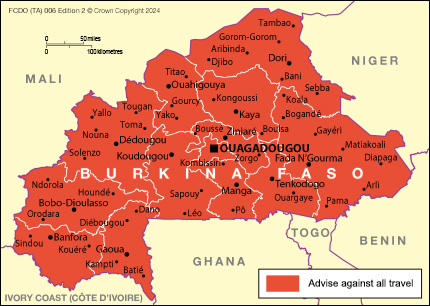
The current risk level for Burkina Faso is high. Check the advice before going.
Get your Burkina Faso guide
64 ranked highlights, routes & tips, works offline (280 pages)
Map of Burkina Faso
Loading the map 🌍
CLICK TO FILTER
city
town
unique site
national park
hike
attraction
festival
region
SHOW COUNTRY’S BESTSHOW ALL
film
0
0
0a
Village Artisanal de Ouagadougou
film
1
1
1a
Village Artisanal de Bobo-Dioulasso
film
2
2
2a
Maison du Peuple
film
3
3
3a
Place des Cinéastes
film
4
4
4a
Tengrela Lake Trail
film
5
5
5a
Mare aux Hippopotames
film
6
6
6a
Dori
film
7
7
7a
Tenkodogo
film
8
8
8a
Lac de Tengrela

Why go?Reasons people choose to visit

Uniqueness

Burkina Faso is for travelers who don’t need a script. You trade glossy for real: dust in your teeth, … read more 👉
Burkina Faso is for travelers who don’t need a script. You trade glossy for real: dust in your teeth, early buses, and big rewards. Keep your miles to the southwest—Bobo, Banfora, Tiébélé—where you can hike the Sindou Peaks, watch hippos on Lake Tengrela, and walk among painted Kassena compounds at dawn. Security shifts; avoid remote borders and never move after dark. ATMs thin out fast, so carry small CFA notes, photocopies of your passport for checkpoints, and patience. Ask before photos; pay modest site fees. Save cash for brochettes, bissap, a guide who knows the footpaths, and a cold soda after the heat breaks.

People

People here meet you with a handshake, a smile, and a volley of greetings that can take a minute. Lean … read more 👉
People here meet you with a handshake, a smile, and a volley of greetings that can take a minute. Lean into it; skipping hellos is the fastest way to burn goodwill. Humor is the social glue—expect teasing, answer in kind, and watch doors open. Invitations to tea or tô are real; accept a little, insist on leaving later, and never flash cash for thanks. Agree on prices before rides or market buys; keep it friendly. Ask before photos, use the right hand, and pepper French with a bit of Mooré or Dioula—Laafi, I ni ce—it pays back all day.

Low cost

Burkina Faso treats a careful backpacker well. Eat where drivers eat, sleep in quartier guesthouses, … read more 👉
Burkina Faso treats a careful backpacker well. Eat where drivers eat, sleep in quartier guesthouses, ride shared taxis, and your daily average stays in the low double digits. Street plates run cheaper than a coffee back home, and transport undercuts coastal West Africa by a lot. The gotchas: ATMs cluster in Ouaga and Bobo—withdraw enough there or you’ll bleed fees and time. Carry small bills. On bush taxis you pay for your seat and your pack—agree before loading. Grab a local SIM and use data, not calls. The heat taxes you through drinks—refill at your lodging to keep costs down.

Scenery

Burkina Faso rewards effort with raw, open landscapes. Dawn over the Sindou Peaks and the Dômes de Fabédougou … read more 👉
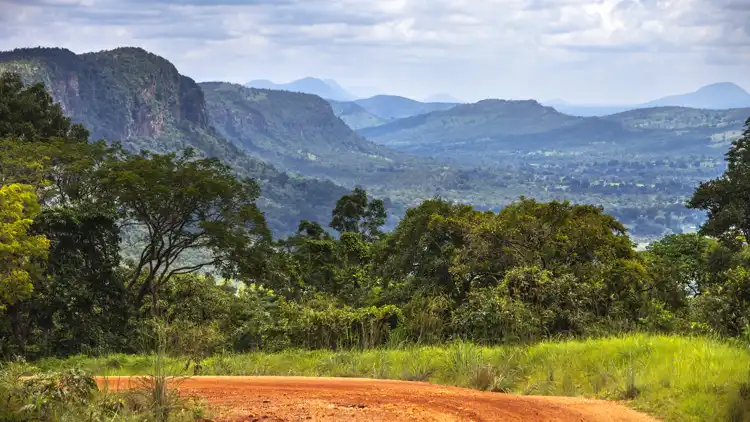
Burkina Faso rewards effort with raw, open landscapes. Dawn over the Sindou Peaks and the Dômes de Fabédougou feels like walking through a stone ocean. The Banfora Escarpment drops to sugarcane and the Karfiguéla Falls; Lake Tengrela holds hippos if you go early. Out east, the savanna in Arly and W runs to the horizon; down south, Nazinga’s elephants own the track. Forest belts still cling to the river corridors. The country isn’t glossy, but if you time your days and move at first light, the views hit hard.
Want the complete picture of Burkina Faso?
The offline Travel Guide brings everything together — routes, highlights & planning.

See what's included in the guide 👉

Get the Travel Guide -

⭐ HighlightsThe places that define a trip here

  • Sindou Peaks (Pics de Sindou): Stone spires rise like a broken forest above dusty millet fields; wind funnels through the corridors and turns sunset into theater. Hike the ridge traverse with a local guide and watch the plains light up as the heat finally leaks away. Pay the community fee at the gate, carry small bills, and wear shoes with bite; harmattan haze softens views mid-winter.
  • Karfiguéla Falls: Down in sugarcane country the cascades slap red rock and leave a cool plume you feel on your face. Scramble to the upper pools and wallow; the lower area is for selfies, the top is for breathing again. Go early, bring strapped sandals, and in rainy months mind the flow—slick mud and a long ride back multiply mistakes.
  • Ranch de Nazinga: Elephants own the piste here, and you feel it when a family steps from the scrub and fills the waterhole. Book a late-afternoon game drive from the ranch HQ and park upwind; engines off, ears open. Dry season is prime, arrive with cash for fees and food, a
read more 👉
  • Sindou Peaks (Pics de Sindou): Stone spires rise like a broken forest above dusty millet fields; wind funnels through the corridors and turns sunset into theater. Hike the ridge traverse with a local guide and watch the plains light up as the heat finally leaks away. Pay the community fee at the gate, carry small bills, and wear shoes with bite; harmattan haze softens views mid-winter.
  • Karfiguéla Falls: Down in sugarcane country the cascades slap red rock and leave a cool plume you feel on your face. Scramble to the upper pools and wallow; the lower area is for selfies, the top is for breathing again. Go early, bring strapped sandals, and in rainy months mind the flow—slick mud and a long ride back multiply mistakes.
  • Ranch de Nazinga: Elephants own the piste here, and you feel it when a family steps from the scrub and fills the waterhole. Book a late-afternoon game drive from the ranch HQ and park upwind; engines off, ears open. Dry season is prime, arrive with cash for fees and food, a high-clearance ride, and a hard cutoff—gates close at dusk, no exceptions.
  • Bobo-Dioulasso Old Mosque: The mud-brick giant breathes; timber pegs sprout like ribs and the call to prayer hangs in the alleys. Ask the guardian to let you climb the inner steps to the roof view, then drift into Dioulassoba after dark for a balafon jam that hits your chest. Dress modestly, expect a camera fee, and keep pockets zipped around the bus station.
  • Tiébélé Kassena Compounds: South near Pô, compound walls carry geometric paint that means things—family, harvest, defense—and the courtyard hush keeps you speaking softly. Take the guided walk through the royal house; the stories unlock the patterns and doorways. Respect photo rules, pay the community fee directly, and come early before day-trippers; light is kinder and elders have time. If you’ve got extra grit, detour to the Ruins of Loropéni, the cliff dwellings at Niansogoni, and the Sahelian dunes around Lake Oursi.
Spotted a mistake or missing a highlight? Contact us.

But Burkina Faso offers more...

Discover and compare all of its highlights per category

🧭 RoutesHow to structure a trip

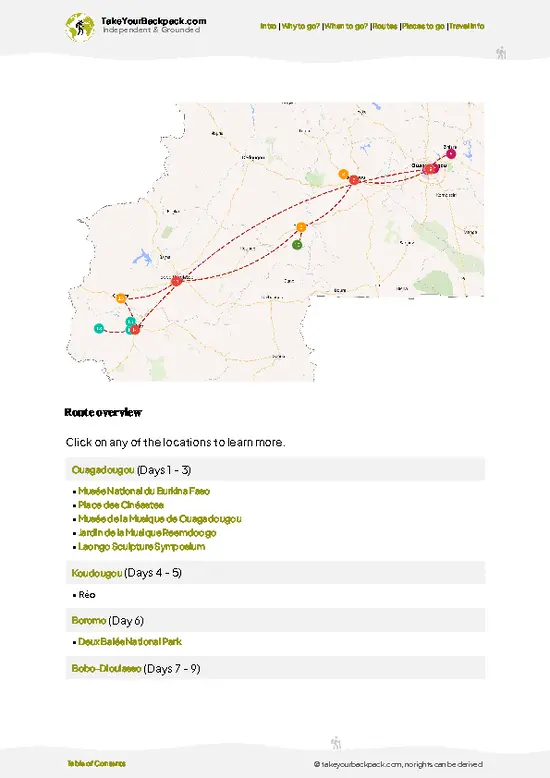
The 5-Day Ouaga & Laongo Culture Hit

The Vibe: A compact, city-based trip for travelers who want museums, music, and contemporary art with minimal overland travel and maximum time on foot or short rides. You’ll dig into Ouagadougou’s creative core, then slip out to the countryside for a day of sculpture and Sahel light.
The Highlights:
  • Exploring Ouagadougou’s key museums and music spaces.
  • Meeting artisans at the Village Artisanal de Ouagadougou.
  • Wandering the granite fields of the Laongo Sculpture Symposium.
  • Evening people-watching around Place des Cinéastes and local venues.

The 10-Day Culture & Cascades Southwest Loop

The Vibe: A balanced journey for travelers who want both city culture and southwest landscapes without rushing, linking Ouagadougou, Bobo-Dioulasso, and Banfora by bus and shared taxi. Expect a mix of museums, live music, artisan quarters, waterfalls, and rock formations.
The Highlights:
  • Immersing yourself in Ouagadougou’s museums and artisan workshops.
  • Soaking up the musical atmosphere
read more 👉

The 5-Day Ouaga & Laongo Culture Hit

The Vibe: A compact, city-based trip for travelers who want museums, music, and contemporary art with minimal overland travel and maximum time on foot or short rides. You’ll dig into Ouagadougou’s creative core, then slip out to the countryside for a day of sculpture and Sahel light.
The Highlights:
  • Exploring Ouagadougou’s key museums and music spaces.
  • Meeting artisans at the Village Artisanal de Ouagadougou.
  • Wandering the granite fields of the Laongo Sculpture Symposium.
  • Evening people-watching around Place des Cinéastes and local venues.

The 10-Day Culture & Cascades Southwest Loop

The Vibe: A balanced journey for travelers who want both city culture and southwest landscapes without rushing, linking Ouagadougou, Bobo-Dioulasso, and Banfora by bus and shared taxi. Expect a mix of museums, live music, artisan quarters, waterfalls, and rock formations.
The Highlights:
  • Immersing yourself in Ouagadougou’s museums and artisan workshops.
  • Soaking up the musical atmosphere of Bobo-Dioulasso.
  • Hiking to the Cascades de Karfiguéla and Karfiguéla Waterfalls Trail.
  • Exploring the Domes de Fabedougou and relaxing by Lac de Tengrela.

The 15-Day Deep Burkina Circuit

The Vibe: A fuller circuit for travelers who want to see how Burkina Faso’s cities, villages, and wild spaces connect, moving at a steady but not frantic pace with a mix of buses, shared taxis, and a few 4x4 transfers. You’ll weave from Ouagadougou’s cultural scene through painted villages and southwest waterfalls to eastern savannas and national parks.
The Highlights:
  • Three days of museums, music, and artisan life in Ouagadougou.
  • Visiting the Laongo Sculpture Symposium and the town of Ziniaré.
  • Exploring Banfora’s Cascades de Karfiguéla, Domes de Fabedougou, and Lac de Tengrela.
  • Venturing to the Royal Court of Tiébélé, Boromo and Deux Balés National Park, and the Fada N’gourma gateway to W National Park.
🌍 Want a ready-to-use travel plan for Burkina Faso?
The overview above compares different route options based on your travel time and style. The complete Travel Guide breaks each itinerary down in detail, including maps, stops, highlights, and transport information.

Explore all route details 👉

Get the Travel Guide -

🌤️ When to go?Best time to visit Burkina Faso

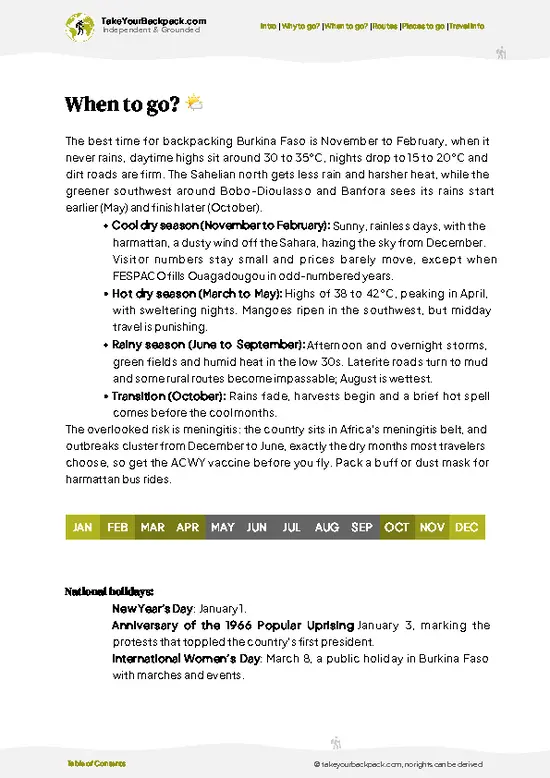
Aim for late November to early January. Rains have quit, mud has baked into passable laterite, and the cascades around Banfora still carry enough water to justify the detour. Days are warm, not punishing; nights drop to sleepable without needing AC. Harmattan has begun to cool the air but hasn’t yet turned the sky into sandpaper, so your lungs and camera sensor survive. Transport runs cleaner because drivers aren’t dodging puddles or heat-sick engines. Prices sit at normal local rates and the small tourist flow hasn’t spiked availability, aside from occasional festival weeks in the capitals. You get dry-season reliability without the gouge.
  • Cool-Dry Peak (Dec-Feb): The grind is real—rooms in Ouaga and Bobo jump during festival weeks and fill fast; the dust dries your throat and dulls sunsets. The high is worth it: easy cross-country buses, cool dawns on the Sindou Peaks, and night markets humming while you eat brochettes straight off the grill. The ignored risk: Harmattan haze can delay flights and wreck contact lenses—don’t tough-guy the dust.
  • Early-Dry Shoulder (late Oct-Nov): The country shifts into gear—roads reopen, puddles shrink, mechanics get buses back on routes, and vendors restock. Waterfalls still run, guides have time, and you move faster for less. Hotels bargain because the rush hasn’t started.
  • Rains/Off-Peak (Jun-Sep): The interior turns quiet, green, and contemplative. Thunderheads roll, villages slow, and you’ll have sites to yourself. Survive it by moving at first light, wearing sandals you can hose off, and double-bagging electronics; after big storms, minibuses simply don’t run and some dirt tracks vanish for days.

Single tip: Pack a thin buff and saline eye drops—those two grams make Harmattan a background hum instead of a tax on your energy.

source: climatestotravel.comJANJanuary: excellent for travelingFEBFebruary: highly recommended for travelingMARMarch: good for travelingAPRApril: good for travelingMAYMay: fair for travelingJUNJune: fair for travelingJULJuly: fair for travelingAUGAugust: fair for travelingSEPSeptember: fair for travelingOCTOctober: good for travelingNOVNovember: highly recommended for travelingDECDecember: excellent for traveling
📅 Traveling in a specific month?
Get a full month-by-month breakdown of weather, crowds, costs, festivals, and seasonal highlights in the complete travel guide.

Get full details when to go 👉

Get the Travel Guide -
pixabay-ouahigouya-1515810

💰 Costs (as of 2026)How expensive it really is

Expect 18,000-25,000 CFA ($30-42) per day if you sleep in dorms, eat in maquis, and ride bush taxis; add 5,000-10,000 CFA if you insist on AC, craft beer, or paid wildlife drives.
  • dorm accommodation: 3,000-7,000 CFA for a dorm bed where hostels exist (mostly Ouaga/Bobo); elsewhere, the “dorm” is a fan room in a basic auberge for 8,000-12,000 CFA, often shared if you’re two. AC tacks on 3,000-5,000 CFA and rarely runs all night. Relative value: cheaper than Senegal and Côte d’Ivoire, similar to Benin/Togo. System tip: ask for a fan room without breakfast, pay in cash up front for a small discount, and confirm “eau courante” actually flows before handing over bills.
  • meals: Supermarket Survival: imports are pricey and dull—cheese, cereal, and canned tuna will bleed you (20-40% more than Ghana/Togo). Street food reality: maquis plates of riz gras, sauce arachide, tô, or spaghetti omelette run 500-1,500 CFA; brochettes with salad 1,000-2,000; big plate 1,500-2,500. Breakfast is bread and Nescafé for coins. Carry a bottle; 1.5L water is 400-600 CFA, or refill from clay filters at lodgings if offered. The value is in hot, local, and repetitive.
  • local transport: The cheapest way to unlock the
read more 👉
Expect 18,000-25,000 CFA ($30-42) per day if you sleep in dorms, eat in maquis, and ride bush taxis; add 5,000-10,000 CFA if you insist on AC, craft beer, or paid wildlife drives.
  • dorm accommodation: 3,000-7,000 CFA for a dorm bed where hostels exist (mostly Ouaga/Bobo); elsewhere, the “dorm” is a fan room in a basic auberge for 8,000-12,000 CFA, often shared if you’re two. AC tacks on 3,000-5,000 CFA and rarely runs all night. Relative value: cheaper than Senegal and Côte d’Ivoire, similar to Benin/Togo. System tip: ask for a fan room without breakfast, pay in cash up front for a small discount, and confirm “eau courante” actually flows before handing over bills.
  • meals: Supermarket Survival: imports are pricey and dull—cheese, cereal, and canned tuna will bleed you (20-40% more than Ghana/Togo). Street food reality: maquis plates of riz gras, sauce arachide, tô, or spaghetti omelette run 500-1,500 CFA; brochettes with salad 1,000-2,000; big plate 1,500-2,500. Breakfast is bread and Nescafé for coins. Carry a bottle; 1.5L water is 400-600 CFA, or refill from clay filters at lodgings if offered. The value is in hot, local, and repetitive.
  • local transport: The cheapest way to unlock the country is day buses and taxi-brousse. Rule of thumb: 1,000-1,500 CFA per hour on the road; Ouaga-Bobo is typically 5,000-7,000 CFA on ordinary class. In towns, shared taxis or moto rides are 200-1,000 CFA depending on distance; agree before you sit. Avoid private hires and night buses—they cost more and save nothing. Expect small baggage fees (100-300 CFA) and a “ticket de quai” at big stations; keep coins ready and your seat number visible.
  • activities: Museums and craft centers are pocket change (500-2,000 CFA). The wallet hit is wildlife: park entry + mandatory guide + 4x4 + fuel can stack to 40,000-70,000 CFA for a day, which is still lower than Benin’s Pendjari or Senegal but pricier than DIY Mole in Ghana because you need a vehicle. Festivals and mask performances sometimes charge 2,000-5,000 CFA; pay locals directly and skip “cultural package” markups.
  • miscellaneous: Budget Leaks: ATM fees (2,000-5,000 CFA per pull), laundry by bucket (1,000-2,000), phone charging during outages (100-300), SIM + 2 GB data (1,000-2,000), and habitual cold sodas (300-600 each) that add up fast. Police checkpoints eat time—carry photocopies of passport/visa to avoid “fines.” Bring small notes; lack of change becomes a tax. Overall, Burkina runs 20-30% cheaper than Côte d’Ivoire and Senegal, roughly on par with Benin/Togo, and better value if you lean into local habits.
⚠️ Prices can change and everyone travels differently, so take this as a rough guide. Hope it helps you plan your adventure!

✈️ The backpacker research shortcutBurkina Faso Travel Guide

An offline-friendly backpacking guide with optimized travel routes, ranked highlights, transport advice, and the best areas to stay.
example page 0 from our offline Travel Guide for Burkina Fasoexample page 1 from our offline Travel Guide for Burkina Fasoexample page 2 from our offline Travel Guide for Burkina Fasoexample page 3 from our offline Travel Guide for Burkina Fasoexample page 4 from our offline Travel Guide for Burkina Fasoexample page 5 from our offline Travel Guide for Burkina Fasoexample page 6 from our offline Travel Guide for Burkina Fasoexample page 7 from our offline Travel Guide for Burkina Faso
The digital guide (280 pages) contains:
64 highlights, ranked by travel appeal
Optimized 5, 10 & 15-day travel routes
Cities, national parks, beaches, historical sites, ...
How to get around
Offline-friendly for travel without Wi-Fi
👉 Click to see all 30+ guide features

📅 Plan smarter in minutes, not weeks
Month by month travel advice
Festivals & national holidays
Budget expectations

🗺️ Go to the right places, skip the overrated ones
Honest pros & cons of destinations
Top hikes, parks & viewpoints
Lesser-known places most travelers miss
Clear “worth it vs skip it” guidance

🛏️ Travel smoothly without rookie mistakes
Best areas to stay
Transport systems explained simply
Common scams & safety advice
SIM cards, money & practical tips

🌍 Understand the country, not just visit it
Culture & traditions
52 Essential phrases & customs
Festivals worth planning around
Traveler-friendly historical context
Insights that make places more meaningful

📱 Built for real travel conditions
Fully downloadable PDF
Works completely offline
Optimized for phone use
Useful in remote areas & buses
Everything in one place
Save weeks of stressful planning
Get instant access to the full guide directly. 30-day money-back guarantee.


Sent to your inbox immediately after payment • 100% Secure Checkout
Best Backpacking Travel Advisor 2025 tourism awardBest Backpacking
Travel Advisor
2025
What others say about Take Your Backpack Guides:
⭐⭐⭐⭐⭐
Fantastic, amazing amount of information!
⭐⭐⭐⭐⭐
My goodness this is amazing, it's what I've been looking for hats off too you!
⭐⭐⭐⭐⭐
I think this is absolutely BRILLIANT
⭐⭐⭐⭐
Very complete and informative. It's still missing places, but I gotta to commend you
⭐⭐⭐⭐⭐
This is truly amazing, thank you, can't wait to explore it with my kids!
⭐⭐⭐⭐⭐
Awesome resource, thank you!
⭐⭐⭐⭐⭐
This is amazing! Can't wait to explore the ones I haven't seen
⭐⭐⭐⭐
I love this! Well done, great idea.
⭐⭐⭐⭐⭐
Thanks for taking the time to make this gem!
⭐⭐⭐⭐⭐
This might be the best website I've ever seen.
⭐⭐⭐⭐⭐
Congratulations, and thank you so much for your work; it's incredibly valuable.
⭐⭐⭐⭐
In all seriousness I think you did a great job pointing out the important spots
⭐⭐⭐⭐⭐
10/10 very good
⭐⭐⭐⭐⭐
As someone who's only just starting to visit regularly this is awesome, thank you.
⭐⭐⭐⭐
Thank you very much! I'm going to visit my dad, it's going to be very useful!
⭐⭐⭐⭐⭐
This is really cool! We'll be travelling for the first time and this definitely come in handy.
⭐⭐⭐⭐⭐
You are now our minister of culture, congratulations 👨‍💼
⭐⭐⭐⭐⭐
Just wanted to tell you that this is a pearl! Going to follow your recommendations.
⭐⭐⭐⭐⭐
This is so cool. I'll definitely be using the resource for my travels soon.
⭐⭐⭐⭐⭐
This is very impressive! Good work.
⭐⭐⭐⭐⭐
This is an amazing and informative site. Very well done!

🛏️ Where to stay?Where to stay in Burkina Faso

Yes — hostels and budget guesthouses exist in Burkina Faso’s main cities, concentrated in Ouagadougou and Bobo‑Dioulasso, while smaller towns and rural areas often have few formal low‑cost options so plan for guesthouses or basic lodges.
In Ouagadougou stay near Centre‑ville for the widest choice, easy access to markets, transport and nightlife but expect noise and higher petty‑crime risk, choose Gounghin or Koulouba for quieter, safer residential guesthouses with fewer traveler amenities and longer transfers to attractions; in Bobo‑Dioulasso the Old Town/Dioulassoba area offers the best budget … read more 👉
Yes — hostels and budget guesthouses exist in Burkina Faso’s main cities, concentrated in Ouagadougou and Bobo‑Dioulasso, while smaller towns and rural areas often have few formal low‑cost options so plan for guesthouses or basic lodges.
In Ouagadougou stay near Centre‑ville for the widest choice, easy access to markets, transport and nightlife but expect noise and higher petty‑crime risk, choose Gounghin or Koulouba for quieter, safer residential guesthouses with fewer traveler amenities and longer transfers to attractions; in Bobo‑Dioulasso the Old Town/Dioulassoba area offers the best budget scene with live music and markets but can be noisy at night, while outer neighborhoods are cheaper and calmer yet have limited transport and services.

If you enjoy meeting fellow travelers, consider choosing hostels with high ratings for atmosphere. On the other hand, if you prefer having your own space, a hotel might be a better option.

🚌 Getting aroundPublic transport and other ways to get around

Burkina Faso moves by feel, not by clock. Timetables are chalk on a wall, ambition more than promise. Vehicles roll when seats fill, or when the driver thinks they will soon. Dawn matters. Heat dictates pace. Police checkpoints chew minutes, tea sellers add five more, and a good spare tire can save your whole day. If you insist on precision, the road will humble you. If you adapt, you’ll cover ground and keep your budget for the mangoes, the music, and the moments.
  • Intercity Coaches The trade is
read more 👉
Burkina Faso moves by feel, not by clock. Timetables are chalk on a wall, ambition more than promise. Vehicles roll when seats fill, or when the driver thinks they will soon. Dawn matters. Heat dictates pace. Police checkpoints chew minutes, tea sellers add five more, and a good spare tire can save your whole day. If you insist on precision, the road will humble you. If you adapt, you’ll cover ground and keep your budget for the mangoes, the music, and the moments.
  • Intercity Coaches The trade is simple: pay a bit more to lose less time. Big buses on the Ouagadougou-Bobo-Banfora spine are 20-40% pricier than bush taxis, but they shave an hour or two, break down less, and handle checkpoints without drama. Buy your ticket the day before, tag your bag (there’s often a small fee), and sit away from the sunny side. AC buses are colder than you think; a light layer beats shivering for six hours.
  • Bush Taxis (Taxi-brousse/Minibus) This is the social engine. Greet people when you squeeze in. Pay with small bills. The conductor will collect three times; hand over once, keep your change in sight. Loads are personal—chickens, sacks, the neighbor’s radio—and you’re sharing the ride with all of it. Tip the loader a coin to actually tie your pack on the roof. Call out clearly where you want to get off, and never climb before the driver invites—respect keeps wheels turning.
  • Bicycle Flat cities, polite traffic, and a web of sandy side streets: that’s your unlock. A cheap used bike lets you cut across Ouaga and Bobo faster than taxis in daylight, reach craft quarters and markets without paying park fees, and glide past minor checkpoints that ignore cyclists. Ride early, rest at noon, and carry a patch kit and water. Night riding is false economy—potholes and unlit motos will cost you skin and francs.
  • Freight Trucks & Pickups When the map goes pale and coaches stop, climb the tarp. Riding a camion-bâché or a pickup bench is the budget disruptor—often half the bush taxi price to remote towns—but you’ll pay in time and vertebrae. Negotiate directly with the driver, secure your pack inside the cab if you can, and bring a scarf and goggles for the dust. Daylight only. At weigh stations and checkpoints, keep documents ready and your phone pocketed.

Master tactical tip: Always buy tomorrow’s first departure the moment you arrive, then move at sunrise along the main spine; this banks daylight for breakdowns and checkpoints, protects your budget from last-seat markups, and lands you with enough time to recover before night.
Distance: Ouagadougou (Thomas Sankara) International Airport sits very close to town — about 3 km (1.9 miles) to the city center around Place des Nations Unies.

Main ways to get into the center (time • cost):
  • Taxi (official city taxis): 10-20 minutes. Expect about 2,000-4,000 XOF in daytime; 3,000-6,000 XOF late at night or with bulky luggage. Taxis are not metered — agree the fare before you get in.
  • City bus (SOTRACO): 20-40 minutes. Around 200-300 XOF per ride. Buses usually don’t enter the terminal area — walk 5-10 minutes to the main road outside the airport gate and flag a bus toward the center. Daytime frequency is decent; service tapers off in the evening (often little or none after about 21:00).
  • Shared taxis (taxi collectif): 15-35 minutes. Roughly 200-300 XOF per seat. They run along main roads; you’ll likely catch one on the main road outside the airport and may need to change once near the center.
  • Hotel transfer: 10-20 minutes. Typically 5,000-10,000 XOF if arranged in advance through mid-range or upscale hotels.
  • On foot: 30-45 minutes for light packers. Walkable in daylight, but heat, dust, and patchy sidewalks make it awkward with luggage; avoid after dark.

Taxi note: There’s no Uber/Bolt. Some locals use phone-dispatch/WhatsApp taxis, but for most visitors the airport taxi rank is simplest. Have small bills and confirm the total price upfront (drivers sometimes add a small parking/airport pickup fee).

Good to know (2025): Cash is needed for buses and most taxis. Evening public transport is limited, so for late arrivals plan on a taxi or a hotel pickup.
⚠️ Prices and routes can change, so take this as a rough guide and ask for local advice when you arrive.

🔒 Safety (risk Level: high)What first-time visitors should know

Safety for solo travelers, including women and LGBTQ+ individuals
Burkina Faso’s safety for solo travelers, including women and LGBTQ+ individuals, is a concern due to ongoing security issues, such as terrorism and civil unrest. Women might face cultural barriers and should dress modestly to blend in. LGBTQ+ travelers should be discreet, as societal attitudes can be conservative. Always check travel advisories and connect with locals or expats for current information before visiting.


Full official government travel advisory (live updates)
View details 👉
safety image

source: www.gov.uk

✈️ VisaVisa requirements for Burkina Faso

Most travelers need a visa to enter Burkina Faso. You can apply for a visa through the Burkina Faso embassy or consulate in your country. Some nationalities can also get a visa on arrival, but it’s safer to check in advance and have one ready to avoid any surprises.

source: diplomatie.gov.bf
⚠️ Visa requirements can change over time, so always check the latest visa requirements with the official embassy or government website before you travel.

🎒 What to pack?What to wear and bring

Burkina Faso is all about hot days and cooler nights, especially from November to February, so think layers. The terrain’s mostly flat savannah, with some hills, so sturdy shoes are a must if you’re planning to trek around. Rainy season hits June to September, so a lightweight rain jacket could be a lifesaver. Culturally, modesty is key—cover those shoulders and knees when you’re out and about.

Apart from this country specific advice, I have also crafted a general packing list that should help on any trip. authorOver the years, I've learned the importance of packing minimally. It's so much easier to jump on the back of a truck or squeeze yourself into the last spot of a minibus without that supersized backpack. If you're headed to a warm destination, leave your winter jacket at home; for colder regions, opt for thin thermal underlayers. Instead of packing your entire wardrobe, bring just three sets of clothes, as laundry facilities are available everywhere.
View the full list 👉
🎒 Planning the practical side of your trip?
Get detailed information on transport, daily budgets, internet access, local customs, food, language, and other essentials in the complete Travel Guide.

Get detailed practical information 👉

Get the Travel Guide -

🙋 FAQCommon questions before visiting

Trip Planning


Personal tip: I normally search on good rating for atmosphere (for meeting people) and location (for easy exploring). Cleanliness as a bonus.


Travel Essentials

Yellow fever vaccination is required for entry into Burkina Faso. Highly recommended vaccines include hepatitis A and B, typhoid, cholera, and rabies. Consider boosters for tetanus, diphtheria, and influenza. Malaria prophylaxis is also advised. Always consult a healthcare provider for the most recent advice.


vaccination requirements
When I first started traveling, I often spent part of my first day in a new country hunting for a local SIM card. While this can still be slightly cheaper, it also takes time and planning.

These days, it's much simpler to install an eSIM before leaving home. Once you arrive in Burkina Faso, you can activate it immediately and have mobile data from the moment you land — which is especially useful for ordering transport or navigating away from busy airports.

There are many providers nowadays, and price differences are usually small. I personally go with Airalo, as it offers excellent network coverage throughout the country and strong global coverage, so you can manage multiple countries from a single app.


Get your e-sim for Burkina Faso

Culture & Customs

Offer a handshake with your right hand when greeting; it’s the norm. Dress modestly, especially if you’re a woman; covering shoulders and knees is preferred. Avoid discussing politics unless you know your company well. Public displays of affection are frowned upon, particularly for LGBTQ+ travelers—it’s best to be discreet. When eating, wait for your host to start, and use your right hand for eating if utensils aren’t provided. Always ask permission before taking photos of people, especially in rural areas.
Trying traditional food is always a great way to experience the culture. Here are some must-try dishes for Burkina Faso.
  • : A staple in Burkinabé cuisine, this dish is made from millet, sorghum, or maize flour and forms a smooth, doughy consistency. It’s usually served with a sauce made from vegetables or meat. Tô is culturally significant as it’s a communal dish often enjoyed in gatherings.
  • Riz Gras: Literally meaning ”fat rice,” this dish is a one-pot meal featuring rice cooked with tomatoes, onions, and meat, often chicken or mutton. It’s popular for its hearty nature and is often served at celebrations and social events.
  • Saga Saga: This is a spinach-based dish, typically cooked with peanut butter, tomatoes, and sometimes fish or meat. It’s a nutritious option and is commonly eaten with rice or tô.
  • Babenda: A flavorful dish made with bitter greens, fermented beans, and smoked or dried fish. It’s a unique taste experience and highlights the use of locally available ingredients and traditional cooking techniques.
  • Poulet Bicyclette: Known for its unique preparation and taste, this is grilled chicken marinated with spices and typically served with onions and mustard. The name is derived from the sight of chickens being transported on bicycles in rural areas.
Locals often drink tap water, but it’s not recommended for travelers due to the risk of waterborne illnesses. Stick to bottled or filtered water to be safe. Always ensure the seal is intact on bottled water before buying.
The main language in Burkina Faso is Mossi. Backpacking is way more rewarding if you know a bit of the local language, so I'd suggest brushing up on the basics just in case your Mossi skills have become a bit rusty.

Want to understand locals better?
The complete Travel Guide for Burkina Faso includes 52 essential words and phrases — greetings, thank-yous, ordering food, transport, numbers, and common local expressions you'll actually hear.

Get your local basic phrases 👉

Get the Travel Guide -


In Burkina Faso, English is not widely spoken, as the official language is French, a remnant of its colonial history. The majority of the population communicates in local languages such as Mossi, Dioula, and Fulfulde. While English is taught in some schools and is used in certain urban areas and tourist destinations, proficiency levels vary significantly.

In larger cities like Ouagadougou, you may encounter English speakers, particularly among younger people and those in the hospitality industry. However, outside urban centers, English speakers are rare. Travelers are encouraged to learn a few basic French phrases and local greetings to enhance communication and cultural interaction.

Overall, while English is not prevalent, with some effort and a willingness to engage with the local language, visitors can navigate and enjoy their experience in Burkina Faso.

Money & Payments

The local currency of Burkina Faso is XOF (CFA Franc BCEAO).

In Burkina Faso, ATM access is mostly limited to major cities like Ouagadougou and Bobo-Dioulasso. Be prepared with cash, as rural areas might not have reliable ATM services. It’s wise to carry a mix of local currency (CFA francs) and some euros, as euros are generally easier to exchange than dollars.

ATMs: They usually dispense CFA francs and might not always accept foreign cards, so have a backup plan.

Cash: Always keep some local cash on hand for markets, street food, and small shops.

Cards: Credit cards are not widely accepted outside of high-end hotels and some restaurants in larger cities. Don’t rely on them for everyday expenses.

Exchange: Exchange bureaus in cities are your best bet for good rates. Avoid the airport if you can, as rates there are usually less favorable. Keep transactions small if you can, as bigger exchanges can attract attention.

In Burkina Faso, tipping is not mandatory but appreciated. In restaurants, leaving a tip of 5-10% for good service is common. For porters or taxi drivers, rounding up the fare or leaving a small amount is a nice gesture.

🧩 Nearby countriesNearby backpacking alternatives

We 💚 feedbackKey takeaways from the trip

Go for the human connection: Bobo’s all-night rhythms, courtyard tea, crafts that still come with calloused hands. That’s the payoff. The weight: security limits where you can roam, buses crawl, and heat plus power cuts punish lazy timing—travel early, budget extra days, keep cash—ATMs hiccup—and carry copies. Don’t buy the blanket no-go myth; stick to the south/center corridors, move in daylight, heed locals, and it’s workable. Burkina won’t woo you with ease; it rewards patience, respect, and a steady pace.

✍️ Help improve this page!
The information on this page is based on in-depth research, insights shared by experienced travelers, and feedback from the local travel community in Burkina Faso. While every effort is made to keep the information accurate and current, conditions can change — so if you spot anything incorrect or outdated, please get in touch.


🙋‍♂️ Give feedback

👋 Meet the founderWho’s Behind Take Your Backpack?

Johan, backpacker and founder of TakeYourBackpackHi, I’m Johan (Netherlands 🇳🇱), the creator of TakeYourBackpack. Over the past decade, I’ve backpacked through 80+ countries across six continents, gaining extensive experience with independent travel, long-term trips, and overland routes.

This site is built on a combination of firsthand travel experience and carefully curated insights from other backpackers. Many guides are based on places I’ve personally visited, while others bring together tips, observations, and practical advice shared by trusted travelers I’ve met along the way.

The goal is to provide realistic, experience-driven guidance — not generic itineraries — so you can explore destinations with better context, clearer expectations, and more confidence.

Get full country guide •
Instant download • 64 highlights • Full Offline guide