×
Botswana 🇧🇼

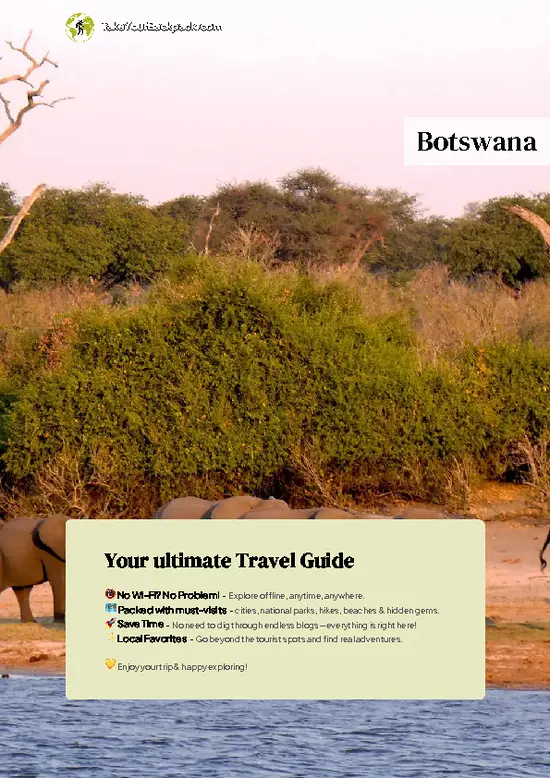
backpacking Africa Botswana 🇧🇼Travel with wildlife rhythms shaping every movement and overnight stay.

Explore BeninExplore Burkina Faso

Backpacking Botswana in 2026

A complete guide including when and where to go, costs, transport, itineraries, and practical travel advice.
What a trip here is really like

Backpacking Botswana
By Johan Kruseman 🇳🇱 | Updated June 4, 2026

Botswana runs on remoteness and deliberate scarcity. Parks lie far apart, many roads are deep sand, and the Okavango is reached by mokoro or small plane; visitor numbers stay low by policy. That space isn’t decoration; it’s the country’s operating principle.

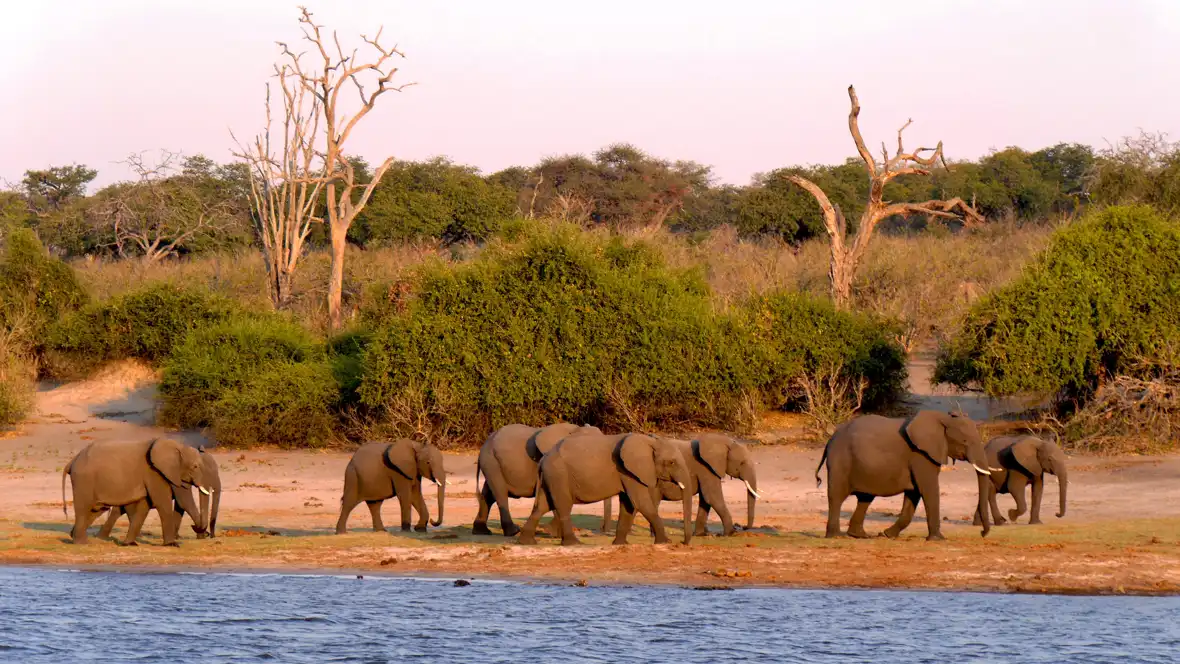
Come for the flood pulse that turns Kalahari scrub into the Okavango’s channels, for Chobe’s elephants stacking the riverbanks in the dry, and for predators working Savuti. Sleep under a hard, star‑crowded sky on the Makgadikgadi pans, track with San guides in the Central Kalahari, and watch a mokoro’s bow split lilies while reed frogs trill. The national rhythm is measured and courteous, anchored by the kgotla’s sense of community. It isn’t easy: heat, thorns, thin supplies outside hubs, and real costs. But those slow you down and act as the filter that delivers long, quiet sightings with no other vehicle in view.

Compared with South Africa’s paved ease, Namibia’s DIY deserts, Zambia’s walking‑led camps, or Zimbabwe’s guiding depth, Botswana trades convenience for privacy and wildlife consistency. It’s for travelers who prize space, patient sightings, and conservation done seriously—whether you’re flying in for a tight, high‑impact safari or steering your own 4x4 with time to spare.

👉 Get the 📖 Travel Guide of Botswana

Okavango Delta (Fly‑in Water Camps)

If you want silence, walking, and mokoro channels instead of bumping along tracks, this is the cleanest play. You fly from Maun on a light aircraft, 15 kg soft bag limit, and land right in camp. The flood peaks roughly May–July; water activities expand, but roads close. Budget-wise, this is pricier than self-drive, yet it cuts transit time to zero and buys you dawn-to-dusk wildlife time. It suits travelers who prefer guides, small groups, and a slower pace over mileage. Malaria precautions and closed shoes for walks aren’t optional; they’re how you keep the calm you came for.

Maun → Moremi → Savuti → Chobe (Self‑Drive Spine)

The classic northbound 4x4 run. Start in Maun, end in Kasane. You trade comfort for control: deep sand in Savuti, possible bridge detours in Moremi, black-cotton mud after big rains. Book park campsites with DWNP or operators before you touch the gate. Carry a compressor, shovel, and recovery points; deflate early, not after you bog. Northbound stacks the payoff—finish with a hot shower, cold stores, and ATMs in Kasane. This route rewards patient drivers who can plan fuel legs, accept 25–40 km/h averages, and keep to dawn/late-afternoon wildlife windows.

Chobe Riverfront/Kasane (No‑4x4 Base)

Short on time or interest in sand? Base in Kasane. Paved access, frequent flights, and day boats that put you eye-level with elephant herds by late afternoon when heat bleeds off. Expect crowds and convoy game drives; the trade is efficiency. You can bolt on a Victoria Falls day trip and still sleep in the same bed. Good for first-timers, families, or anyone prioritizing wildlife-per-hour over solitude.

Makgadikgadi & Nxai Pans

Big sky, white pans, and a navigation exam you shouldn’t cram for. Dry months mean firm surfaces and star fields; wet months bring zebra along the Boteti and roads that liquefy. Use the A3 spine (Maun–Gweta–Nata) and branch in; refuel before you leave it. Inside the pans, 4x4, recovery boards, and conservative tire pressures are the difference between “photo stop” and “night on the salt.” Never drive damp pans. This area rewards disciplined planners and photographers who value space over sightings-per-hour.

Central Kalahari Game Reserve

Empty miles, lion tracks on your doorstep, and no backup if you misjudge range. Enter via Rakops/Matswere or Xade; prebook sites and carry all water. Figure on 700–900 km fuel range to keep options open. Best game is after rains when the valleys green up; summer heat punishes the unprepared. Radios beat phones. This is for travelers who enjoy self-sufficiency, can sit on a waterhole for three hours, and don’t need a lodge to feel safe.
Geography and where places are located
Loading the map 🌍
CLICK TO FILTER
city
town
village
unique site
national park
hike
attraction
festival
region
SHOW COUNTRY’S BESTSHOW ALL
film
0
0
0a
Okavango Delta Mokoro Excursions
film
1
1
1a
Chobe River Sunset Boat Cruises
film
2
2
2a
Makgadikgadi Salt Pan Quad-Bike & Meerkat Excursions
film
3
3
3a
Tsodilo Hills Rock Art Sites
film
4
4
4a
Khama Rhino Sanctuary Game Drives
film
5
5
5a
Mokolodi Nature Reserve Wildlife Experiences
film
6
6
6a
National Museum and Art Gallery
film
7
7
7a
Tsodilo Hills
film
8
8
8a
Central Kalahari Game Reserve
film
9
9
9a
Moremi Gorge Trail
film
10
10
10a
Chobe Riverfront
film
11
11
11a
Khama Rhino Sanctuary Walking Trails
film
12
12
12a
Matsieng Footprints Trail
film
13
13
13a
Okavango Delta
film
14
14
14a
Chobe
Pixabay
film
15
15
15a
Moremi Game Reserve
film
16
16
16a
Makgadikgadi Pans
film
17
17
17a
Nxai Pan
film
18
18
18a
Tuli Block
film
19
19
19a
Khutse Game Reserve
film
20
20
20a
Ghanzi
film
21
21
21a
Nata
film
22
22
22a
Shakawe
film
23
23
23a
Kanye

Why go?Reasons people choose to visit

Wildlife

Botswana rewards animal-first travel because the landscape itself funnels wildlife to you. Each flood of the Okavango concentrates life onto islands; … read more 👉
Botswana rewards animal-first travel because the landscape itself funnels wildlife to you. Each flood of the Okavango concentrates life onto islands; dry edges of Chobe draw the elephants. Government’s high-value–low-impact policy keeps crowds thin; you wait with three vehicles, not thirty. That changes how you go: time your trip to the dry season for easy sightings, or the green season for birds and newborns. Move by mokoro, boat, or 4x4 to match water levels. Pick Chobe for elephants, Moremi/Khwai for predators, the pans and Kalahari for space and stars.

Scenery

Botswana earns its views the hard way. A river pours into desert and makes the Okavango Delta—water where it shouldn’t be. That contrast is the show. … read more 👉
Botswana earns its views the hard way. A river pours into desert and makes the Okavango Delta—water where it shouldn’t be. That contrast is the show. Go when floods peak and you glide by mokoro through reed corridors; go late dry season and the channels shrink, pulling elephants and predators into tight frames on the Chobe and Savuti. Step onto the Makgadikgadi pans for horizon-to-horizon light and night skies that actually teach you constellations. Add the cave systems at Gcwihaba and the rock-painted hills of Tsodilo for texture, not checklist.

People

People meet you with calm warmth, not gush. Respect runs the show. You greet first: ”Dumela, rra” or ”Dumela, mma,” handshake light, right hand supported … read more 👉
People meet you with calm warmth, not gush. Respect runs the show. You greet first: ”Dumela, rra” or ”Dumela, mma,” handshake light, right hand supported by the left. Then business. Conversations breathe; small talk isn’t filler, it’s due diligence, so don’t rush it. Humor is gentle teasing; take it well and return it softly. Elders get the first word. Accept offered water or tea; refusing reads cold. Directions come by landmarks, not street numbers; listen for cattle posts and tall marulas. If someone walks you there, match their pace and thank them: ”Ke a leboga.”
Want the complete picture of Botswana?
The offline Travel Guide brings everything together — routes, highlights & planning.

See what's included in the guide 👉

Get the Travel Guide -

⭐ HighlightsKey places and experiences

  • Okavango Delta: A slow-breathing maze of reed channels where fish eagles call and hippos grunt from black-water pools. Slide out at first light in a mokoro with a community poler and watch the lilies open at your knees while red lechwe splash past. Insider tip: pack a dry bag and sit up front; you’ll keep gear safe and spot crocodiles before the hull nudges them.
  • Chobe Riverfront (Kasane): Heat shimmers off sandbanks stacked with elephants, and the river moves like a conveyor belt of life. Take the last boat of the day when the sun drops and herds wade in chest-deep, trunks like snorkels. Insider tip: choose a smaller boat and claim the upstream-left seat; you’ll get cleaner angles and less engine chatter in your audio and nerves.
  • Makgadikgadi Pans: A white horizon that erases depth, then gives it back with a mirage. Sleep on the salt under a sky so busy you start mapping satellites, or visit the habituated meerkats at dawn as they climb your boots to scout for hawks. Insider tip: go dry
read more 👉
  • Okavango Delta: A slow-breathing maze of reed channels where fish eagles call and hippos grunt from black-water pools. Slide out at first light in a mokoro with a community poler and watch the lilies open at your knees while red lechwe splash past. Insider tip: pack a dry bag and sit up front; you’ll keep gear safe and spot crocodiles before the hull nudges them.
  • Chobe Riverfront (Kasane): Heat shimmers off sandbanks stacked with elephants, and the river moves like a conveyor belt of life. Take the last boat of the day when the sun drops and herds wade in chest-deep, trunks like snorkels. Insider tip: choose a smaller boat and claim the upstream-left seat; you’ll get cleaner angles and less engine chatter in your audio and nerves.
  • Makgadikgadi Pans: A white horizon that erases depth, then gives it back with a mirage. Sleep on the salt under a sky so busy you start mapping satellites, or visit the habituated meerkats at dawn as they climb your boots to scout for hawks. Insider tip: go dry season for quad-bike overnights; drop tire pressure to 1.6-1.8 bar and avoid the pans entirely after heavy rain.
  • Tsodilo Hills: Four sandstone sentinels rising from flat Kalahari, quiet enough that your footsteps feel loud. Hike the Female Hill with a local guide to read ancient painted giraffes and trance-dots in the shade of fig trees. Insider tip: 4x4 access only, start at dawn, and carry your own water; the onsite museum is small, the sun is not.
  • Central Kalahari Game Reserve (Deception Valley): Space and silence, then a black-maned lion prints a story into powder sand. After the first rains, sit on the valley rim and glass for cheetah working the spring-green flats. Insider tip: self-drive only with two spares, 1,000 km fuel range, and bookings made months ahead; plan days at 30-40 km/h on corrugated tracks. For quieter corners, look to Gcwihaba Caves’ limestone chambers, the red rock kopjes of the Tuli Block, and Kgalagadi’s Kaa pans on the far western rim.
Spotted a mistake or missing a highlight? Contact us.

But Botswana offers more...

Discover and compare all of its highlights per category

🧭 RoutesPlanning a route that makes sense

The 5-Day Delta & Chobe Hit

The Vibe: A focused safari blast that strings together Botswana’s most iconic wetlands and riverfront in one tight loop, ideal if you want big wildlife and big sunsets without overcomplicating the logistics. You’ll lean on local operators, stay in a couple of key hubs, and spend most of your waking hours on the water or in a game vehicle instead of on the road.
  • Glide through the Okavango channels on mokoro excursions from Maun.
  • Track predators and elephants in Moremi Game Reserve’s mobile-camp zone.
  • Drift past huge herds on a Chobe River sunset cruise from Kasane.
  • Sample both land and water-based safari styles in just a few days.

The 10-Day Wetlands, Savuti & Salt Pans Circuit

The Vibe: A balanced, mid-length journey that layers the Okavango and Moremi with the drama of Savuti, the classic Chobe Riverfront, and the surreal openness of the Makgadikgadi pans. The pace is steady, with a mix of 4x4 overland legs and one internal hop so you can actually feel each … read more 👉

The 5-Day Delta & Chobe Hit

The Vibe: A focused safari blast that strings together Botswana’s most iconic wetlands and riverfront in one tight loop, ideal if you want big wildlife and big sunsets without overcomplicating the logistics. You’ll lean on local operators, stay in a couple of key hubs, and spend most of your waking hours on the water or in a game vehicle instead of on the road.
  • Glide through the Okavango channels on mokoro excursions from Maun.
  • Track predators and elephants in Moremi Game Reserve’s mobile-camp zone.
  • Drift past huge herds on a Chobe River sunset cruise from Kasane.
  • Sample both land and water-based safari styles in just a few days.

The 10-Day Wetlands, Savuti & Salt Pans Circuit

The Vibe: A balanced, mid-length journey that layers the Okavango and Moremi with the drama of Savuti, the classic Chobe Riverfront, and the surreal openness of the Makgadikgadi pans. The pace is steady, with a mix of 4x4 overland legs and one internal hop so you can actually feel each landscape instead of racing through it.
  • Start in Maun with mokoro time in the Okavango Delta and game drives in Moremi.
  • Cut through Chobe National Park’s Savuti sector for big-cat territory and wide horizons.
  • Base in Kasane for riverfront game viewing and sunset boat cruises.
  • Finish around Nata with quad-biking and meerkat encounters on the Makgadikgadi Pans.

The 15-Day Botswana Deep-Dive

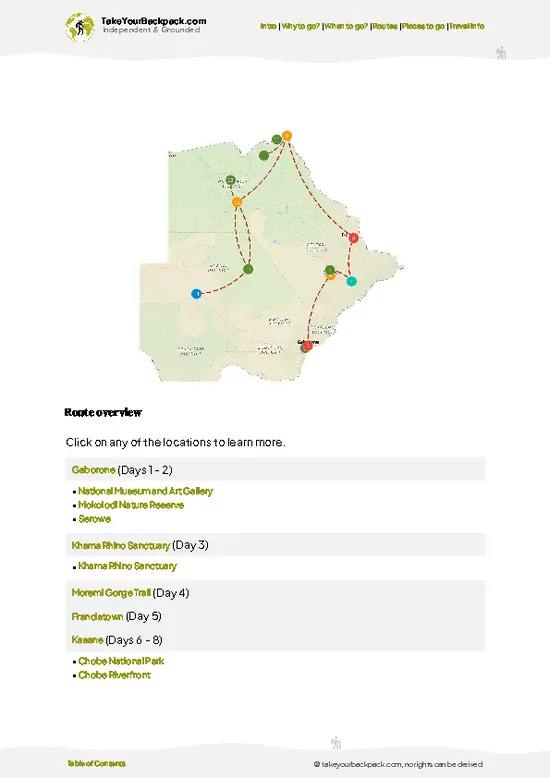
The Vibe: A slow-burn, full-spectrum route that stitches together capital-city culture, rhino conservation, Kalahari emptiness, Delta wetlands, big-name parks, and ancient rock art. You’ll trade a bit of comfort for character in places, but gain a much richer sense of how Botswana fits together beyond the usual safari circuit.
  • Ease in through Gaborone with museums, monuments, and nearby reserves.
  • Visit Khama Rhino Sanctuary and skirt the Central Kalahari for desert scale and starry nights.
  • Spend quality time in Maun, the Okavango Delta, Moremi, Savuti, and the Chobe Riverfront.
  • Head out to Nata, Gweta, Makgadikgadi Pans, and Tsodilo Hills for salt flats, baobabs, and rock art.
🌍 Want a ready-to-use travel plan for Botswana?
The overview above compares different route options based on your travel time and style. The complete Travel Guide breaks each itinerary down in detail, including maps, stops, highlights, and transport information.

Explore all route details 👉

Get the Travel Guide -

🌤️ When to go?Best time to visit Botswana

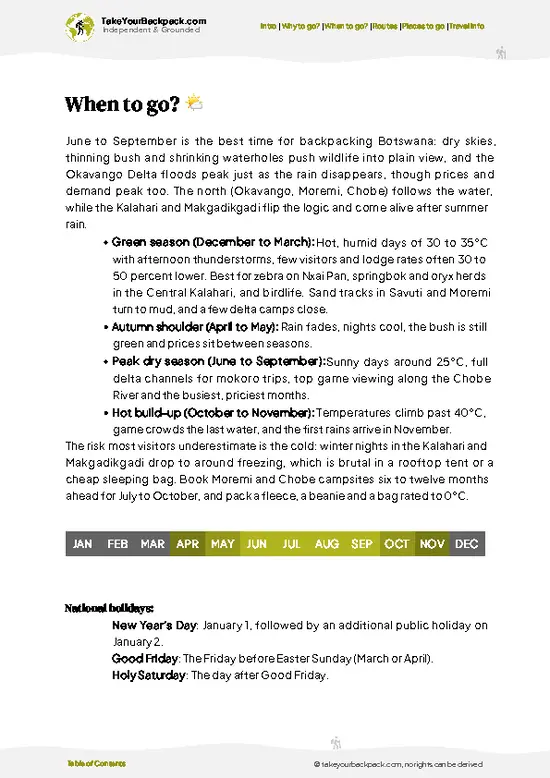
Late May through mid-June is the cleanest win. The rains are done, the mud has baked hard, and mosquitoes taper off. Okavango floodwater is rising from the north, so mokoro channels open while roads remain passable. Days run mild, nights crisp enough for sleep without hauling arctic gear. Wildlife starts pulling toward permanent water, but the safari convoy hasn’t fully arrived and prices still sit in the shoulder band. Basing in Maun or Kasane works: public transport runs predictably, day trips are cheaper, and you can cherry-pick a few 4x4 park days without paying peak-season tax.
  • Dry Peak (Jul-Oct): You pay in dust and early alarms, but predators stack along shrinking water and elephants pack the Chobe riverfront. Campsites sell out, gate queues get real, and October heat slaps. Ignored risk: strict park gate curfews—misjudge distance and you’re bivvying outside the fence.
  • Shoulder Rise (May-Jun): Grasses slump, tracks firm, boats return to dugout channels, and rates lag behind demand. The country exhales; you move faster, spend less, see more. Ignored risk: cold dawns—without a real mid-layer and beanie, those game drives are misery.
  • Green Off-Peak (Dec-Mar): Thunderheads, neon plains, birds everywhere, and long stretches where it’s just you and a road rinsed clean. Take the solitude; plan around storms. Survival hack: pitch on slight rises and carry a small tarp to rig a dry porch—keeps gear off the mud and spirits intact. Ignored risk: black-cotton soil turns to glue; a 2WD will bury to the axle fast.

Book core park campsites a season ahead, but keep gateway nights flexible so you can pivot with water levels and road reports.

source: climatestotravel.comJANJanuary: fair for travelingFEBFebruary: fair for travelingMARMarch: fair for travelingAPRApril: good for travelingMAYMay: highly recommended for travelingJUNJune: excellent for travelingJULJuly: excellent for travelingAUGAugust: excellent for travelingSEPSeptember: excellent for travelingOCTOctober: highly recommended for travelingNOVNovember: good for travelingDECDecember: fair for traveling
📅 Traveling in a specific month?
Get a full month-by-month breakdown of weather, crowds, costs, festivals, and seasonal highlights in the complete travel guide.

Get full details when to go 👉

Get the Travel Guide -
botswana-pixabay-1653100

💰 Costs (as of 2026)Typical budget expectations

Botswana on a backpacker budget runs about 450-700 pula ($35-55) per day if you self-cater and stay in dorms; park days jump to 1,500-3,000 pula.
  • dorm accommodation: 150-300 pula in Gaborone, Maun, and Kasane; 300-400 pula in peak season (Jul-Oct). Outside hubs, dorms thin out and you’ll be pushed toward basic rooms at 350-600 pula. System tip: call or message places directly for a “cash price” to dodge 3-5% card surcharges, and carry a tent—camping in the same compounds often undercuts dorms by 30-50%. Relative to South Africa, beds run higher and stock is scarcer; compared to Namibia, prices are similar but availability is better in the main hubs.
  • meals: Supermarket Survival: Spar/Choppies runs keep meals at 30-60 pula if you use hostel kitchens; grab-and-go pies and rotisserie chicken land around 15-35 pula. Respect the veterinary fences—raw beef moving north gets confiscated—so buy meat on the side you’ll cook it. Street food reality: not as ubiquitous as SA; “chicken dust” braais do a plate for 35-60 pula, while sit-down mains in Maun/Kasane run 90-160 pula (tourist riverfront spots 140-220). Tap water is generally safe in towns; refill and skip bottled costs. Day-to-day food is
read more 👉
Botswana on a backpacker budget runs about 450-700 pula ($35-55) per day if you self-cater and stay in dorms; park days jump to 1,500-3,000 pula.
  • dorm accommodation: 150-300 pula in Gaborone, Maun, and Kasane; 300-400 pula in peak season (Jul-Oct). Outside hubs, dorms thin out and you’ll be pushed toward basic rooms at 350-600 pula. System tip: call or message places directly for a “cash price” to dodge 3-5% card surcharges, and carry a tent—camping in the same compounds often undercuts dorms by 30-50%. Relative to South Africa, beds run higher and stock is scarcer; compared to Namibia, prices are similar but availability is better in the main hubs.
  • meals: Supermarket Survival: Spar/Choppies runs keep meals at 30-60 pula if you use hostel kitchens; grab-and-go pies and rotisserie chicken land around 15-35 pula. Respect the veterinary fences—raw beef moving north gets confiscated—so buy meat on the side you’ll cook it. Street food reality: not as ubiquitous as SA; “chicken dust” braais do a plate for 35-60 pula, while sit-down mains in Maun/Kasane run 90-160 pula (tourist riverfront spots 140-220). Tap water is generally safe in towns; refill and skip bottled costs. Day-to-day food is a touch pricier than SA, on par with Namibia.
  • local transport: The cheapest unlock is the long-distance bus network plus shared taxis. Expect roughly 0.25-0.35 pula/km: Gaborone-Maun 220-300 pula; Maun-Nata 90-130; Nata-Kasane 80-120. In towns, shared taxis are 8-12 pula per ride; private hires cost 30-70 across town. Buses go early and stop by dusk; buy a seat the day before when possible and carry snacks. Hitchhiking is common on highways but usually implies a fuel contribution. For parks, bus to Maun/Kasane and join group day trips; 4x4 rental only beats this when split 3-4 ways.
  • activities: Major cost drivers are park fees + 4x4 + guide + fuel. Mokoro day trips from community poler trusts: 600-900 pula; via lodges 900-1,300. Chobe 3-hour river cruise: 300-500; game drives: 400-700; full-day combos: 900-1,200. Okavango scenic flights: 1,300-1,800 per person in a full plane. Relative value: Botswana wildlife is world-class but pricier than self-drive in Kruger or Etosha; you pay for access and limits on vehicle numbers. Pick one splurge day and pad with free/cheap birding along the Thamalakane or the Kasane riverfront.
  • miscellaneous: Budget leaks: ATM withdrawal fees (often 50-80 pula), lodge card surcharges (3-5%), laundry (40-80 per load), last-minute booking premiums in peak months, and gear hire (cooler, bedding). Data is cheap by bundle (2-4 GB for 40-80 pula; Mascom/Orange shops everywhere). Cross-border day trips to Vic Falls add visas and transfers that can double a day’s spend; only go if you’ll actually use the time. Overall, basics are similar to Namibia and higher than SA; activities are the real wallet punch.
⚠️ Prices can change and everyone travels differently, so take this as a rough guide. Hope it helps you plan your adventure!

✈️ The backpacker research shortcutBotswana Travel Guide

An offline-friendly backpacking guide with optimized travel routes, ranked highlights, transport advice, and the best areas to stay.
example page 0 from our offline Travel Guide for Botswanaexample page 1 from our offline Travel Guide for Botswanaexample page 2 from our offline Travel Guide for Botswanaexample page 3 from our offline Travel Guide for Botswanaexample page 4 from our offline Travel Guide for Botswanaexample page 5 from our offline Travel Guide for Botswanaexample page 6 from our offline Travel Guide for Botswanaexample page 7 from our offline Travel Guide for Botswana
The digital guide (257 pages) contains:
58 highlights, ranked by travel appeal
Optimized 5, 10 & 15-day travel routes
Cities, national parks, beaches, historical sites, ...
How to get around
Offline-friendly for travel without Wi-Fi
👉 Click to see all 30+ guide features

📅 Plan smarter in minutes, not weeks
Month by month travel advice
Festivals & national holidays
Budget expectations

🗺️ Go to the right places, skip the overrated ones
Honest pros & cons of destinations
Top hikes, parks & viewpoints
Lesser-known places most travelers miss
Clear “worth it vs skip it” guidance

🛏️ Travel smoothly without rookie mistakes
Best areas to stay
Transport systems explained simply
Common scams & safety advice
SIM cards, money & practical tips

🌍 Understand the country, not just visit it
Culture & traditions
52 Essential phrases & customs
Festivals worth planning around
Traveler-friendly historical context
Insights that make places more meaningful

📱 Built for real travel conditions
Fully downloadable PDF
Works completely offline
Optimized for phone use
Useful in remote areas & buses
Everything in one place
Save weeks of stressful planning
Get instant access to the full guide directly. 30-day money-back guarantee.


Sent to your inbox immediately after payment • 100% Secure Checkout
Best Backpacking Travel Advisor 2025 tourism awardBest Backpacking
Travel Advisor
2025
What others say about Take Your Backpack Guides:
⭐⭐⭐⭐⭐
Fantastic, amazing amount of information!
⭐⭐⭐⭐⭐
My goodness this is amazing, it's what I've been looking for hats off too you!
⭐⭐⭐⭐⭐
I think this is absolutely BRILLIANT
⭐⭐⭐⭐
Very complete and informative. It's still missing places, but I gotta to commend you
⭐⭐⭐⭐⭐
This is truly amazing, thank you, can't wait to explore it with my kids!
⭐⭐⭐⭐⭐
Awesome resource, thank you!
⭐⭐⭐⭐⭐
This is amazing! Can't wait to explore the ones I haven't seen
⭐⭐⭐⭐
I love this! Well done, great idea.
⭐⭐⭐⭐⭐
Thanks for taking the time to make this gem!
⭐⭐⭐⭐⭐
This might be the best website I've ever seen.
⭐⭐⭐⭐⭐
Congratulations, and thank you so much for your work; it's incredibly valuable.
⭐⭐⭐⭐
In all seriousness I think you did a great job pointing out the important spots
⭐⭐⭐⭐⭐
10/10 very good
⭐⭐⭐⭐⭐
As someone who's only just starting to visit regularly this is awesome, thank you.
⭐⭐⭐⭐
Thank you very much! I'm going to visit my dad, it's going to be very useful!
⭐⭐⭐⭐⭐
This is really cool! We'll be travelling for the first time and this definitely come in handy.
⭐⭐⭐⭐⭐
You are now our minister of culture, congratulations 👨‍💼
⭐⭐⭐⭐⭐
Just wanted to tell you that this is a pearl! Going to follow your recommendations.
⭐⭐⭐⭐⭐
This is so cool. I'll definitely be using the resource for my travels soon.
⭐⭐⭐⭐⭐
This is very impressive! Good work.
⭐⭐⭐⭐⭐
This is an amazing and informative site. Very well done!

🛏️ Where to stay?Choosing the right base for your trip

Yes — hostels, backpacker lodges and budget guesthouses are available in Botswana’s main towns and tourist gateways, though options are sparse outside urban centres and tend to sell out in peak season so book ahead or expect to pay for transfers from camps.
Most budget beds cluster in the city-centre/downtown area of Gaborone, the town-centre and riverside precinct of Maun (Okavango gateway), and the town/park-adjacent zone of Kasane, with smaller selections in Francistown and close to major park entrances.
Gaborone city-centre offers the best nightlife and transport links but is busier and … read more 👉
Yes — hostels, backpacker lodges and budget guesthouses are available in Botswana’s main towns and tourist gateways, though options are sparse outside urban centres and tend to sell out in peak season so book ahead or expect to pay for transfers from camps.
Most budget beds cluster in the city-centre/downtown area of Gaborone, the town-centre and riverside precinct of Maun (Okavango gateway), and the town/park-adjacent zone of Kasane, with smaller selections in Francistown and close to major park entrances.
Gaborone city-centre offers the best nightlife and transport links but is busier and less quiet after dark; Maun’s town and riverside areas put you nearest Okavango departures with decent tourist services but slightly higher prices and limited late-night options; Kasane’s park-side belts are ideal for early Chobe safaris and quiet evenings but have minimal nightlife and often require paid transfers to reserves.

If you enjoy meeting fellow travelers, consider choosing hostels with high ratings for atmosphere. On the other hand, if you prefer having your own space, a hotel might be a better option.

🚌 Getting aroundGetting around Botswana

Botswana moves at dawn and idles at noon. Schedules exist on paper, but the real clock is “when it’s full.” Highways are long, straight, and policed; nights belong to livestock and darkness. If you link early departures with major junctions, the country opens smoothly. If you drift into late afternoon, options thin fast and prices climb. Think cool mornings, quick decisions at bus ranks, and a strict respect for daylight.
  • Intercity buses and coaches The speed-to-cost trade is blunt: they’re slow,
read more 👉
Botswana moves at dawn and idles at noon. Schedules exist on paper, but the real clock is “when it’s full.” Highways are long, straight, and policed; nights belong to livestock and darkness. If you link early departures with major junctions, the country opens smoothly. If you drift into late afternoon, options thin fast and prices climb. Think cool mornings, quick decisions at bus ranks, and a strict respect for daylight.
  • Intercity buses and coaches The speed-to-cost trade is blunt: they’re slow, cheap, and reliable enough if you start early. Gaborone-Francistown runs in half a day; Maun-Kasane via Nata takes most of it. Tickets are bought on the spot; seats go once full. You’ll stop for police checks and veterinary gates where meat can be confiscated and everyone steps on disinfectant mats. It’s a fraction of a private taxi and less than most “shuttles,” but you pay in time, heat, and elbow room. Sit near a window, keep your big pack below or behind the driver, and expect no progress after dark.
  • Combis and shared taxis This is the social fabric in towns. You greet when you board, pass fares forward, and don’t hoard change. Routes are fixed, departures fluid. Tap a coin on the rail or call out when you want off; doors get a gentle hand, not a slam. Elders and parents with kids sit first. Music may be loud, conversation soft. It’s cheap, frequent, and ends early—plan your last ride before sunset or you’ll walk.
  • Mokoro and river boats Water geometry beats roads in the Delta and along Chobe. Where sand or floodplains block you, a dugout with a local poler threads the reeds and reaches islands no vehicle can. Community trusts near Maun and in the panhandle offer day and overnight runs far cheaper than lodge packages. Water levels set the map; hippos set the rules. Pack light, seal it all in dry bags, and expect weight limits that make overpacking your problem, not theirs.
  • Hitching paid lifts The budget disruptor on sparse routes. Stand at junctions like Nata, Sehithwa, or Shakawe with your palm down; agree a contribution before you climb in. It’s faster than waiting for an off-peak bus and cheaper than a charter. Daylight only, pack visible, passport handy for roadblocks. You’re a guest in someone’s cab—belt up, no mud on seats, and thank the driver when you hop out.

Master tip: Chain mornings. Take the first bus to a junction (Nata, Maun, Francistown), step straight into the next ride or a paid lift, and aim to arrive by mid-afternoon; Botswana rewards early momentum and punishes late starts.
Distance: Sir Seretse Khama International Airport (GBE) is about 11 km (7 miles) north of Gaborone’s city center (Main Mall/CBD).

Main ways to get into town
  • Taxi or app-based ride (from the airport rank or via local ride-hailing apps): 20-30 minutes in normal traffic, up to 35 minutes at rush hour. Typical fare to the CBD is about BWP 150-250, depending on time of day and exact drop-off. Cash is common; not all drivers take cards.
  • Minibus “combi” (budget option): There’s no dedicated airport bus. Walk 5-10 minutes out to Airport Road or take a short feeder taxi to Airport Junction Mall, then hop on a combi toward “Station”/“Main Mall.” Expect 40-60 minutes total including waits and a possible transfer. Fares are about BWP 8-12 per ride; with one transfer you’ll spend roughly BWP 16-24. A short feeder taxi to the main road/mall is usually BWP 20-50. Combis run roughly early morning to early evening; service thins after dark and with large luggage it can be cramped.
  • Hotel transfer (prebooked): Many hotels/guesthouses can arrange a private transfer. 20-30 minutes. Pricing varies widely; as a ballpark, BWP 180-300 per vehicle to the CBD.

Taxi notes: You’ll find official airport taxis outside arrivals and they’re generally safe and straightforward. As of 2025, a city-center run typically lands in the BWP 150-250 range. Confirm the price before you set off; tipping is optional but appreciated for helpful service. If you use an app-based ride, prices can be a bit lower off-peak but surge during busy times.

Small extras: Traffic is heaviest around 07:00-08:30 and 16:30-18:30. ATMs are in the terminal if you need cash for taxis or combis.
⚠️ Prices and routes can change, so take this as a rough guide and ask for local advice when you arrive.

🔒 Safety (risk Level: low)Staying safe while traveling

Safety for solo travelers, including women and LGBTQ+ individuals
Botswana is generally safe for solo travelers, including women and LGBTQ+ individuals, but usual travel precautions are recommended. For women, it’s wise to stay alert in less populated areas and avoid walking alone at night. LGBTQ+ travelers should be aware that while same-sex relationships are decriminalized, public displays of affection might attract unwanted attention. Always check local advisories and be culturally sensitive to enhance your travel experience.


Full official government travel advisory (live updates)
View details 👉

✈️ VisaVisa requirements for Botswana

Most travelers from the US, UK, EU, Canada, and Australia don’t need a visa for Botswana for stays up to 90 days. For those who do need one, apply at the nearest Botswana embassy or consulate, and make sure your passport is valid for at least six months from your entry date. Always check the latest requirements before you travel, as they can change.

source: gov.bw
⚠️ Visa requirements can change over time, so always check the latest visa requirements with the official embassy or government website before you travel.

🎒 What to pack?What you'll need while traveling

Botswana’s got a wild mix of climates, so pack smart! Days can get scorching—think 30°C and above—especially in the Kalahari Desert, while nights in the Okavango Delta can be surprisingly chilly. Lightweight, breathable clothes are your best friend, but toss in a warm layer or two for those evening safaris. If you’re heading to rural areas or visiting villages, modest clothing is appreciated; think longer skirts for women and sleeves for both genders. Rainy season hits between November and March, so a compact rain jacket will save you from surprise showers. Keep it light, keep it versatile!

Apart from this country specific advice, I have also crafted a general packing list that should help on any trip. authorOver the years, I've learned the importance of packing minimally. It's so much easier to jump on the back of a truck or squeeze yourself into the last spot of a minibus without that supersized backpack. If you're headed to a warm destination, leave your winter jacket at home; for colder regions, opt for thin thermal underlayers. Instead of packing your entire wardrobe, bring just three sets of clothes, as laundry facilities are available everywhere.
View the full list 👉
🎒 Planning the practical side of your trip?
Get detailed information on transport, daily budgets, internet access, local customs, food, language, and other essentials in the complete Travel Guide.

Get detailed practical information 👉

Get the Travel Guide -

🙋 FAQTravel questions about Botswana

Trip Planning


Personal tip: I normally search on good rating for atmosphere (for meeting people) and location (for easy exploring). Cleanliness as a bonus.


Travel Essentials

Routine vaccines are a must, including MMR, diphtheria-tetanus-pertussis, varicella, polio, and your yearly flu shot.

Consider Hepatitis A and Typhoid vaccines, as you can contract these through contaminated food or water in Botswana.

If you’re planning to spend a lot of time outdoors, especially in rural areas, a rabies vaccine might be wise.

Yellow fever vaccination isn’t typically required unless you’re arriving from a country with risk of yellow fever transmission.

Speak with a travel health specialist to tailor the vaccines to your itinerary.


vaccination requirements
When I first started traveling, I often spent part of my first day in a new country hunting for a local SIM card. While this can still be slightly cheaper, it also takes time and planning.

These days, it's much simpler to install an eSIM before leaving home. Once you arrive in Botswana, you can activate it immediately and have mobile data from the moment you land — which is especially useful for ordering transport or navigating away from busy airports.

There are many providers nowadays, and price differences are usually small. I personally go with Airalo, as it offers excellent network coverage throughout the country and strong global coverage, so you can manage multiple countries from a single app.


Get your e-sim for Botswana

Culture & Customs

Respect traditional customs by greeting people with a handshake or a polite nod. Use your right hand for giving and receiving items. Dress modestly, especially in rural areas. For women, avoid overly revealing clothing. Public displays of affection, especially same-sex, can attract unwanted attention. Homosexuality is illegal in Botswana, so LGBTQ travelers should exercise discretion. Always ask for permission before photographing locals. Be punctual, as time is respected in business and formal settings. Avoid discussing politics or religion unless you’re sure it’s appropriate.
Trying traditional food is always a great way to experience the culture. Here are some must-try dishes for Botswana.
  • Seswaa: This is a traditional meat dish usually made from beef, goat, or lamb. The meat is boiled with just salt and water until tender and then pounded. It’s often served with pap (maize meal) and is a staple at celebrations. It’s a true taste of Botswana’s culinary heritage.
  • Morogo: Essentially wild spinach, Morogo is a nutritious side dish that is often cooked with onions and tomatoes. It’s popular due to its availability and health benefits, symbolizing the resourcefulness of the local cuisine.
  • Vetkoek: While originally from South Africa, these fried dough balls are a beloved snack in Botswana. Often filled with ground beef or enjoyed with jam, they’re a tasty example of regional culinary influence.
  • Bogobe: Made from sorghum or maize, this porridge is a dietary staple in Botswana. It’s often paired with meat or vegetables and holds cultural significance as a traditional meal enjoyed by many.
  • Mopane Worms: Not for the faint-hearted, these caterpillars are a protein-rich delicacy. Usually dried or fried, they’re a unique part of the diet and an adventurous culinary experience.
Tap water in Botswana is generally safe for locals, but it might not sit well with travelers due to varying water treatment standards. It’s advisable for tourists to stick to bottled or filtered water to avoid any stomach issues. Always check the latest local advice, as water quality can vary in rural areas.
The main language in Botswana is Setswana. Backpacking is way more rewarding if you know a bit of the local language, so I'd suggest brushing up on the basics just in case your Setswana skills have become a bit rusty.

Want to understand locals better?
The complete Travel Guide for Botswana includes 52 essential words and phrases — greetings, thank-yous, ordering food, transport, numbers, and common local expressions you'll actually hear.

Get your local basic phrases 👉

Get the Travel Guide -


English is widely spoken in Botswana, serving as the official language and the medium of instruction in schools. Approximately 70% of the population is proficient in English, particularly in urban areas such as Gaborone and Francistown. In these cities, you’ll find that most people, especially in the hospitality and tourism sectors, can communicate effectively in English.

However, in rural regions, the proficiency may vary. While many locals understand basic English, they may primarily speak Setswana, the national language. Travelers might encounter situations where English is less commonly spoken, but most Batswana are friendly and eager to help, often using a mix of English and Setswana to communicate.

Overall, English is a practical language for travelers, and you are unlikely to face significant language barriers. It’s always appreciated if visitors learn a few basic phrases in Setswana, as this shows respect for the local culture and can enhance interactions.

Money & Payments

The local currency of Botswana is BWP (P).

ATMs in Botswana are fairly accessible in cities like Gaborone and Maun, but don’t count on them in rural areas. Always have a backup stash of cash for those remote adventures. South African Rand, US Dollars, and Euros are generally accepted at exchange bureaus, but USD is your best bet for better rates. If you’re planning to exchange, do it at banks or authorized exchange offices to avoid hefty fees. Credit card acceptance is growing, especially in urban areas, but small towns and local markets might only take cash. Carry some pula for day-to-day expenses. Keep in mind that some ATMs might run out of cash or have connectivity issues, so plan ahead!

Tipping in Botswana isn’t obligatory, but it’s appreciated. In restaurants, a 10% tip is standard if service isn’t included. For safari guides and lodge staff, tipping varies based on service quality, typically around BWP 50-100 per day.

🧩 Nearby countriesSimilar backpacking destinations

We 💚 feedbackThe bottom line on traveling here

Botswana rewards calm, deliberate travel. The vibe is competent silence—engines off, dust settling, elephants deciding the timetable. Best surprise: you don’t need a luxury tent to see the same predators; with a real 4x4, two capable drivers, and public campsites booked months ahead, you’re in the game. Costs are high because beds are capped; beat it with self-catering and shoulder-season dates. Small warning: deep sand drinks fuel. Carry extra, lower tire pressures, and respect night rules—no walking, clean camp, red light only.

✍️ Help improve this page!
The information on this page is based on in-depth research, insights shared by experienced travelers, and feedback from the local travel community in Botswana. While every effort is made to keep the information accurate and current, conditions can change — so if you spot anything incorrect or outdated, please get in touch.


🙋‍♂️ Give feedback

👋 Meet the founderWho’s Behind Take Your Backpack?

Johan, backpacker and founder of TakeYourBackpackHi, I’m Johan (Netherlands 🇳🇱), the creator of TakeYourBackpack. Over the past decade, I’ve backpacked through 80+ countries across six continents, gaining extensive experience with independent travel, long-term trips, and overland routes.

This site is built on a combination of firsthand travel experience and carefully curated insights from other backpackers. Many guides are based on places I’ve personally visited, while others bring together tips, observations, and practical advice shared by trusted travelers I’ve met along the way.

The goal is to provide realistic, experience-driven guidance — not generic itineraries — so you can explore destinations with better context, clearer expectations, and more confidence.

Get full Botswana guide •
Instant download • 58 highlights • Full Offline guide