×
Italy 🇮🇹

backpacking Europe Italy 🇮🇹
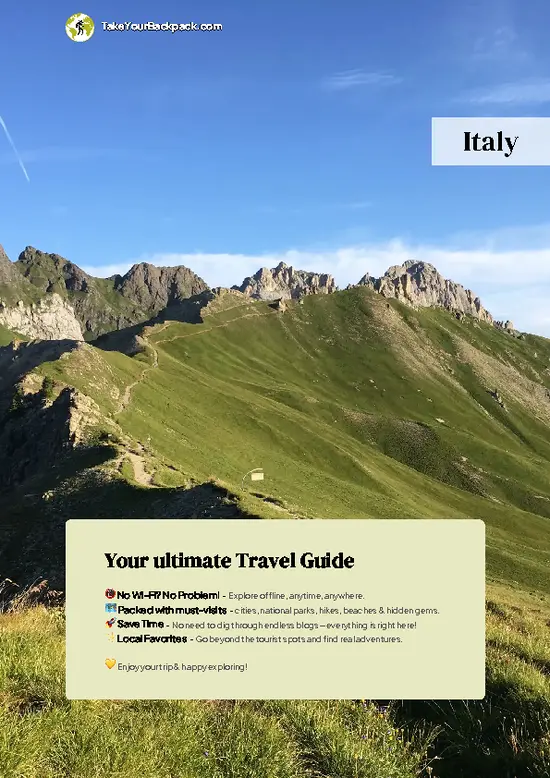
Wander endlessly through layered history woven into everyday life.

Explore IrelandExplore Jersey

Backpacking Italy in 2026

A complete guide including when and where to go, costs, transport, itineraries, and practical travel advice.
A first look at the country

Backpacking Italy
By Johan Kruseman 🇳🇱 | Updated June 5, 2026

You’re wedged at a standing bar, tossing back a one‑euro espresso while a Vespa whines past the door. Italy runs on small rituals and loud opinions. It’s messy, generous, and built for human pace, not perfect schedules.

Come for the appetite and stay for the full‑body culture. This is a place where street corners hold Roman columns, grandmothers edit your order, and mountains, coasts, and vineyards trade places every hour on a regional train. I chase sunrise across the Forum, lunch on ragù in Bologna, and end the day watching alpenglow from a Dolomite ridge—no border crossings required. Art isn’t homework here; it ambushes you. Caravaggio glowers from a side chapel, Botticelli reshapes your idea of beauty, Pompeii puts ancient footsteps under your soles. Then the outdoors resets you: terrace trails above Cinque Terre, Sicilian markets under Etna’s shadow, limestone coves in Puglia, ferratas that make your forearms sing. Yes, there are crowds, heat in August, trains that sulk, ZTL cameras that punish drivers, and restaurants booked weeks in advance. But learn the rhythm—early starts, long lunches, twilight wandering—and the friction turns into flavor.

France polishes, Spain lingers late, Switzerland runs on clocks, Croatia leans on its coast, Slovenia whispers alpine calm. Italy is the overlap: art plus appetite, drama plus daily life, chaos with charm you can actually use. It’s for travelers who want to feel history with their hands, eat like it matters, and squeeze mountains and sea into one honest trip. If you can trade perfection for personality, you’ll be paid back in full.

👉 Get the 📖 Travel Guide of Italy
Rome & Lazio — Essential: The payoff is density: world‑class ruins, cheap pizza by the slice, and street‑level life stacked into a walkable core. Fiumicino trains drop you at Termini; from there the Metro and your feet do the work. Prebook the Colosseum and Vatican or lose half a day in lines. Use Rome as a base for easy day trips (Ostia Antica, Tivoli, Cerveteri). Best for travelers who can handle noise, late dinners, and 20,000‑step days.

Venice & the Veneto Lagoons — Essential: No cars, no shortcuts, just alleys, boats, and tide. Arrive at Santa Lucia by train, sleep in the city, and explore at dawn and after 8 p.m. when day‑trippers vanish. Buy a vaporetto pass if you’ll island‑hop; otherwise, walk everywhere. Hit Rialto’s market early, graze cicchetti bars, then ride out to Torcello or Pellestrina for breathing room. Rewards unhurried walkers, photographers, and anyone who can pack light and ignore souvenir traps.

The Dolomites (Val Gardena–Alta Badia–Tre Cime spine) — Essential: High reward for legwork. Base via Bolzano or Brunico, then bus into the valleys; lifts run on seasonal schedules, so start early. Book rifugi ahead for hut‑to‑hut or day‑hike Seceda, Alpe di Siusi, Lagazuoi, and Tre Cime. Weather flips fast; bring layers and poles. Crowds spike around Ferragosto; go June or September if you can. Built for fit hikers and photographers who value long days and hot soup at dusk.

Tuscany (Florence–Siena–Val d’Orcia) — Essential with a car: Florence is museum reservations and tight streets; Siena is bus‑easy; the Val d’Orcia needs wheels. Respect ZTL cameras, park outside walls, and accept slower days of hill towns, farm lunches, and sunset roads. Book Uffizi and Accademia; eat where workers eat at lunch for value. Best for travelers who’ll trade speed for depth and are happy plotting backroads between Pienza, Montalcino, and Montepulciano.

Amalfi Coast (Sorrento–Positano–Amalfi–Ravello) — Overrated for most: Gorgeous, yes; efficient, no. Buses crawl, ferries cost, parking is warfare, and every viewpoint has a queue. Path of the Gods is slammed after 9 a.m. If you insist, arrive by boat, carry a small bag, and sleep in Praiano, Minori, or Agerola to save cash and sanity. Better value: base in Naples, do Pompeii and Paestum, then take one ferry day to sample the coast and leave.
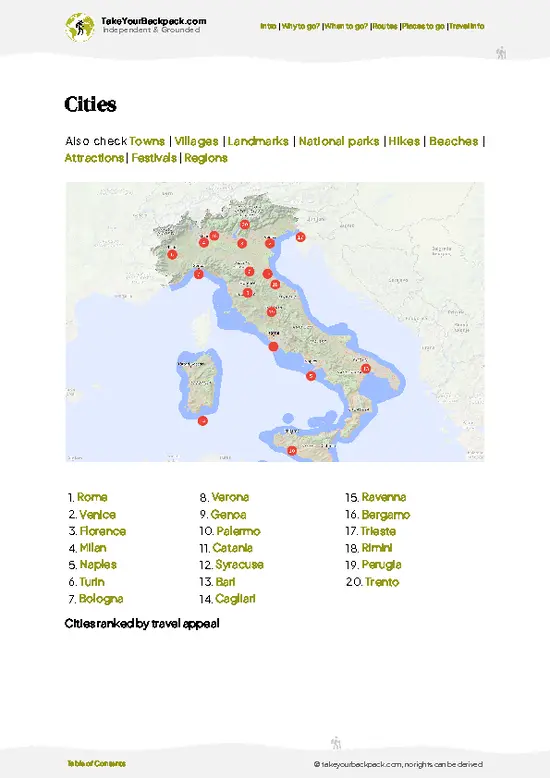
A visual overview of the country
Loading the map 🌍
CLICK TO FILTER
city
town
village
unique site
national park
hike
beach
attraction
festival
region
SHOW COUNTRY’S BESTSHOW ALL
film
0
0
0a
Uffizi Gallery
Pixabay
film
1
1
1a
Vatican Museums
film
2
2
2a
Pompeii Archaeological Park
film
3
3
3a
Accademia Gallery (Galleria dell’Accademia
film
4
4
4a
Borghese Gallery
Pixabay
film
5
5
5a
Doge’s Palace
film
6
6
6a
National Archaeological Museum of Naples
film
7
7
7a
Brera Art Gallery
film
8
8
8a
Capitoline Museums
film
9
9
9a
Teatro alla Scala
film
10
10
10a
Teatro di San Carlo
film
11
11
11a
Gardaland
Pixabay
film
12
12
12a
Spiaggia dei Conigli
Mauro Acquilini
film
13
13
13a
Cala Goloritzé
Tábata
film
14
14
14a
Cala Rossa
Mateusz Głowacki
film
15
15
15a
Spiaggia di Tropea
Mihai Gore
film
16
16
16a
Spiaggia di Baia del Silenzio
Giovanni Z. Italy
film
17
17
17a
Spiaggia di San Vito Lo Capo
Jefferson Andrade
film
18
18
18a
Cefalù
film
19
19
19a
Positano Beach
film
20
20
20a
Spiaggia di Sirolo
Gabriele Paris
film
21
21
21a
Sperlonga
film
22
22
22a
Spiaggia di Forte dei Marmi
film
23
23
23a
Spiaggia di Marina Piccola
Roberto Arneodo
film
24
24
24a
Rome
Pixabay
film
25
25
25a
Florence
Pixabay
film
26
26
26a
Venice
Pixabay
film
27
27
27a
Milan
Raffaele Messetti
film
28
28
28a
Naples
Anita Chambost
film
29
29
29a
Bologna
film
30
30
30a
Verona
Aneta Kupszta
film
31
31
31a
Genoa
Andrea Anichini
film
32
32
32a
Palermo
film
33
33
33a
Syracuse
Serghei Turcan
film
34
34
34a
Bergamo
Olaf Hunger
film
35
35
35a
Dolomites Alta Via 1
film
36
36
36a
Path of the Gods (Sentiero degli Dei)
film
37
37
37a
Sentiero Azzurro (Cinque Terre)
Pixabay
film
38
38
38a
Gran Paradiso Trek
film
39
39
39a
Dolomites’ Tre Cime di Lavaredo
Pixabay
film
40
40
40a
Matterhorn Circuit
Pixabay
film
41
41
41a
Tour of Monte Rosa
Jan Sůra
film
42
42
42a
Puez-Odle Altopiano
Pixabay
film
43
43
43a
Amalfi Coast
Sentiero Degli Dei
film
44
44
44a
Gran Paradiso
Michela Bugni
film
45
45
45a
Cinque Terre
Al Felicio
film
46
46
46a
Stelvio
Tom Van Huet
film
47
47
47a
Dolomiti Bellunesi
film
48
48
48a
Cilento and Vallo di Diano
Monica Russiani
film
49
49
49a
Arcipelago Toscano
film
50
50
50a
Gargano
film
51
51
51a
Abruzzo
Gabriele Giuliani
film
52
52
52a
Pollino
Carmine Anastasia
film
53
53
53a
Parco Nazionale del Gran Sasso
Maurizio Zampa
film
54
54
54a
Foreste Casentinesi
film
55
55
55a
Lago di Braies
Mathias De Pierrepont
film
56
56
56a
Costiera Amalfitana
Massimo Canciani
film
57
57
57a
Dolomites
Yan Helena
film
58
58
58a
Lake Como
Aakash
film
59
59
59a
Sardinia
Magda Sosinska
film
60
60
60a
Val d’Orcia
Paul Rudman
film
61
61
61a
Positano
Pwdigitalarts By Pw
film
62
62
62a
Amalfi
Arefin Gaming
film
63
63
63a
Matera
Max Roma
film
64
64
64a
San Gimignano
Muthuraja S
film
65
65
65a
Siena
Christian Borghetti
film
66
66
66a
Assisi
Luis Vidilla
film
67
67
67a
Alberobello
Nアトム
film
68
68
68a
Lucca
film
69
69
69a
Orvieto
Alby Set
film
70
70
70a
Montalcino
Alby Set
film
71
71
71a
Aosta
film
72
72
72a
Civitanova Marche
Gaetano Zarrilli
film
73
73
73a
Colosseum
Pixabay
film
74
74
74a
Piazza del Duomo, Pisa
Maximilian Richard
film
75
75
75a
Mount Etna
Doppy (winnie)
film
76
76
76a
Trulli of Alberobello
Alexey Slavko
film
77
77
77a
Royal Palace at Caserta
Around The World
film
78
78
78a
Archaeological Area of Agrigento
Paul Neighbour
film
79
79
79a
Tre Cime di Lavaredo
Pixabay
film
80
80
80a
Portofino
Florela Petculescu
film
81
81
81a
Noto
Viktorija Šmalc
film
82
82
82a
Cathedral at Piazza Grande, Modena
Damiana Facchin
film
83
83
83a
Le Colline del Prosecco di Conegliano e Valdobbiadene
Ngo Hai Anh
film
84
84
84a
Manarola
Aymen Mechiche
film
85
85
85a
Vernazza
Astrit Myrtaj
film
86
86
86a
Civita di Bagnoregio
Giustaggio Wild
film
87
87
87a
Castelmezzano
Luca Roberti
film
88
88
88a
Pienza
Alby Set

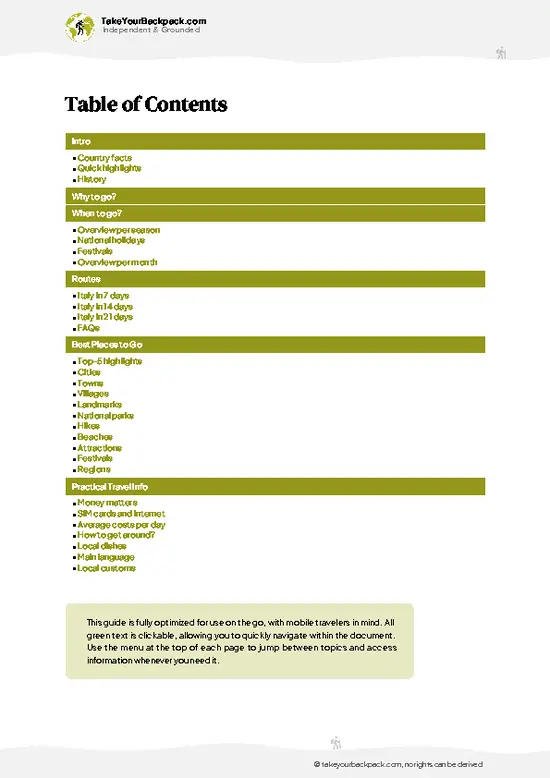
Why go?What makes this country worth the trip

Architecture

Italy pays you back, fast and hard, if you care about buildings. Layers stack in walkable distance: … read more 👉
Italy pays you back, fast and hard, if you care about buildings. Layers stack in walkable distance: Roman concrete that still sheds crowds, medieval street grids built for feet not cars, Renaissance math you feel in your legs on the Duomo climb, Baroque space-bending that messes with your depth perception. Then the moderns: Scarpa’s knife-edge graft at Verona’s Castelvecchio, Hadid’s MAXXI twisting light into circulation, Rationalist EUR’s “Square Colosseum” flexing propaganda in stone.

Pro tip: go at dawn and carry cheap binoculars. The real story hides in capitals, cornices, and tool marks.

I’ve learned more tracing a Scarpa joint with my fingers than from any plaque. Walk slow, sit often, watch the light move. We’ll separate the Essential from the Overrated so you don’t waste steps.

Food

Italy rewards eaters who travel with intent. Each region cooks like it invented dinner, and the rules … read more 👉
Italy rewards eaters who travel with intent. Each region cooks like it invented dinner, and the rules change every 100 kilometers. Naples means blistered pizza and fried things in paper. Bologna is ragù, hand-pinched tortellini, and mortadella you don’t need to apologize for. Rome runs on cacio e pepe and offal. Liguria is pesto that actually tastes like basil and sea. Sicily throws citrus, pistachio, and fish at you until you give in.

Match dish to place and you win. Chase carbonara in Venice and you’ll lose.

Pro tip: stand at the bar for coffee; sit and you’re paying rent. Coperto and bread aren’t free—wave the basket away if you won’t eat it. I still think about a Palermo afternoon: hot panelle and fried sardines eaten on a curb, with a cold beer and zero regrets.

Scenery

Italy pays you back in scenery if you’re willing to sweat. Dolomite spires at dawn, black lava underfoot … read more 👉
Italy pays you back in scenery if you’re willing to sweat. Dolomite spires at dawn, black lava underfoot on Etna, cold limestone caves on the Salento, chestnut forests swallowing old mule tracks in the Apennines, and sea cliffs dropping straight into blue off Sardinia. I’ve done the 5 a.m. trudge to Seceda’s ridge for that first burn of light, and I’ve chewed ash on a night ascent of Stromboli while the crater popped like a slow drum. Both were worth every step. The quiet wins too: a cheap winter ferry on Lake Como when the water is glass and the shoreline isn’t posing for anyone. Pro tip: skip August, chase sunrise, and move by regional trains and buses to dodge parking brawls. Pack a headlamp and a wind layer. Italy rewards the early and the stubborn.

Mountains

Italy is a mountain country first, postcard second. The Dolomites give you limestone cathedrals and … read more 👉
Italy is a mountain country first, postcard second. The Dolomites give you limestone cathedrals and World War I tunnels; the western Alps give you glaciers and big, honest climbs; the Apennines give you silence and wolf country. The rifugi network lets you hike light and eat hot polenta at 2,500 meters. The tradeoff: crowds swarm the easy postcards. Fine—work harder.

Essential: dawn on the Alta Via (I like a Locatelli sunrise over Tre Cime), Gran Paradiso as a first 4,000er, and multi-day loops in Adamello-Brenta. Overrated: midday Lago di Braies and the Seceda catwalk.

Pro tip: go in September, start before 6 a.m., and aim for weekdays. I’ve had the Lagazuoi tunnel to myself with a headlamp, then spent more on the cable car down than on last night’s hut bunk. Worth it.

People

Italians meet you with eyes, tone, and a joke before anything else. Earnest effort gets you adopted; … read more 👉
Italians meet you with eyes, tone, and a joke before anything else. Earnest effort gets you adopted; entitlement gets you ignored. Essential: the 8 a.m. bar counter, shoulder-to-shoulder at a market stall, long benches at a village sagra, the slow carriage of a regionale train. Overrated: glossy aperitivo strips, central squares clogged with cameras, any spot with an English-only menu. Expect teasing, advice, and unsolicited course corrections; it’s care disguised as banter. In Naples I butchered grazie and a baker stuffed a hot sfogliatella in my hand, then made me repeat it until I got it right. Pro tips: learn five phrases, greet first, stand at the bar, ask what they’d order, put your phone away, accept the extra biscotto, and never overtip.

Backpackers

Italy is built for backpackers: short hops, big payoffs, and a social scene that spills into the street. … read more 👉
Italy is built for backpackers: short hops, big payoffs, and a social scene that spills into the street. Regional trains are cheap—often hourly on the main corridors; validate the ticket or the conductor will tax your trip with a fine that hurts. Food is a budget ally—pizza al taglio for a couple euros, a Sicilian arancino for pocket change, and in the north, apericena loads a plate with your drink so dinner is handled. Hostels pull an easy mix in Rome, Naples, Palermo; the conversation continues on church steps and in midnight piazzas. I’ve crashed in Dolomite rifugi for hut-to-hut sunrises that rewired my brain, then washed city dust off in Ligurian swim coves. Pro tip: carry a bottle—Rome’s nasoni fountains and Alpine spouts keep refills free and cold.

Beach life

Italy pays off for beach life because the coastline changes every hour: glassy coves in Liguria, white-sand … read more 👉
Italy pays off for beach life because the coastline changes every hour: glassy coves in Liguria, white-sand bowls in Sardinia, lava shelves in Sicily, caves and long shallows in Puglia. You swim, you eat well, you nap, you do it again. The water gets properly clear—snorkel over seagrass on Ustica, drift along Tavolara’s drop-offs, or fin into the blue grottoes between Cala Luna and Bue Marino. Nightlife? Rimini and Gallipoli bring the bass without killing the sea-day.

Pro tips that matter: shoes for pebbles, cash for lidos, and hit shoulder season—June or September—when the water is warm and the crowds thin. Watch the wind; pick the leeward side to dodge jellyfish. I still rent a small gozzo in the Aeolians, cut the engine at sunset, and float with Stromboli throwing sparks in the distance. That’s the return on effort.

Uniqueness

Italy isn’t off-grid, but step off the postcard strip and it hits harder than countries with bigger … read more 👉
Italy isn’t off-grid, but step off the postcard strip and it hits harder than countries with bigger hype. Essential: Abruzzo’s high Apennines (Majella, Gran Sasso) where ridge walks run empty and rifugi still feel like mountaineers’ places. Essential: Sardinia’s Supramonte canyons and shepherd trails—wild, hot, and worth the salt. Essential: Aosta’s side valleys (Valpelline, Veny) for glacier views without the selfie scrum. Sicily’s Madonie and Nebrodi are slow, oak-scented, and honest.

Overrated: midday Cinque Terre and Amalfi’s buses-in-July—pay more, see less. Overrated: Instagram Dolomites like Braies at 10 a.m.—go dawn or go elsewhere.

Pro tip: carry cash; many rifugi don’t take cards. Tabacco/Kompass maps beat phone apps when the signal dies. I bivied above Campo Imperatore and woke to chamois on the scree—start early, sleep high, and Italy gives back.
Want the complete picture of Italy?
The offline Travel Guide brings everything together — routes, highlights & planning.

See what's included in the guide 👉

Get the Travel Guide -

⭐ HighlightsHighlights of Italy

  • Dolomites - Tre Cime di Lavaredo Loop (Essential): Chalky limestone dust gets into your socks, marmots whistle from the scree, and afternoon thunderheads build like a threat you can smell. You’ll pass rifugi that serve espresso to hikers with mud on their calves. I’ve watched the north faces glow pink, then go cold in minutes. Backpacker Hack: Catch the first bus from Cortina to Rifugio Auronzo to skip the toll and the convoy; walk counterclockwise, carry a shell for fast weather turns, and refill at rifugi taps because streams run dry late summer.
  • Rome - Palatine Hill, Forum, and Colosseum Combo (Essential): Resin from umbrella pines hangs in the heat while your fingers trace pitted marble older than most countries. Dust lifts off the Forum with every step, and crows heckle from the arches. The Colosseum’s outer ring feels colder than the sun-baked stones around it. Backpacker Hack: Buy the combo at the quiet Palatine entrance, do Palatine and Forum first in shade, then a late-day timed
read more 👉
  • Dolomites - Tre Cime di Lavaredo Loop (Essential): Chalky limestone dust gets into your socks, marmots whistle from the scree, and afternoon thunderheads build like a threat you can smell. You’ll pass rifugi that serve espresso to hikers with mud on their calves. I’ve watched the north faces glow pink, then go cold in minutes. Backpacker Hack: Catch the first bus from Cortina to Rifugio Auronzo to skip the toll and the convoy; walk counterclockwise, carry a shell for fast weather turns, and refill at rifugi taps because streams run dry late summer.
  • Rome - Palatine Hill, Forum, and Colosseum Combo (Essential): Resin from umbrella pines hangs in the heat while your fingers trace pitted marble older than most countries. Dust lifts off the Forum with every step, and crows heckle from the arches. The Colosseum’s outer ring feels colder than the sun-baked stones around it. Backpacker Hack: Buy the combo at the quiet Palatine entrance, do Palatine and Forum first in shade, then a late-day timed Colosseum slot; refill your bottle at the nasoni and ignore the first-Sunday free days unless you like queues.
  • Venice - Dawn Canals, Not St. Mark’s (Essential): Before breakfast, the city smells of brine and wet brick; delivery carts rattle over bridges and the oars on a sandolo thump like a heartbeat. You hear footsteps, not selfie-sticks. The water slaps mossy steps that will dump you if you’re careless. Backpacker Hack: Buy a 24-hour vaporetto pass, ride to San Giorgio Maggiore for a crowd-free bell-tower view, use public fountains to dodge café markups, and take a 2-3€ traghetto instead of a gondola when you just need to cross the Grand Canal.
  • Naples - Centro Storico and the Archaeological Museum (Essential): The air flips from frying anchovies to scooter exhaust in a block; church doors crack open to cool marble and candle wax. In the museum, Pompeii’s mosaics punch harder when you’ve got the street grit still on your shoes. Pizza crust here blisters and crackles loud enough to stop conversation. Backpacker Hack: Hit the museum first to read Pompeii later, sleep near Dante/Toledo for walkability, ride Metro Line 1’s art-station circuit, and carry small bills for sfogliatella and street snacks without card drama.
  • Amalfi Coast - Positano & Amalfi Towns (Overrated): Hot bus brakes stink on the cliff road, beach pebbles chew up bare feet, and an espresso costs triple what you paid in Naples for worse service and a view you share with a thousand tripods. The shoreline is carved into paid clubs, and the “old town” lanes are basically boutiques. Backpacker Hack: Base in Salerno or Minori/Maiori, ride the first ferries, hike the Path of the Gods past Nocelle toward Bomerano or down to Praiano to dodge the parade, and swim off the rocks at Marina di Praia; off the map, look to Abruzzo’s Campo Imperatore, Sardinia’s Supramonte coast, or Friuli’s Alpe Adria Trail—my personal favorite is a lonely bivacco above Passo Giau watching the alpenglow burn out.
Spotted a mistake or missing a highlight? Contact us.

But Italy offers more...

Discover and compare all of its highlights per category

🧭 RoutesPlanning a route that makes sense

The 7-Day Tuscan Classics Route

The Vibe: A relaxed, art-and-food-focused week centered on Florence and the Tuscan hills, perfect if you want depth over distance and minimal hotel changes. Expect cobbled streets, world-class galleries, and medieval town squares reached mostly by train and short bus rides.
The Highlights:
  • Renaissance masterpieces at the Uffizi Gallery and Accademia Gallery (Galleria dell’Accademia in Florence
  • Evenings in the brick-lined heart of Siena
  • Day trip to tower-crowned San Gimignano
  • Slow, wall-top strolls around Lucca

The 14-Day Italy Icons & Coast Route

The Vibe: A classic first-time circuit that links Rome, Florence, the Cinque Terre, and Venice at a comfortable pace, mixing blockbuster sights with time to wander and swim. You’ll ride high-speed trains and coastal locals, trading long bus days for scenic rail lines and ferry hops.
The Highlights:
  • Ancient and papal power in Rome with the Colosseum and Vatican Museums
  • Renaissance deep dive in Florence plus a medieval escape
read more 👉

The 7-Day Tuscan Classics Route

The Vibe: A relaxed, art-and-food-focused week centered on Florence and the Tuscan hills, perfect if you want depth over distance and minimal hotel changes. Expect cobbled streets, world-class galleries, and medieval town squares reached mostly by train and short bus rides.
The Highlights:
  • Renaissance masterpieces at the Uffizi Gallery and Accademia Gallery (Galleria dell’Accademia in Florence
  • Evenings in the brick-lined heart of Siena
  • Day trip to tower-crowned San Gimignano
  • Slow, wall-top strolls around Lucca

The 14-Day Italy Icons & Coast Route

The Vibe: A classic first-time circuit that links Rome, Florence, the Cinque Terre, and Venice at a comfortable pace, mixing blockbuster sights with time to wander and swim. You’ll ride high-speed trains and coastal locals, trading long bus days for scenic rail lines and ferry hops.
The Highlights:
  • Ancient and papal power in Rome with the Colosseum and Vatican Museums
  • Renaissance deep dive in Florence plus a medieval escape to Siena
  • Cliffside villages and trails around Manarola, Vernazza, and the Sentiero Azzurro (Cinque Terre)
  • Canals, palaces, and lagoon light in Venice with the Doge’s Palace

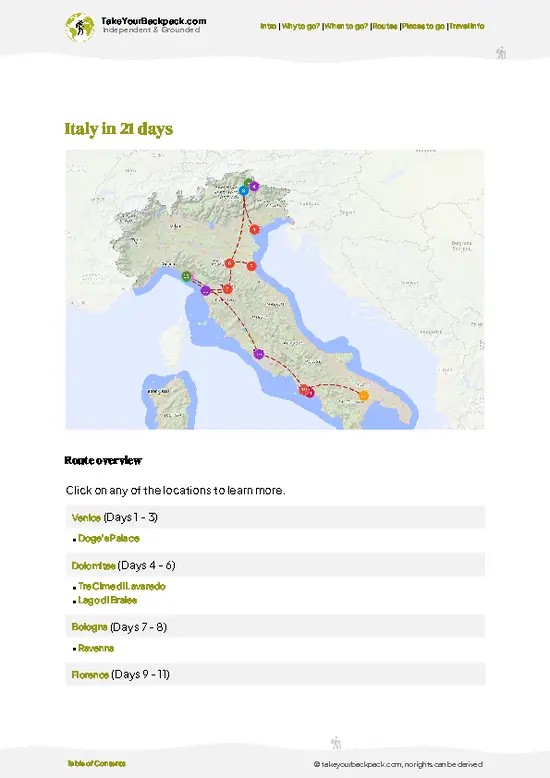
The 21-Day Grand Italy Loop

The Vibe: A three-week deep dive that stitches together Rome, the Amalfi Coast, Naples and Pompeii, Sicily, Florence, and the Dolomites into one big narrative arc. It’s designed for travelers who want ruins, volcanoes, hill towns, and high mountains in a single, well-paced journey using trains, buses, ferries, and a few guided transfers.
The Highlights:
  • Foundational days in Rome with the Colosseum and Vatican Museums
  • Cliffside hiking on the Path of the Gods (Sentiero degli Dei) from a base in the Costiera Amalfitana
  • Ruins and lava landscapes around Naples, the Pompeii Archaeological Park, and Mount Etna from Catania and Taormina
  • Renaissance Florence paired with alpine days along the Dolomites Alta Via 1 and in Dolomiti Bellunesi National Park
🌍 Want a ready-to-use travel plan for Italy?
The overview above compares different route options based on your travel time and style. The complete Travel Guide breaks each itinerary down in detail, including maps, stops, highlights, and transport information.

Explore all route details 👉

Get the Travel Guide -

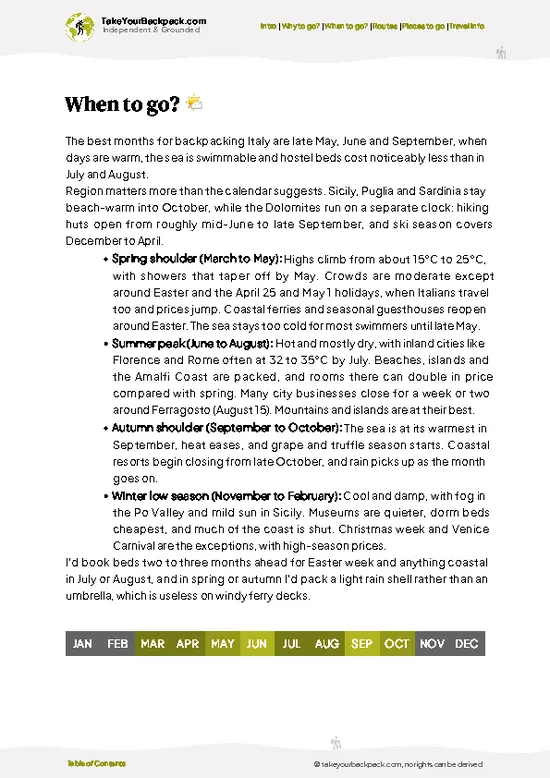
🌤️ When to go?When to go for the best experience

The sweet spot is late May to mid June and mid September to mid October. Warm days without the asphalt bake; seas swimmable; mid-elevation Alps open. After spring holidays and once school is back, beds drop to sane rates and lines loosen. Amalfi buses, Cinque Terre paths, the Vatican—still busy, but you can breathe. Markets brim, harvests hit menus, and ferries keep workable schedules. This window is Essential. July-August is Overrated unless you’re chasing festivals and bathtub-warm water.
  • Peak (July-August): Lines coil at Pompeii before breakfast, dorms price like hotels, and coastal buses wheeze past full. The upside is raw: midnight swims off Sicily, piazzas alive past midnight, Dolomites huts fully open, daylight for a bonus hike. If you crave heat and buzz, take the hit.
  • Shoulder (late May-June; mid-September-mid-October): Momentum. Shutters lift, ferries add runs, trails dry, and the country shifts from prep to pace. Autumn exhales—grape trucks, chestnut smoke, crisp views. Late spring pops with wildflowers and warming water. Prices ease, reservations get sane, and you move instead of queueing. Best balance for miles, meals, and mood.
  • Off-Peak (November-March): The Interior. Museums breathe; hill towns echo; you hear your footsteps. Expect rain streaks, short days, and closed passes in the north. Southern coasts stay workable and cheaper. Survival hack: wear a base layer, carry a compact umbrella, book heated rooms, and time travel legs to land before dusk.

I lock discounted high-speed train fares early and keep lodging cancellable, but I always pack a rain shell and one warm layer—even in June.

source: climatestotravel.comJANJanuary: fair for travelingFEBFebruary: fair for travelingMARMarch: good for travelingAPRApril: good for travelingMAYMay: highly recommended for travelingJUNJune: excellent for travelingJULJuly: good for travelingAUGAugust: good for travelingSEPSeptember: excellent for travelingOCTOctober: highly recommended for travelingNOVNovember: fair for travelingDECDecember: fair for traveling
📅 Traveling in a specific month?
Get a full month-by-month breakdown of weather, crowds, costs, festivals, and seasonal highlights in the complete travel guide.

Get full details when to go 👉

Get the Travel Guide -
!2021-08-09 07.36.51

💰 Costs (as of 2026)How expensive it really is

Plan on €65-€90 per day in Italy if you sleep in dorms, ride regional trains, and eat from counters instead of menus with pictures.
  • dorm accommodation: €20-35 in the south and smaller cities; €28-45 in Bologna/Turin/Naples; €35-55 in Rome/Florence/Venice, higher at peak. City tax is a quiet extra (€2-4 per night) and often cash. Linens are usually included; “breakfast” is often a croissant and coffee, not fuel for a big day. System tip: shortlist on the big apps, then email the hostel—direct bookings often shave 5-10% and let you confirm the tax up front. Aim Mon-Thu and outside the historic cores; a 15-minute tram ride can save €10 a night. Bring a padlock; lockers exist but not always locks.
  • meals: Supermarket Survival: €8-12/day if you stick to bread, fruit, yogurt, canned tuna, and a cheap espresso at the bar (standing). Street-food reality: pizza al taglio by weight (€3-6 a big slab), panini (€4-7), arancini/supplì (€2-3), gelato (€2.50-3.50 for two scoops if you avoid tourist squares). Aperitivo in the north can be the best dinner value—€8-12 for a drink plus a legit snack spread. Sit-down trattorie run €12-18 for a primo, €18-28 for a secondo; “coperto” (cover) adds €1-3 per person,
read more 👉
Plan on €65-€90 per day in Italy if you sleep in dorms, ride regional trains, and eat from counters instead of menus with pictures.
  • dorm accommodation: €20-35 in the south and smaller cities; €28-45 in Bologna/Turin/Naples; €35-55 in Rome/Florence/Venice, higher at peak. City tax is a quiet extra (€2-4 per night) and often cash. Linens are usually included; “breakfast” is often a croissant and coffee, not fuel for a big day. System tip: shortlist on the big apps, then email the hostel—direct bookings often shave 5-10% and let you confirm the tax up front. Aim Mon-Thu and outside the historic cores; a 15-minute tram ride can save €10 a night. Bring a padlock; lockers exist but not always locks.
  • meals: Supermarket Survival: €8-12/day if you stick to bread, fruit, yogurt, canned tuna, and a cheap espresso at the bar (standing). Street-food reality: pizza al taglio by weight (€3-6 a big slab), panini (€4-7), arancini/supplì (€2-3), gelato (€2.50-3.50 for two scoops if you avoid tourist squares). Aperitivo in the north can be the best dinner value—€8-12 for a drink plus a legit snack spread. Sit-down trattorie run €12-18 for a primo, €18-28 for a secondo; “coperto” (cover) adds €1-3 per person, and table service bumps coffee from €1.20 to €3+. Compared with Spain/Portugal, expect to spend 10-25% more to feel equally fed; compared with France, Italy is similar outside Paris. Tip from the road: Rome’s street fountains (nasoni) kept me from buying three bottles a day in August; free, cold, everywhere.
  • local transport: The cheapest way to unlock the country is Regionale trains: €6-12 for 60-120 minutes of travel (think Florence-Pisa, Naples-Salerno), €15-25 for longer hops. They’re slower but reliable, and no reservation fees. High-speed Frecce/Italo slice hours but slice your budget too (€25-70+ per leg); book well ahead if you must. Intercity buses (including the pan-European players) run €5-20 on off-peak routes and beat trains on some north-south jumps. In cities, a 90-100 minute ticket costs €1.50-2; day passes €4-7. Always validate paper tickets; inspectors are relentless, and I watched a backpacker lose €50 for a “forgot to stamp” mistake on a two-stop ride.
  • activities: Big drivers: headline museums and timed monuments. Uffizi/Accademia €20-30 in season, Colosseum/Forum integrated tickets ~€16-22, Vatican Museums €17-25, Duomo climbs €15-20. Venice gondolas are a fixed luxury (€80 day, ~30-40 minutes; more at night). Beach clubs (lidi) charge €15-30 for an umbrella and chair; hikes are free unless you’re in managed parks like Cinque Terre (trail pass €7-14/day depending on train bundle). Winery tastings in rural areas are sane (€10-20) if you skip tour-bus estates. City passes only pay if you stack 3+ paid sights in 24-48 hours; otherwise churches, piazzas, markets, and hill walks give you the best return.
  • miscellaneous: Budget leaks: ATM markups and dynamic currency conversion (decline it); laundry €5-8 self-service; baggage storage €6-10; paid bathrooms €1; “pane e coperto” you didn’t ask for; seat surcharges at cafés; tiny bottles of water on hot days (use fountains instead); short-hop taxis in old towns. Data is cheap by European standards—€10-15 gets a month of local SIM data if you bring ID. Tipping isn’t a thing beyond rounding; service is typically included. Versus neighbors: Italy is kinder than Switzerland by half, pricier than the Balkans by a long shot, and sits between France and Spain for day-to-day burn. Small tip: when a gelateria posts by weight, ask for “due euro” and watch them scoop; it keeps portions (and surprises) under control.
⚠️ Prices can change and everyone travels differently, so take this as a rough guide. Hope it helps you plan your adventure!

✈️ The backpacker research shortcutItaly Travel Guide

An offline-friendly backpacking guide with optimized travel routes, ranked highlights, transport advice, and the best areas to stay.
example page 0 from our offline Travel Guide for Italyexample page 1 from our offline Travel Guide for Italyexample page 2 from our offline Travel Guide for Italyexample page 3 from our offline Travel Guide for Italyexample page 4 from our offline Travel Guide for Italyexample page 5 from our offline Travel Guide for Italyexample page 6 from our offline Travel Guide for Italyexample page 7 from our offline Travel Guide for Italy
The digital guide (542 pages) contains:
148 highlights, ranked by travel appeal
Optimized 7, 14 & 21-day travel routes
Best neighborhoods to stay
How to get around
Offline-friendly for travel without Wi-Fi
👉 See all 30+ guide features

📅 Plan smarter in minutes, not weeks
Month by month travel advice
Festivals & national holidays
Budget expectations

🗺️ Go to the right places, skip the overrated ones
Honest pros & cons of destinations
Top hikes, parks & viewpoints
Lesser-known places most travelers miss
Clear “worth it vs skip it” guidance

🛏️ Travel smoothly without rookie mistakes
Best areas to stay
Transport systems explained simply
Common scams & safety advice
SIM cards, money & practical tips

🌍 Understand the country, not just visit it
Culture & traditions
52 Essential phrases & customs
Festivals worth planning around
Traveler-friendly historical context
Insights that make places more meaningful

📱 Built for real travel conditions
Fully downloadable PDF
Works completely offline
Optimized for phone use
Useful in remote areas & buses
Everything in one place
Save weeks of stressful planning
Get instant access to the full guide directly. 30-day money-back guarantee.


Sent to your inbox immediately after payment • 100% Secure Checkout
Best Backpacking Travel Advisor 2025 tourism awardBest Backpacking
Travel Advisor
2025
What others say about Take Your Backpack Guides:
⭐⭐⭐⭐⭐
Fantastic, amazing amount of information!
⭐⭐⭐⭐⭐
My goodness this is amazing, it's what I've been looking for hats off too you!
⭐⭐⭐⭐⭐
I think this is absolutely BRILLIANT
⭐⭐⭐⭐
Very complete and informative. It's still missing places, but I gotta to commend you
⭐⭐⭐⭐⭐
This is truly amazing, thank you, can't wait to explore it with my kids!
⭐⭐⭐⭐⭐
Awesome resource, thank you!
⭐⭐⭐⭐⭐
This is amazing! Can't wait to explore the ones I haven't seen
⭐⭐⭐⭐
I love this! Well done, great idea.
⭐⭐⭐⭐⭐
Thanks for taking the time to make this gem!
⭐⭐⭐⭐⭐
This might be the best website I've ever seen.
⭐⭐⭐⭐⭐
Congratulations, and thank you so much for your work; it's incredibly valuable.
⭐⭐⭐⭐
In all seriousness I think you did a great job pointing out the important spots
⭐⭐⭐⭐⭐
10/10 very good
⭐⭐⭐⭐⭐
As someone who's only just starting to visit regularly this is awesome, thank you.
⭐⭐⭐⭐
Thank you very much! I'm going to visit my dad, it's going to be very useful!
⭐⭐⭐⭐⭐
This is really cool! We'll be travelling for the first time and this definitely come in handy.
⭐⭐⭐⭐⭐
You are now our minister of culture, congratulations 👨‍💼
⭐⭐⭐⭐⭐
Just wanted to tell you that this is a pearl! Going to follow your recommendations.
⭐⭐⭐⭐⭐
This is so cool. I'll definitely be using the resource for my travels soon.
⭐⭐⭐⭐⭐
This is very impressive! Good work.
⭐⭐⭐⭐⭐
This is an amazing and informative site. Very well done!

🛏️ Where to stay?Areas travelers tend to prefer

Yes — hostels and budget guesthouses are widespread across Italy, especially in major cities, tourist towns and near train stations; book ahead for summer and holiday weekends to avoid paying a premium or being stuck with very limited options.
Best concentrations: Rome — Termini (cheapest, top transport links, noisy and can feel seedy at night), Trastevere (atmosphere and nightlife, slightly pricier), Monti (central and quieter); Florence — Santa Maria Novella (near train and sights, busy), Oltrarno (quieter, local vibe); Venice — Cannaregio (more budget options, residential and safer at night), … read more 👉
Yes — hostels and budget guesthouses are widespread across Italy, especially in major cities, tourist towns and near train stations; book ahead for summer and holiday weekends to avoid paying a premium or being stuck with very limited options.
Best concentrations: Rome — Termini (cheapest, top transport links, noisy and can feel seedy at night), Trastevere (atmosphere and nightlife, slightly pricier), Monti (central and quieter); Florence — Santa Maria Novella (near train and sights, busy), Oltrarno (quieter, local vibe); Venice — Cannaregio (more budget options, residential and safer at night), Dorsoduro (student scene and bars); Milan — Central/Brera (good transport, pricier), Navigli (nightlife); Bologna — Station/student area (cheap, lively); Naples — Historic Centre (very central, chaotic and noisy).
Trade-offs are clear: station areas save time and cash but add noise and late crowds, central/atmospheric neighborhoods cost more but put you next to highlights, and choosing dorms over private rooms maximizes savings at the expense of privacy and sometimes secure storage.

If you enjoy meeting fellow travelers, consider choosing hostels with high ratings for atmosphere. On the other hand, if you prefer having your own space, a hotel might be a better option.

🚌 Getting aroundPublic transport and other ways to get around

Italy moves like a timetable scribbled on a wine-stained napkin. The high-speed rails hum to the minute, then a regional train drifts in five late with a shrug. Drivers improvise, conductors enforce, and the north plays stricter than the south. You win by reading the mood and the clock at the same time: buy ahead for the big jumps, travel early, validate everything, and keep your bag where you can feel it.
  • Intercity Trains (Frecciarossa/Italo + Regionale) The speed is real and the savings are too,
read more 👉
Italy moves like a timetable scribbled on a wine-stained napkin. The high-speed rails hum to the minute, then a regional train drifts in five late with a shrug. Drivers improvise, conductors enforce, and the north plays stricter than the south. You win by reading the mood and the clock at the same time: buy ahead for the big jumps, travel early, validate everything, and keep your bag where you can feel it.
  • Intercity Trains (Frecciarossa/Italo + Regionale) The speed is real and the savings are too, if you commit early. Super-economy fares slash the price of Milan-Rome to bus money, with reserved seats, power sockets, and air-con that actually works. Last-minute, you pay a tourist tax in time or euros. For short hops, a Regionale Veloce costs half but adds 30-60 minutes and no seat guarantee. Validate regional tickets, sit tight through “sciopero” ripples, and board early to claim overhead space. Essential for long north-south jumps; overrated for sub-200 km routes where regionale wins the math.
  • City Buses and Metro You step into the local bloodstream. Validate the moment you board, backpack on your front, and yield seats without ceremony. Lines are suggestions at rush hour, doors open like a scrum, and inspectors appear when you least expect. Rome’s metro is quick but crowded; Naples runs on eye contact and elbows; Turin and Milan feel more orderly. Small talk is minimal, but a clipped “permesso” clears a path. Cheap, frequent, and unavoidable. Essential.
  • Ferries and Vaporetti Water redraws the map. In Venice, boats are the street grid; nothing else touches the lagoon islands, and a 24-72 hour pass pays back fast if you ride often and off-peak. On coasts, ferries stitch Capri, Ischia, Elba, and Aeolian towns that trains ignore. Wind can cancel plans and fares jump in high season, so carry layers and a stomach that forgives chop. Essential in Venice and for island runs; overrated where rails parallel the shore and you’re chasing a “view” you can get from a cliff walk.
  • Long-Distance Buses (Itabus, FlixBus, Marino) The quiet rebellion against rail sticker shock. Book early and you undercut high-speed trains by half, sometimes more, with direct links that dodge transfers. Seats recline, Wi-Fi limps, and delays stack at Autogrill stops and ring-road traffic. Terminals live in awkward suburbs, drivers charge for big bags, and 6 a.m. arrivals test your patience and your caffeine plan. Brutal on weekends, gold on weeknights. Essential as a budget disruptor when advance train deals are gone.

Master tip: Anchor your route with one early high-speed ticket bought weeks ahead, then stitch the rest with regionale trains and a single night bus to skip a hostel night, always validating paper tickets and traveling before 9 a.m. to dodge heat, crowds, and delay creep.
Short answer
Rome has two airports. Fiumicino (FCO) is about 30 km/19 mi from the center; Ciampino (CIA) is about 15 km/9 mi. Most people aim for Roma Termini station as the “city center” reference.

From Fiumicino (FCO - Leonardo da Vinci)
  • Leonardo Express (non-stop train to Termini) — 32 minutes, about €14 one way. Runs roughly every 15 minutes most of the day.
  • Regional FL1 train (to Trastevere, Ostiense/Piramide, Tuscolana, Tiburtina) — 30-55 minutes depending on where you get off; €8 to those stations. To reach Termini, add a Metro ride (about €1.50) from Tiburtina or Piramide.
  • Airport buses to Termini (Terravision, SIT, T.A.M., etc.) — 45-70 minutes depending on traffic; typically €6-€8 if bought online or at the kiosk.

From Ciampino (CIA)
  • City bus + Metro (ATAC 520 to Cinecittà for Metro A, or 720 to Laurentina for Metro B) — 45-60 minutes; one 100-minute ticket covers both, about €1.50 total.
  • Shuttle bus to Termini (Terravision, SIT, ATRAL, etc.) — 40-60 minutes; usually €6-€8.
  • Bus to Ciampino town station + regional train to Termini — around 30-45 minutes total; about €2-€3 combined.

Taxi options
Official white Rome taxis (look for the “Comune di Roma” crest) have fixed fares to the historic center (within the Aurelian Walls): from FCO it’s €50; from CIA it’s €31. Price includes luggage and up to 4 passengers. Expect 35-60 minutes from FCO and 25-45 minutes from Ciampino, depending on traffic.

Useful tips
  • Buy train/bus tickets from airport machines, kiosks, or official apps/websites. Validate paper tickets on regional trains and buses before boarding; Leonardo Express tickets bought for a specific train don’t need stamping.
  • Morning/evening rush hours and rainy days can add serious time to bus and taxi rides—if you’re catching a train or tour, take a train from FCO to be safe.

All times and prices are typical for 2025; they can change, so check schedules and fares before you travel.
⚠️ Prices and routes can change, so take this as a rough guide and ask for local advice when you arrive.

🔒 Safety (risk Level: low)What first-time visitors should know

Safety for solo travelers, including women and LGBTQ+ individuals
Italy is generally safe for solo travelers, including women and LGBTQ+ individuals. Major cities like Rome, Milan, and Florence have diverse communities and are accustomed to tourists, but be cautious of pickpockets, especially in crowded areas. For LGBTQ+ travelers, larger cities offer a more inclusive atmosphere, though some rural areas might be less progressive. Always stay aware of your surroundings and trust your instincts, just like anywhere else.


Full official government travel advisory (live updates)
View details 👉

✈️ VisaVisa requirements for Italy

Visa requirements for Italy depend on your nationality. Travelers from the U.S., Canada, and Australia can stay without a visa for up to 90 days within a 180-day period. If you need a visa, apply through the Italian consulate or embassy in your country by filling out the Schengen visa application form, providing a valid passport, and proof of accommodation and financial means.

source: vistoperitalia.esteri.it
⚠️ Visa requirements can change over time, so always check the latest visa requirements with the official embassy or government website before you travel.

🎒 What to pack?Packing essentials for the trip

Italy’s climate can be a real mixed bag, so pack with versatility in mind. Summers can get scorching, particularly in the south, while the north can be a bit more temperate and even chilly at night. Winters in northern cities, like Milan or Turin, might surprise you with their cold snaps, so a warm layer is essential. If you’re planning to hit the beach, a swimsuit is a must, but also remember some churches and religious sites require modest clothing—think covered shoulders and knees. Finally, Italy’s cobblestone streets aren’t forgiving on feet, so pack comfy shoes for all those walking tours and gelato sprints.

Apart from this country specific advice, I have also crafted a general packing list that should help on any trip. authorOver the years, I've learned the importance of packing minimally. It's so much easier to jump on the back of a truck or squeeze yourself into the last spot of a minibus without that supersized backpack. If you're headed to a warm destination, leave your winter jacket at home; for colder regions, opt for thin thermal underlayers. Instead of packing your entire wardrobe, bring just three sets of clothes, as laundry facilities are available everywhere.
View the full list 👉
🎒 Planning the practical side of your trip?
Get detailed information on transport, daily budgets, internet access, local customs, food, language, and other essentials in the complete Travel Guide.

Get detailed practical information 👉

Get the Travel Guide -

🙋 FAQCommon questions before visiting

Trip Planning


Personal tip: I normally search on good rating for atmosphere (for meeting people) and location (for easy exploring). Cleanliness as a bonus.


Travel Essentials

Routine vaccinations are usually sufficient for Italy. Ensure you’re up-to-date on:

- Measles, Mumps, Rubella (MMR)
- Diphtheria-Tetanus-Pertussis
- Polio
- Varicella (chickenpox)
- Yearly flu shot

Consider Hepatitis A if you’re planning to explore rural areas or try street food. Hepatitis B is recommended if you might have close contact with locals or travel extensively. No special vaccines are required otherwise. Always check with a healthcare provider.


vaccination requirements
When I first started traveling, I often spent part of my first day in a new country hunting for a local SIM card. While this can still be slightly cheaper, it also takes time and planning.

These days, it's much simpler to install an eSIM before leaving home. Once you arrive in Italy, you can activate it immediately and have mobile data from the moment you land — which is especially useful for ordering transport or navigating away from busy airports.

There are many providers nowadays, and price differences are usually small. I personally go with Airalo, as it offers excellent network coverage throughout the country and strong global coverage, so you can manage multiple countries from a single app.


Get your e-sim for Italy

Culture & Customs

Dress modestly when visiting churches; cover shoulders and knees. Italians appreciate punctuality less than some cultures, so expect flexible start times. Use both hands to gesture, but avoid the ”OK” hand sign, as it’s considered rude. Always greet with a ”buongiorno” or ”buonasera” when entering shops. Avoid discussing sensitive topics like politics or religion unless you’re familiar with the locals. LGBTQ+ travelers generally find Italy welcoming, but public displays of affection might attract attention in smaller towns. Women should be aware that some men may be more forward than expected; a firm ”no” usually suffices. Always try to speak a little Italian—locals appreciate the effort.
Trying traditional food is always a great way to experience the culture. Here are some must-try dishes for Italy.
  • Pizza Margherita: Originating from Naples, this classic pizza features a thin crust topped with tomato sauce, mozzarella cheese, and fresh basil. It’s simple but showcases the quality of Italian ingredients.
  • Risotto alla Milanese: A creamy rice dish from Milan, made with arborio rice, saffron, and plenty of butter and cheese. It’s a luxurious staple of northern Italian cuisine.
  • Lasagna: Layers of pasta, meat sauce, béchamel, and cheese baked to perfection. This hearty dish is a Sunday favorite in many Italian homes, especially in Emilia-Romagna.
  • Osso Buco: A specialty from Lombardy, this dish consists of braised veal shanks cooked with white wine and broth. It’s often served with a side of risotto or polenta.
  • Gelato: Italy’s take on ice cream, made with milk, sugar, and various flavorings. It’s denser and more flavorful than regular ice cream, making it a must-try for dessert lovers.
  • Carbonara: A Roman pasta dish made with eggs, cheese, pancetta, and pepper. It’s a comforting and rich meal that highlights the simplicity and flavor of Italian cooking.
Yes, tap water in Italy is generally safe to drink, and locals often do. However, in older buildings or remote areas, pipes might affect water quality, so using bottled or filtered water is a safe bet. If you’re unsure, ask locals or check for signs near taps.
The main language in Italy is Italian. Backpacking is way more rewarding if you know a bit of the local language, so I'd suggest brushing up on the basics just in case your Italian skills have become a bit rusty.

Want to understand locals better?
The complete Travel Guide for Italy includes 52 essential words and phrases — greetings, thank-yous, ordering food, transport, numbers, and common local expressions you'll actually hear.

Get your local basic phrases 👉

Get the Travel Guide -


In Italy, English proficiency varies significantly by region and demographic. Major tourist destinations like Rome, Florence, and Venice typically have a higher concentration of English speakers, particularly in hotels, restaurants, and shops catering to tourists. Younger Italians and those in urban areas are generally more fluent in English, often due to education and exposure to global media.

However, in rural areas or smaller towns, English may be less commonly spoken, and locals might have limited proficiency. It’s advisable for travelers to learn a few basic Italian phrases, as this can enhance interactions and show respect for the local culture.

While many Italians are eager to help and communicate, relying solely on English in less touristy areas may lead to challenges. Overall, while English is widely understood in tourist hotspots, having some Italian phrases at your disposal can enrich your travel experience.

Money & Payments

The local currency of Italy is EUR (€).

Traveling in Italy? Here’s the lowdown on handling money:

ATMs: They’re all over the place, especially in cities and larger towns. Look for ”Bancomat” signs. Stick to ATMs attached to banks for better security and fees.

Cash: Carry some euros for small purchases like coffee or gelato. Many places prefer small notes, so avoid anything over €50 if you can.

Dollars or Euros: Euros are king here. Don’t bother with dollars; you’ll get hit with bad exchange rates if you try to use or exchange them.

Card Acceptance: Credit and debit cards are widely accepted in tourist areas, but small shops, especially outside big cities, might be cash-only. Always ask before you buy.

Exchanging Money: Use ATMs for the best rates. Currency exchange offices in tourist spots tend to have hefty fees. Avoid airport exchange counters unless you’re desperate.

Tipping in Italy isn’t mandatory, but leaving a small amount for good service is appreciated. In restaurants, rounding up the bill or leaving a couple of euros is common. Tipping taxi drivers and hotel staff is not expected, but you can round up fares or leave small change if you wish.

🧩 Nearby countriesOther countries to combine with Italy

📸 PhotosA visual impression of the trip

Take your backpack - Italy - 0
Take your backpack - Italy - 1
Take your backpack - Italy - 2
Take your backpack - Italy - 3
Take your backpack - Italy - 4
Take your backpack - Italy - 5
Take your backpack - Italy - 6
Take your backpack - Italy - 7
Take your backpack - Italy - 8
Take your backpack - Italy - 9
Take your backpack - Italy - 10
Take your backpack - Italy - 11
Take your backpack - Italy - 12
Take your backpack - Italy - 13
Take your backpack - Italy - 14
Take your backpack - Italy - 15
Photographed by: Johan Kruseman

Observations and takeaways

Conquering some vertigo to reach that unique party place in the Dolomites

Conquering some vertigo to reach that unique party place in the Dolomites

Italy | Yet another average holiday: flight ticket bought for correct day but incorrect year 🙈, so jumped in my 🚗, to get to the dolomites in time, picked a mountain pass but there was a gas leak discovered in the village so the only road was closed for 3 hours, made it just in time to our starting point to hike the same evening to our first mountain but a...
Read more
Venice without tourists

Venice without tourists

Italy | While backpacking Slovenia i found out that Venice was just around the corner. Though it was hard to leave the rocky mountains and turquoise blue rivers behind for a few days, Venice without cruise ships was something i could not let pass by. Check out how peaceful Venice can be...
Read more
More stories

We 💚 feedbackKey takeaways from the trip

Go to Italy for the density: you can hike limestone spires at dawn, eat lunch that only exists in that valley, then stand with Caravaggio by sunset—all in a week by train. The tax is crowd management and price cliffs in the big-hitters; in July, a dorm bed in Venice can cost what a private does in Andalusia, and major museums run on time slots. Essential: Dolomites, Rome after dark, Naples for grit and flavor, Sicily beyond the coasts. Overrated: Cinque Terre in peak months, Pisa beyond the field, Amalfi without an off-season plan. Strategic tip: pick two regions and base in mid-size towns on regional lines; day-trip, book the choke points, and breathe.

✈️ When did I visit Italy?
Italy I have vistited a couple of times: Rome already when I was still in high school, and I did a 7 day hike in the Dolomites in 2021. Since then, this guide is regularly updated based on feedback from locals and recent backpackers (last update: 7 January 2026)

✍️ Help improve this page!
The information on this page is based on my own backpacking experience in Italy, supplemented with up-to-date research and feedback from other travelers. Travel details can change, so if you notice anything outdated or incomplete, feel free to let me know.


🙋‍♂️ Give feedback

👋 Meet the founderWho’s Behind Take Your Backpack?

Johan, backpacker and founder of TakeYourBackpackHi, I’m Johan (Netherlands 🇳🇱), the creator of TakeYourBackpack. Over the past decade, I’ve backpacked through 80+ countries across six continents, gaining extensive experience with independent travel, long-term trips, and overland routes.

This site is built on a combination of firsthand travel experience and carefully curated insights from other backpackers. Many guides are based on places I’ve personally visited, while others bring together tips, observations, and practical advice shared by trusted travelers I’ve met along the way.

The goal is to provide realistic, experience-driven guidance — not generic itineraries — so you can explore destinations with better context, clearer expectations, and more confidence.

Get Full Country Guide |
Instant download • 148 highlights • Full Offline guide