×
Liberia 🇱🇷

backpacking Africa Liberia 🇱🇷Move slowly through coastal forest towns and markets.

Explore LesothoExplore Libya

Backpacking Liberia in 2026

A complete guide including when and where to go, costs, transport, itineraries, and practical travel advice.
The big picture before you go

Backpacking Liberia
By Johan Kruseman 🇳🇱 | Updated June 5, 2026

The biggest myth is that Liberia is war scars and off-limits to backpackers. On the ground it runs on sea breeze, wood smoke, and jokes in Kolokwa. It’s a coastal republic with rainforest in its lungs and a rhythm that rewards anyone who shows up curious.

Robertsport’s point breaks peel past dugout canoes, and empty sand lets you hear your heartbeat between sets. In Monrovia, pepper soup clears your sinuses, hipco spills from shared taxis, and evenings end with palm wine under a weak streetlight. Sapo’s jungle presses close—buttress roots, hornbills, rain tapping a thousand green drums. Yes, roads wash out, transport crawls, checkpoints test patience, and heat sits on your shoulders—yet the payoff is visceral: clean wave, dawn steam lifting off river stones, a beer on a tin-roofed porch, earned.

Next to Sierra Leone’s polished beach circuits, Côte d’Ivoire’s big-city gloss, and Guinea’s highland trails, Liberia feels raw and intimate. It’s for travelers who can ride the wait, surf before breakfast, follow stories into markets, and measure luxury by space, salt, and hellos.

👉 Get the 📖 Travel Guide of Liberia

Monrovia & the Sinkor–ELWA Strip

Monrovia hits first: diesel in the air, horns, sandals slapping on wet pavement at Waterside Market. It’s chaotic, but it works if you base yourself along Sinkor to ELWA where you can move on foot and by keh-keh. RIA is a straight shot; an hour feels normal, two in rain. Days mean errands, museums, the Ducor’s haunted hill. Evenings mean feet in sand, pepper soup sweat, a cold Club Beer while the sky goes copper. Stay central, carry small bills, skip West Point after dark, and you’ll find the city’s rhythm quickly.

Robertsport & Lake Piso

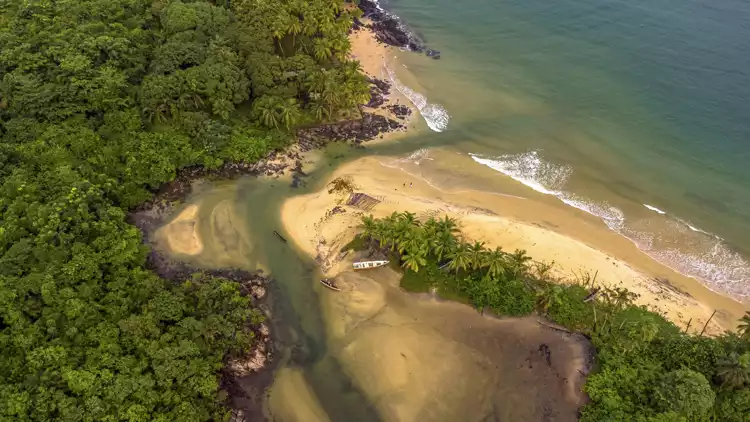
Northwest is for salt and patience. The road is mostly smooth, then breaks into pothole chess before Robertsport when the rains chew it up. You come for left-hand points that peel forever, dugout canoes tilting through shorebreak, and grilled barracuda eaten with sandy hands. Lake Piso sits calm behind the dunes—good for paddles when the ocean’s mean. Cash only, power blinks, bring a headlamp. If you surf, you’ll stay longer than planned; if you don’t, the campfire and star-slammed nights still make the ride worth it.

Gbarnga–Ganta–Nimba Highlands Spine

This inland corridor rewards the traveler who likes movement. Shared taxis stream from Red Light; checkpoints slow you, so keep copies of your ID and small notes. Gbarnga is your springboard—motorbike to Kpatawee Falls for cold, brown water and slick rock scrambles. Push on to Ganta’s border bustle, then Yekepa’s iron-ore hills and cooler air. Trails in East Nimba shift from red dust to clay; expect sweat and views over scarred ridges. Street grills take care of dinner: goat skewers, plantain, ginger beer that bites.

Sapo National Park & the Deep Southeast

This is the hard one. The coastal spine through Buchanan–Greenville–Harper turns to mud and broken bridges in the rains. You arrange a ranger, carry your own food, and wade rivers with leeches tapping at your socks. The payoff is forest that feels ancient: hornbills at dawn, chimp calls far off, fresh pygmy hippo prints on a sandbar if luck shows up. It’s for expedition minds who like uncertainty and sleep fine in a hammock under a tarp.

Marshall & Buchanan Coast

Short on time? Work this stretch. Marshall’s mangroves offer quiet canoe drifts and birdlife within a day trip of the city. Buchanan sits farther, reachable by a steady taxi run; the beaches sprawl, the Atlantic pounds, and you pick your swimming windows carefully. It’s a softer version of the southeast: seafood shacks, cold beer in the shade, and a wide, wind-cut horizon when you need the city out of your ears without committing to a multi-day slog.
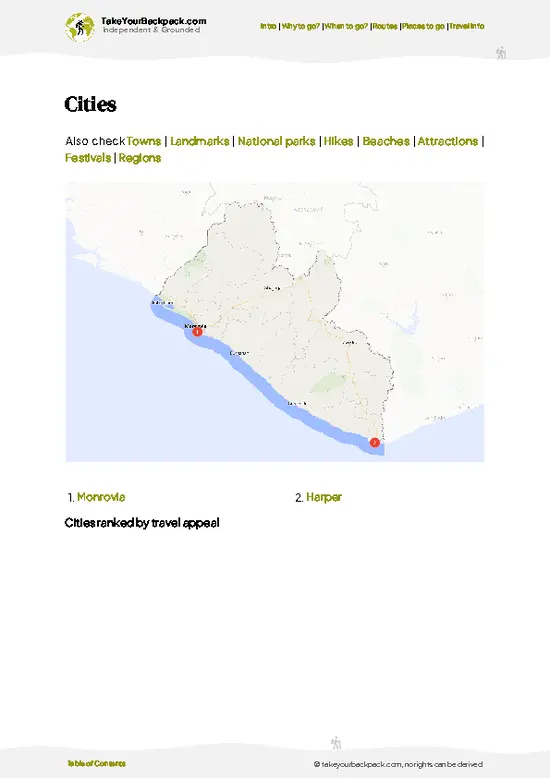
Map of Liberia
Loading the map 🌍
CLICK TO FILTER
city
town
unique site
national park
hike
beach
attraction
festival
region
SHOW COUNTRY’S BESTSHOW ALL
film
0
0
0a
Liberia National Museum
film
1
1
1a
Waterside Market
film
2
2
2a
Liberian National Cultural Center
film
3
3
3a
Antoinette Tubman Stadium
film
4
4
4a
Buchanan Beach
film
5
5
5a
Gola
film
6
6
6a
East Nimba Nature Reserve

Why go?What makes this country worth the trip

People

In Liberia, strangers greet you like a lost cousin. “My man, you good?” and that snap at the end of … read more 👉
In Liberia, strangers greet you like a lost cousin. “My man, you good?” and that snap at the end of the handshake—clean, loud, a small rite. If you look unsure at a junction, someone walks you there, no map talk, just boots and jokes, “Small-small, you’ll reach.” Chairs appear from nowhere; a plastic bucket for handwash; rice and cassava leaf pushed your way—“Come eat.” They tease your sweat, then guard your day, haggling for a fair ride. Laughter cuts through diesel and sea-salt air, and by dusk you’re on a stoop, cold bottle sweating too.

Uniqueness

Liberia makes you work. Red-dirt roads, seam-splitting potholes, checkpoints, shared taxis with four … read more 👉
Liberia makes you work. Red-dirt roads, seam-splitting potholes, checkpoints, shared taxis with four in front, sweat-slicked backs. The air—salt, woodsmoke, petrol, ripe mango. Monrovia’s Waterside Market: fish scales glitter, tailors hammer treadles, you keep a hand on your bag and lean into the noise. And then the payoffs: empty, warm points at Robertsport where the set lines forever; a night in a village near Sapo with generator off and forest loud, palm wine sour-sweet, cassava leaf stew; first cold Club beer pulled from a rusty cooler. That’s the soul.

Low cost

Liberia rewards the scrappy traveler. You eat where the steam fogs the shack windows—rice piled high, … read more 👉
Liberia rewards the scrappy traveler. You eat where the steam fogs the shack windows—rice piled high, cassava leaf thick with smoke and palm oil—and pay coin-by-coin. Bush taxis and pehn‑pehn motorbikes blur the red dust for pocket change, especially once you’re out of Monrovia. Rooms are basic—fan, mosquito net, bucket shower—but cheap enough to linger. Shop from market women, not supermarkets. Nurse a cold beer pulled from a humming freezer while the generator drones. Keep it lean and your daily average lands around the cost of a single mid-range dinner in Western Europe.

Scenery

Start in Liberia where the noon light is hard and the wind carries chalky dust off the Pan-American. … read more 👉
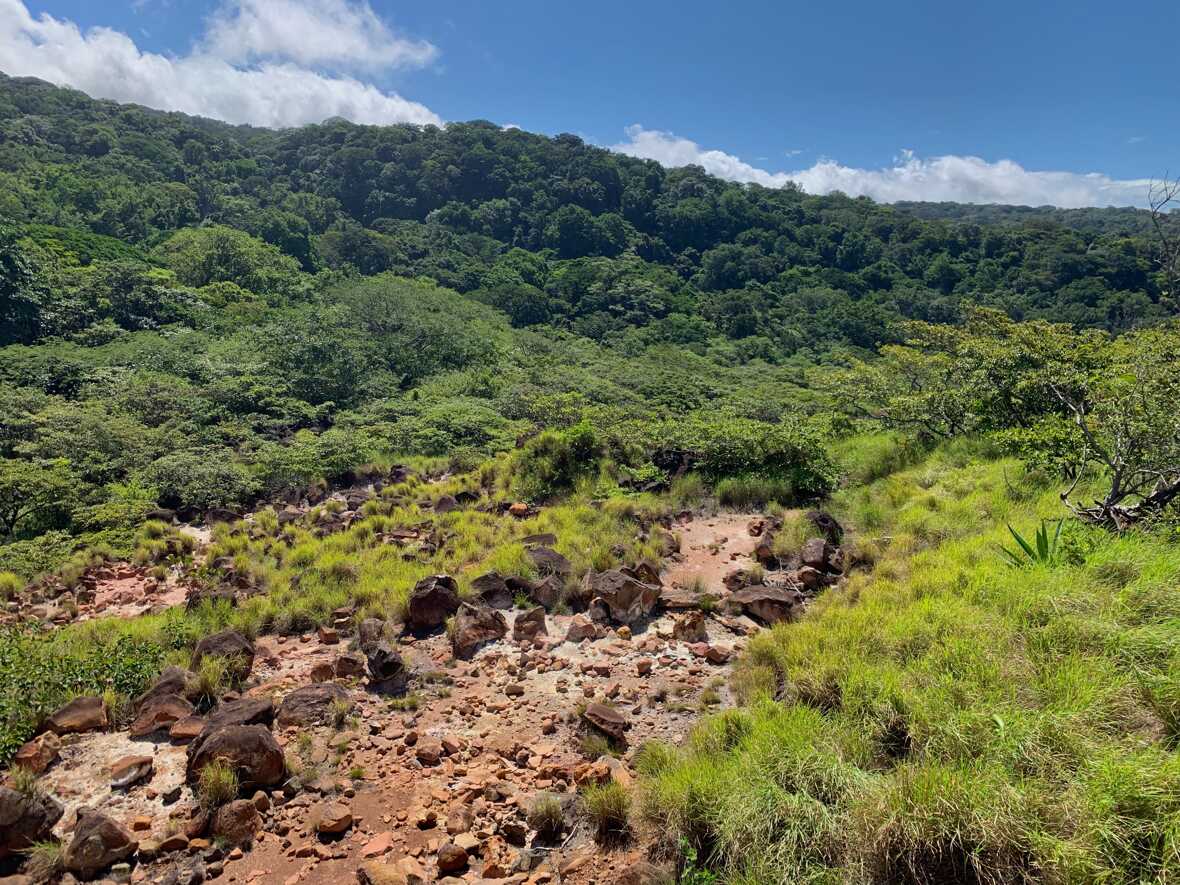
Start in Liberia where the noon light is hard and the wind carries chalky dust off the Pan-American. Sweat through the slow climb to Rincón de la Vieja and the sulfur sting hits your nose before the fumaroles do; keep going and blue pools and a cold cascade erase the burn. Drop into Barra Honda and you taste limestone and bat musk. Swing east: Lake Arenal plates the hills. Out on Santa Rosa’s dry forest, cicadas drill the silence and savannah shivers with heat. Then the Pacific opens, the beer goes cold in your hand, and everything makes sense.
Want the complete picture of Liberia?
The offline Travel Guide brings everything together — routes, highlights & planning.

See what's included in the guide 👉

Get the Travel Guide -

⭐ HighlightsHighlights of Liberia

  • Monrovia’s Waterside Market and Providence Island: Heat rises off the corrugated roofs, the air sharp with smoked fish, engine fumes, and crushed pepper as porters shoulder rice sacks through horns and handshakes. Walk the bridge to Providence Island and stand where the river meets the sea breeze while you read the plaques and watch boys fling themselves into the water; it’s the city’s most honest viewpoint. Go early, carry small bills in a front pocket, and keep your phone buried until you’re on the island, where a caretaker may ask a small fee—worth it for ten quiet minutes above the noise.
  • Robertsport’s Point Breaks and Lake Piso Shore: Salt hangs thick and the sand squeaks underfoot; the lefts peel along the point clean as a ruler when the wind behaves. Paddle out at Fisherman’s for a long, lazy line you’ll ride all the way to burning legs, then rinse off in Piso’s calm edge and sink a cold Club beer from a beach shack at sunset. Bring reef booties for urchins, rent a board from the
read more 👉
  • Monrovia’s Waterside Market and Providence Island: Heat rises off the corrugated roofs, the air sharp with smoked fish, engine fumes, and crushed pepper as porters shoulder rice sacks through horns and handshakes. Walk the bridge to Providence Island and stand where the river meets the sea breeze while you read the plaques and watch boys fling themselves into the water; it’s the city’s most honest viewpoint. Go early, carry small bills in a front pocket, and keep your phone buried until you’re on the island, where a caretaker may ask a small fee—worth it for ten quiet minutes above the noise.
  • Robertsport’s Point Breaks and Lake Piso Shore: Salt hangs thick and the sand squeaks underfoot; the lefts peel along the point clean as a ruler when the wind behaves. Paddle out at Fisherman’s for a long, lazy line you’ll ride all the way to burning legs, then rinse off in Piso’s calm edge and sink a cold Club beer from a beach shack at sunset. Bring reef booties for urchins, rent a board from the local surf club if you didn’t haul one, and in the rains assume the last stretch needs a high-clearance ride.
  • Sapo National Park Rainforest: The forest breathes—wet leaf litter, resin, and a chorus of insects that never clocks out—while buttress roots stack like fallen cathedrals. Do a dawn ridge-to-river loop with a ranger and sit ten silent minutes above a salt lick; you might not see the hippos, but you’ll feel the forest wake. Dry season only, leech socks save your ankles, and double-bag anything you don’t want soaked at the creek crossings.
  • Kpatawee Waterfalls: Shade cools fast under breadfruit trees, and the falls throw mist that tastes faintly of iron-rich rock. Scramble to the upper tier, slide the algae-slick lip into a pool that numbs the road dust out of your bones, then stretch on warm stone. Weekdays beat school-out crowds, there’s a small community fee, and sandals with grip keep you upright on the green slime.
  • Bomi Blue Lake (Bomi Hills): An old iron pit turned impossible blue, sheer walls mirrored so perfectly you check twice for wind. Climb the rim first for the color hit, then swim the edge where the rock shelves shallow before the drop; voices echo like a quarry. Late afternoon light makes the water glow, there are no lifeguards and it goes deep fast, so bring water, pack out trash, and barter a moto in Tubmanburg. For off-the-map days, try East Nimba Nature Reserve’s clouded ridges near Yekepa, the quiet tracks of Gola Forest on the Sierra Leone border, or Bopolu’s hilltop relics of old inland trade.
Spotted a mistake or missing a highlight? Contact us.

But Liberia offers more...

Discover and compare all of its highlights per category

🧭 RoutesHow to structure a trip

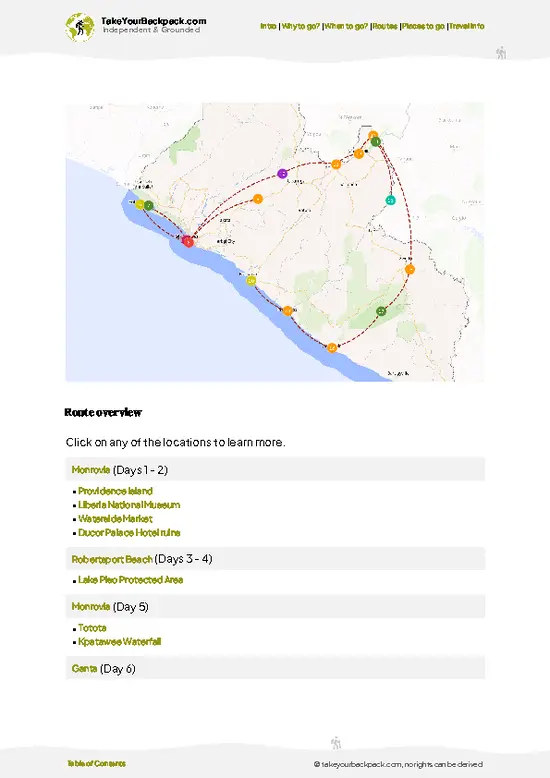
The 5-Day Coast & Capital Taster

The vibe: A relaxed first dip into Liberia built around Monrovia’s history and the easygoing beaches of Buchanan, with minimal long-distance travel and plenty of downtime. You get city grit, founding stories, and soft-sand evenings without needing expedition-level stamina.
  • Monrovia’s core sights, including the Liberia National Museum and Providence Island.
  • Street-life immersion and fabric hunting at Waterside Market.
  • Slow days on Buchanan Beach with a side visit to Silver Beach.
  • Atmospheric sunset views from the Ducor Palace Hotel ruins.

The 10-Day Highlands, Waterfalls & Coast Circuit

The vibe: A balanced loop that mixes Monrovia’s culture, inland waterfalls, and highland scenery before unwinding on the coast, with a steady but manageable travel rhythm. It’s for travelers who want more than beaches but still like a comfortable pace and repeat bases.
  • Monrovia’s museums, markets, and cultural performances.
  • Swimming and picnicking at Kpatawee Waterfall from a Gbarnga
read more 👉

The 5-Day Coast & Capital Taster

The vibe: A relaxed first dip into Liberia built around Monrovia’s history and the easygoing beaches of Buchanan, with minimal long-distance travel and plenty of downtime. You get city grit, founding stories, and soft-sand evenings without needing expedition-level stamina.
  • Monrovia’s core sights, including the Liberia National Museum and Providence Island.
  • Street-life immersion and fabric hunting at Waterside Market.
  • Slow days on Buchanan Beach with a side visit to Silver Beach.
  • Atmospheric sunset views from the Ducor Palace Hotel ruins.

The 10-Day Highlands, Waterfalls & Coast Circuit

The vibe: A balanced loop that mixes Monrovia’s culture, inland waterfalls, and highland scenery before unwinding on the coast, with a steady but manageable travel rhythm. It’s for travelers who want more than beaches but still like a comfortable pace and repeat bases.
  • Monrovia’s museums, markets, and cultural performances.
  • Swimming and picnicking at Kpatawee Waterfall from a Gbarnga base.
  • Highland forays around Ganta and the East Nimba Nature Reserve.
  • Laid-back beach time in Buchanan and at Silver Beach.

The 15-Day Liberia Deep Dive: Coast, Rainforest & Mountains

The vibe: A full-country adventure that strings together capital culture, surfy beaches, rainforest trekking, and mountain hikes, using a mix of public transport and targeted 4x4 hires to keep it realistic. It’s built for travelers who want to feel the country change under their feet, not just skim the surface.
  • Monrovia’s historic core, from Providence Island to the Centennial Pavilion.
  • Coastal arc through Buchanan Beach, Silver Beach, and Robertsport Beach near Lake Piso.
  • Rainforest immersion and waterfall hiking in Sapo National Park.
  • Highland exploration in the Nimba Mountains, Mount Nimba region, and East Nimba Nature Reserve, capped with a Kpatawee Waterfall finale.
🌍 Want a ready-to-use travel plan for Liberia?
The overview above compares different route options based on your travel time and style. The complete Travel Guide breaks each itinerary down in detail, including maps, stops, highlights, and transport information.

Explore all route details 👉

Get the Travel Guide -

🌤️ When to go?A month-by-month overview

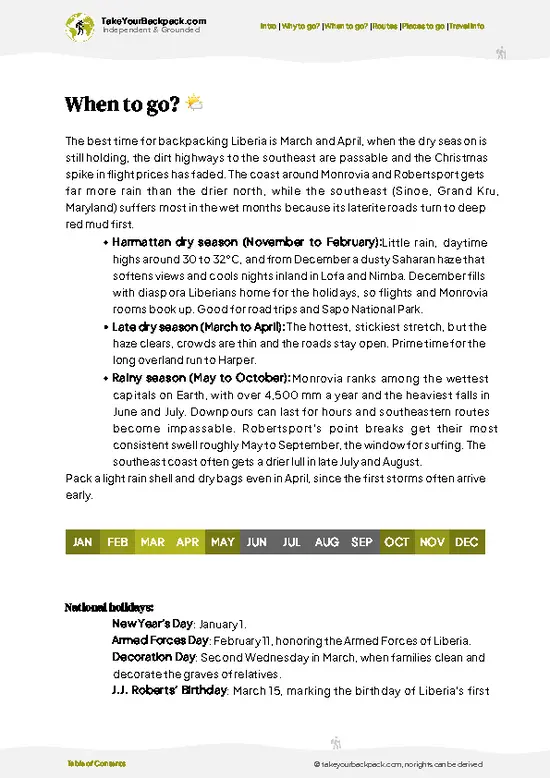
Late November to mid-December and late February to early April are the sweet spots for Liberia. The rains have stepped back, roads bake hard instead of dissolving into red porridge, and bush taxis actually leave close to when drivers promise. Harmattan dust softens by March, so the Atlantic turns blue again and the horizon stops looking like a sepia postcard. Holiday pricing cools after New Year, expat traffic thins, and guesthouses have beds without the festive markup. Rivers still carry enough water for clean swimming holes, mosquitoes slack off compared to the monsoon, and you can reach inland towns without chaining your day to a stuck truck.
  • Holiday Dry Peak (Dec-Jan): Prices climb, the sun bites by 10 a.m., and harmattan powders your teeth. The payoff: fast overland days, glowing beach evenings at Robertsport, and grilled barracuda with an ice-cold Club Beer while the generator hums.
  • Dust-Lift Shoulder (Mar-Apr): Skies clear, dust settles, and markets surge back to life. Roads stay firm, rooms drop, mangoes hit the stalls, and you can move—early starts, long strides, coast to forest in one clean push.
  • Monsoon Core (Jun-Sep): The country turns inward. Tin roofs drum, forest breathes, and tracks melt. Survival hack: line your pack with a contractor bag and ride at first light; storms build after lunch.
  • Early Dry Reset (Oct-Nov): Rains taper, everything steams green, and backroads reopen one by one. Best narrow window: night turtle patrols around Grand Cape Mount beaches, peaking late Nov-Jan, only when the sand is firm and dark.

Tactical tip: For the Dec-Jan holiday peak, book coastal beds and long-haul seats a week ahead; outside that window, walk in and negotiate.

source: climatestotravel.comJANJanuary: good for travelingFEBFebruary: highly recommended for travelingMARMarch: excellent for travelingAPRApril: excellent for travelingMAYMay: good for travelingJUNJune: fair for travelingJULJuly: fair for travelingAUGAugust: fair for travelingSEPSeptember: fair for travelingOCTOctober: good for travelingNOVNovember: highly recommended for travelingDECDecember: good for traveling
📅 Traveling in a specific month?
Get a full month-by-month breakdown of weather, crowds, costs, festivals, and seasonal highlights in the complete travel guide.

Get full details when to go 👉

Get the Travel Guide -
liberia - alan-graph-5MYQnCRZF5U-unsplash

💰 Costs (as of 2025)Prices, expenses, and money tips

Expect $45-60 per day if you move slow, eat what locals eat, and ride packed taxis while the red dust sticks to your skin and that first cold beer at dusk tastes earned.
  • dorm accommodation: True hostels are scarce; where they exist, a bunk runs $12-18, but more often you’ll end up in a basic fan room for $20-30 (Monrovia pushes $30-40 for anything clean). Sheets are clean-ish, generators rumble at night, and bucket showers are normal upcountry. System tip: ask for the “no-AC, cash, multi-night” price and pay in small, crisp USD—weekly rates can chop 15-25% off.
  • meals: Supermarket Survival: imported cheese, cereal, chocolate, and craft snacks are sticker-shock—double Guinea and a notch above Sierra Leone; think $8 pasta sauce, $5 peanut butter, $2.50 tuna. Street food reality: rice mounded high with cassava leaves or palm butter stew $1-2, grilled fish or chicken with plantain $2-4, fried dough and spicy beans for coins, water sachets $0.15-0.25. Local bars sell beer for $1.50-2; expat bars charge $3-4. Cook breakfast, eat street lunch, cheap dinner—your budget breathes again.
  • local transport: The country unlocks with shared taxis, minibuses, and okadas. In-town rides (kekes and taxis)
read more 👉
Expect $45-60 per day if you move slow, eat what locals eat, and ride packed taxis while the red dust sticks to your skin and that first cold beer at dusk tastes earned.
  • dorm accommodation: True hostels are scarce; where they exist, a bunk runs $12-18, but more often you’ll end up in a basic fan room for $20-30 (Monrovia pushes $30-40 for anything clean). Sheets are clean-ish, generators rumble at night, and bucket showers are normal upcountry. System tip: ask for the “no-AC, cash, multi-night” price and pay in small, crisp USD—weekly rates can chop 15-25% off.
  • meals: Supermarket Survival: imported cheese, cereal, chocolate, and craft snacks are sticker-shock—double Guinea and a notch above Sierra Leone; think $8 pasta sauce, $5 peanut butter, $2.50 tuna. Street food reality: rice mounded high with cassava leaves or palm butter stew $1-2, grilled fish or chicken with plantain $2-4, fried dough and spicy beans for coins, water sachets $0.15-0.25. Local bars sell beer for $1.50-2; expat bars charge $3-4. Cook breakfast, eat street lunch, cheap dinner—your budget breathes again.
  • local transport: The country unlocks with shared taxis, minibuses, and okadas. In-town rides (kekes and taxis) are $0.30-1 per hop if you know the junction names; intercity seats run $3-10 depending on distance and road mood. Last-mile motorbikes cost $1-5 for short sandy stretches, $8-15 for remote beaches or villages. Leave at first light to fill fast and dodge afternoon breakdowns; paying for an extra seat on a long run is a $3-5 mercy purchase. Compared to Guinea it’s pricier; versus Côte d’Ivoire it’s still cheaper outside capitals.
  • activities: Beaches are free; the real costs come from access. Surfboard rental in Robertsport $10-20, with patience rewarded by clean sets after the rains. Park fees and guides hover $10-30 per day, but fuel and 4x4s bite hard—driver + truck can hit $120-150/day, which is where budgets explode. Museum entries and small sights are a couple of dollars. Bring your own snorkel, mask, or board if you can; renting repeatedly adds up.
  • miscellaneous: Budget leaks: ATM fees $5-7 a pull and sketchy uptime; exchange spreads eat 5-10% if you break big bills in a hurry. SIM $1-2; data $3-6/GB and faster in Monrovia than the bush. Laundry by bucket $2-4, charging fees $0.25-0.50 when the power’s dead, and “cold drink tax” at beach shacks adds $0.50-1 a bottle. Visas and checkpoint delays cost time; patience and small notes save money. Relative value: costlier than Guinea/Sierra Leone for comfort, cheaper than Côte d’Ivoire’s big-city habits.
⚠️ Prices can change and everyone travels differently, so take this as a rough guide. Hope it helps you plan your adventure!

✈️ The backpacker research shortcutLiberia Travel Guide

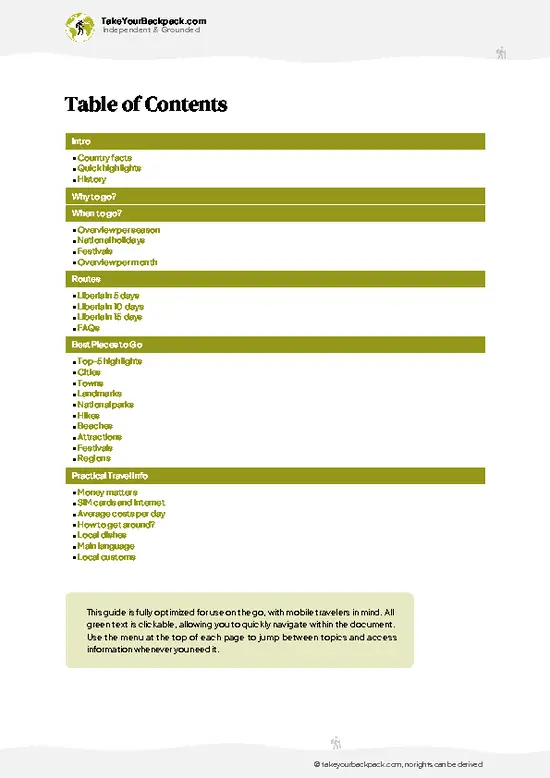
An offline-friendly backpacking guide with optimized travel routes, ranked highlights, transport advice, and the best areas to stay.
example page 0 from our offline Travel Guide for Liberiaexample page 1 from our offline Travel Guide for Liberiaexample page 2 from our offline Travel Guide for Liberiaexample page 3 from our offline Travel Guide for Liberiaexample page 4 from our offline Travel Guide for Liberiaexample page 5 from our offline Travel Guide for Liberiaexample page 6 from our offline Travel Guide for Liberiaexample page 7 from our offline Travel Guide for Liberia
The digital guide (260 pages) contains:
61 highlights, ranked by travel appeal
Optimized 5, 10 & 15-day travel routes
Cities, national parks, beaches, historical sites, ...
How to get around
Offline-friendly for travel without Wi-Fi
👉 Click to see all 30+ guide features

📅 Plan smarter in minutes, not weeks
Month by month travel advice
Festivals & national holidays
Budget expectations

🗺️ Go to the right places, skip the overrated ones
Honest pros & cons of destinations
Top hikes, parks & viewpoints
Lesser-known places most travelers miss
Clear “worth it vs skip it” guidance

🛏️ Travel smoothly without rookie mistakes
Best areas to stay
Transport systems explained simply
Common scams & safety advice
SIM cards, money & practical tips

🌍 Understand the country, not just visit it
Culture & traditions
Local customs
Festivals worth planning around
Traveler-friendly historical context
Insights that make places more meaningful

📱 Built for real travel conditions
Fully downloadable PDF
Works completely offline
Optimized for phone use
Useful in remote areas & buses
Everything in one place
Save weeks of stressful planning
Get instant access to the full guide directly. 30-day money-back guarantee.


Sent to your inbox immediately after payment • 100% Secure Checkout
Best Backpacking Travel Advisor 2025 tourism awardBest Backpacking
Travel Advisor
2025
What others say about Take Your Backpack Guides:
⭐⭐⭐⭐⭐
Fantastic, amazing amount of information!
⭐⭐⭐⭐⭐
My goodness this is amazing, it's what I've been looking for hats off too you!
⭐⭐⭐⭐⭐
I think this is absolutely BRILLIANT
⭐⭐⭐⭐
Very complete and informative. It's still missing places, but I gotta to commend you
⭐⭐⭐⭐⭐
This is truly amazing, thank you, can't wait to explore it with my kids!
⭐⭐⭐⭐⭐
Awesome resource, thank you!
⭐⭐⭐⭐⭐
This is amazing! Can't wait to explore the ones I haven't seen
⭐⭐⭐⭐
I love this! Well done, great idea.
⭐⭐⭐⭐⭐
Thanks for taking the time to make this gem!
⭐⭐⭐⭐⭐
This might be the best website I've ever seen.
⭐⭐⭐⭐⭐
Congratulations, and thank you so much for your work; it's incredibly valuable.
⭐⭐⭐⭐
In all seriousness I think you did a great job pointing out the important spots
⭐⭐⭐⭐⭐
10/10 very good
⭐⭐⭐⭐⭐
As someone who's only just starting to visit regularly this is awesome, thank you.
⭐⭐⭐⭐
Thank you very much! I'm going to visit my dad, it's going to be very useful!
⭐⭐⭐⭐⭐
This is really cool! We'll be travelling for the first time and this definitely come in handy.
⭐⭐⭐⭐⭐
You are now our minister of culture, congratulations 👨‍💼
⭐⭐⭐⭐⭐
Just wanted to tell you that this is a pearl! Going to follow your recommendations.
⭐⭐⭐⭐⭐
This is so cool. I'll definitely be using the resource for my travels soon.
⭐⭐⭐⭐⭐
This is very impressive! Good work.
⭐⭐⭐⭐⭐
This is an amazing and informative site. Very well done!

🛏️ Where to stay?Accommodation types and options

Yes — Liberia city and nearby coastal towns have hostels and budget guesthouses, with the greatest concentration in downtown (around the bus terminal and Parque Central), along the main road toward the airport, and in nearby beach towns like Playa Hermosa and Playa del Coco.
Downtown is cheapest and best for buses, cheap food and some nightlife but is noisier and requires usual evening caution; the airport/main‑road area is quiet and fastest for early flights or car rentals but has few dining or nightlife options and may need taxis; beach towns offer the most hostel choice, surf and party options … read more 👉
Yes — Liberia city and nearby coastal towns have hostels and budget guesthouses, with the greatest concentration in downtown (around the bus terminal and Parque Central), along the main road toward the airport, and in nearby beach towns like Playa Hermosa and Playa del Coco.
Downtown is cheapest and best for buses, cheap food and some nightlife but is noisier and requires usual evening caution; the airport/main‑road area is quiet and fastest for early flights or car rentals but has few dining or nightlife options and may need taxis; beach towns offer the most hostel choice, surf and party options but sit farther from national parks and fill or get pricier in high season, so book ahead.

If you enjoy meeting fellow travelers, consider choosing hostels with high ratings for atmosphere. On the other hand, if you prefer having your own space, a hotel might be a better option.

🚌 Getting aroundHow to travel within the country

Liberia moves on patient clocks and sudden scrums. Cars don’t “depart at 9”; they leave when the last seat is sold and the driver has chewed his bread and called his cousin. Morning air smells like diesel, brine, and pepper soup. Tarmac gives way to orange laterite, and the rain can turn that laterite to clay so slick you feel the car think about it. You read the sky, you read the queue, and you move with the crowd at Red Light or Duala, not against it.
  • Shared bush taxis and minibuses The fastest
read more 👉
Liberia moves on patient clocks and sudden scrums. Cars don’t “depart at 9”; they leave when the last seat is sold and the driver has chewed his bread and called his cousin. Morning air smells like diesel, brine, and pepper soup. Tarmac gives way to orange laterite, and the rain can turn that laterite to clay so slick you feel the car think about it. You read the sky, you read the queue, and you move with the crowd at Red Light or Duala, not against it.
  • Shared bush taxis and minibuses The fastest thing on four wheels that a backpacker can afford, but speed comes with strings. A seat in a shared sedan costs a fraction of a private hire and usually leaves first, but you’re crammed four across the back and the driver will test the suspension and your faith. Buy the front seat outright to halve the spine damage and shave an hour off a long run; it’s more money, still far cheaper than a charter. Be at Red Light (eastbound) or Duala (west/northbound) by first light with exact change, a scarf for dust, and eyes on tire tread. In the rains, double any time someone quotes you.
  • Keh-keh (three-wheeler) This is Monrovia’s moving porch. You greet when you climb in. You slide to make space without being asked. Tap the metal frame to hop out, no drama. Fares are small; pay with low notes and don’t hand over a big bill expecting change from a driver who’s juggling potholes and police waves. Knees in, bag on your lap, pockets zipped. Routes bend with traffic and roadworks; nobody minds detours if the breeze keeps moving. Politics stays outside; football chat is fair game.
  • Pehn-pehn (motorbike taxis) When the road breaks, the bike keeps going. These slip between stalled trucks, thread rubber plantations, and cross plank bridges that would swallow a car. Agree the price before you swing a leg. Long pants, closed shoes, and a bandana save skin and dignity; hot exhausts burn fast. If you’ve got a helmet, wear it—don’t expect one to appear. Rain spikes the fare and the risk; dusk does both.
  • Blue city/intercity buses (NTA) The cheapest ticket in the country when you catch one at ELWA, Red Light, or Randall Street. You trade time for money: queues, bunching, and a crawl through traffic, but the fare undercuts taxis by a wide margin. Stand your line, keep exact change in Liberian dollars, and be ready to bail to a taxi if the bus goes out of service mid-route. When it works, you save enough for two meals.
Master tactical tip: Show up at first light to the right hub, pay for the front seat in the first full car going your way, and you’ll beat the heat, the checkpoints, and half the country’s delays.
Distance: Roberts International Airport (ROB, often “RIA”) is about 56 km (35 miles) by road from central Monrovia (Mamba Point/Broad Street area).

Main ways to get into the city
  • Hotel/guesthouse transfer (pre-booked): Many mid-range and higher-end places will arrange a driver to meet you in arrivals.

    Time: 60-90 minutes, longer at rush hour or in heavy rain.

    Cost: typically USD 40-80 per vehicle, depending on distance and time of day.
  • Private taxi from the terminal: Airport-authorized taxis and freelance drivers wait outside. Agree the fare before you get in; prices rise at night.

    Time: 60-90 minutes.

    Cost: about USD 35-60 in daytime; USD 50-80 late night/very early morning. Cash preferred (USD or LRD).
  • Shared taxis/minibuses (budget): There’s no regular public bus into the terminal. For the cheapest ride, walk out to the main highway at the airport junction (ask for “RIA Junction”; roughly a 15-25 minute walk) and flag a shared taxi or minibus toward ELWA Junction/Red Light, then connect onward to Sinkor/Congo Town/Broad Street.

    Time: 1.5-3 hours door to door, depending on waits and transfers.

    Cost: roughly USD 4-8 total in combined fares. Best for carry-on or a small backpack; awkward with big luggage. Not recommended after dark.

Typical taxi options (quick overview): Metered cabs aren’t a thing here, and there’s no Uber/Bolt as of 2025. Expect USD 35-60 by day and USD 50-80 at night for a private ride from the airport to central Monrovia. You can often negotiate a bit if demand is low.

Practical notes: Traffic bottlenecks near ELWA Junction and Red Light can add serious time. USD is widely accepted; smaller change may come in Liberian dollars. If you want a smoother arrival, pre-book a hotel transfer; if you’re pinching pennies, the shared-taxi route works, just build in extra time and go during daylight.
⚠️ Prices and routes can change, so take this as a rough guide and ask for local advice when you arrive.

🔒 Safety (risk Level: medium)Staying safe while traveling

Safety for solo travelers, including women and LGBTQ+ individuals
Safety in Liberia for solo travelers, including women and LGBTQ+ individuals, can be challenging but manageable with precautions. Political stability is improving, but petty crime remains a concern, especially in urban areas like Monrovia. Women should dress modestly and be wary of walking alone at night. For LGBTQ+ travelers, discretion is advised as the country has conservative views on LGBTQ+ rights.


Full official government travel advisory (live updates)
View details 👉

✈️ VisaDo you need a visa to visit?

Most travelers need a visa to enter Liberia. You can apply for a visa at your nearest Liberian embassy or consulate. Ensure your passport has at least six months’ validity and provide a recent passport-sized photo, application form, and proof of travel itinerary.

source: mofa.gov.lr
⚠️ Visa requirements can change over time, so always check the latest visa requirements with the official embassy or government website before you travel.

🎒 What to pack?What to wear and bring

Liberia’s climate is generally hot and humid, so think lightweight and breathable clothing. If you’re exploring the lush rainforests or hitting the beaches, quick-dry fabrics are your best friend. During the rainy season (May to October), a compact rain jacket or poncho is essential to keep you dry. Respect local customs by packing modest attire, especially if you plan to visit villages or markets—long skirts or pants and shirts that cover your shoulders will do the trick. Lastly, don’t forget to bring a pair of sturdy shoes for those rugged jungle trails.

Apart from this country specific advice, I have also crafted a general packing list that should help on any trip. authorOver the years, I've learned the importance of packing minimally. It's so much easier to jump on the back of a truck or squeeze yourself into the last spot of a minibus without that supersized backpack. If you're headed to a warm destination, leave your winter jacket at home; for colder regions, opt for thin thermal underlayers. Instead of packing your entire wardrobe, bring just three sets of clothes, as laundry facilities are available everywhere.
View the full list 👉
🎒 Planning the practical side of your trip?
Get detailed information on transport, daily budgets, internet access, local customs, food, language, and other essentials in the complete Travel Guide.

Get detailed practical information 👉

Get the Travel Guide -

🙋 FAQThings travelers often ask

Trip Planning


Personal tip: I normally search on good rating for atmosphere (for meeting people) and location (for easy exploring). Cleanliness as a bonus.


Travel Essentials

Yellow fever vaccination is required for entry into Liberia. It’s recommended to have vaccinations for hepatitis A, hepatitis B, typhoid, and rabies, especially for extended stays or rural travel. Consider a polio booster if you haven’t had one as an adult. Make sure your routine vaccinations, like measles-mumps-rubella (MMR) and tetanus, are up to date. Check with a healthcare provider for the latest advice.


vaccination requirements
When I first started traveling, I often spent part of my first day in a new country hunting for a local SIM card. While this can still be slightly cheaper, it also takes time and planning.

These days, it's much simpler to install an eSIM before leaving home. Once you arrive in Liberia, you can activate it immediately and have mobile data from the moment you land — which is especially useful for ordering transport or navigating away from busy airports.

There are many providers nowadays, and price differences are usually small. I personally go with Airalo, as it offers excellent network coverage throughout the country and strong global coverage, so you can manage multiple countries from a single app.


Get your e-sim for Liberia

Culture & Customs

Handshakes are the usual greeting, and it’s polite to ask about family and health. Avoid using your left hand for giving or receiving items, as it’s considered impolite. Dressing modestly is recommended; women should wear knee-length skirts or trousers. Public displays of affection, especially among same-sex couples, can draw unwanted attention. Homosexuality is illegal, so discretion is advised for LGBTQ+ travelers. Respect local traditions and be cautious when discussing politics. Always ask for permission before taking photos of people.
Trying traditional food is always a great way to experience the culture. Here are some must-try dishes for Liberia.
  • Jollof Rice: A staple across West Africa, Liberia’s version is rich and flavorful, often cooked with chicken, fish, or beef. It’s a must-try to understand the regional love for this one-pot dish.
  • Fufu: This dough-like dish is made from cassava or plantains and is usually served with soup or stew. It’s an essential part of Liberian meals, symbolizing communal eating and togetherness.
  • Palm Butter: A thick, spicy stew made from palm nuts, often containing meat or fish. It’s a beloved comfort food that showcases the rich flavors of local ingredients.
  • Collard Greens: Cooked with meats like smoked turkey or beef, this dish is a savory delight and a staple in many households, reflecting the blend of traditional and modern flavors in Liberian cuisine.
  • Pepper Soup: A fiery, fragrant broth made with fish or meat, known for its spicy kick. It’s often enjoyed for its warming qualities and communal serving tradition.
The tap water in Liberia is generally not considered safe for tourists to drink, and even locals often prefer boiled or bottled water. It’s recommended to stick to bottled or filtered water to avoid any health issues. Use tap water only for washing and brushing your teeth if you’re feeling adventurous.
In Liberia, English is the official language and is widely spoken throughout the country. The majority of the population is fluent in English, particularly in urban areas like Monrovia, the capital. English is used in government, education, and media, making it accessible for travelers. However, it’s important to note that many Liberians also speak various local languages and dialects, such as Kreyòl, Bassa, and Grebo.

While most people in cities and towns can communicate effectively in English, proficiency may vary in rural areas where local languages are more prevalent. Travelers might encounter situations where some individuals have limited English skills, especially among older generations or in more remote regions.

Overall, English is a practical means of communication for visitors, and most locals are friendly and eager to assist, often making an effort to engage with travelers in English. To enhance your experience, learning a few local phrases can be appreciated and may help bridge any language gaps.

Money & Payments

The local currency of Liberia is LRD (L$).

When backpacking through Liberia, you’ll find that cash is king. ATMs are mainly in Monrovia and a few other large towns, so carry some cash if you’re heading to rural areas. Liberian dollars are the local currency, but US dollars are widely accepted, especially for larger transactions. Euros aren’t commonly used, so stick to USD if you’re bringing foreign currency.

Most local businesses and smaller shops don’t take cards, so it’s best to pay in cash. For exchanging money, avoid street exchanges and head to banks or reputable exchange offices for better rates and safety. Keep some smaller bills handy for markets and public transport, and always check your change!

Tipping in Liberia is not mandatory but appreciated. In restaurants, leaving a 10-15% tip is a nice gesture if service is good. For taxis, rounding up the fare or giving a small extra amount is common if the driver is helpful.

🧩 Nearby countriesSimilar backpacking destinations

We 💚 feedbackThe bottom line on traveling here

Monrovia hits you with salt air, diesel, and wood smoke; sweat runs before breakfast. Red dust sticks to your calves upcountry, and shared taxis groan over potholes that deserve names. Then the payoff: a cold Club Beer and grilled fish at Robertsport, watching that long left peel. Best surprise: how quickly strangers pull you into a story over cassava leaf. Small warning: rainy season turns time elastic, and ATMs sulk—carry small USD. It’s shifting: roads are creeping toward asphalt, mobile money spreading, surf shacks turning into real guesthouses.

✍️ Help improve this page!
The information on this page is based on in-depth research, insights shared by experienced travelers, and feedback from the local travel community in Liberia. While every effort is made to keep the information accurate and current, conditions can change — so if you spot anything incorrect or outdated, please get in touch.


🙋‍♂️ Give feedback

👋 Meet the founderWho’s Behind Take Your Backpack?

Johan, backpacker and founder of TakeYourBackpackHi, I’m Johan (Netherlands 🇳🇱), the creator of TakeYourBackpack. Over the past decade, I’ve backpacked through 80+ countries across six continents, gaining extensive experience with independent travel, long-term trips, and overland routes.

This site is built on a combination of firsthand travel experience and carefully curated insights from other backpackers. Many guides are based on places I’ve personally visited, while others bring together tips, observations, and practical advice shared by trusted travelers I’ve met along the way.

The goal is to provide realistic, experience-driven guidance — not generic itineraries — so you can explore destinations with better context, clearer expectations, and more confidence.

Get full Liberia guide •
Instant download • 61 highlights • Full Offline guide