Trip Planning
The TakeYourBackpack guidebooks are your all-in-one travel companion, featuring the best cities, national parks, hikes, beaches, and unique sites, along with essential tips on when to go, how to get around, exchanging money, and even local phrases to get you started — everything you need for a smooth, unforgettable backpacking adventure.
Stop researching. Start exploring.Discover all 36 highlights,ranked
and organized into practical routes.
Get instant access
Planning a backpacking route through Guernsey can be tricky — you need to balance must-see places, travel times, budget, and how long to stay in each destination. Our free personalized Guernsey itinerary planner creates a route based on your travel style, trip duration, and interests, so you can spend less time researching and more time exploring.
Personal tip: I normally search on good rating for atmosphere (for meeting people) and location (for easy exploring). Cleanliness as a bonus.
Travel Essentials
No vaccinations are required to visit Guernsey, and there are no specific health risks such as malaria or yellow fever on the island. Being up to date on routine vaccines (measles, mumps and rubella, tetanus, diphtheria, and seasonal flu or COVID-19 boosters) is all most travelers need.
vaccination requirementsWhen I first started traveling, I often spent part of my first day in a new country hunting for a local SIM card. While this can still be slightly cheaper, it also takes time and planning.
These days, it's much simpler to install an eSIM before leaving home. Once you arrive in Guernsey, you can activate it immediately and have mobile data from the moment you land — which is especially useful for ordering transport or navigating away from busy airports.
There are many providers nowadays, and price differences are usually small. I personally go with
Holafly, as it offers excellent network coverage throughout the country and strong global coverage, so you can manage multiple countries from a single app.
HolaFly eSimCulture & Customs
Guernsey’s customs are close to British norms, so queue patiently, say please and thank you, and keep your voice down on buses. Respect the island’s “hedge veg” stalls, roadside honesty boxes selling eggs, flowers and vegetables, by always paying the marked price. On the narrow lanes, give way to walkers and cyclists on the ruettes tranquilles, and if you drive, follow the “filter in turn” rule at marked junctions. Don’t pick flowers or disturb wildlife on the cliffs, and treat the German Occupation sites and Liberation Day with respect, since the Occupation remains a deeply felt part of island memory. Sunday is quieter, with some shops closed. There are no particular concerns for women or gay travelers, and same-sex couples can show affection as openly as in mainland Britain.
Trying traditional food is always a great way to experience the culture. Here are some must-try dishes for Guernsey.
- Guernsey Bean Jar: a slow-cooked stew of haricot or butter beans with pork or beef shin, onions and herbs, traditionally left overnight in a baker’s oven. It is the island’s signature comfort food.
- Guernsey Gâche: a dense, buttery fruit loaf studded with sultanas and candied peel, best sliced and spread with more Guernsey butter. Every bakery and farm shop sells it, and it is the classic taste to take home.
- Gâche Mélée: a moist apple pudding made with flour, suet and sugar, served warm, often with Guernsey cream. It shows how central orchard apples were to the old island kitchen.
- Ormers: a local abalone gathered only on certain spring tides in the winter months, then beaten tender and slow-cooked. Strict seasons protect them, which makes a plate of ormers a rare local treat.
- Guernsey crab and fresh seafood: chancre crab, lobster and scallops landed around the island, eaten simply in crab sandwiches or salads at beach kiosks. The waters here are cold and clean, and the shellfish is the best value splurge on the island.
- Guernsey milk and ice cream: rich, golden milk from the island’s own Guernsey cattle breed, turned into cream, butter and ice cream. The breed is a point of pride, and a cone from a beach kiosk is part of a summer day here.
Tap water in Guernsey is safe to drink and is treated to strict standards by the island’s public water supplier, and locals drink it without a second thought. Tourists can do the same, so there is no need to buy bottled or filtered water. Refill a reusable bottle at your accommodation before a day on the cliff paths.
English is the everyday language across Guernsey, spoken by everyone in St Peter Port, in guesthouses and campsites, and in the farming parishes of the west and south. You will never need another language here. The island’s own Norman French, Guernésiais, survives mainly among a small number of older islanders, and French shows up mostly in place and road names. Learning to pronounce a few of those French names, such as St Sampson’s or Vazon, is the most useful trick for asking directions.
Money & Payments
The local currency of Guernsey is GBP (£).
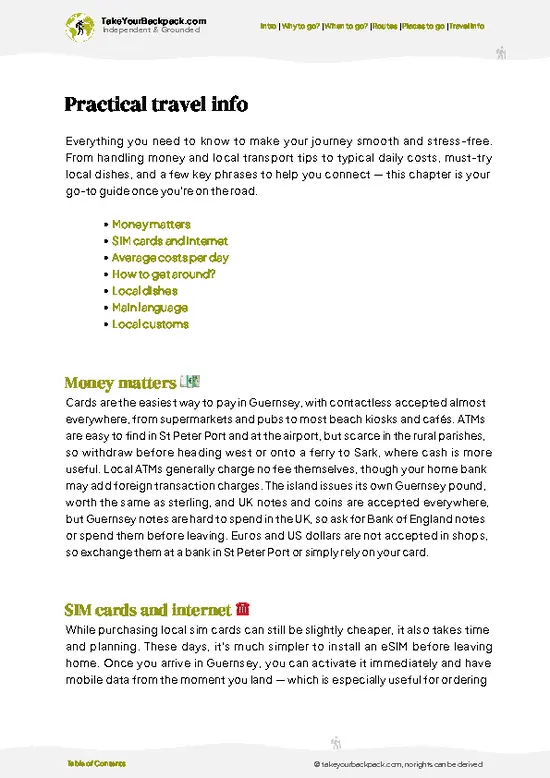
Cards are the easiest way to pay in Guernsey, with contactless accepted almost everywhere, from supermarkets and pubs to most beach kiosks and cafés. ATMs are easy to find in St Peter Port and at the airport, but scarce in the rural parishes, so withdraw before heading west or onto a ferry to Sark, where cash is more useful. Local ATMs generally charge no fee themselves, though your home bank may add foreign transaction charges. The island issues its own Guernsey pound, worth the same as sterling, and UK notes and coins are accepted everywhere, but Guernsey notes are hard to spend in the UK, so ask for Bank of England notes or spend them before leaving. Euros and US dollars are not accepted in shops, so exchange them at a bank in St Peter Port or simply rely on your card.
Tipping in Guernsey follows British habits: about 10 to 12.5% in sit-down restaurants if service is not already added to the bill. In pubs you do not tip for drinks at the bar, and for taxis rounding up to the nearest pound is plenty.
v2.webp)

 Best Backpacking
.jpg) Over the years, I've learned the importance of packing minimally. It's so much easier to jump on the back of a truck or squeeze yourself into the last spot of a minibus without that supersized backpack. If you're headed to a warm destination, leave your winter jacket at home; for colder regions, opt for thin thermal underlayers. Instead of packing your entire wardrobe, bring just three sets of clothes, as laundry facilities are available everywhere.
Over the years, I've learned the importance of packing minimally. It's so much easier to jump on the back of a truck or squeeze yourself into the last spot of a minibus without that supersized backpack. If you're headed to a warm destination, leave your winter jacket at home; for colder regions, opt for thin thermal underlayers. Instead of packing your entire wardrobe, bring just three sets of clothes, as laundry facilities are available everywhere.

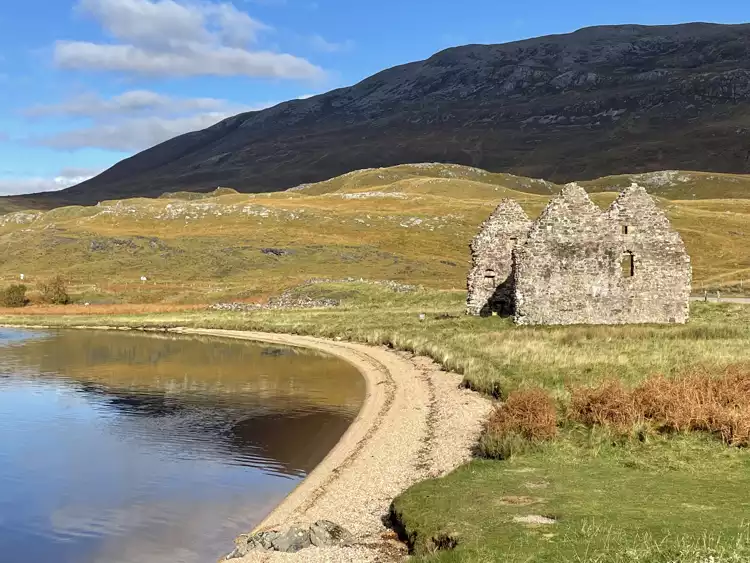
.jpg) Hi, I’m Johan (Netherlands 🇳🇱), the creator of TakeYourBackpack. Over the past 3 decades, I’ve backpacked through 90+ countries across six continents, gaining extensive experience with independent travel, long-term trips, and overland routes.
Hi, I’m Johan (Netherlands 🇳🇱), the creator of TakeYourBackpack. Over the past 3 decades, I’ve backpacked through 90+ countries across six continents, gaining extensive experience with independent travel, long-term trips, and overland routes.