×
Mauritania 🇲🇷

backpacking Africa Mauritania 🇲🇷Cross open desert guided by endless horizon lines.

Explore MaliExplore Mauritius

Backpacking Mauritania in 2026

A complete guide including when and where to go, costs, transport, itineraries, and practical travel advice.
What a trip here is really like

Backpacking Mauritania
By Johan Kruseman 🇳🇱 | Updated June 2, 2026

Ride the iron-ore train for free across the Sahara, perched on the ore itself. You reach it by taxi-brousse to Choum or Nouadhibou, wrap a cheche over your face, and share a wagon with workers heading home. It’s Mauritania in one move: pragmatic, huge, and honest.

Then the country opens: wind-polished stone in the Adrar, dunes spilling toward the Atlantic, and oasis towns where the call to prayer hangs in the dry air. Chinguetti’s square minaret glows at dusk, ancient libraries breathe leather and dust, and Banc d’Arguin’s sail pirogues slice a green-blue shallows busy with birds. Tea pours high and foams sweet; tidinit riffs curl out of courtyards; the Eye of the Sahara ripples the horizon in rings you feel more than see. Heat bites, transport is slow, checkpoints test your patience, and the sand gets everywhere—but the first glass of mint tea after a long haul, or dawn on the dunes with the wind finally down, makes the grit feel earned.

If Morocco is polished and easy and Senegal hums with nightlife, Mauritania is the wide blank page: fewer crowds, bigger sky, deeper quiet. Go if you want space, caravan history, coastal desert light, and the rhythm of a country that still moves at camel pace.

👉 Get the 📖 Travel Guide of Mauritania

Nouakchott–Banc d’Arguin–Nouadhibou (Coastal Spine)

Salt air, diesel, and gulls over the Port de Pêche in Nouakchott set the tone. Push north on the coastal road: wind, sand drifts, and gendarmerie posts where photocopies of your passport smooth things. Banc d’Arguin pays off if you work for it—permit and park guide arranged in Nouakchott or Nouadhibou, long flats, quiet Imraguen camps, and birds working the shallows. Tide and wind decide your schedule more than you do. The payoff is a sunset on hard salt, fish grilled over coals, and silence deep enough to hear your own breath. Suits patient travelers who like nature more than nightlife and can handle slow logistics.

Adrar Plateau (Atar, Chinguetti, Ouadane, Terjit)

Atar is the gritty hub—fuel, spares, shared taxis, and tea that never ends. From there, the passes chew soft sand; a 4x4 and a driver who reads dunes like a book save hours. Chinguetti’s libraries smell of leather and dust; Ouadane’s stones bite your boots. Terjit slides under your guard with cool gueltas and date palms after the heat cooks you into silence. Nights earn their stars: wind dies, the sky explodes, and the third glass of tea feels like a rite. Ideal for walkers and desert nerds who like moving parts and old stones.

Iron Ore Train (Zouérat–Choum–Nouadhibou)

You wait at dusk, scarf tight, while iron dust settles on your teeth. Some days there’s a passenger car; otherwise it’s you and an open wagon. Lash your pack, pad the floor, goggles on. The train groans through the dark for hours; you don’t sleep, you endure. Dawn brings a red line of dunes and the Atlantic haze. Jump at Choum for a rough link to the Adrar, or ride to Nouadhibou for a hot shower and a plate of fish. For hardy minimalists who value the story as much as the ride.

Tagant Plateau (Tidjikja and the oasis chain)

The road thins to piste, then to choices. Tidjikja comes slow—sandstone ribs, wells creaking, kids leading donkeys. You’ll move at oasis tempo: Rachid, Ksar el Barka’s ruins, date gardens and hand-dug channels. Bring range, water discipline, and time. The reward is cliff-edge sunsets and long, clean horizons. Best for self-sufficient travelers who enjoy quiet villages and old routes.

Hodh ech Chargui (Néma and Oualata)

It’s a long eastbound haul with checkpoints and tea breaks that run on conversation. Néma is your last proper market and mechanic; Oualata is a rough track farther, painted facades and tight lanes holding the heat. Cash matters, patience matters more. Hire local, keep your plans elastic. When the evening cools, the walls glow, and a cold bottle of Coke on a doorstep feels like wealth. For culture hunters willing to trade comfort for depth.
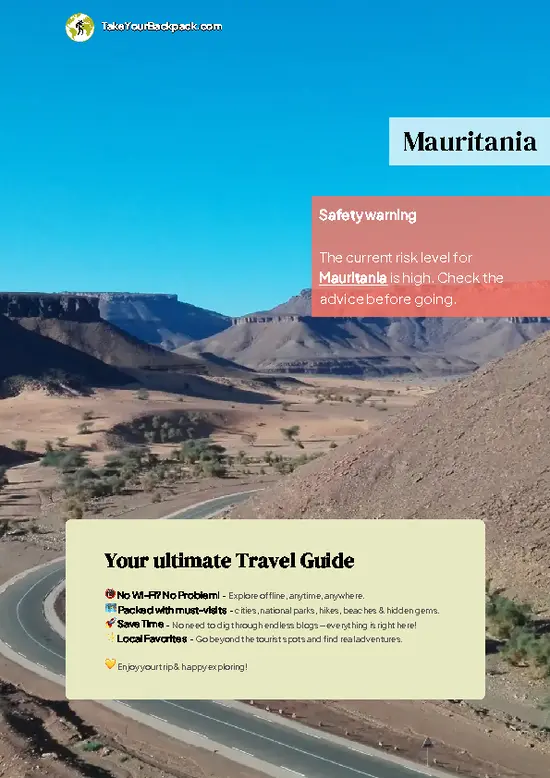
Safety warning

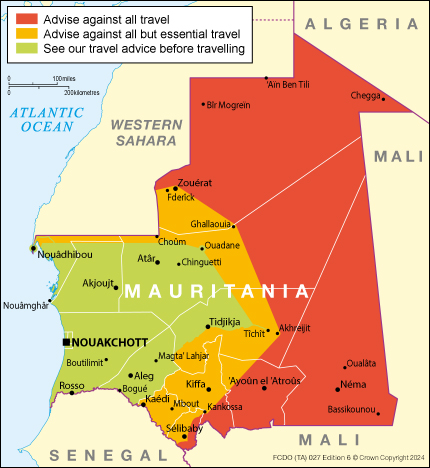
The current risk level for Mauritania is high. Check the advice before going.
Get your Mauritania guide
63 ranked highlights, routes & tips, works offline (269 pages)
Seeing the layout at a glance
Loading the map 🌍
CLICK TO FILTER
city
town
village
unique site
national park
hike
beach
attraction
festival
region
SHOW COUNTRY’S BESTSHOW ALL

Why go?What sets this destination apart

Scenery

Mauritania pays you back in big horizons. Salt wind on the Banc d’Arguin, flamingos lifting off the shallows while Imraguen push their surf canoes. Inland, … read more 👉
Mauritania pays you back in big horizons. Salt wind on the Banc d’Arguin, flamingos lifting off the shallows while Imraguen push their surf canoes. Inland, the Adrar drags you over corrugated tracks to pale dunes of the Erg Amatlich, canyons at Amogjar, and palm shade at Terjit where spring water slicks the rock. South, Diawling’s lakes and the Senegal River’s acacia savannah buzz at dusk. You walk painted rock shelters, pick through stone cities like Chinguetti and Ouadane, and feel the Richat’s ringed ridges underfoot. Hard miles, huge light, mint tea, stars that don’t blink.

Uniqueness

Mauritania feels like you’ve slipped off the map. Asphalt thins to a ribbon, wind sandblasts your ankles, and the horizon becomes a straight line you … read more 👉
Mauritania feels like you’ve slipped off the map. Asphalt thins to a ribbon, wind sandblasts your ankles, and the horizon becomes a straight line you walk toward for hours. You ride the iron ore train, iron dust in your teeth, step off in Nouadhibou looking like a chimney sweep and grinning anyway. In Chinguetti the air smells of stone and paper; librarians show you Qur’an manuscripts older than your country. Nouakchott’s surf pounds pirogues ashore, fish and diesel mixing in your nose. The payoff: Sahara silence, stars hard as salt, and scalding mint tea poured high and sweet.

Low cost

Sand in your teeth, diesel on your collar, and your wallet barely feels it. Mauritania is the kind of place where shared taxis stitch the desert together … read more 👉
Sand in your teeth, diesel on your collar, and your wallet barely feels it. Mauritania is the kind of place where shared taxis stitch the desert together for pocket change, auberge courtyards give you a mattress and a bucket shower, and mint tea keeps arriving until you forget the clock. Eat rice-and-fish or camel brochettes with your fingers and you’re full for little. Hitch when you can, or ride the iron ore train and pay in grit. On a backpacker rhythm, figure roughly $25 a day without trying too hard.
Want the complete picture of Mauritania?
The offline Travel Guide brings everything together — routes, highlights & planning.

See what's included in the guide 👉

Get the Travel Guide -

⭐ HighlightsWhat not to miss along the way

  • Chinguetti’s Old Town and Libraries: Sand hisses through alleys of wind-chewed mud brick, and the minaret watches like a sandstone lighthouse over a sea of dunes. Visit a family-run manuscript library to see brittle astronomy texts and Qurans by lamplight, then climb the back dunes for sunset. Bring small notes for a donation, bag your camera against grit, and ask before photos—the welcome is warmer when you do.
  • Banc d’Arguin National Park: The light goes flat and silver, the air tastes of salt, and thousands of waders stipple the shallows while pirogues whisper past. Take a dawn boat from Iwik or Cap Tafarit to the roosts and watch pelicans lift off in sheets. Tides rule everything—plan around them, carry a windbreaker for the cold spray, and bring cash for permits and the community guide.
  • Nouakchott’s Port de Pêche: Late afternoon, painted pirogues surf the bar, engines coughing, and the beach becomes a moving wall of nets, fish, and shouted directions. Stand at the foam line to watch
read more 👉
  • Chinguetti’s Old Town and Libraries: Sand hisses through alleys of wind-chewed mud brick, and the minaret watches like a sandstone lighthouse over a sea of dunes. Visit a family-run manuscript library to see brittle astronomy texts and Qurans by lamplight, then climb the back dunes for sunset. Bring small notes for a donation, bag your camera against grit, and ask before photos—the welcome is warmer when you do.
  • Banc d’Arguin National Park: The light goes flat and silver, the air tastes of salt, and thousands of waders stipple the shallows while pirogues whisper past. Take a dawn boat from Iwik or Cap Tafarit to the roosts and watch pelicans lift off in sheets. Tides rule everything—plan around them, carry a windbreaker for the cold spray, and bring cash for permits and the community guide.
  • Nouakchott’s Port de Pêche: Late afternoon, painted pirogues surf the bar, engines coughing, and the beach becomes a moving wall of nets, fish, and shouted directions. Stand at the foam line to watch landings, then eat a plate of grilled mullet at the tin shacks behind the boats. Keep pockets slim, wear sandals you don’t mind ruining, and leave before dark when the last haul is weighed.
  • The Iron Ore Train (Zouérat-Nouadhibou): Iron dust coats your teeth, the wagon drums under you, and the desert rolls on until the stars feel close enough to grab. Ride an empty ore car overnight and watch the Milky Way harden into morning. Bring a tarp, goggles, scarf, warm layers, and 4-5 liters of water; boarding at Choum is calmer, and tie your pack before the train jerks.
  • Terjit Oasis (Adrar): Step from furnace heat into cool shade—the spring drips over palms, the canyon walls hold the day’s breath, and tea boils somewhere under fronds. Soak your feet, then climb the ridge for a slow-burn sunset over sand and black rock. Arrive late afternoon for shade, pay the small access fee with a smile, mind the slick algae on stones, and dress modestly for a dip; if you’ve got time, push to Oualata’s painted lanes, the Richat rim near Ouadane, and the quiet palm gardens of Mhaïreth.
Spotted a mistake or missing a highlight? Contact us.

But Mauritania offers more...

Discover and compare all of its highlights per category

🧭 RoutesSuggested travel routes through Mauritania

The 5-Day Adrar Desert Taster

The vibe: A focused, low-stress dive into Mauritania’s desert heartland, built around ancient ksour, an oasis stay, and just enough Nouakchott time to frame the story. You move in a simple loop between the capital, Atar, Chinguetti, and Terjit, trading big distances for long, quiet evenings under the stars.
  • Watch pirogues crash through the surf at Port de Pêche before heading inland.
  • Wander the sand-filled alleys of Chinguetti’s Old Quarter and Friday Mosque.
  • Cool off in the palm shade and pools of Terjit Oasis near Tergit.
  • Sample classic Adrar scenery without committing to hardcore trekking.

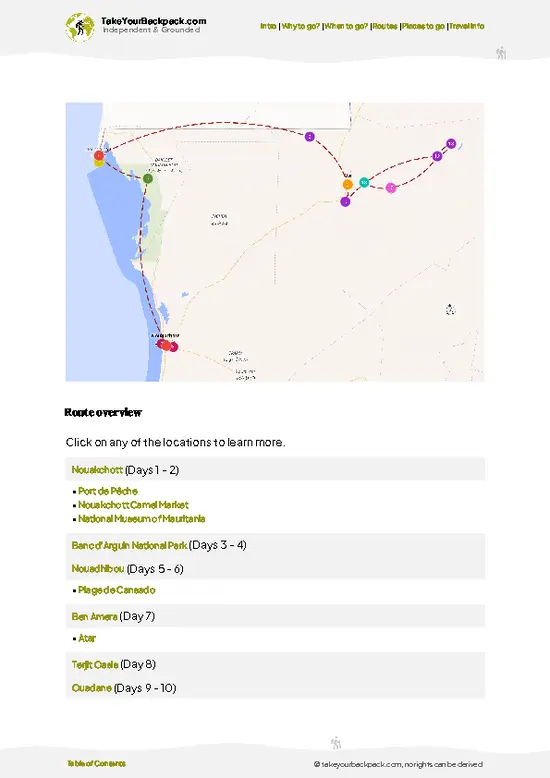
The 10-Day Desert & Coast Explorer

The vibe: A balanced loop that stitches together Nouakchott’s markets, the Adrar’s caravan towns, and the Atlantic peninsula around Nouadhibou, with time for both manuscript libraries and sea cliffs. You’ll feel like you’ve crossed a country, not just a region, but still have slow mornings and two-night stops built in.
  • Absorb Mauritanian daily
read more 👉

The 5-Day Adrar Desert Taster

The vibe: A focused, low-stress dive into Mauritania’s desert heartland, built around ancient ksour, an oasis stay, and just enough Nouakchott time to frame the story. You move in a simple loop between the capital, Atar, Chinguetti, and Terjit, trading big distances for long, quiet evenings under the stars.
  • Watch pirogues crash through the surf at Port de Pêche before heading inland.
  • Wander the sand-filled alleys of Chinguetti’s Old Quarter and Friday Mosque.
  • Cool off in the palm shade and pools of Terjit Oasis near Tergit.
  • Sample classic Adrar scenery without committing to hardcore trekking.

The 10-Day Desert & Coast Explorer

The vibe: A balanced loop that stitches together Nouakchott’s markets, the Adrar’s caravan towns, and the Atlantic peninsula around Nouadhibou, with time for both manuscript libraries and sea cliffs. You’ll feel like you’ve crossed a country, not just a region, but still have slow mornings and two-night stops built in.
  • Absorb Mauritanian daily life in Nouakchott’s camel and central markets.
  • Explore Chinguetti and Ouadane, including historic mosques and manuscript libraries.
  • Walk sections of the Ouadane to Chinguetti Trek for a taste of true desert travel.
  • Stand on the edge of the Atlantic at Cap Blanc and unwind on Plage de Cansado.

The 15-Day Mauritania Grand Circuit

The vibe: A slow, immersive circuit that links wild Atlantic coast, deep desert, oases, high plateaus, and the Senegal River valley, designed for travelers who want to feel the country’s full range rather than just skim the highlights. Expect long but spaced-out overland legs, repeat nights in key bases, and room for side trips into parks and plateaus.
  • Blend Nouakchott’s urban energy with the coastal wilds of Banc d’Arguin National Park.
  • Spend multiple days in the Adrar Region around Chinguetti, Ouadane, and the Richat Structure.
  • Sleep under palms at Terjit Oasis and explore the quieter Tagant Plateau from Tidjikja.
  • Finish along the Senegal River near Diawling National Park and river towns like Rosso and Kaédi.
🌍 Want a ready-to-use travel plan for Mauritania?
The overview above compares different route options based on your travel time and style. The complete Travel Guide breaks each itinerary down in detail, including maps, stops, highlights, and transport information.

Explore all route details 👉

Get the Travel Guide -

🌤️ When to go?Weather, seasons, and timing

The sweet spot is November and late February through March. Inland, days are warm enough to move without the heat turning feral, nights cool but not bone-biting, and the harmattan haze usually loosens so the Adrar’s ridgelines cut clean against the sky. Holiday surges have ebbed, so you aren’t competing with winter groups for the same 4x4s in Atar, and coastal rooms in Nouadhibou/Nouakchott dip from their December highs. Rains are long gone in the south, pistes are passable, and that first glass of scalding mint tea lands as comfort, not survival.
  • Cool-Season Peak (Dec-Jan): You pay in cash and patience—fewer beds in Chinguetti, guides booked, iron-ore train cars crowded—but you earn easy miles. Hike Erg Amatlich in cool air, watch the light go gold on Ouadane’s ruins, then crack a cold Fanta at Atar’s taxi gare with sand still in your teeth.
  • Shoulder Shift (Nov, late Feb-Mar): The country exhales. Shops lift shutters, wind drops a notch, drivers answer calls. Tracks hold shape, prices soften, and you move—dawn walks, midday markets, dusk tea—without the stop-start of peak groups.
  • Heat Lull (Apr-Jun, Sep-Oct): The interior goes quiet and lunar. Start before sunrise, wrap a cheche over mouth and neck, siesta hard in ksour shade, freeze water in town. The solitude is total; your footsteps sound loud on the slabs.
  • Rain Pulse (Jul-Aug): Southern roads smear with mud, buses stall at swollen wadis, and mosquitoes find every ankle. The payoff is the smell of wet sand and gueltas brimming; stick to the Atar-Choum-Nouadhibou spine unless you know a driver who knows the detours.

Tactical tip: For Nov or late Feb-Mar, buy your flight a couple of months out, then hire your guide/4x4 in Atar face-to-face; it’s cheaper and you see the vehicle you’ll trust with the dunes.

source: climatestotravel.comJANJanuary: highly recommended for travelingFEBFebruary: good for travelingMARMarch: excellent for travelingAPRApril: fair for travelingMAYMay: fair for travelingJUNJune: fair for travelingJULJuly: below average for travelingAUGAugust: below average for travelingSEPSeptember: fair for travelingOCTOctober: fair for travelingNOVNovember: excellent for travelingDECDecember: highly recommended for traveling
📅 Traveling in a specific month?
Get a full month-by-month breakdown of weather, crowds, costs, festivals, and seasonal highlights in the complete travel guide.

Get full details when to go 👉

Get the Travel Guide -
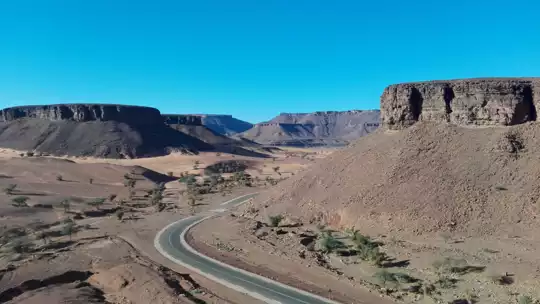
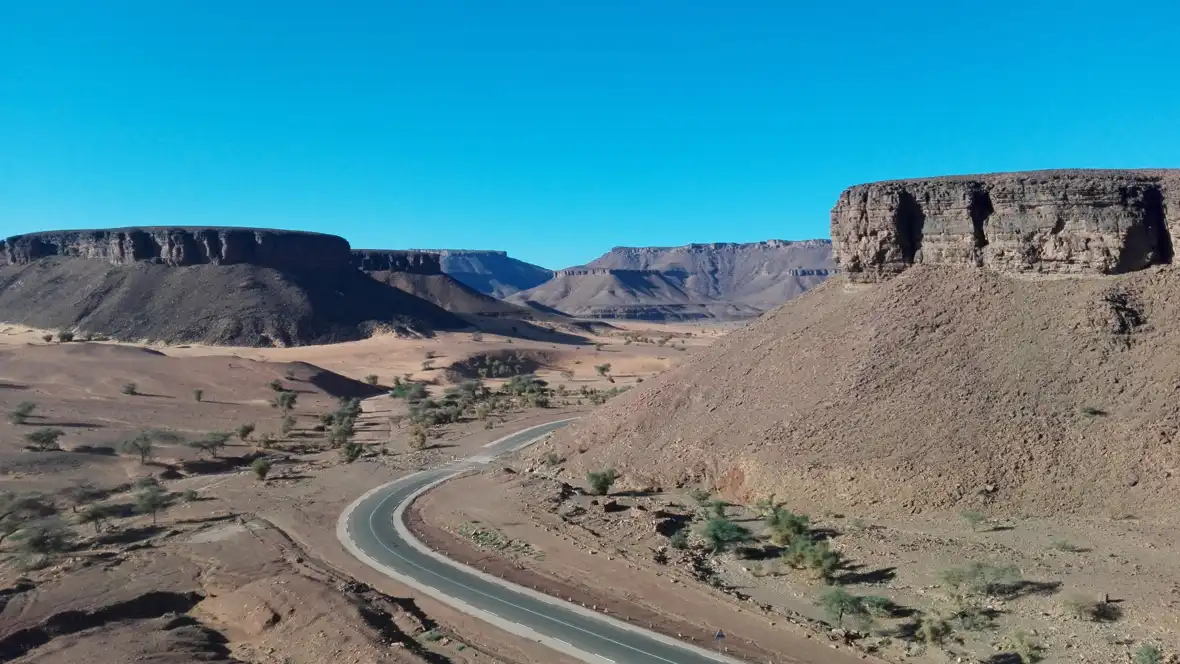
pixabay - mauritania - road-4603419

💰 Costs (as of 2025)How expensive it really is

$35-45 per day if you sleep basic, eat local, and ride share taxis; double it on days you need a 4x4 or a guided desert run.
  • dorm accommodation: $8-18 in Nouakchott/Nouadhibou for a real dorm bed; $5-10 in the interior for a mat on a rooftop or courtyard at an auberge. Dorms are sparse outside cities; you’re usually buying floor space, a mosquito coil, and a bucket shower. System tip: ask for the “prix matelas au toit” (roof mattress rate) and the price “sans petit-déj”—bread-and-jam breakfasts are a poor markup. Compared to Senegal, beds are cheaper but rougher; Morocco gives you more comfort for a few dollars more.
  • meals: Supermarket Survival: baguette + tins + fruit runs about $4-7/day, but imports (cheese, muesli, chocolate) bleed you fast. Street food reality: the plate of rice-and-fish or goat stew is $2-4, sweet mint tea is pocket change, and an omelet baguette is your reliable $1-2 dawn fix at truck stops. Portions are heavy, spice is modest, and hygiene is honest-but-basic. Cheaper than Dakar’s streets; roughly on par with small-town Morocco, with less variety.
  • local transport: The country unlocks with sept-places (shared Peugeots), bush minibuses, and the iron ore train. City
read more 👉
$35-45 per day if you sleep basic, eat local, and ride share taxis; double it on days you need a 4x4 or a guided desert run.
  • dorm accommodation: $8-18 in Nouakchott/Nouadhibou for a real dorm bed; $5-10 in the interior for a mat on a rooftop or courtyard at an auberge. Dorms are sparse outside cities; you’re usually buying floor space, a mosquito coil, and a bucket shower. System tip: ask for the “prix matelas au toit” (roof mattress rate) and the price “sans petit-déj”—bread-and-jam breakfasts are a poor markup. Compared to Senegal, beds are cheaper but rougher; Morocco gives you more comfort for a few dollars more.
  • meals: Supermarket Survival: baguette + tins + fruit runs about $4-7/day, but imports (cheese, muesli, chocolate) bleed you fast. Street food reality: the plate of rice-and-fish or goat stew is $2-4, sweet mint tea is pocket change, and an omelet baguette is your reliable $1-2 dawn fix at truck stops. Portions are heavy, spice is modest, and hygiene is honest-but-basic. Cheaper than Dakar’s streets; roughly on par with small-town Morocco, with less variety.
  • local transport: The country unlocks with sept-places (shared Peugeots), bush minibuses, and the iron ore train. City rides in shared taxis are $0.30-$0.80; intercity seats run $6-10 for medium hops (Atar-Nouakchott), $10-15 for long hauls (Nouakchott-Nouadhibou). The iron ore train from Choum to Nouadhibou is free (or a token tip) if you ride the wagons; it’s a sandblaster at night, so bring goggles, scarf, and a trash bag for your pack. Cheaper than Senegal’s sept-places; rougher and slower than Morocco’s buses.
  • activities: Cost drivers are wheels, fuel, and permits. A 4x4 with driver is $120-180/day plus diesel—split four ways or don’t do it. Camel treks around Chinguetti/Ouadane are $10-20/person/day depending on food and distance. Banc d’Arguin burns cash: permit + pirogue is often $40-70 total per boat, so fill the seats. Museum/library fees are $1-3. The iron ore train costs sweat, not money. Overall cheaper than Moroccan Sahara tours, pricier than doing nothing in Saint-Louis.
  • miscellaneous: Budget leaks: water and cold drinks (1.5L is $0.30-0.70 in towns, double in the desert), sunscreen, and the “one more tea” tax on your day. SIMs are cheap ($3-5) and data decent-value; ATM fees bite, so pull larger sums. Photocopies of your passport save you delays at checkpoints; don’t pay “fines.” Scarves (cheche) are good value and double as dust masks. Fewer hustles than Morocco, but tours sold to “see dunes at sunset” near Atar are overpriced for what you get—walk 20 minutes and keep your money.
⚠️ Prices can change and everyone travels differently, so take this as a rough guide. Hope it helps you plan your adventure!

✈️ The backpacker research shortcutMauritania Travel Guide

An offline-friendly backpacking guide with optimized travel routes, ranked highlights, transport advice, and the best areas to stay.
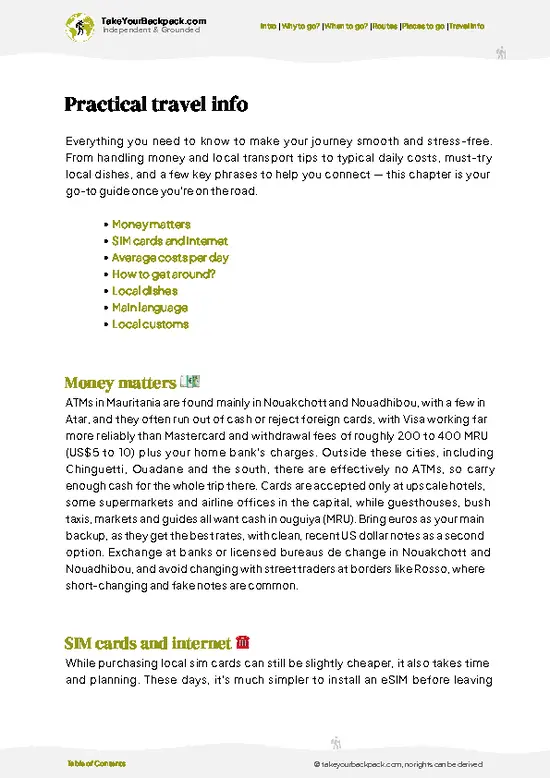
example page 0 from our offline Travel Guide for Mauritaniaexample page 1 from our offline Travel Guide for Mauritaniaexample page 2 from our offline Travel Guide for Mauritaniaexample page 3 from our offline Travel Guide for Mauritaniaexample page 4 from our offline Travel Guide for Mauritaniaexample page 5 from our offline Travel Guide for Mauritaniaexample page 6 from our offline Travel Guide for Mauritaniaexample page 7 from our offline Travel Guide for Mauritania
The digital guide (269 pages) contains:
63 highlights, ranked by travel appeal
Optimized 5, 10 & 15-day travel routes
Cities, national parks, beaches, historical sites, ...
How to get around
Offline-friendly for travel without Wi-Fi
👉 Click to see all 30+ guide features

📅 Plan smarter in minutes, not weeks
Month by month travel advice
Festivals & national holidays
Budget expectations

🗺️ Go to the right places, skip the overrated ones
Honest pros & cons of destinations
Top hikes, parks & viewpoints
Lesser-known places most travelers miss
Clear “worth it vs skip it” guidance

🛏️ Travel smoothly without rookie mistakes
Best areas to stay
Transport systems explained simply
Common scams & safety advice
SIM cards, money & practical tips

🌍 Understand the country, not just visit it
Culture & traditions
52 Essential phrases & customs
Festivals worth planning around
Traveler-friendly historical context
Insights that make places more meaningful

📱 Built for real travel conditions
Fully downloadable PDF
Works completely offline
Optimized for phone use
Useful in remote areas & buses
Everything in one place
Save weeks of stressful planning
Get instant access to the full guide directly. 30-day money-back guarantee.


Sent to your inbox immediately after payment • 100% Secure Checkout
Best Backpacking Travel Advisor 2025 tourism awardBest Backpacking
Travel Advisor
2025
What others say about Take Your Backpack Guides:
⭐⭐⭐⭐⭐
Fantastic, amazing amount of information!
⭐⭐⭐⭐⭐
My goodness this is amazing, it's what I've been looking for hats off too you!
⭐⭐⭐⭐⭐
I think this is absolutely BRILLIANT
⭐⭐⭐⭐
Very complete and informative. It's still missing places, but I gotta to commend you
⭐⭐⭐⭐⭐
This is truly amazing, thank you, can't wait to explore it with my kids!
⭐⭐⭐⭐⭐
Awesome resource, thank you!
⭐⭐⭐⭐⭐
This is amazing! Can't wait to explore the ones I haven't seen
⭐⭐⭐⭐
I love this! Well done, great idea.
⭐⭐⭐⭐⭐
Thanks for taking the time to make this gem!
⭐⭐⭐⭐⭐
This might be the best website I've ever seen.
⭐⭐⭐⭐⭐
Congratulations, and thank you so much for your work; it's incredibly valuable.
⭐⭐⭐⭐
In all seriousness I think you did a great job pointing out the important spots
⭐⭐⭐⭐⭐
10/10 very good
⭐⭐⭐⭐⭐
As someone who's only just starting to visit regularly this is awesome, thank you.
⭐⭐⭐⭐
Thank you very much! I'm going to visit my dad, it's going to be very useful!
⭐⭐⭐⭐⭐
This is really cool! We'll be travelling for the first time and this definitely come in handy.
⭐⭐⭐⭐⭐
You are now our minister of culture, congratulations 👨‍💼
⭐⭐⭐⭐⭐
Just wanted to tell you that this is a pearl! Going to follow your recommendations.
⭐⭐⭐⭐⭐
This is so cool. I'll definitely be using the resource for my travels soon.
⭐⭐⭐⭐⭐
This is very impressive! Good work.
⭐⭐⭐⭐⭐
This is an amazing and informative site. Very well done!

🛏️ Where to stay?Where to stay in Mauritania

There are very few traditional hostels in Mauritania, but budget accommodation exists as small guesthouses, auberges and cheap hotels mainly in coastal cities and desert towns; expect basic facilities, intermittent hot water, simple bedding and variable cleanliness.

In Nouakchott most budget options concentrate in Tevragh Zeina (safer, closer to restaurants and expat services but pricier), Sebkha (cheaper, near markets and bus routes but dustier and busier), and the central/port area (convenient for transport and the fish market but noisier and less polished).

In Nouadhibou the city centre/portread more 👉
There are very few traditional hostels in Mauritania, but budget accommodation exists as small guesthouses, auberges and cheap hotels mainly in coastal cities and desert towns; expect basic facilities, intermittent hot water, simple bedding and variable cleanliness.

In Nouakchott most budget options concentrate in Tevragh Zeina (safer, closer to restaurants and expat services but pricier), Sebkha (cheaper, near markets and bus routes but dustier and busier), and the central/port area (convenient for transport and the fish market but noisier and less polished).

In Nouadhibou the city centre/port area has the widest low-cost choices near transport yet fewer amenities and occasional security checks, while desert hubs like Atar and Chinguetti offer very basic guesthouses ideal for accessing dunes and ruins but demand advance planning, cash payments and tolerance for spartan conditions.

If you enjoy meeting fellow travelers, consider choosing hostels with high ratings for atmosphere. On the other hand, if you prefer having your own space, a hotel might be a better option.

🚌 Getting aroundGetting around Mauritania

Mauritania moves by consensus, not timetables. Engines idle under a flat white sun until the last seat sells; the wind lifts grit into your teeth; prayer calls reset the day more than any posted schedule. When things shift, they shift fast—a driver appears, a trunk slams, and the road opens empty and huge. You earn the miles here by patience, small cash, and sand-resistant lungs. The payoff is real: tea foaming roadside in Atar, the ocean smell hitting as Nouadhibou’s fog rolls in, or the first … read more 👉
Mauritania moves by consensus, not timetables. Engines idle under a flat white sun until the last seat sells; the wind lifts grit into your teeth; prayer calls reset the day more than any posted schedule. When things shift, they shift fast—a driver appears, a trunk slams, and the road opens empty and huge. You earn the miles here by patience, small cash, and sand-resistant lungs. The payoff is real: tea foaming roadside in Atar, the ocean smell hitting as Nouadhibou’s fog rolls in, or the first blast of cold night air on the ore train.
  • Intercity shared taxis and Hiace vans Speed costs exactly the price of empty space. Cheap means waiting—vehicles leave only when full, and “full” can mean four across the back. Pay for an extra seat (or two) and departures happen fast, knees get room, and drivers gun it between checkpoints. Roads are mostly paved on the Nouakchott-Atar-Nouadhibou corridors, but expect police stops; hand over a passport copy “fiche” and you’re rolling in seconds. It’s the best value for distance; private hire is 5-10x more and rarely that much quicker.
  • City share-taxis (Nouakchott & Nouadhibou) No meters, no small talk unless you start it. Greet with a simple “salaam,” state your junction, agree the fare before the door shuts, and keep coins ready—drivers hate making change. Seats are communal; men give space if a woman joins, and back-left isn’t a throne—it’s the hot seat over the wheel well. Drivers stack rides; if you need a direct run, say it and pay a bit more. Don’t slam doors, don’t eat fish in the back, and expect the engine to cut during prayers.
  • Iron Ore Train (Nouadhibou ⇄ Zouérat/Choum) The budget disruptor of the Sahara. The ore wagons are effectively free; you climb a ladder near sunset, tarp your pack against iron grit, and ride overnight under a sky that feels close enough to bruise. It replaces pricey flights and long detours, and drops you at Choum for a 4x4 hop to Atar. Goggles, scarf, and a sleeping bag are not optional; the dust is metallic and the wind bites. Wait for the full stop before boarding—couplers can snap like a jaw.
  • Shared 4x4 pickups to the Adrar Geometry beats asphalt here. From Atar to Chinguetti or Ouadane, pickups run pistes no bus can touch—over the Amogjar Pass at dawn when the rock glows, across firmed sand flats where tracks braid and vanish. You pay more per seat than a minivan, but it unlocks oases, cliff libraries, and gueltas. Leave early, expect tire deflation for sand, and tie your bag well; the reward is a date-palm shadow and hot tea where the map shows only beige.

Master tactical tip: Print 15-20 passport “fiches” and budget to buy the front seat—together they turn waits and checkpoints into green lights, and you’ll cross the country hours faster with less dust in your lungs.
Distance
Nouakchott-Oumtounsy International Airport (NKC) sits about 30 km (19 miles) northwest of the city center.

Main ways to get into town (times and typical costs, 2025)
  • Airport taxi (private hire) — 30-45 minutes. Expect roughly 300-600 MRU in daytime, 500-900 MRU late night/very early morning (about US$8-24). Always agree the fare before you get in.
  • Shared taxis/minibuses (informal “public” transport) — 45-70 minutes overall. There’s no official shuttle into the terminal; you’ll usually need to walk 10-15 minutes to the airport access road or main junction and flag a shared taxi or minibus heading toward Ksar/Tevragh-Zeina/centre-ville. Typical fare is 30-80 MRU per seat (US$0.80-2.20), possibly with a change en route.
  • Hotel/guesthouse pickup — 30-45 minutes. Many midrange places can arrange a driver. Expect 400-1,000 MRU (US$11-27), sometimes bundled if you booked direct—confirm when reserving.
  • Pre-booked private transfer — 30-45 minutes. Local agencies/drivers offer set-price meet-and-greet. Usually 500-900 MRU (US$14-24) depending on time of day and vehicle.
  • Car rental — 30-40 minutes to central districts on a straightforward paved road. From about 1,800-2,500 MRU per day (US$50-70) plus fuel; useful if you’re touring beyond Nouakchott.

Notes
- No Uber/Bolt in Mauritania. Payment is cash; MRU is preferred. Have small bills for shared transport.
- Police checkpoints are common on the airport road; drivers handle the stops. Travel after dark is fine but expect higher taxi quotes.
- If you’re new to town or arriving late, a hotel pickup or pre-booked driver is the least stressful.

Taxi quick take
A regular taxi from the airport to central Nouakchott runs about 300-600 MRU by day and 500-900 MRU at night, depending on your haggling, traffic, and exact drop-off.
⚠️ Prices and routes can change, so take this as a rough guide and ask for local advice when you arrive.

🔒 Safety (risk Level: high)Is Mauritania safe to visit?

Safety for solo travelers, including women and LGBTQ+ individuals
Mauritania can pose challenges for solo travelers, especially women and LGBTQ+ individuals. The country is conservative with strict social norms, so it’s crucial to dress modestly and respect local customs. LGBTQ+ travelers should be cautious, as same-sex relationships are illegal and not tolerated. Always stay updated on local travel advisories and consider joining group tours for added safety.


Full official government travel advisory (live updates)
View details 👉
safety image

source: www.gov.uk

✈️ VisaWhat travelers should know about visas

Most travelers need a visa to enter Mauritania. You can obtain a visa on arrival at Nouakchott–Oumtounsy International Airport. Bring a passport photo and cash to pay the visa fee.
⚠️ Visa requirements can change over time, so always check the latest visa requirements with the official embassy or government website before you travel.

🎒 What to pack?What you'll need while traveling

Mauritania’s got a wild mix of terrains—think sprawling deserts and Atlantic coastline. The Sahara is no joke, so pack for serious heat during the day and cool nights. It’s a conservative country, so keep clothing modest; long sleeves and pants are a good bet. If you’re hitting up the coast, the sea breeze can be a relief, but it can also surprise with cooler temps, so a light jacket might come in handy. Also, sandstorms can pop up, so a scarf or something to cover your face and eyes is smart.

Apart from this country specific advice, I have also crafted a general packing list that should help on any trip. authorOver the years, I've learned the importance of packing minimally. It's so much easier to jump on the back of a truck or squeeze yourself into the last spot of a minibus without that supersized backpack. If you're headed to a warm destination, leave your winter jacket at home; for colder regions, opt for thin thermal underlayers. Instead of packing your entire wardrobe, bring just three sets of clothes, as laundry facilities are available everywhere.
View the full list 👉
🎒 Planning the practical side of your trip?
Get detailed information on transport, daily budgets, internet access, local customs, food, language, and other essentials in the complete Travel Guide.

Get detailed practical information 👉

Get the Travel Guide -

🙋 FAQFrequently asked questions

Trip Planning


Personal tip: I normally search on good rating for atmosphere (for meeting people) and location (for easy exploring). Cleanliness as a bonus.


Travel Essentials

Hepatitis A and B, typhoid, and yellow fever vaccinations are recommended for travel to Mauritania. If you’ll be spending a lot of time outdoors or in rural areas, consider rabies and meningitis vaccines. Malaria prophylaxis is also advised. Consult your healthcare provider for personalized advice.


vaccination requirements
When I first started traveling, I often spent part of my first day in a new country hunting for a local SIM card. While this can still be slightly cheaper, it also takes time and planning.

These days, it's much simpler to install an eSIM before leaving home. Once you arrive in Mauritania, you can activate it immediately and have mobile data from the moment you land — which is especially useful for ordering transport or navigating away from busy airports.

There are many providers nowadays, and price differences are usually small. I personally go with Airalo, as it offers excellent network coverage throughout the country and strong global coverage, so you can manage multiple countries from a single app.


Get your e-sim for Mauritania

Culture & Customs

Respect local customs by dressing modestly; women should cover their heads and wear long skirts or pants. Men should avoid wearing shorts. Greet with your right hand and avoid showing the soles of your feet when sitting.

Homosexuality is illegal and not accepted, so be discreet and cautious. Women travelers should be mindful of social norms and might want to consider traveling with a male companion to avoid unwanted attention.

When invited to a meal, it’s polite to accept, but remember to wash your hands before eating as meals are often communal and eaten with hands. Avoid discussing politics or religion unless invited to do so.
Trying traditional food is always a great way to experience the culture. Here are some must-try dishes for Mauritania.
  • Thieboudienne: This is the national dish of Mauritania, a hearty meal consisting of fish, rice, and vegetables. It’s a dish that brings people together, often enjoyed in large gatherings. The rich flavors come from a tomato-based sauce, and it’s a great way to experience local spices.
  • Mechoui: A popular dish for celebrations, this is slow-roasted lamb that’s tender and flavorful. It’s often seasoned with a mix of spices and sometimes served with flatbread. The communal aspect of sharing a mechoui meal is a big part of its cultural significance.
  • Mahfe: A peanut-based stew, usually made with lamb or chicken, served with rice. The creamy texture and rich flavor make it a favorite for many locals. Mahfe is a perfect introduction to the unique blend of African and Arab influences in Mauritanian cuisine.
  • Zrig: A refreshing, slightly fermented camel milk drink. It’s a traditional beverage in Mauritania, offering a taste of the nomadic lifestyle. Zrig is not just a drink but a symbol of hospitality and tradition.
The tap water in Mauritania is generally not recommended for tourists to drink, even though locals might consume it. It’s best to stick to bottled or filtered water to avoid any potential health issues. Always check that bottled water is sealed properly before purchasing.
The main language in Mauritania is Arabic. Backpacking is way more rewarding if you know a bit of the local language, so I'd suggest brushing up on the basics just in case your Arabic skills have become a bit rusty.

Want to understand locals better?
The complete Travel Guide for Mauritania includes 52 essential words and phrases — greetings, thank-yous, ordering food, transport, numbers, and common local expressions you'll actually hear.

Get your local basic phrases 👉

Get the Travel Guide -


In Mauritania, English is not widely spoken. The official language is Arabic, specifically Hassaniya Arabic, and French is commonly used, especially in administration and education due to the country’s colonial history. While you may encounter some English speakers in urban areas or among the younger population, proficiency is generally limited.

Tourists and travelers might find English speakers in hotels, tourist sites, and among those involved in the tourism industry, but outside these contexts, communication can be challenging. It is advisable for travelers to learn basic Arabic phrases or use translation apps to facilitate interactions.

In summary, while English is present in certain areas, it is not a prevalent language in Mauritania, so being prepared with alternative communication methods is recommended for a smoother travel experience.

Money & Payments

The local currency of Mauritania is MRU (UM).

In Mauritania, ATMs are mostly found in larger cities like Nouakchott and Nouadhibou. They can be a bit finicky, so don’t rely on them exclusively. It’s smart to carry cash, specifically Mauritanian ouguiya, for smaller towns where ATMs are rare.

Bringing some backup currency like euros or dollars is a good move. Euros are more widely accepted for exchange, but dollars can work too. Avoid carrying large bills; smaller denominations are easier to exchange.

Credit cards aren’t widely accepted outside the main cities and some higher-end hotels, so plan accordingly. When you need to exchange money, stick to official exchange bureaus or banks. Avoid street exchangers to steer clear of scams or bad rates.

Tipping in Mauritania isn’t a widespread practice, but it’s appreciated if you receive exceptional service. In restaurants, leaving a small tip of about 5-10% is generous. For taxi drivers and hotel staff, rounding up the fare or offering a little extra is a nice gesture.

🧩 Nearby countriesSimilar backpacking destinations

We 💚 feedbackThe bottom line on traveling here

Mauritania rewards patience. Go for the iron ore train: climb a wagon at dusk, goggles on, scarf tight, and ride through a desert that smells of dust and diesel until the stars burn like coals above you; at dawn you roll into Nouadhibou caked black and grinning. The tax is waiting—checkpoints, erratic transport, sand in your teeth, and meals that repeat. Buy a cheche on day one and learn the wrap; it’s shade, warmth, dust filter, and instant goodwill at every stop.

✍️ Help improve this page!
The information on this page is based on in-depth research, insights shared by experienced travelers, and feedback from the local travel community in Mauritania. While every effort is made to keep the information accurate and current, conditions can change — so if you spot anything incorrect or outdated, please get in touch.


🙋‍♂️ Give feedback

👋 Meet the founderWho’s Behind Take Your Backpack?

Johan, backpacker and founder of TakeYourBackpackHi, I’m Johan (Netherlands 🇳🇱), the creator of TakeYourBackpack. Over the past decade, I’ve backpacked through 80+ countries across six continents, gaining extensive experience with independent travel, long-term trips, and overland routes.

This site is built on a combination of firsthand travel experience and carefully curated insights from other backpackers. Many guides are based on places I’ve personally visited, while others bring together tips, observations, and practical advice shared by trusted travelers I’ve met along the way.

The goal is to provide realistic, experience-driven guidance — not generic itineraries — so you can explore destinations with better context, clearer expectations, and more confidence.

Get full Mauritania guide •
Instant download • 63 highlights • Full Offline guide