×
Malta 🇲🇹

backpacking Europe Malta 🇲🇹Walk centuries of history within island-sized distances.

Explore LuxembourgExplore Moldova

Backpacking Malta in 2026

A complete guide including when and where to go, costs, transport, itineraries, and practical travel advice.
A practical introduction for travelers

Backpacking Malta
By Johan Kruseman 🇳🇱 | Updated June 7, 2026

Catch the first rattly bus to Mdina with a warm pastizz in your hand and you’ll have the golden lanes to yourself. Malta pays out when you trade sleep and taxis for timing and legs. Small island, big layers—temples, fort walls, and a sea swim can fit into one smart loop.

This place runs on limestone and legend: Valletta’s bastions pouring into Grand Harbour, festa fireworks cracking over village squares, Gozo’s honeyed cliffs and salt pans, catacombs and Bronze Age stones that predate the pyramids. You jump from iron ladders into glass-clear water, eat rabbit stew with locals, then watch the sun melt into Dingli Cliffs. Challenges exist—heat that bakes, buses that shrug at schedules, rocky entries instead of long sand, cruise-day swells at Blue Lagoon—but go early, go shoulder season, use the little ferries, and the frictions turn into stories you earned.

Compared to Sicily, Malta is tighter and easier in English; versus Greece, fewer beaches but richer fortresses and dive sites. It’s for travelers who want high-density history and seawater in the same day, and who value smart timing over plush comfort.

👉 Get the 📖 Travel Guide of Malta
Valletta + Three Cities (harbor ferries) Base yourself here if you value density over downtime. Take the Upper Barrakka lift, skip the buses, and ferry to Birgu in five minutes; come back after dark when the walls are quiet. Trade-offs: hills, slick limestone, and midday cruise groups. High-value: museum cluster, side-street wine bars, and vantage points without paying for a tour.

Sliema–St Julian’s (promenade spine) Connected and student-heavy, with swims off ladders before breakfast and late buses after midnight. Ferries to Valletta beat traffic; the seafront is your treadmill. Trade-offs: noise, construction, pricier drinks than the south. High-value: coastal walks, cheap pastizzi stops, and reliable transport when you’re tired.

Gozo (slow lanes, big payoff) Rugged and remote; buses are sparse, so rent a scooter or car at Mġarr and loop the island. Trade-offs: added transfer time via Ċirkewwa and exposure to wind. High-value: Ramla sunrise, Wied il-Għasri solitude, and clifftop trails without selfie-stick herds.

Mdina–Rabat + Dingli (one line, two moods) Ride from Valletta, enter Mdina after 18:00, then wander Rabat for ftira. Walk or bus to Dingli Cliffs for golden hour. Trade-offs: thin evening services and strong sea breeze. High-value: quiet lanes, catacombs, and big sky.

South Coast: Marsaxlokk & Delimara Hit the Sunday market before 09:00, then hike the limestone to St Peter’s Pool. Bring reef shoes and water; shade is fantasy. Trade-offs: bus changes and packed returns. High-value: free cliff jumps and clear water, no ticket gate.
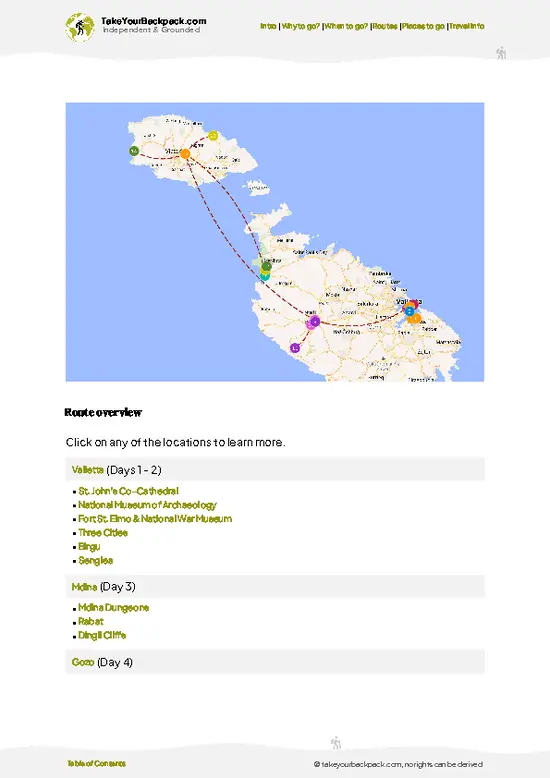
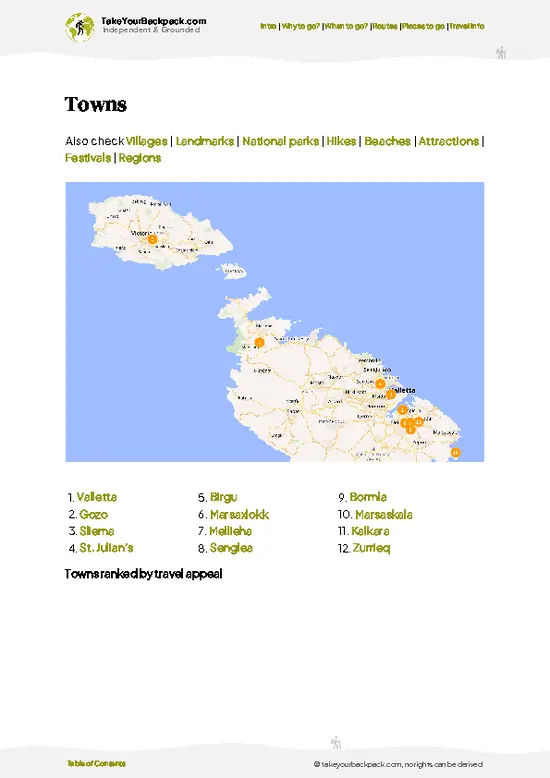
Seeing the layout at a glance
Loading the map 🌍
CLICK TO FILTER
town
village
unique site
national park
hike
beach
attraction
festival
region
SHOW COUNTRY’S BESTSHOW ALL
film
0
0
0a
St. John’s Co-Cathedral
film
1
1
1a
Fort St. Elmo & National War Museum
film
2
2
2a
National Museum of Archaeology
film
3
3
3a
Domus Romana (Roman Villa
film
4
4
4a
Malta National Aquarium
film
5
5
5a
Teatru Manoel
film
6
6
6a
Comino’s Blue Lagoon
Pierre Tijou
film
7
7
7a
Ramla Bay
Daniele Dall'aglio
film
8
8
8a
Golden Bay
Tiziana Ro
film
9
9
9a
Mellieha Bay
Arkadiusz Szczęsny
film
10
10
10a
Paradise Bay
film
11
11
11a
Gnejna Bay
Romain Perea
film
12
12
12a
St. Peter’s Pool
film
13
13
13a
Xlendi Bay
film
14
14
14a
Fomm ir-Rih
Romain Perea
film
15
15
15a
Armier Bay
film
16
16
16a
Ghar Lapsi
Jean-francois Grange
film
17
17
17a
St. George’s Bay
film
18
18
18a
Għajn Tuffieħa Bay
Ireneusz Mizgalski
film
19
19
19a
Victoria Lines
Manuel Pace Balzan
film
20
20
20a
Coastal Walk from Marsaskala to St. Thomas Bay
Petar Ljubicic
film
21
21
21a
Majjistral
Joseph Grech
film
22
22
22a
Il-Majjistral Nature and History Park
film
23
23
23a
Dwejra
Akademia Judo RzeszÓw
film
24
24
24a
Buskett
Simon
film
25
25
25a
Ta’ Qali
film
26
26
26a
L-Aħrax tal-Mellieħa
film
27
27
27a
Ghadira
Denise Aquilina
film
28
28
28a
Simar
Pascal Aloisio
film
29
29
29a
Three Cities
Alex
film
30
30
30a
Valletta
Alfredo Luigi Zampieri
film
31
31
31a
Gozo
Feena Dream
film
32
32
32a
St. Julian’s
film
33
33
33a
Sliema
film
34
34
34a
Marsaxlokk
Artibus
film
35
35
35a
Kalkara
Beata Matysiak
film
36
36
36a
Dingli Cliffs
Robert
film
37
37
37a
Mdina Dungeons
film
38
38
38a
Mdina
Sandra Enciso
film
39
39
39a
Rabat

Why go?What makes this country worth the trip

Architecture

Malta is limestone on steroids: Knights-era bastions, a silent medieval capital, and temples older than the pyramids—plus a crisp Renzo Piano reboot at … read more 👉
Malta is limestone on steroids: Knights-era bastions, a silent medieval capital, and temples older than the pyramids—plus a crisp Renzo Piano reboot at Valletta’s gate. Go early and the stone glows; go late and Mdina empties. Book Hypogeum months out or pivot to Ħaġar Qim/Mnajdra at sunrise. Ditch buses for your feet in Birgu’s lanes at dusk.

Beach life

Malta rewards beach hunters who play the elements. Limestone coves, fishbowl-clear water, and shore dives you can reach in flip‑flops. Watch the wind: … read more 👉
Malta rewards beach hunters who play the elements. Limestone coves, fishbowl-clear water, and shore dives you can reach in flip‑flops. Watch the wind: north wind means south-coast glass, and jellyfish drift with it—switch sides. Dawn ferry to Comino beats the flotilla; sunset at Għajn Tuffieħa steals the day. Pay a lido ladder, or scramble rock—your call.

Low cost

Malta is a wallet-soft island if you play it right. Aim for a mid–two-digit daily spend and you’ll eat well (pastizzi, ftira), sleep in hostels, and ride … read more 👉
Malta is a wallet-soft island if you play it right. Aim for a mid–two-digit daily spend and you’ll eat well (pastizzi, ftira), sleep in hostels, and ride the island-wide buses. Trade-off: buses are slow; pay more for a scooter to claw back hours. Stick to ferries over taxis, swim for free, hit temple combo-tickets, and pregame with corner-shop cans, not Paceville pours.
Want the complete picture of Malta?
The offline Travel Guide brings everything together — routes, highlights & planning.

See what's included in the guide 👉

Get the Travel Guide -

⭐ HighlightsUnmissable destinations

  • Ħal Saflieni Hypogeum: Time or money—pick one. Tickets are scarce and pricier than other sites, but the first slot gives near-quiet and space to breathe. The air hits cool and mineral on your skin, and carved chambers swallow footsteps.
  • Blue Lagoon, Comino: Sleep in and you’ll bob in sunscreen soup; catch the first boat from Cirkewwa and you’ll own the cove for an hour. Private skiff costs more but buys flexibility. No shade, slick rocks, crystalline water that salts your lips dry.
  • Mdina after dark: Daytime is for postcards; go at 9 p.m. when tour groups vanish. The compromise is a late bus or a pricier cab, but you get hushed alleys, warm lamplight on polished stone, and the bell’s soft thud over Rabat.
  • Ħaġar Qim & Mnajdra Temples: Go at opening; wind and sun punish by noon. It’s a downhill-out, uphill-back deal—bring water, not bravado. Under the canopies you can trace tool marks in honeyed limestone while the sea hammers the cliffs below.
  • The Three Cities at sunset: Skip the bus; the Valletta
read more 👉
  • Ħal Saflieni Hypogeum: Time or money—pick one. Tickets are scarce and pricier than other sites, but the first slot gives near-quiet and space to breathe. The air hits cool and mineral on your skin, and carved chambers swallow footsteps.
  • Blue Lagoon, Comino: Sleep in and you’ll bob in sunscreen soup; catch the first boat from Cirkewwa and you’ll own the cove for an hour. Private skiff costs more but buys flexibility. No shade, slick rocks, crystalline water that salts your lips dry.
  • Mdina after dark: Daytime is for postcards; go at 9 p.m. when tour groups vanish. The compromise is a late bus or a pricier cab, but you get hushed alleys, warm lamplight on polished stone, and the bell’s soft thud over Rabat.
  • Ħaġar Qim & Mnajdra Temples: Go at opening; wind and sun punish by noon. It’s a downhill-out, uphill-back deal—bring water, not bravado. Under the canopies you can trace tool marks in honeyed limestone while the sea hammers the cliffs below.
  • The Three Cities at sunset: Skip the bus; the Valletta ferry is faster, cheaper, and drops you in the lanes you actually want. Rigging clinks, diesel drifts, and bastions flush gold as you loop Birgu to Senglea’s Gardjola. Off-the-map: Fomm ir-Riħ’s wild cove, Xrobb l-Għaġin’s wind-carved point, and Għar Lapsi’s natural pool.
Spotted a mistake or missing a highlight? Contact us.

But Malta offers more...

Discover and compare all of its highlights per category

🧭 RoutesPlanning a route that makes sense

The 2-Day Grand Harbour Focus

The Vibe: A compact, culture-heavy sprint through Valletta and the Grand Harbour, perfect if you want maximum history with minimal logistics and no hotel hopping. You’ll walk almost everywhere, dipping into churches, museums, and bastions while still leaving time for slow harbor views.
The Highlights:
  • Baroque art and Caravaggio masterpieces at St. John’s Co-Cathedral
  • Fortified harborside history at Fort St. Elmo & National War Museum
  • Prehistoric context at the National Museum of Archaeology
  • Atmospheric lanes and waterfronts in Birgu and the wider Three Cities

The 3-Day City-and-Coast Sampler

The Vibe: A balanced first-timer route that splits time between Valletta’s stone streets, the Grand Harbour towns, and the sandy bays of Malta’s northwest. Expect a moderate pace with one base change, using buses and short ferries to trade city walls for sea cliffs and beaches.
The Highlights:
  • Two nights soaking up Valletta’s museums, churches, and harbor views
  • Ferry-hopping into
read more 👉

The 2-Day Grand Harbour Focus

The Vibe: A compact, culture-heavy sprint through Valletta and the Grand Harbour, perfect if you want maximum history with minimal logistics and no hotel hopping. You’ll walk almost everywhere, dipping into churches, museums, and bastions while still leaving time for slow harbor views.
The Highlights:
  • Baroque art and Caravaggio masterpieces at St. John’s Co-Cathedral
  • Fortified harborside history at Fort St. Elmo & National War Museum
  • Prehistoric context at the National Museum of Archaeology
  • Atmospheric lanes and waterfronts in Birgu and the wider Three Cities

The 3-Day City-and-Coast Sampler

The Vibe: A balanced first-timer route that splits time between Valletta’s stone streets, the Grand Harbour towns, and the sandy bays of Malta’s northwest. Expect a moderate pace with one base change, using buses and short ferries to trade city walls for sea cliffs and beaches.
The Highlights:
  • Two nights soaking up Valletta’s museums, churches, and harbor views
  • Ferry-hopping into the historic backstreets of Birgu and Senglea
  • Swimming and sunset at Golden Bay and Għajn Tuffieħa Bay
  • Coastal walking inside Il-Majjistral Nature and History Park

The 5-Day Malta & Gozo Deep Dive

The Vibe: A slower, more layered journey that threads Valletta, the Grand Harbour, Mdina, Gozo, and Malta’s northwest into one island-hopping arc. You’ll mix museums and cathedrals with cliff walks, fishing villages, and red-sand beaches, using buses and ferries at an easygoing pace.
The Highlights:
  • Historic immersion in Valletta and the Three Cities
  • Mdina’s quiet lanes, Rabat’s local feel, and the drama of Dingli Cliffs
  • Gozo’s Ramla Bay and the coastal landscapes around Dwejra
  • Golden Bay, Għajn Tuffieħa Bay, and the wild trails of Il-Majjistral Nature and History Park
🌍 Want a ready-to-use travel plan for Malta?
The overview above compares different route options based on your travel time and style. The complete Travel Guide breaks each itinerary down in detail, including maps, stops, highlights, and transport information.

Explore all route details 👉

Get the Travel Guide -

🌤️ When to go?Choosing the right months to travel

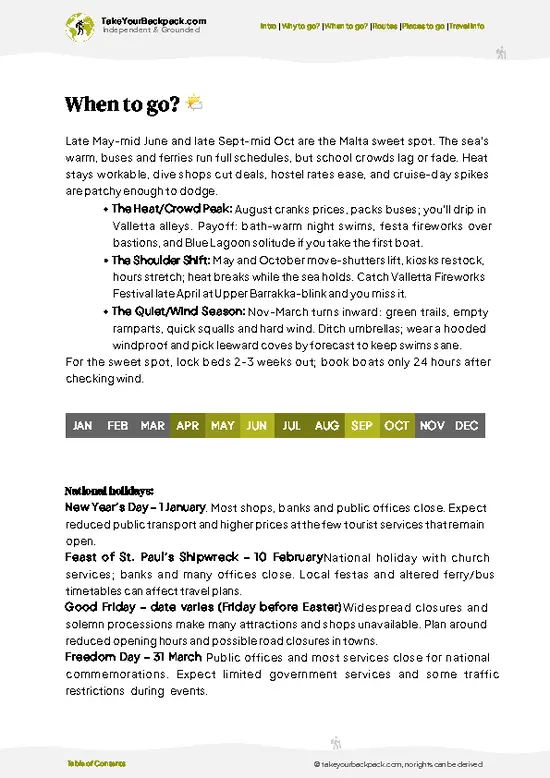
Late May-mid June and late Sept-mid Oct are the Malta sweet spot. The sea’s warm, buses and ferries run full schedules, but school crowds lag or fade. Heat stays workable, dive shops cut deals, hostel rates ease, and cruise-day spikes are patchy enough to dodge.
  • The Heat/Crowd Peak: August cranks prices, packs buses; you’ll drip in Valletta alleys. Payoff: bath-warm night swims, festa fireworks over bastions, and Blue Lagoon solitude if you take the first boat.
  • The Shoulder Shift: May and October move—shutters lift, kiosks restock, hours stretch; heat breaks while the sea holds. Catch Valletta Fireworks Festival late April at Upper Barrakka—blink and you miss it.
  • The Quiet/Wind Season: Nov-March turns inward: green trails, empty ramparts, quick squalls and hard wind. Ditch umbrellas; wear a hooded windproof and pick leeward coves by forecast to keep swims sane.

For the sweet spot, lock beds 2-3 weeks out; book boats only 24 hours after checking wind.

source: climatestotravel.comJANJanuary: fair for travelingFEBFebruary: fair for travelingMARMarch: fair for travelingAPRApril: good for travelingMAYMay: highly recommended for travelingJUNJune: excellent for travelingJULJuly: good for travelingAUGAugust: good for travelingSEPSeptember: excellent for travelingOCTOctober: highly recommended for travelingNOVNovember: fair for travelingDECDecember: fair for traveling
📅 Traveling in a specific month?
Get a full month-by-month breakdown of weather, crowds, costs, festivals, and seasonal highlights in the complete travel guide.

Get full details when to go 👉

Get the Travel Guide -
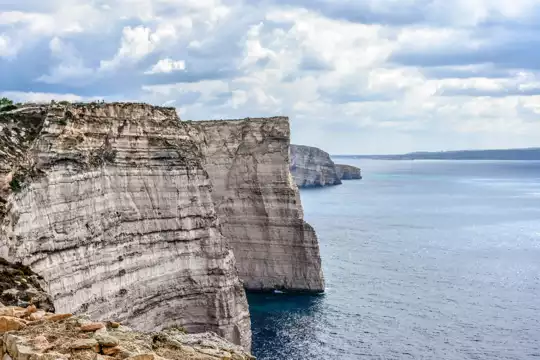
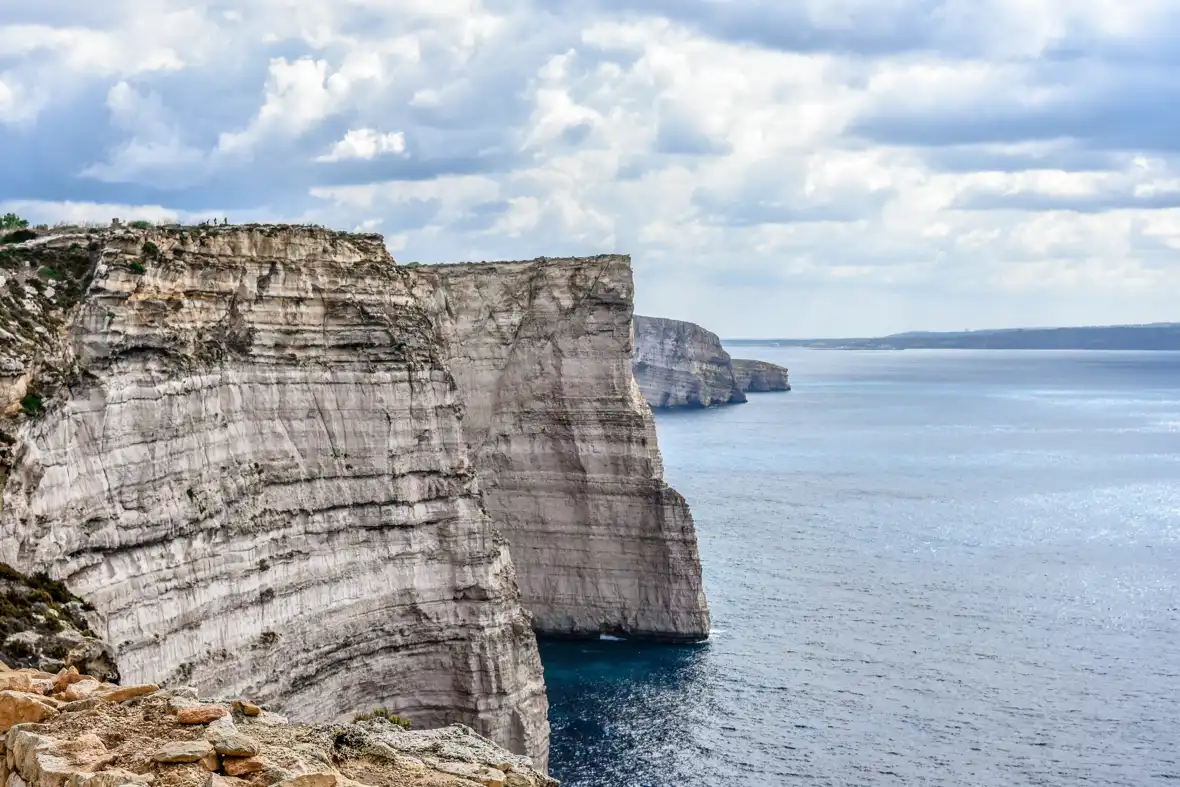
malta-pixabay - cliff-7930586

💰 Costs (as of 2026)How expensive it really is

€50-65/day if you sleep in dorms, ride buses, cook a bit, and choose one paid activity every few days.
  • dorm accommodation: €20-30 off-season, €30-45 in summer (St. Julian’s and Sliema spike to €50 on weekends). System tip: book Sun-Thu, choose hostels with kitchens, and base in Gżira/Sliema so you can walk the promenade and skip late buses; consider Gozo midweek for cheaper beds and calmer nights.
  • meals: Supermarket Survival: €8-12/day if you buy bread, tomatoes, ġbejna, fruit, and water from Lidl/Greens; bakeries sell pastizzi for €0.60-1.00. Street food reality: a ftira or ħobż biż-żejt runs €5-8; seafront “snack bars” charge double for the same. Sit-down mains are €12-20 plus 5-10% service. Compared with Sicily, groceries are similar but takeaway is pricier; still cheaper than Greek islands.
  • local transport: Cheapest unlock: bus 12-Journey card (~€15) makes rides ~€1.25 vs €2 cash; if you’ll bus-hop all week, the 7-day pass (~€21) pays off. Night buses €3. Valletta-Three Cities ferry is a cheap time-saver; to Gozo, the slow ferry from Ċirkewwa is ~€5 return (time-heavy, cheapest), the fast ferry from Valletta is quicker but ~€12 one-way. Car hire only beats buses if two people split
read more 👉
€50-65/day if you sleep in dorms, ride buses, cook a bit, and choose one paid activity every few days.
  • dorm accommodation: €20-30 off-season, €30-45 in summer (St. Julian’s and Sliema spike to €50 on weekends). System tip: book Sun-Thu, choose hostels with kitchens, and base in Gżira/Sliema so you can walk the promenade and skip late buses; consider Gozo midweek for cheaper beds and calmer nights.
  • meals: Supermarket Survival: €8-12/day if you buy bread, tomatoes, ġbejna, fruit, and water from Lidl/Greens; bakeries sell pastizzi for €0.60-1.00. Street food reality: a ftira or ħobż biż-żejt runs €5-8; seafront “snack bars” charge double for the same. Sit-down mains are €12-20 plus 5-10% service. Compared with Sicily, groceries are similar but takeaway is pricier; still cheaper than Greek islands.
  • local transport: Cheapest unlock: bus 12-Journey card (~€15) makes rides ~€1.25 vs €2 cash; if you’ll bus-hop all week, the 7-day pass (~€21) pays off. Night buses €3. Valletta-Three Cities ferry is a cheap time-saver; to Gozo, the slow ferry from Ċirkewwa is ~€5 return (time-heavy, cheapest), the fast ferry from Valletta is quicker but ~€12 one-way. Car hire only beats buses if two people split it and you’re short on time.
  • activities: Cost drivers: Blue Lagoon/Comino boats €25-35 (extras onboard add up), diving €80-120 for two-tank days (shore dives are value), Hypogeum ~€35 and must be booked early, St. John’s Co-Cathedral ~€15. A multi-site heritage pass is worth it if you’ll hit 3-4 temples/museums; otherwise pay à la carte. Tours are cheaper than Spain’s coast, pricier than mainland Greece.
  • miscellaneous: Budget Leaks: sunbeds €10-20, “service fees” on drinks in tourist strips, Euronet-style ATMs with nasty rates, water at kiosks €1.50 vs supermarket €0.30/L (use water vending machines), airport bus €2 vs taxi €20-25. Cocktails in Paceville cost more than Sicily, beer is similar; pregame from the shop if you care about the math.
⚠️ Prices can change and everyone travels differently, so take this as a rough guide. Hope it helps you plan your adventure!

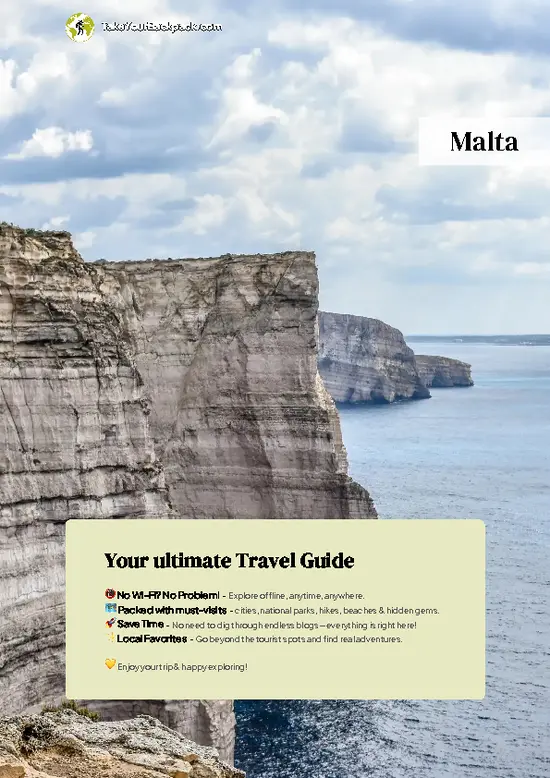
✈️ The backpacker research shortcutMalta Travel Guide

An offline-friendly backpacking guide with optimized travel routes, ranked highlights, transport advice, and the best areas to stay.
example page 0 from our offline Travel Guide for Maltaexample page 1 from our offline Travel Guide for Maltaexample page 2 from our offline Travel Guide for Maltaexample page 3 from our offline Travel Guide for Maltaexample page 4 from our offline Travel Guide for Maltaexample page 5 from our offline Travel Guide for Maltaexample page 6 from our offline Travel Guide for Maltaexample page 7 from our offline Travel Guide for Malta
The digital guide (235 pages) contains:
59 highlights, ranked by travel appeal
Optimized 2, 3 & 5-day travel routes
Cities, national parks, beaches, historical sites, ...
How to get around
Offline-friendly for travel without Wi-Fi
👉 Click to see all 30+ guide features

📅 Plan smarter in minutes, not weeks
Month by month travel advice
Festivals & national holidays
Budget expectations

🗺️ Go to the right places, skip the overrated ones
Honest pros & cons of destinations
Top hikes, parks & viewpoints
Lesser-known places most travelers miss
Clear “worth it vs skip it” guidance

🛏️ Travel smoothly without rookie mistakes
Best areas to stay
Transport systems explained simply
Common scams & safety advice
SIM cards, money & practical tips

🌍 Understand the country, not just visit it
Culture & traditions
52 Essential phrases & customs
Festivals worth planning around
Traveler-friendly historical context
Insights that make places more meaningful

📱 Built for real travel conditions
Fully downloadable PDF
Works completely offline
Optimized for phone use
Useful in remote areas & buses
Everything in one place
Save weeks of stressful planning
Get instant access to the full guide directly. 30-day money-back guarantee.


Sent to your inbox immediately after payment • 100% Secure Checkout
Best Backpacking Travel Advisor 2025 tourism awardBest Backpacking
Travel Advisor
2025
What others say about Take Your Backpack Guides:
⭐⭐⭐⭐⭐
Fantastic, amazing amount of information!
⭐⭐⭐⭐⭐
My goodness this is amazing, it's what I've been looking for hats off too you!
⭐⭐⭐⭐⭐
I think this is absolutely BRILLIANT
⭐⭐⭐⭐
Very complete and informative. It's still missing places, but I gotta to commend you
⭐⭐⭐⭐⭐
This is truly amazing, thank you, can't wait to explore it with my kids!
⭐⭐⭐⭐⭐
Awesome resource, thank you!
⭐⭐⭐⭐⭐
This is amazing! Can't wait to explore the ones I haven't seen
⭐⭐⭐⭐
I love this! Well done, great idea.
⭐⭐⭐⭐⭐
Thanks for taking the time to make this gem!
⭐⭐⭐⭐⭐
This might be the best website I've ever seen.
⭐⭐⭐⭐⭐
Congratulations, and thank you so much for your work; it's incredibly valuable.
⭐⭐⭐⭐
In all seriousness I think you did a great job pointing out the important spots
⭐⭐⭐⭐⭐
10/10 very good
⭐⭐⭐⭐⭐
As someone who's only just starting to visit regularly this is awesome, thank you.
⭐⭐⭐⭐
Thank you very much! I'm going to visit my dad, it's going to be very useful!
⭐⭐⭐⭐⭐
This is really cool! We'll be travelling for the first time and this definitely come in handy.
⭐⭐⭐⭐⭐
You are now our minister of culture, congratulations 👨‍💼
⭐⭐⭐⭐⭐
Just wanted to tell you that this is a pearl! Going to follow your recommendations.
⭐⭐⭐⭐⭐
This is so cool. I'll definitely be using the resource for my travels soon.
⭐⭐⭐⭐⭐
This is very impressive! Good work.
⭐⭐⭐⭐⭐
This is an amazing and informative site. Very well done!

🛏️ Where to stay?Best areas to base yourself

Yes — Malta has hostels and budget accommodation concentrated in Sliema, St Julian’s (Spinola/Paceville), Valletta, the northern resort strip around Bugibba/Qawra, plus cheaper options on Mellieħa and the island of Gozo.

Sliema gives frequent ferries and buses to Valletta but can be pricier; St Julian’s hosts most nightlife and many hostels but is noisy late-night and rowdy around Paceville; Valletta is best for sightseeing and central access yet has fewer budget beds; Bugibba–Qawra is the cheapest coastal strip with basic amenities and good bus links; Mellieħa offers sandy beaches and Comino/Gozo … read more 👉
Yes — Malta has hostels and budget accommodation concentrated in Sliema, St Julian’s (Spinola/Paceville), Valletta, the northern resort strip around Bugibba/Qawra, plus cheaper options on Mellieħa and the island of Gozo.

Sliema gives frequent ferries and buses to Valletta but can be pricier; St Julian’s hosts most nightlife and many hostels but is noisy late-night and rowdy around Paceville; Valletta is best for sightseeing and central access yet has fewer budget beds; Bugibba–Qawra is the cheapest coastal strip with basic amenities and good bus links; Mellieħa offers sandy beaches and Comino/Gozo ferries but is farther from Valletta and night transport is limited; Gozo (Victoria) gives low-cost guesthouses and a quiet island pace but slower inter-island travel and fewer dorm-style hostels.

If you enjoy meeting fellow travelers, consider choosing hostels with high ratings for atmosphere. On the other hand, if you prefer having your own space, a hotel might be a better option.

🚌 Getting aroundTransportation options and logistics

Malta moves on a patient pulse. Timetables exist; traffic decides. Buses crawl through stone villages, then sprint open coast roads. Ferries are the locals’ diagonal. Travel early, retreat at noon, move again after six. Ignore that rhythm and you’ll watch full buses breeze by.
  • Malta Public Bus Network Cheapest by far, but you pay in minutes. Cross-island for the price of a coffee, or taxi it for ten times more. Valletta-Cirkewwa is 70-90 minutes if traffic plays nice. X routes hit airport/ferry;
read more 👉
Malta moves on a patient pulse. Timetables exist; traffic decides. Buses crawl through stone villages, then sprint open coast roads. Ferries are the locals’ diagonal. Travel early, retreat at noon, move again after six. Ignore that rhythm and you’ll watch full buses breeze by.
  • Malta Public Bus Network Cheapest by far, but you pay in minutes. Cross-island for the price of a coffee, or taxi it for ten times more. Valletta-Cirkewwa is 70-90 minutes if traffic plays nice. X routes hit airport/ferry; summer TD lines cost a bit more but shave chunks of time. Board front, tap contactless/Tallinja, signal early, and expect bunching at rush and school changeover.
  • Harbour Ferries & dgħajsa The geometry hack. Valletta-Sliema and Valletta-Three Cities in seven salty minutes instead of a 40-minute bus loop. A few euros, frequent in daylight, last boats earlier than your dinner. In chop, sit aft to stay dry. Dgħajsa skiffs run on demand; pay the skipper cash and enjoy the shortcut.
  • Gozo Channel Ferry Social rules are simple: let foot passengers off, don’t block the vehicle ramp, and keep bags off seats. You pay only when leaving Gozo, which feels like a gift. Grab pastizzi on board, then link Bus 301 at Mġarr if you’re aiming for Victoria. Deck is windy; dawn sailings are hushed.
  • Ride-hailing (Bolt/eCabs/Uber) The budget disruptor for gaps and late nights. Short hops under a tenner beat a 25-minute wait. Split with two friends and it undercuts wasted time. Call from the correct side of the road to avoid U-turns; expect surge around Paceville after 22:00 and post-festas.

Master tip: Chain diagonals off-peak—ferry into Valletta, express bus out, then a short ride-hail for the last mile—and you’ll cross the country faster than any single-mode plan, for a fraction of a taxi.
Valletta sits about 8 km (5 miles) from Malta International Airport (MLA), so it’s a quick hop into the city.
  • Public bus (Route X4) — Direct airport-Valletta service. Drops you at the Valletta Bus Terminus by City Gate (easy walk to the center).
    Travel time: about 20-30 minutes, longer at rush hour.
    Cost: €2.00-€2.50 (daytime, season-dependent), €3.00 at night. Pay with contactless card/phone or cash on board.
    Frequency: roughly every 20-30 minutes most of the day.
    Timetables and live times: Malta Public Transport.
  • Night buses — Limited late services operate on some nights.
    Travel time: similar to daytime.
    Cost: €3.00.
    Check the Tallinja app or the link above for exact timings.

Taxi and ride-hailing: A licensed white taxi from the airport kiosk has a fixed fare to Valletta (around €17 as of 2025); ride-hailing apps like Bolt/Uber typically run €12-€20 depending on demand. Travel time is usually 15-20 minutes.

Tip: If you’re taking the bus, the terminus is right outside the city walls; most sights in Valletta are a 5-10 minute walk from there. Traffic can spike around commuting hours, so add a little buffer if you’re on a schedule.
⚠️ Prices and routes can change, so take this as a rough guide and ask for local advice when you arrive.

🔒 Safety (risk Level: low)Is Malta safe to visit?

Safety for solo travelers, including women and LGBTQ+ individuals
Malta is generally safe for solo travelers, including women and LGBTQ+ individuals. Petty crime like pickpocketing can happen, especially in crowded areas, so keep your belongings secure. The local LGBTQ+ community is active, and LGBTQ+ travelers should feel comfortable, especially in places like Valletta and St Julians. Always stay aware of your surroundings and trust your instincts, like anywhere else.


Full official government travel advisory (live updates)
View details 👉

✈️ VisaVisa requirements for Malta

Most travelers from the EU, the US, Canada, Australia, and New Zealand do not need a visa for stays up to 90 days in Malta. If you’re from a country that requires a Schengen visa, apply through the Maltese embassy or consulate in your area, typically needing a completed application form, passport, photo, and proof of travel insurance. For the latest info, always double-check with your local Maltese consulate.
⚠️ Visa requirements can change over time, so always check the latest visa requirements with the official embassy or government website before you travel.

🎒 What to pack?What to pack for Malta

Malta’s climate is mostly sunny, but it can get pretty windy, especially on the coast. Summers are hot and dry, while winters are mild with the occasional rain, so pack accordingly. Malta’s got beaches, rocky coastlines, and some hilly terrain, so think versatile and comfy footwear. If you plan on visiting any churches or temples, remember that modest attire is a must—cover those shoulders and knees. And don’t forget, Malta’s all about the sea, so swimwear is a must for that spontaneous dip!

Apart from this country specific advice, I have also crafted a general packing list that should help on any trip. authorOver the years, I've learned the importance of packing minimally. It's so much easier to jump on the back of a truck or squeeze yourself into the last spot of a minibus without that supersized backpack. If you're headed to a warm destination, leave your winter jacket at home; for colder regions, opt for thin thermal underlayers. Instead of packing your entire wardrobe, bring just three sets of clothes, as laundry facilities are available everywhere.

View the full list 👉
🎒 Planning the practical side of your trip?
Get detailed information on transport, daily budgets, internet access, local customs, food, language, and other essentials in the complete Travel Guide.

Get detailed practical information 👉

Get the Travel Guide -

🙋 FAQQuick answers to practical concerns

Trip Planning


Personal tip: I normally search on good rating for atmosphere (for meeting people) and location (for easy exploring). Cleanliness as a bonus.


Travel Essentials

Routine Vaccinations: Ensure you’re up-to-date on routine vaccines: MMR (measles, mumps, rubella), DTaP (diphtheria, tetanus, pertussis), varicella (chickenpox), and polio.

Hepatitis A: Recommended for travelers. It can spread through contaminated food or water.

Hepatitis B: Consider if you might have close contact with locals, be sexually active, or get any medical treatment.

Flu Vaccine: If traveling during flu season, consider a flu shot.

Always check current health advisories and consult a travel health professional for personalized advice.


vaccination requirements
When I first started traveling, I often spent part of my first day in a new country hunting for a local SIM card. While this can still be slightly cheaper, it also takes time and planning.

These days, it's much simpler to install an eSIM before leaving home. Once you arrive in Malta, you can activate it immediately and have mobile data from the moment you land — which is especially useful for ordering transport or navigating away from busy airports.

There are many providers nowadays, and price differences are usually small. I personally go with Airalo, as it offers excellent network coverage throughout the country and strong global coverage, so you can manage multiple countries from a single app.


Get your e-sim for Malta

Culture & Customs

Dress modestly, especially when visiting churches. It’s respectful to cover shoulders and knees. Try greeting locals with a friendly ”Bongu” (good morning) or ”Bonswa” (good evening). Tipping isn’t mandatory but appreciated, usually around 5-10% for good service.

Avoid discussing politics or religion in depth, as these can be sensitive topics. Public displays of affection are generally accepted, but be discreet in more traditional areas. For LGBTQ+ travelers, Malta is very progressive, but always stay aware of your surroundings. Women should feel comfortable traveling solo, but as always, keeping an eye on your belongings and surroundings is wise.
Trying traditional food is always a great way to experience the culture. Here are some must-try dishes for Malta.
  • Fenek: This is rabbit stew, and it’s a beloved Maltese classic. Often slow-cooked with wine and garlic, it’s a dish with roots deep in Maltese tradition, symbolizing the island’s rustic culinary history.
  • Pastizzi: These are flaky pastries, usually filled with ricotta or mushy peas. Ubiquitous and affordable, pastizzi are a staple snack, capturing the essence of Maltese street food culture.
  • Ftira: A kind of open sandwich made with local bread, typically topped with tuna, capers, tomatoes, and olives. It’s a perfect bite to enjoy by the beach, reflecting the island’s Mediterranean vibes.
  • Ġbejniet: These are small round cheeses made from sheep’s milk. They can be fresh, dried, or peppered and are a true taste of rural Malta, often featured in salads or as a simple snack.
  • Kapunata: Similar to ratatouille, this vegetable dish is a mix of eggplant, bell peppers, and tomatoes, seasoned with herbs. It’s a testament to the island’s agricultural bounty and Mediterranean influences.
Tap water in Malta is technically safe to drink, but it’s desalinated and can taste a bit off, so locals often opt for bottled or filtered water. Tourists might prefer doing the same for taste reasons, although health-wise, it’s generally fine. If you’re on a tight budget, consider bringing a reusable bottle with a filter.
The main language in Malta is Maltese. Backpacking is way more rewarding if you know a bit of the local language, so I'd suggest brushing up on the basics just in case your Maltese skills have become a bit rusty.

Want to understand locals better?
The complete Travel Guide for Malta includes 52 essential words and phrases — greetings, thank-yous, ordering food, transport, numbers, and common local expressions you'll actually hear.

Get your local basic phrases 👉

Get the Travel Guide -


English is widely spoken in Malta, making it an accessible destination for English-speaking travelers. As one of the official languages alongside Maltese, English is used in government, education, and media. Most Maltese people are bilingual, often speaking English fluently, especially in urban areas and tourist hotspots like Valletta, Sliema, and St. Julian’s.

In restaurants, shops, and hotels, staff typically have a good command of English, ensuring that communication is smooth for visitors. Additionally, road signs and public information are usually available in English, further facilitating navigation and understanding.

While some older generations may have varying levels of proficiency, younger Maltese individuals are generally well-educated in English, having learned it from an early age. Overall, travelers can expect minimal language barriers, allowing them to fully enjoy Malta’s rich history, culture, and hospitality.

Money & Payments

The local currency of Malta is EUR (€).

When you’re backpacking through Malta, it’s good to know that euros are the way to go. Forget about using dollars; they won’t get you far here. ATMs are pretty easy to find, especially in urban areas like Valletta or Sliema. However, if you’re exploring the more remote parts of the islands, it’s smart to carry some cash. Keep small bills as not everyone loves breaking a 50.

Credit and debit cards are widely accepted, but small eateries and local shops might still prefer cash. Just make sure your card doesn’t charge hefty foreign transaction fees. As for exchanging money, banks and official exchange bureaus are your best bet. Steer clear of airport exchange services if you want to avoid bad rates.

In Malta, tipping isn’t compulsory but appreciated. In restaurants, a tip of about 5-10% is common if service charge isn’t included. For taxis and other services, rounding up to the nearest euro is a nice gesture.

🧩 Nearby countriesNearby backpacking alternatives

We 💚 feedbackThe bottom line on traveling here

Malta runs hot: baroque stone, festa fireworks, bath-warm seas, and night buses that show up when they feel like it. Pay for a boat and you buy time; wait for buses and you buy stories. Best surprise: ladders cemented into rocky coves—no sand, just a clean plunge. Watch the midday sun; it beats you hollow, and Comino is a crush after 10 a.m. The island’s pivoting—Gozo fast ferries, pedestrian Valletta, cleaner harbours, and stricter beach crowd controls inching in.

✍️ Help improve this page!
The information on this page is based on in-depth research, insights shared by experienced travelers, and feedback from the local travel community in Malta. While every effort is made to keep the information accurate and current, conditions can change — so if you spot anything incorrect or outdated, please get in touch.


🙋‍♂️ Give feedback

👋 Meet the founderWho’s Behind Take Your Backpack?

Johan, backpacker and founder of TakeYourBackpackHi, I’m Johan (Netherlands 🇳🇱), the creator of TakeYourBackpack. Over the past decade, I’ve backpacked through 80+ countries across six continents, gaining extensive experience with independent travel, long-term trips, and overland routes.

This site is built on a combination of firsthand travel experience and carefully curated insights from other backpackers. Many guides are based on places I’ve personally visited, while others bring together tips, observations, and practical advice shared by trusted travelers I’ve met along the way.

The goal is to provide realistic, experience-driven guidance — not generic itineraries — so you can explore destinations with better context, clearer expectations, and more confidence.

Get full Malta guide •
Instant download • 59 highlights • Full Offline guide