×
Mauritius 🇲🇺

backpacking Africa Mauritius 🇲🇺Circle coastal roads blending cultures effortlessly.

Explore MauritaniaExplore Mayotte

Backpacking Mauritius in 2026

A complete guide including when and where to go, costs, transport, itineraries, and practical travel advice.
A first look at the country

Backpacking Mauritius
By Johan Kruseman 🇳🇱 | Updated June 3, 2026

Mauritius isn’t just a honeymoon island of all-inclusive resorts. It’s a living blend of Creole, Indian, African, and French threads wrapped around basalt peaks and coral lagoons. The move is to trade a little pool time for markets, music, and history.

Think sega drums at dusk, dholl puri slapped hot on a Port Louis corner, old sugar estates pouring rum, and two UNESCO anchors—Le Morne’s cliff of resistance and Aapravasi Ghat’s first steps of arrival. Hike Black River Gorges at first light, kite the Le Morne lagoon when the trades wake, snorkel a reef pass before the boats. Traffic crawls, buses cost coins but burn hours, and resort markups sting—classic time–money–comfort math—but when you trade polish for texture, the island pays you back.

Réunion has bigger peaks and EU prices; Seychelles is glossy with less street life; Madagascar is wondrous but work; Rodrigues is the slow cousin. Mauritius suits travelers who want culture with their lagoon, soft adventure without chaos, and value measured in flavor and reef time.

👉 Get the 📖 Travel Guide of Mauritius

North: Grand Baie, Pereybere, Cap Malheureux

Easy base if you want beaches plus bars. M2 buses and shared taxis keep costs low; expect traffic and jet-ski noise. Boat runs to Coin de Mire are quick. Sociable travelers win; light sleepers lose. Eat at La Cuvette stalls; I book catamarans Tue–Thu for cheaper seats.

West & Southwest: Flic-en-Flac, Tamarin, Le Morne (A3 spine)

Sunset coast for hikers and surfers. Buses crawl; rent a car or budget long transfers. I start Le Morne at 6:00 for shade and empty ladders; Tamarin dolphins only pay off at dawn. Cheaper food and buses in Flic-en-Flac; day-trip to Black River Gorges and Chamarel.

East Coast: Belle Mare to Trou d’Eau Douce

Windy lagoons, quiet nights, long swims. Resorts dominate, yet public beaches deliver. Buses are thin, scooters earn their keep. Base near Belle Mare for snack shacks and Flacq market (Wed/Sun). Île aux Cerfs boats from Trou d’Eau Douce—I haggle before 9:00; kitesurfers thrive.

South & Southeast: Mahebourg, Blue Bay, Gris Gris

Closest to the airport and the most honest slice. Mahebourg’s waterfront for street food; Blue Bay Marine Park before 10:00 for clear water and cheaper glass-bottom boats if you join locals. Gris Gris is for walks, not swims. I stage first or last night here—calm vibe, early evenings, strong wind.
Geography and where places are located
Loading the map 🌍
CLICK TO FILTER
city
town
village
unique site
national park
hike
beach
attraction
festival
region
SHOW COUNTRY’S BESTSHOW ALL
film
0
0
0a
Le Morne
film
1
1
1a
Trou aux Biches
film
2
2
2a
Belle Mare
film
3
3
3a
Tamarin Bay
film
4
4
4a
La Cuvette
film
5
5
5a
Anse La Raie
film
6
6
6a
Le Morne Brabant
film
7
7
7a
Tamarind Falls
film
8
8
8a
Black River Gorges
film
9
9
9a
La Vallée de Ferney
film
10
10
10a
Bras d’Eau
film
11
11
11a
Rochester Falls
film
12
12
12a
Le Souffleur

Why go?What makes this country worth the trip

Beach life

Mauritius is beach life with a safety net: reef-protected lagoons for lazy swims, outer reefs for real snorkeling and dives, and west-coast sunsets that actually earn the hype. Stay north or west for calmer winter seas; the east … read more 👉
Mauritius is beach life with a safety net: reef-protected lagoons for lazy swims, outer reefs for real snorkeling and dives, and west-coast sunsets that actually earn the hype. Stay north or west for calmer winter seas; the east blows hard then. Hit Blue Bay at 8 a.m. before boat convoys. Grand Baie handles the night; Sundays pack the public beaches—go early or choose Monday.

Low cost

Mauritius quietly favors penny‑pinchers: you can cruise on a low‑to‑mid double‑digit USD daily average if you play it local. Buses are slow but cheap; taxis are fast but burn your day’s spend. Eat dholl puri and fried noodles … read more 👉
Mauritius quietly favors penny‑pinchers: you can cruise on a low‑to‑mid double‑digit USD daily average if you play it local. Buses are slow but cheap; taxis are fast but burn your day’s spend. Eat dholl puri and fried noodles instead of resort buffets, picnic on public beaches. Sleep in simple guesthouses; rent a scooter only when the bus grid will cost you hours.
Want the complete picture of Mauritius?
The offline Travel Guide brings everything together — routes, highlights & planning.

See what's included in the guide 👉

Get the Travel Guide -

⭐ HighlightsKey places and experiences

  • Le Morne Brabant: Trade winds rake a basalt fin above a neon lagoon. Hike at first light to the mid-summit; the reef line looks sketched. Pay a guide for the scramble or start early, pack gloves, and respect any chain-marked closures.
  • Blue Bay Marine Park: Water so clear it exposes your excuses. Do a boat drop at the Coral Garden and drift-snorkel back to the public beach. Private skiff costs more but buys space; be there by 9, avoid weekends, bring your own mask.
  • Île aux Cerfs: Yes, it’s busy near the jetty; walk twenty minutes east and you’ll earn quiet sand and thigh-deep jade. Catch the earliest shuttle from Trou d’Eau Douce, carry water and shade, and skip the overpriced parasail distractions.
  • Chamarel Seven Colored Earth & Waterfall: Heat shimmers over rippled mineral dunes while the falls pound a forest bowl. Hit mid-morning after dry weather, then taste rum at the Rhumerie. The combo ticket is worth it; scooters grind on the steep approach when wet.
  • Port Louis Central Market & Aapravasi
read more 👉
  • Le Morne Brabant: Trade winds rake a basalt fin above a neon lagoon. Hike at first light to the mid-summit; the reef line looks sketched. Pay a guide for the scramble or start early, pack gloves, and respect any chain-marked closures.
  • Blue Bay Marine Park: Water so clear it exposes your excuses. Do a boat drop at the Coral Garden and drift-snorkel back to the public beach. Private skiff costs more but buys space; be there by 9, avoid weekends, bring your own mask.
  • Île aux Cerfs: Yes, it’s busy near the jetty; walk twenty minutes east and you’ll earn quiet sand and thigh-deep jade. Catch the earliest shuttle from Trou d’Eau Douce, carry water and shade, and skip the overpriced parasail distractions.
  • Chamarel Seven Colored Earth & Waterfall: Heat shimmers over rippled mineral dunes while the falls pound a forest bowl. Hit mid-morning after dry weather, then taste rum at the Rhumerie. The combo ticket is worth it; scooters grind on the steep approach when wet.
  • Port Louis Central Market & Aapravasi Ghat: Diesel, cumin, and voices—eat dhal puri, chase it with alouda, then step into the UNESCO site for the island’s hard truth. Go by 8:30, carry small notes, and exit through Chinatown for breeze; off-map fixes: Pont Naturel’s wave-thump, Ferney Valley’s forest trails, and Bras d’Eau’s quiet lagoons.
Spotted a mistake or missing a highlight? Contact us.

But Mauritius offers more...

Discover and compare all of its highlights per category

🧭 RoutesHow travelers typically move through the country

The 2-Day West Coast Hit List

The vibe: A quick, high-impact escape built around one base, one big hike, and serious lagoon time, ideal if you want to feel you’ve “done” Mauritius without racing all over the map. Expect a relaxed pace with early starts for the trail and lazy sunsets on the sand.
  • Base yourself in Flic en Flac for easy access to both the beach and the southwest.
  • Hike the iconic Le Morne Brabant for huge views over the reef.
  • Swim and unwind on Le Morne and Flic en Flac beaches.

The 3-Day North & Capital Combo

The vibe: A balanced long weekend that mixes easy north-coast beaches with a deep dive into the island’s history in Port Louis. You’ll trade a bit of hammock time for real context, while still keeping transfers short and manageable.
  • Stay in Grand Baie for walkable food, nightlife, and boat access.
  • Hop between Trou aux Biches, Mont Choisy, and Pereybere for varied beach days.
  • Spend a full day in Port Louis exploring Aapravasi Ghat and the city’s markets.

The 5-Day Island Loop:

read more 👉

The 2-Day West Coast Hit List

The vibe: A quick, high-impact escape built around one base, one big hike, and serious lagoon time, ideal if you want to feel you’ve “done” Mauritius without racing all over the map. Expect a relaxed pace with early starts for the trail and lazy sunsets on the sand.
  • Base yourself in Flic en Flac for easy access to both the beach and the southwest.
  • Hike the iconic Le Morne Brabant for huge views over the reef.
  • Swim and unwind on Le Morne and Flic en Flac beaches.

The 3-Day North & Capital Combo

The vibe: A balanced long weekend that mixes easy north-coast beaches with a deep dive into the island’s history in Port Louis. You’ll trade a bit of hammock time for real context, while still keeping transfers short and manageable.
  • Stay in Grand Baie for walkable food, nightlife, and boat access.
  • Hop between Trou aux Biches, Mont Choisy, and Pereybere for varied beach days.
  • Spend a full day in Port Louis exploring Aapravasi Ghat and the city’s markets.

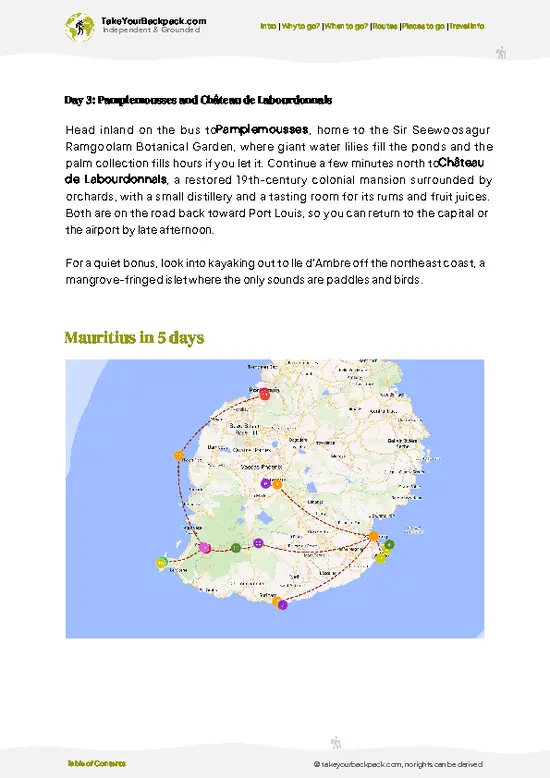
The 5-Day Island Loop: North, Capital & Wild South

The vibe: A fuller island circuit that layers beaches, sugar and labor history, mountain forests, and wave-battered cliffs into one coherent journey. The pace is steady but not rushed, with three main bases to avoid backtracking.
  • Ease in with two nights in Grand Baie and time on Trou aux Biches and Mont Choisy.
  • Stay in Port Louis to explore Aapravasi Ghat and the capital’s street life.
  • Head south for Chamarel, Black River Gorges National Park, Bel Ombre, and the raw coastline at Gris Gris and Rochester Falls.
🌍 Want a ready-to-use travel plan for Mauritius?
The overview above compares different route options based on your travel time and style. The complete Travel Guide breaks each itinerary down in detail, including maps, stops, highlights, and transport information.

Explore all route details 👉

Get the Travel Guide -

🌤️ When to go?A month-by-month overview

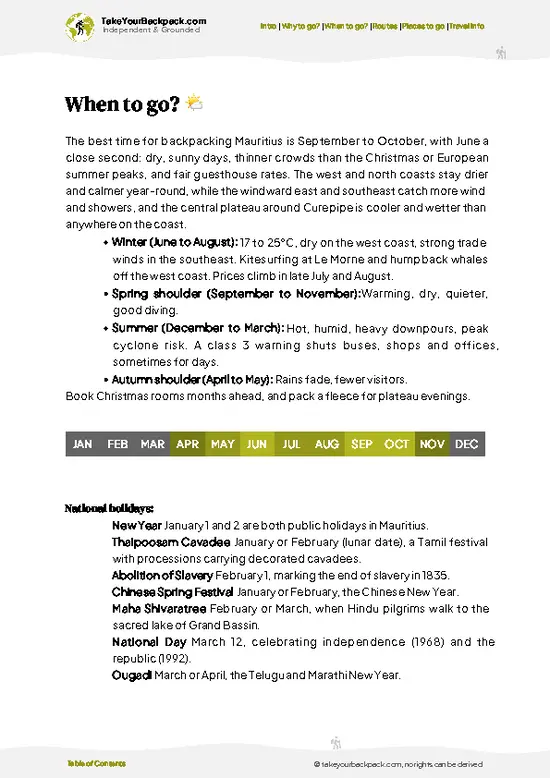
The sweet spot is late May-June and September-October: summer heat breaks, trade winds relax, and prices slide between school holidays. Trails firm, coastal traffic eases, lagoons stay warm and clear. You get diving without cyclone roulette and breezes for boards without sandblasting. Rooms and cars open up.
  • The Crowd/Heat Peak: December’s peak is a grind—rates spike, tables book out, beaches jam. The payoff: pre-dawn baths in glassy lagoons, sega on the sand, fruit so ripe it drips.
  • The Transition/Shoulder: May-June and September move. Humidity drops, winds even out, buses breathe. Guesthouses answer fast, reefs settle by late morning, trails stop sucking at your shoes.
  • The Off-Peak/Extreme: January-March turns inward. Forests steam, waterfalls punch, crowds vanish. Survival hack: base west, start at first light, stash a dry bag. Ignored risk: cyclone alerts halt buses and boats; cash and ATMs get flaky.

Shoulder months: book coast stays about a month out.

source: climatestotravel.comJANJanuary: fair for travelingFEBFebruary: fair for travelingMARMarch: fair for travelingAPRApril: good for travelingMAYMay: highly recommended for travelingJUNJune: excellent for travelingJULJuly: highly recommended for travelingAUGAugust: highly recommended for travelingSEPSeptember: excellent for travelingOCTOctober: excellent for travelingNOVNovember: good for travelingDECDecember: fair for traveling
📅 Traveling in a specific month?
Get a full month-by-month breakdown of weather, crowds, costs, festivals, and seasonal highlights in the complete travel guide.

Get full details when to go 👉

Get the Travel Guide -
!mauritius-pixabay-island-4471208

💰 Costs (as of 2025)Typical budget expectations

A disciplined backpacker lands around 1,600-2,400 MUR ($35-50) per day in Mauritius if they ride buses, eat local, and ration paid tours.
  • dorm accommodation: 700-1,300 MUR/night on the coasts; 500-900 MUR inland. Fewer hostels than Madagascar, but far cheaper than Réunion/Seychelles guesthouse rates. System tip: book one night online to secure the bed, then extend direct via WhatsApp for 10-20% off; midweek and 3+ night deals are common.
  • meals: Supermarket Survival: baguette + tuna + fruit + yogurt runs 150-250 MUR/day and crushes costs. Street food reality: two dholl puri (20-40 MUR each), mine frite or fried rice (125-200 MUR), boulettes soup (120-180 MUR), fresh alouda (40-60 MUR). You’ll eat better and still spend less than Réunion; pricier than Madagascar but cleaner, bigger portions.
  • local transport: Buses are the unlock: 24-60 MUR short hops, 60-100 MUR cross-island, cash to the conductor; service thins after 6-8 pm and Sundays. For remote beaches/waterfalls, rent a small car 1,200-1,800 MUR/day; split three ways and it beats taxis and tours. Taxis quote tourist rates—only worth it shared and pre-agreed.
  • activities: Cost drivers are sea days: catamaran or Île aux Cerfs 1,800-3,000
read more 👉
A disciplined backpacker lands around 1,600-2,400 MUR ($35-50) per day in Mauritius if they ride buses, eat local, and ration paid tours.
  • dorm accommodation: 700-1,300 MUR/night on the coasts; 500-900 MUR inland. Fewer hostels than Madagascar, but far cheaper than Réunion/Seychelles guesthouse rates. System tip: book one night online to secure the bed, then extend direct via WhatsApp for 10-20% off; midweek and 3+ night deals are common.
  • meals: Supermarket Survival: baguette + tuna + fruit + yogurt runs 150-250 MUR/day and crushes costs. Street food reality: two dholl puri (20-40 MUR each), mine frite or fried rice (125-200 MUR), boulettes soup (120-180 MUR), fresh alouda (40-60 MUR). You’ll eat better and still spend less than Réunion; pricier than Madagascar but cleaner, bigger portions.
  • local transport: Buses are the unlock: 24-60 MUR short hops, 60-100 MUR cross-island, cash to the conductor; service thins after 6-8 pm and Sundays. For remote beaches/waterfalls, rent a small car 1,200-1,800 MUR/day; split three ways and it beats taxis and tours. Taxis quote tourist rates—only worth it shared and pre-agreed.
  • activities: Cost drivers are sea days: catamaran or Île aux Cerfs 1,800-3,000 MUR (with lunch), dolphin boats 1,500-2,500 MUR, scuba 1,800-2,800 MUR/dive, kitesurf lessons 3,000-6,000 MUR. Land is cheap: Black River Gorges free, Chamarel area 250-550 MUR. Cheaper than Seychelles boats; more polished (and pricier) than Madagascar.
  • miscellaneous: Budget leaks: airport taxi to the north 1,200-1,800 MUR (bus is 40-100 MUR with a change), beach cocktails 300-600 MUR vs 80-120 MUR supermarket beer, sunscreen 400-800 MUR, ATM fees 200-300 MUR, 3-4% card surcharges, laundry 200-300 MUR per load at local shops. Buy 5L water jugs (60-100 MUR) or carry a filter.
⚠️ Prices can change and everyone travels differently, so take this as a rough guide. Hope it helps you plan your adventure!

✈️ The backpacker research shortcutMauritius Travel Guide

An offline-friendly backpacking guide with optimized travel routes, ranked highlights, transport advice, and the best areas to stay.
example page 0 from our offline Travel Guide for Mauritiusexample page 1 from our offline Travel Guide for Mauritiusexample page 2 from our offline Travel Guide for Mauritiusexample page 3 from our offline Travel Guide for Mauritiusexample page 4 from our offline Travel Guide for Mauritiusexample page 5 from our offline Travel Guide for Mauritiusexample page 6 from our offline Travel Guide for Mauritiusexample page 7 from our offline Travel Guide for Mauritius
The digital guide (256 pages) contains:
68 highlights, ranked by travel appeal
Optimized 2, 3 & 5-day travel routes
Cities, national parks, beaches, historical sites, ...
How to get around
Offline-friendly for travel without Wi-Fi
👉 Click to see all 30+ guide features

📅 Plan smarter in minutes, not weeks
Month by month travel advice
Festivals & national holidays
Budget expectations

🗺️ Go to the right places, skip the overrated ones
Honest pros & cons of destinations
Top hikes, parks & viewpoints
Lesser-known places most travelers miss
Clear “worth it vs skip it” guidance

🛏️ Travel smoothly without rookie mistakes
Best areas to stay
Transport systems explained simply
Common scams & safety advice
SIM cards, money & practical tips

🌍 Understand the country, not just visit it
Culture & traditions
Local customs
Festivals worth planning around
Traveler-friendly historical context
Insights that make places more meaningful

📱 Built for real travel conditions
Fully downloadable PDF
Works completely offline
Optimized for phone use
Useful in remote areas & buses
Everything in one place
Save weeks of stressful planning
Get instant access to the full guide directly. 30-day money-back guarantee.


Sent to your inbox immediately after payment • 100% Secure Checkout
Best Backpacking Travel Advisor 2025 tourism awardBest Backpacking
Travel Advisor
2025
What others say about Take Your Backpack Guides:
⭐⭐⭐⭐⭐
Fantastic, amazing amount of information!
⭐⭐⭐⭐⭐
My goodness this is amazing, it's what I've been looking for hats off too you!
⭐⭐⭐⭐⭐
I think this is absolutely BRILLIANT
⭐⭐⭐⭐
Very complete and informative. It's still missing places, but I gotta to commend you
⭐⭐⭐⭐⭐
This is truly amazing, thank you, can't wait to explore it with my kids!
⭐⭐⭐⭐⭐
Awesome resource, thank you!
⭐⭐⭐⭐⭐
This is amazing! Can't wait to explore the ones I haven't seen
⭐⭐⭐⭐
I love this! Well done, great idea.
⭐⭐⭐⭐⭐
Thanks for taking the time to make this gem!
⭐⭐⭐⭐⭐
This might be the best website I've ever seen.
⭐⭐⭐⭐⭐
Congratulations, and thank you so much for your work; it's incredibly valuable.
⭐⭐⭐⭐
In all seriousness I think you did a great job pointing out the important spots
⭐⭐⭐⭐⭐
10/10 very good
⭐⭐⭐⭐⭐
As someone who's only just starting to visit regularly this is awesome, thank you.
⭐⭐⭐⭐
Thank you very much! I'm going to visit my dad, it's going to be very useful!
⭐⭐⭐⭐⭐
This is really cool! We'll be travelling for the first time and this definitely come in handy.
⭐⭐⭐⭐⭐
You are now our minister of culture, congratulations 👨‍💼
⭐⭐⭐⭐⭐
Just wanted to tell you that this is a pearl! Going to follow your recommendations.
⭐⭐⭐⭐⭐
This is so cool. I'll definitely be using the resource for my travels soon.
⭐⭐⭐⭐⭐
This is very impressive! Good work.
⭐⭐⭐⭐⭐
This is an amazing and informative site. Very well done!

🛏️ Where to stay?Where to stay in Mauritius

Yes. Hostels and budget accommodation are available in Mauritius but cluster in tourist towns rather than along every resort strip, so expect most beds in the north and west and fewer cheap options (and higher prices) on exclusive east and south coasts.
Best pockets: Grand Baie (north) — most budget beds, lively nightlife, easy boat trips and services but crowded in high season; Flic en Flac (west) — long beach, good snorkeling, relaxed evenings and quieter nights, fewer dorms but affordable guesthouses; Port Louis (capital) — cheapest stays near markets and transport hubs but noisy and no beach … read more 👉
Yes. Hostels and budget accommodation are available in Mauritius but cluster in tourist towns rather than along every resort strip, so expect most beds in the north and west and fewer cheap options (and higher prices) on exclusive east and south coasts.
Best pockets: Grand Baie (north) — most budget beds, lively nightlife, easy boat trips and services but crowded in high season; Flic en Flac (west) — long beach, good snorkeling, relaxed evenings and quieter nights, fewer dorms but affordable guesthouses; Port Louis (capital) — cheapest stays near markets and transport hubs but noisy and no beach access; Belle Mare/Palmar (east) — quiet mornings and kitesurfing access but mainly mid‑range resorts with limited hostels; Mahebourg (southeast) — close to the airport and island ferries, local vibe and affordable rooms; Le Morne/southwest — dramatic landscapes and water sports but remote, pricier and scarce low‑budget beds.

If you enjoy meeting fellow travelers, consider choosing hostels with high ratings for atmosphere. On the other hand, if you prefer having your own space, a hotel might be a better option.

🚌 Getting aroundGetting around Mauritius

Mauritius moves by tide and timetable. Weekday mornings snap to school bells and office traffic; outside rush, things loosen. The Metro keeps time like a Swiss watch; the buses follow a village clock. If you lean into that rhythm—early starts, quick transfers—you glide. Sleep in and you’ll stew in coastal traffic.
  • Metro Express The efficiency trade-off is clean: you pay a few rupees more than a bus, and you get air-con, level boarding, and Port Louis-Curepipe runs that ignore gridlock. It’s a straight
read more 👉
Mauritius moves by tide and timetable. Weekday mornings snap to school bells and office traffic; outside rush, things loosen. The Metro keeps time like a Swiss watch; the buses follow a village clock. If you lean into that rhythm—early starts, quick transfers—you glide. Sleep in and you’ll stew in coastal traffic.
  • Metro Express The efficiency trade-off is clean: you pay a few rupees more than a bus, and you get air-con, level boarding, and Port Louis-Curepipe runs that ignore gridlock. It’s a straight spine, not a net; beaches aren’t on it. Ride it for the big hop, then fan out by bus. Last services taper in the evening, so don’t plan a late return.
  • Public Bus This is the social fabric. Wave decisively to stop it; climb on, sit, and the conductor will find you—small notes win friends. Greet with a quick “bonzour,” give elders the seat, bag on lap, not the spare cushion. Ring the bell early; stops come fast. Express buses skip some halts and are worth the extra coins at rush hour. After sunset, frequencies thin to a trickle.
  • Bicycle The geometric unlock for the coast. Cane-field lanes and B-roads stitch villages in ways cars miss, letting you slip from beach to snack stand to reef track without backtracking to highways. Roll at first light before trade winds and heat kick up; traffic pinches near roundabouts. Lights, lock, and left-hand reflexes are non-negotiable.
  • Shared taxi-van The budget disruptor. Look for battered white minibuses with cardboard route signs; cash fare close to bus prices but quicker, fewer stops, and door-drop if you ask politely. Semi-legal, common, and done by dusk. Hang on; drivers move with purpose.

Master tactical tip: Cross the island on the first Metro of the day, then switch to an express bus for the coast; you’ll beat traffic twice and be toes-in-sand before the tour coaches leave their hotels.
The airport (Sir Seewoosagur Ramgoolam International, MRU) sits about 48 km (30 miles) from Port Louis. By car it’s usually 45-60 minutes, longer in rush hour.

Main ways to reach the city:
  • Public bus (direct when available) — Look for buses to Port Louis at the signed stop just outside Arrivals. Daytime frequency is roughly every 30-60 minutes, with reduced service evenings and Sundays. Expect 90-120 minutes travel time. Typical fare: MUR 50-75. Space for big luggage is limited and these are regular city buses.
  • Bus to Curepipe + Metro Express to Port Louis — If a direct bus isn’t running or you prefer a faster finish:

    - Bus MRU → Curepipe: about 45-60 minutes, MUR 30-45.

    - Metro Express Curepipe → Port Louis: about 35-45 minutes, MUR 35-60.

    Total: 80-120 minutes, MUR 65-105. Buy metro tickets at station machines/counters. Note: as of 2025 the light-rail does not reach the airport.
  • Shared shuttle (pre-booked) — Door-to-door or central drop-offs. Around 60-90 minutes depending on stops. Typical price: MUR 700-1,200 per person.
  • Taxi — Official airport taxis wait outside Arrivals and usually work on fixed fares. Expect MUR 1,800-2,500 to central Port Louis; 45-70 minutes depending on traffic. Night surcharges of around 10-15% are common. Always confirm the fare before you go.

Good to know:
- Buses run roughly 05:30-20:30; late evening services are sparse. For late flights, plan on a taxi or pre-booked transfer.
- Pay bus fares in cash (small notes/coins help). Metro tickets are sold at machines/counters at stations.
- Travel times and fares are approximate and can vary with traffic and schedules (updated for 2025).
⚠️ Prices and routes can change, so take this as a rough guide and ask for local advice when you arrive.

🔒 Safety (risk Level: low)Safety considerations for travelers

Safety for solo travelers, including women and LGBTQ+ individuals
Mauritius is generally safe for solo travelers, including women and LGBTQ+ individuals, but like anywhere, stay aware of your surroundings. While locals are friendly, some areas may have conservative views, so discretion is advised for LGBTQ+ travelers, especially outside tourist spots. Petty crime, like pickpocketing, can occur, so keep valuables secure. Public transport is reliable and a good budget option for exploring the island.


Full official government travel advisory (live updates)
View details 👉

✈️ VisaEntry requirements and paperwork

Most travelers can enter Mauritius visa-free for up to 90 days. However, if you’re not from one of these countries, you’ll need a visa. To apply, visit the Mauritius embassy or consulate in your region, or check their official website for an e-visa option.

source: passport.govmu.org
⚠️ Visa requirements can change over time, so always check the latest visa requirements with the official embassy or government website before you travel.

🎒 What to pack?Packing essentials for the trip

Mauritius is all about diverse experiences, from lounging on stunning beaches to trekking through lush jungles and mountains. You’ll want to pack clothes for hot and humid weather, but don’t forget that the inland areas can get a bit cooler, especially at night. If you’re planning to visit temples or other cultural sites, modest clothing is a must—think long pants or skirts and tops that cover your shoulders. Also, some trails can be a bit rugged, so sturdy footwear will be your best friend. Keep in mind the tropical climate means sudden rain showers, so be ready for unexpected weather changes.

Apart from this country specific advice, I have also crafted a general packing list that should help on any trip. authorOver the years, I've learned the importance of packing minimally. It's so much easier to jump on the back of a truck or squeeze yourself into the last spot of a minibus without that supersized backpack. If you're headed to a warm destination, leave your winter jacket at home; for colder regions, opt for thin thermal underlayers. Instead of packing your entire wardrobe, bring just three sets of clothes, as laundry facilities are available everywhere.

View the full list 👉
🎒 Planning the practical side of your trip?
Get detailed information on transport, daily budgets, internet access, local customs, food, language, and other essentials in the complete Travel Guide.

Get detailed practical information 👉

Get the Travel Guide -

🙋 FAQTravel questions about Mauritius

Trip Planning


Personal tip: I normally search on good rating for atmosphere (for meeting people) and location (for easy exploring). Cleanliness as a bonus.


Travel Essentials

Hepatitis A and B, typhoid, and Tdap (tetanus, diphtheria, pertussis) vaccinations are typically recommended for Mauritius. Consider rabies if you’ll be in remote areas or interacting with animals. Check if your routine vaccinations are up to date. Always consult a healthcare provider before traveling.


vaccination requirements
When I first started traveling, I often spent part of my first day in a new country hunting for a local SIM card. While this can still be slightly cheaper, it also takes time and planning.

These days, it's much simpler to install an eSIM before leaving home. Once you arrive in Mauritius, you can activate it immediately and have mobile data from the moment you land — which is especially useful for ordering transport or navigating away from busy airports.

There are many providers nowadays, and price differences are usually small. I personally go with Airalo, as it offers excellent network coverage throughout the country and strong global coverage, so you can manage multiple countries from a single app.


Get your e-sim for Mauritius

Culture & Customs

Dress modestly when visiting religious sites, covering shoulders and knees. Remove shoes before entering temples. Public displays of affection are frowned upon; keep it low-key. English and French are widely spoken, but try using a few Creole phrases to connect with locals. For LGBTQ+ travelers, Mauritius is generally tolerant, but discretion is advised, especially in rural areas. Women should feel relatively safe traveling alone, but it’s wise to stay aware and avoid isolated areas after dark.
Trying traditional food is always a great way to experience the culture. Here are some must-try dishes for Mauritius.
  • Dholl Puri: A flatbread stuffed with ground split peas, typically served with bean curry, rougaille, and pickles. It’s a staple street food and a perfect representation of the island’s Indian culinary influence.
  • Rougaille: A tomato-based stew made with fish, chicken, or sausages. The dish showcases the island’s Creole heritage and is a comforting, flavorful option found in many homes and restaurants.
  • Gâteau Piment: Small, spicy fritters made from split peas and chili. These are often enjoyed as a snack or appetizer and are a popular street food that reflects the island’s love for spicy flavors.
  • Mine Frite: Stir-fried noodles with vegetables, chicken, or seafood. A nod to the Chinese influence in Mauritian cuisine, it’s a quick and tasty meal found at many food stalls.
  • Boulet Boulettes: Dumplings made from fish, chicken, or vegetables, typically served in a broth. Popular at local markets, they’re a favorite comfort food with a variety of flavors.
Locals generally drink the tap water in Mauritius, but it’s not always recommended for tourists due to differing water treatment sensitivities. It’s safer to stick to bottled or filtered water to avoid any digestive surprises. Always check for any local advisories, especially after heavy rains when water quality can fluctuate.
In Mauritius, English is widely spoken and understood, especially in urban areas and tourist destinations. As one of the official languages, it is used in government, education, and business. Most Mauritians are bilingual or multilingual, often fluent in Creole, French, and English.

While English is prevalent, the level of proficiency can vary. In major cities like Port Louis and tourist hotspots, you will find that many locals, including hotel staff, shopkeepers, and guides, can communicate effectively in English. However, in more rural areas, you might encounter individuals who are more comfortable speaking Creole or French.

Overall, English-speaking travelers should feel at ease navigating the island, as the local population is generally friendly and willing to assist. Signs, menus, and information materials are often available in English, making it easier for visitors to explore and enjoy the rich culture and stunning landscapes of Mauritius.

Money & Payments

The local currency of Mauritius is MUR (₨).

If you’re backpacking in Mauritius, you’re in luck because ATMs are pretty widespread, especially in tourist areas and towns. However, it’s always smart to carry a bit of cash for those remote parts where card machines might be as scarce as unicorns. The local currency is the Mauritian Rupee (MUR), and while some places might accept dollars or euros, it’s usually at a lousy rate. So, stick to rupees.

When it comes to cards, most big hotels and restaurants will take them, but smaller shops and street vendors often won’t. Always double-check for any additional card fees that might sneak up on you.

For currency exchange, banks usually offer the best rates, but they can be a bit slow. Currency exchange offices are quicker but usually come with higher rates. Try to avoid exchanging money at the airport unless you like getting less bang for your buck. Remember to have your passport handy when exchanging money, as it’s often required.

In Mauritius, tipping isn’t mandatory but appreciated for good service. Restaurants usually add a service charge, so check your bill; if not included, leaving around 10% is a nice gesture. For taxis and hotel staff, rounding up the fare or leaving a small tip is common.

🧩 Nearby countriesOther countries to combine with Mauritius

📸 PhotosWhat it looks like on the ground

Take your backpack - Mauritius - 0
Take your backpack - Mauritius - 1
Take your backpack - Mauritius - 2
Take your backpack - Mauritius - 3
Take your backpack - Mauritius - 4
Take your backpack - Mauritius - 5
Take your backpack - Mauritius - 6
Take your backpack - Mauritius - 7
Photographed by: Johan Kruseman

We 💚 feedbackKey takeaways from the trip

Forget the honeymoon-only myth—Mauritius works with a backpack. Pay with time instead of cash: buses cost coins but crawl, and they quit early, so start at dawn or you’ll be stuck. Rent a car for two days to stitch the island together, then go back to buses and beach walks. Beaches are legally public—use signed “public beach” access and stroll past the resorts. Small win: cheap SIMs with solid coverage. Small snag: trade-wind days on the east coast can feel like sandblasting. Save one sunrise for Le Morne.

✍️ Help improve this page!
The information on this page is based on in-depth research, insights shared by experienced travelers, and feedback from the local travel community in Mauritius. While every effort is made to keep the information accurate and current, conditions can change — so if you spot anything incorrect or outdated, please get in touch.


🙋‍♂️ Give feedback

👋 Meet the founderWho’s Behind Take Your Backpack?

Johan, backpacker and founder of TakeYourBackpackHi, I’m Johan (Netherlands 🇳🇱), the creator of TakeYourBackpack. Over the past decade, I’ve backpacked through 80+ countries across six continents, gaining extensive experience with independent travel, long-term trips, and overland routes.

This site is built on a combination of firsthand travel experience and carefully curated insights from other backpackers. Many guides are based on places I’ve personally visited, while others bring together tips, observations, and practical advice shared by trusted travelers I’ve met along the way.

The goal is to provide realistic, experience-driven guidance — not generic itineraries — so you can explore destinations with better context, clearer expectations, and more confidence.

Get full Mauritius guide •
Instant download • 68 highlights • Full Offline guide