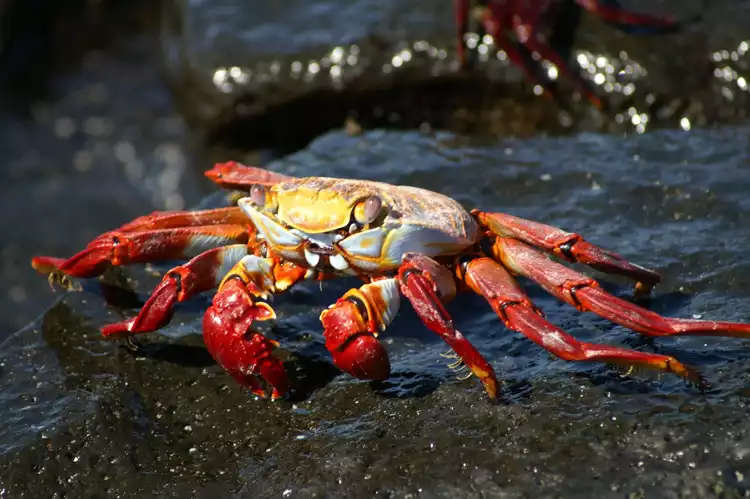
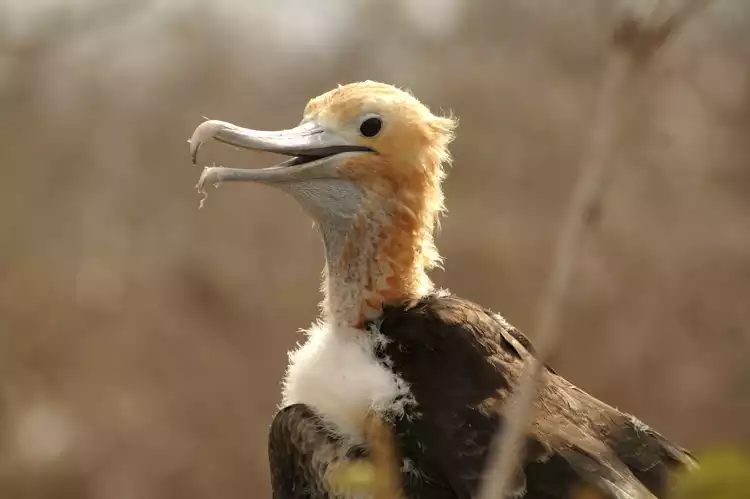
×
Ecuador 🇪🇨

backpacking South America Ecuador 🇪🇨
Shift ecosystems quickly between coast, Andes, and jungle.

Explore ColombiaExplore Falkland Islands

Backpacking Ecuador in 2026

A complete guide including when and where to go, costs, transport, itineraries, and practical travel advice.
A first look at the country

Backpacking Ecuador
By Johan Kruseman 🇳🇱 | Updated May 21, 2026

Altitude hits, buses are slow and cheap, and the Galápagos costs—Ecuador forces you to trade time, money, or comfort. Its microclimates stack like floors in a tower, so you climb and descend all day. Protected ecosystems demand permits and patience, and that discipline builds a country of sharp contrasts and care.

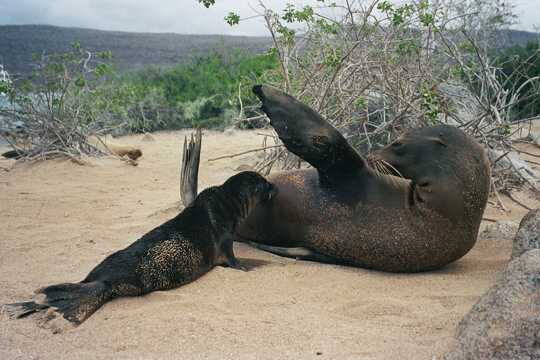
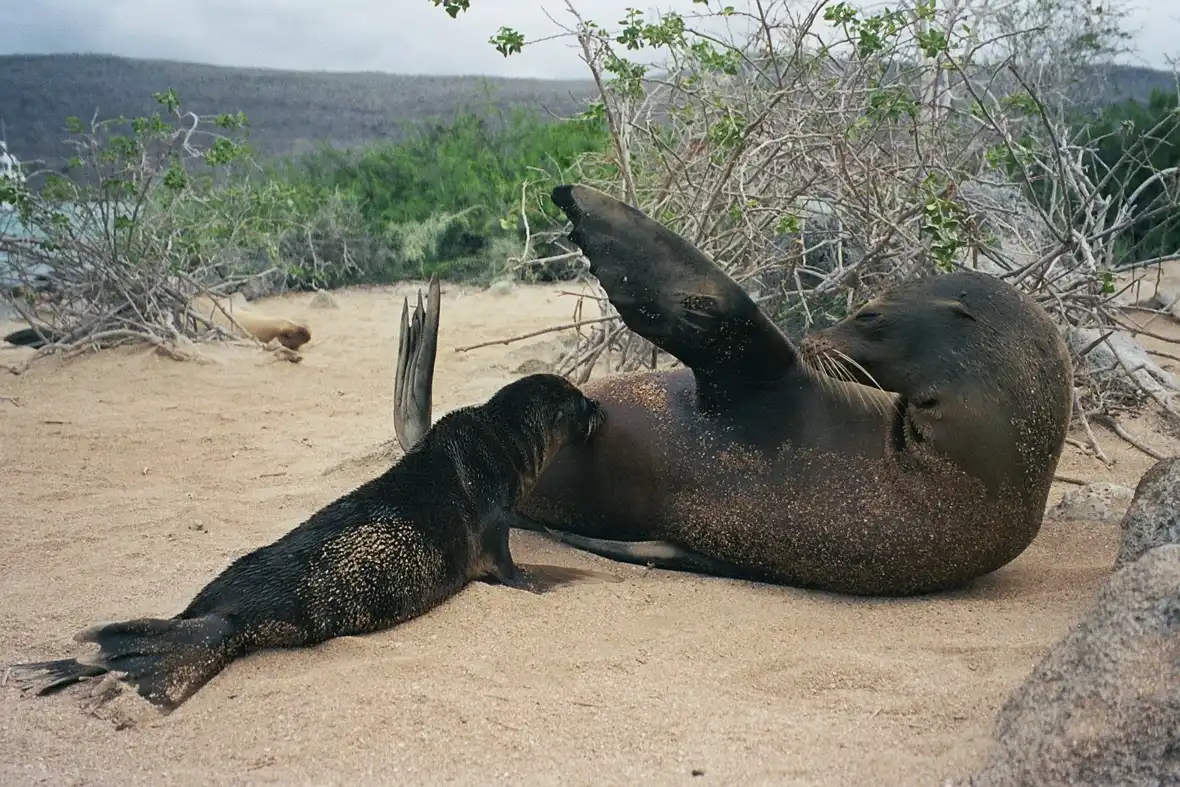
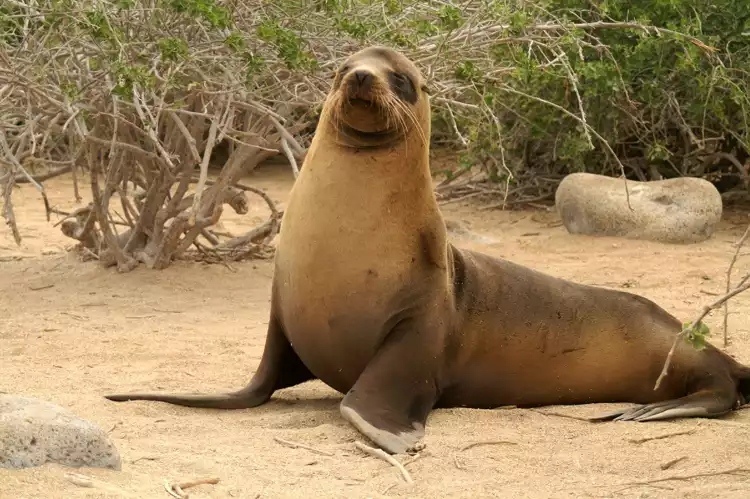
Quito’s highland spine stacks church towers against snow peaks; then the Avenue of the Volcanoes drags you past Cotopaxi’s ash and the emerald ring of Quilotoa to the hot-spring buzz of Baños. Swing west to Mindo for hummingbirds and cloud-forest waterfalls; roll to the coast for ceviche with sandy feet; pivot east into Cuyabeno’s blackwater for pink river dolphins. If you splurge on the Galápagos, blue-footed boobies share your trail and sea lions own the benches. The air thins, rain soaks gear, protests can stall buses, but slowing down sharpens every win.

Compared with Peru’s epic distances and Colombia’s all-night buses, Ecuador compresses Andes, Amazon, Pacific, and islands into a trip you can actually finish. Go if you want huge variety fast, wildlife on its own terms, and the kind of value where you’ll pay—or wait—only when the payoff is real.

👉 Get the 📖 Travel Guide of Ecuador

Avenue of the Volcanoes: Quito–Cotopaxi–Quilotoa–Baños

Ride the Pan-American and chain big wins with small buses. Base in Quito or Latacunga for Cotopaxi and the Quilotoa rim, then drop to Baños for hot springs and canyon biking. Time cost is front-loaded in early starts and acclimatization; comfort drops at 4,000 m with thin air, cold wind, and gritty ash. Money stays reasonable: public transport is cheap, guides and park fees are manageable, and you sleep in simple hostales. This spine rewards hikers who pack layers, move fast, and don’t mind a 5 a.m. bus for a clean summit window.

Cuyabeno Amazon (Lago Agrio to river lodges)

Commit four to five days or skip it. You bus overnight to Lago Agrio, bounce a truck to the dock, then canoe deep into blackwater lagoons where phones die and generators hum. Comfort takes hits: rubber boots, sweat, mosquitoes, and night paddles under rain. Money goes midrange but includes food, guide, and boats, so the value per wildlife sighting beats many quick fixes. This rewards patient travelers who accept set lodge schedules to trade time and comfort for dense jungle and real quiet.

Pacific Coast: Montañita–Puerto López–Machalilla

One coastal highway, endless stop-start buses. Heat slaps you, salt eats zippers, and nightlife in Montañita runs until breakfast; shift to Olón or Puerto López if you want sleep. Cash buys cheap ceviche, surfboard rentals, and boat runs to bird-rich islands and a protected beach you can reach by pickup. Time bleeds on slow transport; comfort depends on earplugs and shade. This loop pays off for surfers and seafood chasers who accept sweat and noise to keep costs low.

Cuenca & Cajas Highlands

Walk a compact historic core by day and bus 45 minutes to Cajas for cold, boggy páramo by morning. Expect drizzle, altitude, and ankle-deep sponge—bring waterproof boots and a hard shell. Money sits midrange: good coffee, cheap dorms, affordable park entry and taxis. Time efficiency is high if you like city beds and day hikes. This rewards hikers who want clean logistics without giving up rugged terrain.

Galápagos Islands (land-based)

The high-cost, high-payoff outlier. Flights, park fees, and day tours hammer the budget; ferries pound your spine on rough crossings; sun and salt punish gear. Time moves in ferry timetables and fixed tour slots—three islands in a week is a push, two is sane. Comfort is mixed: easy wildlife encounters, hard seas and prices. Go if wildlife is your north star and you can spend; skip if your whole Ecuador trip is two weeks on a tight budget.
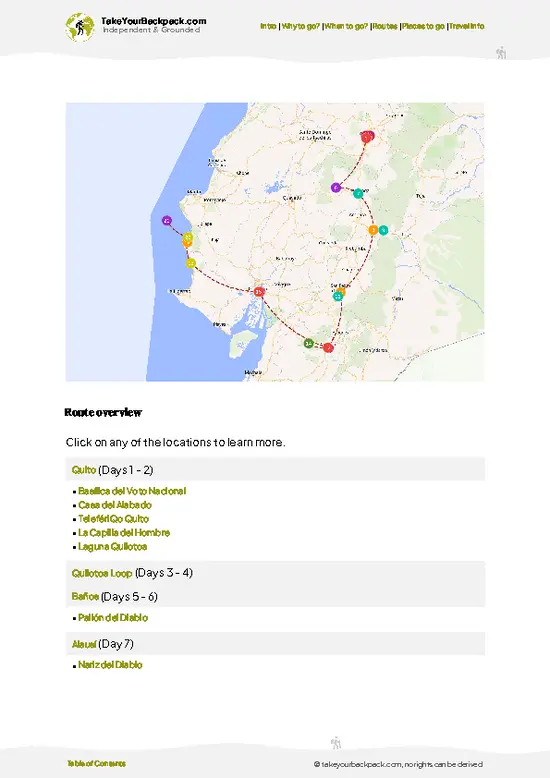
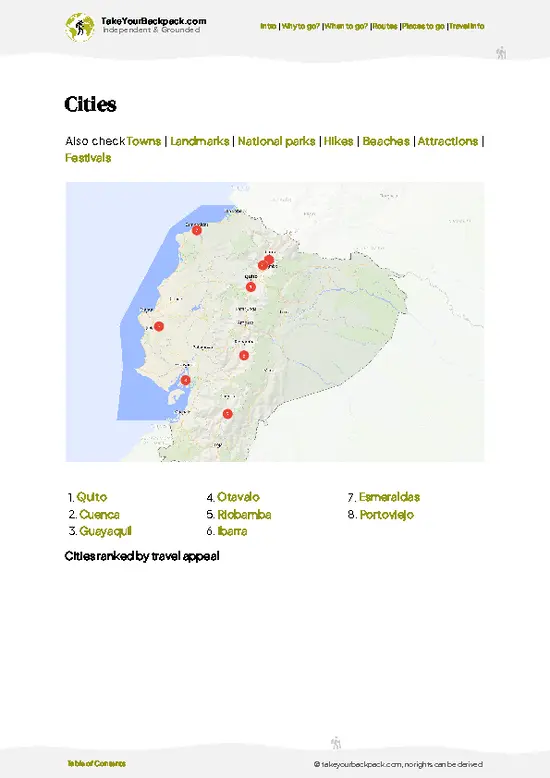
Geography and where places are located
Loading the map 🌍
CLICK TO FILTER
city
town
unique site
national park
hike
beach
attraction
festival
region
SHOW COUNTRY‘S BESTSHOW ALL
film
0
0
0a
TelefériQo Quito
film
1
1
1a
Iglesia de la Compañía de Jesús
film
2
2
2a
Basilica del Voto Nacional
film
3
3
3a
Mitad del Mundo Monument and Ethnographic Museum
film
4
4
4a
Museo de Sitio Intiñán
film
5
5
5a
La Ronda Historic Street
film
6
6
6a
La Capilla del Hombre and Guayasamín Museum
film
7
7
7a
Museo Nacional del Ecuador
film
8
8
8a
Museo Pumapungo
film
9
9
9a
Malecón 2000 and La Perla Ferris Wheel
film
10
10
10a
Playa de los Frailes
Karen Parraga
film
11
11
11a
Montañita
Hotel Kundalini Montañita
film
12
12
12a
Salinas
film
13
13
13a
Quito
Pixabay
film
14
14
14a
Otavalo
Andres Salazar
film
15
15
15a
Ibarra
film
16
16
16a
Ambato
film
17
17
17a
El Altar
Jessenia Rueda
film
18
18
18a
Laguna de Cuicocha
film
19
19
19a
Cajas Inca Trail
film
20
20
20a
Pailón del Diablo Trail
film
21
21
21a
Nariz del Diablo
Herna Castilo
film
22
22
22a
Galapagos
film
23
23
23a
Cotopaxi
Miguel Anchaluisa
film
24
24
24a
Cuyabeno Wildlife Reserve
Yoram Kaiser
film
25
25
25a
Sangay
Wilmer Ll. (ato)
film
26
26
26a
Cajas
Christian Gonzalez
film
27
27
27a
Machalilla
Diego Salas Cba
film
28
28
28a
Mindo Cloud Forest
film
29
29
29a
Chimborazo
Turismo Riobamba
film
30
30
30a
Cayambe-Coca
film
31
31
31a
Los Illinizas
Marcelo Solís
film
32
32
32a
Andean Highlands
film
33
33
33a
El Cajas
film
34
34
34a
Vilcabamba
Mohamed Elsaid
film
35
35
35a
Puerto Villamil
film
36
36
36a
Zaruma
Gabriela Cedillo
film
37
37
37a
Laguna Quilotoa
Rafael Machado
film
38
38
38a
Papallacta Hot Springs
David L
film
39
39
39a
Isla de la Plata
Tu Guía En México

Why go?What draws travelers here

Wildlife

Ecuador compresses the planet’s wildlife into a country you can cross before lunch. You can snorkel … read more 👉
Ecuador compresses the planet’s wildlife into a country you can cross before lunch. You can snorkel with sea lions in the Galápagos, then ride a night canoe in Cuyabeno watching caiman eyes glow, and finish in the Andean páramo under condors. It rewards sweat: rain, mud, and early alarms pay off with close encounters. Pro tip: set the alarm for 4:45 a.m.—dawn is when monkeys move and birds feed; carry a red headlamp for night walks. I’ve had blue-footed boobies miss me by inches on Isla Española and glass frogs pulse beside Mindo’s trails after storms.

Backpackers

Ecuador is built for backpackers. Cheap, fast-enough buses ($1/hour) sling you from páramo to surf in … read more 👉
Ecuador is built for backpackers. Cheap, fast-enough buses ($1/hour) sling you from páramo to surf in a day, if you trade sleep and knee room for distance. You can burn cash on the Galápagos, or stretch it with the Quilotoa Loop, Cajas ridgelines, and jungle trips out of Tena—more sweat, more story. I’ve thawed after an eight-hour freezer of a night bus to Loja and still hit a market by dawn. Pro tip: carry small bills and a sandwich; AC runs polar, and drivers rarely break a $10.

Scenery

Ecuador rewards motion. In one long day you can skirt a jade crater (Quilotoa), grind up Cotopaxi’s … read more 👉
Ecuador rewards motion. In one long day you can skirt a jade crater (Quilotoa), grind up Cotopaxi’s ash to the refugio, then drop into the Amazon’s dripping green or the limestone tunnels of Jumandy. The trade-off is clear: buses cost pocket change but eat hours and stomachs on hairpins; a hired driver stings the budget but triples what you see; altitude days feel “wasted” until they save you from headaches. Pro tip: chase dawn—mountains show before noon haze. I froze on Quilotoa’s rim for the first pink on Cotopaxi. Paid in sleep. Earned the view.

Mountains

Ecuador packs the high Andes into tight mileage: bus two hours, step onto 4,000 m páramo, start climbing. … read more 👉
Ecuador packs the high Andes into tight mileage: bus two hours, step onto 4,000 m páramo, start climbing. Time buys acclimatization in Quito; money buys glacier guides for Cotopaxi, Cayambe, or Chimborazo; comfort gets traded for midnight starts, thin air, and sleet that bites. The payoff is real: ash under your boots, condors surfing ridgelines, a chain of volcanoes laid out from Rumiñahui. Pro tip: base in Latacunga, stash extra gear, do the Quilotoa Loop to build lungs, then tag Illiniza Norte. I learned to leave trailheads by 8 a.m.—storms punish late starters.

Low cost

Ecuador rewards the patient cheapskate. Buses crawl the Andes for pennies, so you trade hours and stiff … read more 👉
Ecuador rewards the patient cheapskate. Buses crawl the Andes for pennies, so you trade hours and stiff knees for big horizons. Sleep in no-frills hostels and chase almuerzos del día; a backpacker day lands roughly $30–40 without pain. Markets cut costs but demand early starts and elbow room. Walk or ride city buses, then selectively splurge—one volcano climb, a jungle day, a legit coffee in Loja. Pro tip: night buses buy distance and save a bed, but steal sleep. My go-to: ask for “completo” in small towns; it fuels a full hike for very little.

People

If you move fast and seal yourself in taxis, you miss Ecuador’s best engine: people. Slow down and they … read more 👉
If you move fast and seal yourself in taxis, you miss Ecuador’s best engine: people. Slow down and they pull you in—vendors crack jokes, abuelas press fruit into your hand, a stranger walks you two blocks just to show the turn. Pay less, ride the ranchera or the coastal bus, and conversation blooms; pay more, close the door, and comfort costs connection. I got roped into an ecua‑volley game near Otavalo and left with two dinner invites. Pro tip: claim a stool at a market jugo stand, order seconds, and let the banter roll.

Food

Come hungry. Ecuador rewards movement: coast to Andes to Amazon, the menu flips every bus ride. Slurp … read more 👉
Come hungry. Ecuador rewards movement: coast to Andes to Amazon, the menu flips every bus ride. Slurp encebollado at dawn, tear into hornado at noon, mop up Manabí’s peanut-rich viche, then bargain for cuy and blistered llapingachos in the highlands. On a tight budget, the $3–$4 almuerzo crushes midrange restaurants; street stools beat white tablecloths on flavor, if not comfort. I’ve chased 6 a.m. encebollado in Manta to kill a long night—worked. Pro tip: hit Quito’s Mercado Iñaquito or Cuenca’s 10 de Agosto before 11; the good pots empty fast. Always ask for the house ají.
Want the complete picture of Ecuador?
The offline Travel Guide brings everything together — routes, highlights & planning.

See what's included in the guide 👉

Get the Travel Guide -

⭐ HighlightsUnmissable destinations

  • Galápagos Islands (land-based): Fly in, pay the park fee, then wrestle costs by staying on Santa Cruz, Isabela, or San Cristóbal and using day boats. You trade flexibility for choppy ferries and early alarms, but you keep cash in your pocket. Proof of presence: sea lions bark at dusk while marine iguanas sneeze salt onto black lava.
  • Quito Historic Center and Teleférico: Climb steep streets to baroque churches or buy time with the cable car to 4,000 meters and hike the ridge. Money cuts the climb; altitude taxes your lungs either way. Go mornings for safer, clearer hours. Proof of presence: incense lingers in stone naves while thin air leaves a metallic taste on your tongue.
  • Cotopaxi National Park: A guided summit drains your wallet but trades risk for a shot at sunrise on ice; a day hike to the refugio costs less yet still punishes legs and lungs. Expect wind that strips warmth in minutes. Proof of presence: pumice crunches under crampons and volcanic grit sticks to your lip balm.
  • Quilotoa
read more 👉
  • Galápagos Islands (land-based): Fly in, pay the park fee, then wrestle costs by staying on Santa Cruz, Isabela, or San Cristóbal and using day boats. You trade flexibility for choppy ferries and early alarms, but you keep cash in your pocket. Proof of presence: sea lions bark at dusk while marine iguanas sneeze salt onto black lava.
  • Quito Historic Center and Teleférico: Climb steep streets to baroque churches or buy time with the cable car to 4,000 meters and hike the ridge. Money cuts the climb; altitude taxes your lungs either way. Go mornings for safer, clearer hours. Proof of presence: incense lingers in stone naves while thin air leaves a metallic taste on your tongue.
  • Cotopaxi National Park: A guided summit drains your wallet but trades risk for a shot at sunrise on ice; a day hike to the refugio costs less yet still punishes legs and lungs. Expect wind that strips warmth in minutes. Proof of presence: pumice crunches under crampons and volcanic grit sticks to your lip balm.
  • Quilotoa Loop: Hike village to village and earn the crater rim with sweat, or bus in for a fast viewpoint and leave depth on the table. Cheap hospedajes and set meals keep budget steady; quads pay on sandy descents. Proof of presence: eucalyptus smoke in your sweater and fine dust grinding between your molars.
  • Cuyabeno Wildlife Reserve: Endure the overnight bus to Lago Agrio and a long canoe in, then trade hot showers for wildlife density that would cost double in Yasuní. Group lodges are basic; the payoff screams at dusk. Proof of presence: howler monkeys roar like wind through tin and your shirt dries salty after every paddle. Off the map: Bombuscaro in Podocarpus, the mangroves around Muisne, and the high páramo above Angochagua; my personal favorite is Bombuscaro at first light.
Spotted a mistake or missing a highlight? Contact us.

But Ecuador offers more...

Discover and compare all of its highlights per category

🧭 RouteHow travelers typically move through the country

The 5-Day Quito & Highlands Taster

The vibe: A relaxed, single-base escape built around Quito’s colonial core, big city views, and a playful dip into the equator line story, perfect if you want impact without long bus rides. You’ll walk, ride a cable car, and take short day trips rather than constantly packing your bag.
The highlights:
  • Exploring Quito’s historic center with its grand basilicas and gold-covered churches
  • Riding the TelefériQo for sweeping Andean views above the capital
  • Strolling La Ronda at night for food, music, and street life
  • Visiting the Mitad del Mundo and Intiñán sites at the equator line

The 10-Day Andes, Crater & Cloud Forest Circuit

The vibe: A balanced loop for travelers who want a bit of everything—colonial streets, crater hikes, waterfalls, and cloud forest—without sprinting across the whole country. Expect a mix of bus rides, taxis, and easy walks, with enough time in each stop to actually settle in.
The highlights:
  • Two full days in Quito to hit the key churches, viewpoints,
read more 👉

The 5-Day Quito & Highlands Taster

The vibe: A relaxed, single-base escape built around Quito’s colonial core, big city views, and a playful dip into the equator line story, perfect if you want impact without long bus rides. You’ll walk, ride a cable car, and take short day trips rather than constantly packing your bag.
The highlights:
  • Exploring Quito’s historic center with its grand basilicas and gold-covered churches
  • Riding the TelefériQo for sweeping Andean views above the capital
  • Strolling La Ronda at night for food, music, and street life
  • Visiting the Mitad del Mundo and Intiñán sites at the equator line

The 10-Day Andes, Crater & Cloud Forest Circuit

The vibe: A balanced loop for travelers who want a bit of everything—colonial streets, crater hikes, waterfalls, and cloud forest—without sprinting across the whole country. Expect a mix of bus rides, taxis, and easy walks, with enough time in each stop to actually settle in.
The highlights:
  • Two full days in Quito to hit the key churches, viewpoints, and art museums
  • Hiking around Laguna Quilotoa and the surrounding Andean Highlands
  • Waterfall-chasing and hot springs time in Baños
  • Birdlife and misty trails in the Mindo cloud forest, plus a final soak at Papallacta Hot Springs

The 15-Day Andes-to-Ocean Grand Route

The vibe: A deep-dive journey that strings together Ecuador’s greatest hits—highland cities, volcano country, national parks, and the Pacific coast—at a steady, immersive pace. You’ll travel mostly overland by bus, watching the landscapes shift from thin-air páramo to warm, salty breezes.
The highlights:
  • Multiple days in Quito for historic sites, TelefériQo views, and a day trip into Cotopaxi
  • Highland time around Laguna Quilotoa, Riobamba, and the El Altar and Chimborazo areas
  • Adventure and waterfalls around Baños, plus culture and museums in Cuenca
  • Hiking in Cajas National Park and unwinding on the coast around Machalilla and Playa de los Frailes, with a boat trip to Isla de la Plata
🌍 Want a ready-to-use travel plan for Ecuador?
The overview above gives a quick comparison of route options based on your travel time and style. The full Travel Guide shows each route in detail, with maps, stops, highlights, and transport types.

Explore all route details 👉

Get the Travel Guide -

🌤️ When to go?When to go for the best experience

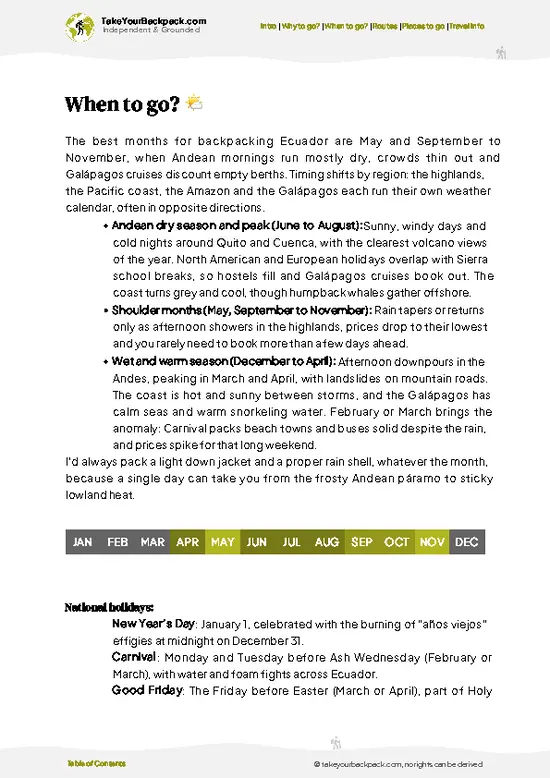
Sweet spot: May and late October-November. Andes rains ease and trails set while nights stay manageable; volcano days stop feeling like roulette. On the coast, May keeps warm, clear water as storms taper; late Oct-Nov delivers green hills without summer crowds. The Amazon stays high for easy boats with less bite. After Easter and again after September, buses breathe, hostels bargain, and you move fast without peak premiums.
  • The Crowd/Heat Peak: Jun-Aug and late Dec-early Jan. Prices jump, dorms cram, refugios sell out. You sweat on packed buses and queue for permits. Payoff: a windless Cotopaxi sunrise or humpbacks off Puerto López that hush the beach.
  • The Transition/Shoulder: Apr-May. Rains back off, clouds tear by midday, shopkeepers repaint signs, drivers stop again. You stitch coast heat to clearing ridges in one push; gear dries; bargaining returns; kilometers stack cheaply.
  • The Off-Peak/Extreme: Jan-Mar (coast/Amazon) and Mar-Apr (highlands). Towns hush under heavy storms; trails turn inward. Waterfalls roar and you sleep alone. Survival hack: start pre-dawn and line your pack—thread the gaps between downpours.
  • The Second Shoulder: Oct-Nov. The country exhales: firm trails, green slopes, fair sun, friendly rates. Crowd anomaly: early November spikes for Día de los Difuntos and Cuenca fiestas—rooms vanish—then it drops to easy mode again.

Tactical tip: For June-August and holiday weeks, I lock volcano huts and popular hostels 7-10 days out; otherwise I walk in and let the forecast choose my next bus.

source: climatestotravel.comJANJanuary: fair for travelingFEBFebruary: fair for travelingMARMarch: fair for travelingAPRApril: good for travelingMAYMay: excellent for travelingJUNJune: good for travelingJULJuly: good for travelingAUGAugust: good for travelingSEPSeptember: highly recommended for travelingOCTOctober: highly recommended for travelingNOVNovember: excellent for travelingDECDecember: fair for traveling
Traveling in a specific month?
This page covers the best seasons to visit. For a complete month-by-month breakdown — including weather, crowds, costs, national holidays, and festivals — download the full Travel Guide.

Get the Travel Guide -
10020

💰 Costs (as of 2026)Typical budget expectations

Plan on $30-45 per day if you move on buses, sleep in dorms, and eat set lunches; plan on $60+ once tours, party towns, or island dreams enter the chat.
  • dorm accommodation: Highlands and secondary cities run $8-12; Quito and Cuenca $9-14; coast hot spots and weekends $12-18; Galápagos $18-25 for the truly bare-bones. Expect thin blankets at altitude and cold tile floors. The system: show up midweek, compare three hostels within two blocks, ask “cash price,” commit to 3+ nights for $1-2 off, and always verify kitchen, lockers, and real hot water before you hand over a dollar. Compared to Peru and Colombia, dorms are a couple bucks higher because USD rules here.
  • meals: Supermarket Survival means $5-7 per day if you cook eggs, rice, tomatoes, bananas, and tuna; it costs time and you’ll fight for stove space. Street food reality is faster and just as cheap: almuerzo del día runs $2.50-3.50 with soup, main, and juice; night snacks $1-2 for empanadas, llapingachos, or hornado sandwiches; simple dinners $3-5. I skip sit-down tourist menus; they add 12% tax and often a 10% service charge. Relative to Peru, expect to pay about $0.50-1 more per plate; similar to Colombia in big cities.
  • local transport:
read more 👉
Plan on $30-45 per day if you move on buses, sleep in dorms, and eat set lunches; plan on $60+ once tours, party towns, or island dreams enter the chat.
  • dorm accommodation: Highlands and secondary cities run $8-12; Quito and Cuenca $9-14; coast hot spots and weekends $12-18; Galápagos $18-25 for the truly bare-bones. Expect thin blankets at altitude and cold tile floors. The system: show up midweek, compare three hostels within two blocks, ask “cash price,” commit to 3+ nights for $1-2 off, and always verify kitchen, lockers, and real hot water before you hand over a dollar. Compared to Peru and Colombia, dorms are a couple bucks higher because USD rules here.
  • meals: Supermarket Survival means $5-7 per day if you cook eggs, rice, tomatoes, bananas, and tuna; it costs time and you’ll fight for stove space. Street food reality is faster and just as cheap: almuerzo del día runs $2.50-3.50 with soup, main, and juice; night snacks $1-2 for empanadas, llapingachos, or hornado sandwiches; simple dinners $3-5. I skip sit-down tourist menus; they add 12% tax and often a 10% service charge. Relative to Peru, expect to pay about $0.50-1 more per plate; similar to Colombia in big cities.
  • local transport: Buses unlock the country for pocket change. City buses and corridor lines cost $0.35-0.50; rideshare hops across town $2-5 if you avoid surge; taxis are fine if they run the meter. Intercity buses hover around $1-1.50 per hour, so Quito to Baños lands in the $5-7 range, Cuenca to Guayaquil about the same. Night buses save a bed but tax your sleep; keep valuables on you and choose a seat near the front. This is cheaper than Chile and on par with Colombia, with routes dense enough to improvise day by day.
  • activities: This is where budgets swing. Galápagos burns cash fast: flights, $100+ in park fees, and day tours at $80-150 each. Amazon on a budget is doable via Cuyabeno at roughly $250-350 for 4-5 days all-in. Big volcano goals demand a guide and gear: Cotopaxi or Cayambe runs $200-350. High-value free or cheap hits exist: Quilotoa Loop on your own, Pichincha hikes for the teleférico fare, Baños bike-and-waterfall day for a $8-12 rental, surfboard $10-15 per day. Pick one splurge; don’t bleed slowly on “little” tours.
  • miscellaneous: Budget leaks hide in the cracks. ATMs skim $3-6 per pull, and taxis “without change” will make you donate your fives; I now carry a brick of $1s. Laundry $2-3 per kilo, sunscreen $10-15, SIMs $5-10 with enough data for maps and calls, craft beer $3-5 versus $1-1.50 for a national lager. Water is cheap if you buy 5-liter jugs for $2 and refill; expensive if you drip-feed on 500 ml bottles. Ecuador’s value beats Chile and Argentina, but prices jump in tourist hubs—keep moving and pay local.
⚠️ Prices can change and everyone travels differently, so take this as a rough guide. Hope it helps you plan your adventure!

✈️ The backpacker research shortcutEcuador Travel Guide

An offline-friendly backpacking guide with optimized travel routes, ranked highlights, transport advice, and the best areas to stay.
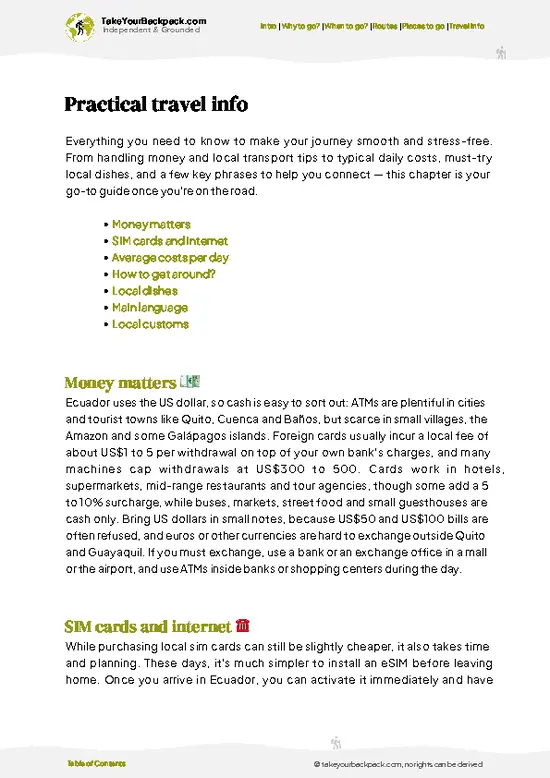
example page 0 from our offline Travel Guide for Ecuadorexample page 1 from our offline Travel Guide for Ecuadorexample page 2 from our offline Travel Guide for Ecuadorexample page 3 from our offline Travel Guide for Ecuadorexample page 4 from our offline Travel Guide for Ecuadorexample page 5 from our offline Travel Guide for Ecuador
The digital guide (311 pages) contains:
94 highlights, ranked by travel appeal
Optimized 5, 10 & 15-day travel routes
Best neighborhoods to stay
How to get around
Offline-friendly for travel without Wi-Fi
👉 See all 30+ guide features

📅 Plan smarter in minutes, not weeks
Month by month travel advice
Festivals & national holidays
Budget expectations

🗺️ Go to the right places, skip the overrated ones
Honest pros & cons of destinations
Top hikes, parks & viewpoints
Lesser-known places most travelers miss
Clear “worth it vs skip it” guidance

🛏️ Travel smoothly without rookie mistakes
Best areas to stay
Transport systems explained simply
Common scams & safety advice
SIM cards, money & practical tips

🌍 Understand the country, not just visit it
Culture & traditions
52 Essential phrases & customs
Festivals worth planning around
Traveler-friendly historical context
Insights that make places more meaningful

📱 Built for real travel conditions
Fully downloadable PDF
Works completely offline
Optimized for phone use
Useful in remote areas & buses
Everything in one place
Save weeks of stressful planning
Get instant access to the full guide directly. 30-day money-back guarantee.


Sent to your inbox immediately after payment • 100% Secure Checkout
Best Backpacking Travel Advisor 2025 tourism awardBest Backpacking
Travel Advisor
2025
What others say about Take Your Backpack Guides:
⭐⭐⭐⭐⭐
Fantastic, amazing amount of information!
⭐⭐⭐⭐⭐
My goodness this is amazing, it's what I've been looking for hats off too you!
⭐⭐⭐⭐⭐
I think this is absolutely BRILLIANT
⭐⭐⭐⭐
Very complete and informative. It's still missing places, but I gotta to commend you
⭐⭐⭐⭐⭐
This is truly amazing, thank you, can't wait to explore it with my kids!
⭐⭐⭐⭐⭐
Awesome resource, thank you!
⭐⭐⭐⭐⭐
This is amazing! Can't wait to explore the ones I haven't seen
⭐⭐⭐⭐
I love this! Well done, great idea.
⭐⭐⭐⭐⭐
Thanks for taking the time to make this gem!
⭐⭐⭐⭐⭐
This might be the best website I've ever seen.
⭐⭐⭐⭐⭐
Congratulations, and thank you so much for your work; it's incredibly valuable.
⭐⭐⭐⭐
In all seriousness I think you did a great job pointing out the important spots
⭐⭐⭐⭐⭐
10/10 very good
⭐⭐⭐⭐⭐
As someone who's only just starting to visit regularly this is awesome, thank you.
⭐⭐⭐⭐
Thank you very much! I'm going to visit my dad, it's going to be very useful!
⭐⭐⭐⭐⭐
This is really cool! We'll be travelling for the first time and this definitely come in handy.
⭐⭐⭐⭐⭐
You are now our minister of culture, congratulations 👨‍💼
⭐⭐⭐⭐⭐
Just wanted to tell you that this is a pearl! Going to follow your recommendations.
⭐⭐⭐⭐⭐
This is so cool. I'll definitely be using the resource for my travels soon.
⭐⭐⭐⭐⭐
This is very impressive! Good work.
⭐⭐⭐⭐⭐
This is an amazing and informative site. Very well done!

🛏️ Where to stay?Best areas to base yourself

Yes — hostels and budget accommodation are widespread across Ecuador, with the best concentration in Quito, Cuenca, Guayaquil, Baños, Montañita and Puerto Ayora (Galápagos).
In Quito choose La Mariscal for nightlife and traveler services but expect noise, Centro Histórico for the cheapest options and direct access to sights but avoid late-night streets, and La Floresta for cafés and quieter blocks; in Cuenca stay near Parque Calderón for safe walking and colonial charm; in Guayaquil look at the Malecón/Las Peñas waterfront for convenience with mixed safety perceptions; in Baños the downtown … read more 👉
Yes — hostels and budget accommodation are widespread across Ecuador, with the best concentration in Quito, Cuenca, Guayaquil, Baños, Montañita and Puerto Ayora (Galápagos).
In Quito choose La Mariscal for nightlife and traveler services but expect noise, Centro Histórico for the cheapest options and direct access to sights but avoid late-night streets, and La Floresta for cafés and quieter blocks; in Cuenca stay near Parque Calderón for safe walking and colonial charm; in Guayaquil look at the Malecón/Las Peñas waterfront for convenience with mixed safety perceptions; in Baños the downtown strip puts you near hot springs and activities but is busy, while Montañita’s town center is party-focused and the outskirts are quieter and better for surfing.
Expect dorms to be the cheapest and often basic with shared bathrooms, anticipate higher prices and fewer beds in the Galápagos, book ahead in high season, and pick accommodations on side streets or near main tourist hubs if you prioritize quiet and safety.

If you enjoy meeting fellow travelers, consider choosing hostels with high ratings for atmosphere. On the other hand, if you prefer having your own space, a hotel might be a better option.

🚌 Getting aroundGetting around Ecuador

Ecuador moves like a river in the mountains. Schedules exist, but altitude, fog, and a driver with a whistle call the game. Big corridors run close to the clock, while rural links play by feel and full seats. You move faster by rising early, buying what leaves next, and letting the Andes set the tempo. Fight the curves and you lose time. Flow with them and you cross a whole country between breakfast and dusk.
  • Intercity Buses The Efficiency Trade-off. This is the backbone and the bargain, roughly
read more 👉
Ecuador moves like a river in the mountains. Schedules exist, but altitude, fog, and a driver with a whistle call the game. Big corridors run close to the clock, while rural links play by feel and full seats. You move faster by rising early, buying what leaves next, and letting the Andes set the tempo. Fight the curves and you lose time. Flow with them and you cross a whole country between breakfast and dusk.
  • Intercity Buses The Efficiency Trade-off. This is the backbone and the bargain, roughly a dollar per hour across the highlands. You trade speed for reach and price. Switchbacks, snack stops, and roadside pickups slow the pace, but the network hits nearly every town. Day rides are safer and more scenic. Night rides save a hostel night but demand vigilance. Sit front left for fresh air and fewer stomach flips, keep your small bag on your lap, and wear layers for surprise AC.
  • City Buses, Trole, and Metro Quito The Social Fabric. This is shoulder-to-shoulder mobility for coins. You queue, you board fast, you swing your pack to your chest, and you yield seats to abuelas without hesitation. Vendors weave through hawking candy and phone cables. No food on the Metro, no lingering in doors, and no loud phone calls. Tap a card, move inward, guard pockets, and read the room. When in doubt, mirror the commuters and you blend.
  • Lanchas and River Canoes The Geometric Unlock. Water punches through where roads give up, especially in the Oriente and tidal estuaries. Boats ignore landslides and find communities hidden behind green walls. Departures follow cargo, weather, and tide more than clocks. Pay for the seat, not the exact minute. Wear your lifejacket, bag your gear against spray, and accept wet landings. If you want jungle outposts or mangrove crossings, this is the only honest line in.
  • Camionetas and Colectivos The Budget Disruptor. Shared pickups and taxis stitch gaps between bus lines and trailheads. They leave when full, undercut private taxis, and slash hours off detours. Perfect for the Quilotoa Loop, market days, and last-mile climbs to villages. Flag at plazas or gas stations, agree on price before doors shut, and carry small bills. Ride in the back only if locals do and the weather cooperates.

Master tip: Move at dawn along trunk lines, buy your next ticket the second your feet hit the terminal floor, and stack short hops with buffer minutes so delays bend around you instead of breaking your day.
How far is the airport from the center?
Mariscal Sucre International Airport (UIO) is about 40 km (25 miles) east of central Quito. Depending on traffic and your route, plan on 45-90 minutes into town.

Main ways to get into the city
1) Quito Airport Express (Aeroservicios)
A direct coach from the airport to central-north Quito (La Mariscal/La Carolina area). Runs daily from early morning to late night with departures roughly every 30-60 minutes.
Time: about 60-75 minutes, traffic depending.
Cost: typically USD $10-$12 one way. Buy tickets at the counter in arrivals or online.

2) Public bus to city terminals, then transfer
Green airport buses run to the Río Coca (north) and Quitumbe (south) terminals.
Time: airport bus is about 60-75 minutes to Río Coca, 70-100 minutes to Quitumbe. From there, connect to the Quito Metro (Line 1 runs Quitumbe-El Labrador) or the Trole/Ecovía buses to reach the Historic Center or La Mariscal. The Metro ride to the Historic Center stations (e.g., San Francisco/La Alameda) is about 15-25 minutes from Quitumbe.
Cost: airport bus USD $2-$3; Metro USD $0.45; city buses USD $0.35-$0.45.

Taxi and ride-hailing
Official airport taxis operate with set zone pricing. Expect about USD $25-$35 to La Mariscal/La Carolina and USD $30-$40 to the Historic Center; more late at night or in heavy traffic. Ride-hailing apps (Uber/Cabify/DiDi) are available; pickups are usually from the parking area and can be slightly cheaper (often USD $18-$30), but surge pricing applies.

Notes
- Traffic into Quito can be slow at rush hour and during rain, which is why times vary.
- You’ll pay in US dollars; carry small bills for buses.
⚠️ Prices and routes can change, so take this as a rough guide and ask for local advice when you arrive.

🔒 Safety (risk Level: medium)Safety considerations for travelers

Safety for solo travelers, including women and LGBTQ+ individuals
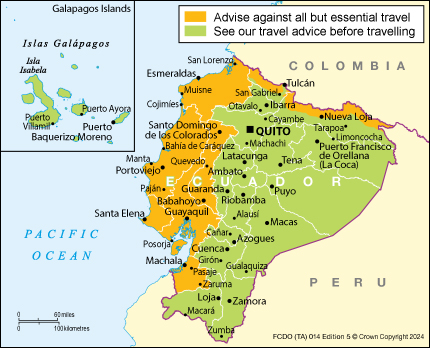
Ecuador is generally safe for solo travelers, including women and LGBTQ+ individuals, but like anywhere, stay alert and informed. In major cities like Quito and Guayaquil, keep an eye on your belongings, especially in crowded areas. LGBTQ+ travelers may find the big cities more inclusive; rural areas can be more conservative. Trust your instincts, avoid isolated areas at night, and consider joining local LGBTQ+ groups or online forums for current insights.


Full official government travel advisory (live updates)
View details 👉
safety image

source: www.gov.uk

✈️ VisaWhat travelers should know about visas

Most nationalities, including those from the US, Canada, and EU countries, can enter Ecuador visa-free for up to 90 days. Always double-check the latest entry requirements on the official Ecuadorian consulate website before traveling, as rules can change. If you need a visa after arrival, contact the nearest Ecuadorian consulate for application details.

source: ecuador.travel
⚠️ Visa requirements can change over time, so always check the latest visa requirements with the official embassy or government website before you travel.

🎒 What to pack?What to pack for Ecuador

Ecuador’s got a bit of everything climate-wise, so pack smart. For the Andes, think layers—mornings can be chilly but it warms up fast. The Amazon? It’s humid and rainy, so quick-dry clothes are a lifesaver. If you’re hitting the coast, lightweight gear and swimwear are key. Remember, some places like churches expect modest attire, so a light scarf or shawl can be handy. It’s the land of four seasons in a day, so be ready for anything!

Apart from this country specific advice, I have also crafted a general packing list that should help on any trip. authorOver the years, I've learned the importance of packing minimally. It's so much easier to jump on the back of a truck or squeeze yourself into the last spot of a minibus without that supersized backpack. If you're headed to a warm destination, leave your winter jacket at home; for colder regions, opt for thin thermal underlayers. Instead of packing your entire wardrobe, bring just three sets of clothes, as laundry facilities are available everywhere.
View the full list 👉

🙋 FAQTravel questions about Ecuador

Trip Planning


Personal tip: I normally search on good rating for atmosphere (for meeting people) and location (for easy exploring). Cleanliness as a bonus.


Travel Essentials

Routine Vaccinations: Ensure you’re up-to-date with routine vaccines like measles-mumps-rubella (MMR), diphtheria-tetanus-pertussis, varicella (chickenpox), polio, and your yearly flu shot.

Hepatitis A: Recommended for all travelers. You can get it through contaminated food or water.

Hepatitis B: Consider if you might have sexual contact, get a tattoo, or need medical treatment.

Typhoid: Recommended if you plan to eat or drink outside major restaurants and hotels.

Yellow Fever: Required if traveling to certain parts of the Amazon Basin. Check specific regions and entry requirements.

Rabies: Consider if you’ll be involved in outdoor activities like camping, caving, or working with animals.

Check the CDC or your local health authority for the most current info. Plan vaccinations early, as some require multiple shots.


vaccination requirements
When I first started traveling, I often spent part of my first day in a new country hunting for a local SIM card. While this can still be slightly cheaper, it also takes time and planning.

These days, it's much simpler to install an eSIM before leaving home. Once you arrive in Ecuador, you can activate it immediately and have mobile data from the moment you land — which is especially useful for ordering transport or navigating away from busy airports.

There are many providers nowadays, and price differences are usually small. I personally go with Airalo, as it offers excellent network coverage throughout the country and strong global coverage, so you can manage multiple countries from a single app.


Get your e-sim for Ecuador

Culture & Customs

Ecuadorians value politeness, so always greet with a smile and a handshake. When addressing someone, use their title and last name. For gay travelers, larger cities like Quito and Guayaquil are more open-minded, but discretion is advised in rural areas. Women should be prepared for some catcalling; it’s usually harmless but can be annoying. Dress conservatively, especially when visiting churches or indigenous communities. Avoid discussing politics unless you’re familiar with local perspectives to prevent any tension. Always ask for permission before taking photos of people, particularly indigenous communities.
Trying traditional food is always a great way to experience the culture. Here are some must-try dishes for Ecuador.
  • Encebollado: This hearty fish soup, typically made with albacore tuna, yuca, and pickled red onions, is a breakfast staple and a beloved hangover cure in Ecuador. The combination of tangy and savory flavors makes it a local favorite.
  • Llapingachos: These are delicious potato patties stuffed with cheese, often served with chorizo, fried eggs, and avocado. Originating from the highlands, they are a comfort food that showcases Ecuador’s love for potatoes.
  • Ceviche: While ceviche is popular along the coast of many South American countries, Ecuador’s version often includes shrimp and a tangy tomato-based sauce. It’s a refreshing dish that captures the coastal influences of the country’s cuisine.
  • Hornado: This is roasted and seasoned pork, typically served with mote (hominy), llapingachos, and salad. It’s a communal dish often found at local markets and is synonymous with festivities and gatherings.
  • Fanesca: A rich, hearty soup traditionally eaten during Easter, made with 12 different grains and legumes to represent the 12 apostles. It’s a testament to Ecuador’s agricultural diversity and cultural heritage.
Tap water in Ecuador is generally not recommended for tourists to drink, as it might not be treated consistently and can upset sensitive stomachs. While locals might drink it in certain areas, it’s safer for travelers to stick with bottled or filtered water to avoid any issues. Always check the seal on bottled water to ensure it’s unopened.
The main language in Ecuador is Spanish. Backpacking is way more rewarding if you know a bit of the local language, so I'd suggest brushing up on the basics just in case your Spanish skills have become a bit rusty.

Want to understand locals better?
The complete Travel Guide for Ecuador includes 52 essential words and phrases — greetings, thank-yous, ordering food, transport, numbers, and common local expressions you'll actually hear.

Get your local basic phrases 👉

Get the Travel Guide -


In Ecuador, English proficiency varies significantly by region and demographic. In major cities like Quito and Guayaquil, you will find a higher number of English speakers, particularly among younger people and those in the tourism industry, such as hotel staff, tour guides, and restaurant employees. In rural areas and smaller towns, however, English is less commonly spoken, and Spanish is the primary language.

While many Ecuadorians understand basic English, fluency is not widespread. Travelers may encounter challenges in communication outside tourist hotspots, so knowing some basic Spanish phrases can be beneficial. Additionally, many signs, menus, and information in tourist areas may be available in English, making navigation easier for non-Spanish speakers.

Overall, while you can get by with English in Ecuador’s urban centers and tourist areas, learning a few Spanish phrases can enhance your experience and interactions with locals.

Money & Payments

The local currency of Ecuador is USD ($).

ATM access: ATMs are pretty common in cities and larger towns, but might be scarce in rural areas. Keep a backup stash of cash just in case. Also, remember to notify your bank about your travels to avoid any card blocks.

Cash: Ecuador uses the US dollar, so no need to worry about currency conversion if you’re coming from the States. If you’re arriving with euros, exchange them for dollars at banks or authorized exchange houses in major cities for the best rates.

Cards: Credit and debit cards are accepted in most urban restaurants, hotels, and larger stores, but always have cash on hand for markets, small shops, and street vendors. Visa and MasterCard are more widely accepted than other cards.

Exchange: Skip the airport exchange rates if you can—they’re usually not great. Head to a local bank or use the ATMs for a better deal. Just keep an eye out for any foreign transaction fees your bank might charge.

In Ecuador, tipping isn’t mandatory but is appreciated in many situations. In restaurants, a 10% service charge is often included in the bill, but leaving an additional small tip is a nice gesture if the service was excellent. For taxi drivers, rounding up the fare is common practice.

🧩 Nearby countriesNearby backpacking alternatives

We 💚 feedbackKey takeaways from the trip

Ecuador moves fast in distance and slow in hours. You save money on $5–$10 buses and pay in spine-jolting switchbacks and lost days; spring for a short flight or a guided Galápagos hop and you burn cash but bank time and wildlife. Altitude hits hard—give Quito or Latacunga two days. Layers always; rain wins. Cash rules; avoid night buses. Surprise: $3 almuerzos and Baños hot springs after a cruel climb. Best for hikers, birders, divers, DIYers. Not for resort collectors or punctuality addicts.

✈️ When did I visit Ecuador?
Ecuador I visited during my half year trip through South and Central America back in 2003 While my visit dates back, this guide is continuously refined using feedback from locals and current backpackers (last update: 14 January 2026)

✍️ Help improve this page!
The information on this page is based on my own backpacking experience in Ecuador, supplemented with up-to-date research and feedback from other travelers. Travel details can change, so if you notice anything outdated or incomplete, feel free to let me know.


🙋‍♂️ Give feedback

👋 Meet the founderWho’s Behind Take Your Backpack?

Johan, backpacker and founder of TakeYourBackpackHi, I’m Johan (Netherlands 🇳🇱), the creator of TakeYourBackpack. Over the past decade, I’ve backpacked through 80+ countries across six continents, gaining extensive experience with independent travel, long-term trips, and overland routes.

This site is built on a combination of firsthand travel experience and carefully curated insights from other backpackers. Many guides are based on places I’ve personally visited, while others bring together tips, observations, and practical advice shared by trusted travelers I’ve met along the way.

The goal is to provide realistic, experience-driven guidance — not generic itineraries — so you can explore destinations with better context, clearer expectations, and more confidence.

Get Full Country Guide |
Instant download • 94 highlights • Full Offline guide