×
Saint Martin 🇲🇫

backpacking North America Saint Martin 🇲🇫Cross cultures casually by foot in minutes.

Explore St. LuciaExplore St. Vincent & the Grenadines

Backpacking Saint Martin in 2026

A complete guide including when and where to go, costs, transport, itineraries, and practical travel advice.
An overview of visiting Saint Martin

Backpacking Saint Martin
By Johan Kruseman 🇳🇱 | Updated June 1, 2026

Saint Martin isn’t a luxury-only island—you can cross two countries by minibus and eat well for pocket money. Think lolos (smoke-and-salt grills), bakery baguettes, and U.S. dollars that work on both sides. It’s French and Dutch, calm and loud, and the contrast is the point.

Come for beach-hopping and character: Maho’s plane flyovers, Creole Rock’s clear water, Pic Paradis views, Marigot’s markets, and kayak hops to Pinel. French, Dutch, and Creole mingle; eat ribs and accras at a lolo, then a boulangerie sandwich with a cold Carib. Realities—few hostels, high-season rates, traffic, hurricane months, sargassum, and thinner buses after dark—fade when you travel shoulder season, base in walkable hubs, ride buses by day, start early, and keep gear simple.

Compared with Anguilla’s quiet (and prices), St Barts’ polish, or Saba’s vertical hiking without beaches, Saint Martin is the balanced hub—lively, accessible, and varied. Go if you want Caribbean flavor and easy logistics without a resort wristband; it fits carry-on travelers, food lovers, and first-timers who like wins that feel earned.

Simpson Bay & Maho (Airport Strip)

Stay or base here if you want frictionless logistics: most car rentals, supermarkets, marinas, and buses run this strip. You’ll trade quiet for convenience and bars. Plan around bridge openings; traffic locks up. Maho parking is scarce and not cheap. Border is open; roaming charges aren’t.

Grand Case & Happy Bay

Grand Case rewards evenings: grills (“lolos”), calm water when winds cooperate, and sunset-facing sand. Street parking is tight; use the sandy lots and don’t leave gear inside. The 15–20 minute coastal trail to Happy Bay is worth it; no services, so bring water and leave valuables.

Orient Bay & Cul-de-Sac/Pinel

On the east coast, Orient Bay is for wind-driven sports and people who like a social beach. Chair rentals come with minimum spends; bring a towel if you’d rather save cash. From nearby Cul-de-Sac, cash ferries pop to Pinel Islet—shallow, kid-friendly, but sargassum can spoil some months.

Marigot & Pic Paradis

Marigot works for markets, Fort Louis views, and the Anguilla ferry if you’ve got a day spare—passport and fees required. For green relief, drive to Pic Paradis; the road is steep and narrow. Loterie Farm parking costs more but feels safer. Mosquitoes bite after rain; pack spray.
A visual overview of the country
Loading the map 🌍
CLICK TO FILTER
town
village
unique site
national park
hike
beach
attraction
festival
SHOW COUNTRY’S BESTSHOW ALL
film
0
0
0a
Yoda Guy Movie Exhibit
film
1
1
1a
Orient Bay
Rafael Barbosa
film
2
2
2a
Baie Rouge
film
3
3
3a
Grand Case Beach
Grand Case Beach Club
film
4
4
4a
Anse Marcel
film
5
5
5a
Happy Bay
Marius Ana
film
6
6
6a
Pinel Island
Joseph Phelps
film
7
7
7a
Ilet Pinel
film
8
8
8a
Happy Beach
film
9
9
9a
Bellevue
film
10
10
10a
Loterie Farm
film
11
11
11a
Pic Paradis
film
12
12
12a
Grand Case
film
13
13
13a
Fort Louis

Why go?Reasons people choose to visit

Beach life

Saint Martin pays off if you play the wind. Calm, glassy water and easy snorkeling run along the leeward coast—Grand Case to Baie Longue—Creole Rock for fish, Pinel for turtles. Surf and kites on the Atlantic side when the trades kick. Maho brings roaring aircraft, Simpson Bay the late bars. Pick your bay by conditions and you squeeze more out of every day.
Want the complete picture of Saint Martin?
The offline Travel Guide brings everything together — routes, highlights & planning.

See what's included in the guide 👉

Get the Travel Guide -

⭐ HighlightsUnmissable destinations

  • Maho Beach: Stand under the final approach to Princess Juliana and feel the jetwash lift the hair on your arms. The roar swallows conversation, and the air tastes faintly of kerosene. Skip fence-clinging; it’s not bravado, it’s hospital. Park early or walk in from Simpson Bay; bar chairs cost extra.
  • Grand Case: Dinner is smoke, laughter, and grills popping fat along Boulevard de Grand Case. Eat at a lolo for ribs and accras; fingers sticky with tamarind and Scotch bonnet. Bring cash—small cards get shrugged at—and expect slow, French-paced service that rewards patience with a sunset over Creole Rock.
  • Orient Bay (French side): A long, windy arc where kites hiss overhead and the surf slaps hard. Salt spray freckles your sunglasses, sand squeaks underfoot. Sargassum can swamp sections in summer, and chair packages creep pricey; plant your own towel or walk to the naturist end if that’s your lane.
  • Pic Paradis: The island’s high point pays out a 360° read of lagoon and sea if you earn it. The
read more 👉
  • Maho Beach: Stand under the final approach to Princess Juliana and feel the jetwash lift the hair on your arms. The roar swallows conversation, and the air tastes faintly of kerosene. Skip fence-clinging; it’s not bravado, it’s hospital. Park early or walk in from Simpson Bay; bar chairs cost extra.
  • Grand Case: Dinner is smoke, laughter, and grills popping fat along Boulevard de Grand Case. Eat at a lolo for ribs and accras; fingers sticky with tamarind and Scotch bonnet. Bring cash—small cards get shrugged at—and expect slow, French-paced service that rewards patience with a sunset over Creole Rock.
  • Orient Bay (French side): A long, windy arc where kites hiss overhead and the surf slaps hard. Salt spray freckles your sunglasses, sand squeaks underfoot. Sargassum can swamp sections in summer, and chair packages creep pricey; plant your own towel or walk to the naturist end if that’s your lane.
  • Pic Paradis: The island’s high point pays out a 360° read of lagoon and sea if you earn it. The road is chewed up; hike the last stretch and carry water, leaving the car empty. Wind snaps at your shirt, and your boots grind red dust into the tread.
  • Loterie Farm: On Pic Paradis’ flank, forest trails and zip lines sit behind a gate and a fee; worth it if shade is your currency. You’ll hear tree frogs and the whirr of trolleys; the spring-fed pool bites cold. Mosquitoes are relentless—repellent saves you more than the daybed does. Happy Bay’s footpath, Fort Louis at dusk, and a dawn kayak to Pinel Island are the quieter detours that pay back effort.
Spotted a mistake or missing a highlight? Contact us.

But Saint Martin offers more...

Discover and compare all of its highlights per category

🧭 RoutesHow to structure a trip

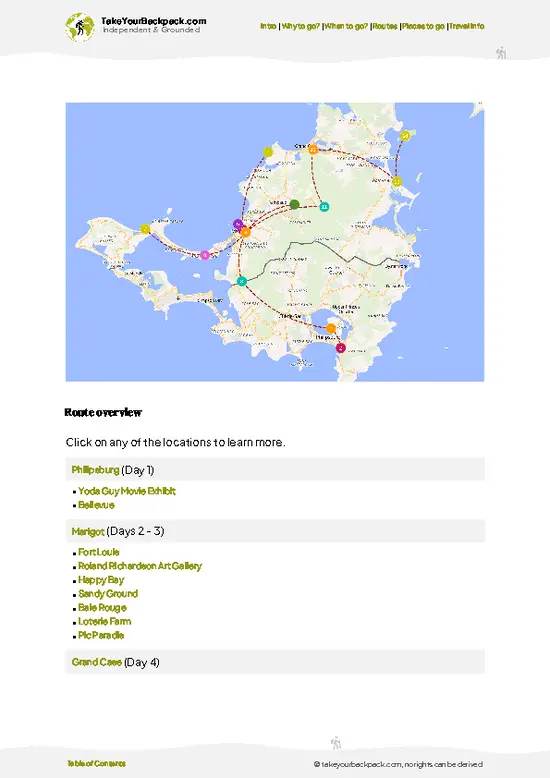
The 2-Day French-Side Taster

The Vibe: A relaxed, food-forward hop between one harbor town and one beach town, perfect if you want maximum sea time and minimal driving. You’ll split your days between café-lined streets, a hilltop fort, and long swims on the French side.
The Highlights:
  • Sunset swims and seaside dinners in Grand Case
  • Harbor cafés and market browsing in Marigot
  • Panoramic views from Fort Louis
  • Beach time and shoreline walks at Orient Bay
  • The 3-Day Nature & Culture Loop

    The Vibe: A balanced three-day loop that mixes jungle trails, coastal hikes, and one delightfully oddball movie museum. Ideal if you want to feel the island’s green interior and its creative side without sacrificing lazy beach hours.
    The Highlights:
  • Shaded trails and chill time at Loterie Farm
  • Island-wide views from Pic Paradis
  • Coastal hiking to the quiet sands of Happy Bay
  • Film history and props at the Yoda Guy Movie Exhibit
  • The 5-Day Two-Sides-of-Saint-Martin Journey

    The Vibe: A deeper dive that lets you feel both Dutch-side
read more 👉

The 2-Day French-Side Taster

The Vibe: A relaxed, food-forward hop between one harbor town and one beach town, perfect if you want maximum sea time and minimal driving. You’ll split your days between café-lined streets, a hilltop fort, and long swims on the French side.
The Highlights:
  • Sunset swims and seaside dinners in Grand Case
  • Harbor cafés and market browsing in Marigot
  • Panoramic views from Fort Louis
  • Beach time and shoreline walks at Orient Bay
  • The 3-Day Nature & Culture Loop

    The Vibe: A balanced three-day loop that mixes jungle trails, coastal hikes, and one delightfully oddball movie museum. Ideal if you want to feel the island’s green interior and its creative side without sacrificing lazy beach hours.
    The Highlights:
  • Shaded trails and chill time at Loterie Farm
  • Island-wide views from Pic Paradis
  • Coastal hiking to the quiet sands of Happy Bay
  • Film history and props at the Yoda Guy Movie Exhibit
  • The 5-Day Two-Sides-of-Saint-Martin Journey

    The Vibe: A deeper dive that lets you feel both Dutch-side buzz and French-side ease, with time for art, movie lore, and multiple beach moods. You’ll change bases once, using each as a springboard for day trips to coves, galleries, and coastal walks.
    The Highlights:
  • Boardwalk strolls and bay views from Philipsburg
  • Grand Case’s beach, lolos, and easygoing nightlife
  • Local art in Marigot and lounging at Orient Bay
  • Quiet coves and sheltered waters at Happy Bay and Anse Marcel
🌍 Want a ready-to-use travel plan for Saint Martin?
The overview above compares different route options based on your travel time and style. The complete Travel Guide breaks each itinerary down in detail, including maps, stops, highlights, and transport information.

Explore all route details 👉

Get the Travel Guide -

🌤️ When to go?Weather, seasons, and timing

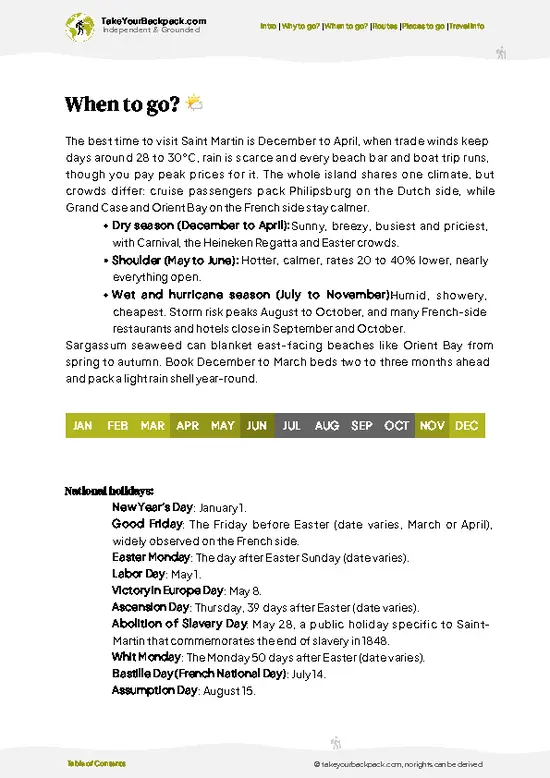
I aim for late April-early June or mid-November-mid-December—the island’s sweet spots. Trade winds hold, rain comes as quick squalls, and hurricanes sit mostly at bay. Rates drop after winter, cruise-day crowds thin, and water stays warm with decent visibility. In late spring, sargassum can smear windward shores; pivot to Cupecoy, Mullet, or Happy Bay.
  • High/Dry Peak: Gridlock around Simpson Bay and Grand Case, higher rates, packed beach clubs. The payoff: steady sun, live music, clear morning water.
  • Shoulder Shift: Rates slide, cruise calls ease, clouds build then rinse the heat. Often ignored: sargassum; favor leeward coves for clean swims.
  • Hurricane Off-Peak: Heat presses, squalls pop, ferries and small guesthouses pause. You get empty Pic Paradis trails. Hack: start at dawn, siesta, carry a drybag.

Sweet-spot play: lock a car and your first night’s bed two weeks out; keep the rest cancelable and aim for leeward beaches.

source: climatestotravel.comJANJanuary: excellent for travelingFEBFebruary: excellent for travelingMARMarch: excellent for travelingAPRApril: highly recommended for travelingMAYMay: highly recommended for travelingJUNJune: good for travelingJULJuly: fair for travelingAUGAugust: fair for travelingSEPSeptember: below average for travelingOCTOctober: fair for travelingNOVNovember: highly recommended for travelingDECDecember: excellent for traveling
📅 Traveling in a specific month?
Get a full month-by-month breakdown of weather, crowds, costs, festivals, and seasonal highlights in the complete travel guide.

Get full details when to go 👉

Get the Travel Guide -
StMartin-pascal-bernardon-33pBxDuFIUo-unsplash

💰 Costs (as of 2025)Travel costs in Saint Martin

$90-120 per day if you ride the buses, self-cater, and skip big-ticket boat days; add 30-50% in peak season.
  • dorm accommodation: Dorms are scarce; when you find one it’s usually $30-45, otherwise you’re in a basic guesthouse/room-share at $70-110. System tip: target crew-style hostels and shared apartments around Simpson Bay or Marigot, book weeks ahead, and angle for weekly rates; base near a supermarket and bus route to save every day thereafter.
  • meals: Supermarket Survival: $12-18/day if you live on baguette, cheese, tins of tuna, fruit, and a rotisserie chicken stretched over rice. Street food reality: the French-side lolos and Dutch-side BBQ trucks do solid plates for $10-15; sit-down mains hit $18-30. Beer is $2-3 from a shop, $5-7 at a bar; rum by the bottle beats cocktails. Cheaper than St. Barts, pricier than the Dominican Republic.
  • local transport: Minibuses are the unlock—$1-2 per ride along the main ring roads; flag them anywhere, pay cash (USD widely taken). Taxis are punishing ($15-30 for short hops). Car rental only pays if you split: $35-50/day off-season ($60+ peak) plus $10-15/day insurance; split four ways and it undercuts taxis fast. No real night bus network—budget
read more 👉
$90-120 per day if you ride the buses, self-cater, and skip big-ticket boat days; add 30-50% in peak season.
  • dorm accommodation: Dorms are scarce; when you find one it’s usually $30-45, otherwise you’re in a basic guesthouse/room-share at $70-110. System tip: target crew-style hostels and shared apartments around Simpson Bay or Marigot, book weeks ahead, and angle for weekly rates; base near a supermarket and bus route to save every day thereafter.
  • meals: Supermarket Survival: $12-18/day if you live on baguette, cheese, tins of tuna, fruit, and a rotisserie chicken stretched over rice. Street food reality: the French-side lolos and Dutch-side BBQ trucks do solid plates for $10-15; sit-down mains hit $18-30. Beer is $2-3 from a shop, $5-7 at a bar; rum by the bottle beats cocktails. Cheaper than St. Barts, pricier than the Dominican Republic.
  • local transport: Minibuses are the unlock—$1-2 per ride along the main ring roads; flag them anywhere, pay cash (USD widely taken). Taxis are punishing ($15-30 for short hops). Car rental only pays if you split: $35-50/day off-season ($60+ peak) plus $10-15/day insurance; split four ways and it undercuts taxis fast. No real night bus network—budget for a ride or be home early.
  • activities: Free beaches and the Pic Paradis hike are your value core. Costs spike with water: two-tank dive $95-130, jet ski $70-100/hour, Pinel ferry $10-15 roundtrip, Anguilla day trip $60-90 plus taxes, St. Barts more. Chair/umbrella sets run $15-25; bring a mat and your own mask to avoid $8-10/day rentals. Pricier than Guadeloupe, far cheaper than St. Barts.
  • miscellaneous: Budget leaks: 10-15% “service charge” appears on Dutch-side bills—don’t tip twice; on the French side, paying USD at 1:1 is a bad trade—use euros or a no-FX-fee card. ATMs often add $5-8; pull fewer, larger withdrawals. Roaming burns cash—buy a Digicel/Flow SIM ($10-20). Tap water is treated—refill instead of buying bottles. Sunday closures on the French side force you into restaurants—stock up Saturday.
⚠️ Prices can change and everyone travels differently, so take this as a rough guide. Hope it helps you plan your adventure!

✈️ The backpacker research shortcutSaint Martin Travel Guide

An offline-friendly backpacking guide with optimized travel routes, ranked highlights, transport advice, and the best areas to stay.
example page 0 from our offline Travel Guide for Saint Martinexample page 1 from our offline Travel Guide for Saint Martinexample page 2 from our offline Travel Guide for Saint Martinexample page 3 from our offline Travel Guide for Saint Martinexample page 4 from our offline Travel Guide for Saint Martinexample page 5 from our offline Travel Guide for Saint Martinexample page 6 from our offline Travel Guide for Saint Martinexample page 7 from our offline Travel Guide for Saint Martin
The digital guide (106 pages) contains:
23 highlights, ranked by travel appeal
Optimized 2, 3 & 5-day travel routes
Cities, national parks, beaches, historical sites, ...
How to get around
Offline-friendly for travel without Wi-Fi
👉 Click to see all 30+ guide features

📅 Plan smarter in minutes, not weeks
Month by month travel advice
Festivals & national holidays
Budget expectations

🗺️ Go to the right places, skip the overrated ones
Honest pros & cons of destinations
Top hikes, parks & viewpoints
Lesser-known places most travelers miss
Clear “worth it vs skip it” guidance

🛏️ Travel smoothly without rookie mistakes
Best areas to stay
Transport systems explained simply
Common scams & safety advice
SIM cards, money & practical tips

🌍 Understand the country, not just visit it
Culture & traditions
52 Essential phrases & customs
Festivals worth planning around
Traveler-friendly historical context
Insights that make places more meaningful

📱 Built for real travel conditions
Fully downloadable PDF
Works completely offline
Optimized for phone use
Useful in remote areas & buses
Everything in one place
Save weeks of stressful planning
Get instant access to the full guide directly. 30-day money-back guarantee.


Sent to your inbox immediately after payment • 100% Secure Checkout
Best Backpacking Travel Advisor 2025 tourism awardBest Backpacking
Travel Advisor
2025
What others say about Take Your Backpack Guides:
⭐⭐⭐⭐⭐
Fantastic, amazing amount of information!
⭐⭐⭐⭐⭐
My goodness this is amazing, it's what I've been looking for hats off too you!
⭐⭐⭐⭐⭐
I think this is absolutely BRILLIANT
⭐⭐⭐⭐
Very complete and informative. It's still missing places, but I gotta to commend you
⭐⭐⭐⭐⭐
This is truly amazing, thank you, can't wait to explore it with my kids!
⭐⭐⭐⭐⭐
Awesome resource, thank you!
⭐⭐⭐⭐⭐
This is amazing! Can't wait to explore the ones I haven't seen
⭐⭐⭐⭐
I love this! Well done, great idea.
⭐⭐⭐⭐⭐
Thanks for taking the time to make this gem!
⭐⭐⭐⭐⭐
This might be the best website I've ever seen.
⭐⭐⭐⭐⭐
Congratulations, and thank you so much for your work; it's incredibly valuable.
⭐⭐⭐⭐
In all seriousness I think you did a great job pointing out the important spots
⭐⭐⭐⭐⭐
10/10 very good
⭐⭐⭐⭐⭐
As someone who's only just starting to visit regularly this is awesome, thank you.
⭐⭐⭐⭐
Thank you very much! I'm going to visit my dad, it's going to be very useful!
⭐⭐⭐⭐⭐
This is really cool! We'll be travelling for the first time and this definitely come in handy.
⭐⭐⭐⭐⭐
You are now our minister of culture, congratulations 👨‍💼
⭐⭐⭐⭐⭐
Just wanted to tell you that this is a pearl! Going to follow your recommendations.
⭐⭐⭐⭐⭐
This is so cool. I'll definitely be using the resource for my travels soon.
⭐⭐⭐⭐⭐
This is very impressive! Good work.
⭐⭐⭐⭐⭐
This is an amazing and informative site. Very well done!

🛏️ Where to stay?Accommodation types and options

Yes — Saint Martin (Sint Maarten) has hostels and budget accommodation, mostly small hostels, guesthouses and private rooms concentrated in Philipsburg, Simpson Bay, Marigot, Grand Case and Orient Bay.
Philipsburg gives best transport, beaches and shops but is crowded and pricier on cruise days; Simpson Bay has the densest budget cluster and nightlife yet sits near the airport and can be noisy; Marigot is quieter and safer with ferry links but has fewer very cheap beds; Grand Case is peaceful and food-focused with limited hostel options; Orient Bay is lively for beach parties but more resort-priced … read more 👉
Yes — Saint Martin (Sint Maarten) has hostels and budget accommodation, mostly small hostels, guesthouses and private rooms concentrated in Philipsburg, Simpson Bay, Marigot, Grand Case and Orient Bay.
Philipsburg gives best transport, beaches and shops but is crowded and pricier on cruise days; Simpson Bay has the densest budget cluster and nightlife yet sits near the airport and can be noisy; Marigot is quieter and safer with ferry links but has fewer very cheap beds; Grand Case is peaceful and food-focused with limited hostel options; Orient Bay is lively for beach parties but more resort-priced and seasonal.

If you enjoy meeting fellow travelers, consider choosing hostels with high ratings for atmosphere. On the other hand, if you prefer having your own space, a hotel might be a better option.

🚌 Getting aroundWhat moving around is really like

Saint Martin runs on tides and favors, not timetables. Minibuses pulse with school bells and shopping hours, then thin to a shrug after dark. Bridges swing open for yachts and the island cleaves into two long arguments of idling cars. You learn to move early, shade-hop at midday, and never assume the next ride is guaranteed.
  • Minibuses (“dollar buses”) Cash only, hail-and-ride, placards in the windshield: Philipsburg, Marigot, Maho, Grand Case. Greet the driver, sit tight, press the buzzer or say
read more 👉
Saint Martin runs on tides and favors, not timetables. Minibuses pulse with school bells and shopping hours, then thin to a shrug after dark. Bridges swing open for yachts and the island cleaves into two long arguments of idling cars. You learn to move early, shade-hop at midday, and never assume the next ride is guaranteed.
  • Minibuses (“dollar buses”) Cash only, hail-and-ride, placards in the windshield: Philipsburg, Marigot, Maho, Grand Case. Greet the driver, sit tight, press the buzzer or say “bus stop” before your corner. Fares sit around $2-3 (USD or euros), exact change wins smiles. They’re frequent by day, scarce on Sundays and after 8-9 pm. Don’t board with beach coolers the size of a toddler; space is communal. Cross-border is fine—no passport check, just pay again if you switch routes.
  • Rental car The fastest door-to-door when you time it right, and the slowest mistake if you hit the Simpson Bay bridge lifts or cruise-ship exodus. Day rates look cheap until insurance, deposits, and fuel nudge the total; still beats two taxis. Drive on the right, expect sudden speed bumps, tight parking, and scooters in blind spots. Lock the trunk, leave nothing visible, and avoid Orient/Grand Case parking pinch at peak lunch hours.
  • Local boats to Pinel/Tintamarre Water beats wheels for the northeast islets. From Cul-de-Sac, small shuttles hop to Pinel on a loose half-hour rhythm, cash roundtrip posted at the dock, last boats mid-late afternoon. Miss it and you’ll pay extra to a fisherman. Bring water and sun cover; there’s no cheap shade. Bypass long island detours and reach sand you can’t drive to.
  • Airport walk-out + bus Skip the taxi at SXM: exit, turn left, and in 10-12 minutes you’re on the main road by Maho where buses roll both ways. Works with a backpack, not a hard-shell suitcase. After dark, buses thin and this stops being clever. Daytime, it chops a $20-$35 taxi into a $2 ride.
Master tactical tip: Move at dawn, and never plan a cross-island trip during Simpson Bay bridge openings—beat the lift or route via Cole Bay/Marigot before the island stalls.
L’Espérance Airport (SFG) — often called Grand Case or “Marigot airport” — sits about 6-7 km (4-4.5 miles) from Marigot’s town center.
  • Minibus (public bus): Walk out to the main road and flag a minibus with “Marigot” in the window. They run every 10-20 minutes in the daytime (much less frequent evenings and Sundays). Expect 15-25 minutes to town depending on traffic and stops. Fare is about €2 (US$2), cash only; have small change.
  • Taxi: Usually available outside the terminal or by phone if none are waiting. Around 10-15 minutes to the center. Typical daytime fare €15-€25; nights/Sundays/holidays can be €25-€35. Cash preferred; cards not guaranteed. No Uber/Lyft on the island (2025).
  • Car rental: Several agencies in/near the terminal. Driving to Marigot takes 10-15 minutes. Good value if you’ll explore the island: roughly €35-€60 per day plus fuel. Parking in Marigot is generally free but can be tight midday.
  • Pre-booked private transfer: Handy if you want a meet-and-greet. Similar timing (10-15 minutes). Expect about €25-€45 for a small car for this short route.
  • Walking: Possible but not ideal with luggage or heat. It’s 6-7 km (4-4.5 miles), about 1-1.5 hours on roads with limited sidewalks.

Tip: Buses don’t run late at night; if you land after dusk, plan on a taxi or pre-booked transfer.
⚠️ Prices and routes can change, so take this as a rough guide and ask for local advice when you arrive.

🔒 Safety (risk Level: low)What first-time visitors should know

Safety for solo travelers, including women and LGBTQ+ individuals
Saint Martin is generally safe for solo travelers, including women and LGBTQ+ individuals, but like anywhere, it’s wise to stay aware of your surroundings. Stick to well-lit areas at night, and keep your belongings secure, especially in crowded spots. The island is quite welcoming, but exercise caution in less touristy areas and avoid isolated beaches after dark. Always check local advice and current safety updates before your trip.

✈️ VisaVisa requirements for Saint Martin

Visa requirements for Saint Martin depend on your nationality. Citizens from the EU, USA, Canada, and several other countries can enter visa-free for short stays. If you do need a visa, apply through the French consulate or embassy in your country, as Saint Martin is a French overseas collectivity.

source: diplomatie.gouv.fr
⚠️ Visa requirements can change over time, so always check the latest visa requirements with the official embassy or government website before you travel.

🎒 What to pack?A practical packing list

Saint Martin is a sun-soaked paradise, so pack light and breathable clothes to deal with the heat and humidity. Think about throwing in a light rain jacket because tropical showers can catch you off guard. The island’s beaches are the main draw, but if you’re planning to explore its hills or rent a scooter, make sure you’ve got good shoes and a hat to protect yourself from the sun. The vibe is pretty chill, so casual attire is fine, but bring something a bit smarter if you plan to hit the nicer restaurants or nightlife spots. Lastly, don’t forget that you’ll want a swimsuit for those crystal-clear waters.

Apart from this country specific advice, I have also crafted a general packing list that should help on any trip. authorOver the years, I've learned the importance of packing minimally. It's so much easier to jump on the back of a truck or squeeze yourself into the last spot of a minibus without that supersized backpack. If you're headed to a warm destination, leave your winter jacket at home; for colder regions, opt for thin thermal underlayers. Instead of packing your entire wardrobe, bring just three sets of clothes, as laundry facilities are available everywhere.
View the full list 👉
🎒 Planning the practical side of your trip?
Get detailed information on transport, daily budgets, internet access, local customs, food, language, and other essentials in the complete Travel Guide.

Get detailed practical information 👉

Get the Travel Guide -

🙋 FAQThings travelers often ask

Trip Planning


Personal tip: I normally search on good rating for atmosphere (for meeting people) and location (for easy exploring). Cleanliness as a bonus.


Travel Essentials

Hepatitis A and B vaccinations are recommended for visiting Saint Martin. Consider a typhoid shot if you’re planning to eat street food. Ensure your routine vaccines (like MMR, DTP) are up to date. Check with a healthcare professional for personalized advice.


vaccination requirements
When I first started traveling, I often spent part of my first day in a new country hunting for a local SIM card. While this can still be slightly cheaper, it also takes time and planning.

These days, it's much simpler to install an eSIM before leaving home. Once you arrive in Saint Martin, you can activate it immediately and have mobile data from the moment you land — which is especially useful for ordering transport or navigating away from busy airports.

There are many providers nowadays, and price differences are usually small. I personally go with Airalo, as it offers excellent network coverage throughout the country and strong global coverage, so you can manage multiple countries from a single app.


Get your e-sim for Saint Martin

Culture & Customs

Respect local customs in Saint Martin by dressing modestly, especially in non-beach areas. Tipping is common; around 15% is appreciated for good service.

Do greet locals with a polite ”Bonjour” when entering shops or restaurants. Don’t photograph people without permission, particularly in more private or residential areas.

For LGBTQ+ travelers, Saint Martin is generally welcoming, but discretion is advised in more conservative areas. Women should feel comfortable but remain cautious, as in any unfamiliar place.
Trying traditional food is always a great way to experience the culture. Here are some must-try dishes for Saint Martin.
  • Johnny Cakes: These are deep-fried cornmeal cakes that are super popular across the Caribbean. You’ll find them on the breakfast table or as a side dish. They’re beloved for their simplicity and versatility, often served with saltfish or just butter.
  • Conch Fritters: Made from the chewy conch meat mixed with spices, these are deep-fried to perfection. They’re a staple appetizer and offer a taste of the island’s seafood bounty. Pair them with a spicy dipping sauce for the full experience.
  • Callaloo Soup: A hearty and nutritious dish, callaloo soup uses leafy greens, often combined with okra, and sometimes features crab or salt meat. It’s a nod to the island’s Afro-Caribbean roots and is beloved for its rich, comforting flavors.
  • Guavaberry Liqueur: Although technically a drink, this liqueur is a must-try. Made from the local guavaberry fruit, it’s a traditional holiday treat but available year-round. Sip it to enjoy a unique taste of the island’s culture and festivities.
Tap water in Saint Martin is generally considered safe for locals, but tourists often prefer bottled or filtered water to be cautious. While many drink it without issues, if you have a sensitive stomach, sticking to bottled water is a safer bet.
The main language in Saint Martin is French. Backpacking is way more rewarding if you know a bit of the local language, so I'd suggest brushing up on the basics just in case your French skills have become a bit rusty.

Want to understand locals better?
The complete Travel Guide for Saint Martin includes 52 essential words and phrases — greetings, thank-yous, ordering food, transport, numbers, and common local expressions you'll actually hear.

Get your local basic phrases 👉

Get the Travel Guide -


In Saint Martin, English is widely spoken, particularly in the northern part of the island, which is governed by the French. The island is a popular tourist destination, and many locals in the hospitality and service industries, such as hotels, restaurants, and shops, are fluent in English. This makes it easy for English-speaking visitors to navigate and communicate.

In the southern part of the island, which is Dutch Sint Maarten, English is the official language and is used in government, education, and daily life. Most residents are bilingual, often speaking Dutch or Papiamento alongside English.

While French is the official language in the northern French side, many locals also speak English, especially those involved in tourism. Overall, travelers will find that English is commonly understood and spoken, making Saint Martin a welcoming destination for English-speaking tourists. However, learning a few basic phrases in French or Dutch can enhance the experience and is appreciated by the locals.

Money & Payments

The local currency of Saint Martin is EUR (€).

ATMs: ATMs are pretty accessible on both the French and Dutch sides of Saint Martin, mostly clustered in urban areas and tourist spots. Stick to using ATMs at banks for better security.

Cash: It’s smart to carry some cash, especially for smaller vendors and local markets. The French side uses euros (EUR) while the Dutch side uses Netherlands Antillean guilders (ANG), but U.S. dollars (USD) are widely accepted on both sides.

Currency: Bring a mix of euros and U.S. dollars. Most places accept dollars, but having some euros can get you better deals on the French side.

Card Acceptance: Credit and debit cards are commonly accepted in hotels, restaurants, and larger shops. However, smaller establishments may prefer cash, so don’t rely solely on cards.

Exchange: To exchange your money, check out local banks or currency exchange offices. Avoid airport exchange counters as they usually have less favorable rates.

In Saint Martin, tipping is appreciated but not obligatory. Many restaurants include a 15% service charge on the bill, but if it’s not included, a tip of 10-15% is customary. For other services like taxis or hotel staff, small tips in line with local currency are well-received.

🧩 Nearby countriesSimilar backpacking destinations

We 💚 feedbackThe bottom line on traveling here

Go for the split personality that works in your favor: French bakeries and beach grills within the same morning, world-class water right off Pinel and Baie Rouge. The tax you pay is movement—buses thin out after dark, taxis charge per ride, and a rental car brings traffic, dents, and parking tickets if you’re sloppy. Don’t overthink the border; you drift between sides without checks. The real trick: carry euros for the French side, dollars for the Dutch, or you’ll eat the lazy 1:1 exchange.

✍️ Help improve this page!
The information on this page is based on in-depth research, insights shared by experienced travelers, and feedback from the local travel community in Saint Martin. While every effort is made to keep the information accurate and current, conditions can change — so if you spot anything incorrect or outdated, please get in touch.


🙋‍♂️ Give feedback

👋 Meet the founderWho’s Behind Take Your Backpack?

Johan, backpacker and founder of TakeYourBackpackHi, I’m Johan (Netherlands 🇳🇱), the creator of TakeYourBackpack. Over the past decade, I’ve backpacked through 80+ countries across six continents, gaining extensive experience with independent travel, long-term trips, and overland routes.

This site is built on a combination of firsthand travel experience and carefully curated insights from other backpackers. Many guides are based on places I’ve personally visited, while others bring together tips, observations, and practical advice shared by trusted travelers I’ve met along the way.

The goal is to provide realistic, experience-driven guidance — not generic itineraries — so you can explore destinations with better context, clearer expectations, and more confidence.

Get full country guide •
Instant download • 23 highlights • Full Offline guide