×
South Korea 🇰🇷

backpacking Asia South Korea 🇰🇷Ride fast trains between ancient neighborhoods.

Explore SingaporeExplore Sri Lanka

Backpacking South Korea in 2026

A complete guide including when and where to go, costs, transport, itineraries, and practical travel advice.
An overview of visiting South Korea

Backpacking South Korea
By Johan Kruseman 🇳🇱 | Updated June 1, 2026

Your first fork: spend on the KTX and sprint the Seoul–Gyeongju–Busan spine, or save with buses and trade money for hours. Rail compresses the country into bite-size days; buses stretch the same map into a slow, cheap glide. That single lever sets your rhythm in a nation that moves fast yet thinks in centuries.

What pulls you here is the tension that works: palaces and hanok lanes framed by LEDs and subway chimes; late-night stews after a jjimjilbang reset; monks’ drums at dawn, coffee labs by noon. Seoul hums with order and impulse; Gyeongju puts gold crowns and wooden halls within arm’s reach; Busan spreads beaches, cliffside temples, and fish still flicking at the market. Mountains are not a side quest—they’re the national pastime. Seoraksan’s granite spines, Jirisan’s long ridges, Hallasan’s crater above tangerine groves, cherry blossoms in spring and fires of maple in fall. Challenges exist: weekend trail crowds, summer humidity, winter bite, English thinning outside cities, few public trash bins. But the system rewards quick learners—tap a T-money, ride a trailhead bus at dawn, order makgeolli and pajeon like you mean it, try a temple stay—and every tiny mastery turns the place from “trip” into “terrain you command.”

Compared with Japan, Korea is punchier, cheaper to cross at speed, and less ceremonious; compared with China, distances are humane and logistics lighter while heritage sits close to the surface. It’s a country for city lovers who want mountain weekends, food-led travelers who like heat and nuance, and anyone who enjoys modern efficiency carrying old bones.

👉 Get the 📖 Travel Guide of South Korea

Seoul & Capital Orbit

Start here because the system bends to you. The subway grid is dense, late, and cheap with a single T-money card; base yourself on Line 2 (the ring) to cut transfers and you’ll spend more time doing than moving. Student-heavy districts (Hongdae, Sinchon, Hyehwa) reward night owls and casual eaters; palace zones reward early risers who beat tour buses. Day trips ride the same logic: AREX to Incheon’s coast, rapid trains to Suwon. Hike Bukhansan on weekdays; buses to trailheads run often, parking lots jam.

Gyeongbu Spine: Daejeon–Daegu–Gyeongju–Busan

One rail artery unlocks four different moods without a flight. KTX drops you into Daegu for temple overnights (Haeinsa via Seobu bus), into Singyeongju for Silla ruins by local bus, and into Busan for markets, stairs, and sea air. Base in Busan if you like big-city nights and day-trip days; Seomyeon splits the metro map in half. Base in Daegu if you’re here for traditions and mountain edges. The spine makes tight, 1–2 hour hops normal, so pack light and move.

Gangwon Mountains & East Coast

Rugged and remote by Korean standards, but cleanly organized if you play the bus game. Express coaches from Seoul drop you in Sokcho or Yangyang; from there, minibuses crawl to Seoraksan gates on reliable intervals. Hikers and winter people win here; surfers catch Yangyang swells when the cities bake. Trains are sparse, so a rental car pays back if you’re linking valleys in a day. Start trailheads early, soak in a jjimjilbang after, and avoid Sunday evening traffic back to Seoul.

Jeolla Slow Belt: Jeonju–Gwangju–Boseong–Yeosu

Food-first travelers earn the best bowls by riding the Honam/Jeolla rail to Jeonju or Gwangju, then stitching buses to tea fields (Boseong) and coastal walks (Yeosu). Service runs fine, but frequencies thin at night, so plan loops that end near your bed by 9 pm. Prices run lower than Seoul by a clear margin, which encourages grazing. Expect more Korean-only signage; learn dish names and order with confidence. This region rewards patience and an empty schedule that bends around meals.

Jeju Island

Windy, volcanic, and spread out. The win condition is segmenting the island by quadrant and minimizing cross-island drives. Flights are constant; rent a car at the airport or commit to the airport limousine plus local buses and accept slower days. Base in Seogwipo for Olle trails and waterfalls, in the north for markets and museums. Hike Hallasan with an early permit mindset and weather margin. Eat outside tour-bus lunch hours and let the ring road dictate your sequence, not your whims.
A visual overview of the country
Loading the map 🌍
CLICK TO FILTER
city
town
village
unique site
national park
hike
beach
attraction
festival
region
SHOW COUNTRY’S BESTSHOW ALL
film
0
0
0a
Lotte World
film
1
1
1a
National Museum of Korea
Pixabay
film
2
2
2a
National Theatre of Korea
film
3
3
3a
Jungmun Saekdal Beach
film
4
4
4a
Seoul
Pixabay
film
5
5
5a
Suwon
film
6
6
6a
Seoraksan Ulsanbawi Rock Trail
film
7
7
7a
Hallasan
film
8
8
8a
Namsan Mountain Trail
film
9
9
9a
Songnisan Beopjusa Temple Trail
film
10
10
10a
Juwangsan Daejeonsa Temple Trail
film
11
11
11a
Danyang Dodamsambong Peaks Trail
film
12
12
12a
Seoraksan
film
13
13
13a
Odaesan
film
14
14
14a
Songnisan
film
15
15
15a
Gyeongju
film
16
16
16a
Chiaksan
film
17
17
17a
Wolchulsan
film
18
18
18a
Boseong
film
19
19
19a
Yangyang
film
20
20
20a
Yangdong
film
21
21
21a
Jeju’s Seongsan Ilchulbong
film
22
22
22a
Haeinsa Temple
film
23
23
23a
Suncheon Bay
film
24
24
24a
Hwaseong Fortress
film
25
25
25a
Gaya Tumuli
film
26
26
26a
Hahoe

Why go?What makes this country worth the trip

Food

Korea rewards eaters who understand its system. Streets specialize: a block of jokbal, an alley of kalguksu, … read more 👉
Korea rewards eaters who understand its system. Streets specialize: a block of jokbal, an alley of kalguksu, a market row for bindaetteok. That concentration kills guesswork—follow the vats, sit, and you’re close to the best version. Late nights work because food runs 24/7: pojangmacha for spicy tteokbokki and soju when restaurants close, convenience stores for kimbap and hot water ramen at 3 a.m. Call buttons, not waiters hovering; press, order fast, and you’ll turn tables like a local. Banchan is refilled, so order fewer mains and build the meal from the side dishes. Metal chopsticks are slippery; use the spoon for rice and soups and eat hotter, faster. No tipping, prices posted, portions generous—share. Markets first, regional towns second; Seoul polishes, Jeonju and Jeju teach.

Mountains

South Korea is a hiker’s cheat code. Mountains knit the whole country, transit stitches you to them. … read more 👉
South Korea is a hiker’s cheat code. Mountains knit the whole country, transit stitches you to them. You can sleep in Seoul, hit Bukhansan’s granite before breakfast, or ride a bus to Seoraksan and be on ridge ladders by noon. Trails are brutally direct but immaculately signed; stairs where it’s exposed, ropes where it’s slick, emergency call boxes at saddles. Park gates often have gear shops, coin lockers, and a CU or GS25 for kimbap—so you pack light and move fast. Autumn burns red; winter is ice—microspikes turn “maybe” into “yes.” Weekends draw half the nation, so go early or go Tuesday and have the ridge to yourself. Finish with a jjimjilbang soak and soup. The system rewards those who plan one step ahead.

People

Koreans run on nunchi—quiet social radar—and age-based hierarchy. That’s the switch: show small respect, … read more 👉
Koreans run on nunchi—quiet social radar—and age-based hierarchy. That’s the switch: show small respect, get big warmth. Bow a touch, offer or accept things with two hands, let the eldest move first. A few Korean phrases earn over-the-top help; effort is the currency. The country moves ppalli-ppalli, fast-fast, so decide before the counter, step aside to check a map, and you’ll be waved through rather than nudged. Jeong, that sticky kindness, compounds: accept help, then reciprocate with a humble thank-you or a convenience-store coffee, and strangers become allies. “Maybe later” often means no; give easy exits and you’ll be invited back. Keep humor light and self-deprecating, volume low on subways, seats to elders. If drinks appear, pour for others, never yourself, and turn slightly when sipping with seniors.

Architecture

South Korea is a live lesson in how ideas become buildings. Joseon palaces use axial courtyards to encode … read more 👉
South Korea is a live lesson in how ideas become buildings. Joseon palaces use axial courtyards to encode hierarchy; fortress walls ride mountain spines; hanok houses solve climate with ondol floors and deep eaves. Then you drop into a Zaha curve at Dongdaemun or the knife-edge of Lotte World Tower and see the same obsession with order, flow, and comfort, updated. The system favors you. Five royal sites sit on one subway spine; a single combo ticket links them; wearing a hanbok waives entry. Closures are staggered, so slot another palace when one goes dark. Gyeongju’s Silla core fits in a day’s bike loop; Suwon’s wall glows at blue hour and encircles dinner. Use exit numbers, not addresses. Bring socks for ondol rooms. You’re not sightseeing; you’re reading a machine.

Low cost

South Korea is cheap if you play its system. No tipping and tax-included menus flatten the surprises. … read more 👉
South Korea is cheap if you play its system. No tipping and tax-included menus flatten the surprises. Use a T-money card and ride buses/subways with automatic transfer discounts; choose express buses over the KTX for long hops and you cut transport burn without losing time. Eat where locals lunch: kimbap shops, stews with free banchan refills, and convenience-store sets you microwave and eat at the tables outside. Hit department-store food halls 30–60 minutes before closing for markdowns. Water is free in restaurants and public fountains, so skip bottled. Sleep smart: hostels are excellent value, jjimjilbangs double as overnight shelter, and weekly goshiwon rooms crush costs if you’re staying put. Hikes are free, city museums are low-cost, and Wi‑Fi is everywhere. Run it well and you’re around $35–55 per day.
Want the complete picture of South Korea?
The offline Travel Guide brings everything together — routes, highlights & planning.

See what's included in the guide 👉

Get the Travel Guide -

⭐ HighlightsWhat not to miss along the way

  • Bukhansan Baegundae Ridge: Granite slabs pull you up by chain and railing, Seoul spilling out behind you like circuitry as you climb; the metal is cold on your palms, and your gloves come away smelling of pine resin. Go at first light on a weekday to beat summit bottlenecks; start at Bukhansanseong for a steady grade up and exit via Ui-dong to turn the crowd tide. Light gloves for the chains, a wind layer for the exposed crest, and cash for trailhead kimbap turns a grind into flow. For quieter edges, slide over to Doseonsa’s mossy courtyards, step into the Ui-dong valley boulders, and watch climbers testing Insubong’s dome.
  • Gyeongbokgung Palace: Wide courtyards breathe with drumbeats at the changing of the guard, lacquered colors sharp under hard noon light; you hear soles click on stone and the flags snap like sails. Closed Tuesdays, so plan the palace arc on another day and buy the combined palace-shrine ticket to amortize costs if you’re doing more than one. The guard ceremony runs on
read more 👉
  • Bukhansan Baegundae Ridge: Granite slabs pull you up by chain and railing, Seoul spilling out behind you like circuitry as you climb; the metal is cold on your palms, and your gloves come away smelling of pine resin. Go at first light on a weekday to beat summit bottlenecks; start at Bukhansanseong for a steady grade up and exit via Ui-dong to turn the crowd tide. Light gloves for the chains, a wind layer for the exposed crest, and cash for trailhead kimbap turns a grind into flow. For quieter edges, slide over to Doseonsa’s mossy courtyards, step into the Ui-dong valley boulders, and watch climbers testing Insubong’s dome.
  • Gyeongbokgung Palace: Wide courtyards breathe with drumbeats at the changing of the guard, lacquered colors sharp under hard noon light; you hear soles click on stone and the flags snap like sails. Closed Tuesdays, so plan the palace arc on another day and buy the combined palace-shrine ticket to amortize costs if you’re doing more than one. The guard ceremony runs on the hour late morning to mid-afternoon; stand just left of Gwanghwamun for the cleanest sightline, and wear a hanbok for free entry if you like the hack. When you need space, duck into Baek In-je House in Bukchon, stroll Seochon’s Tongin Market back alleys, and climb to Sajik Park for a quiet treetop overlook.
  • Busan’s Jagalchi Market and Yeongdo Waterfront: Wet floors, shouted prices, and the iodine bite of fresh brine hang in the air; upstairs, steam fogs the windows while a cook torches your catch and the butane taps hiss. The system is simple: pick your fish by weight downstairs, carry the slip to a restaurant for a small prep fee, and add a maeuntang soup to turn trimmings into lunch—arrive before noon to avoid the queue-rush. Walk the bridge to Yeongdo afterward for a salt-wind reset and a straight horizon. For less peopled edges, follow the Jeoryeong Coastal Walk, detour to Amnam Park’s wave-worn platforms, and poke through Namhang Market’s utilitarian stalls.
  • Seongsan Ilchulbong, Jeju: The path climbs in carved basalt steps, wind pressing your jacket flat while gulls yaw in the updraft; salt gathers on your lips, and the crater’s grass hums under the gusts. Sunrise is the cliché, but the trick is earlier than the buses or late afternoon when the tour wave drains—either way, commit to 40 steady minutes, then linger after everyone sprints back down. Parking and buses jam fast, so arrive on foot from the village and eat afterward. If you want room to breathe, wander Seopjikoji’s lava shelves, walk Aewol’s Handam Coastal Path, and time a ferry hop to Udo after breakfast.
  • Bulguksa and Seokguram, Gyeongju: Stone terraces stack with calm geometry, wood beams creak like ships, and incense threads the cool air; at Seokguram the viewing chamber is hushed, your breath audible in the glassed grotto. Start at Bulguksa at gate-open to own the courtyards, then bus or taxi up to Seokguram and walk the forest road down to invert the shuttle crowds; the grotto uses timed entries, so expect a brief, focused window. Bring a transit card and small bills; it speeds every gate. For sidesteps, roll a bike through Yangdong Folk Village’s farm lanes, sit under gingko at Oksan Seowon, and stroll the Samneung pine path by late light.
Spotted a mistake or missing a highlight? Contact us.

But South Korea offers more...

Discover and compare all of its highlights per category

🧭 RoutesSuggested travel routes through South Korea

The 7-Day Seoul & Peaks Starter Route

The vibe: One city, zero FOMO—this week is all about digging into Seoul’s royal history, food alleys, and easy-access mountain trails at a relaxed, walkable pace. You’ll sleep in one place, move mostly by subway and bus, and trade long transfers for deeper neighborhood time.
The highlights:
  • Palace-hopping between Gyeongbokgung and Changdeokgung’s Secret Garden.
  • Getting lost in Bukchon’s hanok lanes and Insadong’s tea houses.
  • Sampling classic street food at Gwangjang Market.
  • Hiking Namsan and Bukhansan for big city views and quick nature hits.

The 14-Day City, Coast & Jeju Balance Route

The vibe: Two weeks to connect the dots between Seoul’s palaces, Busan’s beaches, and Jeju’s volcanic coastlines, with enough time to breathe in each stop. Expect a mix of KTX hops, short flights, and local buses, plus a couple of marquee hikes if you want them.
The highlights:
  • Royal Seoul plus markets, design districts, and a DMZ day trip.
  • Busan’s Haeundae and Gwangalli beaches
read more 👉

The 7-Day Seoul & Peaks Starter Route

The vibe: One city, zero FOMO—this week is all about digging into Seoul’s royal history, food alleys, and easy-access mountain trails at a relaxed, walkable pace. You’ll sleep in one place, move mostly by subway and bus, and trade long transfers for deeper neighborhood time.
The highlights:
  • Palace-hopping between Gyeongbokgung and Changdeokgung’s Secret Garden.
  • Getting lost in Bukchon’s hanok lanes and Insadong’s tea houses.
  • Sampling classic street food at Gwangjang Market.
  • Hiking Namsan and Bukhansan for big city views and quick nature hits.

The 14-Day City, Coast & Jeju Balance Route

The vibe: Two weeks to connect the dots between Seoul’s palaces, Busan’s beaches, and Jeju’s volcanic coastlines, with enough time to breathe in each stop. Expect a mix of KTX hops, short flights, and local buses, plus a couple of marquee hikes if you want them.
The highlights:
  • Royal Seoul plus markets, design districts, and a DMZ day trip.
  • Busan’s Haeundae and Gwangalli beaches paired with Gamcheon’s hillside art village.
  • Jeju’s Seongsan Ilchulbong crater and coastal sections of the Jeju Olle Trail.
  • Optional summit days on Hallasan or gentler walks in Hallasan National Park.

The 21-Day Deep Korea Mountains-to-Sea Route

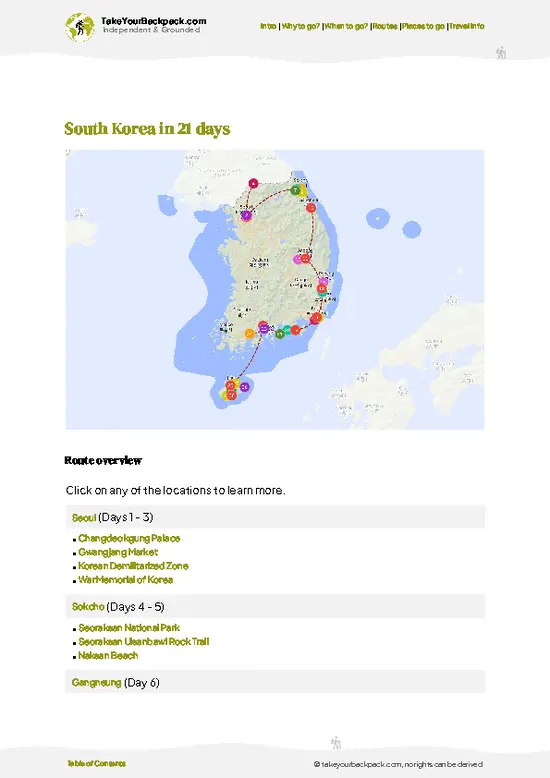
The vibe: A full three-week immersion that strings together Seoul, Gyeongju, Busan, Jeju, and the green southwest into one long, satisfying arc. You’ll ride high-speed trains, buses, and ferries, mixing temple valleys, national parks, and small-town tea fields with just enough city nights.
The highlights:
  • Multi-day deep dive into Seoul’s palaces, markets, and Bukhansan’s granite peaks.
  • Ancient tombs and trails around Gyeongju National Park and Namsan.
  • Busan’s beaches, coastal temples, and side trips into the Yeongnam Alps.
  • Jeju’s volcanoes and beaches plus the tea fields of Boseong, bamboo of Damyang, and wetlands of Suncheon Bay.
🌍 Want a ready-to-use travel plan for South Korea?
The overview above compares different route options based on your travel time and style. The complete Travel Guide breaks each itinerary down in detail, including maps, stops, highlights, and transport information.

Explore all route details 👉

Get the Travel Guide -

🌤️ When to go?When to go for the best experience

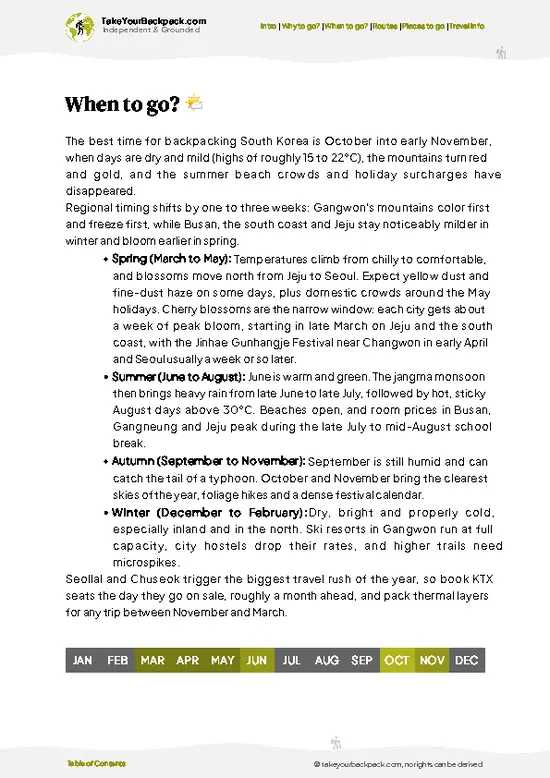
The sweet spot lands twice: late May to mid June and mid October to early November. In spring, the yellow dust slackens, the monsoon hasn’t arrived, and weekdays slide back to normal rates after cherry-blossom mania; trails are firm, rivers clear, and coastal nights are cool enough to sleep with a thin bag. In autumn, Chuseok passes, humidity drains out of the air, mosquitoes quit, and you get that hard blue sky that makes city views and ridge lines pop; weekend park towns fill with leaf-chasers, but midweek you’ll find beds and bus seats without a fight. Avoid early May holiday stacks and the late June-July jangma; dodge late August typhoon ripples on coasts. The logic is simple: travel in the dry gaps between spectacle and school break, and you get better light, better trail footing, and prices closer to baseline.
  • Summer Peak (Jul-Aug): You pay in sweat and won’t get a seat on a Busan beach train without planning, but the high is real: baseball nights thundering, neon markets running past midnight, and sea swims that make a dorm bunk feel earned. Dorm prices and lines climb with school holidays; pack salt tabs, start hikes pre-dawn, and claim late dinners after the rush to win back hours.
  • Shoulder Flow (late May-mid Jun; mid Oct-early Nov): The country exhales—queues thin, menus swap to seasonal specials, and buses start arriving early instead of late because traffic eases. You move faster, stack more in a day, and still sleep cheap. Hit Naejangsan or Seoraksan the exact two weeks when the canopy flips to fire; that window is brief and worth targeting.
  • Winter Off-Peak (Dec-Feb): Solitude sits heavy on granite ridges and along frozen rivers; cities glitter and steam from fishcake stalls curls into dry air. Survival hack: microspikes for icy stairs, merino next-to-skin, and a jjimjilbang mapped near each station as your warm, all-night safety net.
  • Monsoon Pulse (late Jun-mid Jul, typhoon fringes late Aug-Sep): Travel by radar of rhythm, not clock—sprint between squalls, museum-up when it dumps, then reemerge for washed-clean streets and empty palaces. Dry-bag your pack core, wear quick-drain shoes, and choose granite peaks with slab runoff over clay trails that turn to grease.

For October foliage weekends and late-May Saturdays, reserve beds near Seoraksan or Naejangsan three weeks ahead; keep the rest of the itinerary walk-up and midweek.

source: climatestotravel.comJANJanuary: fair for travelingFEBFebruary: fair for travelingMARMarch: good for travelingAPRApril: good for travelingMAYMay: good for travelingJUNJune: highly recommended for travelingJULJuly: fair for travelingAUGAugust: fair for travelingSEPSeptember: fair for travelingOCTOctober: excellent for travelingNOVNovember: highly recommended for travelingDECDecember: fair for traveling
📅 Traveling in a specific month?
Get a full month-by-month breakdown of weather, crowds, costs, festivals, and seasonal highlights in the complete travel guide.

Get full details when to go 👉

Get the Travel Guide -
south korea - pixabay - business-5475283

💰 Costs (as of 2026)How expensive it really is

A practical shoestring in South Korea runs 60,000-90,000 KRW per day if you stick to dorms, local diners, and buses.
  • dorm accommodation: 18,000-35,000 KRW per night in most cities; 25,000-45,000 KRW in Seoul/Jeju or on weekends. System tip: travel Sun-Thu and book early near subway lines, not in tourist alleys; you’ll pay less and sleep better. If prices spike, a jjimjilbang (sauna) is a legitimate plan B at ~10,000-18,000 KRW and buys you a shower and a floor mat. For stays over a week, a goshiwon (micro-room) can undercut dorms. Relative value: cheaper than Japan, a touch higher than Taiwan, far higher than Vietnam/Thailand.
  • meals: Supermarket Survival: 6,000-12,000 KRW/day if you lean on gimbap rolls, convenience-store dosirak, and closing-time discounts (most shops mark down in the late evening). Hot water, microwaves, and free chopsticks make DIY easy. Street-food reality: tourist markets charge sit-down prices for snack portions; better value is bunshik/kimbap-cheonguk diners where 6,000-9,000 KRW gets you a hot bowl and refillable banchan. Share stews or barbecue at lunch for per-person savings. Water is free; no tipping. Coffee and craft beer are where budgets die (expect 4,500-6,
read more 👉
A practical shoestring in South Korea runs 60,000-90,000 KRW per day if you stick to dorms, local diners, and buses.
  • dorm accommodation: 18,000-35,000 KRW per night in most cities; 25,000-45,000 KRW in Seoul/Jeju or on weekends. System tip: travel Sun-Thu and book early near subway lines, not in tourist alleys; you’ll pay less and sleep better. If prices spike, a jjimjilbang (sauna) is a legitimate plan B at ~10,000-18,000 KRW and buys you a shower and a floor mat. For stays over a week, a goshiwon (micro-room) can undercut dorms. Relative value: cheaper than Japan, a touch higher than Taiwan, far higher than Vietnam/Thailand.
  • meals: Supermarket Survival: 6,000-12,000 KRW/day if you lean on gimbap rolls, convenience-store dosirak, and closing-time discounts (most shops mark down in the late evening). Hot water, microwaves, and free chopsticks make DIY easy. Street-food reality: tourist markets charge sit-down prices for snack portions; better value is bunshik/kimbap-cheonguk diners where 6,000-9,000 KRW gets you a hot bowl and refillable banchan. Share stews or barbecue at lunch for per-person savings. Water is free; no tipping. Coffee and craft beer are where budgets die (expect 4,500-6,000 KRW for a latte, 7,000-12,000 KRW for a pint). Relative value: cheaper than Japan for casual meals, pricier than Taiwan, much pricier than Southeast Asia.
  • local transport: Buy a T-money/Cashbee card and tap everywhere—subway, buses, some taxis—getting transfer discounts and avoiding cash surcharges. In cities, rides cluster around 1,300-1,600 KRW with distance add-ons; staying central reduces fare creep. To unlock the country on the cheap, favor intercity buses or regular trains; they’re widespread, frequent, and often half the KTX price. Use overnight buses on long hops to save a hostel night. Taxis are fair but jump at night and in traffic; bikes/e-scooters fill short gaps. Relative value: dramatically cheaper than Japan’s trains, a hair more than Taiwan, on par with China’s buses.
  • activities: The wallet-kickers are theme parks, observation decks, cable cars, DMZ tours, ski passes, and temple stays (think 50,000-120,000 KRW each depending on the item). Palaces, museums, and fortresses are budget-friendly (often 1,000-5,000 KRW; combo palace tickets are a deal). Baseball is a cheap night out; hiking is free and world-class, with the bus fare being the main cost. Relative value: sightseeing is cheaper than Japan/Hong Kong, pricier than Vietnam.
  • miscellaneous: Budget leaks: chain coffee, dessert cafés, convenience-store snacking every hour, night taxis, fruit (imported prices sting), delivery fees, airport express trains, coin laundry, and ATM foreign fees. Plug the holes: carry a bottle (water is everywhere), drink convenience-store beers by the river instead of bar tabs, choose all-stop airport trains or buses, batch laundry, and withdraw larger amounts to amortize ATM fees. No tipping; VAT is included. Souvenirs cost less in university areas than in tourist markets.
⚠️ Prices can change and everyone travels differently, so take this as a rough guide. Hope it helps you plan your adventure!

✈️ The backpacker research shortcutSouth Korea Travel Guide

An offline-friendly backpacking guide with optimized travel routes, ranked highlights, transport advice, and the best areas to stay.
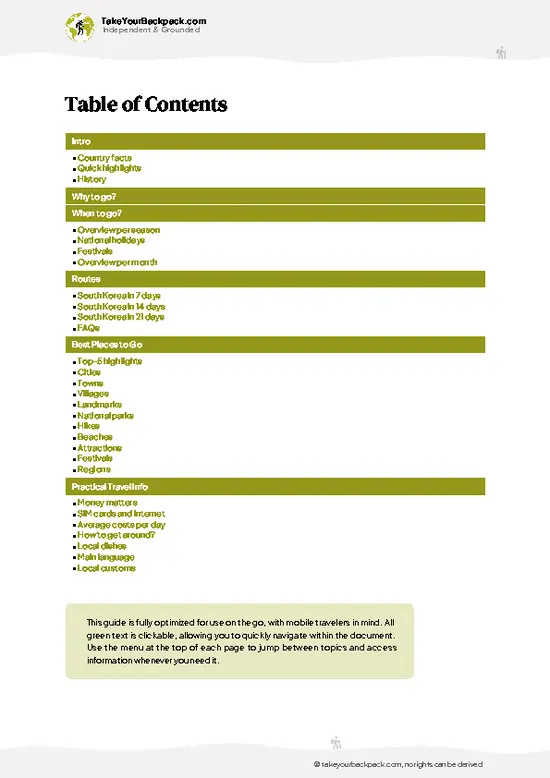
example page 0 from our offline Travel Guide for South Koreaexample page 1 from our offline Travel Guide for South Koreaexample page 2 from our offline Travel Guide for South Koreaexample page 3 from our offline Travel Guide for South Koreaexample page 4 from our offline Travel Guide for South Koreaexample page 5 from our offline Travel Guide for South Koreaexample page 6 from our offline Travel Guide for South Koreaexample page 7 from our offline Travel Guide for South Korea
The digital guide (408 pages) contains:
115 highlights, ranked by travel appeal
Optimized 7, 14 & 21-day travel routes
Cities, national parks, beaches, historical sites, ...
How to get around
Offline-friendly for travel without Wi-Fi
👉 Click to see all 30+ guide features

📅 Plan smarter in minutes, not weeks
Month by month travel advice
Festivals & national holidays
Budget expectations

🗺️ Go to the right places, skip the overrated ones
Honest pros & cons of destinations
Top hikes, parks & viewpoints
Lesser-known places most travelers miss
Clear “worth it vs skip it” guidance

🛏️ Travel smoothly without rookie mistakes
Best areas to stay
Transport systems explained simply
Common scams & safety advice
SIM cards, money & practical tips

🌍 Understand the country, not just visit it
Culture & traditions
52 Essential phrases & customs
Festivals worth planning around
Traveler-friendly historical context
Insights that make places more meaningful

📱 Built for real travel conditions
Fully downloadable PDF
Works completely offline
Optimized for phone use
Useful in remote areas & buses
Everything in one place
Save weeks of stressful planning
Get instant access to the full guide directly. 30-day money-back guarantee.


Sent to your inbox immediately after payment • 100% Secure Checkout
Best Backpacking Travel Advisor 2025 tourism awardBest Backpacking
Travel Advisor
2025
What others say about Take Your Backpack Guides:
⭐⭐⭐⭐⭐
Fantastic, amazing amount of information!
⭐⭐⭐⭐⭐
My goodness this is amazing, it's what I've been looking for hats off too you!
⭐⭐⭐⭐⭐
I think this is absolutely BRILLIANT
⭐⭐⭐⭐
Very complete and informative. It's still missing places, but I gotta to commend you
⭐⭐⭐⭐⭐
This is truly amazing, thank you, can't wait to explore it with my kids!
⭐⭐⭐⭐⭐
Awesome resource, thank you!
⭐⭐⭐⭐⭐
This is amazing! Can't wait to explore the ones I haven't seen
⭐⭐⭐⭐
I love this! Well done, great idea.
⭐⭐⭐⭐⭐
Thanks for taking the time to make this gem!
⭐⭐⭐⭐⭐
This might be the best website I've ever seen.
⭐⭐⭐⭐⭐
Congratulations, and thank you so much for your work; it's incredibly valuable.
⭐⭐⭐⭐
In all seriousness I think you did a great job pointing out the important spots
⭐⭐⭐⭐⭐
10/10 very good
⭐⭐⭐⭐⭐
As someone who's only just starting to visit regularly this is awesome, thank you.
⭐⭐⭐⭐
Thank you very much! I'm going to visit my dad, it's going to be very useful!
⭐⭐⭐⭐⭐
This is really cool! We'll be travelling for the first time and this definitely come in handy.
⭐⭐⭐⭐⭐
You are now our minister of culture, congratulations 👨‍💼
⭐⭐⭐⭐⭐
Just wanted to tell you that this is a pearl! Going to follow your recommendations.
⭐⭐⭐⭐⭐
This is so cool. I'll definitely be using the resource for my travels soon.
⭐⭐⭐⭐⭐
This is very impressive! Good work.
⭐⭐⭐⭐⭐
This is an amazing and informative site. Very well done!

🛏️ Where to stay?Choosing the right base for your trip

Yes — hostels and budget accommodation are widely available across South Korea, concentrated in Seoul (Hongdae, Myeongdong, Itaewon, Gangnam), Busan (Haeundae, Seomyeon) and Jeju City.
Hongdae: very cheap and packed with nightlife but noisy late; Myeongdong: central, excellent transport and shopping yet touristy and slightly pricier; Itaewon: international food and late-night scene but can be rowdy; Gangnam: modern, well-connected and safer-feeling, though higher-priced and fewer traditional hostels; Haeundae: beach access and many guesthouses but crowded in summer; Seomyeon: transport hub with … read more 👉
Yes — hostels and budget accommodation are widely available across South Korea, concentrated in Seoul (Hongdae, Myeongdong, Itaewon, Gangnam), Busan (Haeundae, Seomyeon) and Jeju City.
Hongdae: very cheap and packed with nightlife but noisy late; Myeongdong: central, excellent transport and shopping yet touristy and slightly pricier; Itaewon: international food and late-night scene but can be rowdy; Gangnam: modern, well-connected and safer-feeling, though higher-priced and fewer traditional hostels; Haeundae: beach access and many guesthouses but crowded in summer; Seomyeon: transport hub with lots of budget options but busy and urban; Jeju City: best base for island travel and quieter off-season though hostel choices are fewer and some attractions require longer travel.

If you enjoy meeting fellow travelers, consider choosing hostels with high ratings for atmosphere. On the other hand, if you prefer having your own space, a hotel might be a better option.

🚌 Getting aroundTransportation options and logistics

South Korea moves like a metronome with a soft underside. Timetables lock tight, arrows tell you where to stand, and transfers are engineered to snap together if you respect the flow. Trains hit their marks; city buses cascade; ferries obey the weather, not your mood. The game is two-speed travel: sprint the spine fast, then fan out cheap. Tap once, move twice, and keep your pack tidy so you can pivot when the opportunity appears. The system rewards those who move neatly.
  • KTX/SRT high-speed rail
read more 👉
South Korea moves like a metronome with a soft underside. Timetables lock tight, arrows tell you where to stand, and transfers are engineered to snap together if you respect the flow. Trains hit their marks; city buses cascade; ferries obey the weather, not your mood. The game is two-speed travel: sprint the spine fast, then fan out cheap. Tap once, move twice, and keep your pack tidy so you can pivot when the opportunity appears. The system rewards those who move neatly.
  • KTX/SRT high-speed rail The Efficiency Trade-off: This is how you compress the peninsula. Seoul-Busan in roughly 2.5 hours, often twice the price of a highway bus but half the time and zero fatigue. Book off-peak to dodge the weekend surge and you’ll pay less while still moving at 300 km/h. Car numbers are painted on the platform; stand exactly there, board fast, and sit immediately. Snacks come from the convenience store upstairs, not a dining car. If sold out, short hops sometimes allow standing tickets; anything longer, don’t suffer—switch to the bus network and arrive human.
  • Metro + city buses The Social Fabric: This is the daily heartbeat. Tap a T-money or Cashbee, line up at the platform arrows, let people exit before you enter. Voices low, no phone calls, backpacks off in crowds, and the yellow priority seats belong to elders even when empty. On buses, hold a strap before the driver launches; they brake with conviction. Tap in at the front, tap out at the rear or gate to trigger transfer discounts to subway or another bus. Eating on trains is frowned on; a bottle of water is fine. Respect the flow and it carries you.
  • Express/Intercity buses The Budget Disruptor: When rail prices spike or seats vanish, the highway delivers. Standard seats are cheapest; “premium” recliners still undercut KTX by a wide margin. Departures are frequent, tickets easy at kiosks, and drivers stop at service areas for bathrooms and cheap food. Pick the right Seoul terminal—Express (Gangnam), Nambu, or Dong Seoul—to avoid a crosstown slog before you even start. Stow big bags underneath, keep essentials on you, and use late-night runs to trade time for a saved hostel night. For small cities and national parks, buses beat rail straight to the gate.
  • Coastal ferries The Geometric Unlock: Water gets you where rails don’t—Jeju, Ulleungdo, and the speckled islands off Mokpo and Wando. Bring your passport for ticketing, arrive early for boarding, and expect cancellations when wind kicks up. Fast catamarans cost more; slower car ferries are cheaper and steadier. Floor seating is common; stash your pack and claim a corner. Seasick? Sit low and center. Cyclists roll on easily, and hikers use ferries to stitch together island trails and fishing villages no bus ever reaches. Build a buffer day; the sea sets the schedule.

Master tip: Run a two-speed plan—book the longest leg on KTX/SRT at off-peak times, then stitch the last 10-150 km with express buses from the terminal that aligns with your incoming metro line, all paid by a single T-money so transfers stay fluid and you never stand in the wrong queue.
Incheon International Airport (ICN) sits about 60 km (37 miles) west of central Seoul (Seoul Station/City Hall area).

Main public transport options
  • AREX Express Train (non-stop to Seoul Station)

    Time: about 43 minutes from Terminal 1, 51 minutes from Terminal 2

    Cost: 9,500 KRW (adult; separate ticket required)

    Notes: Fastest reliable option. Trains run roughly every 20-40 minutes. From Seoul Station you can transfer to Lines 1/4/Gyeongui-Jungang or taxis.
  • AREX All-Stop (commuter subway)

    Time: about 56 minutes from Terminal 1, 66 minutes from Terminal 2 to Seoul Station (longer if you’re transferring to other lines)

    Cost: roughly 4,450-4,850 KRW depending on terminal and destination within Seoul

    Notes: Cheapest option. Runs every 5-10 minutes. Pay with T-money/credit card (contactless) and follow signs for “Airport Railroad (AREX).”
  • Airport Limousine Buses

    Time: typically 60-90+ minutes, depending on traffic and your stop (City Hall/Myeongdong/Gangnam, etc.)

    Cost: about 10,000-18,000 KRW by route/class

    Notes: Good if your hotel is near a bus stop and you don’t want to transfer with luggage. Tickets sold at counters or pay with T-money on board. Frequencies vary by line.

Taxi
Regular taxis from the airport to central Seoul usually cost about 55,000-75,000 KRW in daytime, plus expressway tolls (around 7,000-9,000 KRW). Late-night or heavy-traffic rides can reach 70,000-95,000 KRW. Deluxe/black taxis and pre-booked international flat-rate taxis cost more but have larger vehicles and English support.

Tip: If you’re aiming for speed and predictability, take the AREX Express. On a tight budget, pick the All-Stop train. If your accommodation is right by a bus stop and you’d like a seat without transfers, the limousine bus is convenient.
⚠️ Prices and routes can change, so take this as a rough guide and ask for local advice when you arrive.

🔒 Safety (risk Level: low)Common concerns and things to watch out for

Safety for solo travelers, including women and LGBTQ+ individuals
South Korea is generally safe for solo travelers, including women and LGBTQ+ individuals. Violent crime rates are low, and public transportation is reliable and well-patrolled. While cultural sensitivity is advised, especially regarding LGBTQ+ visibility, major cities like Seoul and Busan are more welcoming. Just stay alert, like you would anywhere else, and you’ll likely find it a smooth experience.


Full official government travel advisory (live updates)
View details 👉

✈️ VisaWhat travelers should know about visas

Most visitors from countries like the USA, Canada, and the EU don’t need a visa for stays up to 90 days in South Korea. However, they must apply for a Korea Electronic Travel Authorization (K-ETA) before departure. Check your country’s eligibility and apply online via the official K-ETA website for a smooth entry.
⚠️ Visa requirements can change over time, so always check the latest visa requirements with the official embassy or government website before you travel.

🎒 What to pack?What to pack for South Korea

If you’re planning a backpacking trip to South Korea, keep in mind the country’s diverse climate and landscapes. Summers can be seriously humid, especially in Seoul, so breathable clothing is key, while winters get icy, so pack layers if you’re heading there in colder months. Don’t forget that South Korea’s got some epic mountains, so consider shoes that can handle a bit of hiking. When visiting temples, modest attire is a must, so pack a lightweight scarf or shawl to cover up when needed. Lastly, while beaches like those on Jeju Island are beautiful, they’re not always bikini-friendly, so be prepared with a tee or cover-up.

Apart from this country specific advice, I have also crafted a general packing list that should help on any trip. authorOver the years, I've learned the importance of packing minimally. It's so much easier to jump on the back of a truck or squeeze yourself into the last spot of a minibus without that supersized backpack. If you're headed to a warm destination, leave your winter jacket at home; for colder regions, opt for thin thermal underlayers. Instead of packing your entire wardrobe, bring just three sets of clothes, as laundry facilities are available everywhere.
View the full list 👉
🎒 Planning the practical side of your trip?
Get detailed information on transport, daily budgets, internet access, local customs, food, language, and other essentials in the complete Travel Guide.

Get detailed practical information 👉

Get the Travel Guide -

🙋 FAQFrequently asked questions

Trip Planning


Personal tip: I normally search on good rating for atmosphere (for meeting people) and location (for easy exploring). Cleanliness as a bonus.


Travel Essentials

Hepatitis A and Hepatitis B vaccinations are recommended for travelers to South Korea. Consider getting a Typhoid vaccine if you plan on eating street food or staying in rural areas. Routine vaccines like MMR, DTaP, and influenza should be up-to-date. Japanese Encephalitis is suggested if visiting rural areas during rice growing season. Rabies is generally not needed unless you plan on working with animals. Always consult a healthcare professional for personalized advice.


vaccination requirements
When I first started traveling, I often spent part of my first day in a new country hunting for a local SIM card. While this can still be slightly cheaper, it also takes time and planning.

These days, it's much simpler to install an eSIM before leaving home. Once you arrive in South Korea, you can activate it immediately and have mobile data from the moment you land — which is especially useful for ordering transport or navigating away from busy airports.

There are many providers nowadays, and price differences are usually small. I personally go with Airalo, as it offers excellent network coverage throughout the country and strong global coverage, so you can manage multiple countries from a single app.


Get your e-sim for South Korea

Culture & Customs

Use both hands when giving or receiving items, like gifts or money, to show respect. Bow slightly when greeting or thanking someone. Avoid tipping, as it’s not customary and can be seen as rude. Public displays of affection are generally frowned upon, especially in more traditional areas. For LGBTQ+ travelers, while Seoul’s Itaewon has a vibrant scene, discretion is advised in more conservative areas. Women traveling alone should be aware that separate subway cars for women exist during rush hours. Remove shoes when entering homes and some traditional accommodations. Avoid speaking loudly in public places.
Trying traditional food is always a great way to experience the culture. Here are some must-try dishes for South Korea.
  • Bibimbap: A colorful mix of rice, vegetables, meat, and a fried egg, topped with gochujang (chili pepper paste). It’s popular because it represents balance and variety in Korean cuisine.
  • Kimchi: Fermented vegetables, primarily napa cabbage and radishes, seasoned with chili pepper, garlic, and ginger. It’s a staple in Korean meals and symbolizes health and tradition.
  • Bulgogi: Marinated beef slices grilled to perfection, often served with rice and leafy greens. It’s a favorite due to its sweet and savory flavors and its role in bringing people together at the table.
  • Samgyeopsal: Thick slices of pork belly, grilled at your table and usually wrapped in lettuce with sauces and sides. This dish is a social experience, perfect for dining with friends or family.
  • Tteokbokki: Spicy and sweet rice cakes, often found in street markets. It’s a beloved street food that provides a taste of Korean comfort and spice.
Yes, tap water in South Korea is technically safe to drink, and many locals do consume it. However, tourists often find the taste not great, so using bottled or filtered water is common. When in doubt, go for a cheap bottled option or refill a reusable bottle at water dispensers found in many public places.
The main language in South Korea is Korean. Backpacking is way more rewarding if you know a bit of the local language, so I'd suggest brushing up on the basics just in case your Korean skills have become a bit rusty.

Want to understand locals better?
The complete Travel Guide for South Korea includes 52 essential words and phrases — greetings, thank-yous, ordering food, transport, numbers, and common local expressions you'll actually hear.

Get your local basic phrases 👉

Get the Travel Guide -


In South Korea, English proficiency varies significantly depending on the location and the demographic. In major cities like Seoul and Busan, many younger people, especially those in urban areas and the service industry, speak English reasonably well. Signs in tourist areas are often bilingual, making navigation easier for English-speaking travelers.

However, in more rural areas, English speakers may be less common, and communication can be challenging. Older generations may have limited English skills, as English education has improved in recent years but was not as emphasized in the past.

While many South Koreans are eager to help and will try to communicate, it’s beneficial for travelers to learn a few basic Korean phrases. Apps and translation tools can also bridge the gap. Overall, while English is not universally spoken, travelers can generally find enough English speakers to navigate their way through the country comfortably.

Money & Payments

The local currency of South Korea is KRW (₩).

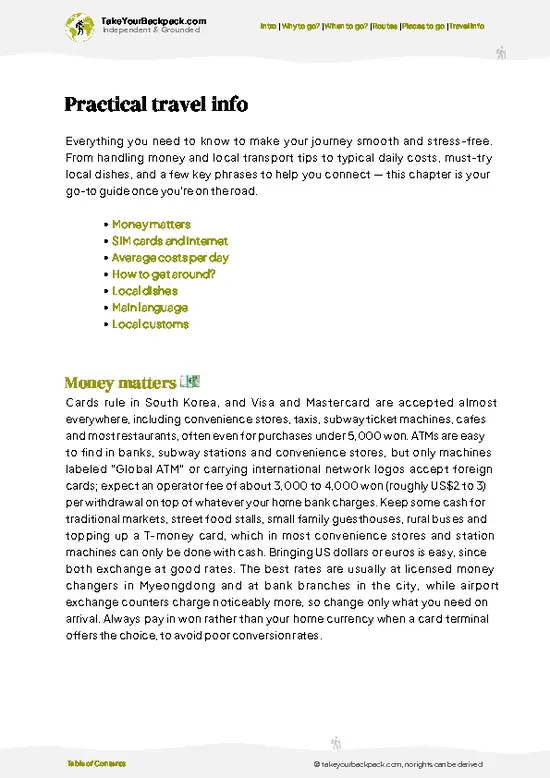
When backpacking in South Korea, cash is king, especially outside urban centers. ATMs are pretty accessible in cities and towns, but note that not all machines accept foreign cards. Look for those labeled ’Global ATM.’ Carry a stash of cash for rural areas, just in case.

Opt for Korean Won over dollars or euros. South Korean businesses rarely accept foreign currencies. Most places take major credit cards, but smaller eateries, markets, and rural spots might be cash-only.

For exchanging money, banks offer the best rates. Avoid airport exchanges due to high fees. Alternatively, head to Myeongdong in Seoul for competitive rates at currency exchange shops. Enjoy the trip!

Tipping in South Korea isn’t customary and can even be considered rude in some cases. Most places, like restaurants and taxis, don’t expect tips, as service charges are usually included in the bill. Instead, if you receive exceptional service and want to show appreciation, a small gift or a simple thank you in Korean (고맙습니다, gomabseubnida) goes a long way.

🧩 Nearby countriesOther countries to combine with South Korea

We 💚 feedbackKey takeaways from the trip

South Korea rewards you for learning its operating system. Get a T‑money card on arrival; it works across subways, buses, some taxis, and even convenience-store snacks, so transfers become a tap-chain, not a puzzle. Bridge check‑out/check‑in gaps with station lockers and a jjimjilbang: stash the pack, soak, nap, move again. Navigate with Naver or Kakao, not Google; restaurant kiosks have ENG buttons, and water/banchan refills are standard. Small downside: public bins are scarce—carry a trash bag. ATMs labeled “Global” (KEB Hana, Woori) spit out cash when others sulk. Hike early; metro-saturated trailheads fill fast. Direction of travel: more English in apps and signage, more contactless payment acceptance, and smoother eSIM/rail-ticket onboarding—each year the learning curve gets shorter.

✍️ Help improve this page!
The information on this page is based on in-depth research, insights shared by experienced travelers, and feedback from the local travel community in South Korea. While every effort is made to keep the information accurate and current, conditions can change — so if you spot anything incorrect or outdated, please get in touch.


🙋‍♂️ Give feedback

👋 Meet the founderWho’s Behind Take Your Backpack?

Johan, backpacker and founder of TakeYourBackpackHi, I’m Johan (Netherlands 🇳🇱), the creator of TakeYourBackpack. Over the past decade, I’ve backpacked through 80+ countries across six continents, gaining extensive experience with independent travel, long-term trips, and overland routes.

This site is built on a combination of firsthand travel experience and carefully curated insights from other backpackers. Many guides are based on places I’ve personally visited, while others bring together tips, observations, and practical advice shared by trusted travelers I’ve met along the way.

The goal is to provide realistic, experience-driven guidance — not generic itineraries — so you can explore destinations with better context, clearer expectations, and more confidence.

Get full country guide •
Instant download • 115 highlights • Full Offline guide