Trip Planning
The TakeYourBackpack guidebooks are your all-in-one travel companion, featuring the best cities, national parks, hikes, beaches, and unique sites, along with essential tips on when to go, how to get around, exchanging money, and even local phrases to get you started — everything you need for a smooth, unforgettable backpacking adventure.
Stop researching. Start exploring.Discover all 104 highlights,ranked
and organized into practical routes.
Get instant access
Planning a backpacking route through Russia can be tricky — you need to balance must-see places, travel times, budget, and how long to stay in each destination. Our free personalized Russia itinerary planner creates a route based on your travel style, trip duration, and interests, so you can spend less time researching and more time exploring.
Personal tip: I normally search on good rating for atmosphere (for meeting people) and location (for easy exploring). Cleanliness as a bonus.
Travel Essentials
No vaccinations are required to enter Russia, but make sure routine shots (measles, diphtheria, tetanus, polio) are up to date. Hepatitis A and B are recommended for most travelers. If you plan to hike or camp in forests in Siberia, the Urals or the Far East between April and September, consider the tick-borne encephalitis vaccine, which needs several weeks to complete. Rabies is worth discussing with your doctor for long trips in remote areas.
vaccination requirementsWhen I first started traveling, I often spent part of my first day in a new country hunting for a local SIM card. While this can still be slightly cheaper, it also takes time and planning.
These days, it's much simpler to install an eSIM before leaving home. Once you arrive in Russia, you can activate it immediately and have mobile data from the moment you land — which is especially useful for ordering transport or navigating away from busy airports.
There are many providers nowadays, and price differences are usually small. I personally go with
Holafly, as it offers excellent network coverage throughout the country and strong global coverage, so you can manage multiple countries from a single app.
HolaFly eSimCulture & Customs
In Russia, take your shoes off when entering someone’s home (hosts often offer slippers), and bring a small gift such as chocolate, wine or flowers. Flowers should always be an odd number, because even numbers are reserved for funerals. Don’t shake hands across a doorway, don’t whistle indoors and avoid sitting on cold ground, as older Russians in particular take these superstitions seriously. When someone proposes a toast, join in and keep eye contact. In Orthodox churches, women cover their hair and avoid shorts or short skirts, and men remove hats. Avoid photographing military sites, police, government buildings or border areas, and steer clear of casual political talk, especially about the war, as criticism of the army can carry criminal penalties. Women may find traditional gender roles still common, such as men paying or holding doors. Gay travelers should avoid any public affection.
Trying traditional food is always a great way to experience the culture. Here are some must-try dishes for Russia.
- Borscht: A beet soup with cabbage, potatoes and often beef, served with a spoonful of smetana (sour cream) and rye bread. It turns up on almost every canteen menu and is the everyday comfort soup of the country.
- Pelmeni: Small dumplings filled with minced pork, beef or lamb, boiled and eaten with sour cream, butter or vinegar. They come from Siberia and the Urals, where families froze huge batches outside in winter, and they remain the cheapest filling meal you’ll find.
- Blini: Thin pancakes eaten with sour cream, jam, condensed milk, or salmon roe on special occasions. They are the centerpiece of Maslenitsa, the week-long farewell to winter before Lent.
- Shchi: A cabbage soup, fresh or made with sauerkraut, that has fed Russian households for centuries. Its sour, warming flavor makes it a classic cold-weather meal.
- Beef Stroganoff: Strips of beef in a sour cream and mushroom sauce, usually served over buckwheat or mashed potatoes. It dates to 19th-century aristocratic kitchens and is now a standard home-cooked dish.
- Olivier salad: Diced potatoes, carrots, pickles, peas, eggs and meat bound with mayonnaise. No New Year’s table in Russia is complete without a big bowl of it.
- Syrniki: Small fried pancakes made from tvorog (farmer’s cheese), served for breakfast with sour cream or jam. Cafés across the country serve them, and they make a cheap, satisfying start to the day.
Tap water in Russia is not recommended for drinking straight from the faucet, and most locals boil it or use a filter jug at home. In St. Petersburg in particular, old pipes and a history of giardia mean travelers should stick to bottled or filtered water. Bottled water is cheap and sold everywhere, and the hot water samovars on trains are safe for tea and instant noodles.
The main language in Russia is
Russian. Backpacking is way more rewarding if you know a bit of the local language, so I'd suggest brushing up on the basics just in case your Russian skills have become a bit rusty.
Want to understand locals better?The complete Travel Guide for Russia includes 52 essential words and phrases — greetings, thank-yous, ordering food, transport, numbers, and common local expressions you'll actually hear.
Get your local basic phrases 👉
Get the Travel Guide - in Russia is limited: in Moscow and St. Petersburg you’ll find it at hotels, some restaurants and among many people under 35, while hostel staff in the big cities usually speak enough to sort out check-in and directions. In smaller cities and rural areas, especially in Siberia and the Far East, expect almost none, and signs and menus are usually only in Cyrillic. No second foreign language helps much, so your best investment is learning the Cyrillic alphabet, which takes an evening or two and lets you read station names and menus. Download Yandex Translate with offline Russian, which handles camera translation of signs well, and learn a few words like “spasibo” (thank you) and “skolko?” (how much).
Money & Payments
The local currency of Russia is RUB (₽).
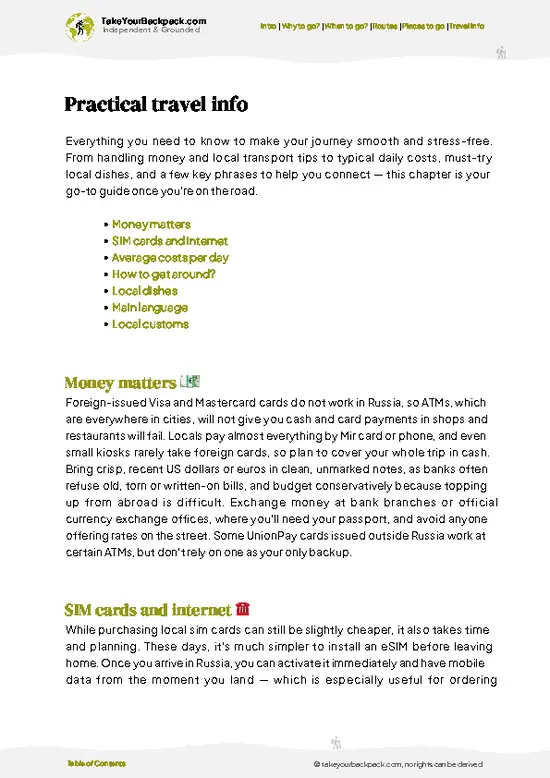
Foreign-issued Visa and Mastercard cards do not work in Russia, so ATMs, which are everywhere in cities, will not give you cash and card payments in shops and restaurants will fail. Locals pay almost everything by Mir card or phone, and even small kiosks rarely take foreign cards, so plan to cover your whole trip in cash. Bring crisp, recent US dollars or euros in clean, unmarked notes, as banks often refuse old, torn or written-on bills, and budget conservatively because topping up from abroad is difficult. Exchange money at bank branches or official currency exchange offices, where you’ll need your passport, and avoid anyone offering rates on the street. Some UnionPay cards issued outside Russia work at certain ATMs, but don’t rely on one as your only backup.
Tipping in Russia is appreciated but not mandatory, and around 10% is standard in sit-down restaurants and cafés if service charges are not already on the bill. Leave tips in cash where possible, since card terminals often don’t allow adding a tip, and many cafés display a QR code for tipping staff. Rounding up for taxi drivers or leaving 100 to 200 rubles for hotel porters and tour guides is plenty.
v2.webp)

 Best Backpacking
.jpg) Over the years, I've learned the importance of packing minimally. It's so much easier to jump on the back of a truck or squeeze yourself into the last spot of a minibus without that supersized backpack. If you're headed to a warm destination, leave your winter jacket at home; for colder regions, opt for thin thermal underlayers. Instead of packing your entire wardrobe, bring just three sets of clothes, as laundry facilities are available everywhere.
Over the years, I've learned the importance of packing minimally. It's so much easier to jump on the back of a truck or squeeze yourself into the last spot of a minibus without that supersized backpack. If you're headed to a warm destination, leave your winter jacket at home; for colder regions, opt for thin thermal underlayers. Instead of packing your entire wardrobe, bring just three sets of clothes, as laundry facilities are available everywhere.


.jpg) Hi, I’m Johan (Netherlands 🇳🇱), the creator of TakeYourBackpack. Over the past 3 decades, I’ve backpacked through 90+ countries across six continents, gaining extensive experience with independent travel, long-term trips, and overland routes.
Hi, I’m Johan (Netherlands 🇳🇱), the creator of TakeYourBackpack. Over the past 3 decades, I’ve backpacked through 90+ countries across six continents, gaining extensive experience with independent travel, long-term trips, and overland routes.