Trip Planning
The TakeYourBackpack guidebooks are your all-in-one travel companion, featuring the best cities, national parks, hikes, beaches, and unique sites, along with essential tips on when to go, how to get around, exchanging money, and even local phrases to get you started — everything you need for a smooth, unforgettable backpacking adventure.
Stop researching. Start exploring.Discover all 35 highlights,ranked
and organized into practical routes.
Get instant access
Planning a backpacking route through Lesotho can be tricky — you need to balance must-see places, travel times, budget, and how long to stay in each destination. Our free personalized Lesotho itinerary planner creates a route based on your travel style, trip duration, and interests, so you can spend less time researching and more time exploring.
Personal tip: I normally search on good rating for atmosphere (for meeting people) and location (for easy exploring). Cleanliness as a bonus.
Travel Essentials
For Lesotho, make sure routine vaccines (MMR, tetanus-diphtheria, polio, flu) are up to date, and get hepatitis A and typhoid, since food and water hygiene varies in rural areas. Hepatitis B is recommended, and rabies is worth considering if you plan long hikes or pony treks through villages with herd dogs. There is no malaria risk, and a yellow fever certificate is only required if you arrive from a country with yellow fever transmission.
vaccination requirementsWhen I first started traveling, I often spent part of my first day in a new country hunting for a local SIM card. While this can still be slightly cheaper, it also takes time and planning.
These days, it's much simpler to install an eSIM before leaving home. Once you arrive in Lesotho, you can activate it immediately and have mobile data from the moment you land — which is especially useful for ordering transport or navigating away from busy airports.
There are many providers nowadays, and price differences are usually small. I personally go with
Holafly, as it offers excellent network coverage throughout the country and strong global coverage, so you can manage multiple countries from a single app.
HolaFly eSimCulture & Customs
Basotho culture is courteous and community-centered, so show respect to elders, and if you plan to camp or stay overnight near a village, ask permission from the local chief first. Always ask before photographing people, especially herders and women, and never approach or photograph initiation schools (lebollo), which are secret and sacred. Dress modestly in rural areas, with women in particular covering knees and shoulders, and receive items with your right hand or both hands. Don’t hand out sweets or money to children who ask along trails, as it encourages begging; supporting community-run lodges and guides is a better way to give back. Public displays of affection are frowned upon for all couples, and same-sex couples should be especially discreet.
Trying traditional food is always a great way to experience the culture. Here are some must-try dishes for Lesotho.
- Papa le moroho: Stiff white maize porridge eaten with cooked greens such as spinach, cabbage or wild leaves. It’s the daily base of nearly every Basotho meal, eaten by hand and filling enough to power a day of herding.
- Likhobe: A slow-cooked mix of samp (crushed maize) and beans. Cheap, hearty and common at home tables, it’s the dish you’ll find in villages when meat is scarce.
- Motoho: A slightly sour fermented sorghum porridge, often served at breakfast. It carries a tangy flavor that shows Lesotho’s long tradition of fermenting grains.
- Liphaphatha: Flat, pan-cooked breads with a soft center, sold hot at roadside stalls and taxi ranks. They make the easiest snack to grab between minibus rides.
- Mafi: Thick soured milk, eaten on its own or poured over papa. Cattle are central to Basotho culture and wealth, and mafi is one of the most traditional ways their milk is enjoyed.
- Joala: Home-brewed sorghum beer, thick and mildly sour. Villages announce a fresh batch by raising a flag outside the house, and sharing it is a social event in rural life.
Tap water in Maseru and the larger towns of Lesotho is treated and many locals drink it, while rural people often use springs and village taps. For travelers, it’s safest to filter or purify water rather than drink it straight from the tap, especially in the highlands where streams pass through grazing land. A filter bottle or purification tablets save money and plastic, and bottled water is easy to buy in towns.
The main language in Lesotho is
Sesotho. Backpacking is way more rewarding if you know a bit of the local language, so I'd suggest brushing up on the basics just in case your Sesotho skills have become a bit rusty.
Want to understand locals better?The complete Travel Guide for Lesotho includes 52 essential words and phrases — greetings, thank-yous, ordering food, transport, numbers, and common local expressions you'll actually hear.
Get your local basic phrases 👉
Get the Travel Guide - is an official language in Lesotho, so in Maseru, at border posts, banks, lodges and pony-trek centers you can get by without trouble. Younger, school-educated Basotho usually speak it comfortably. In the highland villages many older people and herders speak only Sesotho, which is the language that helps most anywhere in the country. Learn a handful of words such as “Lumela” (hello), “Khotso” (peace) and “Kea leboha” (thank you), and download an offline phrase list, since mobile data is patchy in the mountains.
Money & Payments
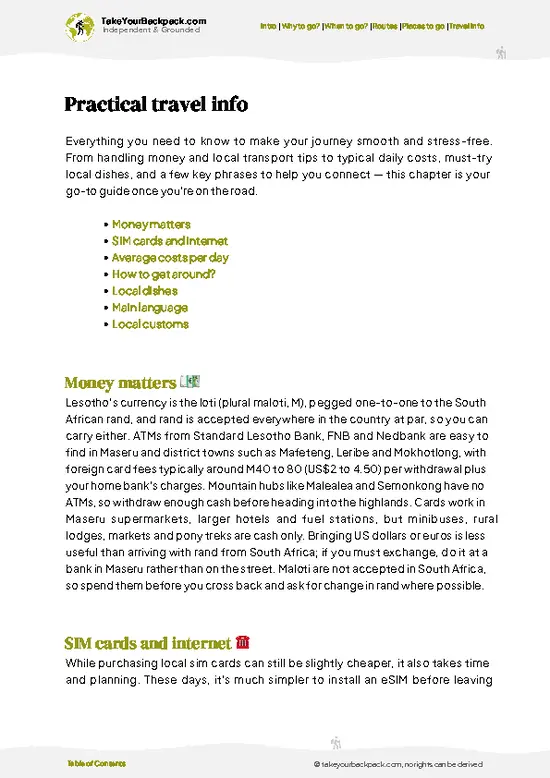
The local currency of Lesotho is LSL (M).
Lesotho’s currency is the loti (plural maloti, M), pegged one-to-one to the South African rand, and rand is accepted everywhere in the country at par, so you can carry either. ATMs from Standard Lesotho Bank, FNB and Nedbank are easy to find in Maseru and district towns such as Mafeteng, Leribe and Mokhotlong, with foreign card fees typically around M40 to 80 (US$2 to 4.50) per withdrawal plus your home bank’s charges. Mountain hubs like Malealea and Semonkong have no ATMs, so withdraw enough cash before heading into the highlands. Cards work in Maseru supermarkets, larger hotels and fuel stations, but minibuses, rural lodges, markets and pony treks are cash only. Bringing US dollars or euros is less useful than arriving with rand from South Africa; if you must exchange, do it at a bank in Maseru rather than on the street. Maloti are not accepted in South Africa, so spend them before you cross back and ask for change in rand where possible.
Tipping in Lesotho is appreciated but not strictly expected, with about 10 percent the norm at sit-down restaurants in Maseru and lodges. Pony-trek leaders, hiking guides and village guides rely on tips, so plan on roughly M50 to 100 (US$3 to 6) per day for good service. Give fuel attendants and car guards around M5 to 10 (US$0.30 to 0.60).
v2.webp)



 Best Backpacking
.jpg) Over the years, I've learned the importance of packing minimally. It's so much easier to jump on the back of a truck or squeeze yourself into the last spot of a minibus without that supersized backpack. If you're headed to a warm destination, leave your winter jacket at home; for colder regions, opt for thin thermal underlayers. Instead of packing your entire wardrobe, bring just three sets of clothes, as laundry facilities are available everywhere.
Over the years, I've learned the importance of packing minimally. It's so much easier to jump on the back of a truck or squeeze yourself into the last spot of a minibus without that supersized backpack. If you're headed to a warm destination, leave your winter jacket at home; for colder regions, opt for thin thermal underlayers. Instead of packing your entire wardrobe, bring just three sets of clothes, as laundry facilities are available everywhere.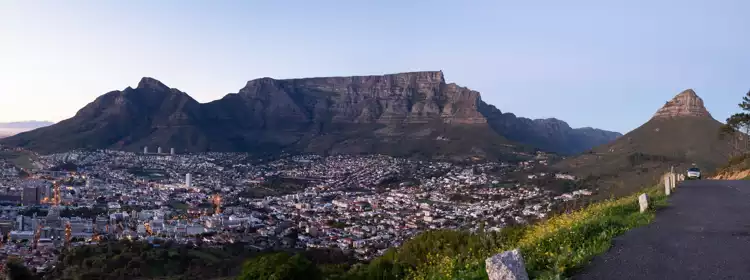

.jpg) Hi, I’m Johan (Netherlands 🇳🇱), the creator of TakeYourBackpack. Over the past 3 decades, I’ve backpacked through 90+ countries across six continents, gaining extensive experience with independent travel, long-term trips, and overland routes.
Hi, I’m Johan (Netherlands 🇳🇱), the creator of TakeYourBackpack. Over the past 3 decades, I’ve backpacked through 90+ countries across six continents, gaining extensive experience with independent travel, long-term trips, and overland routes.