×
Oman 🇴🇲

backpacking Asia Oman 🇴🇲Follow desert roads into surprising coastal calm.

Explore North KoreaExplore Pakistan

Backpacking Oman in 2026

A complete guide including when and where to go, costs, transport, itineraries, and practical travel advice.
The big picture before you go

Backpacking Oman
By Johan Kruseman 🇳🇱 | Updated June 8, 2026

In Oman, you choose: spend on a 4x4 and unlock the wild, or save cash and stay city-bound. Buses thin fast beyond Muscat. The good stuff starts where the asphalt ends.

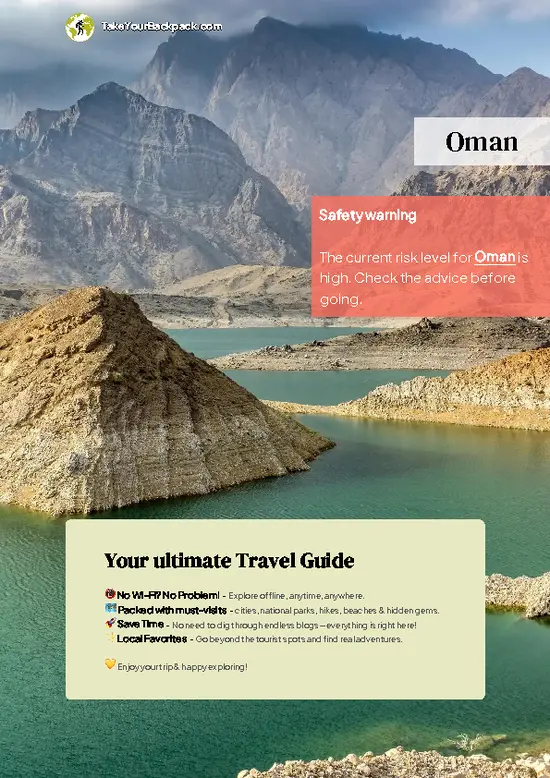
At dawn the Hajar Mountains turn the color of ash and peach, and dry wadis suddenly hold jade pools cold enough to sting your teeth. The air in old souqs is frankincense and cardamom; hands press dates and coffee into yours before you think to ask. Sand shifts like tide in the Wahiba and the Empty Quarter, and at Ras Al Jinz turtles heave out of a black sea to lay future pilgrims under the moon. Fort towers in Nizwa and Bahla catch the late light; dhows in Sur smell of salt and timber. Heat, long drives, modest dress, and gravel tracks are real, plus flash floods if clouds build—but leave early, carry water, keep a scarf, and the country opens. Solving the map yourself makes the campfire taste better.

Compared to the UAE’s gloss, Oman moves slower and older; Saudi feels more formal; Yemen is off-limits for most. Come if you crave mountains and coast over nightlife, value hospitality over hype, and want a safe, big-sky road trip where the journey is the point.

👉 Get the 📖 Travel Guide of Oman

Muscat and the Batinah Spine

Start here because Oman runs on wheels and Muscat is the hub. The city sprawls along the sea; rent a car, keep to camera-checked limits, and enjoy cheap fuel. Dawn on Muttrah Corniche smells of fish and diesel; the souq wakes slowly, so eat a cheap karak and watch the light slide over whitewash. Use Muscat as a day-trip launcher: quick forts along Batinah, boats to Daymaniyat for clear water. This rewards planners who like soft culture and easy logistics, not aimless walkers.

Eastern Hajar Coast: Quriyat to Sur

The coastal highway is the cleanest intro to wadis and sea. Because tour buses stack up by 10, hit Wadi Shab at first light with a dry bag and grippy sandals; the swim to the cave is cold and worth the goosebumps. Bimmah Sinkhole is a fast stop, Sur’s dhow yard smells of tar and sawdust, and Ras al Jinz runs strict night turtle walks—book, wear dark clothes, no flash. A sedan works; avoid wadis after rain.

Nizwa and the High Hajar (Jabal Shams/Jabal Akhdar)

Cool air, long views, hard driving. Akhdar has a 4WD checkpoint for a reason—steep grades and terraces that reward slow walkers with rose-scented breeze in spring. Shams is mostly paved; a careful sedan reaches Khateem for the Balcony Walk along a hard, airy ledge. Sleep in Nizwa, set an alarm for the Friday goat market, and descend mountains in low gear to save brakes.

Sharqiyah Sands with Wadi Bani Khalid

One inland spine from Muscat via Ibra ties desert and pools. If you lack 4WD, meet a camp pickup at Al Wasil, deflate if you drive yourself, and hit the crests for first light when the sand feels like cold silk underfoot. Pair it with Wadi Bani Khalid’s clear basins; dress modestly, wear rubber soles, and skip cliff jumps.

Dhofar/Salalah and the Frankincense Coast

Far, so fly unless you like long-haul desert driving. In khareef the hills drip, fog eats the road, and frankincense smoke hangs in Haffa Souq; book early and use headlights even at noon. Off-season means dry cliffs, empty beaches, and long coastal runs to Mughsail and Darbat. Best for seasonal chasers and patient drivers.
Map of Oman
Loading the map 🌍
CLICK TO FILTER
city
town
village
unique site
national park
hike
beach
attraction
festival
region
SHOW COUNTRY’S BESTSHOW ALL
film
0
0
0a
Al Mughsail Beach
film
1
1
1a
Salalah Beach
film
2
2
2a
Qurum Beach
film
3
3
3a
Qantab Beach
film
4
4
4a
Ras Al-Hadd
film
5
5
5a
Khasab Beach
film
6
6
6a
Nizwa
film
7
7
7a
Ibra
film
8
8
8a
Al Suwaiq
film
9
9
9a
Jebel Shams
film
10
10
10a
Balcony Walk in Al Jabal Al Akhdar
film
11
11
11a
Al Hoota Cave Trail
film
12
12
12a
Dimaniyat Islands Nature Reserve
film
13
13
13a
Wadi Shab
film
14
14
14a
Wadi Bani Khalid
film
15
15
15a
Jebel Samhan
film
16
16
16a
Al Wusta Wildlife Reserve
film
17
17
17a
Al Saleel
film
18
18
18a
Wadi Al Arbaeen
film
19
19
19a
Hawiyat Najm Park
film
20
20
20a
Al Jabal Al Akhdar
film
21
21
21a
Dhofar Mountains
film
22
22
22a
Jebel Akhdar
film
23
23
23a
Al Hamra
film
24
24
24a
Al Kamil Wal Wafi
film
25
25
25a
Nizwa Fort
film
26
26
26a
Bahla Fort
film
27
27
27a
Khor Rori
film
28
28
28a
Misfat Al Abriyeen

Why go?What makes this country worth the trip

Beach life

Oman’s coast earns the hype the hard way: warm, glassy water, reefs close to shore, and coves carved … read more 👉
Oman’s coast earns the hype the hard way: warm, glassy water, reefs close to shore, and coves carved into pale limestone. At sunrise, the cliffs around Muscat glow honey-gold and you can be snorkeling with turtles or dropping on easy dives over the Daymaniyat by mid‑morning; by afternoon the sea goes cobalt and the wind stays gentle enough for lazy swims. South in Dhofar the sand squeaks underfoot and the air carries a trace of frankincense. Nights skew mellow: beach camps, grill smoke, stars. Resorts handle the cocktails; the sea handles everything else.

Low cost

Oman rewards the dirtbag playbook. Wild camping is legal and normal, so you swap neon lobbies for wadi … read more 👉
Oman rewards the dirtbag playbook. Wild camping is legal and normal, so you swap neon lobbies for wadi gravel and sea-breeze nights. Fuel is cheap; split a rental or ride shared taxis and you cover big distances without bleeding cash. Indian/Pakistani cafeterias sling heapings and cardamom-sweet karak; ablution taps at mosques and petrol stations refill bottles. Most star attractions—beaches, wadis, canyons—are free. Expect around $40 a day if you camp and share wheels; a bit more if you want a bed and AC.

Scenery

Oman rewards effort with contrast. At dawn you climb a sand ridge in silence, light pouring over the … read more 👉
Oman rewards effort with contrast. At dawn you climb a sand ridge in silence, light pouring over the Wahiba like hot brass; an hour later you’re knee‑deep in a wadi pool under fig shade, cicadas drilling the heat. Limestone caves breathe cool air; cliffs above Jebel Shams cut the horizon like a saw. By evening the sea throws salt at your face on Musandam’s fjords, and, in khareef, Dhofar smells of frankincense and wet stone. Distances are tight, roads honest, wild camps legal—so you can actually chain these days together.

Mountains

Oman’s mountains lift you out of the coastal furnace into clear, juniper-tinged air. The Hajar are raw … read more 👉
Oman’s mountains lift you out of the coastal furnace into clear, juniper-tinged air. The Hajar are raw limestone and old donkey paths: balcony ledges above Wadi Ghul, terraced hamlets on cool slopes. The payoff is earned—long views, hard shade—through 4WD approaches, dawn starts, and 3–4 liters on your back. Winter brings crisp, stable days; wild camping is legal, so you sleep on the rim and watch the walls change from slate to honey at sunrise. Follow painted blazes, pace by goat bells, swap a ridge apple for a farmer’s dates.

Architecture

Oman rewards architecture hunters because the country reads in stone: Portuguese watchtowers on sea … read more 👉
Oman rewards architecture hunters because the country reads in stone: Portuguese watchtowers on sea cliffs, oasis forts, frankincense ruins in Dhofar, and Muscat’s marble-and-teak modern builds. The why: you see centuries of trade in a single loop. The how: dawn at Nizwa or Bahla for warm light on mudbrick; midday shade in Jabrin’s painted rooms; late call to prayer under the domes of the Grand Mosque, dressed modestly. Rent a car, carry small cash—forts keep short hours—and move when the air cools and the limestone breathes.
Want the complete picture of Oman?
The offline Travel Guide brings everything together — routes, highlights & planning.

See what's included in the guide 👉

Get the Travel Guide -

⭐ HighlightsHighlights of Oman

  • Jebel Shams Balcony Walk (W6): Start at sunrise so the cliff stays in shade and the wind hasn’t kicked up. Park at Al Khitaym, follow the red-white-yellow blazes to Sab Bani Khamis, and carry layers; the rim bites even in heat. The canyon hums like a drum and basalt grit creaks under your boots. Off-map: Wadi Ghul terraces, Al Khitaym’s far hamlet, Misfat al Abriyeen falaj lanes.
  • Wadi Shab: Beat the buses by crossing with the first skiff, then move light—reef shoes, small dry bag, nothing dangling. Forty minutes of palm shade, then cold blue pools to the squeeze-cave. Park above the flood line. The water flashes green and the air smells of fig leaves and wet limestone. Off-map: Mibam in Wadi Tiwi, Wadi Al Arbeieen, the telegraph-track beach at Fins.
  • Wahiba Sands (Sharqiya): Drop tires to 16-18 psi, waypoint the blacktop, and never crest blind; slide the leeward side and camp out of the wind. If you lack 4x4, hire a driver at Al Wasil and learn by watching. Sand whispers across your ankles
read more 👉
  • Jebel Shams Balcony Walk (W6): Start at sunrise so the cliff stays in shade and the wind hasn’t kicked up. Park at Al Khitaym, follow the red-white-yellow blazes to Sab Bani Khamis, and carry layers; the rim bites even in heat. The canyon hums like a drum and basalt grit creaks under your boots. Off-map: Wadi Ghul terraces, Al Khitaym’s far hamlet, Misfat al Abriyeen falaj lanes.
  • Wadi Shab: Beat the buses by crossing with the first skiff, then move light—reef shoes, small dry bag, nothing dangling. Forty minutes of palm shade, then cold blue pools to the squeeze-cave. Park above the flood line. The water flashes green and the air smells of fig leaves and wet limestone. Off-map: Mibam in Wadi Tiwi, Wadi Al Arbeieen, the telegraph-track beach at Fins.
  • Wahiba Sands (Sharqiya): Drop tires to 16-18 psi, waypoint the blacktop, and never crest blind; slide the leeward side and camp out of the wind. If you lack 4x4, hire a driver at Al Wasil and learn by watching. Sand whispers across your ankles and the night smells of tea, diesel, and camel. Off-map: Mintirib’s amber dunes, Al Huq sabkha, Al Ashkhara spit.
  • Muttrah Corniche & Souq, Muscat: Hit dusk when the heat eases and the sea breeze funnels along the quay. Park by the fish market, watch the last auction, then thread incense alleys before textiles; keep small notes and bargain after tea. Frankincense resin gums your fingers while diesel and brine wallop the nostrils. Off-map: Sidab steps, Kalbuh pocket beach, the watchtower ridge path.
  • Nizwa Fort & Friday Goat Market: Arrive before dawn; stand on the inner ring and let the sellers circle you, not the other way round. Buy dates by weight and keep clear of horns. Climb the fort later when the stone cools. Hooves rattle the concrete and cardamom coffee pricks the tongue. Off-map: Tanuf ruins, Al Hamra mud lanes, Birkat Al Mouz falaj.
Spotted a mistake or missing a highlight? Contact us.

But Oman offers more...

Discover and compare all of its highlights per category

🧭 RoutesPlanning a route that makes sense

The 5-Day Muscat & Mountains Taster

The Vibe: A relaxed, first-time-friendly loop that keeps you close to Muscat while still delivering forts, canyons, and classic Omani village life. Expect short drives, plenty of time on foot, and a focus on culture and scenery over rushing between regions.
The Highlights:
  • Sultan Qaboos Grand Mosque and the National Museum of Oman in Muscat
  • Sunset strolls and easy downtime along Qurum Beach
  • Nizwa Fort and the old town’s palm-fringed setting
  • Canyon views around Jebel Shams and the mountain village of Misfat Al Abriyeen

The 10-Day Coast, Desert & Highlands Circuit

The Vibe: A balanced road trip for travelers who want the “classic Oman mix” of coast, wadis, desert camping, and mountain forts without feeling rushed. You’ll move most days, but with enough two-night stops to actually settle into each region.
The Highlights:
  • Muscat’s big cultural anchors, from the Grand Mosque to the Royal Opera House
  • Coastal drives to Sur with swims in Wadi Shab and stops at Fins Beach
read more 👉

The 5-Day Muscat & Mountains Taster

The Vibe: A relaxed, first-time-friendly loop that keeps you close to Muscat while still delivering forts, canyons, and classic Omani village life. Expect short drives, plenty of time on foot, and a focus on culture and scenery over rushing between regions.
The Highlights:
  • Sultan Qaboos Grand Mosque and the National Museum of Oman in Muscat
  • Sunset strolls and easy downtime along Qurum Beach
  • Nizwa Fort and the old town’s palm-fringed setting
  • Canyon views around Jebel Shams and the mountain village of Misfat Al Abriyeen

The 10-Day Coast, Desert & Highlands Circuit

The Vibe: A balanced road trip for travelers who want the “classic Oman mix” of coast, wadis, desert camping, and mountain forts without feeling rushed. You’ll move most days, but with enough two-night stops to actually settle into each region.
The Highlights:
  • Muscat’s big cultural anchors, from the Grand Mosque to the Royal Opera House
  • Coastal drives to Sur with swims in Wadi Shab and stops at Fins Beach and Bimmah Sinkhole
  • A night out in the dunes of Wahiba Sands and time in oasis pools at Wadi Bani Khalid
  • Nizwa’s fort-and-souq combo plus highland walks in Al Jabal Al Akhdar and around Jebel Shams

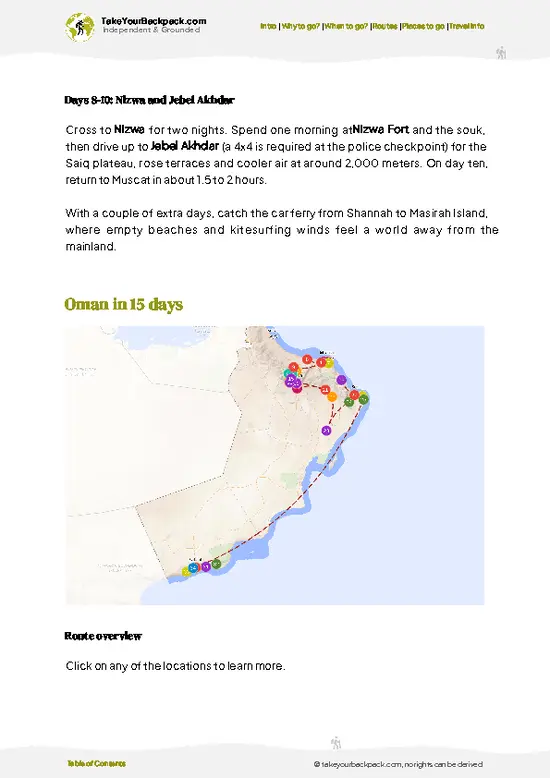
The 15-Day Grand Oman Explorer

The Vibe: A deep-dive journey for travelers who want to see how Oman’s pieces fit together, from coral islands and wadis to deserts, high plateaus, and the fjord-like coasts of Musandam. The pace is steady, with a mix of cultural days, hiking days, and boat days that keep things varied.
The Highlights:
  • Three nights in Muscat with time for the Grand Mosque, museums, Qurum Beach, and the Dimaniyat Islands Nature Reserve
  • A full coastal arc through Sur, Wadi Shab, Fins Beach, and Ras Al Jinz’s turtle beaches
  • Desert and interior time around Wahiba Sands, Wadi Bani Khalid, Nizwa, Bahla Fort, and the highlands of Al Jabal Al Akhdar and Jebel Shams
  • A finale in Khasab and Musandam, with dhow cruises among cliff-lined inlets and downtime on Khasab Beach
🌍 Want a ready-to-use travel plan for Oman?
The overview above compares different route options based on your travel time and style. The complete Travel Guide breaks each itinerary down in detail, including maps, stops, highlights, and transport information.

Explore all route details 👉

Get the Travel Guide -

🌤️ When to go?A month-by-month overview

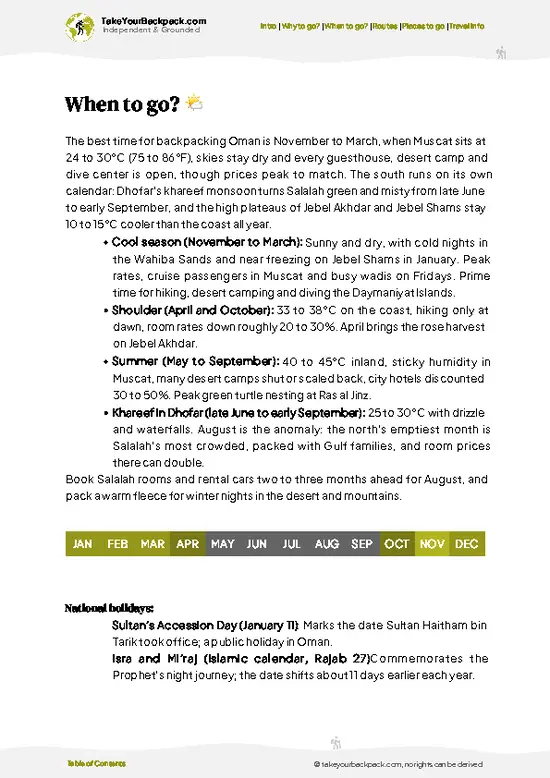
The sweet spot runs mid-November to early December, then late February through March. Air turns dry and clear; desert nights need a blanket; afternoons still invite you into jade wadis; the sea keeps its bathwater warmth. After the holiday rush or just before it, room rates and car hires ease, guides pick up the phone, and trailheads breathe. Rains may rinse the canyons, but the big flash episodes are scarce; pools are fresh, not roaring. You move all day without feeling cooked, and you sleep without waking damp.
  • Peak Season: December-January brings lines at wadis, sold-out desert camps, and surge pricing. Pay the toll and you get powder-blue skies, crisp forts, and campfires under fat constellations.
  • Shoulder Season: October cools by the week; March shakes off winter holidays. Doors roll up earlier, dhow crews repaint, turtles still ghost ashore, traffic thins. Momentum without elbowing, and prices loosen.
  • Off-Peak Heat: May to September turns the interior into a mirage. Empty roads, silent forts, mountains to yourself. Move pre-dawn, siesta, freeze bottles, wear a sun hood; chase shaded wadis and altitude.
  • Khareef (Dhofar Monsoon): June-September drapes Salalah in mist and slick mud. Odd twist: August packs out with regional holidaymakers while Oman elsewhere is empty. Bring grippy sandals and a light shell.

For the sweet spot, book a car and your first two nights a month out; keep the rest flexible to chase clear skies.

source: climatestotravel.comJANJanuary: highly recommended for travelingFEBFebruary: highly recommended for travelingMARMarch: highly recommended for travelingAPRApril: good for travelingMAYMay: fair for travelingJUNJune: fair for travelingJULJuly: fair for travelingAUGAugust: fair for travelingSEPSeptember: fair for travelingOCTOctober: good for travelingNOVNovember: excellent for travelingDECDecember: highly recommended for traveling
📅 Traveling in a specific month?
Get a full month-by-month breakdown of weather, crowds, costs, festivals, and seasonal highlights in the complete travel guide.

Get full details when to go 👉

Get the Travel Guide -
pixabay -oman-3632384

💰 Costs (as of 2025)Prices, expenses, and money tips

Expect 12-20 OMR ($30-50) per day if you share a car and camp; without wheels, plan on 20-30 OMR.
  • dorm accommodation: 6-10 OMR in Muscat or Salalah when booked midweek; outside big towns, dorms basically vanish and the cheapest privates run 12-18 OMR. System tip: treat Oman as a camping country—pack a lightweight mat and pitch on beaches or gravel plateaus (legal, quiet, stars like crushed glass). When you need a shower, rotate one night in a hostel, then two camping. Message properties directly on WhatsApp for weekly rates; owners commonly shave 10-20% off platform prices.
  • meals: Supermarket Survival (Lulu/Carrefour) keeps you at 1.5-3 OMR/day: flatbread, labneh, dates, tins of tuna, and gas-station karak tea that smells of cardamom and diesel. Street food reality: Indian/Pakistani cafeterias are everywhere, stainless-steel tables and clatter—paratha + egg 0.3-0.6 OMR, chicken biryani 1-1.8 OMR, grilled chicken + bread 2-3 OMR. It’s pricier than Egypt, similar to UAE cafeteria pricing, and far cheaper than sit-down spots in Dubai or Doha. Coffee chains and hotel buffets will nuke your budget; keep them as rewards after long drives.
  • local transport: Mwasalat city buses in Muscat cost
read more 👉
Expect 12-20 OMR ($30-50) per day if you share a car and camp; without wheels, plan on 20-30 OMR.
  • dorm accommodation: 6-10 OMR in Muscat or Salalah when booked midweek; outside big towns, dorms basically vanish and the cheapest privates run 12-18 OMR. System tip: treat Oman as a camping country—pack a lightweight mat and pitch on beaches or gravel plateaus (legal, quiet, stars like crushed glass). When you need a shower, rotate one night in a hostel, then two camping. Message properties directly on WhatsApp for weekly rates; owners commonly shave 10-20% off platform prices.
  • meals: Supermarket Survival (Lulu/Carrefour) keeps you at 1.5-3 OMR/day: flatbread, labneh, dates, tins of tuna, and gas-station karak tea that smells of cardamom and diesel. Street food reality: Indian/Pakistani cafeterias are everywhere, stainless-steel tables and clatter—paratha + egg 0.3-0.6 OMR, chicken biryani 1-1.8 OMR, grilled chicken + bread 2-3 OMR. It’s pricier than Egypt, similar to UAE cafeteria pricing, and far cheaper than sit-down spots in Dubai or Doha. Coffee chains and hotel buffets will nuke your budget; keep them as rewards after long drives.
  • local transport: Mwasalat city buses in Muscat cost coins, but they don’t reach wadis, dunes, or clifftop villages. The cheapest way to unlock the country is to split a rental: 10-16 OMR/day for a small sedan (4x4 only needed for serious off-road), fuel is cheap, roads are immaculate, and camping is free—three people makes Oman surprisingly affordable compared to Jordan/UA E. Use OTaxi for fair fares in towns; avoid airport curb hails. Intercity buses (e.g., Muscat-Nizwa/Sur) are good value, then hitch short stretches—the norm is a quick, friendly lift with the AC blasting oud.
  • activities: Free or close: beaches, old quarters at dusk, wadis like Shab/Tiwi (budget 1 OMR for the tiny boat), and most viewpoints. Forts are 1-5 OMR; still cheaper than major sites in Jordan. Cost drivers: dhow trips in Musandam/Dimaniyat 12-30 OMR, desert camps/tours 20-50 OMR, canyoning with guides 25-60 OMR, diving/snorkel trips 25-50 OMR per outing. DIY hiking and camping give the best value; tours add comfort, not access, in many places.
  • miscellaneous: Budget leaks: airport taxis (8-12 OMR unless you use OTaxi), ATM fees (1-3 OMR per withdrawal—pull larger sums), data SIMs that look cheap but burn fast (grab a 3-7 OMR pack and throttle video), speeding fines from sneaky cameras, and bottled water. Carry a 5L jug and refill at mosques/petrol stations; the air tastes of salt and heat, and you’ll drink more than you think. Laundry sinks and a rope beat hotel services. Compared to the UAE, leaks sting less on fuel but more on spontaneous taxis; compared to Jordan, lodging is the heavier line item.
⚠️ Prices can change and everyone travels differently, so take this as a rough guide. Hope it helps you plan your adventure!

✈️ The backpacker research shortcutOman Travel Guide

An offline-friendly backpacking guide with optimized travel routes, ranked highlights, transport advice, and the best areas to stay.
example page 0 from our offline Travel Guide for Omanexample page 1 from our offline Travel Guide for Omanexample page 2 from our offline Travel Guide for Omanexample page 3 from our offline Travel Guide for Omanexample page 4 from our offline Travel Guide for Omanexample page 5 from our offline Travel Guide for Omanexample page 6 from our offline Travel Guide for Omanexample page 7 from our offline Travel Guide for Oman
The digital guide (349 pages) contains:
89 highlights, ranked by travel appeal
Optimized 5, 10 & 15-day travel routes
Cities, national parks, beaches, historical sites, ...
How to get around
Offline-friendly for travel without Wi-Fi
👉 Click to see all 30+ guide features

📅 Plan smarter in minutes, not weeks
Month by month travel advice
Festivals & national holidays
Budget expectations

🗺️ Go to the right places, skip the overrated ones
Honest pros & cons of destinations
Top hikes, parks & viewpoints
Lesser-known places most travelers miss
Clear “worth it vs skip it” guidance

🛏️ Travel smoothly without rookie mistakes
Best areas to stay
Transport systems explained simply
Common scams & safety advice
SIM cards, money & practical tips

🌍 Understand the country, not just visit it
Culture & traditions
52 Essential phrases & customs
Festivals worth planning around
Traveler-friendly historical context
Insights that make places more meaningful

📱 Built for real travel conditions
Fully downloadable PDF
Works completely offline
Optimized for phone use
Useful in remote areas & buses
Everything in one place
Save weeks of stressful planning
Get instant access to the full guide directly. 30-day money-back guarantee.


Sent to your inbox immediately after payment • 100% Secure Checkout
Best Backpacking Travel Advisor 2025 tourism awardBest Backpacking
Travel Advisor
2025
What others say about Take Your Backpack Guides:
⭐⭐⭐⭐⭐
Fantastic, amazing amount of information!
⭐⭐⭐⭐⭐
My goodness this is amazing, it's what I've been looking for hats off too you!
⭐⭐⭐⭐⭐
I think this is absolutely BRILLIANT
⭐⭐⭐⭐
Very complete and informative. It's still missing places, but I gotta to commend you
⭐⭐⭐⭐⭐
This is truly amazing, thank you, can't wait to explore it with my kids!
⭐⭐⭐⭐⭐
Awesome resource, thank you!
⭐⭐⭐⭐⭐
This is amazing! Can't wait to explore the ones I haven't seen
⭐⭐⭐⭐
I love this! Well done, great idea.
⭐⭐⭐⭐⭐
Thanks for taking the time to make this gem!
⭐⭐⭐⭐⭐
This might be the best website I've ever seen.
⭐⭐⭐⭐⭐
Congratulations, and thank you so much for your work; it's incredibly valuable.
⭐⭐⭐⭐
In all seriousness I think you did a great job pointing out the important spots
⭐⭐⭐⭐⭐
10/10 very good
⭐⭐⭐⭐⭐
As someone who's only just starting to visit regularly this is awesome, thank you.
⭐⭐⭐⭐
Thank you very much! I'm going to visit my dad, it's going to be very useful!
⭐⭐⭐⭐⭐
This is really cool! We'll be travelling for the first time and this definitely come in handy.
⭐⭐⭐⭐⭐
You are now our minister of culture, congratulations 👨‍💼
⭐⭐⭐⭐⭐
Just wanted to tell you that this is a pearl! Going to follow your recommendations.
⭐⭐⭐⭐⭐
This is so cool. I'll definitely be using the resource for my travels soon.
⭐⭐⭐⭐⭐
This is very impressive! Good work.
⭐⭐⭐⭐⭐
This is an amazing and informative site. Very well done!

🛏️ Where to stay?Best areas to base yourself

Yes. Hostels and budget accommodation exist in Oman but are less common than in backpacker hotspots; most options cluster in Muscat (Mutrah, Ruwi, Qurum), Salalah, Nizwa, Sur, plus a few around Sohar and the mountain trails (Jebel Shams/Jebel Akhdar).
Mutrah puts you by the corniche and souq—good for sights and some nightlife but slightly pricier; Ruwi is the transport hub and cheaper but busy and less atmospheric; Qurum is quieter and beach-close with fewer dorms; Salalah has the most seasonal budget choices during Khareef but books fast; Nizwa and the mountains offer cheap guesthouses near … read more 👉
Yes. Hostels and budget accommodation exist in Oman but are less common than in backpacker hotspots; most options cluster in Muscat (Mutrah, Ruwi, Qurum), Salalah, Nizwa, Sur, plus a few around Sohar and the mountain trails (Jebel Shams/Jebel Akhdar).
Mutrah puts you by the corniche and souq—good for sights and some nightlife but slightly pricier; Ruwi is the transport hub and cheaper but busy and less atmospheric; Qurum is quieter and beach-close with fewer dorms; Salalah has the most seasonal budget choices during Khareef but books fast; Nizwa and the mountains offer cheap guesthouses near forts and trails but very limited dorm-style hostels and require transport; Sur and Ras Al Jinz suit coastal and turtle-watching trips, are peaceful at night but have sparse options.

If you enjoy meeting fellow travelers, consider choosing hostels with high ratings for atmosphere. On the other hand, if you prefer having your own space, a hotel might be a better option.

🚌 Getting aroundTransportation options and logistics

Oman moves on a calm, sand-clock rhythm. Depots snap to time, but once you roll, the land decides. Long, straight highways patrolled by speed cameras keep drivers steady at 120. Heat pushes life toward dawn and dusk. The air smells faintly of diesel and frankincense outside stations; inside buses, the AC hums cold enough to need a light layer. Lean into the patience and you get rewarded with clean transfers and clear horizons.
  • Mwasalat intercity coaches The Efficiency Trade-off: these are your spine
read more 👉
Oman moves on a calm, sand-clock rhythm. Depots snap to time, but once you roll, the land decides. Long, straight highways patrolled by speed cameras keep drivers steady at 120. Heat pushes life toward dawn and dusk. The air smells faintly of diesel and frankincense outside stations; inside buses, the AC hums cold enough to need a light layer. Lean into the patience and you get rewarded with clean transfers and clear horizons.
  • Mwasalat intercity coaches The Efficiency Trade-off: these are your spine for big jumps—Muscat to Nizwa, Sur, Sohar, even Salalah. Tickets are cheap against the kilometers covered, with numbered seats, luggage tags, and drivers who keep to the posted limit. You pay in time: a Muscat-Salalah haul is a full overnight, with fluorescent-lit cafeteria stops and tea strong enough to stand a spoon. Weekends fill fast; buy a day early at Azaiba terminal and sit left-side to dodge afternoon sun. Carry your passport for any border-linked routes like the Muscat-Dubai run and keep a hoodie for the meat-locker AC.
  • Muscat city buses The Social Fabric: board at the front, greet the driver, have small notes ready or the card the system sells. People give space; men avoid taking the seat right next to a woman if there’s an empty row. Elders and families get first claim without anyone saying it. Stops are fixed but discretion matters—signal early with the button and a brief wave as the bus approaches, because shade is rare and overshooting means a hot backtrack. No food, soft voices, and modest dress keep everything easy.
  • National ferries and local dhows The Geometric Unlock: water reaches what roads dodge. Fast ferries slam open the lines to Musandam’s cut-off villages and to Masirah Island’s wind-harried flats. Schedules are real but seas win arguments; winter winds can pause runs. Buy at the terminal, show ID, walk on with a pack, and watch the dawn peel off the water while goats and cartons roll in behind you. On Masirah, rides are thin at the jetty; pair up and flag a pickup to Hilf or start walking—drivers will usually scoop you within fifteen minutes.
  • Shared route taxis The Budget Disruptor: orange-and-white sedans stitch gaps the buses skip. They leave when full, run set corridors, and cost less than any metered ride if you know the landmark name—Ruwi Clock Tower, Muttrah fish market, Fanja roundabout. Agree the fare up front, sit where the driver points, and keep small bills. A palm-down wave brings them in; expect mid-route detours to drop others. They’re faster than buses on short hops because they ignore half the stops.

Master tip: travel at first light—catch the dawn bus or the earliest share taxi, when heat is low, drivers are fresh, and Oman runs closest to schedule.
Distance
Muscat International Airport (MCT) sits about 30 km (19 miles) from the main downtown areas (Ruwi/Muttrah). Traffic on Sultan Qaboos Street can swing the timing a bit.

Main public transport
  • Mwasalat public bus (red city buses)
    • Where: The airport stop is signposted outside Arrivals.
    • Route: Buses run along the main highway toward Ruwi (via Al Khuwair/Qurum). Look for services showing “Airport ↔ Ruwi/Mabela.”
    • Frequency: About every 15-30 minutes during the day; thinner late evening.
    • Time: 35-60 minutes to Ruwi, depending on traffic.
    • Cost: Around 0.5-1.0 OMR; Airport → Ruwi is typically about 1.0 OMR.
    • Tickets: Buy from the driver; keep small change. Service after midnight is limited—plan a taxi if you land very late.


Taxis (including apps)
  • Airport taxis: Fixed/regulated fares from the official desk in Arrivals. Expect roughly 8-12 OMR to central areas like Ruwi/Muttrah (20-35 minutes). You’ll get a quoted price before you go.
  • App taxis (OTaxi, Mwasalat Taxi): Usually a bit cheaper than airport taxis—about 6-10 OMR to central areas. You may need to meet your driver at Departures or the car park due to airport pickup rules.

Good to know
  • There’s no metro or train in Muscat. Buses and taxis are the practical options from the airport.
  • Uber/Careem don’t operate in Oman; use OTaxi or Mwasalat Taxi for ride-hailing.
⚠️ Prices and routes can change, so take this as a rough guide and ask for local advice when you arrive.

🔒 Safety (risk Level: medium)What first-time visitors should know

Safety for solo travelers, including women and LGBTQ+ individuals
Oman is generally considered safe for solo travelers, including women and LGBTQ+ individuals, due to its low crime rates and welcoming locals. Women should dress modestly to respect local customs, especially in rural areas. LGBTQ+ travelers might face cultural sensitivity, so discretion is advised in public spaces. Always stay informed about local laws and current events for a smooth trip.


Full official government travel advisory (live updates)
View details 👉

✈️ VisaEntry requirements and paperwork

Most travelers need a visa to visit Oman, except citizens from GCC countries. You can apply for an e-visa through the official Omani e-visa website. Make sure your passport is valid for at least six months from your entry date.

source: rop.gov.om
⚠️ Visa requirements can change over time, so always check the latest visa requirements with the official embassy or government website before you travel.

🎒 What to pack?What you'll need while traveling

Oman offers a mix of desert, mountains, and stunning coastline, so pack smart! Expect scorching temps in the desert, but it gets chilly in the mountains, especially at night. Lightweight, breathable fabrics are your best friends during the day. Women should pack a scarf for visiting mosques and dress modestly to respect local customs; think loose-fitting clothes covering shoulders and knees. Don’t forget about the sun—Oman’s rays show no mercy, so sun protection is a must.

Apart from this country specific advice, I have also crafted a general packing list that should help on any trip. authorOver the years, I've learned the importance of packing minimally. It's so much easier to jump on the back of a truck or squeeze yourself into the last spot of a minibus without that supersized backpack. If you're headed to a warm destination, leave your winter jacket at home; for colder regions, opt for thin thermal underlayers. Instead of packing your entire wardrobe, bring just three sets of clothes, as laundry facilities are available everywhere.

View the full list 👉
🎒 Planning the practical side of your trip?
Get detailed information on transport, daily budgets, internet access, local customs, food, language, and other essentials in the complete Travel Guide.

Get detailed practical information 👉

Get the Travel Guide -

🙋 FAQCommon questions before visiting

Trip Planning


Personal tip: I normally search on good rating for atmosphere (for meeting people) and location (for easy exploring). Cleanliness as a bonus.


Travel Essentials

Hepatitis A and B, typhoid, and rabies are recommended for Oman. Consider measles-mumps-rubella (MMR) and the Tdap (tetanus, diphtheria, and pertussis) booster if you haven’t had them in a while. Malaria isn’t a concern in most areas, but always double-check for updates. Don’t forget routine vaccines like the flu shot. Always consult a healthcare provider for personalized advice.


vaccination requirements
When I first started traveling, I often spent part of my first day in a new country hunting for a local SIM card. While this can still be slightly cheaper, it also takes time and planning.

These days, it's much simpler to install an eSIM before leaving home. Once you arrive in Oman, you can activate it immediately and have mobile data from the moment you land — which is especially useful for ordering transport or navigating away from busy airports.

There are many providers nowadays, and price differences are usually small. I personally go with Airalo, as it offers excellent network coverage throughout the country and strong global coverage, so you can manage multiple countries from a single app.


Get your e-sim for Oman

Culture & Customs

Dress modestly, especially in rural areas; women should cover shoulders and knees. Greet with a light handshake if offered. Always use your right hand for eating or giving items. Public displays of affection are frowned upon. LGBTQ+ travelers should be discreet as homosexuality is illegal. Alcohol is available but respect local drinking norms. When invited to someone’s home, remove shoes and bring a small gift like dates. Avoid discussing politics or religion publicly.
Trying traditional food is always a great way to experience the culture. Here are some must-try dishes for Oman.
  • Shuwa: This is a celebratory dish often prepared for special occasions. It’s slow-cooked marinated lamb wrapped in banana leaves and placed in an underground sand oven for up to 48 hours. The result is incredibly tender and flavorful meat that’s perfect for sharing.
  • Majboos: A staple in Omani households, this dish consists of rice cooked with saffron, spices, and either chicken or beef. It’s akin to biryani and is a comforting, hearty meal that showcases the region’s use of spices.
  • Mishkak: These are skewered meats, often lamb or beef, marinated in a blend of spices and grilled over open flames. They’re popular street food and a great way to experience Omani flavors on the go.
  • Harees: A traditional dish made of wheat and meat, usually chicken or lamb, cooked until it reaches a porridge-like consistency. It’s especially popular during Ramadan and Eid, providing a hearty, fulfilling meal.
  • Halwa: Not a dish per se, but a sweet treat made from sugar, rosewater, saffron, and various nuts. It’s a must-try dessert that’s often enjoyed with coffee, reflecting the generous hospitality of Omani culture.
Tap water in Oman is generally safe and locals do drink it, but for tourists, especially those with sensitive stomachs, it’s better to stick to bottled or filtered water. Bottled water is widely available and affordable. A portable water filter can be a handy tool for eco-conscious travelers wanting to reduce plastic waste.
The main language in Oman is Arabic. Backpacking is way more rewarding if you know a bit of the local language, so I'd suggest brushing up on the basics just in case your Arabic skills have become a bit rusty.

Want to understand locals better?
The complete Travel Guide for Oman includes 52 essential words and phrases — greetings, thank-yous, ordering food, transport, numbers, and common local expressions you'll actually hear.

Get your local basic phrases 👉

Get the Travel Guide -


English is widely spoken in Oman, particularly in urban areas and tourist destinations. The country has a significant expatriate population, and English serves as a common language among various nationalities. Many Omanis, especially those in the hospitality and service industries, have a good command of English, making it relatively easy for travelers to communicate.

In cities like Muscat, you’ll find that most signs are in both Arabic and English, and many locals are comfortable engaging in conversations in English. However, in more rural areas, English proficiency may vary, and some locals may speak only Arabic. Learning a few basic Arabic phrases can enhance your experience and is often appreciated by the locals.

Overall, while English is not the official language, its widespread use in Oman ensures that travelers can navigate the country with relative ease.

Money & Payments

The local currency of Oman is OMR (ر.ع.).

ATMs: You’ll find ATMs in major cities like Muscat and Salalah, but they can be scarce in smaller towns and rural areas. It’s a good idea to withdraw enough cash before heading off the beaten path. Most ATMs accept international debit and credit cards.

Cash: Carrying cash is essential, especially if you’re venturing outside the main cities. Omani Rials (OMR) are the way to go. Small towns and markets often prefer cash and might not accept cards.

Dollars or Euros: While US Dollars and Euros aren’t widely accepted for direct purchases, they can be exchanged at banks or exchange kiosks. Always check the rates as they can vary.

Card Acceptance: Credit and debit cards are commonly accepted in hotels, larger restaurants, and shops in urban areas. However, don’t rely on them in smaller towns or for public transport.

Exchanging Money: Banks and licensed exchange offices are your best bet for exchanging currency. Avoid airport kiosks if possible, as they often offer less favorable rates.

Tipping in Oman isn’t mandatory, but it’s appreciated. In restaurants, leaving around 10% of the bill is common if service isn’t included. For taxi drivers and hotel staff, rounding up the bill or leaving a small tip is a nice gesture.

🧩 Nearby countriesNearby backpacking alternatives

We 💚 feedbackFinal notes for travelers

Oman rewards self-sufficient travelers: dawn light rinses the wadis pale blue, frankincense drifts in Mutrah, and the empty road becomes the itinerary. Because buses are sparse, drive or ride-share; petrol is cheap, but alcohol hides in hotel bars at a markup. Start hikes at first call to prayer; nap at noon; swim the canyons in grippy sandals. Modesty earns you tea and easy smiles. Wild camping is legal and starry. Best for drivers, hikers, photographers, patient planners; not ideal for nightlife-chasers or public-transport diehards.

✍️ Help improve this page!
The information on this page is based on in-depth research, insights shared by experienced travelers, and feedback from the local travel community in Oman. While every effort is made to keep the information accurate and current, conditions can change — so if you spot anything incorrect or outdated, please get in touch.


🙋‍♂️ Give feedback

👋 Meet the founderWho’s Behind Take Your Backpack?

Johan, backpacker and founder of TakeYourBackpackHi, I’m Johan (Netherlands 🇳🇱), the creator of TakeYourBackpack. Over the past decade, I’ve backpacked through 80+ countries across six continents, gaining extensive experience with independent travel, long-term trips, and overland routes.

This site is built on a combination of firsthand travel experience and carefully curated insights from other backpackers. Many guides are based on places I’ve personally visited, while others bring together tips, observations, and practical advice shared by trusted travelers I’ve met along the way.

The goal is to provide realistic, experience-driven guidance — not generic itineraries — so you can explore destinations with better context, clearer expectations, and more confidence.

Get full Oman guide •
Instant download • 89 highlights • Full Offline guide