×
Nepal 🇳🇵

backpacking Asia Nepal 🇳🇵
Climb life-changing trails step by deliberate step.

Explore MyanmarExplore North Korea

Backpacking Nepal in 2026

A complete guide including when and where to go, costs, transport, itineraries, and practical travel advice.
An overview of visiting Nepal

Backpacking Nepal
By Johan Kruseman 🇳🇱 | Updated May 23, 2026

You no longer have to grind across Nepal on bone‑rattling buses. Improved highways, steadier microbuses, and reliable short-hop flights link the main hubs far better than a decade ago. That frees you to spend your energy where it matters: in tea houses and on trails where prayer flags snap and your calves earn every view.

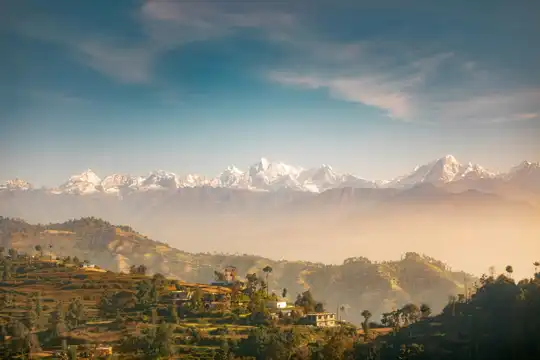
Here the land steps from rhino grasslands to ice‑bright summits, and days find a rhythm—dal bhat at noon, yak bells at dusk, starlight over a black ridge. You thread medieval squares in Bhaktapur, spin mani wheels in Langtang, hear monks chant while the city hums, then climb into air that feels newly washed. Yes, there’s altitude to respect, dust on the switchbacks, leeches in monsoon, a flight that waits out cloud while you sip milk tea. That friction sharpens the payoff: sunrise from Poon Hill, the wind in Mustang, a hot stove bench I’ve clung to, steam off momos, and the first cold beer in Pokhara with your legs humming.

Against India’s roar, Nepal moves more gently; against Bhutan’s controlled tours, it gives you freedom; against Tibet’s permits, it’s simpler to reach. Come if you crave big mountains without ego, living temples with patina, and wild hours that reward anyone willing to sweat for them.

👉 Get the 📖 Travel Guide of Nepal

Kathmandu Valley

The valley hits you with horns, brick dust, and a maze of alleys that force you to move with intent. Use it as basecamp: permits, last‑minute gear on Thamel’s side streets, and cheap, fast eats. Ride a rattling microbus to Patan or Bhaktapur; walk the old squares at dawn when the tea boils and pigeons scatter. Day-hike the Nagarkot–Changu Narayan ridge for a leg-stretcher without committing to altitude. Best for culture-first travelers who don’t mind grime to reach woodcarved courtyards and a rooftop dal bhat with a cold Gorkha.

Pokhara & Annapurna Corridor

One road spine from Kathmandu delivers you to Pokhara, where you stage for teahouse circuits. The foothills don’t ease you in: endless stone staircases, sweat down your back, then hot ginger tea in a smoky kitchen. Poon Hill, Mardi Himal, or longer Annapurna Circuit sections if time allows. ACAP and TIMS are straightforward; rental poles and down jackets are everywhere. Social vibe: first-timers, returnees chasing one more ridge, and porters who keep you honest about pace. High reward for limited time and mid-range fitness.

Everest (Khumbu)

Fly to Lukla if the weather allows; get comfortable with delays. Or grind a jeep to Phaplu and add days on foot. The trail slaps you early—Namche’s switchbacks punch the lungs, and altitude punishes impatience. Teahouses cost more than Annapurna; coffee and bakeries ease the sting. Permits are handled at the gates. Good for disciplined hikers who want the big arena: Tengboche bells, creaking glaciers, and a hot shower you earn.

Langtang & Helambu

Close to the capital, but the road to Syabrubesi still shakes the spine. Steep forest climbs, rivers roaring, and Kyanjin Gompa waiting with yak cheese and sharp air. Flexible 4–8 day loops, fewer crowds than Annapurna, and real village rhythm. Ideal for walkers wanting altitude flavor without a flight.

Mustang (Jomsom–Muktinath & Upper Mustang)

Reach Jomsom by wind-prone flight or a dusty jeep through the Kali Gandaki. Lower Mustang is road-scarred but raw: pilgrim traffic at Muktinath, fossils in your pocket, apple pies in windswept towns. Upper Mustang demands a pricey restricted permit and a guide; the wind owns the afternoons, and the monasteries feel lived-in, not staged. For seasoned travelers who can handle dust, pay for access, and savor salt-butter tea in Lo Manthang after a hard, dry walk.
Map of Nepal
Loading the map 🌍
CLICK TO FILTER
city
town
village
unique site
national park
hike
attraction
festival
region
SHOW COUNTRY‘S BESTSHOW ALL
film
0
0
0a
Pokhara
Sundar Baral
film
1
1
1a
Solukhumbu
film
2
2
2a
Everest Base Camp Trek
Unsplash
film
3
3
3a
Annapurna Circuit
Unsplash
film
4
4
4a
Mardi Himal Trek
film
5
5
5a
Great Himalaya Trail
Unsplash
film
6
6
6a
Sagarmatha
iStockphoto
film
7
7
7a
Chitwan
film
8
8
8a
Rara
film
9
9
9a
Kathmandu Valley
film
10
10
10a
Rukum
film
11
11
11a
Bhaktapur
film
12
12
12a
Bandipur
film
13
13
13a
Gorkha
film
14
14
14a
Ilam
film
15
15
15a
Panauti
film
16
16
16a
Kirtipur
film
17
17
17a
Sankhu
film
18
18
18a
Mount Everest
Pixabay
film
19
19
19a
Lumbini
film
20
20
20a
Boudhanath Stupa
film
21
21
21a
Sundarijal
film
22
22
22a
Panchase
film
23
23
23a
Namche Bazaar

Why go?Reasons people choose to visit

Mountains

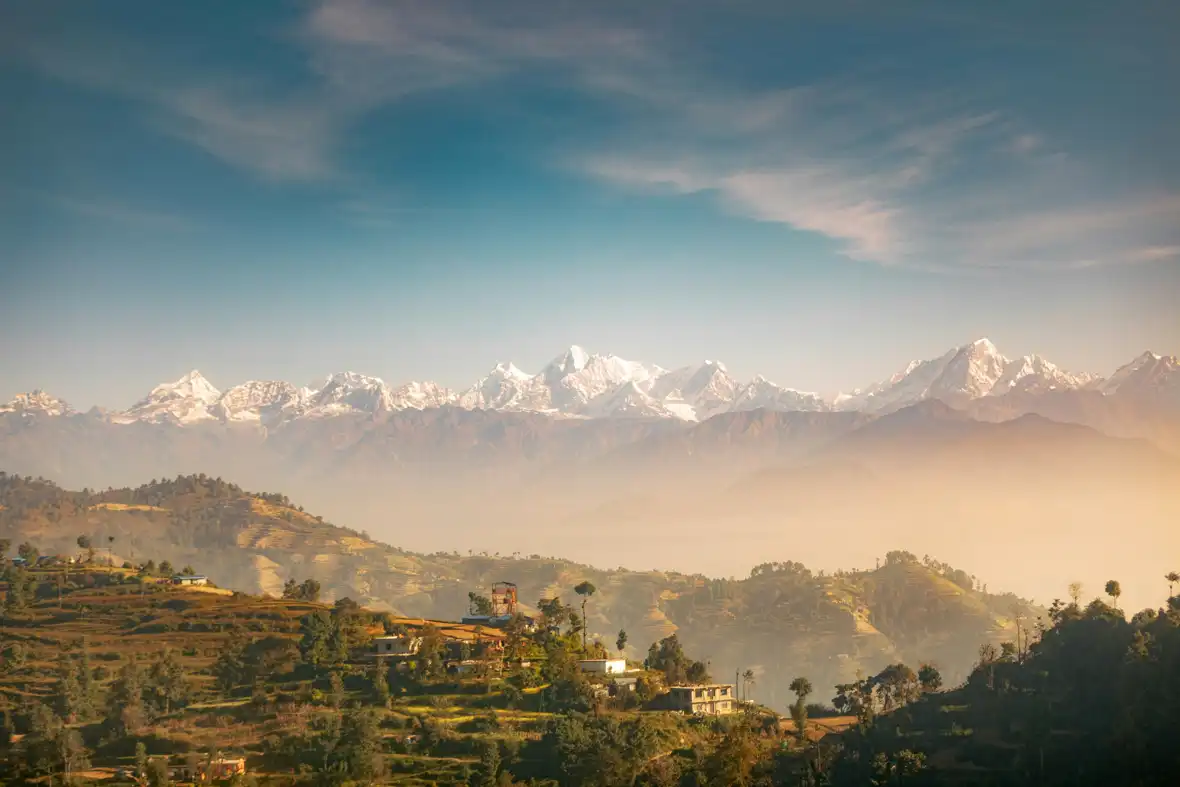
Nepal makes you climb for your views. Stone steps bite calves, thin air narrows your world to breath … read more 👉
Nepal makes you climb for your views. Stone steps bite calves, thin air narrows your world to breath and boot. Then the trail rounds a mani wall and the whole Annapurna amphitheater hits you like sunrise in stereo. Yak bells, juniper smoke, prayer flags cracking in the wind—earned miles taste better. Pro tip: leave at first light to slip past mule trains and afternoon clouds; carry a buff for dust. I still remember the first cold beer in Namche after the EBC push, legs wrecked, lungs clean, Khumbu glowing. You don’t just see mountains here—you earn them.

Low cost

Nepal stretches a backpacker’s budget without starving the fun. Simple teahouses trade a free bed if … read more 👉
Nepal stretches a backpacker’s budget without starving the fun. Simple teahouses trade a free bed if you eat their curry and dal bhat—bottomless ladles keep you moving. Local buses rattle but undercut every other option; I walked in from Jiri to skip the Lukla flight and spent roughly a daily average equal to a single Western Europe hostel bed. Pro tip: carry a filter and refill from taps—bottles bleed money in the hills. Haggle politely in off-hours. The payoff? Sunrise on Annapurna, noodles steaming, first cold beer in Pokhara hitting like a medal.

People

They meet you with quick smiles and a teasing eye-roll when you gasp on the first climb. A kid matches … read more 👉
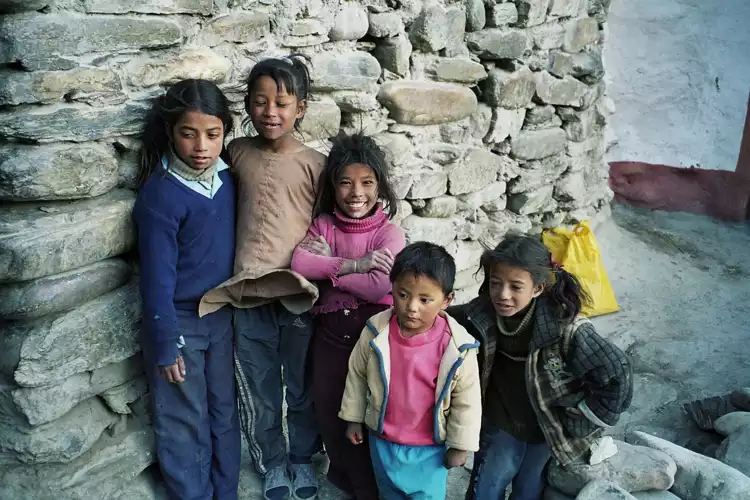
They meet you with quick smiles and a teasing eye-roll when you gasp on the first climb. A kid matches your stride, asks your name, and darts off laughing. In kitchens blackened by smoke, aunties shove more dal bhat onto your plate and say, “Eat, brother,” like it’s an order. Men on the bus make room, then roast your weak chili game until you cough and grin. Pro tip: lead with a firm “Namaste” and two palms; accept tea even if you’re late. My best nights came around a clay hearth, trading stories while rain hammered the tin roof.

Wildlife

Nepal hits hard for wildlife. The Terai’s heat presses down, elephant grass cuts your shins, and then … read more 👉
Nepal hits hard for wildlife. The Terai’s heat presses down, elephant grass cuts your shins, and then a one-horned rhino ghosts out at 20 meters and everything goes quiet. Chitwan and Bardia deliver tigers, gharials, sloth bears, and rhino; Koshi Tappu turns dawn into a wall of bird calls. I’ve sweated through foot patrols, leech socks on, and earned the cold beer at a Tharu homestay as the Rapti glows and crocodiles cruise past. Pro tip: skip elephant rides, book dawn walks with a sharp naturalist, and sit still—five extra minutes often becomes the sighting.

Backpackers

Nepal earns its backpacker stripes the hard way: diesel breath at the New Bus Park, calf-burn on stone … read more 👉
Nepal earns its backpacker stripes the hard way: diesel breath at the New Bus Park, calf-burn on stone steps, and tea-house beds that creak but hold. Then dawn drops the curtain—Machhapuchhre cuts the sky from Poon Hill, steam from your chai warming cracked lips. Thamel and Lakeside keep the scene buzzing: cheap beds, gear that’ll do, dal bhat refills that never quit, and cold Everest beers when the dust settles. Pro tip: bring a water filter and spend money on socks, not knockoff shells. Pro tip: skip the Lukla flight—jeep to Salleri and walk in with pride.

Food

Nepal rewards effort with food that sticks to your ribs and wakes your palate. Morning steam from momo … read more 👉
Nepal rewards effort with food that sticks to your ribs and wakes your palate. Morning steam from momo baskets; jhol momo broth; Newari grills throw smoke; choila; chiura; gundruk tang. Trek and you earn dal bhat—heap of rice, lentils, tarkari, pickle, and seconds without fuss. In Langtang I hiked hungry to Kyanjin and inhaled yak cheese with buckwheat roti; the tea house owner laughed and poured hot raksi. Pro tip: skip Thamel gloss; eat in Patan’s courtyards—ask for a Newari khaja set. Another: try tongba in the hills; sip slow between breaths.

Scenery

Nepal rewards effort. Grind up stone steps through rhododendron forest, lungs rasping, then the Annapurna … read more 👉
Nepal rewards effort. Grind up stone steps through rhododendron forest, lungs rasping, then the Annapurna wall fills your whole field of view and the pain drops away. At Poon Hill, I watched ice creep up my bottle at dawn—every switchback paid off. Drop low and you swap granite for elephant grass in Chitwan’s savannah, humid, noisy, very alive. In Pokhara, slip a boat onto Phewa at first light and watch the peaks paint themselves onto the water. Pro tip: pack a cheap down jacket; shade bites above 3,000 meters even when the sun roasts the trail.

Architecture

Nepal rewards legwork. The Kathmandu Valley still runs on brick and beam: tiered temples, tight courtyards, … read more 👉
Nepal rewards legwork. The Kathmandu Valley still runs on brick and beam: tiered temples, tight courtyards, palace squares where every carved strut tells a trade’s history. You climb Swayambhu’s stairs at dawn, calves burning, bells hammering, and the city unfurls—brown roofs to a hard white horizon. In Bhaktapur you duck low doorways, trace stone spouts, and feel centuries under your soles. Pro tip: hit Patan Durbar Square before 7 a.m.; chai in hand, watch woodcarvers set tools and light rake palace walls. Carry socks for shrines and move clockwise—locals will notice if you don’t.

Uniqueness

Nepal makes you earn every mile. Microbuses grind up switchbacks, dust grits your teeth. In the hills, … read more 👉
Nepal makes you earn every mile. Microbuses grind up switchbacks, dust grits your teeth. In the hills, yak trains shove you off stone steps, leeches find ankles in the monsoon, and woodsmoke from teahouses hangs in your clothes. Trails thread terraces and rhododendron, skirting mani walls and prayer wheels; you give way to porters hauling your bodyweight. Then it hits: dawn from Pikey Peak or Kala Patthar, giants flare, and dhal bhat seconds taste like victory—the first cold Everest beer seals it. Pro tip: walk in from Jiri or Salleri; I start before 6 and carry a buff for dust.
Want the complete picture of Nepal?
The offline Travel Guide brings everything together — routes, highlights & planning.

See what's included in the guide 👉

Get the Travel Guide -

⭐ HighlightsWhat not to miss along the way

  • Everest Base Camp Trail, Khumbu: The path clings to cliffs and rattles across wire bridges while prayer flags snap like whipcord in the wind; yak bells tick and oxygen thins, so you move with intent. Dust coats your teeth by Phakding, then Ama Dablam slices into view and you forget the ache. I earned my view at Namche, hands wrapped around a cold bottle, watching cloud shadows crawl across the Khumbu.
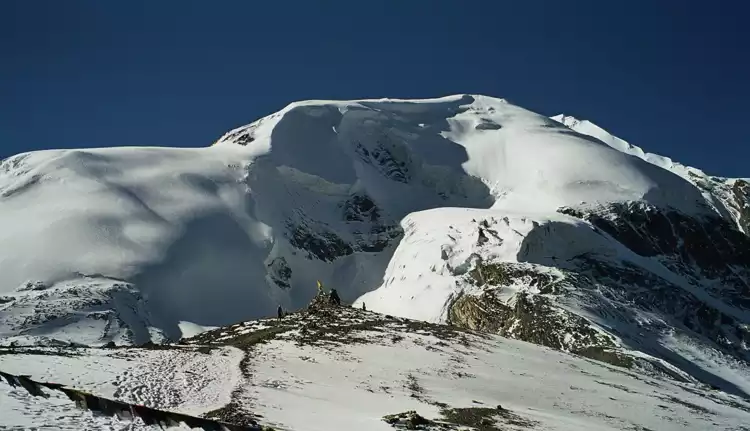
  • Thorong La, Annapurna Circuit: You leave high camp in the black cold, headlamp beam painting frost and prayer stones, lungs clawing at the thin air. Each step bites; water slushes in the bottle even inside your jacket. Then the pass crest arrives—blue sign, fistful of prayer flags, world dropping away to Mustang—and the tea stall’s salty noodle broth brings your fingers back to life.
  • Langtang Valley and Kyanjin Ri: River roar on your left, landslide scars on your right, and juniper smoke curling from stone huts; you climb into a bowl of rock and glaciers that feels earned, not gifted. Yak butter
read more 👉
  • Everest Base Camp Trail, Khumbu: The path clings to cliffs and rattles across wire bridges while prayer flags snap like whipcord in the wind; yak bells tick and oxygen thins, so you move with intent. Dust coats your teeth by Phakding, then Ama Dablam slices into view and you forget the ache. I earned my view at Namche, hands wrapped around a cold bottle, watching cloud shadows crawl across the Khumbu.
  • Thorong La, Annapurna Circuit: You leave high camp in the black cold, headlamp beam painting frost and prayer stones, lungs clawing at the thin air. Each step bites; water slushes in the bottle even inside your jacket. Then the pass crest arrives—blue sign, fistful of prayer flags, world dropping away to Mustang—and the tea stall’s salty noodle broth brings your fingers back to life.
  • Langtang Valley and Kyanjin Ri: River roar on your left, landslide scars on your right, and juniper smoke curling from stone huts; you climb into a bowl of rock and glaciers that feels earned, not gifted. Yak butter tea leaves a waxy film on your lips at Kyanjin. Dawn on Kyanjin Ri hits hard—ice in your nostrils, 360 degrees of ridges punching at the sky.
  • Bhaktapur Durbar Square: Pre-dawn sweepers push yesterday into neat piles while brick alleys warm under first light; bells answer from temple roofs and the air tastes of incense and diesel. Potters slap clay in the square, and a bowl of sweet, cool juju dhau slides down like a reward for waking early. Climb a low rooftop and watch the city switch itself on.
  • Chitwan National Park: Mist sits on the Rapti as the dugout canoe rips a quiet V; a gharial’s eyes glide past, and later the elephant grass slashes at your shins on a slow, wired walk. A rhino materializes, wet hide steaming, and snorts you backwards. Sunset at Sauraha is river-cold beer and silt between your toes; for quieter circuits, push to Tsum Valley, Khaptad, or Rara Lake—my personal favorite is Kyanjin Ri at first light when the air cuts clean.
Spotted a mistake or missing a highlight? Contact us.

But Nepal offers more...

Discover and compare all of its highlights per category

🧭 RouteSuggested travel routes through Nepal

The 5-Day Kathmandu Valley Immersion

The Vibe: A slow-burn introduction to Nepal built around temples, old royal squares, and street life, all within easy reach of your guesthouse. You stay in and around Kathmandu, trading long travel days for deeper time in a single, culture-rich valley.
The Highlights:
  • Historic walks through Kathmandu Durbar Square and the palace complex.
  • Sunset and city views from Swayambhu’s hilltop stupa.
  • Evening kora and rooftop meals around Boudhanath.
  • A day wandering Bhaktapur’s brick lanes and courtyards.

The 10-Day Valley-to-Lakes Classic

The Vibe: A balanced first trip that mixes Kathmandu’s intensity with the calmer rhythm of Pokhara and a hilltown stop, using one overland hop to change the scenery without turning the journey into a marathon. You get temples, old towns, and lake views with room to breathe in each place.
The Highlights:
  • Three full days exploring the cultural heavyweights of the Kathmandu Valley.
  • Overnights in Bhaktapur and Dhulikhel for quieter, small-town
read more 👉

The 5-Day Kathmandu Valley Immersion

The Vibe: A slow-burn introduction to Nepal built around temples, old royal squares, and street life, all within easy reach of your guesthouse. You stay in and around Kathmandu, trading long travel days for deeper time in a single, culture-rich valley.
The Highlights:
  • Historic walks through Kathmandu Durbar Square and the palace complex.
  • Sunset and city views from Swayambhu’s hilltop stupa.
  • Evening kora and rooftop meals around Boudhanath.
  • A day wandering Bhaktapur’s brick lanes and courtyards.

The 10-Day Valley-to-Lakes Classic

The Vibe: A balanced first trip that mixes Kathmandu’s intensity with the calmer rhythm of Pokhara and a hilltown stop, using one overland hop to change the scenery without turning the journey into a marathon. You get temples, old towns, and lake views with room to breathe in each place.
The Highlights:
  • Three full days exploring the cultural heavyweights of the Kathmandu Valley.
  • Overnights in Bhaktapur and Dhulikhel for quieter, small-town evenings.
  • Lakeside downtime and short hikes around Pokhara.
  • A night in Bandipur’s car-free main street high above the valleys.

The 15-Day Culture, Trek & Jungle Circuit

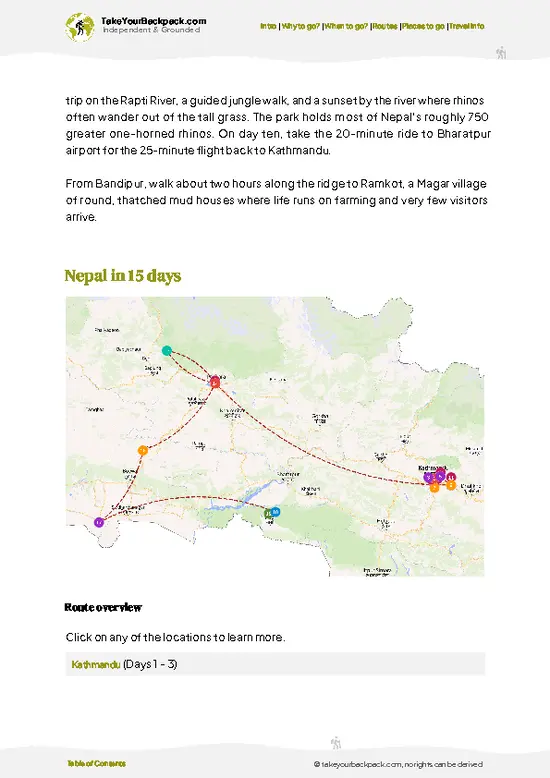
The Vibe: A full-spectrum Nepal journey that layers city temples, a rewarding short trek, and lowland wildlife into one coherent loop, using a mix of buses and flights to keep the pace steady but not rushed. It’s ideal if you want to feel the shift from high hills to humid plains and back again.
The Highlights:
  • Deep cultural time in Kathmandu, Patan, and Bhaktapur.
  • A multi-day Ghorepani Poon Hill trek out of Pokhara with big mountain sunrises.
  • Wildlife safaris and river sunsets around Chitwan National Park.
  • Final reset in Kathmandu’s Garden of Dreams before flying out.
🌍 Want a ready-to-use travel plan for Nepal?
The overview above gives a quick comparison of route options based on your travel time and style. The full Travel Guide shows each route in detail, with maps, stops, highlights, and transport types.

Explore all route details 👉

Get the Travel Guide -

🌤️ When to go?Choosing the right months to travel

Late November to early December and mid-March to early April are the sweet spots. Post-monsoon dust has been scrubbed from the air, trails have dried, and the jet stream hasn’t slammed the high passes yet. In spring, the heat hasn’t built, storms are still mostly afternoon tantrums, and rhododendrons start firing without the April expedition crush. Prices dip after the October surge and before holiday spikes; teahouse beds open up; porters and jeeps are available without bidding wars. Days land in the “walk all day” zone at mid-altitudes; nights cool off enough to sleep hard without hauling expedition-grade insulation. You move faster, spend less time waiting, and still get the big-mountain clarity that brought you here.
  • Peak (Post-Monsoon, Oct-Nov): You grind through busy checkpoints, pay festival-inflated room rates, and dodge trekking poles on stone steps. The payoff: razor-sharp horizons at dawn, planes actually flying to Lukla, and a dining hall packed with trail stories. October roars; tea houses in Namche and Ghorepani fill by noon.
  • Shoulder (Late Nov-Early Dec / Mid-Mar-Early Apr): Shops unlatch, trails breathe, and prices slide a notch. Porters pick up work, jeep drivers bargain, and you move—camp to camp—without racing the crowd. Views hold; logistics loosen.
  • Off-Peak (Monsoon, Jun-Aug): The country turns inward. Forests drip, leeches patrol, landslides reset the road map. Survival hack: dawn starts and knee-high leech socks; bag electronics in two dry bags and ride the rain shadow (Mustang, Dolpo) when the hills drown.
  • Deep Winter (Jan-Early Feb): Empty trails, iron skies, and quiet villages. Passes ice over; water freezes in the bottle by dawn. Carry microspikes and a real puffy; aim lower routes (Langtang valley floors, Poon Hill) for solitude without frostbite.

Personal tip: For October and April objectives, book the first-flight seat to Lukla six weeks out and keep a two-day buffer—early slot plus buffer beats every delay I’ve eaten.

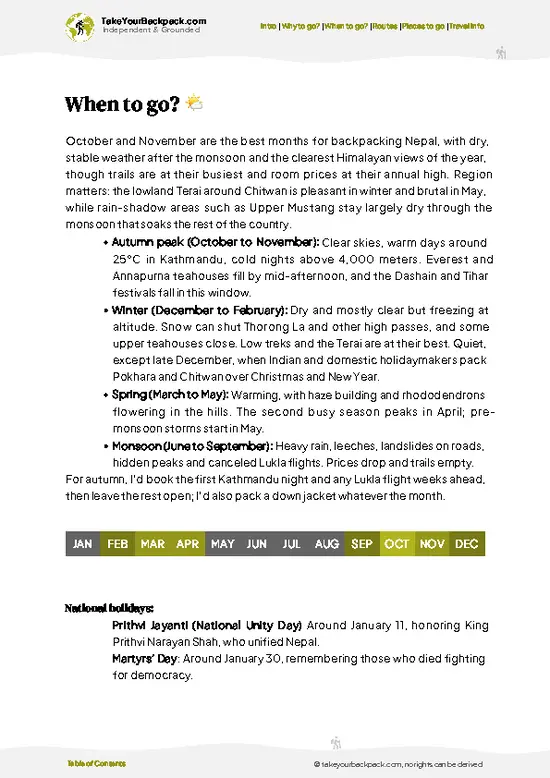
source: climatestotravel.comJANJanuary: fair for travelingFEBFebruary: good for travelingMARMarch: highly recommended for travelingAPRApril: highly recommended for travelingMAYMay: fair for travelingJUNJune: below average for travelingJULJuly: below average for travelingAUGAugust: below average for travelingSEPSeptember: good for travelingOCTOctober: excellent for travelingNOVNovember: highly recommended for travelingDECDecember: good for traveling
Traveling in a specific month?
This page covers the best seasons to visit. For a complete month-by-month breakdown — including weather, crowds, costs, national holidays, and festivals — download the full Travel Guide.

Get the Travel Guide -
IZFB9AD8-unsplash

💰 Costs (as of 2026)Travel costs in Nepal

Plan on $25-35 per day in cities and $30-45 on trek if you keep it tight and skip flights.
  • dorm accommodation: Kathmandu/Pokhara dorms run $4-10; touristy Thamel lakeside beds hit $8-12; basic teahouse rooms on trek can be $2-5 but the catch is you eat there. System tip: walk in at midday, check the mattress/blankets and power backup, then say “free room if I eat dinner and breakfast?”—that’s how the mountains work; carry a liner so you can accept the cheaper bed without worrying. Compared to India, dorms are a hair pricier but cleaner on average; far cheaper than Bhutan or Tibet options.
  • meals: Supermarket Survival: bread, bananas, instant noodles, and eggs keep you at $4-6/day in the city, but you’ll hate yourself by day three. Street food reality: dal bhat in a local canteen is $2-3 in town and $5-8 at altitude; momos and chow mein run $1-3 and fill the tank; “western” menus jump to $6-12 and drain cash fast. I once paid more for a cappuccino than a full dal bhat—imported coffee is the stealth tax. Nepal is slightly pricier than India for dairy and packaged snacks, cheaper than China’s tourist zones.
  • local transport: The cheapest way to unlock the country is buses and shared jeeps.
read more 👉
Plan on $25-35 per day in cities and $30-45 on trek if you keep it tight and skip flights.
  • dorm accommodation: Kathmandu/Pokhara dorms run $4-10; touristy Thamel lakeside beds hit $8-12; basic teahouse rooms on trek can be $2-5 but the catch is you eat there. System tip: walk in at midday, check the mattress/blankets and power backup, then say “free room if I eat dinner and breakfast?”—that’s how the mountains work; carry a liner so you can accept the cheaper bed without worrying. Compared to India, dorms are a hair pricier but cleaner on average; far cheaper than Bhutan or Tibet options.
  • meals: Supermarket Survival: bread, bananas, instant noodles, and eggs keep you at $4-6/day in the city, but you’ll hate yourself by day three. Street food reality: dal bhat in a local canteen is $2-3 in town and $5-8 at altitude; momos and chow mein run $1-3 and fill the tank; “western” menus jump to $6-12 and drain cash fast. I once paid more for a cappuccino than a full dal bhat—imported coffee is the stealth tax. Nepal is slightly pricier than India for dairy and packaged snacks, cheaper than China’s tourist zones.
  • local transport: The cheapest way to unlock the country is buses and shared jeeps. In cities, hop Sajha/microbuses and electric tempos for cents; intercity, the no-frills microbus beats the “tourist bus” by a couple dollars but rides rough. Tourist buses Kathmandu-Pokhara cost a bit more yet spare you goat stops; shared jeeps take you where roads get mean for $10-20 a seat. Roads are slow—200 km can be 7-9 hours—so leave at dawn and save a night’s accommodation with daylight travel. Nepal lacks India’s rail cushion; per kilometer can feel pricier for what you get.
  • activities: Major cost drivers are permits, flights, and guides. Expect $20-50 per region for conservation/park permits and another chunk for trek registration; guides run roughly $25-35/day, porters $18-25/day plus tips. Domestic flights (Lukla, Jomsom) torch budgets at $150-200 one-way; walking in saves hundreds but costs days. Paragliding in Pokhara sits around $70-90; rafting day trips $40-70; Kathmandu’s Durbar Squares and big stupas charge $5-15. Rent gear in Thamel/Pokhara instead of buying—solid value if you check zippers and buckles.
  • miscellaneous: Budget Leaks: beer $3-5 (more than a meal), espresso $2-4, bakery runs multiply fast, airport taxis overcharge, ATMs skim $4-6 plus poor rates, and on trek you’ll pay $1-3 for hot showers, device charging, and Wi-Fi. Bottled water doubles every 1,000 m of altitude—carry a filter and refill from taps or kitchen kettles. SIMs are cheap; data is good value versus India-like pricing, but roaming drains credit. I charge a power bank during dinner and skip the per-charge fee. Nepal stays a bargain if you dodge imported cravings and pay village prices for village food.
⚠️ Prices can change and everyone travels differently, so take this as a rough guide. Hope it helps you plan your adventure!

✈️ The backpacker research shortcutNepal Travel Guide

An offline-friendly backpacking guide with optimized travel routes, ranked highlights, transport advice, and the best areas to stay.
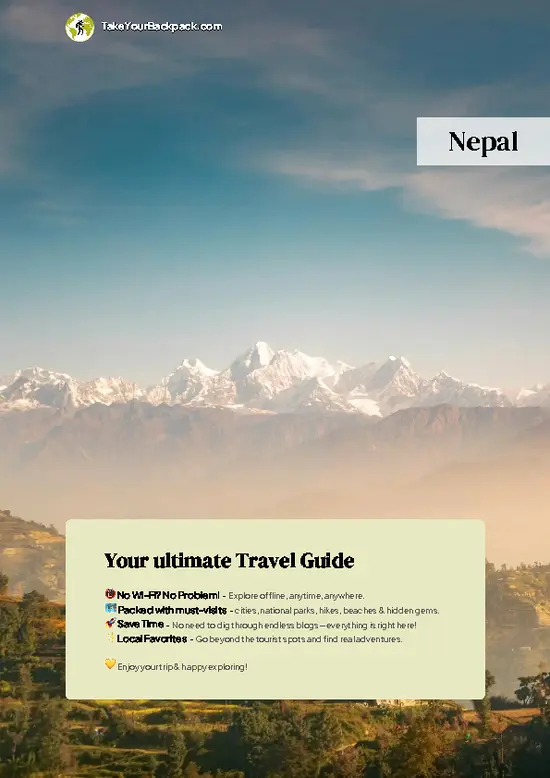
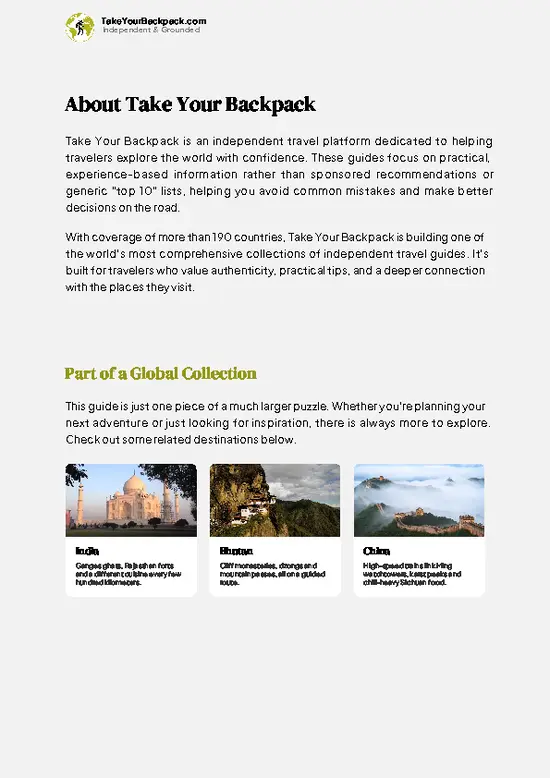
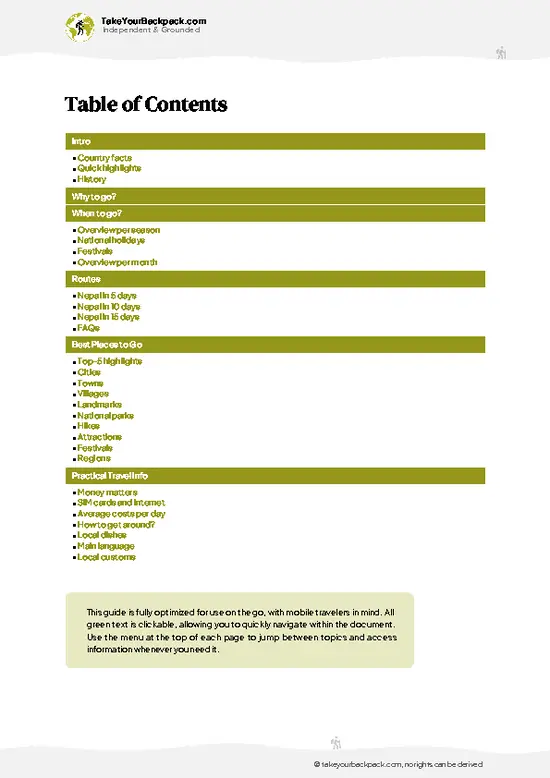
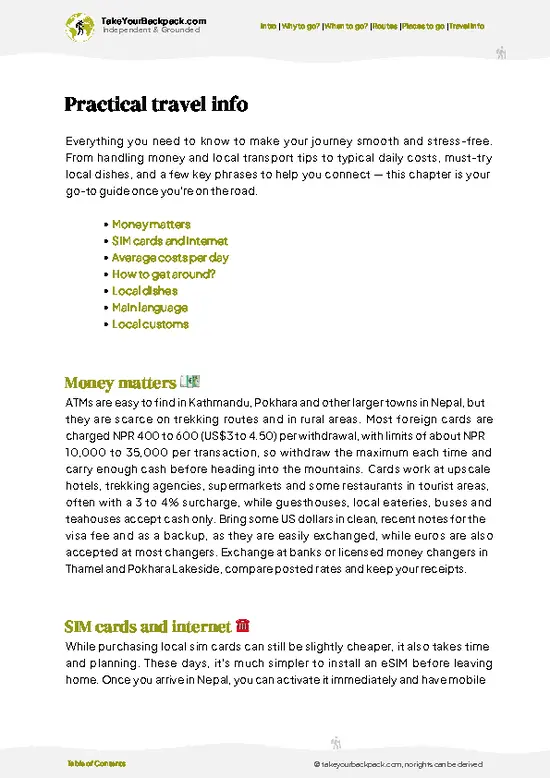
example page 0 from our offline Travel Guide for Nepalexample page 1 from our offline Travel Guide for Nepalexample page 2 from our offline Travel Guide for Nepalexample page 3 from our offline Travel Guide for Nepalexample page 4 from our offline Travel Guide for Nepalexample page 5 from our offline Travel Guide for Nepal
The digital guide (347 pages) contains:
107 highlights, ranked by travel appeal
Optimized 5, 10 & 15-day travel routes
Best neighborhoods to stay
How to get around
Offline-friendly for travel without Wi-Fi
👉 See all 30+ guide features

📅 Plan smarter in minutes, not weeks
Month by month travel advice
Festivals & national holidays
Budget expectations

🗺️ Go to the right places, skip the overrated ones
Honest pros & cons of destinations
Top hikes, parks & viewpoints
Lesser-known places most travelers miss
Clear “worth it vs skip it” guidance

🛏️ Travel smoothly without rookie mistakes
Best areas to stay
Transport systems explained simply
Common scams & safety advice
SIM cards, money & practical tips

🌍 Understand the country, not just visit it
Culture & traditions
52 Essential phrases & customs
Festivals worth planning around
Traveler-friendly historical context
Insights that make places more meaningful

📱 Built for real travel conditions
Fully downloadable PDF
Works completely offline
Optimized for phone use
Useful in remote areas & buses
Everything in one place
Save weeks of stressful planning
Get instant access to the full guide directly. 30-day money-back guarantee.


Sent to your inbox immediately after payment • 100% Secure Checkout
Best Backpacking Travel Advisor 2025 tourism awardBest Backpacking
Travel Advisor
2025
What others say about Take Your Backpack Guides:
⭐⭐⭐⭐⭐
Fantastic, amazing amount of information!
⭐⭐⭐⭐⭐
My goodness this is amazing, it's what I've been looking for hats off too you!
⭐⭐⭐⭐⭐
I think this is absolutely BRILLIANT
⭐⭐⭐⭐
Very complete and informative. It's still missing places, but I gotta to commend you
⭐⭐⭐⭐⭐
This is truly amazing, thank you, can't wait to explore it with my kids!
⭐⭐⭐⭐⭐
Awesome resource, thank you!
⭐⭐⭐⭐⭐
This is amazing! Can't wait to explore the ones I haven't seen
⭐⭐⭐⭐
I love this! Well done, great idea.
⭐⭐⭐⭐⭐
Thanks for taking the time to make this gem!
⭐⭐⭐⭐⭐
This might be the best website I've ever seen.
⭐⭐⭐⭐⭐
Congratulations, and thank you so much for your work; it's incredibly valuable.
⭐⭐⭐⭐
In all seriousness I think you did a great job pointing out the important spots
⭐⭐⭐⭐⭐
10/10 very good
⭐⭐⭐⭐⭐
As someone who's only just starting to visit regularly this is awesome, thank you.
⭐⭐⭐⭐
Thank you very much! I'm going to visit my dad, it's going to be very useful!
⭐⭐⭐⭐⭐
This is really cool! We'll be travelling for the first time and this definitely come in handy.
⭐⭐⭐⭐⭐
You are now our minister of culture, congratulations 👨‍💼
⭐⭐⭐⭐⭐
Just wanted to tell you that this is a pearl! Going to follow your recommendations.
⭐⭐⭐⭐⭐
This is so cool. I'll definitely be using the resource for my travels soon.
⭐⭐⭐⭐⭐
This is very impressive! Good work.
⭐⭐⭐⭐⭐
This is an amazing and informative site. Very well done!

🛏️ Where to stay?Choosing the right base for your trip

Yes—Nepal has many hostels and budget guesthouses concentrated in Kathmandu’s Thamel, Pokhara’s Lakeside, and around heritage/pilgrimage hubs like Boudha and Patan, plus basic teahouse lodging on trekking routes (very basic facilities, limited hot water and electricity).
Thamel offers the widest selection, immediate access to transport, shops and nightlife but is crowded, noisy and has higher petty-theft risk, so choose quieter side streets, higher-floor rooms and secure valuables.
Lakeside puts you on the lake with easy boat access and trekking buses and a more relaxed nightlife but attracts … read more 👉
Yes—Nepal has many hostels and budget guesthouses concentrated in Kathmandu’s Thamel, Pokhara’s Lakeside, and around heritage/pilgrimage hubs like Boudha and Patan, plus basic teahouse lodging on trekking routes (very basic facilities, limited hot water and electricity).
Thamel offers the widest selection, immediate access to transport, shops and nightlife but is crowded, noisy and has higher petty-theft risk, so choose quieter side streets, higher-floor rooms and secure valuables.
Lakeside puts you on the lake with easy boat access and trekking buses and a more relaxed nightlife but attracts tourist prices and strip noise; Boudha and Patan are quieter and culturally rich yet have fewer hostel options and longer transfers to trekking starts.

If you enjoy meeting fellow travelers, consider choosing hostels with high ratings for atmosphere. On the other hand, if you prefer having your own space, a hotel might be a better option.

🚌 Getting aroundTransportation options and logistics

Nepal moves on rumor and throttle. Schedules bend around weather, landslides, and tea breaks; momentum comes from leaving early and riding the wave that forms at dawn. Conductors whistle, horns talk, and the road dictates rank. You learn to read the flow—when to sprint for a seat, when to settle for the roof, when to wait out a jam with milk tea. It’s chaotic intuition with a rhythm: push hard in the cool morning, win daylight, and earn the mountain view and cold beer before the wind shifts.
  • Intercity
read more 👉
Nepal moves on rumor and throttle. Schedules bend around weather, landslides, and tea breaks; momentum comes from leaving early and riding the wave that forms at dawn. Conductors whistle, horns talk, and the road dictates rank. You learn to read the flow—when to sprint for a seat, when to settle for the roof, when to wait out a jam with milk tea. It’s chaotic intuition with a rhythm: push hard in the cool morning, win daylight, and earn the mountain view and cold beer before the wind shifts.
  • Intercity buses and microbuses The cheap backbone. Kathmandu-Pokhara by day bus takes 6-8 hours if the highway behaves; a flight does it in under an hour but costs several times more and still loses to a bus if clouds sit on the runway. Microbuses shave an hour but cram knees and luggage; tourist “deluxe” buses pad time with safer drivers, numbered seats, and a lunch stop where the dal bhat actually refuels you. Night rides run faster but raise the risk on hairpins. Pay for the morning departure; buy the left window for river views and fewer roadside fumes.
  • Local buses and Hiace vans This is the social fabric. Wave them down; there’s no tidy stop, just a conductor hanging from the door shouting the route. Pay in small bills after boarding. Seats marked for women or elders are non-negotiable. Backpacks off the aisle, phones zipped, elbows in. When you want off, tug the bell cord or call the stop—confidence matters more than volume. You’ll be shoulder-to-shoulder with office workers and schoolkids, and the whole thing moves because everyone gives an inch.
  • Shared jeeps to trailheads The geometric unlock. When the bus quits, jeeps keep going—Syabrubesi for Langtang, Salleri/Phaplu for an Everest approach without flying, Jomsom-Muktinath, Besisahar up the Marsyangdi. They roll at first light once seats fill, strap packs to the roof, and crawl through landslide gashes that would turn a coach around. It’s brutal, dusty, and entirely worth it: you step out already in mountain air, a half-day closer to the trail than the bus crowd.
  • Ride-hail moto taxis The budget disruptor inside cities. Apps like Pathao or Tootle cut Kathmandu cross-town slogs to minutes for a fraction of a taxi, no bargaining, helmet passed back, you slip through gridlock while taxis bake. Keep your pack snug, knees in, mask up against exhaust, pay cash or wallet in-app. It’s the only way to make a tight bus connection without bleeding time and rupees.

Master tip: move at dawn—book the first departure, ride the clear roads and stable weather, and you’ll stack margins all day that no ticket or upgrade can buy.
Distance: Tribhuvan International Airport (TIA) is about 5.5 km (3.4 miles) from central Kathmandu/Thamel.

Main public transport options
  • City bus (Sajha Yatayat) — Walk 5-10 minutes out of the terminal to the main road at Sinamangal and flag a Sajha bus toward Ratna Park/New Road.

    Time: 30-60 minutes (can stretch to 75-90 in rush hour).

    Cost: NPR 25-30 (about US$0.20).
  • Microbus/minibus — Also from the Sinamangal/Ring Road stops; frequent services to Ratna Park.

    Time: 25-50 minutes depending on traffic and stops.

    Cost: NPR 20-30 (about US$0.15-0.25).
  • Hotel shuttle — Many mid-range and above hotels in Thamel/Durbar Marg offer pickups; confirm in advance.

    Time: 20-45 minutes.

    Cost: Often free with booking, otherwise roughly NPR 1,000-2,000 (US$8-15).

From Ratna Park/New Road it’s about a 15-25 minute walk to Thamel; or take a short taxi for NPR 150-300 (US$1-2).

Taxis and ride-hailing
  • Prepaid airport taxi — Book at the counter in Arrivals for a fixed fare to Thamel.

    Time: 20-45 minutes.

    Cost: typically NPR 700-1,000 by day, NPR 800-1,200 late night (about US$5-9).
  • Metered/street taxis — Meters are rarely used; agree the fare before you get in.

    Cost: usually NPR 600-1,000 to Thamel (US$5-8) depending on traffic and bargaining.
  • Ride-hailing (Pathao, inDrive) — Often cheaper; cars and motorbikes available. Pickups may be easier just outside the airport gate or at Departures.

    Cost: car NPR 400-800 (US$3-6); motorbike NPR 150-300 (US$1-2).

Notes: Buses don’t come into the terminal area—head to the main road outside the gate. Have small cash for fares. Traffic is heaviest roughly 8:00-10:00 and 16:00-19:00. Prices are current for 2025 but can fluctuate with fuel costs.
⚠️ Prices and routes can change, so take this as a rough guide and ask for local advice when you arrive.

🔒 Safety (risk Level: medium)Common concerns and things to watch out for

Safety for solo travelers, including women and LGBTQ+ individuals
Nepal is generally safe for solo travelers, including women and LGBTQ+ individuals, but always stay aware of your surroundings. Women may face occasional unwanted attention, so dressing modestly and avoiding isolated areas at night is wise. LGBTQ+ travelers should be cautious in rural areas where conservative views prevail, although urban centers like Kathmandu are more accepting. Always check for the latest travel advisories and connect with fellow travelers for up-to-date local insights.


Full official government travel advisory (live updates)
View details 👉

✈️ VisaWhat travelers should know about visas

Yes, most travelers need a visa to visit Nepal. You can get a visa on arrival at Tribhuvan International Airport in Kathmandu; just bring passport-sized photos and USD for the fee. Alternatively, apply for an eVisa online before your trip to skip the airport hassle.

source: mofa.gov.np
⚠️ Visa requirements can change over time, so always check the latest visa requirements with the official embassy or government website before you travel.

🎒 What to pack?What to wear and bring

Traveling to Nepal is all about embracing extremes, from the chilly peaks of the Himalayas to the steamy lowlands of the Terai. Pack layers to handle everything from daytime treks at high altitudes to cool nights. The monsoon season can drench you from June to September, so think waterproof. Culturally, modesty matters—covering shoulders and knees is appreciated, especially in temples. Bring clothes that are respectful but also comfy for long walks and climbs.

Apart from this country specific advice, I have also crafted a general packing list that should help on any trip. authorOver the years, I've learned the importance of packing minimally. It's so much easier to jump on the back of a truck or squeeze yourself into the last spot of a minibus without that supersized backpack. If you're headed to a warm destination, leave your winter jacket at home; for colder regions, opt for thin thermal underlayers. Instead of packing your entire wardrobe, bring just three sets of clothes, as laundry facilities are available everywhere.
View the full list 👉

✈️ FAQThings travelers often ask

Trip Planning


Personal tip: I normally search on good rating for atmosphere (for meeting people) and location (for easy exploring). Cleanliness as a bonus.


Travel Essentials

Hepatitis A and B, Typhoid, and Tetanus are commonly recommended vaccinations for Nepal. Depending on your itinerary, consider Rabies and Japanese Encephalitis, especially if you’re trekking or spending extended time in rural areas. Check your routine vaccines like MMR and Polio. Always consult with a healthcare professional for the latest advice.


vaccination requirements
When I first started traveling, I often spent part of my first day in a new country hunting for a local SIM card. While this can still be slightly cheaper, it also takes time and planning.

These days, it's much simpler to install an eSIM before leaving home. Once you arrive in Nepal, you can activate it immediately and have mobile data from the moment you land — which is especially useful for ordering transport or navigating away from busy airports.

There are many providers nowadays, and price differences are usually small. I personally go with Airalo, as it offers excellent network coverage throughout the country and strong global coverage, so you can manage multiple countries from a single app.


Get your e-sim for Nepal

Culture & Customs

Respect local customs: greet with ”Namaste” and use right hand for eating and giving. Remove shoes before entering homes or temples. Dress modestly; women should cover shoulders and knees. Public displays of affection are frowned upon. Homosexuality is a sensitive subject; discretion is advised for LGBTQ+ travelers. Accept food and drink offerings politely. Avoid stepping over people or their feet, and don’t point soles of feet at anyone. Use both hands when giving or receiving items, especially money.
Trying traditional food is always a great way to experience the culture. Here are some must-try dishes for Nepal.
  • Dal Bhat: A staple in every Nepali household, this dish consists of steamed rice and lentil soup. It’s the backbone of Nepali diet and is often served with vegetable curries, pickles, and sometimes meat. Eating Dal Bhat is an immersion into the daily life of Nepal.
  • Momo: These are Nepali-style dumplings filled with meat or veggies, served with spicy dipping sauce. Originally from Tibet, momos have become a beloved street food across Nepal, perfect for a quick and tasty snack.
  • Sel Roti: A traditional homemade, sweet, ring-shaped rice bread, often made during festivals. Its unique combination of crispy exterior and soft interior makes it a delightful snack, and its preparation is a festive activity in itself.
  • Newari Khaja Set: A diverse platter featuring a variety of Newari dishes like beaten rice, spicy potatoes, and marinated meat. It represents the rich culinary tradition of the Newar community and is best enjoyed in local eateries in the Kathmandu Valley.
  • Gundruk: A fermented leafy green vegetable dish, often served as a side. It’s a way to preserve vegetables and has a distinctive tangy flavor. Gundruk reflects the resourcefulness of Nepali cuisine, especially in rural areas.
Tap water in Nepal is generally not safe for tourists to drink, even though some locals might consume it. It’s advisable to stick to bottled or filtered water to avoid any health issues. Consider using a portable water purifier if you’re trekking or exploring rural areas.
The main language in Nepal is Nepali. Backpacking is way more rewarding if you know a bit of the local language, so I'd suggest brushing up on the basics just in case your Nepali skills have become a bit rusty.

Want to understand locals better?
The complete Travel Guide for Nepal includes 52 essential words and phrases — greetings, thank-yous, ordering food, transport, numbers, and common local expressions you'll actually hear.

Get your local basic phrases 👉

Get the Travel Guide -


In Nepal, English is widely spoken, particularly in urban areas and among the younger population. It is commonly used in tourism, education, and business, making it easier for travelers to communicate. Major cities like Kathmandu and Pokhara have many English-speaking locals, including hotel staff, tour guides, and shopkeepers. However, in rural areas, English proficiency may be limited, and travelers might encounter language barriers.

Nepal’s education system includes English as a second language, so many people, especially those in the hospitality and tourism sectors, have a basic understanding. Nonetheless, it’s beneficial for travelers to learn a few basic Nepali phrases, as this can enhance interactions and show respect for the local culture.

Overall, while English is not universally spoken, travelers will find enough English speakers to navigate most situations comfortably.

Money & Payments

The local currency of Nepal is NPR (Rs).

When backpacking in Nepal, carrying some cash is a smart move, especially when you’re hitting up remote areas where ATMs are as rare as a decent cup of coffee in the middle of nowhere. In cities like Kathmandu and Pokhara, ATMs are fairly common, but they can be unreliable, so don’t bank on them as your only option. Most ATMs accept major cards like Visa and MasterCard, but fees can add up, so plan your withdrawals wisely.

If you’re wondering about currency, local Nepali rupees are your go-to. While dollars and euros might be welcome in some tourist shops or hotels, using them elsewhere isn’t practical. Keep a stash of small bills (100s and 500s) for everyday expenses.

Credit and debit card acceptance is still pretty limited outside upscale hotels and restaurants, so don’t expect to swipe your way through the country. For currency exchange, it’s best to stick to authorized money changers in tourist areas or banks to avoid getting shortchanged. Just keep your eyes peeled for commission fees and always ask what’s the best rate they can offer.

In Nepal, tipping isn’t mandatory, but it’s appreciated, especially in the tourism sector. If you’re happy with the service, leaving around 5-10% at restaurants or rounding up the fare for taxi drivers is a nice gesture. For guides and porters, consider tipping more generously based on the length and difficulty of your trek.
🧩 Nearby countriesOther countries to combine with Nepal

📸 PhotosScenes from around the country

Take your backpack - Nepal - 0
Take your backpack - Nepal - 1
Take your backpack - Nepal - 2
Take your backpack - Nepal - 3
Take your backpack - Nepal - 4
Take your backpack - Nepal - 5
Take your backpack - Nepal - 6
Take your backpack - Nepal - 7
Take your backpack - Nepal - 8
Take your backpack - Nepal - 9
Take your backpack - Nepal - 10
Take your backpack - Nepal - 11
Take your backpack - Nepal - 12
Take your backpack - Nepal - 13
Take your backpack - Nepal - 14
Take your backpack - Nepal - 15
Take your backpack - Nepal - 16
Take your backpack - Nepal - 17
Take your backpack - Nepal - 18
Take your backpack - Nepal - 19
Take your backpack - Nepal - 20
Take your backpack - Nepal - 21
Take your backpack - Nepal - 22
Take your backpack - Nepal - 23
Take your backpack - Nepal - 24
Take your backpack - Nepal - 25
Take your backpack - Nepal - 26
Take your backpack - Nepal - 27
Take your backpack - Nepal - 28
Take your backpack - Nepal - 29
Take your backpack - Nepal - 30
Take your backpack - Nepal - 31
Take your backpack - Nepal - 32
Take your backpack - Nepal - 33
Take your backpack - Nepal - 34
Photographed by: Johan Kruseman

Experiences from time spent here

From 10 buildings burning bodies to playing a real-life computer game

From 10 buildings burning bodies to playing a real-life computer game

Nepal | Wow, my first week in Nepal has been a blast! I couldn‘t have asked for a better start to this vacation. So, first things first, let me tell you about my little adventure at London Heathrow. I had to convince them that my tube of toothpaste, deodorant, contact lens solution, and sunscreen weren‘t terrorist weapons. Apparently, these extremely dange...
Read more
How a 4 hour conversation saved me 80 rupees

How a 4 hour conversation saved me 80 rupees

Nepal | Well, folks, my last day in Nepal has arrived, and I‘ve experienced way too many bizarre things once again. There were so many of them that I had to make a choice between organizing them chronologically or alphabetically, but in the end, I opted for a small selection. I think I left off my last message with a heavy negotiation over an alarm clock....
Read more
Hiking the Himalaya’s on flip flops

Hiking the Himalaya’s on flip flops

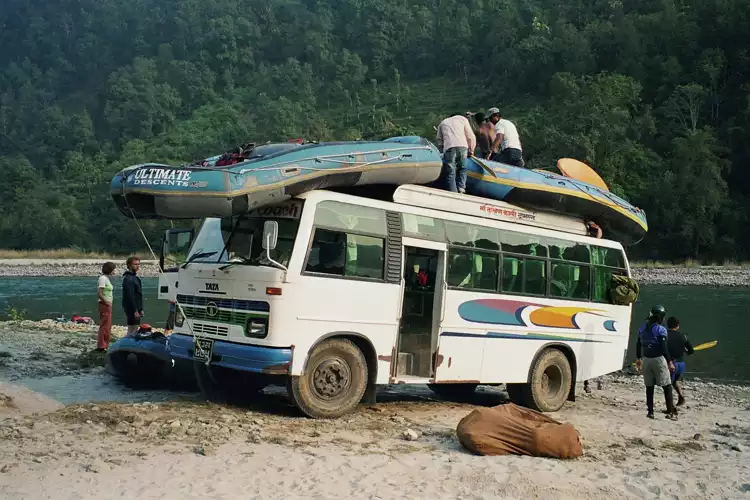
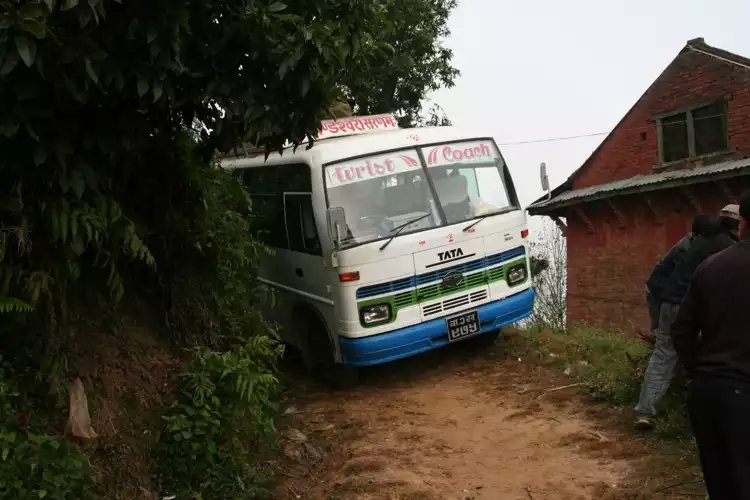
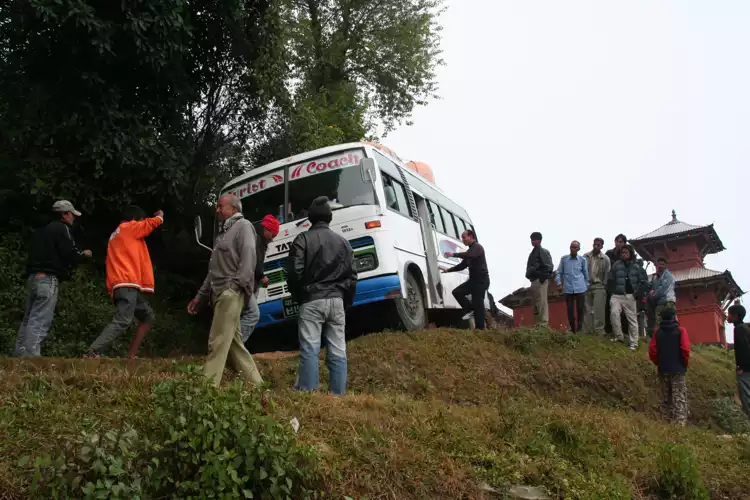
Nepal | The next day marked the beginning of my Himalayan trek. Since there was no legroom on the bus, I decided to spend the journey on the bus roof. The driver was afraid of villagers throwing stones, so he‘d stop before each bend, walk a few hundred meters ahead to check if it was safe, and then drive the bus that short distance. This made the bus ride ...
Read more
Reaching the highest point in my life

Reaching the highest point in my life

Nepal | A village later, in Manang, the trek got serious. We were now at 3540 meters, and they had hired a Norwegian doctor to scare us about the dangers of altitude sickness. If you exhibited one of the symptoms (no sleeping, loss of appetite, headache, etc.), you weren‘t allowed to continue and had to acclimatize for a day. Unfortunately, it wasn‘t an op...
Read more
How telling what time it is, made me a Saint on the roof of a bus

How telling what time it is, made me a Saint on the roof of a bus

Nepal | Fortunately, we had a guide with us on our journey. The trek lasted for two weeks, circling the Annapurna Massif. The highlight was supposed to be seeing Annapurna-1 (an 8100-meter-high mountain). After 10 days of hiking, the guide finally pointed out Annapurna-1 to us. We were ecstatic and filled our camera rolls and memory cards until we reached ...
Read more

Surprise encounter with school kids

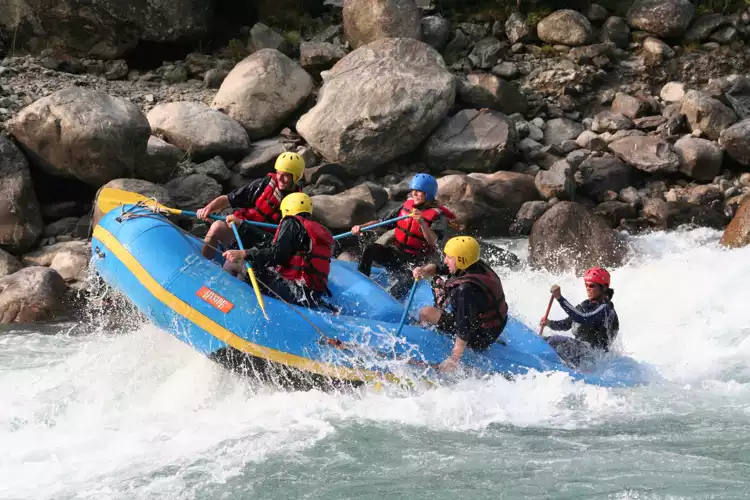
Nepal | After a full day of bus rides back to Kathmandu, I spent the next two days rafting on the Bote Kosi. It wasn‘t very exciting, so on my second-to-last day, I decided to rent a mountain bike one more time to cruise around Kathmandu (the most fun part of the entire vacation). Just an hour out of Kathmandu, we stumbled upon a school class in a forest. ...
Read more
More stories

We 💚 feedbackFinal notes for travelers

Final thoughts: Nepal rewards effort. I came for the peaks, stayed for teahouse warmth. You grind up stone steps, lungs bite at 3,500 meters, buses crawl cliff edges. Then dawn hits Ama Dablam like a match, and the first cold Everest beer in Namche tastes earned. Cheap teahouses keep budgets sane; dust and power cuts will test patience. Best for hikers who like early starts and simple rooms. Not ideal for club-chasers, rigid itineraries, or anyone allergic to chaos and altitude.

✈️ When did I visit Nepal?
Being a mountain lover, Nepal is one of my favorites. I visited it in November 2006, hiking the full Annapurna circuit as my highlight. Originally written after my visit, this guide has been kept up to date with input from locals and recent travelers (last update: 6 March 2026)

✍️ Help improve this page!
The information on this page is based on my own backpacking experience in Nepal, supplemented with up-to-date research and feedback from other travelers. Travel details can change, so if you notice anything outdated or incomplete, feel free to let me know.


🙋‍♂️ Give feedback

👋 Meet the founderWho’s Behind Take Your Backpack?

Johan, backpacker and founder of TakeYourBackpackHi, I’m Johan (Netherlands 🇳🇱), the creator of TakeYourBackpack. Over the past decade, I’ve backpacked through 80+ countries across six continents, gaining extensive experience with independent travel, long-term trips, and overland routes.

This site is built on a combination of firsthand travel experience and carefully curated insights from other backpackers. Many guides are based on places I’ve personally visited, while others bring together tips, observations, and practical advice shared by trusted travelers I’ve met along the way.

The goal is to provide realistic, experience-driven guidance — not generic itineraries — so you can explore destinations with better context, clearer expectations, and more confidence.

Get Full Country Guide |
Instant download • 107 highlights • Full Offline guide