×
Tonga 🇹🇴

backpacking Oceania Tonga 🇹🇴Live communal days shaped by ocean traditions.

Explore Timor-LesteExplore Tuvalu

Backpacking Tonga in 2026

A complete guide including when and where to go, costs, transport, itineraries, and practical travel advice.
An overview of visiting Tonga

Backpacking Tonga
By Johan Kruseman 🇳🇱 | Updated June 7, 2026

Sundays in Tonga stop the clock. Most shops, ferries, and tours pause as hymns drift across town and families gather around the umu. That stillness sets the pace here—community first, the ocean second, your watch a distant third.

You come for the whales, to slide into cobalt water off Vava’u and feel a calf’s wake brush your legs; for sea caves where light turns blue to silver; for Tongatapu’s blowholes pounding like a drumline; for Ha’apai’s honest, empty sandbars and the slow grace of a kava night. Heat sits on your shoulders, buses rattle, schedules yield to weather, cash rules outside Nuku’alofa, roosters claim the dawn, and coral will punish bare feet. But an icy ‘Ikale’ after salt and sun, the sweet smoke of an umu, and the moment a whale’s eye meets yours make every delay feel like part of the rite.

Fiji is busier and resort-ready; Samoa smoother and beach-house easy; French Polynesia polished; the Cooks tidy. Tonga is for patient travelers—sailors, whale‑dreamers, culture-first wanderers—who’d rather follow tide tables than timetables.

👉 Get the 📖 Travel Guide of Tonga

Tongatapu (Nuku’alofa and the island loop)

Diesel, bakery sugar, and sea salt hit as you step off in Nuku’alofa. Rent a beater and circle to Mapu a Vaea and Ha’amonga. Saturday markets; Sunday hush. Kava bars murmur. Best base for cash, SIMs, fixes, and scrappy street rhythm.

’Eua

Eight-minute hop or a queasy ferry. Red mud, pandanus scratches, banyans, sinkholes, cliffs over hammering surf. Sweat first, then whale spouts from headlands (Jul–Oct) and a cold green-bottle beer from ’Ohonua. Rewards hikers and birders who don’t mind wet boots.

Ha’apai

Flat, sandy, and slow. Bike coral lanes; swim from shore to reef. Small planes cancel in squalls; ferries take their time. Nights are generator hum and huge skies. Best for unhurried travelers and couples who like bare feet and salt-dry hair.

Vava’u (Neiafu + outer islets)

Neiafu is the hub; everything moves by boat. Hire a skiff or tag along with yachties. Swallows glows; Mariner’s Cave needs one calm breath. More operators and better kit, pricier than Ha’apai. For ocean doers: paddlers, divers, whale-swimmers.
Seeing the layout at a glance
Loading the map 🌍
CLICK TO FILTER
town
village
unique site
national park
hike
beach
attraction
festival
region
SHOW COUNTRY’S BESTSHOW ALL
film
0
0
0a
Haʻamonga ʻa Maui Trilithon
film
1
1
1a
Ancient Royal Tombs of Lapaha
film
2
2
2a
Royal Palace of Tonga
film
3
3
3a
Uoleva Island
Wolf-dieter Baumgartner
film
4
4
4a
Mānuka Beach
film
5
5
5a
Mount Talau
Olivera Novaković
film
6
6
6a
Eua
Sheri Ward
film
7
7
7a
’Ene’io Botanical Garden
film
8
8
8a
Niuatoputapu
Masayuki Kotani
film
9
9
9a
Tonga Blowholes
Mark
film
10
10
10a
Ha‘amonga ‘a Maui
film
11
11
11a
Hufangalupe Natural Land Bridge
1986evgen

Why go?What sets this destination apart

People

On Tongatapu’s dusty roadside, pickup drivers slow without fuss; you climb in back and get a wave and a joke before the next village. Everyone says “Mālō e lelei” like it’s a handshake. Expect gentle teasing, generous plates, … read more 👉
On Tongatapu’s dusty roadside, pickup drivers slow without fuss; you climb in back and get a wave and a joke before the next village. Everyone says “Mālō e lelei” like it’s a handshake. Expect gentle teasing, generous plates, kava that numbs your lips, and Sunday songs that lift hair on your arms. Respect Sunday and modest dress, and doors open.

Beach life

Beach life in Tonga feels earned. The sun is blunt, the trade wind throws sand in your teeth, and the reef will nick your ankles if you rush—but then the lagoon clears to glass, parrotfish flicker, and a humpback’s call rolls … read more 👉
Beach life in Tonga feels earned. The sun is blunt, the trade wind throws sand in your teeth, and the reef will nick your ankles if you rush—but then the lagoon clears to glass, parrotfish flicker, and a humpback’s call rolls under your chest. You nap in a fale’s shade, wash salt down with an ’Ikale, and the evening drifts to kava and soft reggae.
Want the complete picture of Tonga?
The offline Travel Guide brings everything together — routes, highlights & planning.

See what's included in the guide 👉

Get the Travel Guide -

⭐ HighlightsThe places that define a trip here

  • Vava’u Humpback Swim (Neiafu): July-October, you roll off a skiff into cobalt water and the cold bites your ribs before the sound of your breath steadies. A whale’s eye—golf-ball big—hangs on you. Diesel on the wind, salt drying white on your forearms afterward.
  • Mapu’a ‘a Vaea Blowholes (Tongatapu): The lava shelf chews spray into geysers that thump your chest like a bass drum. Stand close enough and the mist salts your lips; step back and you’ll see rainbows being born with every set. Best when the swell’s running and the trades howl.
  • ‘Eua National Park Clifftop Walk: The ferry over is a metal stomach-tester; the payoff is red clay on your calves and banyan roots like ladders. At the edge, tropicbirds knife up the cliff face and the Pacific looks like sheet metal. Your shirt dries stiff with salt.
  • Swallows Cave, Vava’u: Time it near noon and the light pours in like a spotlight, turning baitfish into quicksilver. The outboard’s petrol tang fades as you duck inside; guano sharp in the nose,
read more 👉
  • Vava’u Humpback Swim (Neiafu): July-October, you roll off a skiff into cobalt water and the cold bites your ribs before the sound of your breath steadies. A whale’s eye—golf-ball big—hangs on you. Diesel on the wind, salt drying white on your forearms afterward.
  • Mapu’a ‘a Vaea Blowholes (Tongatapu): The lava shelf chews spray into geysers that thump your chest like a bass drum. Stand close enough and the mist salts your lips; step back and you’ll see rainbows being born with every set. Best when the swell’s running and the trades howl.
  • ‘Eua National Park Clifftop Walk: The ferry over is a metal stomach-tester; the payoff is red clay on your calves and banyan roots like ladders. At the edge, tropicbirds knife up the cliff face and the Pacific looks like sheet metal. Your shirt dries stiff with salt.
  • Swallows Cave, Vava’u: Time it near noon and the light pours in like a spotlight, turning baitfish into quicksilver. The outboard’s petrol tang fades as you duck inside; guano sharp in the nose, cool water on your temples, anchor chain ticking against the hull.
  • Ha’apai’s Foa-Nukunamo Sandbar: Pedal the coral road, wind rattling the palms, and the sand squeaks under bare heels where the lagoon thins to glass; eat fry bread at Pangai’s wharf and chase it with an icy Maka. Off-map: ‘Uoleva’s east-side low-tide flats, Euakafa’s queen’s tomb under ironwoods, and Tofua’s ash rim if you can stomach a rough run.
Spotted a mistake or missing a highlight? Contact us.

But Tonga offers more...

Discover and compare all of its highlights per category

🧭 RoutesSuggested travel routes through Tonga

The 2-Day Tongatapu Deep-Dive

The Vibe: A quick-hit introduction to Tonga that trades island-hopping for a concentrated dose of royal history, ancient stone monuments, and capital-city life at an easy pace. You’ll stay based around Nuku‘alofa and explore by taxi and short local rides instead of packing and unpacking.
The Highlights:
  • Walking the streets and waterfront of Nuku‘alofa, Tonga’s royal capital
  • Tracing ancient power at Mu‘a and the Ancient Royal Tombs of Lapaha
  • Standing beneath the massive Haʻamonga ʻa Maui Trilithon and nearby Ha‘amonga ‘a Maui site

The 3-Day Tongatapu Culture & Coast Circuit

The Vibe: A fuller loop of Tongatapu that layers in coastal drama and geology on top of royal history and village life, still without needing domestic flights. You’ll balance time in Nuku‘alofa with day trips to blowholes, tombs, and natural arches.
The Highlights:
  • Capital mornings and market time in Nuku‘alofa
  • Exploring Mu‘a and the Ancient Royal Tombs of Lapaha in Tonga’s old heartland
  • Watching
read more 👉

The 2-Day Tongatapu Deep-Dive

The Vibe: A quick-hit introduction to Tonga that trades island-hopping for a concentrated dose of royal history, ancient stone monuments, and capital-city life at an easy pace. You’ll stay based around Nuku‘alofa and explore by taxi and short local rides instead of packing and unpacking.
The Highlights:
  • Walking the streets and waterfront of Nuku‘alofa, Tonga’s royal capital
  • Tracing ancient power at Mu‘a and the Ancient Royal Tombs of Lapaha
  • Standing beneath the massive Haʻamonga ʻa Maui Trilithon and nearby Ha‘amonga ‘a Maui site

The 3-Day Tongatapu Culture & Coast Circuit

The Vibe: A fuller loop of Tongatapu that layers in coastal drama and geology on top of royal history and village life, still without needing domestic flights. You’ll balance time in Nuku‘alofa with day trips to blowholes, tombs, and natural arches.
The Highlights:
  • Capital mornings and market time in Nuku‘alofa
  • Exploring Mu‘a and the Ancient Royal Tombs of Lapaha in Tonga’s old heartland
  • Watching the ocean hammer the reef at the Tonga Blowholes
  • Visiting the Hufangalupe Natural Land Bridge on Tongatapu’s wild coast

The 5-Day Tonga Capital-to-Vava’u Explorer

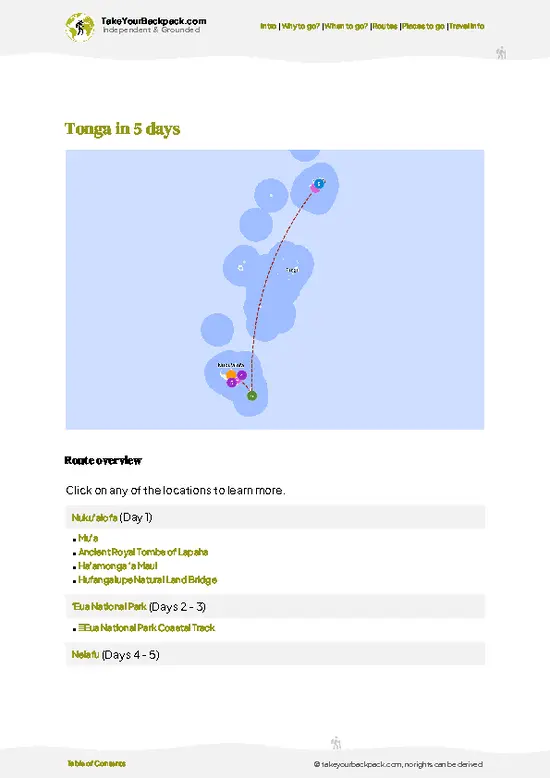
The Vibe: A satisfying first expedition that links Tongatapu’s royal and archaeological sites with the harbor life and island-scattered feel of Vava’u, using one domestic flight and a mix of taxis and boats. The pace is steady, giving you real time in each base instead of a blur of transfers.
The Highlights:
  • Two nights in Nuku‘alofa to absorb palace views, markets, and waterfront life
  • Day-tripping to Mu‘a, the Ancient Royal Tombs of Lapaha, and the Haʻamonga ʻa Maui Trilithon
  • Harbor sunsets and easy-going evenings in Neiafu on Vava’u Island
  • A final blast of Pacific power at the Tonga Blowholes on Tongatapu
🌍 Want a ready-to-use travel plan for Tonga?
The overview above compares different route options based on your travel time and style. The complete Travel Guide breaks each itinerary down in detail, including maps, stops, highlights, and transport information.

Explore all route details 👉

Get the Travel Guide -

🌤️ When to go?Best time to visit Tonga

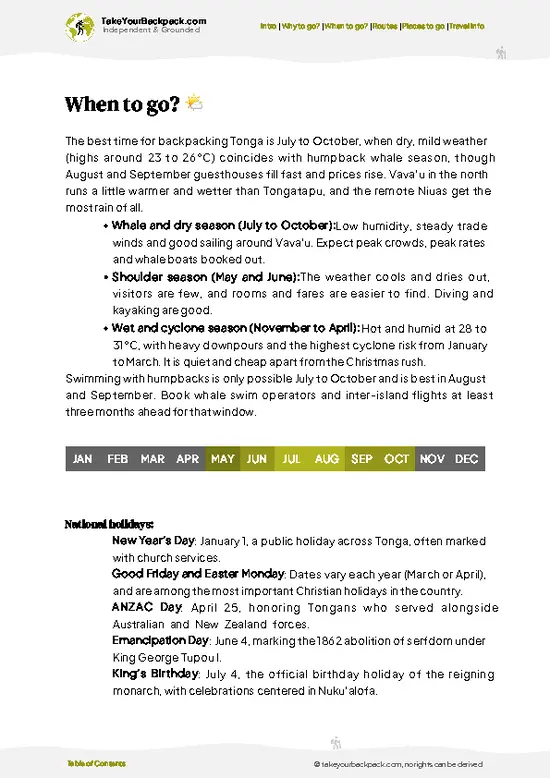
Sweet spot: late June and September-early October. The southeast trades cool nights and dry the clay on ’Eua’s ridges; reefs clear up, and ferries more often keep to the plan. Prices are still human after the winter-holiday surge, and you can still catch humpback song under your ribs without ten boats circling the same pod. Cyclones are off the table, heat backs down, and guesthouses start saying “yes” again.
  • Peak (Whale Run, Jul-Aug): Cost spikes, boats book out, and every van in Vava’u seems full. Then you slide into cobalt water and a cow and calf drift past, close enough to taste salt and adrenaline. Worth the scramble.
  • Shoulder (May-Jun, Sep-Oct): Shops unshutter, seas steady, and trails grip. You move—dawn ferries, afternoon snorkels, dusks with smoke and hymnals. Momentum without elbows.
  • Off-Peak Wet/Cyclone (Nov-Apr): Heavy air, mango-sweet gutters, empty beaches. Start at first light, carry a compact umbrella and dry bag, and switch to sandals when the sky dumps.

Tactical tip: For whale swims in September, book your operator weeks ahead and pad two weather days.

source: climatestotravel.comJANJanuary: below average for travelingFEBFebruary: below average for travelingMARMarch: fair for travelingAPRApril: fair for travelingMAYMay: good for travelingJUNJune: highly recommended for travelingJULJuly: excellent for travelingAUGAugust: excellent for travelingSEPSeptember: highly recommended for travelingOCTOctober: highly recommended for travelingNOVNovember: fair for travelingDECDecember: fair for traveling
📅 Traveling in a specific month?
Get a full month-by-month breakdown of weather, crowds, costs, festivals, and seasonal highlights in the complete travel guide.

Get full details when to go 👉

Get the Travel Guide -
tonga-vince-russell-ohU3 3w0rG0-unsplash

💰 Costs (as of 2026)What things cost day to day

Plan on 100-160 TOP ($45-70) per day if you move slow, cook, and skip boat trips; whale days blow that number apart.
  • dorm accommodation: 35-70 TOP ($15-30) for a fan dorm on Tongatapu or Vava’u; think thin mattress, salt-sticky air, rooster alarms at 5 a.m. System tip: book direct and pay in pa’anga cash to dodge 3-5% card surcharges; ask for a weekly rate and a fan room over AC—power cuts make AC pointless.
  • meals: Supermarket Survival: 12-25 TOP/day if you live on bread, eggs, noodles, tinned fish, and market fruit—buy on Saturday for Sunday when everything shuts. Street food reality: Tonga isn’t a night-stall playground; the move is midday market plates and roadside BBQ (10-18 TOP) and cheap bakery pies. Cheaper than French Polynesia, a notch pricier than Samoa.
  • local transport: Buses rattle by for 1-3 TOP/ride, stop at dusk, and skip Sundays; carry coins and wave them down. Hitchhiking is common and expected to be polite. Bikes rent for 15-25 TOP/day; scooters 40-60 TOP. Cheapest way to unlock the country: base on one island, use buses/bikes, and take the short ferry to ’Eua (rough, 30-50 TOP) instead of piling on domestic flights.
  • activities: Cost drivers are boats. Humpback swims
read more 👉
Plan on 100-160 TOP ($45-70) per day if you move slow, cook, and skip boat trips; whale days blow that number apart.
  • dorm accommodation: 35-70 TOP ($15-30) for a fan dorm on Tongatapu or Vava’u; think thin mattress, salt-sticky air, rooster alarms at 5 a.m. System tip: book direct and pay in pa’anga cash to dodge 3-5% card surcharges; ask for a weekly rate and a fan room over AC—power cuts make AC pointless.
  • meals: Supermarket Survival: 12-25 TOP/day if you live on bread, eggs, noodles, tinned fish, and market fruit—buy on Saturday for Sunday when everything shuts. Street food reality: Tonga isn’t a night-stall playground; the move is midday market plates and roadside BBQ (10-18 TOP) and cheap bakery pies. Cheaper than French Polynesia, a notch pricier than Samoa.
  • local transport: Buses rattle by for 1-3 TOP/ride, stop at dusk, and skip Sundays; carry coins and wave them down. Hitchhiking is common and expected to be polite. Bikes rent for 15-25 TOP/day; scooters 40-60 TOP. Cheapest way to unlock the country: base on one island, use buses/bikes, and take the short ferry to ’Eua (rough, 30-50 TOP) instead of piling on domestic flights.
  • activities: Cost drivers are boats. Humpback swims run 450-750 TOP ($200-330) plus transfers; two-tank dives 220-350 TOP; day sails/kayaks 150-300 TOP; cave/’blowhole’ access 5-20 TOP. Church choirs and kava nights cost little and feel rich. Pricier than Fiji for boats, far cheaper than French Polynesia.
  • miscellaneous: Budget leaks: ATM fees 10-15 TOP, card surcharges 3-5%, bottled water 2-4 TOP (boil if you can), sunscreen and repellent marked up, domestic luggage overages sting, and ferry delays eat unplanned nights. Beer (Ikale) is 5-8 TOP in shops, 8-12 TOP in bars—so the first cold one hits harder than in Samoa, but not Tahiti-level pain.
⚠️ Prices can change and everyone travels differently, so take this as a rough guide. Hope it helps you plan your adventure!

✈️ The backpacker research shortcutTonga Travel Guide

An offline-friendly backpacking guide with optimized travel routes, ranked highlights, transport advice, and the best areas to stay.
example page 0 from our offline Travel Guide for Tongaexample page 1 from our offline Travel Guide for Tongaexample page 2 from our offline Travel Guide for Tongaexample page 3 from our offline Travel Guide for Tongaexample page 4 from our offline Travel Guide for Tongaexample page 5 from our offline Travel Guide for Tongaexample page 6 from our offline Travel Guide for Tongaexample page 7 from our offline Travel Guide for Tonga
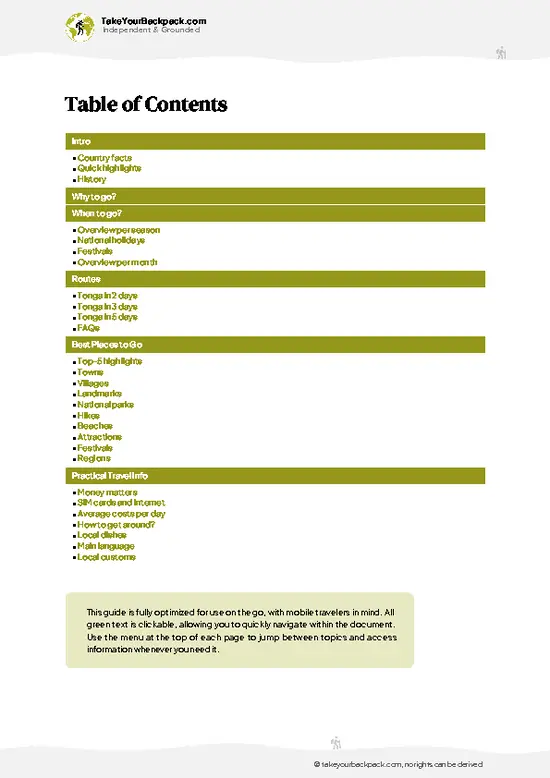
The digital guide (155 pages) contains:
34 highlights, ranked by travel appeal
Optimized 2, 3 & 5-day travel routes
Cities, national parks, beaches, historical sites, ...
How to get around
Offline-friendly for travel without Wi-Fi
👉 Click to see all 30+ guide features

📅 Plan smarter in minutes, not weeks
Month by month travel advice
Festivals & national holidays
Budget expectations

🗺️ Go to the right places, skip the overrated ones
Honest pros & cons of destinations
Top hikes, parks & viewpoints
Lesser-known places most travelers miss
Clear “worth it vs skip it” guidance

🛏️ Travel smoothly without rookie mistakes
Best areas to stay
Transport systems explained simply
Common scams & safety advice
SIM cards, money & practical tips

🌍 Understand the country, not just visit it
Culture & traditions
52 Essential phrases & customs
Festivals worth planning around
Traveler-friendly historical context
Insights that make places more meaningful

📱 Built for real travel conditions
Fully downloadable PDF
Works completely offline
Optimized for phone use
Useful in remote areas & buses
Everything in one place
Save weeks of stressful planning
Get instant access to the full guide directly. 30-day money-back guarantee.


Sent to your inbox immediately after payment • 100% Secure Checkout
Best Backpacking Travel Advisor 2025 tourism awardBest Backpacking
Travel Advisor
2025
What others say about Take Your Backpack Guides:
⭐⭐⭐⭐⭐
Fantastic, amazing amount of information!
⭐⭐⭐⭐⭐
My goodness this is amazing, it's what I've been looking for hats off too you!
⭐⭐⭐⭐⭐
I think this is absolutely BRILLIANT
⭐⭐⭐⭐
Very complete and informative. It's still missing places, but I gotta to commend you
⭐⭐⭐⭐⭐
This is truly amazing, thank you, can't wait to explore it with my kids!
⭐⭐⭐⭐⭐
Awesome resource, thank you!
⭐⭐⭐⭐⭐
This is amazing! Can't wait to explore the ones I haven't seen
⭐⭐⭐⭐
I love this! Well done, great idea.
⭐⭐⭐⭐⭐
Thanks for taking the time to make this gem!
⭐⭐⭐⭐⭐
This might be the best website I've ever seen.
⭐⭐⭐⭐⭐
Congratulations, and thank you so much for your work; it's incredibly valuable.
⭐⭐⭐⭐
In all seriousness I think you did a great job pointing out the important spots
⭐⭐⭐⭐⭐
10/10 very good
⭐⭐⭐⭐⭐
As someone who's only just starting to visit regularly this is awesome, thank you.
⭐⭐⭐⭐
Thank you very much! I'm going to visit my dad, it's going to be very useful!
⭐⭐⭐⭐⭐
This is really cool! We'll be travelling for the first time and this definitely come in handy.
⭐⭐⭐⭐⭐
You are now our minister of culture, congratulations 👨‍💼
⭐⭐⭐⭐⭐
Just wanted to tell you that this is a pearl! Going to follow your recommendations.
⭐⭐⭐⭐⭐
This is so cool. I'll definitely be using the resource for my travels soon.
⭐⭐⭐⭐⭐
This is very impressive! Good work.
⭐⭐⭐⭐⭐
This is an amazing and informative site. Very well done!

🛏️ Where to stay?Areas travelers tend to prefer

Yes — Tonga has hostels and budget guesthouses across the main islands (Tongatapu, Vava’u, Ha’apai); options are basic and limited, so book ahead for peak whale season and expect simple facilities and intermittent transport.

Most choices cluster in Nuku’alofa (Tongatapu) — best for services, transport links and predictable safety but limited nightlife; Neiafu (Vava’u) — best for whale-watching, more tourist services and some nightlife but higher prices; and Pangai (Ha’apai) — cheapest and quietest but very remote with sparse amenities and irregular ferries.

If you enjoy meeting fellow travelers, … read more 👉
Yes — Tonga has hostels and budget guesthouses across the main islands (Tongatapu, Vava’u, Ha’apai); options are basic and limited, so book ahead for peak whale season and expect simple facilities and intermittent transport.

Most choices cluster in Nuku’alofa (Tongatapu) — best for services, transport links and predictable safety but limited nightlife; Neiafu (Vava’u) — best for whale-watching, more tourist services and some nightlife but higher prices; and Pangai (Ha’apai) — cheapest and quietest but very remote with sparse amenities and irregular ferries.

If you enjoy meeting fellow travelers, consider choosing hostels with high ratings for atmosphere. On the other hand, if you prefer having your own space, a hotel might be a better option.

🚌 Getting aroundHow to travel within the country

Tonga runs on tides and church bells, not clocks. Routes swell and shrink; a bus moves when seats fill, a ferry when the swell behaves, a plane when the mechanic nods. You wait in shade, dust on your calves—then it snaps: salt spray, asphalt, and a cold Maka sweating in your fist.
  • Domestic flights Fastest way across the groups; breakfast in Nuku’alofa, lunch in Neiafu when it flies. Pricier than ferries and strict on weight; pay per kilo over. Book mornings. Pack patience and a soft bag. Don’t stack
read more 👉
Tonga runs on tides and church bells, not clocks. Routes swell and shrink; a bus moves when seats fill, a ferry when the swell behaves, a plane when the mechanic nods. You wait in shade, dust on your calves—then it snaps: salt spray, asphalt, and a cold Maka sweating in your fist.
  • Domestic flights Fastest way across the groups; breakfast in Nuku’alofa, lunch in Neiafu when it flies. Pricier than ferries and strict on weight; pay per kilo over. Book mornings. Pack patience and a soft bag. Don’t stack tight connections or same-day boats.
  • Local buses Plastic seats, hymns on the radio, schoolkids with sticky ice blocks. Flag with a low wave; greet the driver; pay coins. Tap a coin or call to drop anywhere. Service fades at dusk and stops on Sunday. Cheap, slow, and honest.
  • Inter-island ferries Water is the unlock. Ferries and cargo boats reach wharves no runway serves. Bring seasick pills, water, and a mat; the deck beats benches. Board early to claim shade. Sea state rules the timetable, and delays stack like crates.
  • Hitchhiking and shared taxis Pickups stop if you look hopeful; ride the tray, keep a hand on your pack, offer a small fuel note. Shared taxis run per seat—name your village and squeeze in. It undercuts solo fares and fills the gaps when buses vanish.

Master tip: Move early and midweek—take first departures, travel Monday to Wednesday, and carry a one-day buffer per island; in Tonga, time cushions beat cash.
Distance
Fuaʻamotu International Airport (TBU) is about 21 km (13 mi) south of central Nukuʻalofa.

Main ways to get into town
  • Public bus (budget option) — Buses don’t come into the airport. Walk about 1.5-2 km to the main road at Fuaʻamotu village and flag a Tongatapu bus heading to Nukuʻalofa.

    Time: 45-70 minutes door to door (includes walk and waiting).

    Cost: TOP 2-3 cash, pay the driver.

    Notes: Runs roughly Mon-Sat daylight hours with variable frequency (about every 30-60 minutes). No buses on Sunday. Space for big luggage is limited.
  • Hotel/guesthouse transfer (prebooked) — Many accommodations arrange meet-and-greet transfers.

    Time: 30-40 minutes.

    Cost: Typically TOP 30-50 per person, or TOP 60-80 per vehicle (one way).

    Notes: Worth it for late flights or Sundays when buses don’t run.
  • Car rental — Desks meet flights, but hours can be irregular.

    Time: 30-35 minutes’ drive.

    Cost: About TOP 70-100 per day plus fuel.

    Notes: Check permit requirements with the rental company before booking, and drive cautiously—roads are simple but poorly lit at night.

Taxi
Metering isn’t standard; agree the fare before you go. Expect around TOP 40-70 per car to central Nukuʻalofa (more late at night or on Sunday). Ride time is typically 30-40 minutes. Cash is safest, though some drivers can take local cards if you ask first.

Practical tips (2025): There’s no Uber/ride-hailing in Tonga. If you want the public bus, ask airport staff to point you toward the main road. For early-morning or late-night arrivals, prebooking a transfer or taxi is the least stressful option.
⚠️ Prices and routes can change, so take this as a rough guide and ask for local advice when you arrive.

🔒 Safety (risk Level: low)Safety considerations for travelers

Safety for solo travelers, including women and LGBTQ+ individuals
Tonga is generally safe for solo travelers, including women, but it’s wise to exercise usual caution, especially in less populated areas. For LGBTQ+ individuals, Tonga is conservative with strong religious influences, so public displays of affection are best avoided. Solo travelers should respect local customs and stay informed about any political changes. Overall, by staying aware and respectful, travelers can enjoy Tonga’s warm hospitality and beautiful landscapes.


Full official government travel advisory (live updates)
View details 👉

✈️ VisaEntry requirements and paperwork

Most nationalities, including citizens from the US, Canada, and EU countries, don’t need a visa for stays up to 30 days in Tonga. Make sure your passport is valid for at least six months beyond your planned departure date. If you plan to stay longer, you must apply for an extension at the Immigration Office in Nuku’alofa.
⚠️ Visa requirements can change over time, so always check the latest visa requirements with the official embassy or government website before you travel.

🎒 What to pack?What to pack for Tonga

Tonga’s tropical climate means you’ll be dealing with heat and humidity, so lightweight, breathable clothing is your best bet. While shorts and tank tops are great for the beach, remember that Tonga is quite traditional, and modest clothing is appreciated, especially in villages or when visiting churches. Pack a sarong or a wrap to cover up when necessary. Expect some rain, especially from November to April, so a compact rain jacket is useful. Beaches are stunning with soft sands, but some areas are rocky, so consider some sturdy footwear if you’re planning to explore beyond the shorelines.

Apart from this country specific advice, I have also crafted a general packing list that should help on any trip. authorOver the years, I've learned the importance of packing minimally. It's so much easier to jump on the back of a truck or squeeze yourself into the last spot of a minibus without that supersized backpack. If you're headed to a warm destination, leave your winter jacket at home; for colder regions, opt for thin thermal underlayers. Instead of packing your entire wardrobe, bring just three sets of clothes, as laundry facilities are available everywhere.
View the full list 👉
🎒 Planning the practical side of your trip?
Get detailed information on transport, daily budgets, internet access, local customs, food, language, and other essentials in the complete Travel Guide.

Get detailed practical information 👉

Get the Travel Guide -

🙋 FAQFrequently asked questions

Trip Planning


Personal tip: I normally search on good rating for atmosphere (for meeting people) and location (for easy exploring). Cleanliness as a bonus.


Travel Essentials

Routine vaccinations like MMR, DTP, and flu shots are recommended. Consider Hepatitis A and B, especially if you plan to explore rural areas or eat street food. Typhoid is also suggested if you’re going off the beaten path. Check the latest updates for COVID-19 requirements. Always consult a healthcare provider for personalized advice.


vaccination requirements
When I first started traveling, I often spent part of my first day in a new country hunting for a local SIM card. While this can still be slightly cheaper, it also takes time and planning.

These days, it's much simpler to install an eSIM before leaving home. Once you arrive in Tonga, you can activate it immediately and have mobile data from the moment you land — which is especially useful for ordering transport or navigating away from busy airports.

There are many providers nowadays, and price differences are usually small. I personally go with Airalo, as it offers excellent network coverage throughout the country and strong global coverage, so you can manage multiple countries from a single app.


Get your e-sim for Tonga

Culture & Customs

Dress modestly, especially in villages; knees and shoulders should be covered. Remove shoes when entering homes. Sundays are for rest; most activities and businesses pause. Avoid public displays of affection, including same-sex couples, to respect local norms. Women should be cautious when traveling alone at night. Respect the local pace—things move slowly, and patience is key. Always ask permission before taking photos of people.
Trying traditional food is always a great way to experience the culture. Here are some must-try dishes for Tonga.
  • Lū Pulu: This is a traditional dish made with corned beef, coconut cream, and taro leaves, all wrapped together and baked until tender. It’s a staple in Tongan feasts, showcasing the island’s love for coconut and hearty flavors.
  • Ota Ika: Think of it as Tonga’s version of ceviche. It’s raw fish marinated in coconut milk, lemon juice, and chopped vegetables. It’s a refreshing, light dish that’s perfect for tasting the ocean’s bounty.
  • Faikakai Topai: A sweet treat made from flour dumplings boiled and then smothered in a caramel sauce made from coconut milk and sugar. It’s a popular dessert during special occasions and highlights the Tongan love for coconut in both savory and sweet dishes.
  • Kapisi Pulu: A comforting dish of corned beef mixed with cabbage and coconut cream. It’s often baked in an underground oven, imbuing it with a smoky flavor that’s deeply satisfying.
Locals in Tonga often drink tap water, but it’s usually recommended for tourists to opt for bottled or filtered water to avoid potential stomach issues. Bottled water is readily available, so it’s a safer bet for travelers. If you’re staying longer, consider bringing a portable water filter.
The main language in Tonga is Tongan. Backpacking is way more rewarding if you know a bit of the local language, so I'd suggest brushing up on the basics just in case your Tongan skills have become a bit rusty.

Want to understand locals better?
The complete Travel Guide for Tonga includes 52 essential words and phrases — greetings, thank-yous, ordering food, transport, numbers, and common local expressions you'll actually hear.

Get your local basic phrases 👉

Get the Travel Guide -


English is widely spoken in Tonga, particularly in urban areas and among the younger population. It serves as one of the official languages alongside Tongan, which is the native language. Most Tongans, especially those involved in tourism, education, and government, have a good command of English. Signs, menus, and informational materials in tourist areas are typically available in English, making it easier for travelers to navigate.

However, in more remote or rural areas, you may encounter individuals who speak limited English, as Tongan is predominantly used in daily life. While basic communication is usually possible, learning a few Tongan phrases can enhance your experience and show respect for the local culture. Overall, English proficiency in Tonga is sufficient for travelers, but being open to language differences can enrich your interactions with the local community.

Money & Payments

The local currency of Tonga is TOP (T$).

When backpacking in Tonga, it’s wise to carry some cash, but don’t go overboard. ATMs are available in major towns like Nuku’alofa and Neiafu, but they can be a bit unpredictable. It’s smart to keep some cash on hand for smaller islands where ATMs are scarce or nonexistent.

Tongan Paʻanga is the local currency, and while US dollars might be accepted at some tourist-focused spots, it’s not guaranteed. Euros are less commonly accepted. For peace of mind, exchange a bit of cash at the airport or local banks when you arrive, but keep an eye on rates as they can vary.

Credit cards are accepted in larger hotels and restaurants, but smaller businesses and local markets often prefer cash. A Visa or MasterCard is your best bet if you’re planning on using plastic. Just in case, notify your bank about your travels to avoid any card issues while island hopping.

Tipping in Tonga isn’t a common practice, as hospitality staff are generally paid a fair wage. If you feel inclined to show appreciation for exceptional service, a small tip or rounding up the bill is appreciated but not expected. In more touristy areas, some hotels and restaurants might add a service charge, so check your bill.

🧩 Nearby countriesNearby backpacking alternatives

We 💚 feedbackIs Tonga worth visiting?

Tonga moves at church-bell pace; Sundays go quiet; you learn to wait. The air smells of salt and frangipani, diesel from utes, kava breath after dark, and an Ikale so cold it sweats. Best surprise: that first choir note rolling out of a tin-roof church, and humpbacks exhaling like steam trains off Vava’u. Watch your feet on razor coral and bring cash; ATMs hiccup. Change is coming—tighter whale-swim rules, solar panels popping up, better inter-island links and internet after the eruption—slow, but moving the right way.

✍️ Help improve this page!
The information on this page is based on in-depth research, insights shared by experienced travelers, and feedback from the local travel community in Tonga. While every effort is made to keep the information accurate and current, conditions can change — so if you spot anything incorrect or outdated, please get in touch.


🙋‍♂️ Give feedback

👋 Meet the founderWho’s Behind Take Your Backpack?

Johan, backpacker and founder of TakeYourBackpackHi, I’m Johan (Netherlands 🇳🇱), the creator of TakeYourBackpack. Over the past decade, I’ve backpacked through 80+ countries across six continents, gaining extensive experience with independent travel, long-term trips, and overland routes.

This site is built on a combination of firsthand travel experience and carefully curated insights from other backpackers. Many guides are based on places I’ve personally visited, while others bring together tips, observations, and practical advice shared by trusted travelers I’ve met along the way.

The goal is to provide realistic, experience-driven guidance — not generic itineraries — so you can explore destinations with better context, clearer expectations, and more confidence.

Get full Tonga guide •
Instant download • 34 highlights • Full Offline guide