×
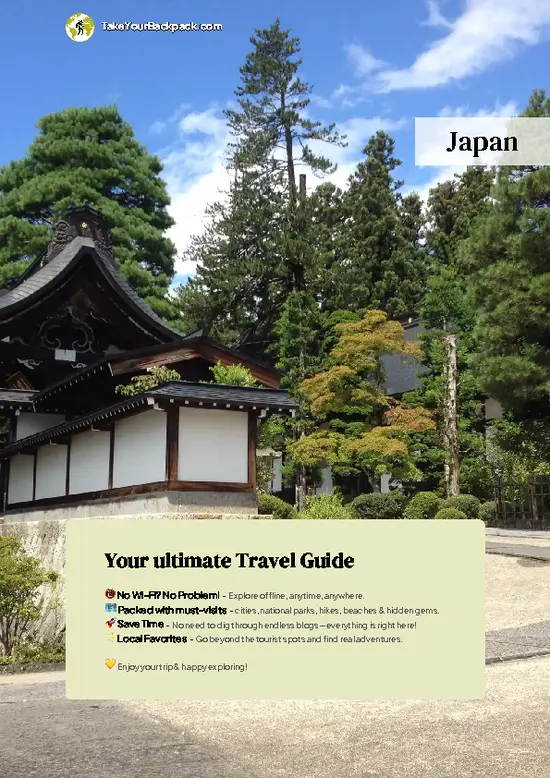
Japan 🇯🇵

backpacking Asia Japan 🇯🇵Navigate precision transit between tradition and futurism daily.

Explore IsraelExplore Jordan

Backpacking Japan in 2026

A complete guide including when and where to go, costs, transport, itineraries, and practical travel advice.
Traveling in Japan: what to expect

Backpacking Japan
By Johan Kruseman 🇳🇱 | Updated June 14, 2026

Your train glides in to the second, and strangers line up with quiet precision while a vending machine sings a tiny melody. It feels choreographed because, here, systems are a shared promise. Japan is where order clears mental space for adventure.

That’s the trick: the country’s famous contrasts aren’t chaos, they’re well-synced layers—neon over noodle steam, cedar shrines behind office towers, powder snow two transfers from sushi that ruins you for the rest of your life. Follow the rhythm—seasonal rituals like hanami and autumn leaves, onsen before dinner, last train not last call—and the landscape opens: Hokkaido’s alpine silence, Fuji’s perfect cone on a blue morning, the mossy hush of Kyoto at dawn, the island art playgrounds of the Seto Inland Sea. Craft isn’t a museum here; a knife-maker explains steel like a poet, a barista weighs drip like a watchmaker, a sumo stable clangs awake before sunrise. Even cities feel navigable because the rail map is a logic puzzle you can actually solve; I once changed platforms in Shin-Osaka with four minutes to spare and never broke stride. Yes, there’s queuing, cash-only corners, quiet trains, tattoos that complicate hot springs, and crowds that reward early alarms. Each small concession is a key: a few phrases, an IC card, shoes off without fuss—do that, and the country lifts you along its current.

Compared to South Korea’s bass-thump nights or Taiwan’s loose, chatty warmth, Japan is more ritual-forward and detail-obsessed; compared to China’s sheer scale, it’s intimacy at high resolution. Come if you enjoy learning a system and then flowing through it—food nerds, design lovers, powder seekers, hikers, solo travelers who like feeling capable the minute the doors slide open.

👉 Get the 📖 Travel Guide of Japan

Kanto Megalopolis (Tokyo–Yokohama–Kamakura–Nikko)

If you want density you can master, start here. Trains come every 2–5 minutes and run like clockwork, so the game is picking a base on the Yamanote Loop (Ueno or Shinagawa for airport links; Shinjuku for westbound day trips) to cut transfers. Tap in with Suica/PASMO and stop thinking about tickets. Slot in Kamakura at sunrise, Nikko midweek. Private lines (Tobu, Odakyu) often beat JR on price; they’re straightforward if you commit to one route. Rewards nimble planners who enjoy big-city puzzles and late-night eats.

Kansai Cultural Core (Kyoto–Osaka–Nara–Kobe)

One urban web, four personalities. The JR Special Rapid ties Kobe–Osaka–Kyoto in about an hour end to end; trains roll every 10–15 minutes. Sleep in Osaka near the Loop Line for food and cheaper rooms, then raid Kyoto’s temples at dawn before buses clog. Use Hankyu for Kyoto’s northwest and Keihan for the river corridor; they’re direct and undercut JR on those legs. Nara works as a morning hit from Osaka. This region pays off for culture hawks who move early and eat late.

Hokuriku + Northern Alps (Kanazawa–Toyama–Matsumoto)

A clean spine with mountain off-ramps. The Hokuriku Shinkansen drops you in Kanazawa or Toyama from Tokyo in 2.5–3 hours; from there, buses and ropeways stitch the Tateyama–Kurobe route. It’s linear, so forward your big bag and carry a daypack. Spring snow walls, summer ridgelines, fall larch—winter shuts pieces down. Takayama and Shirakawa-go slot in via bus; save one buffer day for weather. This is for hikers, onsen seekers, and craft-town wanderers who can live with early starts and timetables.

Tohoku Quiet North (Sendai–Iwate–Aomori–Akita)

Long runs, big silence. The Tohoku Shinkansen sprints to Sendai, Morioka, and Shin-Aomori; after that, local trains thin to hourly and buses test patience. That’s your cue to rent a car for coasts, trailheads, and old hot-spring lodges (Nyuto, Tsuta). Rooms and meals often run 20–40% cheaper than Kanto, so stay longer and spread out. Winter brings deep snow and clear air; autumn peaks late. Suits people who value space over checklists and don’t mind driving.

Kyushu Volcanic Loop (Fukuoka–Nagasaki–Kumamoto–Aso–Beppu)

A rail arc with lava in the middle. The Kyushu Shinkansen links Fukuoka to Kumamoto and Kagoshima; Limited Express Sonic runs to Beppu. Base in Fukuoka for late trains and easy food, then push out: Nagasaki by express, Aso by rental car for crater roads, Beppu or Kurokawa for hot springs. Summer rains hit hard; build slack. On long hops from Tokyo, early flights often rival rail on price. Best for onsen addicts and landscape chasers who like mixing trains with short, targeted drives.
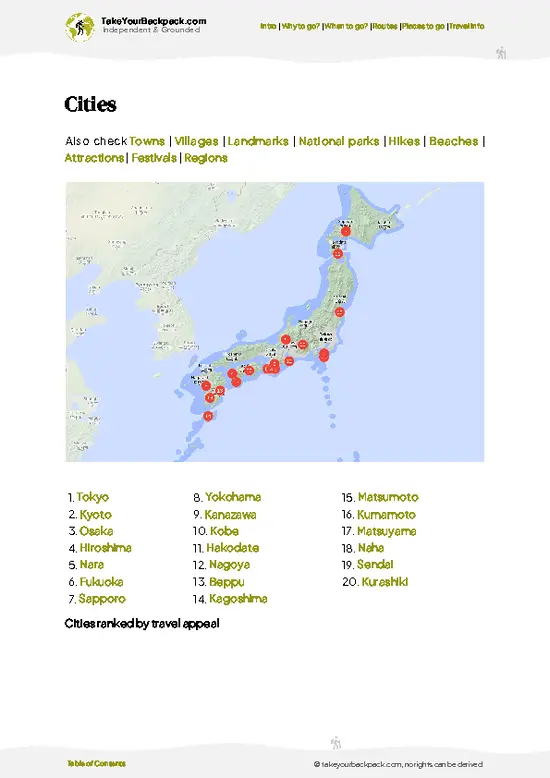
Geography and where places are located
Loading the map 🌍
CLICK TO FILTER
cities
towns
villages
landmarks
national parks
hikes
beaches
attractions
festivals
regions
SHOW COUNTRY’S BESTSHOW ALL

Why go?What draws travelers here

Scenery

Japan stacks scenery like a logic puzzle you can solve. Volcanic spine equals crater lakes, steam vents, … read more 👉
Japan stacks scenery like a logic puzzle you can solve. Volcanic spine equals crater lakes, steam vents, lava caves, and onsen—all linked by trains that run to the minute, so sunrise and blue-hour missions are realistic without a car. Latitude spread equals season-chasing: yakusugi forests in the south while alpine meadows thaw in Hokkaido, then pampas-grass hills in Hakone and the Aso caldera turning gold. Ropeways and well-graded trails put ridge views in reach; coin lockers and luggage forwarding keep you light so you can pivot with weather.

Pro-tip: Fuji’s wind and ice caves stay fridge-cold year-round—pack a puffy and thin gloves. Personal: I took the first Asahidake ropeway, hit the fumarole loop at dawn, then soaked in an onsen before lunch; zero crowds, maximum contrast, no wasted motion.

Mountains

Japan rewards hikers because the country is engineered for it: trains and buses drop you at real trailheads, … read more 👉
Japan rewards hikers because the country is engineered for it: trains and buses drop you at real trailheads, mountain huts stitch the ridgelines, and hot springs sit exactly where your quads give up. That “why” becomes a “how.” Use the rail network to leapfrog cities and sleep near the start; then go hut-to-hut with a light pack. Pro tip: ship your suitcase with takkyubin and carry 8–10 kg at most—I sent mine Tokyo→Takayama and floated through Kamikochi to Yarigatake. The system assumes early starts and cash: huts expect reservations and yen, and 3–4 a.m. headlamps beat clouds, lightning, and crowds. Convenience stores handle fuel and breakfasts; on the back end, an onsen resets everything. In bear country (Hokkaido, parts of Nagano), wear a bell; in typhoon weeks, front-load big days when the window opens.

Architecture

Japan is a workshop of problem‑solving in wood, stone, and steel. Earthquakes, fires, and ritual rebuilding … read more 👉
Japan is a workshop of problem‑solving in wood, stone, and steel. Earthquakes, fires, and ritual rebuilding force clean design logic; read those rules and your days click.

Original castles are rare, so spend energy where craft remains: Himeji, Matsumoto, Hikone, Inuyama. Concrete keeps are for views, not joinery. Pro tip: be at Himeji 30 minutes before opening and walk straight to the top; you’ll have the tight stairwells to yourself.

Timber mastery lives in temples: Horyu‑ji’s bracket arms show how roofs float; shrines teach tatami‑module planning by feel. I carry thin socks—floors are cold and shoes come off.

For modern, walk Omotesando to Aoyama at 7–9 am: Ando, Kuma, Prada’s glass, no crowds. Tokyo International Forum is free, covered, and photographically generous.

Rail links make it a game; chain Hikone morning, Kyoto machiya dusk.

Food

Japan rewards eaters who learn its system. The country runs on seasonality, single‑dish specialists, … read more 👉
Japan rewards eaters who learn its system. The country runs on seasonality, single‑dish specialists, and logistics that move fish from dock to counter before sunrise. Your edge is timing and process. Eat lunch sets (teishoku) before 12:00 for chef-level quality at commuter prices. Hit department‑store basements (depachika) near closing for 20–50% off bentos; it’s orderly chaos worth the elbow work. Ramen shops use ticket machines—decide fast, pay, hand the stub; cash helps. Solo? Say “hitori desu” and take the counter; slurping signals you’re doing it right. Trains make eating part of the game: grab an ekiben and ride. Convenience stores are legal cheat codes—onigiri and hot snacks that won’t sabotage your budget. I plan dinners at 17:30, skip the line, and watch the grill master work from two feet away.

Uniqueness

Japan feels off the beaten track not because it’s far, but because its rules run on a different operating … read more 👉
Japan feels off the beaten track not because it’s far, but because its rules run on a different operating system. The machine is tight. Trains hit the minute, konbini feed you at any hour, and coin lockers let you roam bag-free. Leverage that: IC card + lockers + konbini bentos = agile day-tripping through small stations and half-empty towns. Because local lines are dependable, you can choose the slow train into Tohoku or Shikoku and make the journey the prize. Pro tip: the Seishun 18 Ticket (seasonal) unlocks unlimited local trains for a day rate that undercuts most European rail passes. Onsen are the social engine—scrub first, no suits; seek village rotenburo for real talk. I once swapped apples for onigiri with a farmer in Aomori; charades and curiosity opened every door.

People

Japan’s kindness runs on systems: omoiyari (reading your needs) and low-friction order. That’s why interactions … read more 👉
Japan’s kindness runs on systems: omoiyari (reading your needs) and low-friction order. That’s why interactions are precise, modest, and quick. Match it and everything opens. Speak simply, one request at a time. Point to an address. I carry a pen and write it; success rate jumps.

At counters, you’ll hear irasshaimase, see the change tray, and two-handed returns. Use the tray, step aside after paying. Pro tip: a soft thank-you plus a small bow is the cheat code.

Ask directions and someone may walk you there—responsibility is taken seriously. If they do, match their pace and offer a tiny snack as thanks.

Queues signal the vibe: stand left in Tokyo escalators, right in Osaka; backpack off on trains. Humor is gentle. Counter seats unlock it—yakitori bars or Osaka standing pubs. I’ve had my clumsy chopstick grip roasted, kindly.

Backpackers

Japan rewards backpackers who think in systems. Trains run to the minute; pair an IC card with station … read more 👉
Japan rewards backpackers who think in systems. Trains run to the minute; pair an IC card with station coin lockers (tap to pay) and convenience stores and you’ll cross cities light, fed, and on time. Hostel density in Tokyo, Osaka, and Kyoto lets you pivot—book short, extend where the common room clicks. Night buses link major cities for about a third of a bullet-train fare and double as your bed. Pro tip: stash your pack, ride local lines to side-street districts, then onsen, noodle, sleep. I’ve had my best nights at takoyaki parties in Osaka hostels and low-key language exchanges in Asakusa. Use luggage forwarding (takkyubin) on hike days; arrive light, push bigger miles, still make the last ramen.
Want the complete picture of Japan?
The offline Travel Guide brings everything together — routes, highlights & planning.

See what's included in the guide 👉

Get the Travel Guide -

⭐ HighlightsStandout locations across the country

  • Fushimi Inari Taisha, Kyoto: The torii tunnel works because you control time and direction: go pre-dawn or after 9 pm, start left at the base to move opposite the crowd, and push to Yotsutsuji overlook before looping down side paths where it’s just you and fox shrines. Carry coins; the clack of offering boxes and faint bell rings are your metronome. The air smells of cedar and candle wax, and the lacquered gates leave a faint orange dust on your fingertips.
  • Hakone Loop: This is a transport puzzle you can win: buy a Hakone Freepass at Shinjuku or Odawara, stash your big bag in station lockers, then ride local train to Hakone-Yumoto, bus to the ropeway, ropeway over Owakudani, boat across Ashinoko, and return by switchback railway. Go clockwise to clear Owakudani before wind closures. If Fuji shows, great; if not, the payoff is the system humming. You’ll taste sulfur from black eggs, feel lake spray on the deck, and hear the ropeway cabin thrum overhead.
  • Naoshima Art Island: It rewards early
read more 👉
  • Fushimi Inari Taisha, Kyoto: The torii tunnel works because you control time and direction: go pre-dawn or after 9 pm, start left at the base to move opposite the crowd, and push to Yotsutsuji overlook before looping down side paths where it’s just you and fox shrines. Carry coins; the clack of offering boxes and faint bell rings are your metronome. The air smells of cedar and candle wax, and the lacquered gates leave a faint orange dust on your fingertips.
  • Hakone Loop: This is a transport puzzle you can win: buy a Hakone Freepass at Shinjuku or Odawara, stash your big bag in station lockers, then ride local train to Hakone-Yumoto, bus to the ropeway, ropeway over Owakudani, boat across Ashinoko, and return by switchback railway. Go clockwise to clear Owakudani before wind closures. If Fuji shows, great; if not, the payoff is the system humming. You’ll taste sulfur from black eggs, feel lake spray on the deck, and hear the ropeway cabin thrum overhead.
  • Naoshima Art Island: It rewards early movers and reservations: base in Uno or Takamatsu, catch the first ferry, rent an e-bike at Miyanoura, and pre-book Chichu Art Museum with a tight time slot so the day flows. Mondays can mean closures, so flip to Teshima if needed. Between Ando’s concrete shadows and shoreline installations, the Seto Inland Sea puts salt on your lips, cicadas drone like a faulty power line in summer, and the Benesse shuttle brake squeal becomes your north star.
  • Miyajima (Itsukushima Shrine): Tide dictates the show; check the board at Miyajimaguchi before the ferry so you hit the gate at either full mirror or walkable mudflats. JR Pass holders should use the JR ferry; it angles for the best torii view. Beat tour buses by arriving early, then hike Daisho-in up Mount Misen and ride the ropeway down. Deer will try to eat your map, the shrine’s planks feel cool under bare feet, oysters steam on street grills, and a hot momiji manju burns your fingers.
  • Kumano Kodo, Kii Peninsula: Pick the Nakahechi route for a doable 1-3 day trek; stage in Kii-Tanabe, reserve buses to trailheads, and forward your pack with takuhaibin to keep the climbs honest. Rain turns stones slick, so wear lugged shoes and carry a light tarp; stamps at oji shrines track progress without guesswork. The forest smells of damp cedar and soil, your palm comes away sticky from resin, and Yunomine Onsen’s mineral heat bites in the best way. For off-the-map: Kiso Valley’s pre-dawn Magome-Tsumago walk, the Tottori Sand Dunes at sunset, and remote Aogashima’s volcano village; personal favorite is that Kiso stretch when the post towns creak awake.
Spotted a mistake or missing a highlight? Contact us.

But Japan offers more...

Discover and compare all of its highlights per category

🧭 RoutesHow travelers typically move through the country

The 7-Day Kansai Classics Route

The Vibe: One region, three cities, and a week that feels rich instead of rushed—temples, food, and easy train hops between Kyoto, Nara, and Osaka. You get a deep first taste of Japan’s cultural core without burning time on long-distance travel.
The Highlights:
  • Temple-hopping and backstreet wandering in Kyoto, including Fushimi Inari Taisha and Kiyomizu-dera.
  • A slower day among deer and temple parks in Nara.
  • Osaka nights with castle views by day and street food feasts after dark.

The 14-Day Tokyo-Kyoto-Hiroshima Rail Journey

The Vibe: A classic first-timer arc that links Tokyo’s energy, Kyoto’s history, Nikko’s forests, and Hiroshima’s reflection at a comfortable, train-powered pace. You see several sides of Japan—urban, spiritual, and coastal—without feeling like you’re living out of your suitcase.
The Highlights:
  • Four nights in Tokyo to explore Senso-ji, Meiji Jingu, and Skytree at an unhurried pace.
  • Cedar-lined shrines and cool mountain air around Nikko and its
read more 👉

The 7-Day Kansai Classics Route

The Vibe: One region, three cities, and a week that feels rich instead of rushed—temples, food, and easy train hops between Kyoto, Nara, and Osaka. You get a deep first taste of Japan’s cultural core without burning time on long-distance travel.
The Highlights:
  • Temple-hopping and backstreet wandering in Kyoto, including Fushimi Inari Taisha and Kiyomizu-dera.
  • A slower day among deer and temple parks in Nara.
  • Osaka nights with castle views by day and street food feasts after dark.

The 14-Day Tokyo-Kyoto-Hiroshima Rail Journey

The Vibe: A classic first-timer arc that links Tokyo’s energy, Kyoto’s history, Nikko’s forests, and Hiroshima’s reflection at a comfortable, train-powered pace. You see several sides of Japan—urban, spiritual, and coastal—without feeling like you’re living out of your suitcase.
The Highlights:
  • Four nights in Tokyo to explore Senso-ji, Meiji Jingu, and Skytree at an unhurried pace.
  • Cedar-lined shrines and cool mountain air around Nikko and its UNESCO temple complex.
  • Kyoto and Nara for the full temple-and-tradition immersion.
  • Hiroshima and Miyajima for powerful history and island shrine scenery.

The 21-Day Japan Deep-Dive: Cities, Alps, Islands, and Okinawa

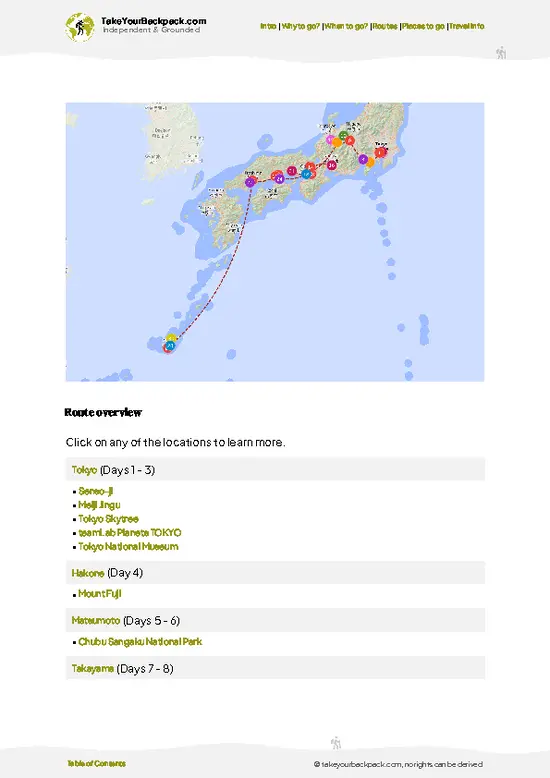
The Vibe: A three-week, slow-burn adventure that layers Tokyo, the Japanese Alps, Kansai, the Inland Sea, Hiroshima, and Okinawa into one coherent story. It’s for travelers who want both the big-name sights and the in-between places that give the country its texture.
The Highlights:
  • Tokyo plus a Hakone onsen escape with views toward Mount Fuji.
  • Castle towns and mountain air in Matsumoto, Takayama, and Shirakawa-go within the Japanese Alps and Chubu Sangaku National Park.
  • Extended time in Kyoto, Nara, and Osaka to really feel the Kansai region.
  • Himeji Castle, Naoshima’s island art, Hiroshima’s Peace Memorial Museum, and a beachy finale in Okinawa around Naha and Emerald Beach.
🌍 Want a ready-to-use travel plan for Japan?
The overview above compares different route options based on your travel time and style. The complete Travel Guide breaks each itinerary down in detail, including maps, stops, highlights, and transport information.

Explore all route details 👉

Get the Travel Guide -

🌤️ When to go?Best time to visit Japan

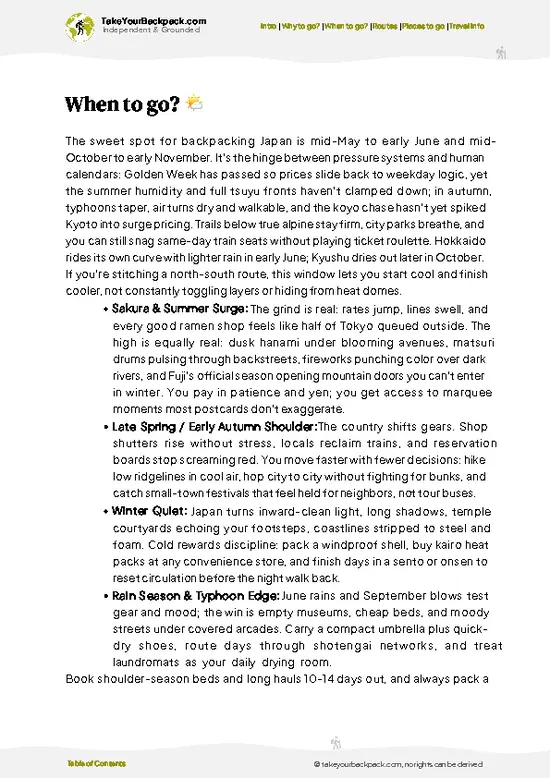
The sweet spot for backpacking Japan is mid-May to early June and mid-October to early November. It’s the hinge between pressure systems and human calendars: Golden Week has passed so prices slide back to weekday logic, yet the summer humidity and full tsuyu fronts haven’t clamped down; in autumn, typhoons taper, air turns dry and walkable, and the koyo chase hasn’t yet spiked Kyoto into surge pricing. Trails below true alpine stay firm, city parks breathe, and you can still snag same-day train seats without playing ticket roulette. Hokkaido rides its own curve with lighter rain in early June; Kyushu dries out later in October. If you’re stitching a north-south route, this window lets you start cool and finish cooler, not constantly toggling layers or hiding from heat domes.
  • Sakura & Summer Surge: The grind is real: rates jump, lines swell, and every good ramen shop feels like half of Tokyo queued outside. The high is equally real: dusk hanami under blooming avenues, matsuri drums pulsing through backstreets, fireworks punching color over dark rivers, and Fuji’s official season opening mountain doors you can’t enter in winter. You pay in patience and yen; you get access to marquee moments most postcards don’t exaggerate.
  • Late Spring / Early Autumn Shoulder: The country shifts gears. Shop shutters rise without stress, locals reclaim trains, and reservation boards stop screaming red. You move faster with fewer decisions: hike low ridgelines in cool air, hop city to city without fighting for bunks, and catch small-town festivals that feel held for neighbors, not tour buses.
  • Winter Quiet: Japan turns inward—clean light, long shadows, temple courtyards echoing your footsteps, coastlines stripped to steel and foam. Cold rewards discipline: pack a windproof shell, buy kairo heat packs at any convenience store, and finish days in a sento or onsen to reset circulation before the night walk back.
  • Rain Season & Typhoon Edge: June rains and September blows test gear and mood; the win is empty museums, cheap beds, and moody streets under covered arcades. Carry a compact umbrella plus quick-dry shoes, route days through shotengai networks, and treat laundromats as your daily drying room.

Book shoulder-season beds and long hauls 10-14 days out, and always pack a light umbrella even in winter; Japan rewards the prepared.

source: climatestotravel.comJANJanuary: good for travelingFEBFebruary: good for travelingMARMarch: good for travelingAPRApril: highly recommended for travelingMAYMay: excellent for travelingJUNJune: highly recommended for travelingJULJuly: fair for travelingAUGAugust: fair for travelingSEPSeptember: fair for travelingOCTOctober: excellent for travelingNOVNovember: highly recommended for travelingDECDecember: good for traveling
📅 Traveling in a specific month?
Get a full month-by-month breakdown of weather, crowds, costs, festivals, and seasonal highlights in the complete travel guide.

Get full details when to go 👉

Get the Travel Guide -
!2015-08-26 12.49.59

💰 Costs (as of 2025)How expensive it really is

¥7,000-¥10,000 per day if you sleep in dorms, eat convenience-store bentos, and use night buses; speed and bar tabs push you to ¥12,000-¥15,000.
  • dorm accommodation: ¥2,500-¥4,500 in most cities; Tokyo/Kyoto weekends can hit ¥3,500-¥5,500, countryside ¥1,800-¥3,000. System tip: book Sun-Thu, avoid Saturdays, and look one train stop outside the marquee districts; prices drop fast with that shift. Last-minute business hotels sometimes undercut dorms (¥4,000-¥6,000) on rainy weeknights—check after 6 pm. Compared to Taiwan/Korea, expect 20-40% higher for equivalent beds, but cleanliness is reliably high and linens usually included (watch for “amenity fees”).
  • meals: Supermarket Survival wins the math: onigiri ¥120-160, udon bowls ¥300-450, bentos ¥400-700—and 20-50% markdowns appear after 7-8 pm. Free water/tea in many counters; no tipping ever. Street food reality: outside festivals, it’s not a cheap-meal backbone—takoyaki ¥600-900, one skewer ¥150-300, adds up fast. The budget hero is “standing” noodles (soba/udon) at stations for ¥350-600 and lunch ramen ¥800-1,100. Versus Southeast Asia you’ll pay 2-3×; versus Korea/Taiwan, meals run ~10-30% higher unless you time those bento discounts.
read more 👉
¥7,000-¥10,000 per day if you sleep in dorms, eat convenience-store bentos, and use night buses; speed and bar tabs push you to ¥12,000-¥15,000.
  • dorm accommodation: ¥2,500-¥4,500 in most cities; Tokyo/Kyoto weekends can hit ¥3,500-¥5,500, countryside ¥1,800-¥3,000. System tip: book Sun-Thu, avoid Saturdays, and look one train stop outside the marquee districts; prices drop fast with that shift. Last-minute business hotels sometimes undercut dorms (¥4,000-¥6,000) on rainy weeknights—check after 6 pm. Compared to Taiwan/Korea, expect 20-40% higher for equivalent beds, but cleanliness is reliably high and linens usually included (watch for “amenity fees”).
  • meals: Supermarket Survival wins the math: onigiri ¥120-160, udon bowls ¥300-450, bentos ¥400-700—and 20-50% markdowns appear after 7-8 pm. Free water/tea in many counters; no tipping ever. Street food reality: outside festivals, it’s not a cheap-meal backbone—takoyaki ¥600-900, one skewer ¥150-300, adds up fast. The budget hero is “standing” noodles (soba/udon) at stations for ¥350-600 and lunch ramen ¥800-1,100. Versus Southeast Asia you’ll pay 2-3×; versus Korea/Taiwan, meals run ~10-30% higher unless you time those bento discounts.
  • local transport: Inside cities, walk clusters + an IC card (Suica/PASMO/ICOCA) to kill ticket friction; typical rides land ¥200-300, and day passes only pay if you stack many rides. For intercity, the cheapest unlock is night buses (often 60-80% less than shinkansen); you trade sleep for budget and arrive downtown. Seasonal hack: the Seishun 18 Ticket gives five days of all-local JR trains for the price of one medium shinkansen hop—slow but surgical if you plan transfers. Regional rail passes are value only when you chain two or three long day trips back-to-back; otherwise buy singles. I keep a folding toothbrush in my daypack and “wash up” at station bathrooms after night runs.
  • activities: Big drivers: theme parks (¥8,000-10,000+), teamLab/Ghibli/limited-ticket attractions (¥2,000-4,000), guided classes (¥6,000-10,000), alpine routes/cable cars. Temples/shrines are usually free; paid headliners run ¥300-1,000. Municipal baths/onsen: ¥400-800 (more for resort pools)—better value than most spa cultures and the surest mood reset per yen. Museums are cheaper than Western Europe, pricier than SEA; pick one anchor per city and fill the rest with free parks and neighborhoods.
  • miscellaneous: Budget leaks: craft coffee ¥500-700, fruit shock-prices, coin lockers ¥300-600, IC card deposit ¥500 parked in plastic, ATM fees, coin laundry (wash ~¥300, dry ~¥100/10 min), luggage forwarding ¥1,000-2,000, vending-machine sipping. Izakaya “otoshi” cover charges (¥300-500) ambush solo drinkers—stand at tachinomi bars to dodge it and pay beer-at-conbini prices. Water is drinkable; carry a bottle and stop buying PET every hour. I once burned ¥1,200 on vending cans crossing Kyushu in summer—one refill at a station tap would’ve covered dinner rice.
⚠️ Prices can change and everyone travels differently, so take this as a rough guide. Hope it helps you plan your adventure!

✈️ The backpacker research shortcutJapan Travel Guide

An offline-friendly backpacking guide with optimized travel routes, ranked highlights, transport advice, and the best areas to stay.
example page 0 from our offline Travel Guide for Japanexample page 1 from our offline Travel Guide for Japanexample page 2 from our offline Travel Guide for Japanexample page 3 from our offline Travel Guide for Japanexample page 4 from our offline Travel Guide for Japanexample page 5 from our offline Travel Guide for Japanexample page 6 from our offline Travel Guide for Japanexample page 7 from our offline Travel Guide for Japan
The digital guide (490 pages) contains:
140 highlights, ranked by travel appeal
Optimized 7, 14 & 21-day travel routes
Cities, national parks, beaches, historical sites, ...
How to get around
Offline-friendly for travel without Wi-Fi
👉 Click to see all 30+ guide features

📅 Plan smarter in minutes, not weeks
Month by month travel advice
Festivals & national holidays
Budget expectations

🗺️ Go to the right places, skip the overrated ones
Honest pros & cons of destinations
Top hikes, parks & viewpoints
Lesser-known places most travelers miss
Clear “worth it vs skip it” guidance

🛏️ Travel smoothly without rookie mistakes
Best areas to stay
Transport systems explained simply
Common scams & safety advice
SIM cards, money & practical tips

🌍 Understand the country, not just visit it
Culture & traditions
52 Essential phrases & customs
Festivals worth planning around
Traveler-friendly historical context
Insights that make places more meaningful

📱 Built for real travel conditions
Fully downloadable PDF
Works completely offline
Optimized for phone use
Useful in remote areas & buses
Everything in one place
Save weeks of stressful planning
Get instant access to the full guide directly. 30-day money-back guarantee.


Sent to your inbox immediately after payment • 100% Secure Checkout
Best Backpacking Travel Advisor 2025 tourism awardBest Backpacking
Travel Advisor
2025
What others say about Take Your Backpack Guides:
⭐⭐⭐⭐⭐
Fantastic, amazing amount of information!
⭐⭐⭐⭐⭐
My goodness this is amazing, it's what I've been looking for hats off too you!
⭐⭐⭐⭐⭐
I think this is absolutely BRILLIANT
⭐⭐⭐⭐
Very complete and informative. It's still missing places, but I gotta to commend you
⭐⭐⭐⭐⭐
This is truly amazing, thank you, can't wait to explore it with my kids!
⭐⭐⭐⭐⭐
Awesome resource, thank you!
⭐⭐⭐⭐⭐
This is amazing! Can't wait to explore the ones I haven't seen
⭐⭐⭐⭐
I love this! Well done, great idea.
⭐⭐⭐⭐⭐
Thanks for taking the time to make this gem!
⭐⭐⭐⭐⭐
This might be the best website I've ever seen.
⭐⭐⭐⭐⭐
Congratulations, and thank you so much for your work; it's incredibly valuable.
⭐⭐⭐⭐
In all seriousness I think you did a great job pointing out the important spots
⭐⭐⭐⭐⭐
10/10 very good
⭐⭐⭐⭐⭐
As someone who's only just starting to visit regularly this is awesome, thank you.
⭐⭐⭐⭐
Thank you very much! I'm going to visit my dad, it's going to be very useful!
⭐⭐⭐⭐⭐
This is really cool! We'll be travelling for the first time and this definitely come in handy.
⭐⭐⭐⭐⭐
You are now our minister of culture, congratulations 👨‍💼
⭐⭐⭐⭐⭐
Just wanted to tell you that this is a pearl! Going to follow your recommendations.
⭐⭐⭐⭐⭐
This is so cool. I'll definitely be using the resource for my travels soon.
⭐⭐⭐⭐⭐
This is very impressive! Good work.
⭐⭐⭐⭐⭐
This is an amazing and informative site. Very well done!

🛏️ Where to stay?Best areas to base yourself

Yes — Japan has plentiful hostels and budget accommodation concentrated in big-city neighborhoods and transport hubs across Tokyo, Kyoto, Osaka and regional centers.

Choose Shinjuku for the widest hostel choice and nonstop transport but expect noise and crowds; Asakusa and Ueno for cheaper beds close to temples and museums though quieter at night; Ikebukuro for budget shopping and decent rail links with fewer historic sights; in Kyoto, Gion/Kawaramachi puts you within walking distance of major temples yet fills fast and feels touristy while areas near Kyoto Station are best for luggage and trains … read more 👉
Yes — Japan has plentiful hostels and budget accommodation concentrated in big-city neighborhoods and transport hubs across Tokyo, Kyoto, Osaka and regional centers.

Choose Shinjuku for the widest hostel choice and nonstop transport but expect noise and crowds; Asakusa and Ueno for cheaper beds close to temples and museums though quieter at night; Ikebukuro for budget shopping and decent rail links with fewer historic sights; in Kyoto, Gion/Kawaramachi puts you within walking distance of major temples yet fills fast and feels touristy while areas near Kyoto Station are best for luggage and trains but lack atmosphere; Namba (Osaka) offers food and nightlife at the cost of sleep, Umeda centers on transport and shopping with more business-style options, and Shin-Osaka is practical for shinkansen connections though has fewer attractions nearby; regional hubs like Susukino (Sapporo) and Hakata (Fukuoka) give affordable beds and easy train access but expect seasonal crowding or winter cold in Sapporo.

If you enjoy meeting fellow travelers, consider choosing hostels with high ratings for atmosphere. On the other hand, if you prefer having your own space, a hotel might be a better option.

🚌 Getting aroundWhat moving around is really like

Japan flows like clockwork with a human pulse. Trains leave at the minute, yet stations breathe—orderly lines, quick bows, the soft thud of closing doors. The system rewards intention. Move with the pattern and you skim; fight it and you grind. Read the signage, stand where the floor markings tell you, ride off-peak when the city exhales, and the country opens like a well-oiled hinge.
  • Shinkansen (bullet train) Speed is the reward; price is the tax. It turns Tokyo-Osaka into a coffee break, but you
read more 👉
Japan flows like clockwork with a human pulse. Trains leave at the minute, yet stations breathe—orderly lines, quick bows, the soft thud of closing doors. The system rewards intention. Move with the pattern and you skim; fight it and you grind. Read the signage, stand where the floor markings tell you, ride off-peak when the city exhales, and the country opens like a well-oiled hinge.
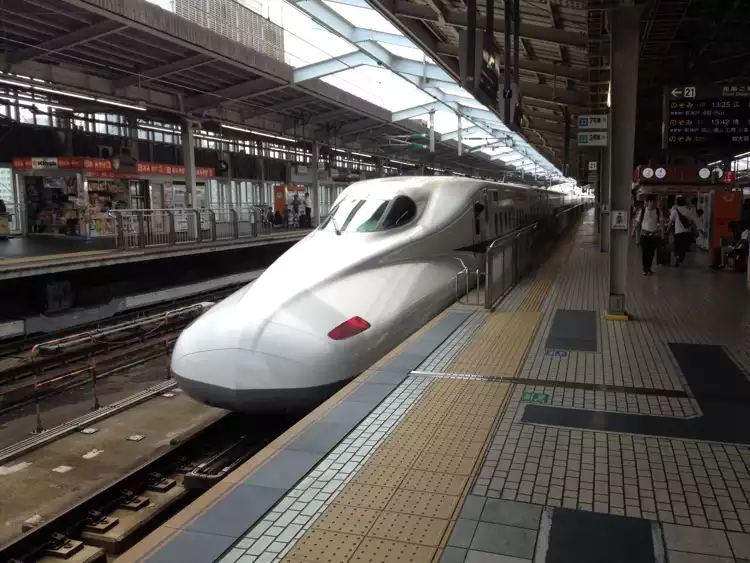
  • Shinkansen (bullet train) Speed is the reward; price is the tax. It turns Tokyo-Osaka into a coffee break, but you pay for the privilege. The pro move: ride Hikari/Sakura instead of the priciest express, target unreserved cars (often the first three) right when the platform staff opens gates, and travel mid-morning or late evening to snag seats. Pack light so you can pivot to unreserved without stressing about overhead space. Use station bento as your meal—clean, fast, and allowed.
  • Local trains and subways This is the daily bloodstream, with rules felt more than spoken. Tap in/out with a Suica/PASMO/ICOCA and stop thinking about fares. Stand left on Tokyo escalators, right in much of Kansai. Phones on silent. No calls. Backpacks on your front during rush, toes behind the line, step off to let people exit, then flow back in. Eating is a no on locals; fine on limited express with a seat tray. Women-only cars appear at peak; the pink signs on the platform mark them.
  • Highway buses The clean break from rail pricing. Tokyo-Osaka can run a third to half the Shinkansen price, and an overnight bus deletes a hostel night. Pick 3-seat-per-row layouts for space, bring layers for the relentless AC, and expect rest-stop breaks for bathrooms and snacks. Departures use curbside bays that aren’t always obvious—arrive early and match the bus company board. Sleep, roll in at dawn, stash your bag in a coin locker, and you’ve just bought a full day.
  • Regional buses Trains skip the last mile; buses finish the geometry. Kamikochi bans cars—bus only. Koya-san demands a cable car then a bus. Fuji’s 5th Stations, Shirakawa-go, Shiretoko trailheads—their clocks run a few times per day, not per hour. In rural zones, board rear, grab the numbered ticket, and watch the fare board; pay at the front with coins or small bills, or tap if IC is accepted. Miss the last bus and your day becomes a hike in the dark.

Master tip: Build days around one decisive move—an overnight bus to reposition, then a late-morning unreserved Shinkansen leap—everything else on IC cards; this cadence dodges rush hours, kills a lodging cost, and converts the country’s rigidity into your fast lane.
Short answer: It depends which Tokyo airport you land at. Haneda is much closer than Narita, so it’s faster and cheaper to reach the center.

From Haneda (HND) to central Tokyo
Distance: about 17 km (11 miles) to Tokyo Station.
  • Keikyu Line → JR (via Shinagawa) — 25-35 minutes. About JPY 500-600 total. Take Keikyu from the airport to Shinagawa, then JR Yamanote/Keihin-Tohoku to Tokyo Station or beyond.
  • Tokyo Monorail → JR (via Hamamatsucho) — 25-35 minutes. About JPY 670-700 total. Monorail to Hamamatsucho, transfer to JR for Tokyo Station or the Yamanote loop.
  • Airport buses (Airport Limousine, Keikyu Bus) — 30-60+ minutes depending on traffic. Typically JPY 900-1,300 to major hubs like Tokyo Station, Ginza, Shinjuku.

Taxi from Haneda: around JPY 6,000-9,000 to central wards on daytime flat-rate services (night surcharge ~20% applies; expressway tolls may be extra). 20-40 minutes depending on traffic.

From Narita (NRT) to central Tokyo
Distance: about 60 km (37 miles) to Tokyo Station.
  • JR Narita Express (N’EX) — 50-65 minutes to Tokyo Station (70-85 to Shinjuku/Shibuya). Reserved seats only. About JPY 3,000-3,500.
  • Keisei Skyliner → JR — 36-41 minutes to Nippori/Ueno on Skyliner, then 7-10 minutes by JR to Tokyo Station. About JPY 2,600-2,800 for Skyliner + JPY 160-210 for JR.
  • Keisei Access Express (to Asakusa/Ginza/Shimbashi) — 60-75 minutes. No seat reservation, commuter-style train. About JPY 1,300-1,500.
  • JR Rapid (via Sobu Line Rapid) — 80-90 minutes to Tokyo Station. About JPY 1,340. Cheapest JR option, slower and can be crowded.
  • Buses
    • Airport Bus TYO-NRT to Tokyo Station/Ginza — 60-90+ minutes. About JPY 1,300.
    • Airport Limousine Bus to major hotels/areas — 70-120 minutes. About JPY 2,800-3,600 depending on destination.


Taxi from Narita: expect JPY 20,000-30,000+ to central Tokyo (flat-rate services by zone available; expressway tolls and night surcharge may apply). Usually 90-120 minutes depending on traffic.

Good to know
- You can use IC cards (Suica/PASMO) on regular trains and most buses. N’EX and Skyliner require a separate reserved-seat ticket.
- With luggage or late arrivals, buses are easy; for reliability during rush hour, trains win.
- Fares and times are typical as of 2025 and can change; check the latest before you go.
⚠️ Prices and routes can change, so take this as a rough guide and ask for local advice when you arrive.

🔒 Safety (risk Level: low)Safety considerations for travelers

Safety for solo travelers, including women and LGBTQ+ individuals
Japan is generally very safe for solo travelers, including women and LGBTQ+ individuals. The country has a low crime rate, and public transportation is reliable and secure even at night. While societal attitudes are slowly evolving, LGBTQ+ travelers may still face some cultural conservatism, so discretion might be wise in rural areas. Overall, exercise standard travel precautions and enjoy the unique blend of tradition and modernity Japan offers.


Full official government travel advisory (live updates)
View details 👉

✈️ VisaEntry requirements and paperwork

Visa requirements for Japan depend on your nationality. Citizens from the US, Canada, EU countries, and several others typically don’t need a visa for short stays (up to 90 days). If you need a visa, apply through Japan’s Ministry of Foreign Affairs website or at a local Japanese embassy or consulate.
⚠️ Visa requirements can change over time, so always check the latest visa requirements with the official embassy or government website before you travel.

🎒 What to pack?What you'll need while traveling

Japan’s climate can be a bit of a rollercoaster, so pack layers to handle everything from humid summers to snowy winters. If you’re hitting up temples, you’ll want **modest clothing**—think covered shoulders and knees. For city adventures, comfy shoes are your best friend, but if you’re eyeing some mountain hikes, you’ll need sturdier footwear. The rainy season (June to mid-July) might surprise you, so a lightweight rain jacket is a smart addition. Remember, **tattoos** can be a no-go in some onsens, so bring a cover-up if you want to enjoy those hot springs without any fuss.

Apart from this country specific advice, I have also crafted a general packing list that should help on any trip. authorOver the years, I've learned the importance of packing minimally. It's so much easier to jump on the back of a truck or squeeze yourself into the last spot of a minibus without that supersized backpack. If you're headed to a warm destination, leave your winter jacket at home; for colder regions, opt for thin thermal underlayers. Instead of packing your entire wardrobe, bring just three sets of clothes, as laundry facilities are available everywhere.

View the full list 👉
🎒 Planning the practical side of your trip?
Get detailed information on transport, daily budgets, internet access, local customs, food, language, and other essentials in the complete Travel Guide.

Get detailed practical information 👉

Get the Travel Guide -

🙋 FAQQuick answers to practical concerns

Trip Planning


Personal tip: I normally search on good rating for atmosphere (for meeting people) and location (for easy exploring). Cleanliness as a bonus.


Travel Essentials

Routine vaccines are recommended for Japan, like measles-mumps-rubella (MMR), diphtheria-tetanus-pertussis, varicella (chickenpox), polio, and your yearly flu shot.

Consider getting vaccinated for hepatitis A and B, especially if you plan on trying street food, local cuisine, or engaging in close contact activities.

Japanese encephalitis is generally not necessary unless you’re planning rural travel or extended stays.

No yellow fever vaccine is needed unless you’re arriving from a country with a risk of yellow fever.


vaccination requirements
When I first started traveling, I often spent part of my first day in a new country hunting for a local SIM card. While this can still be slightly cheaper, it also takes time and planning.

These days, it's much simpler to install an eSIM before leaving home. Once you arrive in Japan, you can activate it immediately and have mobile data from the moment you land — which is especially useful for ordering transport or navigating away from busy airports.

There are many providers nowadays, and price differences are usually small. I personally go with Airalo, as it offers excellent network coverage throughout the country and strong global coverage, so you can manage multiple countries from a single app.


Get your e-sim for Japan

Culture & Customs

Bow when greeting; it’s polite and shows respect. Remove shoes when entering someone’s home and sometimes in traditional accommodations and temples. Public displays of affection are rare and can be considered disrespectful. Avoid speaking loudly on public transport; it’s frowned upon. Tipping is not customary and can be seen as rude. For women, dress modestly—especially in religious sites. LGBTQ+ travelers usually face no issues in Japan, but public affection might attract attention. Use both hands to give or receive business cards.
Trying traditional food is always a great way to experience the culture. Here are some must-try dishes for Japan.
  • Sushi: A classic dish of vinegared rice paired with seafood, often raw, and sometimes vegetables. It’s iconic for its simplicity and the skill required to make it. Sushi is a staple of Japanese cuisine that showcases the country’s emphasis on freshness and presentation.
  • Ramen: A steaming bowl of wheat noodles served in a meat or fish-based broth, often flavored with soy sauce or miso, and topped with ingredients like sliced pork, nori, or green onions. Ramen is wildly popular for its comforting and filling nature, as well as its regional variations.
  • Tempura: Lightly battered and deep-fried seafood or vegetables. This dish is beloved for its crispy texture and is a great example of Japan’s ability to elevate simple ingredients through technique and presentation.
  • Okonomiyaki: Often described as a Japanese savory pancake, it’s a mix of batter, cabbage, and various toppings like meat or seafood, cooked on a griddle. It’s a fun, customizable dish that reflects the casual dining culture of Japan.
  • Sashimi: Thinly sliced raw fish or seafood, served without rice. It highlights the freshness and quality of the ingredients and is a must-try for understanding the Japanese appreciation for pure flavors.
  • Yakitori: Skewered and grilled chicken, often enjoyed with a variety of seasonings and sauces. It’s popular as a street food and in izakayas (Japanese pubs), showcasing the Japanese knack for simple yet flavorful food.
Yes, tap water in Japan is safe to drink, and locals do so regularly. It’s fine for tourists too, so no need to worry about bottled or filtered water unless you prefer it for taste. Just fill up your bottle at any tap and save some yen.
The main language in Japan is Japanese. Backpacking is way more rewarding if you know a bit of the local language, so I'd suggest brushing up on the basics just in case your Japanese skills have become a bit rusty.

Want to understand locals better?
The complete Travel Guide for Japan includes 52 essential words and phrases — greetings, thank-yous, ordering food, transport, numbers, and common local expressions you'll actually hear.

Get your local basic phrases 👉

Get the Travel Guide -


English proficiency in Japan varies widely depending on the region and context. In major cities like Tokyo, Osaka, and Kyoto, many younger people, especially in tourist areas, can communicate in basic English. Signs in public transportation and tourist attractions often include English translations, making navigation easier for non-Japanese speakers.

However, in rural areas, English proficiency tends to be lower, and communication might be challenging. Many locals may understand simple phrases but may not be comfortable speaking English fluently. Japanese culture places a strong emphasis on politeness, and many individuals may hesitate to speak English for fear of making mistakes.

While English is taught in schools, the focus is often on reading and writing rather than conversational skills. As a result, travelers may encounter a mix of helpful locals eager to assist and those who may struggle with English.

To enhance communication, it’s useful for travelers to learn a few basic Japanese phrases or use translation apps. Overall, while English is not universally spoken, many people are willing to help, making it possible to navigate the country with some effort and patience.

Money & Payments

The local currency of Japan is JPY (¥).

Cash is still king in Japan. While big cities are increasingly card-friendly, many local spots, rural areas, and smaller shops might still prefer yen in your pocket. It’s wise to carry some cash, especially if you’re heading off the beaten path.

For ATMs, hit up 7-Eleven or Japan Post branches. Their machines are foreign card-friendly and often have English options. Avoid relying on random ATMs; you might find your card rejected.

Leave your dollars and euros at home. They’re not widely accepted. Instead, exchange your currency for yen at airports or major banks. Rates aren’t great at hotels or random kiosks. Also, consider getting a multi-currency travel card for better rates and convenience.

While Japan is modernizing its payment systems, don’t expect to swipe your card everywhere. Stick with Visa or MasterCard, and always have a backup plan with some cash stashed away.

Tipping in Japan is generally not expected and can even be seen as rude. Excellent service is considered standard, so instead of tipping, express your appreciation with a polite ”arigato” (thank you) or by leaving a small gift. If you must leave a tip, place it in an envelope to avoid direct hand-to-hand exchange.

🧩 Nearby countriesNearby backpacking alternatives

📸 PhotosScenes from around the country

Take your backpack - Japan - 0
Take your backpack - Japan - 1
Take your backpack - Japan - 2
Take your backpack - Japan - 3
Take your backpack - Japan - 4
Take your backpack - Japan - 5
Take your backpack - Japan - 6
Take your backpack - Japan - 7
Take your backpack - Japan - 8
Take your backpack - Japan - 9
Take your backpack - Japan - 10
Take your backpack - Japan - 11
Take your backpack - Japan - 12
Take your backpack - Japan - 13
Take your backpack - Japan - 14
Take your backpack - Japan - 15
Take your backpack - Japan - 16
Take your backpack - Japan - 17
Take your backpack - Japan - 18
Take your backpack - Japan - 19
Photographed by: Johan Kruseman

Travel stories from Japan

Welcome to Japan: self-spraying toilets and 3 bows for a yoghurt

Welcome to Japan: self-spraying toilets and 3 bows for a yoghurt

Japan | After Kyrgyzstan, Mongolia, and North Korea, Japan was quite a culture shock: the third largest economy in the world and in many ways the opposite of my previous countries. Japan felt like one big amusement park. Let‘s start with the toilets: after two months of squatting above piles of previous users‘ excrement and throwing toilet paper in a bin,...
Read more
Climbing the Mount Everest in a T-shirt

Climbing the Mount Everest in a T-shirt

Japan | A day later, I was in the Japanese Alps. And the Japanese take them seriously, very seriously. Although the mountains there had peaks just above 3000 meters with a few scattered patches of snow and perfectly maintained hiking trails, every Japanese person was prepared to climb Mount Everest: helmet on, walking stick in both hands, climbing shoes, a...
Read more
€70 for a bunkbed, excluding electricity for charging your phone

€70 for a bunkbed, excluding electricity for charging your phone

Japan | The mountain hut was also different from what I was used to: a massive building with space for 500 people. Breakfast was served between 5:00 and 6:30 am, as is customary in the Himalayas, so that you can start your mountain hikes on time, even though the longest climb there takes no longer than 2 hours. For just 70 euros, you could get a mattress o...
Read more
Climbing Mount Fuji in a record time to catch the bus

Climbing Mount Fuji in a record time to catch the bus

Japan | After the mountains, I visited Osaka and Kyoto. What took me 10 hours for 250 km in Mongolia, I covered here in 1 hour. And it‘s almost unbelievable that those bullet trains depart every 10 minutes and zoom past at 250 km/h. On my way to Mount Fuji, I could once again enjoy the absurdly efficient transportation system. I covered the first 360 km on...
Read more
Drinking beer and eating frog with the son of the designer of the Nissan GTR

Drinking beer and eating frog with the son of the designer of the Nissan GTR

Japan | The last stop was Tokyo, the ultimate culture shock. Millions of people effortlessly maneuvering from their own point A to their own point B with the same Japanese politeness and orderliness that I had experienced so far. The weather, on the other hand, was chaotic. Due to two strong typhoons passing over Japan, there was constant rain. The second ...
Read more
More stories

We 💚 feedbackFinal notes for travelers

Go to Japan because everyday systems actually work; that’s the cheat code. Trains hit their marks, food is everywhere and decent, stations are towns. This reliability lets you braid rural detours and city errands into one controlled glide instead of burning hours babysitting logistics. The drawback: space and rules. Rooms are tight, check-ins rigid, last trains unforgiving; winging it dies fast during weekends and festivals. One strategic move that changes everything: send your pack ahead with takkyubin and travel with a small day bag. Suddenly you ride any carriage, weave through rush hour, step into tiny ramen shops and public baths, and take stair-heavy shortcuts—with energy left to notice the good stuff.

✈️ When did I visit Japan?
As part of my 1.5 year travel around the world trip, I visited Japan in August 2015. Since then, this guide is regularly updated based on feedback from locals and recent backpackers (last update: 7 January 2025)

✍️ Help improve this page!
The information on this page is based on my own backpacking experience in Japan, supplemented with up-to-date research and feedback from other travelers. Travel details can change, so if you notice anything outdated or incomplete, feel free to let me know.


🙋‍♂️ Give feedback

👋 Meet the founderWho’s Behind Take Your Backpack?

Johan, backpacker and founder of TakeYourBackpackHi, I’m Johan (Netherlands 🇳🇱), the creator of TakeYourBackpack. Over the past decade, I’ve backpacked through 80+ countries across six continents, gaining extensive experience with independent travel, long-term trips, and overland routes.

This site is built on a combination of firsthand travel experience and carefully curated insights from other backpackers. Many guides are based on places I’ve personally visited, while others bring together tips, observations, and practical advice shared by trusted travelers I’ve met along the way.

The goal is to provide realistic, experience-driven guidance — not generic itineraries — so you can explore destinations with better context, clearer expectations, and more confidence.

Get full Japan guide •
Instant download • 140 highlights • Full Offline guide