Trip Planning
The TakeYourBackpack guidebooks are your all-in-one travel companion, featuring the best cities, national parks, hikes, beaches, and unique sites, along with essential tips on when to go, how to get around, exchanging money, and even local phrases to get you started — everything you need for a smooth, unforgettable backpacking adventure.
Stop researching. Start exploring.Discover all 44 highlights,ranked
and organized into practical routes.
Get instant access
Planning a backpacking route through Djibouti can be tricky — you need to balance must-see places, travel times, budget, and how long to stay in each destination. Our free personalized Djibouti itinerary planner creates a route based on your travel style, trip duration, and interests, so you can spend less time researching and more time exploring.
Personal tip: I normally search on good rating for atmosphere (for meeting people) and location (for easy exploring). Cleanliness as a bonus.
Travel Essentials
For Djibouti, make sure routine vaccinations (MMR, tetanus-diphtheria, polio, flu) are current, and get hepatitis A and typhoid, as both spread through food and water. Hepatitis B and rabies are recommended for longer stays, rural travel or contact with animals. A yellow fever certificate is required only if you arrive from a country with yellow fever risk, such as neighboring Ethiopia. Malaria is present, including in Djibouti City, so ask a travel clinic about antimalarial tablets and pack strong mosquito repellent; see a doctor 4 to 8 weeks before departure.
vaccination requirementsWhen I first started traveling, I often spent part of my first day in a new country hunting for a local SIM card. While this can still be slightly cheaper, it also takes time and planning.
These days, it's much simpler to install an eSIM before leaving home. Once you arrive in Djibouti, you can activate it immediately and have mobile data from the moment you land — which is especially useful for ordering transport or navigating away from busy airports.
There are many providers nowadays, and price differences are usually small. I personally go with
Holafly, as it offers excellent network coverage throughout the country and strong global coverage, so you can manage multiple countries from a single app.
HolaFly eSimCulture & Customs
Djibouti is a conservative, mostly Muslim country, so dress modestly, with shoulders and knees covered, and keep beachwear for hotel pools and beaches. Eat, pass money and shake hands with your right hand, and accept tea or coffee when it is offered, as hospitality matters here. Always ask before photographing people, especially women and nomadic Afar families, and never point a camera at military sites, ports, police or government buildings. During Ramadan, avoid eating, drinking or smoking in public during daylight. Khat chewing is a normal afternoon social ritual for many men; do not comment on it or photograph it without permission. Public displays of affection are frowned upon for all couples, and LGBTQ+ travelers should keep their relationships private, while women will find that a calm, firm response deflects most unwanted attention.
Trying traditional food is always a great way to experience the culture. Here are some must-try dishes for Djibouti.
- Skoudehkaris The national dish: rice cooked with lamb or goat, tomato, onion and a warm mix of cardamom, cumin, cinnamon and cloves. It shows the Indian and Arabian spice routes that pass through the port and is served at family gatherings and celebrations.
- Poisson yéménite Whole fish, split open, rubbed with chili and spices and baked against the walls of a clay tandoor-style oven, then served with flatbread and a spicy sauce. Yemeni-run fish restaurants in the capital make this the classic evening meal out.
- Fah-fah A spicy goat or beef soup with vegetables and green chili, often eaten with bread. It is a filling, everyday dish rooted in Somali home cooking.
- Lahoh (laxoox) A spongy, slightly sour fermented flatbread, similar to a thin pancake, eaten for breakfast with honey, sugar and sweet spiced tea, or torn into stews. It is the standard start to the day across Somali households.
- Sambusa Fried triangular pastries stuffed with spiced minced meat or lentils. They are sold from street stalls and are the traditional snack for breaking the fast during Ramadan.
Tap water in Djibouti is not considered safe for travelers to drink, as supplies are limited, often brackish and inconsistently treated. Many locals boil it or buy bottled or filtered water, and visitors should stick to sealed bottled water, which is sold everywhere in the capital. Avoid ice of unknown origin, and carry a filter bottle on longer trips to remote areas.
The main language in Djibouti is
Somali. Backpacking is way more rewarding if you know a bit of the local language, so I'd suggest brushing up on the basics just in case your Somali skills have become a bit rusty.
Want to understand locals better?The complete Travel Guide for Djibouti includes 52 essential words and phrases — greetings, thank-yous, ordering food, transport, numbers, and common local expressions you'll actually hear.
Get your local basic phrases 👉
Get the Travel Guide - is limited in Djibouti: you will manage in upscale hotels, dive operators and some shops in the capital, partly thanks to the large foreign military presence, but most everyday conversation happens in French, Somali, Afar or Arabic. Younger, educated Djiboutians and staff at guesthouses that host foreigners often speak some English, while in rural towns and nomadic areas it is rare. French is the language that helps most by far, followed by Arabic. Download offline French and Arabic packs in a translation app and learn a few French phrases for prices, directions and ordering food.
Money & Payments
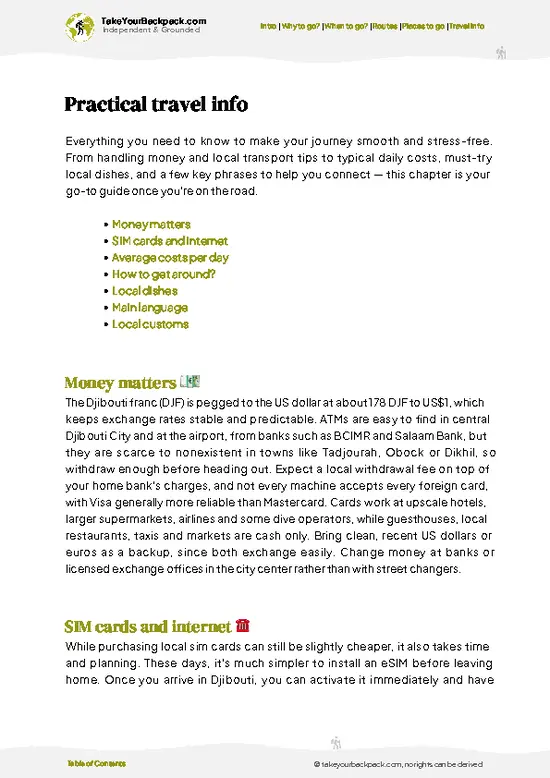
The local currency of Djibouti is DJF (Fr).
The Djibouti franc (DJF) is pegged to the US dollar at about 178 DJF to US$1, which keeps exchange rates stable and predictable. ATMs are easy to find in central Djibouti City and at the airport, from banks such as BCIMR and Salaam Bank, but they are scarce to nonexistent in towns like Tadjourah, Obock or Dikhil, so withdraw enough before heading out. Expect a local withdrawal fee on top of your home bank’s charges, and not every machine accepts every foreign card, with Visa generally more reliable than Mastercard. Cards work at upscale hotels, larger supermarkets, airlines and some dive operators, while guesthouses, local restaurants, taxis and markets are cash only. Bring clean, recent US dollars or euros as a backup, since both exchange easily. Change money at banks or licensed exchange offices in the city center rather than with street changers.
Tipping in Djibouti is appreciated but not strictly expected, and most locals simply round up the bill. In mid-range and upscale restaurants, 5 to 10 percent is a kind gesture if service is not already included, and rounding up taxi fares is common. For drivers and guides on multi-day 4x4 trips to the lakes, around 1,000 to 2,000 DJF (US$6 to 11) per person per day is a fair thank-you.
v2.webp)
 Best Backpacking
.jpg) Over the years, I've learned the importance of packing minimally. It's so much easier to jump on the back of a truck or squeeze yourself into the last spot of a minibus without that supersized backpack. If you're headed to a warm destination, leave your winter jacket at home; for colder regions, opt for thin thermal underlayers. Instead of packing your entire wardrobe, bring just three sets of clothes, as laundry facilities are available everywhere.
Over the years, I've learned the importance of packing minimally. It's so much easier to jump on the back of a truck or squeeze yourself into the last spot of a minibus without that supersized backpack. If you're headed to a warm destination, leave your winter jacket at home; for colder regions, opt for thin thermal underlayers. Instead of packing your entire wardrobe, bring just three sets of clothes, as laundry facilities are available everywhere.

.jpg) Hi, I’m Johan (Netherlands 🇳🇱), the creator of TakeYourBackpack. Over the past 3 decades, I’ve backpacked through 90+ countries across six continents, gaining extensive experience with independent travel, long-term trips, and overland routes.
Hi, I’m Johan (Netherlands 🇳🇱), the creator of TakeYourBackpack. Over the past 3 decades, I’ve backpacked through 90+ countries across six continents, gaining extensive experience with independent travel, long-term trips, and overland routes.