Trip Planning
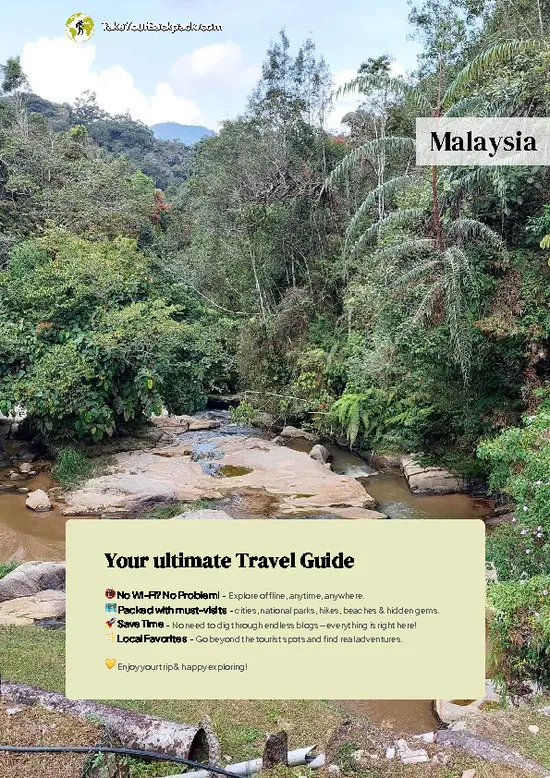
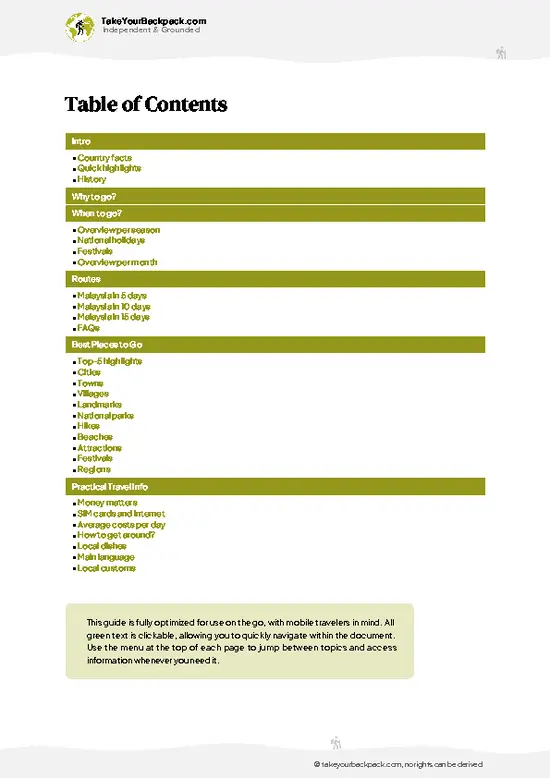
The TakeYourBackpack guidebooks are your all-in-one travel companion, featuring the best cities, national parks, hikes, beaches, and unique sites, along with essential tips on when to go, how to get around, exchanging money, and even local phrases to get you started — everything you need for a smooth, unforgettable backpacking adventure.
Stop researching. Start exploring.Discover all 106 highlights,ranked
and organized into practical routes.
Get instant access
Planning a backpacking route through Malaysia can be tricky — you need to balance must-see places, travel times, budget, and how long to stay in each destination. Our free personalized Malaysia itinerary planner creates a route based on your travel style, trip duration, and interests, so you can spend less time researching and more time exploring.
Personal tip: I normally search on good rating for atmosphere (for meeting people) and location (for easy exploring). Cleanliness as a bonus.
Travel Essentials
No vaccinations are required to enter Malaysia, except a yellow fever certificate if you arrive from a country with yellow fever risk. Make sure routine shots (MMR, tetanus-diphtheria, polio) are up to date, and get hepatitis A and typhoid, since you’ll be eating street food. Hepatitis B, rabies and Japanese encephalitis are worth discussing with a travel clinic for longer trips, rural stays or jungle trekking in Borneo. Dengue is common in cities and has no widely used travel vaccine, so mosquito repellent is your main protection, and malaria is limited to remote rural and forest areas of Sabah and Sarawak.
vaccination requirementsWhen I first started traveling, I often spent part of my first day in a new country hunting for a local SIM card. While this can still be slightly cheaper, it also takes time and planning.
These days, it's much simpler to install an eSIM before leaving home. Once you arrive in Malaysia, you can activate it immediately and have mobile data from the moment you land — which is especially useful for ordering transport or navigating away from busy airports.
There are many providers nowadays, and price differences are usually small. I personally go with
Holafly, as it offers excellent network coverage throughout the country and strong global coverage, so you can manage multiple countries from a single app.
HolaFly eSimCulture & Customs
Malaysia is a multicultural but Muslim-majority country, and a little cultural awareness earns you warm treatment everywhere. Do remove your shoes before entering homes, mosques, temples and some guesthouses, and use your right hand for eating, passing money or handing over items. Do dress modestly at religious sites: cover shoulders and knees, and women should bring a headscarf for mosques, though large mosques in KL and Melaka lend robes at the door. Don’t point with your index finger (use your thumb with fingers folded), don’t touch anyone’s head, and don’t make jokes about the royal family or religion, which can carry legal consequences. During Ramadan, avoid eating, drinking or smoking openly in conservative areas during daylight. Public displays of affection are frowned upon for all couples and carry real legal risk for same-sex couples, so stay discreet. Women may get more respectful treatment by dressing conservatively outside cities, especially on the east coast. Drug laws are extremely harsh, and trafficking can still bring the death penalty.
Trying traditional food is always a great way to experience the culture. Here are some must-try dishes for Malaysia.
- Nasi lemak: Rice cooked in coconut milk with pandan, served with fiery sambal, crispy anchovies, peanuts, cucumber and a boiled or fried egg, often wrapped in a banana leaf. It’s the unofficial national dish, eaten at breakfast, lunch and 2 a.m. by every community in the country.
- Char kway teow: Flat rice noodles stir-fried over a roaring wok with prawns, cockles, Chinese sausage, bean sprouts and egg. The smoky “wok hei” flavor is what Penang hawkers are famous for, and locals queue for specific stalls.
- Laksa: Noodle soup in two main forms: tangy, fish-based Penang assam laksa with tamarind and mint, and rich, coconut curry laksa found around KL. Sarawak laksa, with its spice-paste broth, is Kuching’s pride and a classic breakfast there.
- Roti canai: Flaky, griddled flatbread of Indian-Muslim origin, slapped and folded by hand and served with dhal or curry. Ordered at mamak stalls around the clock, usually with a pulled teh tarik, it’s the backbone of Malaysian late-night culture.
- Satay: Skewers of marinated chicken or beef grilled over charcoal and dipped in a sweet, chunky peanut sauce, with compressed rice cakes (ketupat) and raw onion on the side. Kajang, just outside KL, is the town most associated with it.
- Rendang: Beef or chicken slow-cooked for hours in coconut milk and spices until nearly dry and intensely flavored. It’s a centerpiece of Hari Raya feasts and a dish Malaysians defend passionately.
- Nasi kandar: Penang’s Tamil-Muslim rice spread, where you point at curries, fried chicken and vegetables and the server floods your plate with mixed gravies. Ask for “banjir” if you want it fully drenched.
Tap water in Malaysia is treated and generally meets safety standards at the plant, but aging pipes and storage tanks mean most locals still boil or filter it before drinking. Travelers are advised to stick to filtered or bottled water, which is cheap everywhere at around RM1 to 2 per bottle. Many hostels and guesthouses have filtered refill stations, so a reusable bottle saves money and plastic.
The main language in Malaysia is
Malay. Backpacking is way more rewarding if you know a bit of the local language, so I'd suggest brushing up on the basics just in case your Malay skills have become a bit rusty.
Want to understand locals better?The complete Travel Guide for Malaysia includes 52 essential words and phrases — greetings, thank-yous, ordering food, transport, numbers, and common local expressions you'll actually hear.
Get your local basic phrases 👉
Get the Travel Guide - is widely spoken in Malaysia, especially in Kuala Lumpur, Penang, Melaka and the Borneo hubs, where signs, menus, transport apps and most hotel staff work comfortably in it. Younger Malaysians and hostel staff tend to be fluent, often switching mid-sentence into “Manglish,” a cheerful mix of English, Malay and Chinese dialects ending in “lah.” In rural areas, particularly the conservative east coast states of Kelantan and Terengganu and the Borneo interior, English thins out fast. Malay (Bahasa Malaysia) is the language that helps most; it uses the Latin alphabet and is easy to pronounce, so learning terima kasih (thank you), berapa? (how much?) and tak pedas (not spicy) goes a long way, with Google Translate’s offline Malay pack as backup.
Money & Payments
The local currency of Malaysia is MYR (RM).
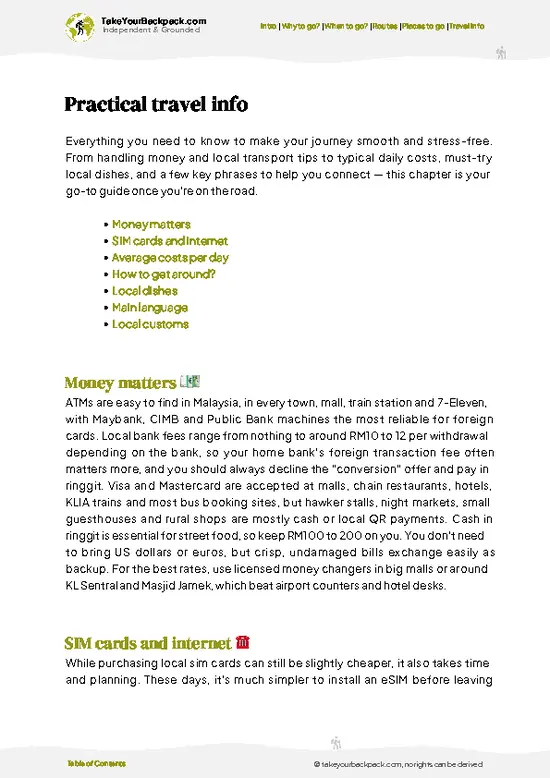
ATMs are easy to find in Malaysia, in every town, mall, train station and 7-Eleven, with Maybank, CIMB and Public Bank machines the most reliable for foreign cards. Local bank fees range from nothing to around RM10 to 12 per withdrawal depending on the bank, so your home bank’s foreign transaction fee often matters more, and you should always decline the “conversion” offer and pay in ringgit. Visa and Mastercard are accepted at malls, chain restaurants, hotels, KLIA trains and most bus booking sites, but hawker stalls, night markets, small guesthouses and rural shops are mostly cash or local QR payments. Cash in ringgit is essential for street food, so keep RM100 to 200 on you. You don’t need to bring US dollars or euros, but crisp, undamaged bills exchange easily as backup. For the best rates, use licensed money changers in big malls or around KL Sentral and Masjid Jamek, which beat airport counters and hotel desks.
Tipping is not expected in Malaysia, and most mid-range and upscale restaurants and hotels already add a 10% service charge plus service tax to the bill. At hawker stalls, food courts and local cafés nobody tips, though rounding up a Grab or taxi fare or leaving small change is always appreciated. For trekking guides, dive crews or hotel porters, RM5 to 20 (US$1 to 5) is a kind gesture for good service rather than an obligation.
v2.webp)
 Best Backpacking
.jpg) Over the years, I've learned the importance of packing minimally. It's so much easier to jump on the back of a truck or squeeze yourself into the last spot of a minibus without that supersized backpack. If you're headed to a warm destination, leave your winter jacket at home; for colder regions, opt for thin thermal underlayers. Instead of packing your entire wardrobe, bring just three sets of clothes, as laundry facilities are available everywhere.
Over the years, I've learned the importance of packing minimally. It's so much easier to jump on the back of a truck or squeeze yourself into the last spot of a minibus without that supersized backpack. If you're headed to a warm destination, leave your winter jacket at home; for colder regions, opt for thin thermal underlayers. Instead of packing your entire wardrobe, bring just three sets of clothes, as laundry facilities are available everywhere.








.jpg) Hi, I’m Johan (Netherlands 🇳🇱), the creator of TakeYourBackpack. Over the past 3 decades, I’ve backpacked through 90+ countries across six continents, gaining extensive experience with independent travel, long-term trips, and overland routes.
Hi, I’m Johan (Netherlands 🇳🇱), the creator of TakeYourBackpack. Over the past 3 decades, I’ve backpacked through 90+ countries across six continents, gaining extensive experience with independent travel, long-term trips, and overland routes.