×
Guinea-Bissau 🇬🇼

backpacking Africa Guinea-Bissau 🇬🇼
Island-hop where tides shape everyday routines.

Explore GuineaExplore Kenya

Backpacking Guinea-Bissau in 2026

A complete guide including when and where to go, costs, transport, itineraries, and practical travel advice.
An overview of visiting Guinea-Bissau

Backpacking Guinea-Bissau
By Johan Kruseman 🇳🇱 | Updated May 30, 2026

You miss the only morning ferry to Bubaque, and the fisherman who shrugs at the timetable offers you a spot in his pirogue instead. That’s Guinea-Bissau: plans bend to tides, and patience buys access. Accept the pace and the country opens—slowly, sincerely, on island time and market rhythm.

Salt in the air at Bissau’s port, red dust at your ankles in Bandim Market, gumbe spilling from a doorway after dark. Out in the Bijagós, mangroves breathe with the tide and Orango’s saltwater hippos surface like myths made real; on Bolama, kapok roots prise open faded colonial facades while kids race past in flip-flops. Sea turtles nest on empty beaches, smoke from grilled barracuda hangs sweet over palm-fringed sand, and Kriol banter turns strangers into hosts. Yes, boats run by tide not clock, power flickers, ATMs are scarce, and rainy-season laterite can swallow a sandal. But the payoff is immediate and human: a cold beer on Bubaque as the Atlantic turns copper, a drumline leading you down a sandy street, palm wine shared under a mango tree.

Next door, Senegal is smoother and busier; Guinea is mountain-wild and road-hard. Guinea-Bissau is for travelers who trade certainty for closeness and prefer rhythm over rush.

Bissau (Capital)

Heat, dust, and movement by 10 a.m. at Bandim Market—fish funk, diesel, shouting in Kriol. You sort SIMs, cash, and onward seats here; shared taxis run set routes, no meters. It rewards street‑savvy travelers. Payoff: sunset beers at Pidjiguiti, guitar riffs drifting over the port.

Bijagós Archipelago (Bubaque–Orango–Bolama)

Ferries leave when the tide agrees, not when you do. Expect salt spray, wet landings, and the hum of generators after dark. It rewards patient, low‑comfort island‑hoppers. Payoff: empty sandbars at low tide, grilled barracuda by kerosene lamp, and—if you commit to Orango—hippos in brackish lagoons.

Cacheu & Varela Coast

One northbound spine through São Domingos, then rough laterite and pockets of deep sand. Bush‑taxis rattle; a 4x4 or moto saves time. Mangrove creeks mean pirogues and black mud to the shins. It rewards birders and paddlers. Payoff: oysters smoked on the bank and a cold beer on a quiet Atlantic beach.

Cantanhez Forest & Tombali

Southbound tracks rattle your spine; in rains, they turn to red glue. Villages sit under tall palms; forest walks are slow, leechy, guided. It rewards wildlife‑minded hikers with patience. Payoff: dawn chimp calls across the canopy and that first breeze after an hour of dripping sweat.
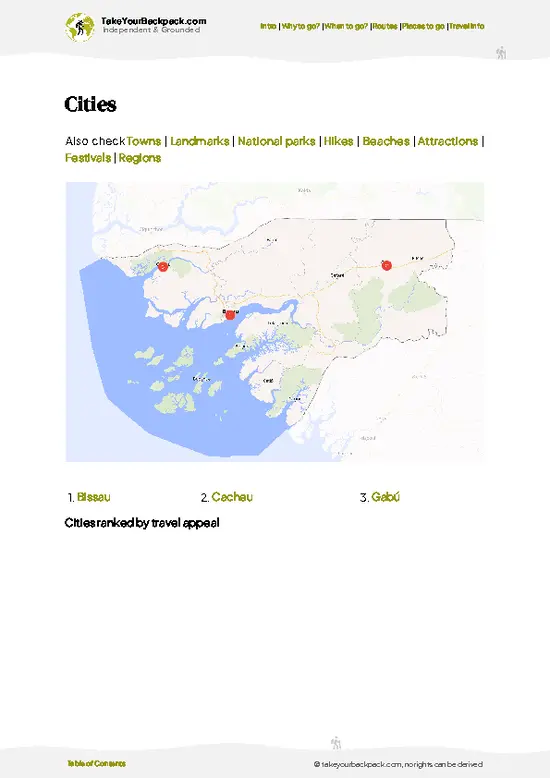
Geography and where places are located
Loading the map 🌍
CLICK TO FILTER
city
town
unique site
national park
hike
beach
attraction
festival
region
SHOW COUNTRY’S BESTSHOW ALL
film
0
0
0a
Fortaleza d’Amura
film
1
1
1a
Igreja da Nossa Senhora da Candelária
film
2
2
2a
Centro Cultural Franco-Bissau-Guineense
film
3
3
3a
Praia de Rubane
film
4
4
4a
Bubaque Island Coastal Walk
film
5
5
5a
Cantanhez Natural Park
film
6
6
6a
Bolama
film
7
7
7a
Catió
film
8
8
8a
Farim
film
9
9
9a
Mansôa
film
10
10
10a
Cabo de Santa Maria

Why go?What draws travelers here

Wildlife

Wildlife pulls you here because it still feels untamed. Mangrove creeks breathe at the tide; you ride … read more 👉
Wildlife pulls you here because it still feels untamed. Mangrove creeks breathe at the tide; you ride a pirogue through diesel haze and salt spray to the Bijagós, where saltwater hippos grunt at dusk, turtles climb bright beaches, and manatees slip like shadows. In Cantanhez, chimps drum at dawn. You earn it—the heat, mosquitoes, red dust—then a cold beer and pelicans at sunset.

Low cost

Red dust, diesel, fish smoke—Guinea-Bissau is gentle on the wallet. Fan rooms in concrete courtyards, … read more 👉
Red dust, diesel, fish smoke—Guinea-Bissau is gentle on the wallet. Fan rooms in concrete courtyards, bucket showers, a net that works. Heaped rice and fish, bissap, and chapas that cost pocket change. Boats to the Bijagós sting a little, but days still land around $25–35. Sunset breeze, an ice-cold beer, and you’ve spent less than lunch back home.

Scenery

Guinea‑Bissau pays out its scenery only after sweat. Red-dust tracks shake you toward tidal mangroves, … read more 👉
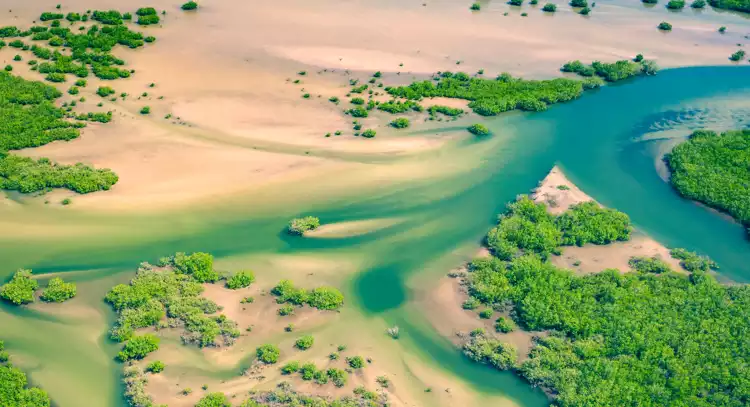
Guinea‑Bissau pays out its scenery only after sweat. Red-dust tracks shake you toward tidal mangroves, palm savannah and island forests in the Bijagós. Dawn on Orango brings sea‑hippos and spoonbills in pewter light. Low tide draws snakes of sand and lagoon mirror pools. You rinse the salt, sit on Bubaque’s pier, and the first cold beer tastes like a win.

Uniqueness

Guinea-Bissau runs on mud, music, and patience. Red-dust roads, broken streetlights, ferries that leave … read more 👉
Guinea-Bissau runs on mud, music, and patience. Red-dust roads, broken streetlights, ferries that leave when they feel like it. You ride pirogues past mangroves that smell of salt and smoke, step into markets sticky with cashew juice. Then the payoff: low-tide sandbars in the Bijagós, hippos snorting at dusk in Orango, a cold beer sweating in your hand.
Want the complete picture of Guinea-Bissau?
The offline Travel Guide brings everything together — routes, highlights & planning.

See what's included in the guide 👉

Get the Travel Guide -

⭐ HighlightsStandout locations across the country

  • Bandim Market, Bissau: Heat bounces off corrugated roofs, and the air mixes diesel, smoked fish, and mashed cashew fruit. Red dust sticks to your calves as you weave past sacks of rice and radios blaring kizomba. Payoff: a cold Cristal under a rattling tin awning.
  • Orango National Park, Bijagós: The pirogue coughs through mangroves; salt dries white on your lips and the sun sits heavy. Barefoot, you cross warm tidal flats, mud squeezing your arches. Dusk comes, and hippos exhale in a brackish lagoon like steam engines.
  • Bolama Island: The ferry leaves you among colonial shells where kapok roots pry up tiles and goats chew paper in an old courtroom. Palm fronds scrape plaster as kids play football in the square. Sunset soaks everything coral while you sip sweet palm wine.
  • Cacheu & the Fortaleza: A squat fort faces the brown river, cannons flecked with rust. Pirogues slide past mangroves hung with oyster shells; woodsmoke from fish sheds claws the throat. Reward: grilled bonga on a plastic table
read more 👉
  • Bandim Market, Bissau: Heat bounces off corrugated roofs, and the air mixes diesel, smoked fish, and mashed cashew fruit. Red dust sticks to your calves as you weave past sacks of rice and radios blaring kizomba. Payoff: a cold Cristal under a rattling tin awning.
  • Orango National Park, Bijagós: The pirogue coughs through mangroves; salt dries white on your lips and the sun sits heavy. Barefoot, you cross warm tidal flats, mud squeezing your arches. Dusk comes, and hippos exhale in a brackish lagoon like steam engines.
  • Bolama Island: The ferry leaves you among colonial shells where kapok roots pry up tiles and goats chew paper in an old courtroom. Palm fronds scrape plaster as kids play football in the square. Sunset soaks everything coral while you sip sweet palm wine.
  • Cacheu & the Fortaleza: A squat fort faces the brown river, cannons flecked with rust. Pirogues slide past mangroves hung with oyster shells; woodsmoke from fish sheds claws the throat. Reward: grilled bonga on a plastic table as the tide turns glassy.
  • Varela Beach: Sand tracks buck the car and powder your ankles; then the Atlantic thumps and casuarinas leak resin in the shade. You swim until the light goes honey, then eat barracuda with gritty fingers. For off-map days: Saltinho Falls on the Corubal, Cantanhez’s chimp forests, and the birdy lagoas of Cufada.
Spotted a mistake or missing a highlight? Contact us.

But Guinea-Bissau offers more...

Discover and compare all of its highlights per category

🧭 RoutesLogical itineraries covering the highlights

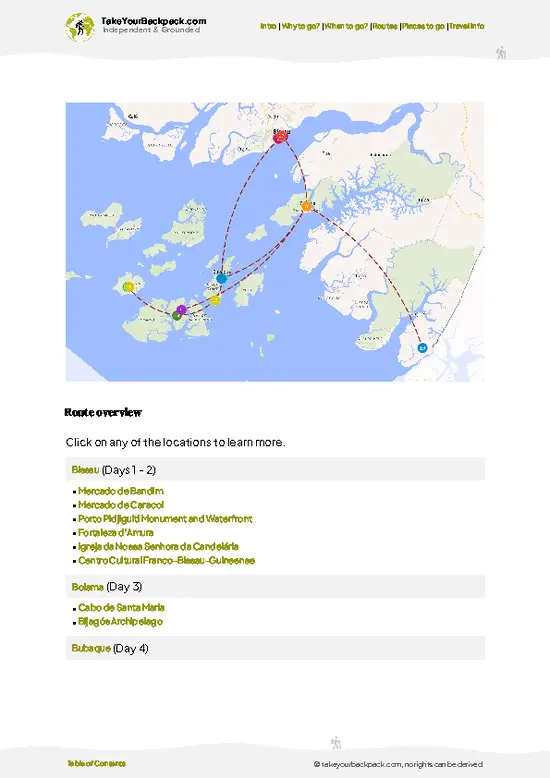
The 2-Day Bissau & Island Taster

The Vibe: A quick-hit intro to Guinea-Bissau that mixes capital energy with one laid-back island day, perfect if you’re passing through or tacking the country onto a longer West Africa trip. You’ll move mostly on foot and by taxi in Bissau, then hop a single boat to feel the Bijagós without overcommitting.
The Highlights:
  • Street-level immersion in Bissau’s markets and harborfront.
  • A focused visit to the Porto Pidjiguiti Monument to ground the history.
  • Boat trip to Bubaque for coastal walking and beach time.
  • Sunset swim at Praia de Bubaque before heading back to the mainland.

The 3-Day Capital & Bijagós Balance

The Vibe: A long-weekend route that splits your time between Bissau’s markets and churches and the wild calm of the Bijagós, with enough breathing room to actually enjoy the boat rides. Expect a mix of taxis, walking, and island boats at a steady, exploratory pace.
The Highlights:
  • Contrasting Bissau’s big, busy Mercado de Bandim with smaller neighborhood markets.
read more 👉

The 2-Day Bissau & Island Taster

The Vibe: A quick-hit intro to Guinea-Bissau that mixes capital energy with one laid-back island day, perfect if you’re passing through or tacking the country onto a longer West Africa trip. You’ll move mostly on foot and by taxi in Bissau, then hop a single boat to feel the Bijagós without overcommitting.
The Highlights:
  • Street-level immersion in Bissau’s markets and harborfront.
  • A focused visit to the Porto Pidjiguiti Monument to ground the history.
  • Boat trip to Bubaque for coastal walking and beach time.
  • Sunset swim at Praia de Bubaque before heading back to the mainland.

The 3-Day Capital & Bijagós Balance

The Vibe: A long-weekend route that splits your time between Bissau’s markets and churches and the wild calm of the Bijagós, with enough breathing room to actually enjoy the boat rides. Expect a mix of taxis, walking, and island boats at a steady, exploratory pace.
The Highlights:
  • Contrasting Bissau’s big, busy Mercado de Bandim with smaller neighborhood markets.
  • Harborfront time at Porto Pidjiguiti and a peek at colonial-era architecture.
  • Island base on Bubaque with a coastal walk and beach downtime.
  • A foray into Orango National Park for trails and raw Atlantic shoreline.

The 5-Day Guinea-Bissau Explorer

The Vibe: A compact but deep dive that threads together the capital, a former island capital, and the Bijagós’ national park landscapes, ideal if you want to feel you’ve really “been” to Guinea-Bissau. Travel is by taxi, shared cars, and boats, paced to avoid back-to-back slogs.
The Highlights:
  • Two full days in Bissau for markets, forts, churches, and cultural centers.
  • A slow day on Bolama to absorb its faded colonial character and quiet streets.
  • Island-hopping into the Bijagós with time on Bubaque’s coastal paths and beaches.
  • Exploring Orango National Park’s trails and wild Atlantic beaches from an island base.
🌍 Want a ready-to-use travel plan for Guinea-Bissau?
The overview above compares different route options based on your travel time and style. The complete Travel Guide breaks each itinerary down in detail, including maps, stops, highlights, and transport information.

Explore all route details 👉

Get the Travel Guide -

🌤️ When to go?Best time to visit Guinea-Bissau

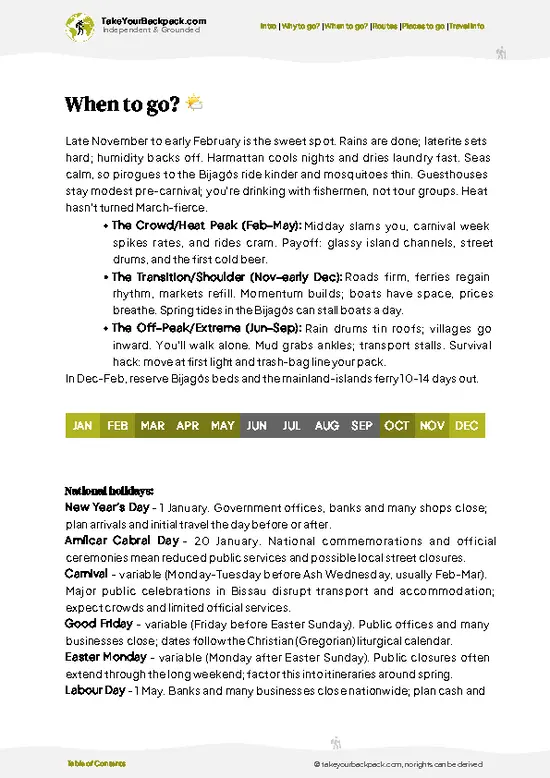
Late November to early February is the sweet spot. Rains are done; laterite sets hard; humidity backs off. Harmattan cools nights and dries laundry fast. Seas calm, so pirogues to the Bijagós ride kinder and mosquitoes thin. Guesthouses stay modest pre-carnival; you’re drinking with fishermen, not tour groups. Heat hasn’t turned March-fierce.
  • The Crowd/Heat Peak (Feb-May): Midday slams you, carnival week spikes rates, and rides cram. Payoff: glassy island channels, street drums, and the first cold beer.
  • The Transition/Shoulder (Nov-early Dec): Roads firm, ferries regain rhythm, markets refill. Momentum builds; boats have space, prices breathe. Spring tides in the Bijagós can stall boats a day.
  • The Off-Peak/Extreme (Jun-Sep): Rain drums tin roofs; villages go inward. You’ll walk alone. Mud grabs ankles; transport stalls. Survival hack: move at first light and trash-bag line your pack.

In Dec-Feb, reserve Bijagós beds and the mainland-islands ferry 10-14 days out.

source: climatestotravel.comJANJanuary: excellent for travelingFEBFebruary: highly recommended for travelingMARMarch: good for travelingAPRApril: good for travelingMAYMay: good for travelingJUNJune: fair for travelingJULJuly: below average for travelingAUGAugust: below average for travelingSEPSeptember: fair for travelingOCTOctober: good for travelingNOVNovember: highly recommended for travelingDECDecember: excellent for traveling
📅 Traveling in a specific month?
Get a full month-by-month breakdown of weather, crowds, costs, festivals, and seasonal highlights in the complete travel guide.

Get full details when to go 👉

Get the Travel Guide -
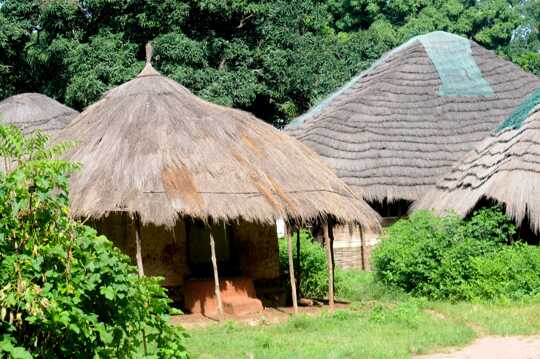
pixabay-guinea-bissau -village-431731

💰 Costs (as of 2026)Travel costs in Guinea-Bissau

Expect $30-45 per day on the mainland; island days jump to $55-80 once boats and guides enter the picture.
  • dorm accommodation: Real dorms are rare; you’ll mostly use pensões and basic guesthouses at 5,000-12,000 CFA for a fan room, 12,000-20,000 CFA with AC (cheaper than coastal Senegal, pricier than rural Guinea). System tip: ask for “quarto simples, ventoinha” and a weekly rate, pay cash in CFA, check water/electric before handing over money, and you’ll often shave 10-20% off the first quote.
  • meals: Supermarket Survival: bread, sardines, Laughing Cow, bananas—2,000-3,500 CFA/day, but imports carry a markup and the bread goes stale in jungle heat. Street food reality: big rice-and-fish plates 1,000-2,500 CFA, grilled chicken, caldo, and peanuts everywhere; sweet coffee or bissap 100-300 CFA. It’s slightly cheaper than Dakar, roughly on par with Guinea-Conakry if you eat where the pots are busy.
  • local transport: Toca-toca minibuses in town cost 100-300 CFA; short moto-taxi hops 300-800 CFA. Bush taxis between towns run 1,500-4,500 CFA per leg—slower than Senegal’s sept-places but cheaper per kilometer. The unlock is the ferry/panga: Bissau-Bubaque deck seats 3,000-5,000 CFA if you time
read more 👉
Expect $30-45 per day on the mainland; island days jump to $55-80 once boats and guides enter the picture.
  • dorm accommodation: Real dorms are rare; you’ll mostly use pensões and basic guesthouses at 5,000-12,000 CFA for a fan room, 12,000-20,000 CFA with AC (cheaper than coastal Senegal, pricier than rural Guinea). System tip: ask for “quarto simples, ventoinha” and a weekly rate, pay cash in CFA, check water/electric before handing over money, and you’ll often shave 10-20% off the first quote.
  • meals: Supermarket Survival: bread, sardines, Laughing Cow, bananas—2,000-3,500 CFA/day, but imports carry a markup and the bread goes stale in jungle heat. Street food reality: big rice-and-fish plates 1,000-2,500 CFA, grilled chicken, caldo, and peanuts everywhere; sweet coffee or bissap 100-300 CFA. It’s slightly cheaper than Dakar, roughly on par with Guinea-Conakry if you eat where the pots are busy.
  • local transport: Toca-toca minibuses in town cost 100-300 CFA; short moto-taxi hops 300-800 CFA. Bush taxis between towns run 1,500-4,500 CFA per leg—slower than Senegal’s sept-places but cheaper per kilometer. The unlock is the ferry/panga: Bissau-Bubaque deck seats 3,000-5,000 CFA if you time the public boat; private speedboats jump to 15,000-30,000 CFA. Diesel-salt air, long waits, real savings.
  • activities: Boats to the Bijagós, park fees (5,000-10,000 CFA), and mandatory local guides (10,000-25,000 CFA/day) drive costs; big lodges price in euros like Cape Verde. On the mainland, museums and forts are token (500-1,500 CFA), markets and beaches are free; your wallet bleeds on water, not entry tickets.
  • miscellaneous: Budget leaks: visas/border fees can eat a day’s budget, ATM fees run 3-5% and reliable machines cluster in Bissau, SIM + a few GB data 2,000-5,000 CFA, bottled water 300-600 CFA, beer 500-1,000 CFA (cold feels earned after the ferry), laundry 1,000-2,000 CFA, occasional “generator” surcharges for AC. Day-to-day small stuff is closer to Guinea than Senegal; imported treats are where you overpay.
⚠️ Prices can change and everyone travels differently, so take this as a rough guide. Hope it helps you plan your adventure!

✈️ The backpacker research shortcutGuinea-Bissau Travel Guide

An offline-friendly backpacking guide with optimized travel routes, ranked highlights, transport advice, and the best areas to stay.
example page 0 from our offline Travel Guide for Guinea-Bissauexample page 1 from our offline Travel Guide for Guinea-Bissauexample page 2 from our offline Travel Guide for Guinea-Bissauexample page 3 from our offline Travel Guide for Guinea-Bissauexample page 4 from our offline Travel Guide for Guinea-Bissauexample page 5 from our offline Travel Guide for Guinea-Bissauexample page 6 from our offline Travel Guide for Guinea-Bissauexample page 7 from our offline Travel Guide for Guinea-Bissau
The digital guide (232 pages) contains:
53 highlights, ranked by travel appeal
Optimized 2, 3 & 5-day travel routes
Cities, national parks, beaches, historical sites, ...
How to get around
Offline-friendly for travel without Wi-Fi
👉 Click to see all 30+ guide features

📅 Plan smarter in minutes, not weeks
Month by month travel advice
Festivals & national holidays
Budget expectations

🗺️ Go to the right places, skip the overrated ones
Honest pros & cons of destinations
Top hikes, parks & viewpoints
Lesser-known places most travelers miss
Clear “worth it vs skip it” guidance

🛏️ Travel smoothly without rookie mistakes
Best areas to stay
Transport systems explained simply
Common scams & safety advice
SIM cards, money & practical tips

🌍 Understand the country, not just visit it
Culture & traditions
52 Essential phrases & customs
Festivals worth planning around
Traveler-friendly historical context
Insights that make places more meaningful

📱 Built for real travel conditions
Fully downloadable PDF
Works completely offline
Optimized for phone use
Useful in remote areas & buses
Everything in one place
Save weeks of stressful planning
Get instant access to the full guide directly. 30-day money-back guarantee.


Sent to your inbox immediately after payment • 100% Secure Checkout
Best Backpacking Travel Advisor 2025 tourism awardBest Backpacking
Travel Advisor
2025
What others say about Take Your Backpack Guides:
⭐⭐⭐⭐⭐
Fantastic, amazing amount of information!
⭐⭐⭐⭐⭐
My goodness this is amazing, it's what I've been looking for hats off too you!
⭐⭐⭐⭐⭐
I think this is absolutely BRILLIANT
⭐⭐⭐⭐
Very complete and informative. It's still missing places, but I gotta to commend you
⭐⭐⭐⭐⭐
This is truly amazing, thank you, can't wait to explore it with my kids!
⭐⭐⭐⭐⭐
Awesome resource, thank you!
⭐⭐⭐⭐⭐
This is amazing! Can't wait to explore the ones I haven't seen
⭐⭐⭐⭐
I love this! Well done, great idea.
⭐⭐⭐⭐⭐
Thanks for taking the time to make this gem!
⭐⭐⭐⭐⭐
This might be the best website I've ever seen.
⭐⭐⭐⭐⭐
Congratulations, and thank you so much for your work; it's incredibly valuable.
⭐⭐⭐⭐
In all seriousness I think you did a great job pointing out the important spots
⭐⭐⭐⭐⭐
10/10 very good
⭐⭐⭐⭐⭐
As someone who's only just starting to visit regularly this is awesome, thank you.
⭐⭐⭐⭐
Thank you very much! I'm going to visit my dad, it's going to be very useful!
⭐⭐⭐⭐⭐
This is really cool! We'll be travelling for the first time and this definitely come in handy.
⭐⭐⭐⭐⭐
You are now our minister of culture, congratulations 👨‍💼
⭐⭐⭐⭐⭐
Just wanted to tell you that this is a pearl! Going to follow your recommendations.
⭐⭐⭐⭐⭐
This is so cool. I'll definitely be using the resource for my travels soon.
⭐⭐⭐⭐⭐
This is very impressive! Good work.
⭐⭐⭐⭐⭐
This is an amazing and informative site. Very well done!

🛏️ Where to stay?Where to stay in Guinea-Bissau

Yes — hostels and budget accommodation exist but are limited: most are basic guesthouses and small budget hotels concentrated in Bissau city centre and on the Bijagós islands (mainly Bubaque and Bolama), with few options outside those hubs.
In Bissau city centre you get proximity to markets, transport links and some nightlife but must expect noise, simple facilities and take precautions against petty crime; the Bandim/market area is cheapest and best for local food and day trips but very basic and loud; the Bijagós islands offer quiet beaches and wildlife with generally relaxed safety but far … read more 👉
Yes — hostels and budget accommodation exist but are limited: most are basic guesthouses and small budget hotels concentrated in Bissau city centre and on the Bijagós islands (mainly Bubaque and Bolama), with few options outside those hubs.
In Bissau city centre you get proximity to markets, transport links and some nightlife but must expect noise, simple facilities and take precautions against petty crime; the Bandim/market area is cheapest and best for local food and day trips but very basic and loud; the Bijagós islands offer quiet beaches and wildlife with generally relaxed safety but far fewer services, irregular transport and sometimes higher prices for essentials.

If you enjoy meeting fellow travelers, consider choosing hostels with high ratings for atmosphere. On the other hand, if you prefer having your own space, a hotel might be a better option.

🚌 Getting aroundTransportation options and logistics

Guinea-Bissau runs on full seats and moving water. Not schedules. Dawn smells of diesel and wet laterite; by noon, dust and humidity clamp down. Cars leave when they’re full, boats when the tide shifts. You submit to that rhythm, and dusk pays out: salt on your skin, a cold beer that finally tastes earned.
  • Bush taxis (intercity shares) Cheapest spine of the country; slow by design. Leaves only when full, then dodges potholes and checkpoints. Pay extra for the front. Be there at dawn—window seat,
read more 👉
Guinea-Bissau runs on full seats and moving water. Not schedules. Dawn smells of diesel and wet laterite; by noon, dust and humidity clamp down. Cars leave when they’re full, boats when the tide shifts. You submit to that rhythm, and dusk pays out: salt on your skin, a cold beer that finally tastes earned.
  • Bush taxis (intercity shares) Cheapest spine of the country; slow by design. Leaves only when full, then dodges potholes and checkpoints. Pay extra for the front. Be there at dawn—window seat, faster exit, cooler ride.
  • City taxis and moto-taxis Say “bom dia,” name your junction, agree the fare, then squeeze. Small bills only. On motos there’s no helmet: grip the rear bar, knees in. Tap roof or shoulder to stop. Don’t slam doors.
  • Bijagós boats Tide sets the clock. Ferries and pirogues carry fish, fuel, goats—and you—to places roads can’t. Buy early, keep the ticket dry, sit upwind. Slow hours, then the mangroves part and Bubaque rises out of green.
  • Cargo trucks and pickups When nothing else moves, trucks do. Wait at junctions, pay a fuel share, ride atop cassava. It’s windy and bone-jarring, but cheaper and quicker than waiting a day for a taxi.

Master tip: Move hub to hub at first light—Bandim yard in Bissau by 6:00, buy or share the front seat to Bafatá/Gabú/Buba, and you’ll beat the waitlists and make same-day onward boats.
Distance: About 9 km (5.5 miles) from Osvaldo Vieira International Airport (OXB) to central Bissau (around the Plateau/Bandim area).

There’s no official airport shuttle. You’ll either grab a private taxi from the terminal or walk out to the main road for shared taxis or minibuses.
  • Minibus (“toca-toca”): From the airport gate, walk a few minutes to the main road and flag one toward Bandim/Centro.
    Time: 25-45 minutes, depending on stops and traffic
    Cost (2025): roughly 200-400 CFA (XOF)
    — Best if you’ve got light luggage; they run mainly in daylight hours
  • Shared taxi (táxi coletivo): Older sedans that run fixed routes; you pay by the seat. Catch one on the main road or just outside the airport area when flights arrive.
    Time: 20-35 minutes
    Cost (2025): about 500-1,000 CFA per seat; small extra for big bags
  • Private taxi (door-to-door): Easiest with luggage; taxis wait outside arrivals when flights land.
    Time: 15-25 minutes
    Cost (2025): typically 3,000-6,000 CFA by day; 4,000-8,000 CFA late evening/night. No meters, so agree the fare before you get in

Notes:
- Public transport thins out after dark; if you arrive late, plan on a taxi.
- Cash is king (CFA). Drivers generally won’t take cards; small bills help.
- No Uber/Bolt; some hotels can arrange a pickup at taxi-like rates.
⚠️ Prices and routes can change, so take this as a rough guide and ask for local advice when you arrive.

🔒 Safety (risk Level: medium)What first-time visitors should know

Safety for solo travelers, including women and LGBTQ+ individuals
Guinea-Bissau has its challenges for solo travelers, with limited infrastructure and occasional political instability. Women should exercise caution, especially after dark, and dress modestly to respect local norms. LGBTQ+ travelers might face societal discrimination as LGBTQ+ rights are not widely recognized. Staying updated on local news and connecting with other travelers can help ensure a safer experience.

✈️ VisaWhat travelers should know about visas

Most travelers need a visa to visit Guinea-Bissau. You can apply for a visa at a Guinea-Bissau embassy or consulate, or opt for a visa on arrival at Osvaldo Vieira International Airport. It’s often simpler to apply for an e-visa online through the official portal if available.
⚠️ Visa requirements can change over time, so always check the latest visa requirements with the official embassy or government website before you travel.

🎒 What to pack?What you'll need while traveling

Guinea-Bissau’s climate is pretty much a mix of hot and humid, with a rainy season from June to November, so pack with that in mind. It’s all about staying cool and dry, but remember the terrain varies from mangrove swamps to lush forests, so sturdy footwear is a must. If you’re planning to explore local villages or markets, opt for modest clothing out of respect for local customs. Plan for a bit of everything—beaches, biodiversity, and occasional mud if you’re hitting the trails.

Apart from this country specific advice, I have also crafted a general packing list that should help on any trip. authorOver the years, I've learned the importance of packing minimally. It's so much easier to jump on the back of a truck or squeeze yourself into the last spot of a minibus without that supersized backpack. If you're headed to a warm destination, leave your winter jacket at home; for colder regions, opt for thin thermal underlayers. Instead of packing your entire wardrobe, bring just three sets of clothes, as laundry facilities are available everywhere.

View the full list 👉
🎒 Planning the practical side of your trip?
Get detailed information on transport, daily budgets, internet access, local customs, food, language, and other essentials in the complete Travel Guide.

Get detailed practical information 👉

Get the Travel Guide -

🙋 FAQFrequently asked questions

Trip Planning


Personal tip: I normally search on good rating for atmosphere (for meeting people) and location (for easy exploring). Cleanliness as a bonus.


Travel Essentials

You should be up-to-date with routine vaccines like MMR, DTP, and varicella. The CDC recommends hepatitis A, typhoid, yellow fever, and hepatitis B. Consider rabies if you’ll be in contact with animals. Malaria prophylaxis is also advised. Always consult a travel clinic for personalized advice.


vaccination requirements
When I first started traveling, I often spent part of my first day in a new country hunting for a local SIM card. While this can still be slightly cheaper, it also takes time and planning.

These days, it's much simpler to install an eSIM before leaving home. Once you arrive in Guinea-Bissau, you can activate it immediately and have mobile data from the moment you land — which is especially useful for ordering transport or navigating away from busy airports.

There are many providers nowadays, and price differences are usually small. I personally go with Airalo, as it offers excellent network coverage throughout the country and strong global coverage, so you can manage multiple countries from a single app.


Get your e-sim for Guinea-Bissau

Culture & Customs

In Guinea-Bissau, greetings are important; a handshake and a friendly inquiry about the family is common. Dress modestly, especially in rural areas—keep shoulders and knees covered. Photography can be sensitive; always ask permission before taking photos of people or military sites.

Avoid discussing politics openly, as it can be a sensitive topic. For LGBTQ+ travelers, discretion is advisable due to conservative attitudes. Women travelers should avoid walking alone at night and dress conservatively to minimize unwanted attention. Always use your right hand for giving or receiving items, as the left is considered impolite.
Trying traditional food is always a great way to experience the culture. Here are some must-try dishes for Guinea-Bissau.
  • Jollof Rice: Though many West African countries claim Jollof as their own, Guinea-Bissau’s version is a must-try. It’s a one-pot dish with rice, tomatoes, and spices, often mixed with fish or chicken. Perfectly embodies the local flavors and communal dining culture.
  • Cafriela de Frango: This is a spicy, grilled chicken dish marinated with garlic, lemon, and peppers. It’s popular for its vibrant flavors and is often served during festive occasions, reflecting the country’s love for flavorful, shared meals.
  • Caldo: A hearty soup usually made with fish or chicken, vegetables, and local spices. It’s a staple food that showcases the simplicity and warmth of local cooking, often enjoyed with family and friends during cooler evenings.
  • Chabéu: A traditional dish made with rice, beans, and a mix of vegetables and meats. It’s a comforting, nutritious dish that highlights the country’s agricultural bounty and resourcefulness.
  • Fumbwa: A unique dish made from wild spinach leaves, ground nuts, and sometimes fish or meat. It represents the use of local, wild ingredients and is loved for its rich taste and nutritional value.
Tap water in Guinea-Bissau isn’t considered safe for tourists; locals might drink it, but they have built up immunity. It’s best for travelers to stick to bottled or filtered water to avoid any health issues. Always double-check that bottled water is sealed properly before purchasing.
The main language in Guinea-Bissau is Portuguese. Backpacking is way more rewarding if you know a bit of the local language, so I'd suggest brushing up on the basics just in case your Portuguese skills have become a bit rusty.

Want to understand locals better?
The complete Travel Guide for Guinea-Bissau includes 52 essential words and phrases — greetings, thank-yous, ordering food, transport, numbers, and common local expressions you'll actually hear.

Get your local basic phrases 👉

Get the Travel Guide -


In Guinea-Bissau, English is not widely spoken. The official language is Portuguese, a remnant of the country’s colonial past, and it is the primary language used in government, media, and education. Additionally, several local languages, such as Crioulo (a Portuguese-based creole), Balanta, and Fula, are commonly spoken among the population.

While you might encounter some English speakers in urban areas, particularly among the younger generation or in tourist-related businesses, proficiency levels can vary significantly. In rural regions, English is even less common, making communication a challenge for travelers who do not speak Portuguese or any local languages.

For those planning to visit, it is advisable to learn a few basic phrases in Portuguese or consider hiring a local guide who can facilitate communication. Overall, while you might find some English speakers, relying on Portuguese or local languages will enhance your travel experience in Guinea-Bissau.

Money & Payments

The local currency of Guinea-Bissau is XOF (CFA).

When backpacking in Guinea-Bissau, carry enough cash as ATMs are sparse and often unreliable. Bissau, the capital, has a few ATMs, but don’t bank on them always working. It’s a good idea to have a mix of CFA francs and a stash of euros or U.S. dollars. Euros are generally easier to exchange than dollars, so keep that in mind when stocking up.

For exchanging money, stick to banks or exchange offices in Bissau for the best rates, and avoid street exchanges. Credit cards aren’t widely accepted outside of some hotels and major establishments in the capital, so plan to use cash for most of your expenses. If you find yourself in a pinch, bigger hotels might offer cash advances on credit cards, but expect hefty fees.

Tipping in Guinea-Bissau isn’t mandatory, but it’s appreciated, especially in restaurants and for services like guides or drivers. If you’re satisfied with the service, leaving 5-10% of the bill as a tip is a kind gesture. Taxi drivers don’t usually expect tips, but rounding up the fare is a nice touch.

🧩 Nearby countriesNearby backpacking alternatives

We 💚 feedbackKey takeaways from the trip

Guinea-Bissau rewards patience. You wade through red dust or ankle-deep mud, breathe diesel at the port, taste salt on your lips after a pirogue ride. Then the light drops over the Bijagós and the world goes quiet except for birds, and that first cold beer from a kiosk earns its keep. The headlines oversell danger; street-level days feel ordinary if you keep a low profile and move in daylight. Small downside: ATMs are fickle—carry CFA. Small win: data SIMs are cheap and quick to set up.

✍️ Help improve this page!
The information on this page is based on in-depth research, insights shared by experienced travelers, and feedback from the local travel community in Guinea-Bissau. While every effort is made to keep the information accurate and current, conditions can change — so if you spot anything incorrect or outdated, please get in touch.


🙋‍♂️ Give feedback

👋 Meet the founderWho’s Behind Take Your Backpack?

Johan, backpacker and founder of TakeYourBackpackHi, I’m Johan (Netherlands 🇳🇱), the creator of TakeYourBackpack. Over the past decade, I’ve backpacked through 80+ countries across six continents, gaining extensive experience with independent travel, long-term trips, and overland routes.

This site is built on a combination of firsthand travel experience and carefully curated insights from other backpackers. Many guides are based on places I’ve personally visited, while others bring together tips, observations, and practical advice shared by trusted travelers I’ve met along the way.

The goal is to provide realistic, experience-driven guidance — not generic itineraries — so you can explore destinations with better context, clearer expectations, and more confidence.

Get full country guide •
Instant download • 53 highlights • Full Offline guide