Trip Planning
The TakeYourBackpack guidebooks are your all-in-one travel companion, featuring the best cities, national parks, hikes, beaches, and unique sites, along with essential tips on when to go, how to get around, exchanging money, and even local phrases to get you started — everything you need for a smooth, unforgettable backpacking adventure.
Stop researching. Start exploring.Discover all 121 highlights,ranked
and organized into practical routes.
Get instant access
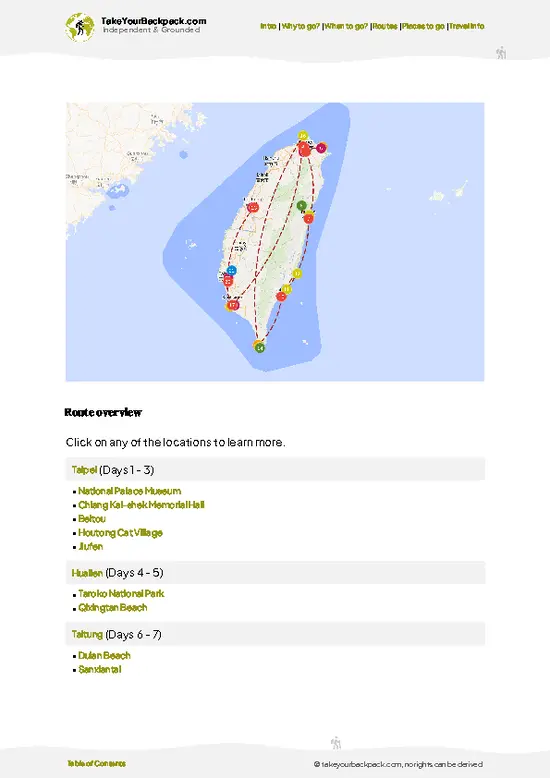
Planning a backpacking route through Taiwan can be tricky — you need to balance must-see places, travel times, budget, and how long to stay in each destination. Our free personalized Taiwan itinerary planner creates a route based on your travel style, trip duration, and interests, so you can spend less time researching and more time exploring.
Personal tip: I normally search on good rating for atmosphere (for meeting people) and location (for easy exploring). Cleanliness as a bonus.
Travel Essentials
No vaccinations are required to enter Taiwan unless you arrive from a yellow fever risk country, in which case proof of yellow fever vaccination may be requested. Make sure routine vaccines (measles-mumps-rubella, tetanus-diphtheria, polio, flu) are current, and Hepatitis A and Hepatitis B are commonly recommended for travelers. Consider Japanese encephalitis vaccination for long rural stays, and rabies vaccination if you will be hiking remotely or handling animals, since rabies circulates among wild ferret-badgers. Dengue occurs in southern Taiwan in summer and autumn and has no standard travel vaccine, so pack strong insect repellent.
vaccination requirementsWhen I first started traveling, I often spent part of my first day in a new country hunting for a local SIM card. While this can still be slightly cheaper, it also takes time and planning.
These days, it's much simpler to install an eSIM before leaving home. Once you arrive in Taiwan, you can activate it immediately and have mobile data from the moment you land — which is especially useful for ordering transport or navigating away from busy airports.
There are many providers nowadays, and price differences are usually small. I personally go with
Holafly, as it offers excellent network coverage throughout the country and strong global coverage, so you can manage multiple countries from a single app.
HolaFly eSimCulture & Customs
In Taiwan, take your shoes off when entering someone’s home and watch for shoe racks at guesthouse entrances. Never stand chopsticks upright in a bowl of rice, since it resembles incense at funerals, and avoid gifting clocks or anything in sets of four, both linked to death. Do hand over money and business cards with both hands, queue patiently, stand on the right of escalators in Taipei, and leave the dark blue priority seats on the MRT for those who need them. Don’t eat or drink inside MRT stations or trains, as fines run NT$1,500 to 7,500. At temples, dress modestly, don’t point at deity statues, and step over the raised threshold rather than on it. During Ghost Month (the seventh lunar month, usually August), locals avoid swimming and whistling at night, so be respectful of offerings left on sidewalks. Public displays of affection are fine for same-sex couples in cities, though more reserved behavior is wise in rural and older communities.
Trying traditional food is always a great way to experience the culture. Here are some must-try dishes for Taiwan.
- Beef Noodle Soup (niú ròu miàn): Thick wheat noodles in a braised, soy-and-spice broth with tender beef shank. Often called Taiwan’s national dish, it has its own annual competition in Taipei and every neighborhood has a contender.
- Braised Pork Rice (lǔ ròu fàn): Finely chopped fatty pork simmered in soy sauce and five-spice, spooned over white rice. It costs around NT$30 to 60 and is the everyday comfort meal across the island.
- Xiaolongbao: Thin-skinned soup dumplings filled with pork and hot broth. Brought by mainland migrants, they became one of Taiwan’s best-known food exports.
- Oyster Omelette (ô-á-tsian): Small oysters fried with egg, leafy greens and sweet potato starch, topped with a sweet-savory red sauce. A night market staple with roots in the coastal Hokkien cooking of southern Taiwan.
- Stinky Tofu (chòu dòufu): Fermented tofu, usually deep-fried and served with pickled cabbage and chili. You smell the stall long before you see it, and locals treat it as a rite of passage for visitors.
- Gua Bao: A soft folded steamed bun stuffed with braised pork belly, pickled mustard greens, crushed peanuts and cilantro. Traditionally eaten at year-end business banquets for good fortune.
- Bubble Tea (zhēnzhū nǎichá): Black milk tea with chewy tapioca pearls, invented in Taiwan in the 1980s. You can customize sugar and ice levels at nearly every shop.
Tap water in Taiwan is treated to safe standards at the source, but most locals boil or filter it first because older pipes and rooftop storage tanks in apartment buildings can affect quality. Drinking straight from the tap is not recommended for travelers. Hostels, hotels, MRT stations and many public buildings have free filtered hot-and-cold water dispensers, so carry a refillable bottle instead of buying bottled water.
The main language in Taiwan is
Mandarin. Backpacking is way more rewarding if you know a bit of the local language, so I'd suggest brushing up on the basics just in case your Mandarin skills have become a bit rusty.
Want to understand locals better?The complete Travel Guide for Taiwan includes 52 essential words and phrases — greetings, thank-yous, ordering food, transport, numbers, and common local expressions you'll actually hear.
Get your local basic phrases 👉
Get the Travel Guide - in Taiwan is patchy: in Taipei signage, MRT announcements and menus at popular spots are bilingual, and hostel staff and many people under 35 can manage a basic conversation. Outside the big cities, at rural bus stations, family-run eateries and mountain villages, expect little to none. Mandarin is the language that helps most, while Taiwanese Hokkien is widely spoken in the south and among older people. Download Google Translate with offline Traditional Chinese and use the camera mode on menus, and learn xièxie (thank you) and zhège (this one) for pointing at food.
Money & Payments
The local currency of Taiwan is TWD (NT$).
Getting cash in Taiwan is easy: ATMs sit inside nearly every 7-Eleven and FamilyMart, run 24 hours, and accept foreign cards on the Plus and Cirrus networks. Local fees are typically zero to about NT$100 per withdrawal, but your home bank may add its own charges, so a fee-free travel debit card saves money. Credit cards work in hotels, department stores, chain restaurants, convenience stores and for HSR tickets, while night markets, street stalls, small family eateries and many guesthouses are cash only. Bring US dollars rather than euros if you carry backup currency, as they get better rates and are accepted at every exchange counter. Exchange at the airport banks or at Bank of Taiwan and other licensed bank branches with your passport, and skip street money changers.
Tipping is not expected in Taiwan, and leaving extra money at casual restaurants, night markets or with taxi drivers can cause mild confusion. Mid-range and upscale restaurants and hotels usually add a 10 percent service charge to the bill, which covers it. Rounding up a taxi fare or tipping a private tour guide is a kind gesture but entirely optional.



 Best Backpacking
 Over the years, I've learned the importance of packing minimally. It's so much easier to jump on the back of a truck or squeeze yourself into the last spot of a minibus without that supersized backpack. If you're headed to a warm destination, leave your winter jacket at home; for colder regions, opt for thin thermal underlayers. Instead of packing your entire wardrobe, bring just three sets of clothes, as laundry facilities are available everywhere.

 Hi, I’m Johan (Netherlands 🇳🇱), the creator of TakeYourBackpack. Over the past 3 decades, I’ve backpacked through 90+ countries across six continents, gaining extensive experience with independent travel, long-term trips, and overland routes.