×
Vanuatu 🇻🇺

backpacking Oceania Vanuatu 🇻🇺Erupting volcano rims, sunken liners and custom fees for every trail.

Explore TuvaluExplore Argentina

Backpacking Vanuatu in 2027

A complete guide including when and where to go, costs, transport, itineraries, and practical travel advice.
What a trip here is really like

Backpacking Vanuatu
By Johan Kruseman 🇳🇱 | Updated October 9, 2026

Every waterfall, cave and beach in Vanuatu belongs to somebody. The constitution vests all land in its custom owners, so a swim at a blue hole or a walk up to a cascade usually means handing a small custom fee to the family whose ground you cross. Pay it with a smile, because that money keeps the trails cut and the ladders tied.

The country hands you moments you can’t get elsewhere in the Pacific. You can hike the ash slope of Mount Yasur on Tanna at dusk and feel each blast thud in your chest. On Pentecost, men leap headfirst off timber towers with vines lashed to their ankles. The flip side comes fast: domestic flights get cancelled, inter-island boats sail when the cargo is ready, and outer islands run on generators and weak phone signal.

Fiji is smoother and more resort-polished, and the Solomon Islands are rougher still. Vanuatu sits between the two. It suits flexible travelers who keep a buffer day in hand, and it will grind down anyone locked into a tight prepaid itinerary.

👉 Get the 📖 Travel Guide of Vanuatu

Efate

Port Vila crams cafes, dive shops and a harborside market into a few hilly blocks, and a sealed ring road loops the island past Eton Beach and the Blue Lagoon. Minibuses stop wherever you wave. It’s the easy, social landing pad for first-timers, and evenings end with grilled fish at the seafront stalls.

Espiritu Santo

Luganville’s main street was built wide for American military traffic in World War II and still feels oversized and sleepy. The east coast road runs north past blue holes and white beaches; the west is roadless, reached on foot or by boat. Divers and swimmers thrive here, cannonballing into clear blue water by afternoon.

Tanna

Tanna runs on dirt. Open-backed 4WD trucks rattle about two hours from Lenakel through banyan forest and over a gray ash plain to the volcano side, and kastom villages hold their traditions tightly. Bring tolerance for dust and bucket showers; you get nights in a bungalow with the ground rumbling.

Ambrym

Ambrym barely has roads, so you walk. Guided treks to the Marum and Benbow craters take around two days across black ash, and northern villages carve towering tamtam slit drums. Fit, self-sufficient travelers get a crater rim with nobody else on it.
Geography and where places are located
Loading the map 🌍
CLICK TO FILTER
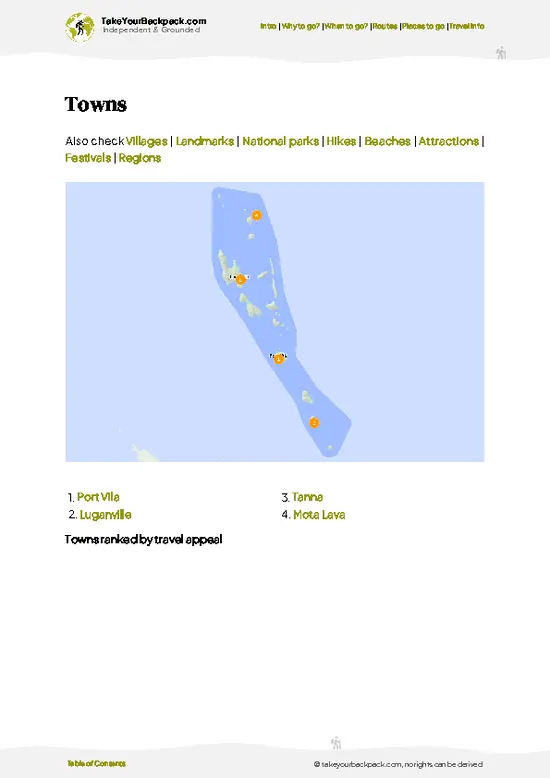
towns
villages
landmarks
national parks
hikes
beaches
attractions
festivals
regions
SHOW COUNTRY’S BESTSHOW ALL

Why go?Reasons people choose to visit

Beach life

Vanuatu beach days happen on the reef as much as the sand. Strap on a mask and you’re over coral within a few strokes of shore. Paddle out to the Hideaway … read more 👉
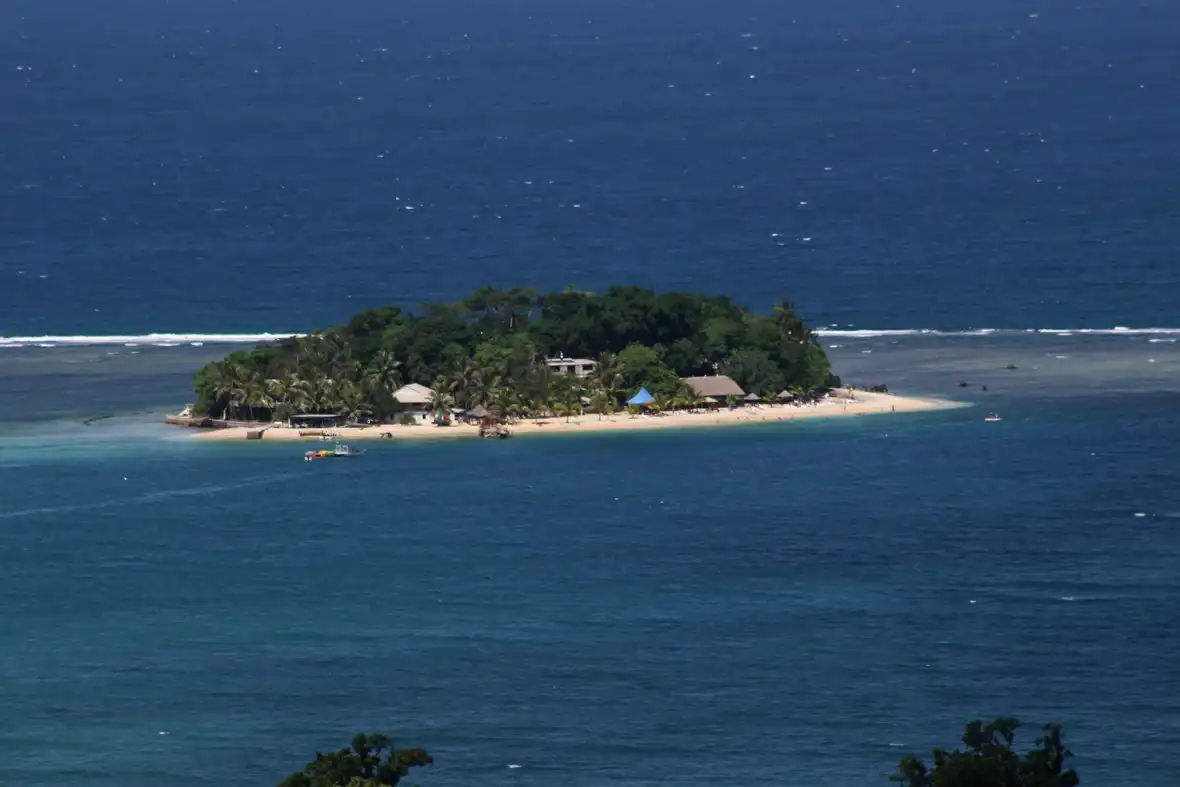
Vanuatu beach days happen on the reef as much as the sand. Strap on a mask and you’re over coral within a few strokes of shore. Paddle out to the Hideaway Island marine reserve near Mele, where parrotfish crowd the shallows and you can post a waterproof card from an underwater mailbox. Reef shoes matter here, because the volcanic and coral edges bite.

Scenery

Vanuatu packs a lot of geology into small islands. Ash plains glow under active volcanoes, limestone blue holes burn electric turquoise, and rainforest … read more 👉
Vanuatu packs a lot of geology into small islands. Ash plains glow under active volcanoes, limestone blue holes burn electric turquoise, and rainforest climbs right down to coral coastline. On Santo, hit the Nanda or Riri blue holes by mid-morning, when the sun lights the water straight down to the bottom. Hire a local guide on Tanna or Ambrym and you’ll reach viewpoints that aren’t on any signpost.

People

Walk any village road in Vanuatu and people call out “Halo!” from gardens and doorways, then ask where you’re from and which island you’ve come from next. … read more 👉
Walk any village road in Vanuatu and people call out “Halo!” from gardens and doorways, then ask where you’re from and which island you’ve come from next. Kids trail you, laughing at your attempts at Bislama. Learn “tankyu tumas” (thank you very much) and watch faces light up. Ask before photographing anyone, and say yes when invited to sit and share a story under a mango tree.

⭐ HighlightsWhat not to miss along the way

  • Mount Yasur: Few active volcanoes let you walk to the rim, and this one keeps erupting every few minutes. Sulfur catches in your throat, grit crunches between your teeth, and each orange flash is followed a beat later by a boom you feel in your sternum. Go for the late session so the lava glows against a dark sky.
  • SS President Coolidge: This former luxury liner, turned troopship, struck American mines off Luganville in 1942 and now lies on its side from roughly 20 to 70 meters down. You walk in from the shore, and deeper dives reach the porcelain figure divers call “the Lady.”
  • Champagne Beach: On Santo’s east coast, powder-white sand meets water so clear the reef looks close enough to touch. At low tide, tiny bubbles fizz up through the sand at the water’s edge, which gave the beach its name.
  • Millennium Cave: A full-day Santo adventure with bamboo ladders, a wade through a pitch-black cave full of squeaking bats, then a float down a canyon river between mossy boulders.
  • Mele Cascades: Just
… read more 👉
  • Mount Yasur: Few active volcanoes let you walk to the rim, and this one keeps erupting every few minutes. Sulfur catches in your throat, grit crunches between your teeth, and each orange flash is followed a beat later by a boom you feel in your sternum. Go for the late session so the lava glows against a dark sky.
  • SS President Coolidge: This former luxury liner, turned troopship, struck American mines off Luganville in 1942 and now lies on its side from roughly 20 to 70 meters down. You walk in from the shore, and deeper dives reach the porcelain figure divers call “the Lady.”
  • Champagne Beach: On Santo’s east coast, powder-white sand meets water so clear the reef looks close enough to touch. At low tide, tiny bubbles fizz up through the sand at the water’s edge, which gave the beach its name.
  • Millennium Cave: A full-day Santo adventure with bamboo ladders, a wade through a pitch-black cave full of squeaking bats, then a float down a canyon river between mossy boulders.
  • Mele Cascades: Just outside Port Vila, limestone pools step up the hillside, rope-assisted, to a cold waterfall you can stand under.
For quieter corners, aim for Lake Letas on Gaua or the reef villages of the Maskelyne Islands off Malekula.
Spotted a mistake or missing a highlight? Contact us.

But Vanuatu offers more...

Discover and compare all of its highlights per category

🧭 RoutesPlanning a route that makes sense

The 2-Day Efate Route

Waterfalls, reef-side swimming and village life within an hour of Port Vila, with no domestic flights. It suits a stopover or a long weekend when you want maximum water time for minimum logistics.
  • Climbing the rope-assisted terraces of the Mele Cascades
  • A walk through Mele Maat village
  • River-meets-reef swimming at Eton Beach
  • Rope swings at Blue Lagoon


👉 explore this 2-day route

The 3-Day Espiritu Santo Route

One island, explored properly, from jungle canyons to Santo’s clearest swimming holes. It is an active trip with one big adventure day and one long day of beaches.
  • Millennium Cave by torchlight
  • The spring-fed Nanda Blue Hole
  • Champagne Beach at low tide
  • A bungalow night at Lonnoc Beach


👉 explore this 3-day route

The 5-Day Volcano and Kastom Route

A two-island trip that pairs Efate’s history and coastline with the raw power of Tanna. The pace is easy, with room for weather, flights and a second look at the crater.
  • The rim of Mount Yasur at dusk
  • Chief Roi Mata’s Domain, Vanuatu’s
… read more 👉

The 2-Day Efate Route

Waterfalls, reef-side swimming and village life within an hour of Port Vila, with no domestic flights. It suits a stopover or a long weekend when you want maximum water time for minimum logistics.
  • Climbing the rope-assisted terraces of the Mele Cascades
  • A walk through Mele Maat village
  • River-meets-reef swimming at Eton Beach
  • Rope swings at Blue Lagoon


👉 explore this 2-day route

The 3-Day Espiritu Santo Route

One island, explored properly, from jungle canyons to Santo’s clearest swimming holes. It is an active trip with one big adventure day and one long day of beaches.
  • Millennium Cave by torchlight
  • The spring-fed Nanda Blue Hole
  • Champagne Beach at low tide
  • A bungalow night at Lonnoc Beach


👉 explore this 3-day route

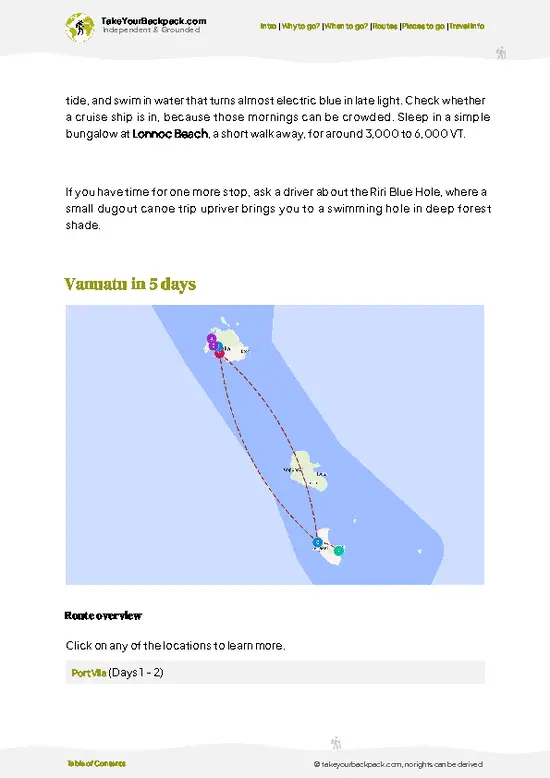
The 5-Day Volcano and Kastom Route

A two-island trip that pairs Efate’s history and coastline with the raw power of Tanna. The pace is easy, with room for weather, flights and a second look at the crater.
  • The rim of Mount Yasur at dusk
  • Chief Roi Mata’s Domain, Vanuatu’s UNESCO site
  • A morning at the National Museum of Vanuatu
  • Island legends at the Secret Garden Cultural Centre

👉 explore this 5-day route

🌤️ When to go?When to go for the best experience

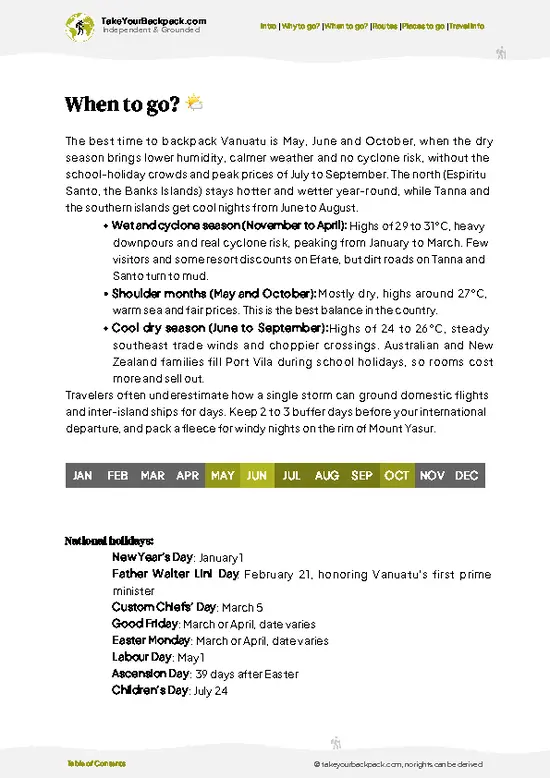
The best time to backpack Vanuatu is May, June and October, when the dry season brings lower humidity, calmer weather and no cyclone risk, without the school-holiday crowds and peak prices of July to September. The north (Espiritu Santo, the Banks Islands) stays hotter and wetter year-round, while Tanna and the southern islands get cool nights from June to August.
  • Wet and cyclone season (November to April): Highs of 29 to 31°C, heavy downpours and real cyclone risk, peaking from January to March. Few visitors and some resort discounts on Efate, but dirt roads on Tanna and Santo turn to mud.
  • Shoulder months (May and October): Mostly dry, highs around 27°C, warm sea and fair prices. This is the best balance in the country.
  • Cool dry season (June to September): Highs of 24 to 26°C, steady southeast trade winds and choppier crossings. Australian and New Zealand families fill Port Vila during school holidays, so rooms cost more and sell out.
Travelers often underestimate how a single storm can ground domestic flights and inter-island ships for days. Keep 2 to 3 buffer days before your international departure, and pack a fleece for windy nights on the rim of Mount Yasur.

source: climatestotravel.comJANJanuary: fair for travelingFEBFebruary: fair for travelingMARMarch: fair for travelingAPRApril: fair for travelingMAYMay: highly recommended for travelingJUNJune: excellent for travelingJULJuly: good for travelingAUGAugust: good for travelingSEPSeptember: good for travelingOCTOctober: highly recommended for travelingNOVNovember: fair for travelingDECDecember: fair for traveling
vanuatu-island-pixabay-3664209

💰 Costs (as of 2026)What things cost day to day

Backpacking Vanuatu on a tight budget costs about US$45 to 75 a day, and the jump comes from domestic flights and volcano fees, not from beds and food.
CategoryBudget RangeLocal Reality
Dorm accommodationUS$20 to 35 (2,400 to 4,200 vatu)A dorm bed in Port Vila usually costs 2,500 to 4,000 vatu (US$21 to 33). In Luganville on Espiritu Santo, expect 2,500 to 3,500 vatu. On Tanna and the outer islands there are almost no dorms. Instead you get family-run bungalows at 3,000 to 6,000 vatu per person, and that price often includes dinner and breakfast. Ask for that deal, because it cuts your food bill too.
MealsUS$10 to 20 (1,200 to 2,400 vatu)At the Port Vila market food stalls, a plate of lap lap or rice with stew or fish runs 400 to 600 vatu (US$3.50 to 5). Supermarket noodles, bread and tinned tuna are imported, so they cost roughly double what you’d pay in Fiji. A café meal in town is 1,500 to 2,500 vatu. Buying fruit from roadside stands, at 100 to 200 vatu a bundle, is the cheapest way to eat well.
Local transportUS$2 to 15 (200 to 1,800 vatu)A minibus ride with an “B” plate anywhere around Port Vila is 150 to 200 vatu. In Luganville you pay the same. On Tanna, a seat on a shared truck
… read more 👉
Backpacking Vanuatu on a tight budget costs about US$45 to 75 a day, and the jump comes from domestic flights and volcano fees, not from beds and food.
CategoryBudget RangeLocal Reality
Dorm accommodationUS$20 to 35 (2,400 to 4,200 vatu)A dorm bed in Port Vila usually costs 2,500 to 4,000 vatu (US$21 to 33). In Luganville on Espiritu Santo, expect 2,500 to 3,500 vatu. On Tanna and the outer islands there are almost no dorms. Instead you get family-run bungalows at 3,000 to 6,000 vatu per person, and that price often includes dinner and breakfast. Ask for that deal, because it cuts your food bill too.
MealsUS$10 to 20 (1,200 to 2,400 vatu)At the Port Vila market food stalls, a plate of lap lap or rice with stew or fish runs 400 to 600 vatu (US$3.50 to 5). Supermarket noodles, bread and tinned tuna are imported, so they cost roughly double what you’d pay in Fiji. A café meal in town is 1,500 to 2,500 vatu. Buying fruit from roadside stands, at 100 to 200 vatu a bundle, is the cheapest way to eat well.
Local transportUS$2 to 15 (200 to 1,800 vatu)A minibus ride with an “B” plate anywhere around Port Vila is 150 to 200 vatu. In Luganville you pay the same. On Tanna, a seat on a shared truck from Lenakel toward the volcano side costs 1,500 to 2,500 vatu. A one-way domestic flight from Vila to Tanna or Santo costs US$120 to 200, and that alone can blow a week’s savings. On the Vila to Santo route, an overnight deck ticket on the ferry costs 7,000 to 10,000 vatu.
ActivitiesUS$5 to 85 (600 to 10,000 vatu)On Tanna, the Mount Yasur volcano fee is around 9,750 vatu (about US$80) before transport, which makes it the biggest single cost in the country. On Santo, the blue holes charge 500 to 1,000 vatu entry each. Champagne Beach is 2,000 vatu per vehicle-ish group fee. Snorkeling from the shore is free if you bring your own mask.
MiscellaneousUS$3 to 10 (350 to 1,200 vatu)A shell of kava at a nakamal costs 100 to 200 vatu, and three shells a night adds up. A Digicel or Vodafone SIM with a data bundle costs 1,000 to 2,000 vatu. Custom village and waterfall fees are usually 500 to 1,000 vatu.
Total Daily BudgetUS$45 to 75 (5,400 to 9,000 vatu)A cheap day in Port Vila looks like a dorm at 3,000 vatu plus two market meals at 1,000 vatu, bus fares at 400 vatu and kava at 300 vatu, for about 4,700 vatu before activities. Add a volcano day or a flight and the average climbs to the top of the range.
Compared with its neighbors, Vanuatu costs more than Fiji, where dorms and transport are cheaper and easier to find. It costs far less than New Caledonia, where even a basic meal can run US$20 or more. It is roughly on par with the Solomon Islands. Prices are in vatu, and the rate sits at about 120 vatu to US$1. Card machines are rare outside Port Vila and Luganville, so carry cash before you head to Tanna or the outer islands. Tipping is not expected, and bargaining at markets is considered rude, so the price you’re quoted is the real price.
⚠️ Prices can change and everyone travels differently, so take this as a rough guide. Hope it helps you plan your adventure!

✈️ The backpacker research shortcutVanuatu Travel Guide

An offline-friendly backpacking guide with optimized travel routes, ranked highlights, transport advice, and the best areas to stay.
example page 0 from our offline Travel Guide for Vanuatu
example page 1 from our offline Travel Guide for Vanuatu
example page 2 from our offline Travel Guide for Vanuatu
example page 3 from our offline Travel Guide for Vanuatu
example page 4 from our offline Travel Guide for Vanuatu
example page 5 from our offline Travel Guide for Vanuatu
example page 6 from our offline Travel Guide for Vanuatu
example page 7 from our offline Travel Guide for Vanuatu
The digital guide (149 pages) contains:
✅ 41 highlights, ranked by travel appeal
✅ Optimized 2, 3 & 5-day travel routes
✅ Cities, national parks, landmarks, beaches
✅ How to get around
✅ Offline-friendly for travel without Wi-Fi
👉 Click to see all 30+ guide features

📅 Plan smarter in minutes, not weeks
✅ Month by month travel advice
✅ Festivals & national holidays
✅ Budget expectations

🗺️ Go to the right places, skip the overrated ones
✅ Honest pros & cons of destinations
✅ Top hikes, parks & viewpoints
✅ Lesser-known places most travelers miss
✅ Clear “worth it vs skip it” guidance

🛏️ Travel smoothly without rookie mistakes
✅ Best areas to stay
✅ Transport systems explained simply
✅ Common scams & safety advice
✅ SIM cards, money & practical tips

🌍 Understand the country, not just visit it
✅ Culture & traditions
✅ 52 Essential phrases & customs
✅ Festivals worth planning around
✅ Traveler-friendly historical context
✅ Insights that make places more meaningful

📱 Built for real travel conditions
✅ Fully downloadable PDF
✅ Works completely offline
✅ Optimized for phone use
✅ Useful in remote areas & buses
✅ Everything in one place
Save weeks of stressful planning
Get instant access to your full guide. 30‑day money-back guarantee.
+ Add another guide for just

By proceeding you agree to our terms.
Sent to your inbox immediately after payment • 100% Secure Checkout
Best Backpacking Travel Advisor 2025 tourism awardBest Backpacking
Travel Advisor
2025
What others say about Take Your Backpack Guides:
⭐⭐⭐⭐⭐
Fantastic, amazing amount of information!
⭐⭐⭐⭐⭐
My goodness this is amazing, it's what I've been looking for hats off too you!
⭐⭐⭐⭐⭐
I think this is absolutely BRILLIANT
⭐⭐⭐⭐
Very complete and informative. It's still missing places, but I gotta to commend you
⭐⭐⭐⭐⭐
This is truly amazing, thank you, can't wait to explore it with my kids!
⭐⭐⭐⭐⭐
Awesome resource, thank you!
⭐⭐⭐⭐⭐
This is amazing! Can't wait to explore the ones I haven't seen
⭐⭐⭐⭐
I love this! Well done, great idea.
⭐⭐⭐⭐⭐
Thanks for taking the time to make this gem!
⭐⭐⭐⭐⭐
This might be the best website I've ever seen.
⭐⭐⭐⭐⭐
Congratulations, and thank you so much for your work; it's incredibly valuable.
⭐⭐⭐⭐
In all seriousness I think you did a great job pointing out the important spots
⭐⭐⭐⭐⭐
10/10 very good
⭐⭐⭐⭐⭐
As someone who's only just starting to visit regularly this is awesome, thank you.
⭐⭐⭐⭐
Thank you very much! I'm going to visit my dad, it's going to be very useful!
⭐⭐⭐⭐⭐
This is really cool! We'll be travelling for the first time and this definitely come in handy.
⭐⭐⭐⭐⭐
You are now our minister of culture, congratulations 👨‍💼
⭐⭐⭐⭐⭐
Just wanted to tell you that this is a pearl! Going to follow your recommendations.
⭐⭐⭐⭐⭐
This is so cool. I'll definitely be using the resource for my travels soon.
⭐⭐⭐⭐⭐
This is very impressive! Good work.
⭐⭐⭐⭐⭐
This is an amazing and informative site. Very well done!

🛏️ Where to stay?Where to stay in Vanuatu

Vanuatu has only a handful of true hostels, but budget guesthouses, backpacker lodges and simple island bungalows are easy to find, typically at 2,500 to 6,000 VT (about US$20 to 50) a night. In Port Vila, downtown and the seafront put you within walking distance of the market, restaurants and the limited nightlife, though it can be noisy and is best avoided on foot late at night. The Elluk and Nambatu areas are quieter but need a minibus ride. Luganville on Santo is low-key and practical for dive trips, while Tanna’s family-run bungalows near Mt Yasur trade electricity and comforts for being … read more 👉
Vanuatu has only a handful of true hostels, but budget guesthouses, backpacker lodges and simple island bungalows are easy to find, typically at 2,500 to 6,000 VT (about US$20 to 50) a night. In Port Vila, downtown and the seafront put you within walking distance of the market, restaurants and the limited nightlife, though it can be noisy and is best avoided on foot late at night. The Elluk and Nambatu areas are quieter but need a minibus ride. Luganville on Santo is low-key and practical for dive trips, while Tanna’s family-run bungalows near Mt Yasur trade electricity and comforts for being close to the volcano.

If you enjoy meeting fellow travelers, consider choosing hostels with high ratings for atmosphere. On the other hand, if you prefer having your own space, a hotel might be a better option.

🚌 Getting aroundGetting around Vanuatu

In Vanuatu, the fastest way to save money is to wave down any Port Vila minibus with a “B” on its plate and simply tell the driver where you’re going. There are no fixed routes, so the bus takes you close to the door for a flat fare. Off Efate, plan your island hops around flight and boat schedules first and everything else falls into place.
  • Port Vila minibuses: 150 to 200 VT (about US$1.25 to 1.70) per ride in town, 10 to 20 minutes for most trips. Pay cash when you get off. Drivers pick up other
… read more 👉
In Vanuatu, the fastest way to save money is to wave down any Port Vila minibus with a “B” on its plate and simply tell the driver where you’re going. There are no fixed routes, so the bus takes you close to the door for a flat fare. Off Efate, plan your island hops around flight and boat schedules first and everything else falls into place.
  • Port Vila minibuses: 150 to 200 VT (about US$1.25 to 1.70) per ride in town, 10 to 20 minutes for most trips. Pay cash when you get off. Drivers pick up other passengers along the way, so allow for a detour or two. The upside is a cheap ride to the market, the seafront or the lagoon for a sunset swim.
  • Taxis: These have a “T” plate. Expect 500 to 1,500 VT around Port Vila, and agree on the price before you get in. Chartering one for the Efate ring road (about 130 km) gets you to waterfalls and blue holes in a single day.
  • Domestic flights: Vila to Tanna takes about 40 minutes and Vila to Santo about 50, at roughly 13,000 to 25,000 VT (US$110 to 210) one way. Book online or at the town office, and reconfirm the day before because schedules shift. In return, you skip days at sea and look straight down on reefs.
  • Inter-island ships: Cargo and passenger boats run between Vila and Luganville with stops along the way. The trip takes roughly a day and deck fares are a fraction of airfare. Bring food and a mat. You get to watch the outer islands slide past from the rail.
  • Shared trucks on Tanna and Santo: Open-backed utes cost 500 to 3,000 VT depending on distance. The run from Tanna’s airport to the Mt Yasur area takes about 2 hours on rutted roads. Ask your bungalow to arrange a seat, then hold on as the volcano comes into view.
Fly between the far-flung islands and save the ships for legs where you have spare days.
Bauerfield International Airport sits about 6 km (3.7 miles) from central Port Vila, a 10 to 15 minute drive. There are no numbered bus routes in Vanuatu’s capital. Instead, private minibuses marked with a “B” on the plate wait near the terminal or pass on the main road, and they take you straight to your accommodation for about 150 to 200 VT (roughly US$1.25 to 1.70) per person. Taxis, marked with a “T” plate, charge around 1,500 to 2,000 VT (about US$12 to 17) to the town center or nearby guesthouses, so confirm the price before you set off. Ride-hailing apps like Uber do not operate in Vanuatu, so carry some vatu, which you can get from the ATM or exchange counter at the airport.
⚠️ Prices and routes can change, so take this as a rough guide and ask for local advice when you arrive.
🚀 Don’t waste time on the road.
We’ll generate a route that minimizes unnecessary travel and fits your available days.

Generate my itinerary

🔒 Safety (risk Level: low)What first-time visitors should know

Safety for solo travelers, including women and LGBTQ+ individuals
Vanuatu is one of the safer countries in the South Pacific for solo travelers, with low violent crime and a welcoming, community-minded culture. Petty theft and opportunistic break-ins do happen in Port Vila and Luganville, so lock up valuables and take a taxi rather than walking alone after dark. Women traveling solo generally report feeling comfortable, though dressing modestly in villages helps you avoid unwanted attention. Same-sex relationships are legal, but society is conservative and religious, so LGBTQ+ travelers are best keeping public affection discreet. Natural hazards are a bigger risk than people, so follow cyclone warnings and stay within the volcano guides’ limits on Tanna.


Full official government travel advisory (live updates)
View details 👉

✈️ VisaWhat travelers should know about visas

Citizens of the EU, UK, US, Canada, Australia, New Zealand and many other countries do not need to apply in advance for Vanuatu. They receive a free visitor visa on arrival, usually valid for 30 days and extendable through the Department of Immigration. You need a passport valid for at least six months, an onward or return ticket and proof of funds. Travelers from countries outside the exemption list must apply for a visa before travel through the Vanuatu Immigration and Passport Services.
⚠️ Visa requirements can change over time, so always check the latest visa requirements with the official embassy or government website before you travel.

🎒 What to pack?What to pack for Vanuatu

Vanuatu is hot and humid all year, and from November to April the wet season brings heavy downpours and the risk of cyclones. Pack light, quick-drying fabrics and a rain layer you can stuff into a daypack. Much of your time will be spent on coral reefs, rocky shorelines and muddy jungle trails, so sturdy footwear for both water and land matters more than fashion. Outside resorts, village life is conservative and Christian, so bring clothes that cover shoulders and knees, and keep swimwear for the beach. If Mt Yasur on Tanna is on your route, a warm layer helps on the windy crater rim after dark, and since outer islands have few shops and patchy power, bring your own medicines and a way to charge your devices.

Apart from this country specific advice, I have also crafted a general packing list that should help on any trip. authorOver the years, I've learned the importance of packing minimally. It's so much easier to jump on the back of a truck or squeeze yourself into the last spot of a minibus without that supersized backpack. If you're headed to a warm destination, leave your winter jacket at home; for colder regions, opt for thin thermal underlayers. Instead of packing your entire wardrobe, bring just three sets of clothes, as laundry facilities are available everywhere.

View the full list 👉

🙋 FAQFrequently asked questions

Trip Planning

Planning a backpacking route through Vanuatu can be tricky — you need to balance must-see places, travel times, budget, and how long to stay in each destination. Our free personalized Vanuatu itinerary planner creates a route based on your travel style, trip duration, and interests, so you can spend less time researching and more time exploring.


Personal tip: I normally search on good rating for atmosphere (for meeting people) and location (for easy exploring). Cleanliness as a bonus.


Travel Essentials

There are no compulsory vaccinations for Vanuatu, except a yellow fever certificate if you arrive from a country with yellow fever risk. Make sure your routine shots (MMR, tetanus-diphtheria, polio) are up to date. Hepatitis A and typhoid are recommended for most travelers, and hepatitis B is advised for longer stays. Malaria is present in much of the country, especially outside Port Vila, so talk to a travel clinic about antimalarial tablets. Dengue outbreaks also occur, which makes daily insect repellent and long sleeves at dusk your best defense.


vaccination requirements
When I first started traveling, I often spent part of my first day in a new country hunting for a local SIM card. While this can still be slightly cheaper, it also takes time and planning.

These days, it's much simpler to install an eSIM before leaving home. Once you arrive in Vanuatu, you can activate it immediately and have mobile data from the moment you land — which is especially useful for ordering transport or navigating away from busy airports.

There are many providers nowadays, and price differences are usually small. I personally go with Holafly, as it offers excellent network coverage throughout the country and strong global coverage, so you can manage multiple countries from a single app.


HolaFly eSim

Culture & Customs

In Vanuatu, almost all land, beaches, reefs and waterfalls belong to someone under custom ownership. Paying the small “kastom” fee when asked and seeking permission before entering village land or swimming at a spot is expected, not optional. Cover your shoulders and knees in villages and towns, swim in shorts and a T-shirt away from resorts, and always ask before photographing people, ceremonies or sacred sites. Sundays are for church and family, so keep noise down and expect little to be open. Haggling is not part of the culture, and market prices are fixed and fair. At a nakamal (kava bar), drink quietly, since loud behavior is frowned upon. Women should be aware that some village nakamals are traditionally male-only, while those in Port Vila welcome everyone. Don’t touch people’s heads, and avoid public displays of affection, which applies to all couples and is especially wise for same-sex couples.
Trying traditional food is always a great way to experience the culture. Here are some must-try dishes for Vanuatu.
  1. Lap lap: Vanuatu’s national dish. It’s grated yam, taro, manioc or banana mixed with coconut cream, wrapped in leaves and baked over hot stones in an earth oven, often with chicken, pork or fish on top. It anchors feasts, weddings and custom ceremonies.
  2. Simboro: Grated manioc or banana rolled in island cabbage leaves and simmered in coconut milk. It’s soft, rich and a family staple you’ll find at markets and village meals.
  3. Tuluk: A dense, sticky manioc parcel with a pork or beef filling, steamed in leaves. It’s the go-to cheap snack at Port Vila’s market stalls and bus stops.
  4. Santo beef: Grass-fed cattle raised under coconut plantations on Espiritu Santo. It produces tender steaks that locals are proud of, and they cost far less than they would back home.
  5. Coconut crab: A giant land crab cooked in coconut cream or garlic butter, prized as a celebration dish. It’s harvested under size limits, so order it only where the crabs are legally sourced.
  6. Nalot: Roasted taro, breadfruit or banana pounded into a paste and drenched in coconut cream. It’s often served at gatherings alongside kava.
Tap water in Port Vila and Luganville is treated, and many locals drink it, but travelers with sensitive stomachs are usually advised to stick to bottled or filtered water, especially after heavy rain. On outer islands, water typically comes from rainwater tanks or wells and should be boiled, filtered or purified before drinking. A refillable bottle with a filter saves money and cuts plastic waste, since recycling is limited across Vanuatu.
The main language in Vanuatu is Bislama. Backpacking is way more rewarding if you know a bit of the local language, so I'd suggest brushing up on the basics just in case your Bislama skills have become a bit rusty.

Want to understand locals better?
The complete Travel Guide for Vanuatu includes 52 essential words and phrases — greetings, thank-yous, ordering food, transport, numbers, and common local expressions you'll actually hear.

Get your local basic phrases 👉

Get the Travel Guide -


English is widely spoken in Port Vila and Luganville, where hotels, tour operators and most shop staff handle it easily. Younger people and anyone working in tourism usually speak it well. In rural villages and on outer islands, English fades fast, and many people there were schooled in French instead. Bislama is the language that gets you furthest everywhere, and a few phrases like “tank yu tumas” (thank you very much) and “hamas?” (how much) are easy to learn and earn big smiles.

Money & Payments

The local currency of Vanuatu is VUV (VT).
Vanuatu uses the vatu (VT or VUV), at roughly 115 to 125 VT to US$1. ATMs from ANZ, BSP, BRED and the National Bank of Vanuatu are easy to find in Port Vila and Luganville, and you’ll find one at the international airport, but on islands like Tanna there are very few and most other outer islands have none. Expect a local fee of roughly 400 to 800 VT per withdrawal on foreign cards, plus whatever your home bank charges, so take out larger amounts less often. Visa and Mastercard are accepted at hotels, dive shops, supermarkets and bigger restaurants in the two towns, often with a 3 to 5 percent surcharge. Markets, minibuses, bungalows and village fees are cash only. Australian dollars are the easiest foreign currency to exchange, with US dollars and euros a close second, and banks or licensed exchange bureaus in Port Vila give safe, fair rates.
Tipping is not customary in Vanuatu, and it is not expected in restaurants, taxis or guesthouses. In Melanesian culture, giving without reason can create an awkward sense of obligation, so a warm thank-you is usually the better gesture. If a guide or village went well beyond what you paid for, a contribution to the community or school is appreciated more than cash handed to one person.

🧩 Nearby countriesOther countries to combine with Vanuatu

We 💚 feedbackKey takeaways from the trip

Come to Vanuatu for kastom that is still lived daily, where a chief’s word carries weight and land diving belongs to the village, not a stage. The drawback is time: schedules collapse with the weather, and an outer-island loop can eat a week of waiting. A common fear is the language barrier, but schools teach in English or French, so you can talk your way through nearly any situation. Pack patience and you’ll leave with stories most Pacific trips don’t give you.

✍️ Help improve this page!
The information on this page is based on in-depth research, insights shared by experienced travelers, and feedback from the local travel community in Vanuatu. While every effort is made to keep the information accurate and current, conditions can change — so if you spot anything incorrect or outdated, please get in touch.


🙋‍♂️ Give feedback

👋 Meet the founderWho’s Behind Take Your Backpack?

Johan, backpacker and founder of TakeYourBackpackHi, I’m Johan (Netherlands 🇳🇱), the creator of TakeYourBackpack. Over the past 3 decades, I’ve backpacked through 90+ countries across six continents, gaining extensive experience with independent travel, long-term trips, and overland routes.

This site is built on a combination of firsthand travel experience and carefully curated insights from other backpackers. Many guides are based on places I’ve personally visited, while others bring together tips, observations, and practical advice shared by trusted travelers I’ve met along the way.

The goal is to provide realistic, experience-driven guidance — not generic itineraries — so you can explore destinations with better context, clearer expectations, and more confidence.