×
Netherlands 🇳🇱

backpacking Europe Netherlands 🇳🇱
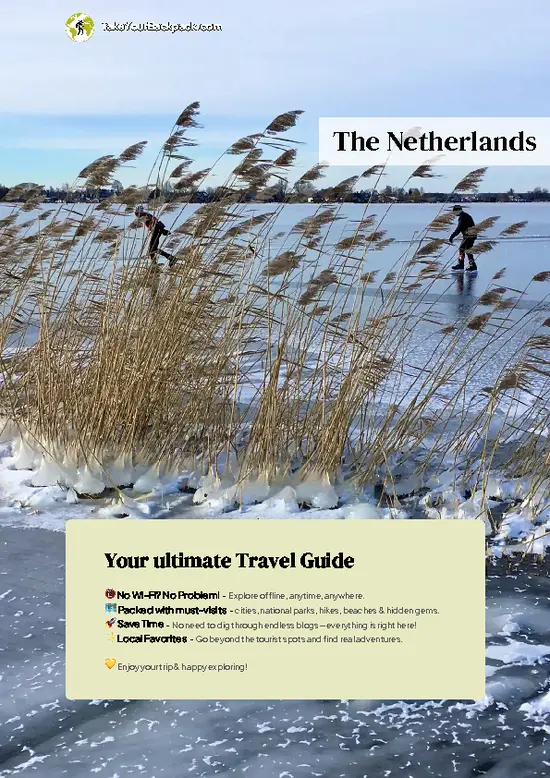
Cycle between canals and cities where everything feels close and easy.

Explore MontenegroExplore North Macedonia

Backpacking The Netherlands in 2026

A complete guide including when and where to go, costs, transport, itineraries, and practical travel advice.
An overview of visiting The Netherlands

Backpacking The Netherlands
By Johan Kruseman 🇳🇱 | Updated May 31, 2026

You tap your OV-chipkaart, hop a double-decker train, and cows and windmills slide by before your coffee cools. That’s the default here: frictions removed, time multiplied. Flat land and water management built a culture of movement—bike-first, rail-tight, human-scale.

The hook is how livable the adventure feels: canal cities built for walking, a nationwide bike web, North Sea dunes and the Wadden at low tide, Golden Age art a tram ride from street markets, and kitchens jumping from herring and fries to Indonesian rijsttafel and Surinamese roti. You feel the polder mentality—practical, cooperative, direct—in everything from museum lines that flow to nights that end with chatter and a warm stroopwafel. Yes, there’s wind, drizzle, crowds, and bikes that don’t forgive daydreaming; learn the right of way, book timed slots, base in Utrecht or Haarlem, and the country opens like a well-oiled hinge.

Compared with Belgium’s slower romance or Germany’s bigger distances, The Netherlands is compact, wired, and made for momentum—ideal for first-time Europe, art chasers, cyclists, and anyone who likes their serendipity running on time.
Randstad Rail Spine: Amsterdam–Haarlem–Leiden–The Hague–Rotterdam
This is the high-frequency game board. Intercity trains move you every few minutes; tap in, ride 15–45 minutes, pop out in a new texture. Amsterdam overwhelms; sleep in Haarlem or Leiden to cut room rates roughly 20–40% midweek and keep canals without the crush. The Hague gives beach air and ministries; Rotterdam gives big-scale modernism and night energy. You win by traveling light, zigzagging midday, and eating early. Payoff: a bench on Leiden’s Rapenburg, feet throbbing, cold pils in hand.

Utrecht + Heuvelrug Ridge
Utrecht is the rail hub heart, and the Heuvelrug is where you earn your dinner. Ten minutes to Driebergen-Zeist, then pine, sand, and quiet lanes. Rent a bike, aim for Amerongen and Rhenen; expect headwinds on the open ridges and soft patches that make your calves bark. Return on the canal-level towpaths. Payoff: a beer in Utrecht’s wharf cellars, sweat drying in the tunnel-light.

Veluwe Plateau
Forest, heath, and long, straight rides that make you settle into a cadence. Base via Arnhem, Apeldoorn, or Ede-Wageningen; buses thin on Sundays, so carry snacks and margin. In Hoge Veluwe, grab the free white bikes and roll pine to gallery: sculpture among trees, then purple heather if it’s late summer. Payoff: quiet deer at dusk and fries at a roadside pavilion.

Wadden Islands
Wind is the boss. Ferries sync with buses from Den Helder, Harlingen, Holwerd, Lauwersoog, but miss the last boat and you’re budgeting for a taxi-and-motel lesson. Rent a three-gear bike, lean into crosswinds, or book a mudflat walk by tide table. Payoff: dunes at golden hour and a foamy Texels Skuumkoppe with sand on your lips.

South Limburg Arc (via Eindhoven to Maastricht)
Follow the intercity south and you finally get hills. Short, punchy climbs (Cauberg, Bemelerberg) reward hikers and cyclists who like sweat with scenery. Trains hop to Belgium and Germany; terraces fill fast during Carnival. Track the Dutch Mountain Trail waymarks. Payoff: a slice of vlaai and a cold Brand in a Maastricht alley.
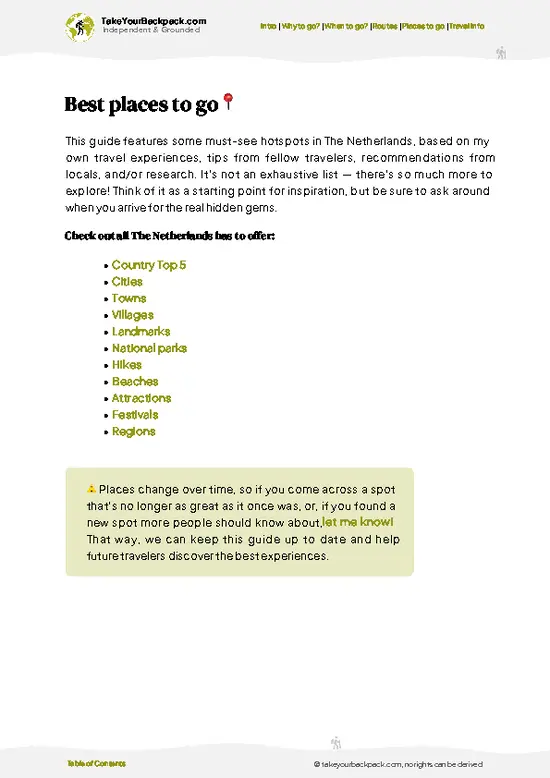
Geography and where places are located
Loading the map 🌍
CLICK TO FILTER
city
town
village
unique site
national park
hike
beach
attraction
festival
region
SHOW COUNTRY’S BESTSHOW ALL
film
0
0
0a
Rijksmuseum
film
1
1
1a
Van Gogh Museum
Pixabay
film
2
2
2a
Anne Frank House
film
3
3
3a
Efteling
Pixabay
film
4
4
4a
Mauritshuis
film
5
5
5a
Het Scheepvaartmuseum (National Maritime Museum)
film
6
6
6a
Heineken Experience
film
7
7
7a
Madurodam
film
8
8
8a
Scheveningen
film
9
9
9a
Zandvoort
Dicker Di
film
10
10
10a
Ameland
Christian Koepper
film
11
11
11a
Vlissingen Beach
film
12
12
12a
Amsterdam
Pixabay
film
13
13
13a
Rotterdam
film
14
14
14a
The Hague
Sanjay Sharma
film
15
15
15a
Utrecht
Gerlof Hoogeveen
film
16
16
16a
Leiden
Jon Lewis
film
17
17
17a
Haarlem
Marco Frederiks
film
18
18
18a
Delft
Boyka Dr
film
19
19
19a
Groningen
film
20
20
20a
Breda
Guido Douven
film
21
21
21a
’s Hertogenbosch
Rimmaandfima Shafran
film
22
22
22a
Alkmaar
Michiel De Bruijcker
film
23
23
23a
Amersfoort
R. Kemp
film
24
24
24a
Apeldoorn
Frank Swadzba
film
25
25
25a
Deventer
Arjan Van Der Haar
film
26
26
26a
Amsterdam Dance Event (ADE)
Amsterdam Dance Event (ade)
film
27
27
27a
Pinkpop
Peter Driessen
film
28
28
28a
Eurosonic Noorderslag
Johan Vink
film
29
29
29a
Paaspop
Robert Van Der Linden
film
30
30
30a
Bospop
Bospop 2022: 8, 9 & 10 Juli
film
31
31
31a
Pieterpad
film
32
32
32a
Krijtlandpad
film
33
33
33a
NS Walk Veluwezoom
film
34
34
34a
Amsterdamse Waterleidingduinen Nature Park
Cas
film
35
35
35a
Sprengenberg Route (Sallandse Heuvelrug)
Ewa Kuświk
film
36
36
36a
Highlight Route, Utrechtse Heuvelrug
film
37
37
37a
Maarten van Rossumpad
film
38
38
38a
Zuiderzeepad
film
39
39
39a
De Hoge Veluwe
Joanna Hanni
film
40
40
40a
Schiermonnikoog
Rudi Ceuppens
film
41
41
41a
Zuid-Kennemerland
film
42
42
42a
Loonse and Drunense Duinen
Robin Van Den Hoven
film
43
43
43a
Sallandse Heuvelrug
film
44
44
44a
Oostvaardersplassen
Mik Me
film
45
45
45a
Dwingelderveld
Nationaal Park Dwingelderveld
film
46
46
46a
Drents-Friese Wold
Rj Torris
film
47
47
47a
Schoorlse Duinen
Geert Straatman
film
48
48
48a
Brunssummerheide
Thom F. Demmenie
film
49
49
49a
Geopark De Hondsrug
Emmy Boertien
film
50
50
50a
Verdronken Land van Saeftinghe
Bjorn Meiresone
film
51
51
51a
Grenspark Kalmthoutse Heide
Veerle Haems
film
52
52
52a
Wadden Islands
Ron Bertelink
film
53
53
53a
Texel
Apm Steenbergen
film
54
54
54a
Ameland
Christian Koepper
film
55
55
55a
Friesland
Jan Willem Bouma
film
56
56
56a
Brabantse Kempen
Ruud Castelijns
film
57
57
57a
Gouda
film
58
58
58a
Volendam
Gulhan Eren
film
59
59
59a
Edam
film
60
60
60a
Enkhuizen
Gerlof Hoogeveen
film
61
61
61a
Zutphen
film
62
62
62a
Veere
film
63
63
63a
Naarden
film
64
64
64a
Roermond
film
65
65
65a
Den Helder
film
66
66
66a
Kampen
Felix
film
67
67
67a
Sneek
film
68
68
68a
Urk
film
69
69
69a
Oisterwijk
film
70
70
70a
Thorn
film
71
71
71a
Oudewater
Martin Lamboo
film
72
72
72a
Woerden
Martin Lamboo
film
73
73
73a
Hulst
Herman Verspecht
film
74
74
74a
Castle de Haar
film
75
75
75a
Giethoorn
Abdelmajid Ouazine
film
76
76
76a
Muiderslot
Raul André Dos Santos Xavier
film
77
77
77a
Hunebedden (dolmens)
Hunebed D27
film
78
78
78a
Bourtange
علاء الدين خربوش ابو محمد
film
79
79
79a
Orvelte
film
80
80
80a
Domburg
film
81
81
81a
Stavoren
Jan Willem Bouma
film
82
82
82a
West Kapelle

Why go?What draws travelers here

Architecture

The Netherlands is architecture you can read with your feet. Built on mud, tamed by dikes, it solved water first and everything else followed: brick for lightness, narrow plots to dodge taxes, gables as merchant billboards, glass to catch pale North Sea light. Cities become a codebook. Amsterdam’s canal ring shows wealth stacking upward, not outward. Utrecht and Delft keep medieval bones with precise renovations. Rotterdam, bomb-flattened, rewired … read more 👉
The Netherlands is architecture you can read with your feet. Built on mud, tamed by dikes, it solved water first and everything else followed: brick for lightness, narrow plots to dodge taxes, gables as merchant billboards, glass to catch pale North Sea light. Cities become a codebook. Amsterdam’s canal ring shows wealth stacking upward, not outward. Utrecht and Delft keep medieval bones with precise renovations. Rotterdam, bomb-flattened, rewired the rules—bridges like sculpture, markets as cathedrals, experiments allowed.

You feel the system in your legs. Slick cobbles after rain. Tight spiral stairs in church towers warming your calves. Headwind on the Maas that turns a short bridge into a test. The payoff lands hard: the chessboard of roofs from Utrecht’s Domtoren; mirrored sky off the Depot in Rotterdam; a brown-café beer by Brouwersgracht where the canal line kinks just enough to catch sunset.

Pro tip: use an OV-fiets from any station and chain canal districts—Jordaan to Oost to IJburg—to see how water management shaped every block. For castles, hit De Haar at opening; first in, you hear the parquet creak and the moat geese before the tour buses arrive.
Want the complete picture of The Netherlands?
The offline Travel Guide brings everything together — routes, highlights & planning.

See what's included in the guide 👉

Get the Travel Guide -

⭐ HighlightsStandout locations across the country

  • Amsterdam Noord & NDSM Wharf: Tar in the air, gulls heckling, spray paint still wet on corrugated steel—this dockyard-turned-playground rewards a short hop across the IJ with scruffy art, ship hulls, and a cheap cold beer in a repurposed container. Backpacker Hack: The GVB ferries behind Centraal Station are free; ride the one to NDSM, explore early, and bring a wind layer for the exposed quays.
  • Hoge Veluwe & Kröller-Müller Museum: Pine resin on your hands from the free white bikes, sand crunching under tires, then a quiet room exploding with Van Gogh color—this is effort paid back in both lungs and retinas. Backpacker Hack: Enter via Otterlo gate near opening, grab a white bike and ride straight to the museum; lockers handle your pack and a combo ticket saves time at the door.
  • Kinderdijk Windmills at Dawn: Reeds hiss, wooden sluice gates clack, and the wind cuts through gloves while blades turn in unison across the polder—sunrise flips the whole system gold. Backpacker Hack: Take the seasonal
read more 👉
  • Amsterdam Noord & NDSM Wharf: Tar in the air, gulls heckling, spray paint still wet on corrugated steel—this dockyard-turned-playground rewards a short hop across the IJ with scruffy art, ship hulls, and a cheap cold beer in a repurposed container. Backpacker Hack: The GVB ferries behind Centraal Station are free; ride the one to NDSM, explore early, and bring a wind layer for the exposed quays.
  • Hoge Veluwe & Kröller-Müller Museum: Pine resin on your hands from the free white bikes, sand crunching under tires, then a quiet room exploding with Van Gogh color—this is effort paid back in both lungs and retinas. Backpacker Hack: Enter via Otterlo gate near opening, grab a white bike and ride straight to the museum; lockers handle your pack and a combo ticket saves time at the door.
  • Kinderdijk Windmills at Dawn: Reeds hiss, wooden sluice gates clack, and the wind cuts through gloves while blades turn in unison across the polder—sunrise flips the whole system gold. Backpacker Hack: Take the seasonal Waterbus from Rotterdam instead of a tour, walk the dike for free views, and only pay the museum mill if you want interiors; a windproof shell is non-negotiable.
  • Utrecht’s Wharf Cellars & Dom Tower: Brick steps slick with river damp, bike bells ricocheting off low arches, espresso steam hanging in the cellar cafés—you feel the medieval engineering still doing its job. Backpacker Hack: Intercity trains beat Sprinters here; book the first Dom Tower slot of the day, then eat an Albert Heijn broodje on the Oudegracht to dodge lunch prices.
  • Texel Dunes by Bike: Salt on your lips, sheep bleating from behind a dike, wind humming through spokes as the path threads heather and marram to De Slufter’s tidal basin—then a foamy Texels beer as your prize. Backpacker Hack: The TESO ferry from Den Helder runs often and is cheap on foot; rent a bike at the pier to skip the Texelhopper minibus booking dance and follow numbered cycle nodes like a cheat code. For off-the-map days, try Schoorlse Duinen’s steep sands, early-morning canoes in Biesbosch, or Schokland’s ghost island; my personal favorite is sunrise at De Slufter, when the sea breathes in and out of the land.
Spotted a mistake or missing a highlight? Contact us.

But The Netherlands offers more...

Discover and compare all of its highlights per category

🧭 RoutesSuggested travel routes through The Netherlands

The 5-Day Amsterdam & Coast Sampler

The Vibe: A relaxed, first-timer-friendly city break that mixes world-class art, canals, and one easy escape to dunes and sea, all powered by trams, trains, and walking shoes. You stay mostly in Amsterdam, trading constant hotel changes for deeper, slower days.
The Highlights:
  • Masterpieces at the Rijksmuseum and Van Gogh Museum
  • Reflective time at the Anne Frank House
  • Canal wandering and café-hopping in Amsterdam
  • Dune walks and beach time around Zandvoort and Amsterdamse Waterleidingduinen Nature Park

The 10-Day Cities, Castles & Forests Loop

The Vibe: A balanced circuit for curious travelers who want big-city culture, storybook castles, and one standout national park without racing the clock. You’ll ride easy train hops between compact hubs and use them as bases for smart day trips.
The Highlights:
  • Amsterdam’s canals and museum district
  • Utrecht’s medieval core and Castle de Haar
  • Rotterdam’s modern skyline paired with the windmills of Kinderdijk
  • Bike rides and art
read more 👉

The 5-Day Amsterdam & Coast Sampler

The Vibe: A relaxed, first-timer-friendly city break that mixes world-class art, canals, and one easy escape to dunes and sea, all powered by trams, trains, and walking shoes. You stay mostly in Amsterdam, trading constant hotel changes for deeper, slower days.
The Highlights:
  • Masterpieces at the Rijksmuseum and Van Gogh Museum
  • Reflective time at the Anne Frank House
  • Canal wandering and café-hopping in Amsterdam
  • Dune walks and beach time around Zandvoort and Amsterdamse Waterleidingduinen Nature Park

The 10-Day Cities, Castles & Forests Loop

The Vibe: A balanced circuit for curious travelers who want big-city culture, storybook castles, and one standout national park without racing the clock. You’ll ride easy train hops between compact hubs and use them as bases for smart day trips.
The Highlights:
  • Amsterdam’s canals and museum district
  • Utrecht’s medieval core and Castle de Haar
  • Rotterdam’s modern skyline paired with the windmills of Kinderdijk
  • Bike rides and art in De Hoge Veluwe National Park

The 15-Day Grand Netherlands Explorer

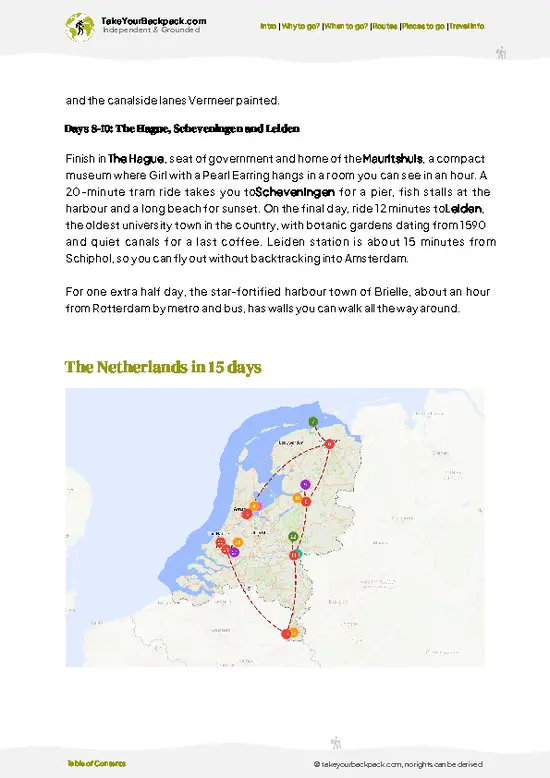
The Vibe: A full-country adventure for travelers who want to see how the Netherlands fits together, from capital canals to southern hills and northern islands, at a steady, exploratory pace. You’ll string together cities, villages, castles, and wild spaces using trains, buses, and ferries.
The Highlights:
  • Deep time in Amsterdam plus classic day trips to Marken, Volendam, and Edam
  • Central-city life in Utrecht and Rotterdam with side trips to Castle de Haar and Kinderdijk
  • Southern flavor in Maastricht and Valkenburg, with walks on the Krijtlandpad
  • Nature time in De Hoge Veluwe and on the Wadden Islands, especially Schiermonnikoog
🌍 Want a ready-to-use travel plan for The Netherlands?
The overview above compares different route options based on your travel time and style. The complete Travel Guide breaks each itinerary down in detail, including maps, stops, highlights, and transport information.

Explore all route details 👉

Get the Travel Guide -

🌤️ When to go?Best time to visit The Netherlands

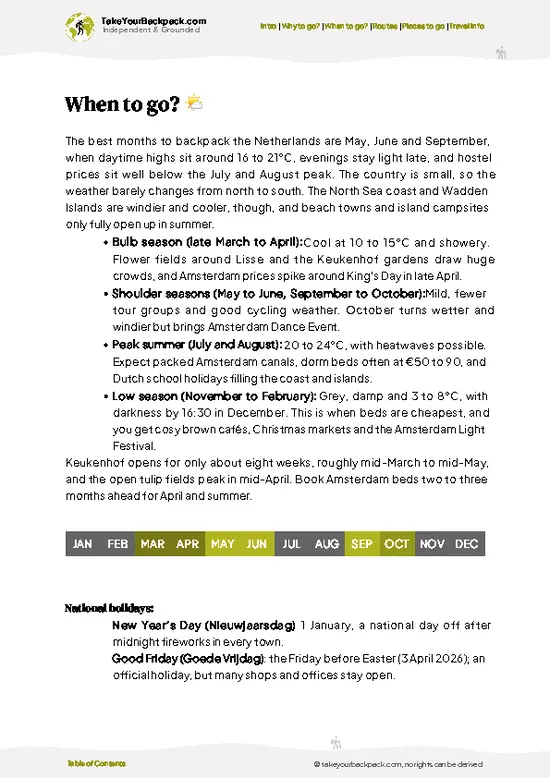
The sweet spot is mid-May to mid-June and again early to late September in The Netherlands. Prices ease off the family-holiday spike, hostel availability loosens, and the weather hits the move-all-day band: cool mornings, mild afternoons, long light. Spring buses thin once the tulip frenzy fades after early May; autumn keeps terraces alive while Atlantic storms mostly bide their time until later. You get fewer queues, drier days by Dutch standards, and bike paths you can actually cruise.
  • Peak Summer: The grind is sticker shock, packed dorms, and vanishing museum slots. The high is long golden evenings, beach bonfires, open-air gigs, and a cold North Sea dunk after riding the dunes.
  • Shoulder: The country shifts gears. Terraces spill out, markets hum, evenings stretch; then families peel off and lines collapse. Ride the bulb fields late April-early May for peak bloom—one tight window, totally different landscape.
  • Off-Peak Winter: Streets glow, canals quiet, and the wind tests your resolve. Wear a windproof shell over wool and skip umbrellas; crosswinds shred them. Move café-to-museum in short, warming hops.

Personal tip: If you want that bloom window, lock a bed and Keukenhof transport about six weeks out; everything else rides fine on short notice.

source: climatestotravel.comJANJanuary: fair for travelingFEBFebruary: fair for travelingMARMarch: good for travelingAPRApril: good for travelingMAYMay: excellent for travelingJUNJune: excellent for travelingJULJuly: fair for travelingAUGAugust: fair for travelingSEPSeptember: excellent for travelingOCTOctober: highly recommended for travelingNOVNovember: fair for travelingDECDecember: fair for traveling
📅 Traveling in a specific month?
Get a full month-by-month breakdown of weather, crowds, costs, festivals, and seasonal highlights in the complete travel guide.

Get full details when to go 👉

Get the Travel Guide -
!2021-02-14 10.54.02-1

💰 Costs (as of 2025)Typical budget expectations

€75-95 per day in The Netherlands if you sleep in dorms, eat from supermarkets, and use off-peak trains or early-booked buses.
  • dorm accommodation: €25-40 outside Amsterdam; €45-70 in Amsterdam on weeknights, easily €60-90 on weekends and event weeks. City tax adds €3-7 per night on top of the sticker price. System tip: base in Utrecht, The Hague, or Rotterdam and day-trip to Amsterdam; I saved ~30% per night and was on a 27-minute train. Book Sun-Thu and direct with the hostel for small discounts; bring a lightweight lock for in-room lockers to dodge rental fees.
  • meals: Supermarket Survival: €12-18/day using Albert Heijn/Lidl—meal deals €4-6, bakery broodjes €3-4, fruit and yogurt for breakfast, and tap water from any sink (carry a bottle). Street food reality: döner/fries €6-10, FEBO croquettes €2-3, herring stands €3-4; a sit-down main runs €16-22 and a beer is €5-7. Relative value: pricier than Germany/Belgium by a few euros per meal, far cheaper than Denmark. Ask for a carafe of tap water with a meal; it’s normal and saves €2-3 per person.
  • local transport: Inside cities, walk or rent a bike (€10-15/day; two locks, always). For trams/metro/buses, tap in/out with your contactless card—no
read more 👉
€75-95 per day in The Netherlands if you sleep in dorms, eat from supermarkets, and use off-peak trains or early-booked buses.
  • dorm accommodation: €25-40 outside Amsterdam; €45-70 in Amsterdam on weeknights, easily €60-90 on weekends and event weeks. City tax adds €3-7 per night on top of the sticker price. System tip: base in Utrecht, The Hague, or Rotterdam and day-trip to Amsterdam; I saved ~30% per night and was on a 27-minute train. Book Sun-Thu and direct with the hostel for small discounts; bring a lightweight lock for in-room lockers to dodge rental fees.
  • meals: Supermarket Survival: €12-18/day using Albert Heijn/Lidl—meal deals €4-6, bakery broodjes €3-4, fruit and yogurt for breakfast, and tap water from any sink (carry a bottle). Street food reality: döner/fries €6-10, FEBO croquettes €2-3, herring stands €3-4; a sit-down main runs €16-22 and a beer is €5-7. Relative value: pricier than Germany/Belgium by a few euros per meal, far cheaper than Denmark. Ask for a carafe of tap water with a meal; it’s normal and saves €2-3 per person.
  • local transport: Inside cities, walk or rent a bike (€10-15/day; two locks, always). For trams/metro/buses, tap in/out with your contactless card—no need to buy an OV-chipkaart, and you pay the standard fare. Day tickets (~€8-9) pay off after three rides in big cities. Intercity: trains are fast but not cheap per km compared to Germany/Belgium; unlock value by traveling off-peak and avoiding the Intercity Direct supplement between Amsterdam-Rotterdam (take the regular Intercity, arrive ~12 minutes later, save a few euros—I do this every time). For long hops, early-booked buses can halve costs.
  • activities: Museums are the wallet hit: Rijks/Van Gogh €20-25; Anne Frank House ~€14; canal cruise €15-20. The Museumkaart pays off if you’re hitting 3-4 museums in a few days; otherwise pay à la carte and fill days with free dunes, beaches, markets, and modern architecture walks in Rotterdam. Tours bundled with beer or gimmicks cost more per minute than a straight ticket; skip them if you’re counting euros.
  • miscellaneous: Budget leaks: paid toilets (€0.70-1), station lockers (€7-10/day), Intercity Direct supplements, bike damage fees, and foreign card FX surcharges. Bottles/cans have a deposit (statiegeld €0.15-0.25); return them or you’re tipping the bin. Tipping is light—round up or ~5-10% for great service, not mandatory. Relative to neighbors: beer and coffee cost a bit more than in Germany/Belgium; transport and museums cost less than across the North Sea or in Scandinavia.
⚠️ Prices can change and everyone travels differently, so take this as a rough guide. Hope it helps you plan your adventure!

✈️ The backpacker research shortcutThe Netherlands Travel Guide

An offline-friendly backpacking guide with optimized travel routes, ranked highlights, transport advice, and the best areas to stay.
example page 0 from our offline Travel Guide for Netherlandsexample page 1 from our offline Travel Guide for Netherlandsexample page 2 from our offline Travel Guide for Netherlandsexample page 3 from our offline Travel Guide for Netherlandsexample page 4 from our offline Travel Guide for Netherlandsexample page 5 from our offline Travel Guide for Netherlandsexample page 6 from our offline Travel Guide for Netherlandsexample page 7 from our offline Travel Guide for Netherlands
The digital guide (491 pages) contains:
128 highlights, ranked by travel appeal
Optimized 5, 10 & 15-day travel routes
Best neighborhoods to stay
How to get around
Offline-friendly for travel without Wi-Fi
👉 See all 30+ guide features

📅 Plan smarter in minutes, not weeks
Month by month travel advice
Festivals & national holidays
Budget expectations

🗺️ Go to the right places, skip the overrated ones
Honest pros & cons of destinations
Top hikes, parks & viewpoints
Lesser-known places most travelers miss
Clear “worth it vs skip it” guidance

🛏️ Travel smoothly without rookie mistakes
Best areas to stay
Transport systems explained simply
Common scams & safety advice
SIM cards, money & practical tips

🌍 Understand the country, not just visit it
Culture & traditions
52 Essential phrases & customs
Festivals worth planning around
Traveler-friendly historical context
Insights that make places more meaningful

📱 Built for real travel conditions
Fully downloadable PDF
Works completely offline
Optimized for phone use
Useful in remote areas & buses
Everything in one place
Save weeks of stressful planning
Get instant access to the full guide directly. 30-day money-back guarantee.


Sent to your inbox immediately after payment • 100% Secure Checkout
Best Backpacking Travel Advisor 2025 tourism awardBest Backpacking
Travel Advisor
2025
What others say about Take Your Backpack Guides:
⭐⭐⭐⭐⭐
Fantastic, amazing amount of information!
⭐⭐⭐⭐⭐
My goodness this is amazing, it's what I've been looking for hats off too you!
⭐⭐⭐⭐⭐
I think this is absolutely BRILLIANT
⭐⭐⭐⭐
Very complete and informative. It's still missing places, but I gotta to commend you
⭐⭐⭐⭐⭐
This is truly amazing, thank you, can't wait to explore it with my kids!
⭐⭐⭐⭐⭐
Awesome resource, thank you!
⭐⭐⭐⭐⭐
This is amazing! Can't wait to explore the ones I haven't seen
⭐⭐⭐⭐
I love this! Well done, great idea.
⭐⭐⭐⭐⭐
Thanks for taking the time to make this gem!
⭐⭐⭐⭐⭐
This might be the best website I've ever seen.
⭐⭐⭐⭐⭐
Congratulations, and thank you so much for your work; it's incredibly valuable.
⭐⭐⭐⭐
In all seriousness I think you did a great job pointing out the important spots
⭐⭐⭐⭐⭐
10/10 very good
⭐⭐⭐⭐⭐
As someone who's only just starting to visit regularly this is awesome, thank you.
⭐⭐⭐⭐
Thank you very much! I'm going to visit my dad, it's going to be very useful!
⭐⭐⭐⭐⭐
This is really cool! We'll be travelling for the first time and this definitely come in handy.
⭐⭐⭐⭐⭐
You are now our minister of culture, congratulations 👨‍💼
⭐⭐⭐⭐⭐
Just wanted to tell you that this is a pearl! Going to follow your recommendations.
⭐⭐⭐⭐⭐
This is so cool. I'll definitely be using the resource for my travels soon.
⭐⭐⭐⭐⭐
This is very impressive! Good work.
⭐⭐⭐⭐⭐
This is an amazing and informative site. Very well done!

🛏️ Where to stay?Accommodation types and options

Yes — hostels and budget accommodation are common across The Netherlands, concentrated in major cities and transport hubs and ranging from dorm beds to inexpensive private rooms for solo and group travelers.
In Amsterdam pick Centrum/Jordaan for immediate access to canals and museums but expect crowds and higher prices; De Pijp and Oost are livelier and slightly cheaper but can be noisy at night; Rotterdam’s city centre and Kop van Zuid offer modern sights, great transport links and active nightlife but less historic charm; The Hague’s Centrum and Scheveningen give museums or beach access with … read more 👉
Yes — hostels and budget accommodation are common across The Netherlands, concentrated in major cities and transport hubs and ranging from dorm beds to inexpensive private rooms for solo and group travelers.
In Amsterdam pick Centrum/Jordaan for immediate access to canals and museums but expect crowds and higher prices; De Pijp and Oost are livelier and slightly cheaper but can be noisy at night; Rotterdam’s city centre and Kop van Zuid offer modern sights, great transport links and active nightlife but less historic charm; The Hague’s Centrum and Scheveningen give museums or beach access with seasonal crowds on the coast; Utrecht’s Central Station/Oudegracht is compact and walkable with plenty of cafes but nightlife concentrates on weekends; Groningen and Maastricht have affordable, student‑centred central areas that are lively after dark but smaller so rooms can fill quickly on weekends.
Most central areas are safe but busy, so pick side streets or suburbs away from main squares and clubs for quieter nights, or book near major train stations for cheaper onward travel and easier day trips.

If you enjoy meeting fellow travelers, consider choosing hostels with high ratings for atmosphere. On the other hand, if you prefer having your own space, a hotel might be a better option.

🚌 Getting aroundPublic transport and other ways to get around

NS Intercity & Sprinter trains
Truth & Trade-off: The backbone. Fast, frequent, no reservation needed, and city-center to city-center beats any car. Fares are fixed by distance, not by booking date, so there’s no killer last-minute deal to chase. Weekend works can swap you to rail-replacement buses without much warning.
Unwritten Rules: Tap in and out every time you pass a gate or change operators. First/Second class are enforced; upgrades are done in the NS app before the conductor reaches you. … read more 👉
NS Intercity & Sprinter trains
Truth & Trade-off: The backbone. Fast, frequent, no reservation needed, and city-center to city-center beats any car. Fares are fixed by distance, not by booking date, so there’s no killer last-minute deal to chase. Weekend works can swap you to rail-replacement buses without much warning.
Unwritten Rules: Tap in and out every time you pass a gate or change operators. First/Second class are enforced; upgrades are done in the NS app before the conductor reaches you. “Stilte” (quiet) zones are real—phone calls will get you side-eye. Bikes need a bike ticket and are off-peak only; folding bikes are fine anytime. With QR e-tickets, use gates marked with a scanner; not all gates scan.

Intercity direct (HSL)
Truth & Trade-off: Schiphol-Rotterdam-Breda is fastest on the high-speed line, shaving real minutes. The catch is a mandatory supplement on that stretch. Miss the supplement and the savings vanish into a fine.
Unwritten Rules: Add the supplement at the platform “toeslag” posts or in the NS app before boarding. If you don’t care about 10-20 minutes, avoid the HSL by routing via Leiden or the regular intercity to skip the fee entirely.

Regional trains (Arriva, Qbuzz/Blauwnet, Keolis, etc.)
Truth & Trade-off: They stitch together the countryside when the blue NS map thins out. Slower, more stops, but they reach where buses meander. Transfers are common; timing matters.
Unwritten Rules: When switching between NS and a regional operator, always tap out then tap in—even if you never leave the platform. One missed tap means a maximum fare charge that’s tedious to recover.

City trams, buses, and metro (GVB, RET, HTM, regional buses)
Truth & Trade-off: They solve the last mile and run like clockwork. Paying onboard with one-off tickets is pricey; tap-in/out fares are kinder. Night lines exist but are thin.
Unwritten Rules: Front-door boarding on many buses; trams have validators at every door—tap in when you enter, tap out when you leave. No cash. Luggage is fine if you don’t block doors. In Amsterdam/Rotterdam/Den Haag, operators are separate; OVpay stitches them together if you just tap.

OVpay contactless, app tickets, and the old OV-chipkaart
Truth & Trade-off: For visitors, tapping a contactless bank card or phone (OVpay) is the simplest, system-wide solution. No card purchase, just pay per kilometer. Trade-off: you don’t get subscriber discounts and you must manage your taps like a hawk.
Unwritten Rules: Tap in and tap out with the same card/device; phone in, phone out—don’t switch to the plastic card in your wallet. Keep only one card near the reader to avoid “card clash.” With app/QR tickets, names are personal; carry matching ID. Forget to tap out and you’ll be hit with a max fare. Refund claims exist but they cost time.

Bike + transit (OV-fiets and rentals)
Truth & Trade-off: The ultimate speed combo in The Netherlands: train between cities, bike the last mile. OV-fiets is cheap and everywhere at stations, but it normally requires a personal transit account. If you’re short-term, use station-area rentals or app bikes.
Unwritten Rules: On trains, bikes need a ticket and are off-peak only; use the bike-marked doors. Elevators are for bikes and wheelchairs first; don’t muscle onto escalators with a bike. Two locks in cities; platforms are safe, outside racks are not invincible.

Ferries and Waterbus
Truth & Trade-off: Free GVB ferries in Amsterdam across the IJ beat any detour. The Rotterdam-Dordrecht Waterbus can outpace road traffic and accepts transit payment.
Unwritten Rules: Ferries can be crowded with bikes; board in flows, not fights. On paid boats, tap in/out as with buses.

Long-distance coaches (FlixBus and similar)
Truth & Trade-off: Cheapest way between major cities if you book ahead, but almost always slower than trains and prone to road delays. Good when rail works scramble your plan.
Unwritten Rules: They’re outside the tap-in/out universe. Arrive early, expect baggage rules, and don’t plan tight connections—buses don’t care about your intercity train.

Car-share and rideshare add-ons
Truth & Trade-off: Useful for rural trailheads beyond the last bus stop. Pricey versus trains on main corridors, but strong for edge cases.
Unwritten Rules: Station pick-ups are common; return cars on time or fees bite. Fuel and parking are the real costs; gridlocked city centers aren’t your friend.

Master tactical tip: Build your route around the four rail hubs—Utrecht, Rotterdam, Amsterdam Zuid/Schiphol, and Zwolle—and ride only Intercity trains between them, then bike or tram the last mile. This avoids HSL supplements unless they actually save you time, minimizes transfers, and turns a cross-country day into three clean moves: Intercity spine, hub hop, short feeder.
Amsterdam Airport Schiphol (AMS) sits about 17 km (11 miles) from Amsterdam’s city center (Amsterdam Centraal).

Main public transport options
  • Train (NS) to Amsterdam Centraal — The station is directly under the terminal (follow signs for “Trains” in Schiphol Plaza). Trains run every 5-10 minutes by day, hourly overnight.
    Travel time: about 13-17 minutes.
    Cost: roughly €6-€8 one-way in 2nd class as of 2025 (cheapest with an e-ticket or contactless “OVpay”; add about €1 if you buy a disposable ticket from the machine).
  • Bus 397 (Amsterdam Airport Express) — Good if you’re staying near Museumplein, Leidseplein, or Elandsgracht (it does not go to Centraal).
    Travel time: about 30-40 minutes.
    Cost: about €6-€8 one-way; tap contactless on board is accepted. If you need Centraal afterward, add roughly 10-15 minutes by tram/metro and ~€3 extra.
  • Night bus N97 — Hourly late-night option along a similar route to the 397.
    Travel time: 35-45 minutes to the central areas it serves.
    Cost: typically €6-€8.
  • Train to Amsterdam Zuid + Metro 52 (North-South line) — Handy if you’re headed to De Pijp, Rokin, or if trains to Centraal are disrupted.
    Travel time: around 20-30 minutes total.
    Cost: roughly similar to the direct train; can be a bit more because NS (train) and GVB (metro) are separate fares.

Taxi and ride-hailing
Taxis queue outside the arrivals hall at the official rank; Uber and Bolt also operate from Schiphol.
Travel time: about 25-45 minutes depending on traffic.
Typical cost to the city center: €45-€70, more at busy times or late at night.

Quick tips
  • Contactless payment (OVpay) works on trains, buses, trams, and metro: just tap in and out with your bank card or phone. One card per person.
  • “Amsterdam Centraal” is the main station for the historic center; check platform screens at Schiphol for direct trains there.
  • If you’re traveling with kids or plan lots of rides, look into child discounts or day passes, but note that most GVB tickets are not valid on NS trains or the 397.
⚠️ Prices and routes can change, so take this as a rough guide and ask for local advice when you arrive.

🔒 Safety (risk Level: low)Safety considerations for travelers

Safety for solo travelers, including women and LGBTQ+ individuals
The Netherlands is generally safe for solo travelers, including women and LGBTQ+ individuals. Major cities like Amsterdam and Rotterdam are known for their tolerance and open-mindedness. Exercise typical urban awareness, especially at night, and keep an eye on your belongings in crowded areas. Public transportation is reliable and well-patrolled, adding to the overall sense of security.


Full official government travel advisory (live updates)
View details 👉

✈️ VisaVisa requirements for The Netherlands

Whether you need a visa to visit The Netherlands depends on your nationality: citizens of the EU/EEA/Switzerland and many visa‑exempt countries (e.g., United States, Canada, Australia, Japan, South Korea, United Kingdom) can enter visa‑free for short stays up to 90 days within any 180‑day period, while other nationalities must obtain a Schengen short‑stay visa.
To apply for a Schengen visa to The Netherlands, submit a Schengen short‑stay (Type C) application at the Dutch embassy/consulate or official visa centre (e.g., VFS Global), provide your passport, recent photo, travel insurance covering €30,000, proof of funds, accommodation and return travel, attend a biometric appointment, pay the fee and allow several weeks for processing; stays longer than 90 days require an MVV/residence permit via the Dutch Immigration and Naturalisation Service (IND).

source: netherlandsandyou.nl
⚠️ Visa requirements can change over time, so always check the latest visa requirements with the official embassy or government website before you travel.

🎒 What to pack?Packing essentials for the trip

Weather in the Netherlands can be as moody as a teenager, so pack for all seasons, especially rain—those showers can sneak up on you. Think layers for the ever-changing temperatures, and don’t forget a reliable rain jacket. The terrain is as flat as a pancake, so comfy walking shoes are a must for exploring cities and countryside alike. The Dutch are pretty chill about attire, but in cities like Amsterdam, you might want to blend in with smart-casual vibes. Oh, and a reusable water bottle is your best friend here; tap water’s delicious and free!

Apart from this country specific advice, I have also crafted a general packing list that should help on any trip. authorOver the years, I've learned the importance of packing minimally. It's so much easier to jump on the back of a truck or squeeze yourself into the last spot of a minibus without that supersized backpack. If you're headed to a warm destination, leave your winter jacket at home; for colder regions, opt for thin thermal underlayers. Instead of packing your entire wardrobe, bring just three sets of clothes, as laundry facilities are available everywhere.
View the full list 👉
🎒 Planning the practical side of your trip?
Get detailed information on transport, daily budgets, internet access, local customs, food, language, and other essentials in the complete Travel Guide.

Get detailed practical information 👉

Get the Travel Guide -

🙋 FAQQuick answers to practical concerns

Trip Planning


Personal tip: I normally search on good rating for atmosphere (for meeting people) and location (for easy exploring). Cleanliness as a bonus.


Travel Essentials

You typically don’t need special vaccinations to visit the Netherlands if you’re up-to-date on routine shots like MMR (measles, mumps, rubella) and DTP (diphtheria, tetanus, pertussis). Hepatitis A is optional if you’re planning to stay long or eat in local spots with questionable hygiene. Check with a healthcare professional for personalized advice.


vaccination requirements
When I first started traveling, I often spent part of my first day in a new country hunting for a local SIM card. While this can still be slightly cheaper, it also takes time and planning.

These days, it's much simpler to install an eSIM before leaving home. Once you arrive in The Netherlands, you can activate it immediately and have mobile data from the moment you land — which is especially useful for ordering transport or navigating away from busy airports.

There are many providers nowadays, and price differences are usually small. I personally go with Airalo, as it offers excellent network coverage throughout the country and strong global coverage, so you can manage multiple countries from a single app.


Get your e-sim for The Netherlands

Culture & Customs

Be punctual; the Dutch value time. When entering a home, remove shoes if asked. Directness is appreciated, so don’t take it personally. Tipping isn’t mandatory, but rounding up the bill or leaving small change is common. Public transport etiquette includes being quiet and keeping seats free of bags.

For LGBTQ+ travelers, the Netherlands is largely accepting, but discretion is wise in conservative areas. Women typically travel safely, but standard precautions apply. Avoid generalizing or making jokes about World War II or drugs. Respect cyclists—don’t walk in bike lanes.
Trying traditional food is always a great way to experience the culture. Here are some must-try dishes for The Netherlands.
  • Stroopwafel: Thin, crispy waffles filled with a rich caramel syrup. Perfect with coffee or tea, these sweet treats are a favorite among locals and have become a beloved symbol of Dutch snacking.
  • Haring: Raw herring served with onions and pickles. It’s a rite of passage for visitors to try ”Hollandse Nieuwe” during the season. Usually eaten by holding the fish by the tail and taking a bite, it’s a genuine Dutch experience.
  • Bitterballen: Deep-fried balls filled with a savory beef or veal ragout. Often served with mustard, these are the go-to bar snack in the Netherlands and a staple at social gatherings.
  • Erwtensoep: A thick pea soup traditionally eaten in winter. Also known as ”snert,” it’s packed with pork, sausage, and root vegetables, offering a hearty taste of Dutch comfort food.
  • Poffertjes: Small, fluffy pancakes served with a dusting of powdered sugar and a pat of butter. Popular at markets and festivals, they’re a sweet indulgence that’s hard to resist.
Tap water in the Netherlands is safe to drink and meets high-quality standards; locals drink it without any issues. It’s perfectly fine for tourists to drink as well—no need for bottled or filtered water unless you prefer it for taste. Just fill up your reusable bottle and go.
The main language in Netherlands is Dutch. Backpacking is way more rewarding if you know a bit of the local language, so I'd suggest brushing up on the basics just in case your Dutch skills have become a bit rusty.

Want to understand locals better?
The complete Travel Guide for The Netherlands includes 52 essential words and phrases — greetings, thank-yous, ordering food, transport, numbers, and common local expressions you'll actually hear.

Get your local basic phrases 👉

Get the Travel Guide -


English is widely spoken in the Netherlands, making it one of the most English-proficient countries in the world. Approximately 90% of the Dutch population can communicate in English, with many being fluent. This proficiency is particularly high among younger generations and in urban areas, where English is often taught from a young age in schools.

In major cities like Amsterdam, Rotterdam, and Utrecht, you’ll find that most locals, including those in the service industry, can converse comfortably in English. Signs, menus, and public transportation information are frequently available in English, further facilitating travel.

Outside urban centers, while English is still commonly understood, proficiency may vary, especially in rural areas. However, the Dutch are generally friendly and eager to assist, often switching to English if they sense a language barrier.

Overall, travelers to the Netherlands can expect minimal language difficulties, making it a welcoming destination for English speakers.

Money & Payments

The local currency of The Netherlands is EUR (€).

ATMs: ATMs are everywhere in the Netherlands, even in smaller towns. Most accept international cards, but be aware of foreign transaction fees. Stick to bank ATMs rather than independent ones to avoid extra charges.

Cash: While the Netherlands is pretty card-friendly, carrying some cash is smart for markets and small shops. Euros only; dollars aren’t accepted.

Card Acceptance: Credit and debit cards are widely accepted, but make sure yours has a chip and PIN. Contactless is also common. Some places, especially in touristy spots, might only accept cards, so have yours handy.

Exchanging Money: If you need to exchange cash, avoid airport exchange counters—rates are horrible. Opt for banks or official exchange offices in cities. Better yet, withdraw euros directly from ATMs using your card.

In the Netherlands, tipping is appreciated but not obligatory, as service charges are typically included in the bill. It’s common to round up the bill or leave small change at cafes and casual restaurants. For more upscale dining, leaving a tip of 5-10% is a nice gesture if the service was good.

🧩 Nearby countriesSimilar backpacking destinations

📸 PhotosTravel photos from The Netherlands

Take your backpack - Netherlands - 0
Take your backpack - Netherlands - 1
Take your backpack - Netherlands - 2
Take your backpack - Netherlands - 3
Take your backpack - Netherlands - 4
Take your backpack - Netherlands - 5
Take your backpack - Netherlands - 6
Take your backpack - Netherlands - 7
Take your backpack - Netherlands - 8
Take your backpack - Netherlands - 9
Take your backpack - Netherlands - 10
Take your backpack - Netherlands - 11
Take your backpack - Netherlands - 12
Take your backpack - Netherlands - 13
Take your backpack - Netherlands - 14
Take your backpack - Netherlands - 15
Take your backpack - Netherlands - 16
Take your backpack - Netherlands - 17
Take your backpack - Netherlands - 18
Take your backpack - Netherlands - 19
Take your backpack - Netherlands - 20
Take your backpack - Netherlands - 21
Take your backpack - Netherlands - 22
Take your backpack - Netherlands - 23
Take your backpack - Netherlands - 24
Take your backpack - Netherlands - 25
Take your backpack - Netherlands - 26
Take your backpack - Netherlands - 27
Take your backpack - Netherlands - 28
Take your backpack - Netherlands - 29
Take your backpack - Netherlands - 30
Take your backpack - Netherlands - 31
Take your backpack - Netherlands - 32
Take your backpack - Netherlands - 33
Take your backpack - Netherlands - 34
Take your backpack - Netherlands - 35
Photographed by: Johan Kruseman

Travel stories from The Netherlands

Off the beaten track

Off the beaten track

Netherlands | As you may or may not know, I like to travel to some of the more unknown countries in the world. This time my eye fell on this little undiscovered gem, easily overlooked due to its impossibly small size. They don’t have supermarkets here: cheese is sold in portions of 11kg at a time by haggling about 2 cents more or less in an outdoor market, they ...
Read more
More stories

We 💚 feedbackFinal notes for travelers

Treat The Netherlands like a network. Trains are the backbone; bikes the capillaries. Tap in/out with any contactless card, raid Albert Heijn for picnic fuel, base in Utrecht or Rotterdam to dodge Amsterdam markups. The wind will slap you sideways; rain comes fast, dries fast. Payoff: late light on canal bricks, hot fries with sate sauce, a cold canal-side beer. The Netherlands is doubling down on safer cycling and crowd control—more bike highways, stricter tourist rules—so the system gets calmer and easier to game.

✈️ When did I visit The Netherlands?
Netherlands is my home base, so whenever I don’t travel, you can find me in this tiny spot on the globe. When friends from abroad visit me, it’s the time to actually explore my own country as a traveler. Originally written after my visit, this guide has been kept up to date with input from locals and recent travelers (last update: 28 March 2025)

✍️ Help improve this page!
The information on this page is based on my own backpacking experience in The Netherlands, supplemented with up-to-date research and feedback from other travelers. Travel details can change, so if you notice anything outdated or incomplete, feel free to let me know.


🙋‍♂️ Give feedback

👋 Meet the founderWho’s Behind Take Your Backpack?

Johan, backpacker and founder of TakeYourBackpackHi, I’m Johan (Netherlands 🇳🇱), the creator of TakeYourBackpack. Over the past decade, I’ve backpacked through 80+ countries across six continents, gaining extensive experience with independent travel, long-term trips, and overland routes.

This site is built on a combination of firsthand travel experience and carefully curated insights from other backpackers. Many guides are based on places I’ve personally visited, while others bring together tips, observations, and practical advice shared by trusted travelers I’ve met along the way.

The goal is to provide realistic, experience-driven guidance — not generic itineraries — so you can explore destinations with better context, clearer expectations, and more confidence.

Get Full Country Guide •
Instant download • 128 highlights • Full Offline guide