×
Paraguay 🇵🇾

backpacking South America Paraguay 🇵🇾Drift river country far from crowds.

Explore GuyanaExplore Peru

Backpacking Paraguay in 2026

A complete guide including when and where to go, costs, transport, itineraries, and practical travel advice.
What a trip here is really like

Backpacking Paraguay
By Johan Kruseman 🇳🇱 | Updated June 4, 2026

Hop a city bus from Encarnación to the Jesuit ruins of Trinidad and watch the stones go amber at sunset. It costs pocket change, runs often, and seats you among tereré gourds and Guaraní chatter. That unrushed ride is Paraguay in miniature—practical, warm, and proud of what lasts.

The draw is human-scale and close-range. Asunción hands you river sunsets on plastic chairs, harp notes drifting between chipá sellers and the soft clack of dominos. Eastward, Encarnación’s Paraná shoreline and the roar of Saltos del Monday balance with red-dirt backroads to craft towns like Areguá and Luque. Head north and the Chaco turns wide and honest—palm savanna, jabiru silhouettes, capybara along culverts, a night sky that feels earned. Short hikes in the Ybytyruzú and at Cerro Koi leave calves humming and end with a cold Pilsen or a frosty tereré under a mango tree. Heat is real, buses run when they run, and Spanish or a few Guaraní phrases go far; leaning into that rhythm is precisely why the small moments land harder.

Argentina has headlines and wine, Brazil has spectacle and surf, Bolivia brings altitude drama; Paraguay rewards travelers who prefer conversation to crowds and patience over polish. Go if you want value, time, and a country that lets you in quietly, then sticks.

👉 Get the 📖 Travel Guide of Paraguay

Asunción & Gran Asunción

Start here if you want the country under your feet. The capital runs on heat, tereré, and long shadows; walk early or late because midday hits like a wall. Mercado 4 is gritty but useful for cheap gear. The Costanera works for sunset miles, then a cold Pilsen. City buses are dirt-cheap and slow; rideshare is faster. This rewards urban walkers who like daily life over monuments and don’t mind sweat and traffic noise.

Southern Missions & Encarnación (Ruta 1/6)

This spine suits patient travelers who like their history with dust on it. Base in Encarnación for river breezes and buses to the Jesuit ruins at Trinidad and Jesús; both are quiet, spread out, and best at late light when the stone finally shows depth. Asunción–Encarnación is a long haul, but frequent. Carry cash—small towns shrug at cards. The payoff is wandering alone through carved walls, then a beer on the Costanera while the Paraná goes black.

Cordillera & Lago Ypacaraí

Close enough for a hard day trip, better as a slow weekend. Caacupé tests your calves with hills and church steps; Areguá hands you pottery and sticky cobbles; San Bernardino turns loud on weekends. Microbuses run constantly from Asunción, but traffic stacks up Friday and Sunday. Light hikes (Cerro Koí) and lakeside rides suit cyclists and walkers who want effort without expedition logistics.

Chaco (Trans-Chaco Route 9)

Go if you like space, heat shimmer, and long odds. Filadelfia makes a practical base: fuel, Mennonite groceries, a bed. Beyond that it’s ranch gates, checkpoints, and thorny scrub. Buses exist but miss connections; 4x4 and extra water make life easier. ATMs are thin, nights are black, and the reward is sky—hawks, stars, and a fire that matters.

Alto Paraná: Ciudad del Este, Itaipú & Saltos del Monday (Ruta 2/7)

A border city built for deals and speed-walkers. The market zone is chaotic; stash valuables deep and move with intent. It rewards people curious about infrastructure and commerce: Itaipú’s scale, Monday Falls’ spray, quick hops to Brazil. Asunción buses are frequent. Stay near the terminal, start early, finish with greasy empanadas and fresh juice.
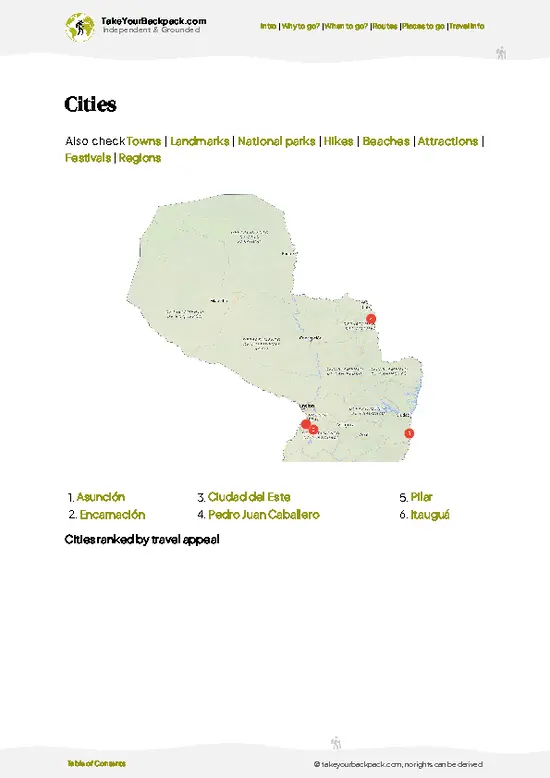
A visual overview of the country
Loading the map 🌍
CLICK TO FILTER
city
town
unique site
national park
hike
beach
attraction
festival
region
SHOW COUNTRY’S BESTSHOW ALL
film
0
0
0a
Saltos del Monday Viewpoints & Visitor Area
film
1
1
1a
Casa de la Independencia Museum
film
2
2
2a
Museo del Barro
film
3
3
3a
Panteón Nacional de los Héroes
film
4
4
4a
San Lazaro Caves
film
5
5
5a
Museo Nacional de Bellas Artes
film
6
6
6a
Manzana de la Rivera
film
7
7
7a
Playa de Encarnación
Djalma Pereira
film
8
8
8a
Playa de la Costanera
film
9
9
9a
Asunción
Julio Fernandez Casanova
film
10
10
10a
San Lorenzo
film
11
11
11a
Salto Cristal Trail
film
12
12
12a
Ñacunday Falls
Paraguayos Unidos
film
13
13
13a
Cerro Akati
Mirador Del Cerro Acati
film
14
14
14a
Cerro Koi Trail
film
15
15
15a
the Chaco
film
16
16
16a
Ybycui
film
17
17
17a
Defensores del Chaco
film
18
18
18a
Mbaracayú Forest Reserve
Laura Viviana Montiel
film
19
19
19a
Ñacunday
Hugo Cesar
film
20
20
20a
Piribebuy
film
21
21
21a
Ayolas
film
22
22
22a
Itá
film
23
23
23a
La Santísima Trinidad de Paraná
Andrea Marchini
film
24
24
24a
Saltos del Monday
Marcela V
film
25
25
25a
Hito Tres Fronteras
Melissa Martinez

Why go?What sets this destination apart

Low cost

Paraguay stretches a budget without squeezing the fun. You can live on a daily average in the low double digits if you keep it simple; mid double digits if you add a private room and a bus or two. Buses rattle and crawl, but fares are pocket change and save you nights—ride late, wake in a new town. Eat the plato del día at markets like Asunción’s Mercado 4; it’s hearty and cheap. Pro tip: the Posadas Turísticas network beats many hostels on price. … read more 👉
Paraguay stretches a budget without squeezing the fun. You can live on a daily average in the low double digits if you keep it simple; mid double digits if you add a private room and a bus or two. Buses rattle and crawl, but fares are pocket change and save you nights—ride late, wake in a new town. Eat the plato del día at markets like Asunción’s Mercado 4; it’s hearty and cheap. Pro tip: the Posadas Turísticas network beats many hostels on price. I refill tereré water at plazas, then earn a cold beer after the heat breaks.
Want the complete picture of Paraguay?
The offline Travel Guide brings everything together — routes, highlights & planning.

See what's included in the guide 👉

Get the Travel Guide -

⭐ HighlightsStandout locations across the country

  • Jesuit Missions of Trinidad & Jesús: Sun-baked sandstone and sculpted saints sit quiet in the grass while cicadas file the air to a buzz. You walk through long, arched corridors and the heat comes up through your boots; red dust stains your socks. Stay to late light—the carvings sharpen, swifts skim the nave, and your tereré cup sweats in your hand.
  • Saltos del Monday: It’s all concrete stairs and railing burn until the canyon opens and the river drops in three heavy curtains. The spray hits your face with the taste of iron; your shirt sticks. Down on the lower platforms the roar drowns the chatter, and the ground trembles just enough to make you square your stance for the photo.
  • Asunción’s Mercado 4 and Costanera: Morning is tarps, motorbikes, and voices cutting across narrow aisles stacked with everything from yuyos to fake jerseys. A yuyera pounds herbs and the smell of mint and diesel mix; you end up with blackened fingertips from counting change and a hot lomito wrapped in paper. Walk
read more 👉
  • Jesuit Missions of Trinidad & Jesús: Sun-baked sandstone and sculpted saints sit quiet in the grass while cicadas file the air to a buzz. You walk through long, arched corridors and the heat comes up through your boots; red dust stains your socks. Stay to late light—the carvings sharpen, swifts skim the nave, and your tereré cup sweats in your hand.
  • Saltos del Monday: It’s all concrete stairs and railing burn until the canyon opens and the river drops in three heavy curtains. The spray hits your face with the taste of iron; your shirt sticks. Down on the lower platforms the roar drowns the chatter, and the ground trembles just enough to make you square your stance for the photo.
  • Asunción’s Mercado 4 and Costanera: Morning is tarps, motorbikes, and voices cutting across narrow aisles stacked with everything from yuyos to fake jerseys. A yuyera pounds herbs and the smell of mint and diesel mix; you end up with blackened fingertips from counting change and a hot lomito wrapped in paper. Walk it off to the Costanera for a river breeze and a cold Pilsen from a kiosk stool.
  • Defensores del Chaco National Park: The road out is red and corrugated, thorns scrape the doors, and the horizon barely moves. Then Cerro León rises and you earn the view—endless scrub, a hawk holding steady in a wind you can finally feel. At night, the silence is a pressure and the stars are so dense you taste dust each time you swallow.
  • Ybycuí National Park & La Rosada: Humid trail, leafcutter ants hauling green flags, and the sweet-rot smell of Atlantic forest; then the brick stacks of the old iron foundry, still warm in color though the furnaces are dead. Keep going to the falls and let cold, tannin-brown water numb your shins before the hike out. Off the map: Cerro Memby’s black rock, Salto Suizo in the Ybytyruzú, the sleepy rail workshops at Sapucai; my personal favorite is dusk tereré on Loma San Jerónimo steps watching the river go purple.
Spotted a mistake or missing a highlight? Contact us.

But Paraguay offers more...

Discover and compare all of its highlights per category

🧭 RoutesPlanning a route that makes sense

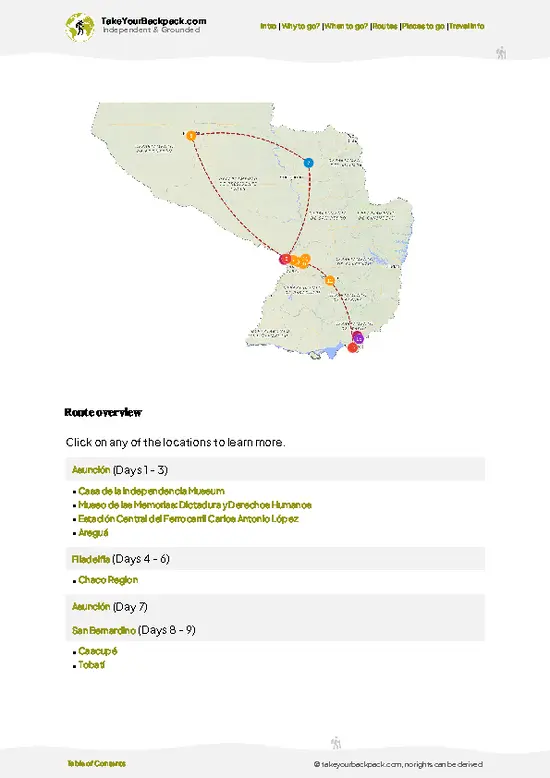
The 5-Day Asunción & Lake Escape

The Vibe: A relaxed, culture-first loop that keeps you mostly based in and around Asunción, mixing independence history, riverfront evenings, and an easy lake-town escape. It’s ideal if you want depth over distance, with short transfers and plenty of time to wander on foot.
The Highlights:
  • Colonial streets, independence sites, and river sunsets in Asunción
  • Art, memory, and museums that explain Paraguay’s past and present
  • Pottery lanes, lake views, and light hiking around Areguá and Cerro Koi
  • The 10-Day Missions, Beaches & Waterfalls Route

    The Vibe: A balanced journey linking Asunción’s urban core with the Jesuit mission belt, laid-back river beaches, and big eastern waterfalls. Expect a steady pace with a couple of longer bus rides, rewarded by full days in each hub instead of constant packing and unpacking.
    The Highlights:
  • Historic plazas, museums, and riverfront nights in Asunción
  • Jesuit ruins at La Santísima Trinidad de Paraná and Jesús de Tavarangüé
  • Beachfront
read more 👉

The 5-Day Asunción & Lake Escape

The Vibe: A relaxed, culture-first loop that keeps you mostly based in and around Asunción, mixing independence history, riverfront evenings, and an easy lake-town escape. It’s ideal if you want depth over distance, with short transfers and plenty of time to wander on foot.
The Highlights:
  • Colonial streets, independence sites, and river sunsets in Asunción
  • Art, memory, and museums that explain Paraguay’s past and present
  • Pottery lanes, lake views, and light hiking around Areguá and Cerro Koi
  • The 10-Day Missions, Beaches & Waterfalls Route

    The Vibe: A balanced journey linking Asunción’s urban core with the Jesuit mission belt, laid-back river beaches, and big eastern waterfalls. Expect a steady pace with a couple of longer bus rides, rewarded by full days in each hub instead of constant packing and unpacking.
    The Highlights:
  • Historic plazas, museums, and riverfront nights in Asunción
  • Jesuit ruins at La Santísima Trinidad de Paraná and Jesús de Tavarangüé
  • Beachfront promenades in Encarnación and the Paraná river vibe
  • Saltos del Monday and Itaipu Nature Reserve from Ciudad del Este
  • The 15-Day Paraguay Deep Dive: Capital, Missions & Chaco

    The Vibe: A slow-burn, country-wide circuit that layers Asunción’s culture, lake towns, missions, waterfalls, forest hikes, and a real taste of the Chaco into one coherent story. It’s for travelers who want to feel the shifts in landscape and lifestyle rather than just collect passport stamps.
    The Highlights:
  • Multi-day immersion in Asunción’s museums, riverfront, and nightlife
  • Lake Ypacaraí towns, easy hill trails, and pottery markets
  • Jesuit missions, Encarnación’s beaches, and the Itaipú-Saltos del Monday combo
  • Waterfalls and forest in Ybycuí and Mbatoví, plus a frontier-style foray into the Chaco from Filadelfia
🌍 Want a ready-to-use travel plan for Paraguay?
The overview above compares different route options based on your travel time and style. The complete Travel Guide breaks each itinerary down in detail, including maps, stops, highlights, and transport information.

Explore all route details 👉

Get the Travel Guide -

🌤️ When to go?Choosing the right months to travel

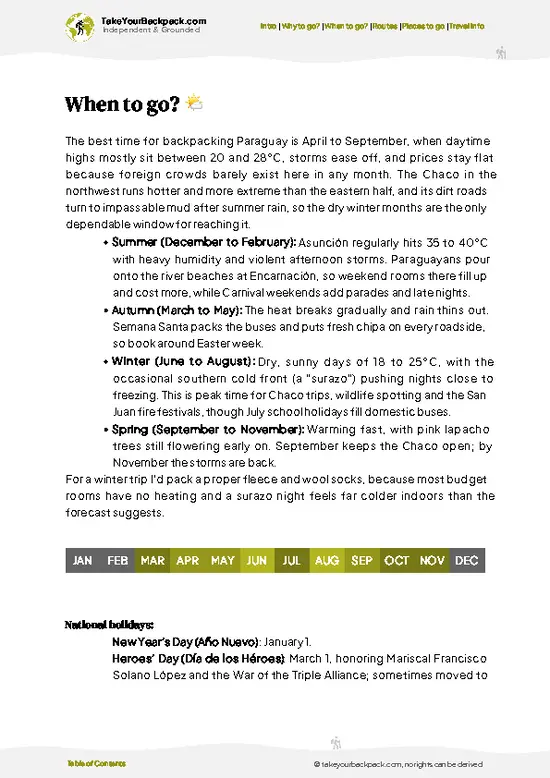
Paraguay’s sweet spot for backpackers is late May-June and again late August-mid-September. Heat has eased, cold snaps are short, and rain stays mostly offstage. Chaco tracks hold firm, the mission circuits aren’t slick, and night buses feel human instead of meat lockers. Mosquito pressure drops, dengue risk ebbs, and rooms run cheaper than the AC-taxed summer. You dodge July’s school break and Holy Week spikes, yet catch lapacho bloom and clear, workable air. It’s the window where distance feels possible and a cold beer actually cools you.
  • Heat Peak (Dec-Feb): You’ll sweat through shirts by noon; buses bake; prices creep up for AC and pools. The payoff: river breezes on Asunción’s costanera, ice-cold pilsner, and midnight asado.
  • Autumn Shoulder (Apr-May): Markets wake without the scorch; shopkeepers repaint shutters; border queues shrink. You move faster, catch football nights in small towns, and bus windows stay open instead of fogged.
  • Winter Off-Peak (Jun-Aug): Blue, empty days and hush in the Chaco. Missions keep their silence. Survival hack: pack a light down layer—rooms heat poorly, and night buses blast AC without mercy.
  • Spring Storm Window (Sep-Nov): Skies flip fast. Hot mornings end in hammering storms; dirt turns to paste and schedules wobble. Use a pack liner, ride early, and enjoy lapacho bloom along the roads.

I book long-haul buses a day ahead in the shoulder and carry a pack liner year-round; it beats any rain cover when the sky unloads.

source: climatestotravel.comJANJanuary: fair for travelingFEBFebruary: fair for travelingMARMarch: good for travelingAPRApril: highly recommended for travelingMAYMay: highly recommended for travelingJUNJune: excellent for travelingJULJuly: good for travelingAUGAugust: excellent for travelingSEPSeptember: highly recommended for travelingOCTOctober: good for travelingNOVNovember: good for travelingDECDecember: fair for traveling
📅 Traveling in a specific month?
Get a full month-by-month breakdown of weather, crowds, costs, festivals, and seasonal highlights in the complete travel guide.

Get full details when to go 👉

Get the Travel Guide -
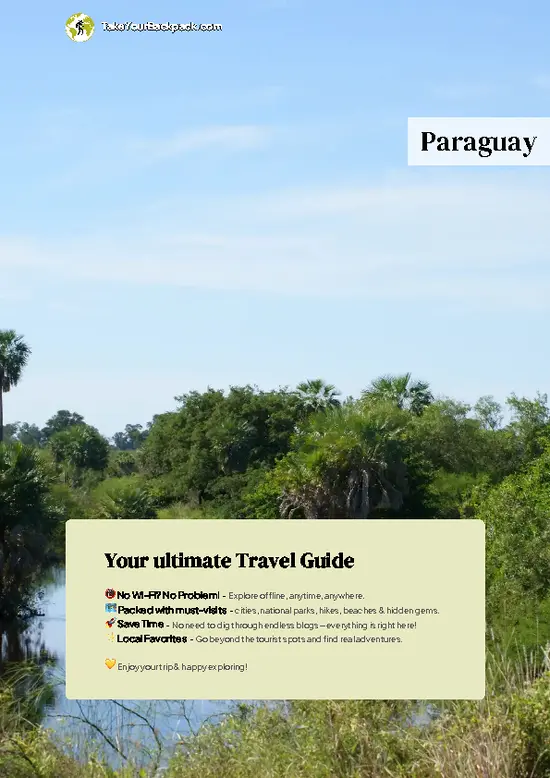
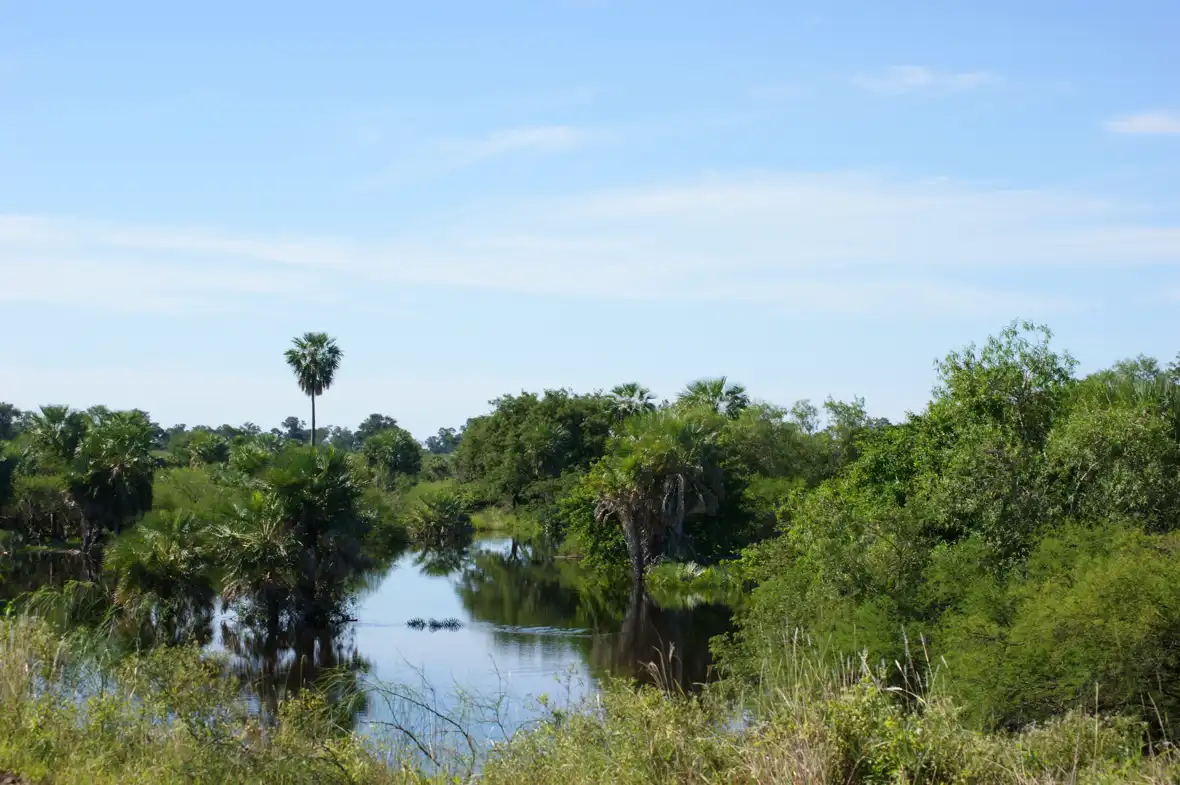
pixabay - paraguay - swamp-184745

💰 Costs (as of 2025)How expensive it really is

Plan on $28-38 per day if you stick to dorms, ride slow buses, and eat where locals do; cheaper than Brazil, roughly on par with Bolivia, and usually under Argentina unless you gamble on its shifting rates.
  • dorm accommodation: $9-15 in Asunción/Encarnación, $7-12 in smaller towns. Hostels are fewer than in Peru or Brazil, so the cheap move is “residenciales” used by workers—basic, clean enough, fan rooms. System tip: book one night online to land the bed, then renegotiate in cash (fan, no A/C) for a weekly rate; A/C often adds $2-4 per night you don’t need if you sleep under a fan and crack the window.
  • meals: Supermarket Survival: bread, tomatoes, canned tuna/beans, bananas, and a 2L water runs $4-6/day; dairy and eggs are good value. Street food reality: chipa or mbejú for breakfast (¢50-$1), empanadas (¢50-$1), a lomito or milanesa sandwich for $2-3.50, comedor plato del día $2-4. Cold local beer (Pilsen/Patria) $1.25-2 from a shop. Cheaper than Brazil by a third; close to Bolivia; usually beats Argentina unless you hit a sweet exchange. I’ve spent more on ice water on a 40°C day than on lunch—heat tax is real.
  • local transport: The country unlocks with ordinary intercity colectivos—no
read more 👉
Plan on $28-38 per day if you stick to dorms, ride slow buses, and eat where locals do; cheaper than Brazil, roughly on par with Bolivia, and usually under Argentina unless you gamble on its shifting rates.
  • dorm accommodation: $9-15 in Asunción/Encarnación, $7-12 in smaller towns. Hostels are fewer than in Peru or Brazil, so the cheap move is “residenciales” used by workers—basic, clean enough, fan rooms. System tip: book one night online to land the bed, then renegotiate in cash (fan, no A/C) for a weekly rate; A/C often adds $2-4 per night you don’t need if you sleep under a fan and crack the window.
  • meals: Supermarket Survival: bread, tomatoes, canned tuna/beans, bananas, and a 2L water runs $4-6/day; dairy and eggs are good value. Street food reality: chipa or mbejú for breakfast (¢50-$1), empanadas (¢50-$1), a lomito or milanesa sandwich for $2-3.50, comedor plato del día $2-4. Cold local beer (Pilsen/Patria) $1.25-2 from a shop. Cheaper than Brazil by a third; close to Bolivia; usually beats Argentina unless you hit a sweet exchange. I’ve spent more on ice water on a 40°C day than on lunch—heat tax is real.
  • local transport: The country unlocks with ordinary intercity colectivos—no frills, dirt cheap, and everywhere. Expect roughly $1-2 per hour of bus time; city buses are $0.50-0.75. Buy tickets at the terminal window, skip “ejecutivo” classes unless you need A/C. For border hops and small towns, short mototaxi rides are $1-2. Cheaper than Brazil by half, similar to Bolivia. I once crossed half the country for the price of a single metro ride in São Paulo; it was slow, but it worked.
  • activities: Entry fees are modest: Jesuit Missions near Encarnación run $3-4 for a combined ticket; museums in Asunción $1-2. Cost drivers are distance and vehicles—anything in the Chaco that needs a 4x4 and fuel jumps to $80-150/day for a guide, and estancia visits with meals can hit $30-60. Boat rides on the Paraguay River $10-20. Paraguay is low on big-ticket attraction fees; you pay for getting there.
  • miscellaneous: Budget leaks: ATM fees of $4-7 per withdrawal and mediocre border exchange rates; luggage fees on buses ($0.50-1 per bag); laundry $2-4/kg; bottled water and ice in the heat; sunscreen; occasional card surcharges. Rideshare apps in Asunción undercut taxis and keep “gringo prices” at bay. Compared to neighbors, these leaks are milder than Brazil but add up faster than in Bolivia. Carry small bills and refill big water bottles—your wallet lasts longer than your patience in the sun.
⚠️ Prices can change and everyone travels differently, so take this as a rough guide. Hope it helps you plan your adventure!

✈️ The backpacker research shortcutParaguay Travel Guide

An offline-friendly backpacking guide with optimized travel routes, ranked highlights, transport advice, and the best areas to stay.
example page 0 from our offline Travel Guide for Paraguayexample page 1 from our offline Travel Guide for Paraguayexample page 2 from our offline Travel Guide for Paraguayexample page 3 from our offline Travel Guide for Paraguayexample page 4 from our offline Travel Guide for Paraguayexample page 5 from our offline Travel Guide for Paraguayexample page 6 from our offline Travel Guide for Paraguayexample page 7 from our offline Travel Guide for Paraguay
The digital guide (352 pages) contains:
90 highlights, ranked by travel appeal
Optimized 5, 10 & 15-day travel routes
Cities, national parks, beaches, historical sites, ...
How to get around
Offline-friendly for travel without Wi-Fi
👉 Click to see all 30+ guide features

📅 Plan smarter in minutes, not weeks
Month by month travel advice
Festivals & national holidays
Budget expectations

🗺️ Go to the right places, skip the overrated ones
Honest pros & cons of destinations
Top hikes, parks & viewpoints
Lesser-known places most travelers miss
Clear “worth it vs skip it” guidance

🛏️ Travel smoothly without rookie mistakes
Best areas to stay
Transport systems explained simply
Common scams & safety advice
SIM cards, money & practical tips

🌍 Understand the country, not just visit it
Culture & traditions
52 Essential phrases & customs
Festivals worth planning around
Traveler-friendly historical context
Insights that make places more meaningful

📱 Built for real travel conditions
Fully downloadable PDF
Works completely offline
Optimized for phone use
Useful in remote areas & buses
Everything in one place
Save weeks of stressful planning
Get instant access to the full guide directly. 30-day money-back guarantee.


Sent to your inbox immediately after payment • 100% Secure Checkout
Best Backpacking Travel Advisor 2025 tourism awardBest Backpacking
Travel Advisor
2025
What others say about Take Your Backpack Guides:
⭐⭐⭐⭐⭐
Fantastic, amazing amount of information!
⭐⭐⭐⭐⭐
My goodness this is amazing, it's what I've been looking for hats off too you!
⭐⭐⭐⭐⭐
I think this is absolutely BRILLIANT
⭐⭐⭐⭐
Very complete and informative. It's still missing places, but I gotta to commend you
⭐⭐⭐⭐⭐
This is truly amazing, thank you, can't wait to explore it with my kids!
⭐⭐⭐⭐⭐
Awesome resource, thank you!
⭐⭐⭐⭐⭐
This is amazing! Can't wait to explore the ones I haven't seen
⭐⭐⭐⭐
I love this! Well done, great idea.
⭐⭐⭐⭐⭐
Thanks for taking the time to make this gem!
⭐⭐⭐⭐⭐
This might be the best website I've ever seen.
⭐⭐⭐⭐⭐
Congratulations, and thank you so much for your work; it's incredibly valuable.
⭐⭐⭐⭐
In all seriousness I think you did a great job pointing out the important spots
⭐⭐⭐⭐⭐
10/10 very good
⭐⭐⭐⭐⭐
As someone who's only just starting to visit regularly this is awesome, thank you.
⭐⭐⭐⭐
Thank you very much! I'm going to visit my dad, it's going to be very useful!
⭐⭐⭐⭐⭐
This is really cool! We'll be travelling for the first time and this definitely come in handy.
⭐⭐⭐⭐⭐
You are now our minister of culture, congratulations 👨‍💼
⭐⭐⭐⭐⭐
Just wanted to tell you that this is a pearl! Going to follow your recommendations.
⭐⭐⭐⭐⭐
This is so cool. I'll definitely be using the resource for my travels soon.
⭐⭐⭐⭐⭐
This is very impressive! Good work.
⭐⭐⭐⭐⭐
This is an amazing and informative site. Very well done!

🛏️ Where to stay?Choosing the right base for your trip

Yes — hostels and budget accommodation exist across Paraguay, concentrated in Asunción, Encarnación and Ciudad del Este, with additional options in other regional centres.
In Asunción most budget choices cluster in Centro/Microcentro (cheapest and best connected to buses and sights but noisy and mixed safety), Villa Morra/Carmelitas (better restaurants, safer evenings, slightly pricier) and Recoleta or near the botanical area (quieter, good for daytime parks but fewer hostels).
Encarnación’s downtown and costanera offer riverside budget stays handy for beaches and nightlife in high season … read more 👉
Yes — hostels and budget accommodation exist across Paraguay, concentrated in Asunción, Encarnación and Ciudad del Este, with additional options in other regional centres.
In Asunción most budget choices cluster in Centro/Microcentro (cheapest and best connected to buses and sights but noisy and mixed safety), Villa Morra/Carmelitas (better restaurants, safer evenings, slightly pricier) and Recoleta or near the botanical area (quieter, good for daytime parks but fewer hostels).
Encarnación’s downtown and costanera offer riverside budget stays handy for beaches and nightlife in high season but crowded during festivals, while Ciudad del Este has very cheap, convenient options near the bus terminal and border for shopping and transfers yet is best avoided on foot at night due to petty crime and limited tourist services.

If you enjoy meeting fellow travelers, consider choosing hostels with high ratings for atmosphere. On the other hand, if you prefer having your own space, a hotel might be a better option.

🚌 Getting aroundGetting around Paraguay

Paraguay moves by heat and patience. Schedules exist, but the country obeys the sun more than the clock. Buses leave when full enough, then stop for anyone waving from the shoulder. Police checkpoints puncture momentum. Dust gets in your teeth on the backroads and the driver’s AC, if it works, swings from sauna to meat-locker. You go slower than the map suggests—then a river bend opens, or a plaza café hands over a cold Pilsen, and the delay feels honest, not wasted.
  • Intercity buses (ómnibus) The
read more 👉
Paraguay moves by heat and patience. Schedules exist, but the country obeys the sun more than the clock. Buses leave when full enough, then stop for anyone waving from the shoulder. Police checkpoints puncture momentum. Dust gets in your teeth on the backroads and the driver’s AC, if it works, swings from sauna to meat-locker. You go slower than the map suggests—then a river bend opens, or a plaza café hands over a cold Pilsen, and the delay feels honest, not wasted.
  • Intercity buses (ómnibus) The speed-to-cost math is brutal and fair: you pay little, you stop a lot. Asunción to Ciudad del Este or Encarnación is cheap by regional standards, but expect roadside pickups, tire checks, and the occasional mate break. Night runs help—cooler, fewer stops, faster. Book “con aire” if you can, sit back right for shade, keep a fleece for arctic AC, and tip the loader a coin so your pack isn’t buried under sacks of mandioca.
  • City colectivos (Asunción and big towns) This is the living room on wheels. You board at the front, greet the driver, feed small bills, swing your pack to your chest, and holler “baja” or tap the bell before your corner. Give your seat to elders without ceremony. Vendors hop on with chipa; tereré kits ride every lap. Doors leak heat, cumbia leaks from the dash, and nobody pretends the ride is private—make space and you’ll be absorbed into the flow.
  • River cargo-passenger boats (Paraguay River) Geometry beats asphalt north of Concepción. The weekly cargo boat to Bahía Negra threads sandbars and delivers you to towns no bus timing can promise. You sling a hammock on the shade deck, bring your own water and bowl, and watch herons stitch the bank at dusk. Immigration and army checks happen; keep passport handy. It’s slow, yes—but it’s the only line that actually reaches the edge of the map.
  • Encarnación-Posadas train The budget detour that outsmarts the bridge. Buses stew in border traffic; the little commuter train hops the river in minutes for pocket change. You stamp out and in on the platforms, no taxi games, and you’re in Argentina before the bus queue lurches a kilometer. It runs on a shorter day than you’d like, so show up early and treat it like a commuter, not a sleeper.

Master tip: Buy tomorrow’s long-distance ticket the moment you step off today’s bus, then move at first light—police checks are quicker, heat is softer, and you’ll beat the “when full enough” rule by two hours.
Distance: Silvio Pettirossi International Airport (ASU) is about 12 km (7.5 miles) from downtown Asunción.

Main ways to get into the city (as of 2025):
  • City bus (municipal lines via Luque; the most used is often Línea 30 “Luque-Asunción”). Buses stop on the main road just outside the airport entrance; some services loop into the airport road. Runs roughly every 10-20 minutes in the day, sparse at night. Travel time 35-60 minutes depending on traffic. Fare typically 3,600-4,500 PYG (about US$0.50-$0.65), cash in guaraníes only.
  • Ride-hailing (Uber and local app MUV). Easy pickup at the arrivals curb. Travel time 20-35 minutes. Typical fare 45,000-70,000 PYG (about US$6-$9), higher in peak hours or late night.
  • Pre-booked private transfer. Door-to-door, useful if you want a set price or arrive late. Travel time 20-35 minutes. Expect 100,000-180,000 PYG (about US$13-$24), depending on vehicle and provider.

Taxi options: Official airport taxis wait outside arrivals. Figure on 80,000-120,000 PYG (about US$11-$16) to the city center; agree the fare before you go or ask for the meter. Night/weekend or heavy traffic can push it higher. Travel time is usually 20-35 minutes.

Notes:
- Buses are fine in daylight; service tapers off after around 21:00, so late arrivals should plan on a ride-hail or taxi.
- Have small bills/coins for the bus; drivers don’t love making change. There are ATMs in arrivals.
- Rush hour (roughly 07:30-09:30 and 17:00-19:30) slows everything down.
⚠️ Prices and routes can change, so take this as a rough guide and ask for local advice when you arrive.

🔒 Safety (risk Level: medium)Staying safe while traveling

Safety for solo travelers, including women and LGBTQ+ individuals
Paraguay is generally safe for solo travelers, including women and LGBTQ+ individuals, with usual precautions. Urban areas like Asunción have typical city challenges, so stay alert and keep valuables secure. LGBTQ+ travelers should be mindful of local social norms, as attitudes can be conservative in rural areas. Overall, use common sense, avoid isolated areas at night, and connect with locals or fellow travelers for advice.


Full official government travel advisory (live updates)
View details 👉

✈️ VisaDo you need a visa to visit?

Most nationalities, including US, Canadian, and EU citizens, can enter Paraguay visa-free for up to 90 days. If a visa is required, apply through the nearest Paraguayan embassy or consulate by providing a completed application form, passport photos, and your travel itinerary. Always check the latest requirements, as they can change.

source: mre.gov.py
⚠️ Visa requirements can change over time, so always check the latest visa requirements with the official embassy or government website before you travel.

🎒 What to pack?Packing essentials for the trip

Paraguay’s climate is a mixed bag, with scorching summers and mild winters. If you’re heading into the Chaco, expect intense heat and remember it can get super humid, especially in the rainy season. The terrain varies from dense forests to sprawling plains, so lightweight, breathable clothing is your best friend. When visiting towns or religious sites, locals appreciate modest attire, so pack some longer sleeves and pants. Exploring the countryside? Good footwear will save your feet on those rugged paths.

Apart from this country specific advice, I have also crafted a general packing list that should help on any trip. authorOver the years, I've learned the importance of packing minimally. It's so much easier to jump on the back of a truck or squeeze yourself into the last spot of a minibus without that supersized backpack. If you're headed to a warm destination, leave your winter jacket at home; for colder regions, opt for thin thermal underlayers. Instead of packing your entire wardrobe, bring just three sets of clothes, as laundry facilities are available everywhere.
View the full list 👉
🎒 Planning the practical side of your trip?
Get detailed information on transport, daily budgets, internet access, local customs, food, language, and other essentials in the complete Travel Guide.

Get detailed practical information 👉

Get the Travel Guide -

🙋 FAQThings travelers often ask

Trip Planning


Personal tip: I normally search on good rating for atmosphere (for meeting people) and location (for easy exploring). Cleanliness as a bonus.


Travel Essentials

Yellow fever vaccination is recommended if you’re visiting eastern Paraguay. Hepatitis A and B vaccines are advisable for most travelers. Consider typhoid vaccination, especially if staying with locals or visiting rural areas. Routine vaccines like MMR (measles, mumps, rubella) and Tdap (tetanus, diphtheria, pertussis) should be up to date. Malaria isn’t a major risk, but consult with a healthcare provider for the latest advice. Always check for updated travel health recommendations before your trip.


vaccination requirements
When I first started traveling, I often spent part of my first day in a new country hunting for a local SIM card. While this can still be slightly cheaper, it also takes time and planning.

These days, it's much simpler to install an eSIM before leaving home. Once you arrive in Paraguay, you can activate it immediately and have mobile data from the moment you land — which is especially useful for ordering transport or navigating away from busy airports.

There are many providers nowadays, and price differences are usually small. I personally go with Airalo, as it offers excellent network coverage throughout the country and strong global coverage, so you can manage multiple countries from a single app.


Get your e-sim for Paraguay

Culture & Customs

Show respect by greeting with a handshake and a smile; say ”Adiós” when leaving. Dress modestly, especially in rural areas. When dining, wait for the host to start eating. It’s polite to bring a small gift if invited to a home. Avoid discussing politics and the Paraguayan War. LGBTQ+ travelers should be cautious; public displays of affection may draw attention. Women travelers should be prepared for occasional machismo but generally find Paraguay safe. Always carry cash, as credit cards aren’t widely accepted.
Trying traditional food is always a great way to experience the culture. Here are some must-try dishes for Paraguay.
  • Chipa: A cheesy, slightly chewy bread made from cassava flour and cheese. It’s a staple snack, often sold by street vendors, and deeply tied to Paraguayan culture, especially during Holy Week.
  • Sopa Paraguaya: Despite the name, this isn’t a soup but a cornbread-like dish. Made with cornmeal, cheese, onions, and milk, it’s a traditional accompaniment for many meals and showcases the blend of indigenous and Spanish culinary influences.
  • Asado: Paraguayans love their barbecues, and asado is a central social event as much as it is a meal. Expect a variety of meats slowly grilled over an open flame, often enjoyed with family and friends during weekends or celebrations.
  • Mbeyú: A traditional starchy cake similar to a pancake, made from cassava starch and cheese. It’s a comfort food for many Paraguayans and reflects the heavy reliance on cassava in the diet.
  • Mbeju: Another cassava-based dish, this one is a thick, starchy tortilla, sometimes mixed with cheese. It’s simple but filling and has been a dietary staple for centuries.
Tap water in Paraguay is generally treated and locals often drink it, but it’s not always recommended for tourists due to varying water quality and potential stomach upsets. It’s a safer bet to stick with bottled or filtered water, especially outside major cities. You can find affordable bottled water almost everywhere, so it’s easy to stay cautious.
The main language in Paraguay is Spanish. Backpacking is way more rewarding if you know a bit of the local language, so I'd suggest brushing up on the basics just in case your Spanish skills have become a bit rusty.

Want to understand locals better?
The complete Travel Guide for Paraguay includes 52 essential words and phrases — greetings, thank-yous, ordering food, transport, numbers, and common local expressions you'll actually hear.

Get your local basic phrases 👉

Get the Travel Guide -


In Paraguay, English is not widely spoken, especially outside major cities like Asunción. The official languages are Spanish and Guarani, with most locals being fluent in one or both. While some professionals in the tourism sector, such as hotel staff and tour guides, may speak English, the general population’s proficiency is limited.

In rural areas, English speakers are even rarer. Therefore, it’s advisable for travelers to learn basic Spanish phrases or use translation apps to enhance communication. Additionally, many Paraguayans are friendly and willing to help, even if there’s a language barrier.

In summary, while you may encounter English speakers in urban settings or tourist areas, it’s not the norm, so preparation is key for a smoother travel experience in Paraguay.

Money & Payments

The local currency of Paraguay is PYG (₲).

ATMs: Paraguay’s ATMs are mostly clustered in urban areas. Stick to ATMs from Banco Nacional de Fomento or Banco Regional for better reliability. Just watch out for those pesky withdrawal fees.

Cash: Cash is king in Paraguay, especially in smaller towns or local markets. Make sure you keep a stash of Guarani on you for food stalls or transport.

Dollars or Euros: U.S. dollars are easier to exchange than euros, but honestly, you’re better off with Guarani. If you bring dollars, keep them crisp; locals are picky about bill condition.

Card Acceptance: Credit cards are becoming more common but don’t count on them everywhere. Big cities are generally card-friendly, but in rural areas, it’s cash or nothing.

Exchanging Money: Exchange at casas de cambio for a decent rate. Avoid the airport for exchanging money—terrible rates there. In cities, ATMs often give better rates than exchange offices, but again, be wary of fees.

Tipping in Paraguay isn’t mandatory, but it’s appreciated for good service. In restaurants, leaving around 10% of the bill is standard if the service charge isn’t included. For taxis, rounding up the fare is common, while hotel porters and housekeeping might expect a few thousand guaraníes as a tip.

🧩 Nearby countriesOther countries to combine with Paraguay

We 💚 feedbackKey takeaways from the trip

Paraguay runs on red dust, shade, and tereré. The vibe is unhurried, half-urban, half-ranch, with buses rattling and vendors passing chipa through windows. Best surprise: how quickly strangers fold you into their circle with a shared guampa by the river, or under a mango tree on a 40°C afternoon. Small warning: heat and dengue-season mosquitoes punish the unprepared; border towns attract pickpockets and the odd shakedown checkpoint. Strategic tip: buy a tereré kit day one—thermos, guampa, bombilla, ice—and you’ll beat the heat and meet people.

✈️ When did I visit Paraguay?
Before visiting Argentina in September 2012, I crossed through Paraguay, ending up at the magical Iguazu Falls. While my visit dates back, this guide is continuously refined using feedback from locals and current backpackers (last update: 25 June 2025)

✍️ Help improve this page!
The information on this page is based on my own backpacking experience in Paraguay, supplemented with up-to-date research and feedback from other travelers. Travel details can change, so if you notice anything outdated or incomplete, feel free to let me know.


🙋‍♂️ Give feedback

👋 Meet the founderWho’s Behind Take Your Backpack?

Johan, backpacker and founder of TakeYourBackpackHi, I’m Johan (Netherlands 🇳🇱), the creator of TakeYourBackpack. Over the past decade, I’ve backpacked through 80+ countries across six continents, gaining extensive experience with independent travel, long-term trips, and overland routes.

This site is built on a combination of firsthand travel experience and carefully curated insights from other backpackers. Many guides are based on places I’ve personally visited, while others bring together tips, observations, and practical advice shared by trusted travelers I’ve met along the way.

The goal is to provide realistic, experience-driven guidance — not generic itineraries — so you can explore destinations with better context, clearer expectations, and more confidence.

Get full Paraguay guide •
Instant download • 90 highlights • Full Offline guide