×
French Guiana 🇬🇫

backpacking South America French Guiana 🇬🇫Travel long roads swallowed by thick equatorial forest.

Explore Falkland IslandsExplore Guyana

Backpacking French Guiana in 2026

A complete guide including when and where to go, costs, transport, itineraries, and practical travel advice.
Traveling in French Guiana: what to expect

Backpacking French Guiana
By Johan Kruseman 🇳🇱 | Updated May 30, 2026

There’s one coastal highway; beyond it, your trip runs on boats and weather. Interior towns link by pirogue and bush plane, and storms can pause plans. That patience matches a place where French order meets river time.

Cayenne’s market hits first—cassava smoke, lime, chilies—then Kourou, where a rocket can turn night into noon. The hook is the forest: Parc Amazonien’s green ocean, blackwater creeks lit by caiman eyes, macaws stitching the air. Ride the Maroni past Maroon villages and slurp Hmong noodles in Cacao. Yes, it’s humid, euro-priced, and mosquito-forward; permits and timetables matter. But when a leatherback hauls up at Awala-Yalimapo, or a ti’ punch cools a long day on the river, the sweat becomes part of the prize.

Suriname leans Dutch and cheaper; Guyana speaks English with big savanna-waterfall drama; Brazil’s Amapá sprawls. French Guiana is for travelers who want deep rainforest and river travel with a dash of France—and don’t mind earning it.

Cayenne & Rémire-Montjoly

Dawn at Cayenne’s market: tarps dripping after a squall, pepper sauce stinging your nose, grilled fish smoke stuck to your shirt. The center is walkable; buses aren’t. Rent a car. Montjoly’s beach is scarred by surf but alive in turtle season. Prices feel French, not South American.

Kourou & Îles du Salut (RN1 spine)

One hour up RN1, Kourou works if you like hardware and history. Book the space center tour; launch nights shake your ribs. Boats to the Îles run rough after noon wind. On Île Royale, monkeys raid packs, currents mean “no” to swimming except the old rock pool. Hammock nights are worth the salt crust.

Kaw Marshes (Roura–Kaw)

The road narrows, asphalt sweats, and reeds take over. Night pirogue rides are slow and quiet until caiman eyes light up like coals. Expect mosquitoes that ignore bravado; long sleeves win. Sleep in simple stilt carbets, wake to fog and herons. Call operators ahead in low water.

Saint-Laurent-du-Maroni & the River

Heat shimmers on the wharf, Suriname music carries across. Walk the Camp de la Transportation and feel the iron. Pirogues run upriver to villages; cash talks, timetables don’t. Checkpoints on RN1 are routine. Good for border people-watching and penal history, not for early nights.

Saül (fly-in interior)

No road, just a small plane and weight limits. Trails leave town like veins—mud to the shins after storms, leafcutter ant highways underfoot, big trees that hush you. Waymarks help, not shortcuts. Bring food, a headlamp, and patience. Nights are dark, cool, and honest.
Seeing the layout at a glance
Loading the map 🌍
CLICK TO FILTER
town
village
unique site
national park
hike
beach
attraction
festival
SHOW COUNTRY’S BESTSHOW ALL
film
0
0
0a
Centre Spatial Guyanais
film
1
1
1a
Camp de la Transportation
film
2
2
2a
Zoo de Guyane
film
3
3
3a
Musée des Cultures Guyanaises
film
4
4
4a
Les Hattes Beach
João Leitão
film
5
5
5a
Remire-Montjoly Beach
Floriane Deneuville-mayer
film
6
6
6a
Kourou Beach
Mickey Lecoq
film
7
7
7a
Crique Cachiri Trail
Ma Mo
film
8
8
8a
Montagne des Singes Trail
Sabrina Marillier-dubois
film
9
9
9a
Parc Amazonien de Guyane
iStockphoto
film
10
10
10a
Nouragues Natural Reserve
Pierre-michel Forget
film
11
11
11a
Trésor Nature Reserve
Angelina Caussé
film
12
12
12a
Cayenne
Serge Herzberg
film
13
13
13a
Cacao
Thomas Feuerstein
film
14
14
14a
Roura
film
15
15
15a
Maripasoula
film
16
16
16a
Îles du Salut
Julien Vandanjon (non Peut-Être)

⭐ HighlightsKey places and experiences

  • Guiana Space Centre, Kourou: You wait in heat that breathes off the laterite like a hair dryer, cicadas drowning the PA. Then the launch—light first, a blink later the low punch in your ribs. Sand trembles. Ten minutes on, a cold Jeune Gueule tastes earned.
  • Îles du Salut (Île Royale & Île Saint-Joseph): The boat slaps warm spray; onshore the cells carry bat guano and rust. Agoutis skitter under palms, surf hisses on black rock. You slide into the small cove, then salt dries to white on your forearms as frigates angle overhead.
  • Kaw Marshes by night: Diesel breath from the pirogue, a warm mist off reeds, and eye-shine—red chips scattered across flat water. Hoatzin wheeze in the dark. A squall needles your poncho, then lifts. Back under the carbet roof, woodsmoke and fried cassava cakes take the chill out.
  • Plage des Hattes, Awala-Yalimapo: Ankles in cool, pocked sand, you trace tracks wider than your arm span. Under red light a leatherback exhales like bellows, eggs thunking softly into the
read more 👉
  • Guiana Space Centre, Kourou: You wait in heat that breathes off the laterite like a hair dryer, cicadas drowning the PA. Then the launch—light first, a blink later the low punch in your ribs. Sand trembles. Ten minutes on, a cold Jeune Gueule tastes earned.
  • Îles du Salut (Île Royale & Île Saint-Joseph): The boat slaps warm spray; onshore the cells carry bat guano and rust. Agoutis skitter under palms, surf hisses on black rock. You slide into the small cove, then salt dries to white on your forearms as frigates angle overhead.
  • Kaw Marshes by night: Diesel breath from the pirogue, a warm mist off reeds, and eye-shine—red chips scattered across flat water. Hoatzin wheeze in the dark. A squall needles your poncho, then lifts. Back under the carbet roof, woodsmoke and fried cassava cakes take the chill out.
  • Plage des Hattes, Awala-Yalimapo: Ankles in cool, pocked sand, you trace tracks wider than your arm span. Under red light a leatherback exhales like bellows, eggs thunking softly into the pit. At first light, shorebirds stitch the tideline and the roadside coffee scalds just right.
  • Saint-Laurent du Maroni, Camp de la Transportation: Iron bars still cold at noon; carved numbers on bunks catch your fingertips. Outside, the Maroni slides like milky tea and pirogues slap upriver. A ti’ punch under a tin awning—glass sweating—makes the stories sit. Off the map: Montagne des Singes near Kourou, the Trésor Reserve at first light, and Saut Maripa’s roar by Saint-Georges.
Spotted a mistake or missing a highlight? Contact us.

But French Guiana offers more...

Discover and compare all of its highlights per category

🧭 RoutesHow travelers typically move through the country

The 2-Day Cayenne & Kaw Wetlands Taster

The vibe: A relaxed, nature-first sampler that keeps you close to Cayenne while still dropping you into real Amazonian wetlands. Perfect if you want big atmosphere and wildlife without committing to long overland journeys.
The highlights:
  • Café-hopping and market wandering in Cayenne’s historic core.
  • Sunset strolls along Remire-Montjoly’s Atlantic shoreline.
  • Boat-based wildlife watching in the Kaw-Roura Natural Reserve.
  • A quiet overnight in Cayenne with Creole food and sea breeze.

The 3-Day Kourou, Islands & Cayenne Circuit

The vibe: A compact loop that blends space-age Kourou, offshore prison islands, and a final cultural hit in Cayenne. Ideal if you want a strong sense of place in just a long weekend, with one boat ride and easy road links.
The highlights:
  • Touring the launch pads and visitor center of the Centre Spatial Guyanais.
  • Exploring the Îles du Salut Historic Site among palms and old cell blocks.
  • Evening walks along Kourou’s shoreline with views of the
read more 👉

The 2-Day Cayenne & Kaw Wetlands Taster

The vibe: A relaxed, nature-first sampler that keeps you close to Cayenne while still dropping you into real Amazonian wetlands. Perfect if you want big atmosphere and wildlife without committing to long overland journeys.
The highlights:
  • Café-hopping and market wandering in Cayenne’s historic core.
  • Sunset strolls along Remire-Montjoly’s Atlantic shoreline.
  • Boat-based wildlife watching in the Kaw-Roura Natural Reserve.
  • A quiet overnight in Cayenne with Creole food and sea breeze.

The 3-Day Kourou, Islands & Cayenne Circuit

The vibe: A compact loop that blends space-age Kourou, offshore prison islands, and a final cultural hit in Cayenne. Ideal if you want a strong sense of place in just a long weekend, with one boat ride and easy road links.
The highlights:
  • Touring the launch pads and visitor center of the Centre Spatial Guyanais.
  • Exploring the Îles du Salut Historic Site among palms and old cell blocks.
  • Evening walks along Kourou’s shoreline with views of the islands offshore.
  • A closing wander through Cayenne’s streets and the Musée des Cultures Guyanaises.

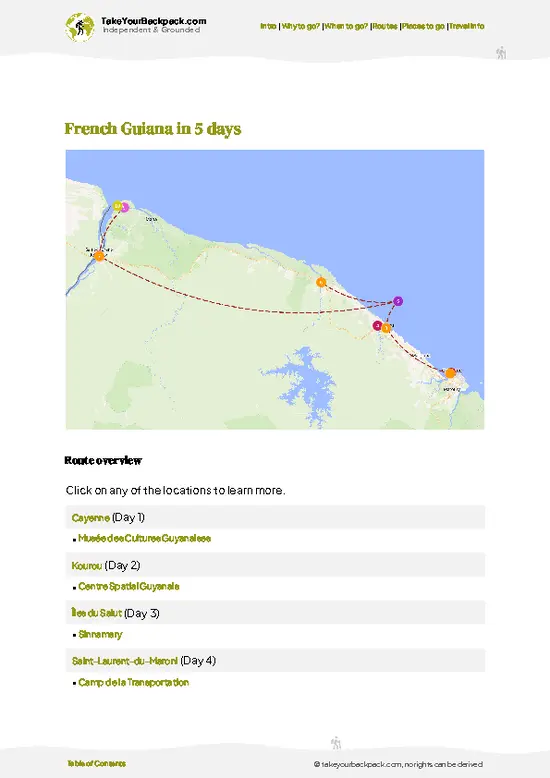
The 5-Day Coast, Space & Amazon Deep-Dive

The vibe: A fuller journey that stitches together Cayenne’s markets, Kaw’s wetlands, Kourou’s rockets, and the Maroni River’s penal history at an unhurried, experience-heavy pace. Best for travelers who want to feel how French Guiana’s forest, sea, and frontier towns all connect.
The highlights:
  • Urban flavor and cultural context in Cayenne and its museum.
  • Immersive boat exploration in the Kaw-Roura Natural Reserve from Roura.
  • Behind-the-scenes insight at the Centre Spatial Guyanais in Kourou.
  • Linked penal-colony history at Îles du Salut and Camp de la Transportation in Saint-Laurent-du-Maroni.
🌍 Want a ready-to-use travel plan for French Guiana?
The overview above compares different route options based on your travel time and style. The complete Travel Guide breaks each itinerary down in detail, including maps, stops, highlights, and transport information.

Explore all route details 👉

Get the Travel Guide -

🌤️ When to go?Weather, seasons, and timing

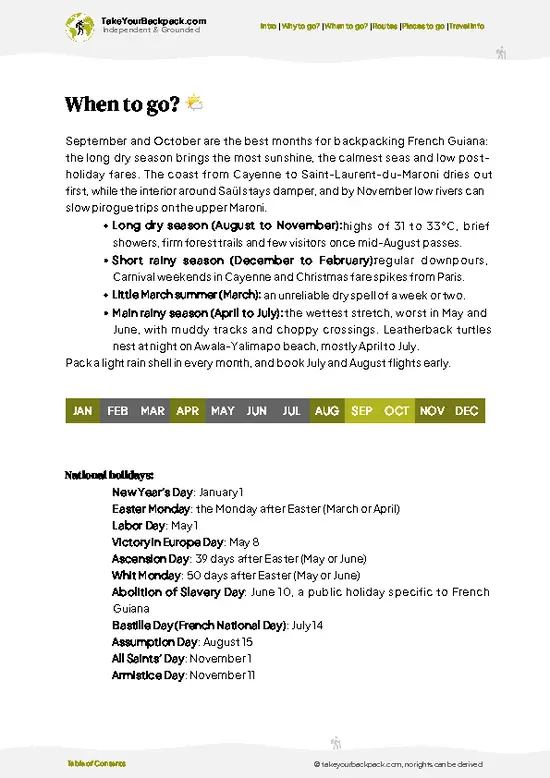
September-October is the sweet spot. The sky finally holds, the forest lets go of its wet grip, and trails stop sucking at your calves. Nights breathe just enough that a hammock dries instead of molding. Mosquitoes lose their swagger. Prices sit between European summer and Christmas, and with Carnival long gone, Cayenne and Kourou feel workable. Rivers run usable without being brown missiles, and the sea to Îles du Salut usually calms—you actually make the crossing instead of telling stories about the attempt.
  • Carnival Burst (Feb-Mar): Hot, pricey, and packed, but the drums in Cayenne hit bone-deep; sweat, rum, feathers, then roadside bouillon that resets you.
  • Late Dry Shift (Sep-Oct): Trails firm, shops extend hours, boats run on time; you cover ground, island-hop, and stack days without weather stealing one.
  • Big Rains (May-July): The interior goes quiet and green; wear knee-high rubber boots, tarp your pack, and walk slow. Nights mean leatherback nesting at Awala-Yalimapo.

Tactical tip: Carry a jungle hammock with integrated bug net and a quick-pitch tarp—your emergency bed when boats slip schedules or a gîte is full.

source: climatestotravel.comJANJanuary: good for travelingFEBFebruary: fair for travelingMARMarch: fair for travelingAPRApril: good for travelingMAYMay: below average for travelingJUNJune: below average for travelingJULJuly: below average for travelingAUGAugust: good for travelingSEPSeptember: excellent for travelingOCTOctober: excellent for travelingNOVNovember: good for travelingDECDecember: good for traveling
📅 Traveling in a specific month?
Get a full month-by-month breakdown of weather, crowds, costs, festivals, and seasonal highlights in the complete travel guide.

Get full details when to go 👉

Get the Travel Guide -
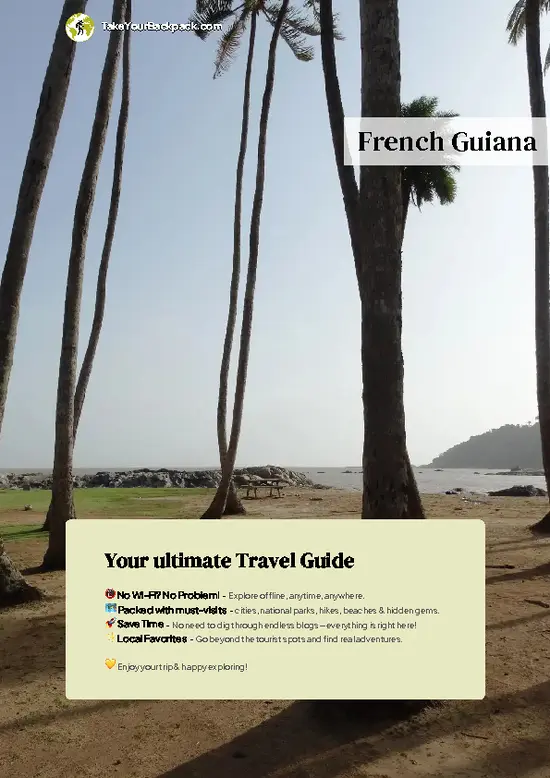
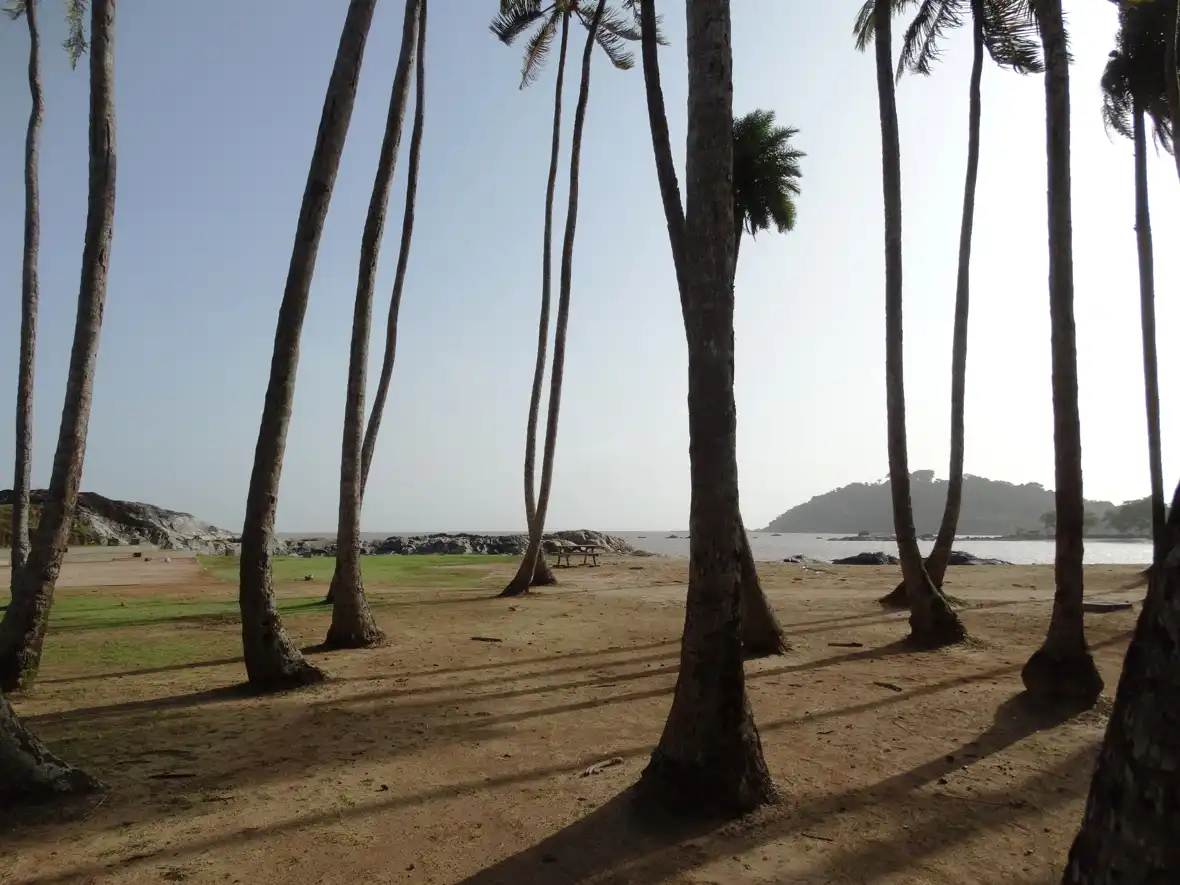
pixabay-french guiana - palm-trees-2060120

💰 Costs (as of 2026)How expensive it really is

Plan on €65-85 per day if you self-cater, sleep cheap, and ride shared taxis; French Guiana charges Euro prices while its neighbors don’t.
  • dorm accommodation: Dorms are scarce and run €22-35 in Cayenne/Kourou; inland often jumps to basic rooms at €45-70. Carbet (hammock shelters) cut costs to €8-15 if you bring your own hammock and net. System tip: carry a hammock + straps and ask gîtes/municipal carbets for “nuit en carbet”—you’ll halve your lodging and sleep cool under a roof when rain hammers the tin.
  • meals: Supermarket Survival: baguette, cheese, tins of fish, fruit, and cold yogurt from Super U/Carrefour gets you fed for €8-12/day. Street food reality: options are thinner than Suriname or Brazil—Creole/Chinese canteens do heaping plates for €10-14, rotisserie chicken + rice €8-10, market bowls in Cacao/Sinnamary €6-9. Beer is €1-2 in a shop, €4-6 at a bar; across the river in Suriname you’ll pay roughly half for similar calories.
  • local transport: Cheapest unlock is taxi collectif on RN1. Cayenne-Kourou €10-15; Cayenne-Saint-Laurent €25-35, early departures, leave when full—carry small bills and patience. City buses are €1-2 but patchy. Hitching works in daylight if you don’t mind
read more 👉
Plan on €65-85 per day if you self-cater, sleep cheap, and ride shared taxis; French Guiana charges Euro prices while its neighbors don’t.
  • dorm accommodation: Dorms are scarce and run €22-35 in Cayenne/Kourou; inland often jumps to basic rooms at €45-70. Carbet (hammock shelters) cut costs to €8-15 if you bring your own hammock and net. System tip: carry a hammock + straps and ask gîtes/municipal carbets for “nuit en carbet”—you’ll halve your lodging and sleep cool under a roof when rain hammers the tin.
  • meals: Supermarket Survival: baguette, cheese, tins of fish, fruit, and cold yogurt from Super U/Carrefour gets you fed for €8-12/day. Street food reality: options are thinner than Suriname or Brazil—Creole/Chinese canteens do heaping plates for €10-14, rotisserie chicken + rice €8-10, market bowls in Cacao/Sinnamary €6-9. Beer is €1-2 in a shop, €4-6 at a bar; across the river in Suriname you’ll pay roughly half for similar calories.
  • local transport: Cheapest unlock is taxi collectif on RN1. Cayenne-Kourou €10-15; Cayenne-Saint-Laurent €25-35, early departures, leave when full—carry small bills and patience. City buses are €1-2 but patchy. Hitching works in daylight if you don’t mind equatorial sun and sudden soakings. Car rental rarely beats €50-70/day plus €1.7-2.0/L fuel, so only worth it for groups.
  • activities: Big costs are boats and guides. Îles du Salut ferries €25-40 return; Kaw Marsh night trips €60-90; multi-day jungle/Maroni river runs €120-200/day all-in. Museums run €3-8; space center tours can be cheap or free but schedules are rigid. Compared to Guyana/Suriname, guided nature here bites harder.
  • miscellaneous: Budget leaks: ATM fees on non-EU cards, overpriced sunscreen/repellent, Sunday closures pushing you into pricier restaurants, laundry €5-10/load, last-mile taxis when storms hit, and SIM + data €20-30 to start (Orange/Free). It’s the cold Cokes, stray Ubers, and “just this once” transfers that blow the budget—costs your neighbors across the borders absorb better.
⚠️ Prices can change and everyone travels differently, so take this as a rough guide. Hope it helps you plan your adventure!

✈️ The backpacker research shortcutFrench Guiana Travel Guide

An offline-friendly backpacking guide with optimized travel routes, ranked highlights, transport advice, and the best areas to stay.
example page 0 from our offline Travel Guide for French Guianaexample page 1 from our offline Travel Guide for French Guianaexample page 2 from our offline Travel Guide for French Guianaexample page 3 from our offline Travel Guide for French Guianaexample page 4 from our offline Travel Guide for French Guianaexample page 5 from our offline Travel Guide for French Guianaexample page 6 from our offline Travel Guide for French Guianaexample page 7 from our offline Travel Guide for French Guiana
The digital guide (182 pages) contains:
42 highlights, ranked by travel appeal
Optimized 2, 3 & 5-day travel routes
Cities, national parks, beaches, historical sites, ...
How to get around
Offline-friendly for travel without Wi-Fi
👉 Click to see all 30+ guide features

📅 Plan smarter in minutes, not weeks
Month by month travel advice
Festivals & national holidays
Budget expectations

🗺️ Go to the right places, skip the overrated ones
Honest pros & cons of destinations
Top hikes, parks & viewpoints
Lesser-known places most travelers miss
Clear “worth it vs skip it” guidance

🛏️ Travel smoothly without rookie mistakes
Best areas to stay
Transport systems explained simply
Common scams & safety advice
SIM cards, money & practical tips

🌍 Understand the country, not just visit it
Culture & traditions
52 Essential phrases & customs
Festivals worth planning around
Traveler-friendly historical context
Insights that make places more meaningful

📱 Built for real travel conditions
Fully downloadable PDF
Works completely offline
Optimized for phone use
Useful in remote areas & buses
Everything in one place
Save weeks of stressful planning
Get instant access to the full guide directly. 30-day money-back guarantee.


Sent to your inbox immediately after payment • 100% Secure Checkout
Best Backpacking Travel Advisor 2025 tourism awardBest Backpacking
Travel Advisor
2025
What others say about Take Your Backpack Guides:
⭐⭐⭐⭐⭐
Fantastic, amazing amount of information!
⭐⭐⭐⭐⭐
My goodness this is amazing, it's what I've been looking for hats off too you!
⭐⭐⭐⭐⭐
I think this is absolutely BRILLIANT
⭐⭐⭐⭐
Very complete and informative. It's still missing places, but I gotta to commend you
⭐⭐⭐⭐⭐
This is truly amazing, thank you, can't wait to explore it with my kids!
⭐⭐⭐⭐⭐
Awesome resource, thank you!
⭐⭐⭐⭐⭐
This is amazing! Can't wait to explore the ones I haven't seen
⭐⭐⭐⭐
I love this! Well done, great idea.
⭐⭐⭐⭐⭐
Thanks for taking the time to make this gem!
⭐⭐⭐⭐⭐
This might be the best website I've ever seen.
⭐⭐⭐⭐⭐
Congratulations, and thank you so much for your work; it's incredibly valuable.
⭐⭐⭐⭐
In all seriousness I think you did a great job pointing out the important spots
⭐⭐⭐⭐⭐
10/10 very good
⭐⭐⭐⭐⭐
As someone who's only just starting to visit regularly this is awesome, thank you.
⭐⭐⭐⭐
Thank you very much! I'm going to visit my dad, it's going to be very useful!
⭐⭐⭐⭐⭐
This is really cool! We'll be travelling for the first time and this definitely come in handy.
⭐⭐⭐⭐⭐
You are now our minister of culture, congratulations 👨‍💼
⭐⭐⭐⭐⭐
Just wanted to tell you that this is a pearl! Going to follow your recommendations.
⭐⭐⭐⭐⭐
This is so cool. I'll definitely be using the resource for my travels soon.
⭐⭐⭐⭐⭐
This is very impressive! Good work.
⭐⭐⭐⭐⭐
This is an amazing and informative site. Very well done!

🛏️ Where to stay?Accommodation types and options

Yes — hostels and other budget accommodation exist in French Guiana but options are limited and concentrated in the main towns: Cayenne (city centre), Remire-Montjoly (coastal/near airport), Kourou (Space Centre) and Saint-Laurent-du-Maroni.
Choose Cayenne for the most listings, transport links and nightlife but expect noise and pockets of poor lighting after dark; Remire-Montjoly for beach access and quieter stays with fewer services; Kourou for easy access to the space centre and river trips with modest tourist infrastructure; and Saint-Laurent for the cheapest, most remote base for border … read more 👉
Yes — hostels and other budget accommodation exist in French Guiana but options are limited and concentrated in the main towns: Cayenne (city centre), Remire-Montjoly (coastal/near airport), Kourou (Space Centre) and Saint-Laurent-du-Maroni.
Choose Cayenne for the most listings, transport links and nightlife but expect noise and pockets of poor lighting after dark; Remire-Montjoly for beach access and quieter stays with fewer services; Kourou for easy access to the space centre and river trips with modest tourist infrastructure; and Saint-Laurent for the cheapest, most remote base for border or jungle access but plan for very basic facilities, limited evening safety, cash-only spots and arranged transport if arriving late.

If you enjoy meeting fellow travelers, consider choosing hostels with high ratings for atmosphere. On the other hand, if you prefer having your own space, a hotel might be a better option.

🚌 Getting aroundHow to travel within the country

French Guiana moves by humidity and instinct. Dawn is the real timetable: mist on the mangroves, diesel warming, drivers squinting into the low gold light. By late morning the heat gets heavy, schedules soften, and a rain squall can reset the day like a flipped breaker. Patience pays—when the road finally opens and the forest breathes, you feel the country exhale with you.
  • Taxi collectif (intercity minibus) The speed vs. cost trade is blunt: about half the price of renting a car, about twice the
read more 👉
French Guiana moves by humidity and instinct. Dawn is the real timetable: mist on the mangroves, diesel warming, drivers squinting into the low gold light. By late morning the heat gets heavy, schedules soften, and a rain squall can reset the day like a flipped breaker. Patience pays—when the road finally opens and the forest breathes, you feel the country exhale with you.
  • Taxi collectif (intercity minibus) The speed vs. cost trade is blunt: about half the price of renting a car, about twice the time of driving yourself. They leave when full, not when posted, so show early, claim the front seat, and keep your passport ready for gendarme checkpoints. Expect loud zouk, quick overtakes, erratic AC, and a stop for roadside boudin or a warm soda that tastes miraculous after sweaty kilometers.
  • Pirogue on the Maroni/Oyapock Rivers unlock what asphalt can’t: Apatou, Grand-Santi, the brown-water seams where the forest closes in. You sit low on a wooden bench, spray in your face, fuel fumes in your nose, life vest on when the river police wave you over. Pay by seat, departures bunch around weather and demand, and the reward is a bend where egrets lift and the banks go silent except for the motor’s thrum.
  • Urban buses (Cayenne/Kourou) This is the social fabric ride: bonjour the driver, don’t flash big bills, press stop early, and expect AC that’s either arctic or a rumor. Midday it’s schoolkids and market bags; after dusk, service thins. Keep damp packs off seats and let people off before you push in—small courtesies keep the circuit smooth.
  • Covoiturage and thumb-in-the-daylight The budget disruptor: roundabouts on RN1 and RN2 are informal hubs where rides appear—chip in for fuel and you’ll beat minibus queues. Daylight only, bright shirt for visibility, and a hard no to boozy drivers. One good lift can leapfrog you coast-to-border in a single, cheap run.

Master tactical tip: move at first light; be at the minibus stand by 6:00 with small euros and your passport, and plan to land by early afternoon so storms and thin evening service can’t trap you between towns.
Cayenne - Félix Eboué Airport (CAY) is in Matoury, about 16 km (10 miles) from central Cayenne (around Place des Palmistes).

As of 2025 there’s no dedicated airport bus and no Uber/ride-hailing. You can use the local bus (with a short walk), pre-book a transfer, or take a taxi.

Main public transport options
  • Local bus (Cayenne urban network): There isn’t a stop at the terminal. The nearest stops are along Route de l’Aéroport, about a 10-15 minute walk from arrivals. From there, buses to central Cayenne run roughly every 20-40 minutes on weekdays, less often on Saturdays, and very limited or none on Sundays/holidays.

    Time: 40-60 minutes total, including the walk and waiting time (the ride itself is about 25-35 minutes).

    Cost: about €1.50-€2.00 for a single ticket (buy from the driver; small change helps).
  • Pre-booked transfer/shuttle: Several local operators and some hotels offer private transfers door to door. Book online in advance if you arrive late or have bulky luggage.

    Time: 20-30 minutes, traffic permitting.

    Cost: typically €35-€50 per car to central Cayenne (shared shuttles are irregular).

Taxis
You’ll find licensed taxis outside arrivals. Expect about €30-€40 in daytime and €40-€50 late evening/night, Sundays, or holidays. The ride takes 20-30 minutes. Many drivers prefer cash; some accept cards—ask first. Agree the fare before you set off if there’s no meter.

Good to know
  • Local buses finish early (early evening). Don’t count on them for late arrivals—plan a taxi or transfer instead.
  • If you want flexibility beyond Cayenne (e.g., Kourou or beaches), on-site car rental is available; typical rates are €35-€60/day plus fuel.
  • Check current timetables and any service notices on the local transport site (search: CACL transport Cayenne) and flight info at the airport site: guyane.aeroport.fr.
⚠️ Prices and routes can change, so take this as a rough guide and ask for local advice when you arrive.

🔒 Safety (risk Level: low)What first-time visitors should know

Safety for solo travelers, including women and LGBTQ+ individuals
French Guiana is generally safe for solo travelers, including women and LGBTQ+ individuals, but caution is always wise. Stick to well-traveled areas and avoid isolated spots at night. Public displays of affection, especially for LGBTQ+ couples, might attract attention in smaller towns, so discretion is advised. Keep an eye on your belongings, as petty theft can occur in crowded places.

✈️ VisaUnderstanding entry rules

French Guiana is an overseas region of France, so visa requirements depend on your nationality. If you’re from the EU, EEA, or Switzerland, no visa is needed. Non-EU travelers might need a Schengen visa; check the French consulate’s website in your country for specific visa application details.
⚠️ Visa requirements can change over time, so always check the latest visa requirements with the official embassy or government website before you travel.

🎒 What to pack?What to wear and bring

French Guiana packs a punch with its steamy jungles, wet coastal areas, and a really laid-back vibe. Expect a tropical climate—hot and humid with frequent rains, especially from December to July. You’re going to spend a lot of time outdoors, so light, breathable fabrics are your best friend. In the more rural and indigenous areas, it’s good to dress modestly out of respect, so think about packing clothing that covers shoulders and knees. Don’t forget that mosquito repellent is practically your ticket to happiness here; those little guys are relentless!

Apart from this country specific advice, I have also crafted a general packing list that should help on any trip. authorOver the years, I've learned the importance of packing minimally. It's so much easier to jump on the back of a truck or squeeze yourself into the last spot of a minibus without that supersized backpack. If you're headed to a warm destination, leave your winter jacket at home; for colder regions, opt for thin thermal underlayers. Instead of packing your entire wardrobe, bring just three sets of clothes, as laundry facilities are available everywhere.

View the full list 👉
🎒 Planning the practical side of your trip?
Get detailed information on transport, daily budgets, internet access, local customs, food, language, and other essentials in the complete Travel Guide.

Get detailed practical information 👉

Get the Travel Guide -

🙋 FAQFrequently asked questions

Trip Planning


Personal tip: I normally search on good rating for atmosphere (for meeting people) and location (for easy exploring). Cleanliness as a bonus.


Travel Essentials

Yellow fever vaccination is mandatory for entry into French Guiana. Make sure your routine vaccines (like MMR, DPT, and varicella) are up-to-date. Consider hepatitis A and B, typhoid, and rabies, especially if you plan on exploring rural areas or have extended stays. Always check the latest health advisories before you travel.


vaccination requirements
When I first started traveling, I often spent part of my first day in a new country hunting for a local SIM card. While this can still be slightly cheaper, it also takes time and planning.

These days, it's much simpler to install an eSIM before leaving home. Once you arrive in French Guiana, you can activate it immediately and have mobile data from the moment you land — which is especially useful for ordering transport or navigating away from busy airports.

There are many providers nowadays, and price differences are usually small. I personally go with Airalo, as it offers excellent network coverage throughout the country and strong global coverage, so you can manage multiple countries from a single app.


Get your e-sim for French Guiana

Culture & Customs

Respect local customs in French Guiana by greeting with a handshake or a kiss on the cheek, depending on familiarity. Dress modestly, especially in rural areas—shorts and tank tops are best left for the beach. When dining, wait for the host to say “bon appétit” before starting your meal. Public displays of affection may attract unwanted attention, so keep it low-key. LGBTQ+ travelers should exercise discretion, as societal attitudes can be conservative outside urban areas. Avoid discussing politics or local issues unless you’re well-informed. Remember, patience is key; things move at a more relaxed pace here.
Trying traditional food is always a great way to experience the culture. Here are some must-try dishes for French Guiana.
  • Colombo: This is a hearty, spicy curry-like stew often made with chicken, beef, or fish. Its roots trace back to Indian indentured workers who brought the dish to the Caribbean. It’s a staple in French Guiana, reflecting the region’s diverse cultural tapestry.
  • Blaff: A simple, flavorful fish stew typically seasoned with lime, garlic, and various spices. It’s a go-to dish for its fresh taste and ease of preparation, often enjoyed by locals and tourists alike.
  • Awara Broth: A traditional dish especially enjoyed during Easter, this thick stew is made from the fruit of the awara palm, along with various meats and spices. It’s more than just food; it’s a cultural experience that brings families together.
  • Roti: While not unique to French Guiana, this flatbread often accompanied by curried meat or vegetables is popular, showcasing the Indian influence in the local cuisine.
  • Creole Sausages: These sausages are packed with spices and herbs, offering a taste of the Creole influence that permeates the food scene. They’re often grilled and served at local gatherings and festivals.
Tap water in French Guiana is generally safe for locals to drink, but it’s often recommended that tourists stick to bottled or filtered water just to be cautious. Bottled water is widely available, so it’s easy to play it safe if your stomach isn’t accustomed to the local water.
The main language in French Guiana is French. Backpacking is way more rewarding if you know a bit of the local language, so I'd suggest brushing up on the basics just in case your French skills have become a bit rusty.

Want to understand locals better?
The complete Travel Guide for French Guiana includes 52 essential words and phrases — greetings, thank-yous, ordering food, transport, numbers, and common local expressions you'll actually hear.

Get your local basic phrases 👉

Get the Travel Guide -


In French Guiana, French is the official language, and it is predominantly spoken by the local population. English is not widely spoken, but you may encounter some English speakers in urban areas, tourist spots, and among younger residents who have learned it in school. However, fluency can vary significantly.

In more remote regions and among older generations, English proficiency is generally low. Travelers may find it helpful to learn a few basic French phrases, as this can enhance communication and cultural interactions. Additionally, the presence of several indigenous languages and Creole also adds to the linguistic diversity of the region.

For those planning to visit, using translation apps or carrying a phrasebook can be beneficial. Overall, while you can get by with English in certain areas, a basic understanding of French will greatly improve your experience in French Guiana.

Money & Payments

The local currency of French Guiana is EUR (€).

If you’re backpacking through French Guiana, here’s how to handle your money without hitting too many bumps:

ATM Access: ATMs are mostly found in larger towns like Cayenne. Don’t rely on them in remote areas or small villages. Always have a backup plan since some machines might be out of service.

Cash: Stick to euros. French Guiana uses the euro, and while dollars might be accepted in some spots, it’s not guaranteed. Always have a bit of cash on you for markets, street vendors, or bus fares.

Card Acceptance: Credit and debit cards are widely accepted in bigger towns, but don’t expect to swipe your card in rural areas. Inform your bank about your travel plans to avoid any card issues.

Currency Exchange: If you’re coming from outside the eurozone, exchange your currency before you arrive or at the airport. Local banks and exchange offices can handle currency exchange, but rates might not be favorable, and options are limited outside main towns.

Tipping in French Guiana isn’t obligatory, but it’s appreciated for excellent service. A 5-10% tip at restaurants is generous, while rounding up the taxi fare is common. In bars and cafes, leaving the small change from your bill is a nice gesture.

🧩 Nearby countriesOther countries to combine with French Guiana

We 💚 feedbackWhat to know before planning your trip

French Guiana makes you earn it. Humidity like a hot towel, red mud to your shins, mosquitoes drilling at dusk. Then dawn lifts off Kaw marsh and a scarlet ibis cuts grey, or a rocket rips clouds over Kourou. That’s the reason: raw Amazon and rockets in one trip. The rub: euro prices and thin transport; without a car, you wait and you pay. Forward: tougher gold-mining patrols, steadier Ariane 6 launches, and community carbets getting formalized. That first ice-cold Lorraine in Cayenne is a win.

✍️ Help improve this page!
The information on this page is based on in-depth research, insights shared by experienced travelers, and feedback from the local travel community in French Guiana. While every effort is made to keep the information accurate and current, conditions can change — so if you spot anything incorrect or outdated, please get in touch.


🙋‍♂️ Give feedback

👋 Meet the founderWho’s Behind Take Your Backpack?

Johan, backpacker and founder of TakeYourBackpackHi, I’m Johan (Netherlands 🇳🇱), the creator of TakeYourBackpack. Over the past decade, I’ve backpacked through 80+ countries across six continents, gaining extensive experience with independent travel, long-term trips, and overland routes.

This site is built on a combination of firsthand travel experience and carefully curated insights from other backpackers. Many guides are based on places I’ve personally visited, while others bring together tips, observations, and practical advice shared by trusted travelers I’ve met along the way.

The goal is to provide realistic, experience-driven guidance — not generic itineraries — so you can explore destinations with better context, clearer expectations, and more confidence.

Get full country guide •
Instant download • 42 highlights • Full Offline guide