×
Bosnia and Herzegovina 🇧🇦

backpacking Europe Bosnia and Herzegovina 🇧🇦
Follow river valleys where cultures still meet naturally today.

Explore BelgiumExplore Bulgaria

Backpacking Bosnia and Herzegovina in 2026

A complete guide including when and where to go, costs, transport, itineraries, and practical travel advice.
The big picture before you go

Backpacking Bosnia and Herzegovina
By Johan Kruseman 🇳🇱 | Updated May 21, 2026

Ride Sarajevo’s cable car up Trebević and walk the mossy, graffiti-scarred Olympic bobsled track. It’s minutes from Baščaršija and friendly to a backpacker budget. It also captures Bosnia’s knack for turning scars into story and play.

Bosnia and Herzegovina is mountains and water first: Dinaric ridges crashing into emerald rivers, stone towns where Ottoman courtyards meet Austro‑Hungarian corners. Sevdah spills from cafés, coffee lands black and thick, grills hiss with ćevapi. In Mostar, divers arc off Stari Most into the Neretva’s chill; on the Via Dinarica you stride ridge to ridge, and in Sutjeska, Perućica breathes like a green lung after rain. Buses can be stubborn, cash rules, and off‑trail landmines still mark limits—so you slow down, stick to the waymarks, get handed rakija, and let the cold river bite back.

Next to Croatia’s polished coast, Montenegro’s showpiece bays, Serbia’s late-night swagger, and Slovenia’s tidy alpine postcard, Bosnia and Herzegovina trades beaches for backbone—higher trails, deeper stories, softer prices. It’s for hikers, river chasers, and the history-curious who want warmth and days they earn.

Sarajevo & the Olympic Peaks

Sarajevo works because the mountain rims are close enough to taste the pine. Trams screech, coffee smells like roasted nuts, and within 20 minutes you can be on Trebević’s old bobsled track, concrete sweating moss. Take the cable car up; hike down to feel the city grow louder with each switchback. Bjelašnica and Jahorina reward patient weather windows—alpine meadows in June, ice if you’re careless in shoulder season. Base here if you want dense history at night and real elevation by day. Buses radiate everywhere; tickets often cash-only at smoky kiosks. Early morning is your friend, especially for steep sun.

Neretva Corridor: Mostar – Blagaj – Kravice

This is a heat-and-limestone run. The Sarajevo–Mostar train is slow but honest; window seat, eyes on canyon walls, then the river flares turquoise. Mostar’s old bridge is a midday elbow fight—go at dawn when the stones are cool and you can hear your footsteps. Hop a local bus or taxi to Blagaj for cold spring air under the cliff, then push south to Kravice for a bracing swim that rinses the dust. This corridor suits travelers who can work around the sun: siesta hard, eat late, move early. Easy logistics along one spine; summer crowds are real, but they thin with patience.

Sutjeska & Maglić (via Foča)

Rugged and remote. Base in Foča, then hire a jeep or a no-nonsense taxi to Sutjeska’s trailheads. Markings vary; carry a map or GPX and stick to known routes—mine signs still guard the wrong meadows. Maglić is a haul with hands-on rock and weather that flips fast; Zelengora’s lakes are softer but far. You earn everything here: wet boots in boggy grass, cold metal on chain sections, then the shock of blue at Trnovačko Lake. Best for strong hikers comfortable with thin infrastructure and early starts.

Una Valley & Bihać

Green river, white noise. Camps line the banks with damp firewood smell and grill smoke at dusk. Rafting outfits run shuttles to Štrbački buk; going solo by taxi costs more than it should. Expect long road times from central Bosnia; this is cleaner if you’re swinging from Croatia. Mosquitoes mean sleeves at sunset. The payoff is simple: foam, thunder, and a cold beer while your shoes steam dry.

Trebinje & Eastern Herzegovina

Sun-baked stone and slow evenings. Trebinje sits close to Dubrovnik but moves cheaper and calmer; buses run cross-border, yet schedules drift, so pad time. Hike Leotar in the morning, then climb to Hercegovačka Gračanica for sunset over vineyards and a glass of local Vranac. You come here to exhale, raid markets for peaches, and day-trip to the coast without paying coastal prices.
Seeing the layout at a glance
Loading the map 🌍
CLICK TO FILTER
city
town
village
unique site
national park
hike
beach
attraction
festival
SHOW COUNTRY’S BESTSHOW ALL
film
0
0
0a
Sarajevo War Tunnel
film
1
1
1a
Gazi Husrev-beg Mosque Complex
film
2
2
2a
Gallery 11/07/95 Sarajevo
film
3
3
3a
Srebrenica-Potočari Memorial Center
film
4
4
4a
National Museum of Bosnia and Herzegovina
film
5
5
5a
Trebević Cable Car and Abandoned Bobsleigh Track
film
6
6
6a
Old Bridge Museum Mostar
film
7
7
7a
Bijambare Cave Complex Visitor Area
film
8
8
8a
Međugorje Apparition Hill Area
film
9
9
9a
Neum Beach
film
10
10
10a
Bijela Plaža
film
11
11
11a
Sarajevo
Miodrag Davidović
film
12
12
12a
Mostar
Nemesis&İkarus
film
13
13
13a
Banja Luka
Boris Veriš
film
14
14
14a
Lukomir Highland Village
Vaclav J.
film
15
15
15a
Bjelašnica
film
16
16
16a
Prenj
film
17
17
17a
Jahorina
film
18
18
18a
Vranica Mountain
film
19
19
19a
Vlašić
film
20
20
20a
Bjelašnica Mountain
Yasier Omar
film
21
21
21a
Sutjeska
Igor Simović
film
22
22
22a
Blidinje Nature Park
Joško Lukić
film
23
23
23a
Kozara
film
24
24
24a
Trebevic Nature Park
film
25
25
25a
Prenj Nature Park
film
26
26
26a
Velez Nature Park
film
27
27
27a
Travnik
film
28
28
28a
Bihac
Rijad Kilim
film
29
29
29a
Foča
film
30
30
30a
Ljubuški
film
31
31
31a
Livno
film
32
32
32a
Zvornik
Beloica S.
film
33
33
33a
Old Bridge in Mostar
Vladimir Uhlik
film
34
34
34a
Kravice Waterfalls
Przemysław Misiuda
film
35
35
35a
Jajce Waterfall
Dario Jelcic
film
36
36
36a
Blagaj Tekke
Sonja Ilic
film
37
37
37a
Mehmed Paša Sokolović Bridge in Višegrad
Miroslav Matic (mita)
film
38
38
38a
Vjetrenica Cave, Ravno
Špilja Vjetrenica
film
39
39
39a
Vrelo Bosne
Geza Komaromi
film
40
40
40a
Kastel Fortress
film
41
41
41a
Srebrenik Fortress
Bojan Lukic
film
42
42
42a
Rakitnica Canyon
Haris A.
film
43
43
43a
Mogorjelo
film
44
44
44a
Visoko Pyramids
film
45
45
45a
Počitelj
Mirko Popovic

Why go?What draws travelers here

Uniqueness

Bosnia and Herzegovina feels raw in the best way. Sarajevo’s tram rails hum, minarets and church bells … read more 👉
Bosnia and Herzegovina feels raw in the best way. Sarajevo’s tram rails hum, minarets and church bells overlap, and bullet-pocked facades sit beside cafés steaming burek. You hike Trebević past the graffiti-scarred bobsled track, or push into Sutjeska’s dark beech to reach Maglić, thighs burning, rewarded by glacier-cold water on your face. In Mostar, local divers hurl themselves below Stari Most into the jade Neretva; later, Sarajevsko beer sweats in your palm. Buses rumble, signs flip between Cyrillic and Latin, and stone-roofed Lukomir serves lamb and plum rakija like a handshake.

Low cost

I’ve stretched a day’s budget across mountains and markets here. Diesel-scented buses and slow trains … read more 👉
I’ve stretched a day’s budget across mountains and markets here. Diesel-scented buses and slow trains get you across the country for the clink of small coins. Breakfast is a hot, flaky burek; lunch, cevapi eaten with greasy fingers on a warm curb; coffee comes thick, bitter, and cheap. Hostels and grandma-run rooms hand you a key and sometimes a glass of rakija. Carry cash; many places don’t take cards. Museums, bridges, and war-torn hillsides are mostly free to see. Call it roughly $30–40 a day if you travel light—simple beds, buses, grills—without feeling like you’re skimping.

Scenery

Bosnia is for people who like their scenery earned. The hills smell of pine and woodsmoke, limestone … read more 👉
Bosnia is for people who like their scenery earned. The hills smell of pine and woodsmoke, limestone under boots. Switchbacks on Prenj bite calves; sun bounces off white karst. Then you crest a ridge and see glacier-scored spines and the Neretva cut emerald below. Drop to rivers: Una mist at Štrbački buk on your face, Kravica drumming your chest. Crawl the cool Vjetrenica cave, breath fogging your lamp. Camp beside Boračko or Prokoško Lake; nights are crickets and cold air. Finish with a Bosnian coffee in Mostar as the bridge glows and your legs hum.

People

Bosnians meet you with a handshake that lingers and a joke that lands dry. In Sarajevo’s smoke-stained … read more 👉
Bosnians meet you with a handshake that lingers and a joke that lands dry. In Sarajevo’s smoke-stained cafés, a stranger slides over, orders Bosnian coffee in a džezva, and won’t let you pay; carry small bills if you want to sneak the check. Directions aren’t pointed—they’re walked, three blocks in the rain. In mountain villages, woodsmoke, sheep bells, a plastic bottle of plum rakija pressed into your palm; sip, don’t wince. Plates refill without asking. They’ll tease your accent, then toast you: Živjeli. Say hvala. Eat slow. And remember: only meat is burek; the rest are pite.

Architecture

Bosnia and Herzegovina rewards you with stone under your boots and centuries layered in a single street. … read more 👉
Bosnia and Herzegovina rewards you with stone under your boots and centuries layered in a single street. Mostar’s Stari Most arcs over green water, limestone slick with mist. In Sarajevo, tram bells and the call to prayer bounce off Ottoman courtyards, Austro‑Hungarian facades, and the Moorish‑revival Vijećnica. Hike to Počitelj’s citadel or Srebrenik Fortress; calves burn, then the Neretva valley opens like a map. Stećci lie in sheep pastures, carved with dancers and spirals. Concrete spomeniks flare in forests, and the Avaz Twist Tower adds glass to the skyline. Finish with a Sarajevsko, concrete cool, dusk softening the scars.
Want the complete picture of Bosnia and Herzegovina?
The offline Travel Guide brings everything together — routes, highlights & planning.

See what's included in the guide 👉

Get the Travel Guide -

⭐ HighlightsThe places that define a trip here

  • Sarajevo, Baščaršija & Yellow Fortress: Morning hits the copper shops first—the ping of hammers, bitter coffee steam, and the char of onions off a ćevapi grill that clings to your jacket. Climb the cracked steps to the Yellow Fortress; calves burn, palms dusted in lime, city laid out like a pocketful of coins. A kiosk beer turns icy at dusk as the muezzin skims the rooftops. Side trails: Skakavac Waterfall, the abandoned Trebević bobsled track, and the old Goat’s Bridge.
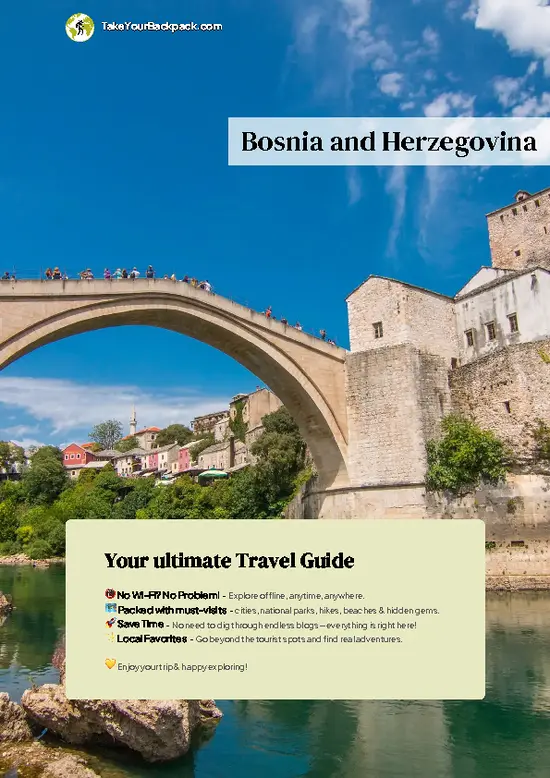
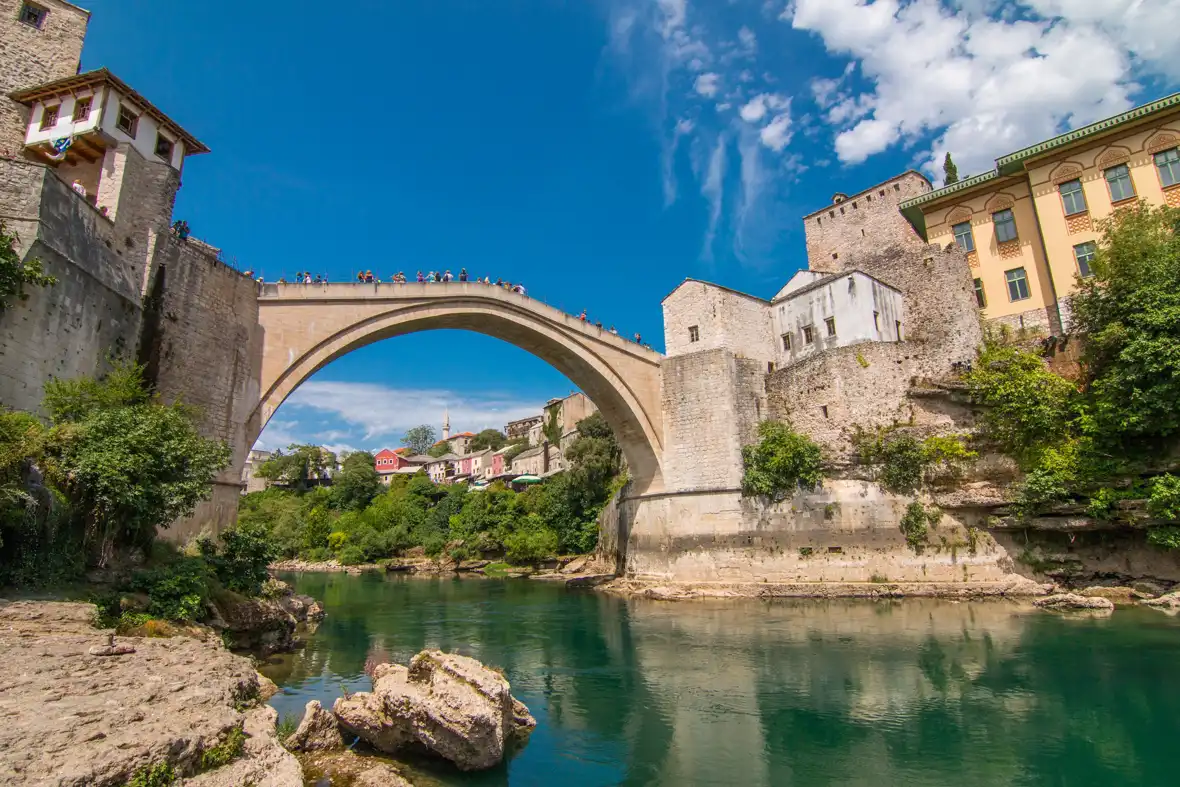
  • Mostar’s Stari Most: The bridge glows white-hot at noon, stone polished by centuries of soles, and the Neretva below is glacier-cold to the wrist. Divers pace, then drop—a clean slap, a collective inhale, then the smell of wet limestone and pressed pomegranate. Sit on the river slabs until your shorts wick through and the town quiets. Nearby detours: Blagaj Tekija at the Buna spring, the hill village of Počitelj, and Fortica’s steel skywalk.
  • Sutjeska National Park: Maglić & Perućica: Trail starts soft in beech duff and turns
read more 👉
  • Sarajevo, Baščaršija & Yellow Fortress: Morning hits the copper shops first—the ping of hammers, bitter coffee steam, and the char of onions off a ćevapi grill that clings to your jacket. Climb the cracked steps to the Yellow Fortress; calves burn, palms dusted in lime, city laid out like a pocketful of coins. A kiosk beer turns icy at dusk as the muezzin skims the rooftops. Side trails: Skakavac Waterfall, the abandoned Trebević bobsled track, and the old Goat’s Bridge.
  • Mostar’s Stari Most: The bridge glows white-hot at noon, stone polished by centuries of soles, and the Neretva below is glacier-cold to the wrist. Divers pace, then drop—a clean slap, a collective inhale, then the smell of wet limestone and pressed pomegranate. Sit on the river slabs until your shorts wick through and the town quiets. Nearby detours: Blagaj Tekija at the Buna spring, the hill village of Počitelj, and Fortica’s steel skywalk.
  • Sutjeska National Park: Maglić & Perućica: Trail starts soft in beech duff and turns mean—slick roots, steep switchbacks, horseflies around your ears. Break above treeline on scree that chews your ankles; lungs rasp, resin in the sun, and then that sudden drop of Trnovačko’s heart-shaped lake, green as a bottle. Cold water stuns the knees and erases the climb. Quieter picks: Zelengora’s Gornje Bare, the concrete spomenik at Tjentište, and the Prijevor ridge.
  • Kravica Waterfall, Ljubuški: A tufa amphitheater drumming itself hoarse, mist in your teeth, algae-slick stones that force barefoot shuffles. Men grill sausages under walnuts; smoke mixes with river spray, and a plastic cup of beer sweats faster than you can drink it. Wade in until your thighs go numb and the heat finally breaks. Side missions: Koćuša Falls near Veljaci, Peć Mlini’s river cave, and the Ljubuški fortress.
  • Jajce Waterfall & Pliva: A waterfall drops straight into town, throwing cool onto your face that tastes faintly of limestone. Up the hill, wooden mills creak and leak while trout snap at bread in the eddies; your hands come away smelling of wet grain. Ramparts at sunset give it all context. Add-ons: the underground catacombs, the Mlinčići watermills path, and Jajce’s Roman Mithraeum.
Spotted a mistake or missing a highlight? Contact us.

But Bosnia and Herzegovina offers more...

Discover and compare all of its highlights per category

🧭 RoutesSuggested travel routes through Bosnia and Herzegovina

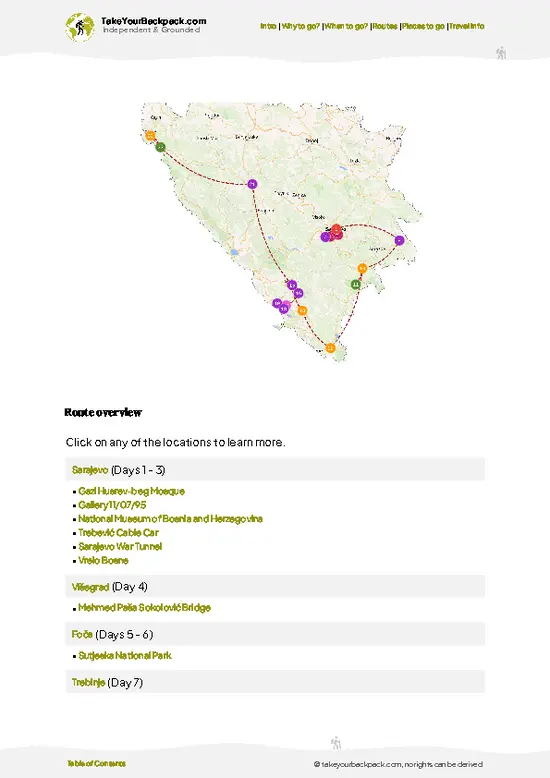
The 5-Day Sarajevo & Peaks Sampler

The Vibe: A slow-burn city-and-mountains intro built around Sarajevo’s history, coffee culture, and one big day in the surrounding hills, all with minimal bus time and maximum depth. You stay mostly in one region, letting the stories of the siege and the Ottoman past sink in instead of racing across the map.
The Highlights:
  • Sarajevo’s Ottoman core and the Gazi Husrev-beg Mosque area
  • War history at Gallery 11/07/95 and the Sarajevo War Tunnel
  • Trebević cable car rides and walks along the abandoned bobsleigh track
  • A day out to Konjic on the Neretva river
  • The 10-Day Bosnia Classics & Herzegovina Waters

    The Vibe: A balanced loop that stitches together Sarajevo’s depth, highland villages, and Herzegovina’s bridges and waterfalls at a comfortable, one-more-coffee pace. You’ll change bases a few times, but each stop earns its place with strong character and easy day-trip options.
    The Highlights:
  • Multi-day immersion in Sarajevo’s old town and recent history
  • Mountain escapes
read more 👉

The 5-Day Sarajevo & Peaks Sampler

The Vibe: A slow-burn city-and-mountains intro built around Sarajevo’s history, coffee culture, and one big day in the surrounding hills, all with minimal bus time and maximum depth. You stay mostly in one region, letting the stories of the siege and the Ottoman past sink in instead of racing across the map.
The Highlights:
  • Sarajevo’s Ottoman core and the Gazi Husrev-beg Mosque area
  • War history at Gallery 11/07/95 and the Sarajevo War Tunnel
  • Trebević cable car rides and walks along the abandoned bobsleigh track
  • A day out to Konjic on the Neretva river
  • The 10-Day Bosnia Classics & Herzegovina Waters

    The Vibe: A balanced loop that stitches together Sarajevo’s depth, highland villages, and Herzegovina’s bridges and waterfalls at a comfortable, one-more-coffee pace. You’ll change bases a few times, but each stop earns its place with strong character and easy day-trip options.
    The Highlights:
  • Multi-day immersion in Sarajevo’s old town and recent history
  • Mountain escapes to Trebević and the Bjelašnica highlands
  • Riverside downtime in Konjic on the way south
  • Mostar’s Old Bridge paired with Kravice Waterfalls, Blagaj Tekke, and Počitelj
  • The 15-Day Grand Bosnia & Herzegovina Circuit

    The Vibe: A full-country adventure that links Sarajevo, high Dinaric ridges, central fortress towns, wild national parks, and Herzegovina’s stone bridges into one big, satisfying loop. The pace is steady rather than rushed, with time to linger in small towns and follow your curiosity down side valleys.
    The Highlights:
  • Layered Sarajevo: mosques, museums, war sites, and nearby mountain viewpoints
  • Highland days around Bjelašnica, Lukomir, and the Via Dinarica corridor
  • Wild river time in Sutjeska and Una National Parks with a base in Foča and Bihać
  • Central Bosnia’s Jajce and Travnik plus a Herzegovina finale in Mostar, Kravice, Blagaj, and Počitelj
🌍 Want a ready-to-use travel plan for Bosnia and Herzegovina?
The overview above compares different route options based on your travel time and style. The complete Travel Guide breaks each itinerary down in detail, including maps, stops, highlights, and transport information.

Explore all route details 👉

Get the Travel Guide -

🌤️ When to go?Choosing the right months to travel

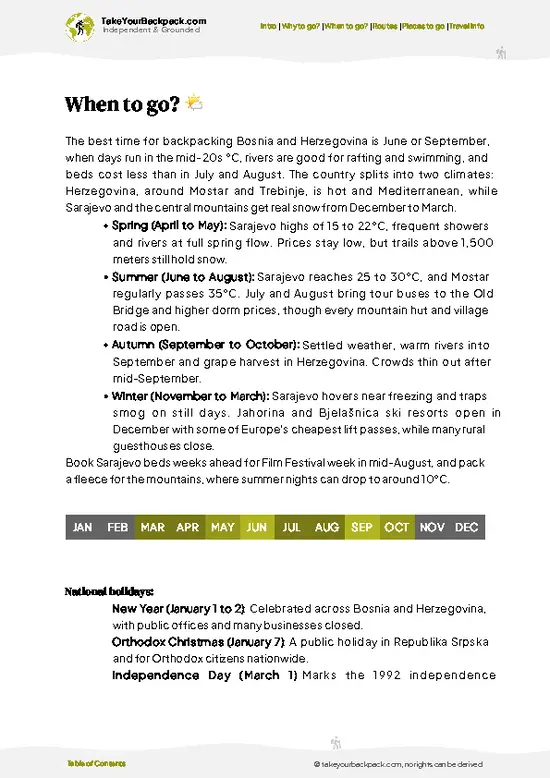
Late May to mid-June and mid-September to early October is Bosnia and Herzegovina’s sweet spot. Heat backs off in Mostar, but rivers still hold summer warmth; mountain snow has retreated from Bjelašnica and Prenj’s main trails, yet nights keep the bugs and sweat at bay. Guesthouses haven’t flipped to high-summer pricing, buses and the Sarajevo-Mostar train have spare seats, and crowds thin enough that sevdah from a courtyard carries down the lane. Spring rains taper, autumn storms haven’t set in, and the light turns crisp—the kind that makes limestone glow and the first cold Sarajevsko taste earned.
  • Peak Summer: Streets radiate heat; Stari Most goes shoulder-to-shoulder by noon; beds jump and you queue for everything. Then sunset drops, stone cools, and you plunge into the Neretva or nurse a cold beer in a shady han as the call to prayer skims the bridge.
  • Shoulder: Shutters lift, markets brim with peppers and plums, trails dry fast. Huts unlock, room rates dip, buses run full not frantic, and train windows crack to the river’s clean scent. You move—city to ridge to water—in a day without rushing.
  • Winter Off-Peak: Short days, blue smoke in Sarajevo’s valley, rain slicking Old Town stone, high country snowed deep and quiet. Locals linger over thick coffee; you walk empty alleys and own every museum. Survival hack: pocket microspikes for Sarajevo’s glassy sidewalks.

For the shoulder window, book rooms roughly a week ahead to keep flexibility while dodging last-minute price bumps.

source: climatestotravel.comJANJanuary: fair for travelingFEBFebruary: fair for travelingMARMarch: good for travelingAPRApril: good for travelingMAYMay: highly recommended for travelingJUNJune: excellent for travelingJULJuly: good for travelingAUGAugust: good for travelingSEPSeptember: excellent for travelingOCTOctober: highly recommended for travelingNOVNovember: fair for travelingDECDecember: fair for traveling
📅 Traveling in a specific month?
Get a full month-by-month breakdown of weather, crowds, costs, festivals, and seasonal highlights in the complete travel guide.

Get full details when to go 👉

Get the Travel Guide -
pixabay-bosnia-1111419

💰 Costs (as of 2026)What things cost day to day

€35-55 per day if you sleep in dorms, eat like a local, and stick to buses or the Sarajevo-Mostar train.
  • dorm accommodation: €10-16 most of the year; €15-22 in July-August in Sarajevo and Mostar, a touch less in secondary towns like Jajce or Trebinje. You’ll get creaky bunks, thin duvets in mountain towns, and hot showers that sometimes need patience. System tip: book night one online to secure the bed, then extend in cash directly—hosts often drop the platform cut and include the tourist tax (usually 1-2 BAM); ask up front so it doesn’t appear on checkout.
  • meals: Supermarket Survival: €5-8/day buys somun bread, kajmak, tomatoes, tinned fish, and yogurt—enough for two picnic meals with a view over bullet-scarred blocks or a riverbank. Street food reality: a small cevapi plate is €3-5, large €5-7; a greasy-hot burek slice €1-2.5; espresso €1; half-liter beer €1.5-2.5. Old Town menus in Sarajevo/Mostar add 20-40% for the view; still cheaper than Croatia, roughly on par with Serbia.
  • local transport: The cheapest unlock is rail where it exists: Sarajevo-Mostar is scenic and usually €5-7, about 20-40% less than the bus. Everywhere else, buses rule: €6-15 for 2-5 hour hops, plus €0.5-1 for
read more 👉
€35-55 per day if you sleep in dorms, eat like a local, and stick to buses or the Sarajevo-Mostar train.
  • dorm accommodation: €10-16 most of the year; €15-22 in July-August in Sarajevo and Mostar, a touch less in secondary towns like Jajce or Trebinje. You’ll get creaky bunks, thin duvets in mountain towns, and hot showers that sometimes need patience. System tip: book night one online to secure the bed, then extend in cash directly—hosts often drop the platform cut and include the tourist tax (usually 1-2 BAM); ask up front so it doesn’t appear on checkout.
  • meals: Supermarket Survival: €5-8/day buys somun bread, kajmak, tomatoes, tinned fish, and yogurt—enough for two picnic meals with a view over bullet-scarred blocks or a riverbank. Street food reality: a small cevapi plate is €3-5, large €5-7; a greasy-hot burek slice €1-2.5; espresso €1; half-liter beer €1.5-2.5. Old Town menus in Sarajevo/Mostar add 20-40% for the view; still cheaper than Croatia, roughly on par with Serbia.
  • local transport: The cheapest unlock is rail where it exists: Sarajevo-Mostar is scenic and usually €5-7, about 20-40% less than the bus. Everywhere else, buses rule: €6-15 for 2-5 hour hops, plus €0.5-1 for station “platform” fees and €0.5-1 per bag in the hold (a classic budget leak). City trams/trolleybuses run ~€0.8-1.2 if you buy tickets at kiosks; conductors charge a bit more. Taxis are fair by meter but avoid flat “tourist” quotes. Compared to Croatia and Montenegro, intercity rides are cheaper, but slower—mountain roads and cigarette breaks are part of the deal.
  • activities: Cost drivers are guided history/war tours (€15-25), day trips to Srebrenica or Sutjeska with transport (€25-40), whitewater rafting on the Neretva/Una (€30-45 including lunch), and the Trebević cable car (€10-12 return). Museum entries and fortress walks are €1-5. Hiking is free if you self-navigate; pay for a guide or 4x4 when trails cross remote ridges or mine-marked zones. Tours run 30-50% less than Croatia’s coast, a bit more than Serbia.
  • miscellaneous: Budget leaks: ATM fees and bad exchange rates if you pay in euros—use BAM and decline “conversion” offers. Bus luggage and platform fees add up over a week. Laundry at hostels is €5-8 per load; DIY options are scarce. SIMs run roughly €4-8 for a week with a few gigs; bring your passport. Coffee culture is real—three €1 espressos a day will quietly dent your math. Tap water is generally fine; refill to avoid €1 bottles. Beer on a hot bridge after a dusty walk? Cheap enough to feel like a win.
⚠️ Prices can change and everyone travels differently, so take this as a rough guide. Hope it helps you plan your adventure!

✈️ The backpacker research shortcutBosnia and Herzegovina Travel Guide

An offline-friendly backpacking guide with optimized travel routes, ranked highlights, transport advice, and the best areas to stay.
example page 0 from our offline Travel Guide for Bosnia and Herzegovinaexample page 1 from our offline Travel Guide for Bosnia and Herzegovinaexample page 2 from our offline Travel Guide for Bosnia and Herzegovinaexample page 3 from our offline Travel Guide for Bosnia and Herzegovinaexample page 4 from our offline Travel Guide for Bosnia and Herzegovinaexample page 5 from our offline Travel Guide for Bosnia and Herzegovinaexample page 6 from our offline Travel Guide for Bosnia and Herzegovinaexample page 7 from our offline Travel Guide for Bosnia and Herzegovina
The digital guide (324 pages) contains:
86 highlights, ranked by travel appeal
Optimized 5, 10 & 15-day travel routes
Cities, national parks, beaches, historical sites, ...
How to get around
Offline-friendly for travel without Wi-Fi
👉 Click to see all 30+ guide features

📅 Plan smarter in minutes, not weeks
Month by month travel advice
Festivals & national holidays
Budget expectations

🗺️ Go to the right places, skip the overrated ones
Honest pros & cons of destinations
Top hikes, parks & viewpoints
Lesser-known places most travelers miss
Clear “worth it vs skip it” guidance

🛏️ Travel smoothly without rookie mistakes
Best areas to stay
Transport systems explained simply
Common scams & safety advice
SIM cards, money & practical tips

🌍 Understand the country, not just visit it
Culture & traditions
52 Essential phrases & customs
Festivals worth planning around
Traveler-friendly historical context
Insights that make places more meaningful

📱 Built for real travel conditions
Fully downloadable PDF
Works completely offline
Optimized for phone use
Useful in remote areas & buses
Everything in one place
Save weeks of stressful planning
Get instant access to the full guide directly. 30-day money-back guarantee.


Sent to your inbox immediately after payment • 100% Secure Checkout
Best Backpacking Travel Advisor 2025 tourism awardBest Backpacking
Travel Advisor
2025
What others say about Take Your Backpack Guides:
⭐⭐⭐⭐⭐
Fantastic, amazing amount of information!
⭐⭐⭐⭐⭐
My goodness this is amazing, it's what I've been looking for hats off too you!
⭐⭐⭐⭐⭐
I think this is absolutely BRILLIANT
⭐⭐⭐⭐
Very complete and informative. It's still missing places, but I gotta to commend you
⭐⭐⭐⭐⭐
This is truly amazing, thank you, can't wait to explore it with my kids!
⭐⭐⭐⭐⭐
Awesome resource, thank you!
⭐⭐⭐⭐⭐
This is amazing! Can't wait to explore the ones I haven't seen
⭐⭐⭐⭐
I love this! Well done, great idea.
⭐⭐⭐⭐⭐
Thanks for taking the time to make this gem!
⭐⭐⭐⭐⭐
This might be the best website I've ever seen.
⭐⭐⭐⭐⭐
Congratulations, and thank you so much for your work; it's incredibly valuable.
⭐⭐⭐⭐
In all seriousness I think you did a great job pointing out the important spots
⭐⭐⭐⭐⭐
10/10 very good
⭐⭐⭐⭐⭐
As someone who's only just starting to visit regularly this is awesome, thank you.
⭐⭐⭐⭐
Thank you very much! I'm going to visit my dad, it's going to be very useful!
⭐⭐⭐⭐⭐
This is really cool! We'll be travelling for the first time and this definitely come in handy.
⭐⭐⭐⭐⭐
You are now our minister of culture, congratulations 👨‍💼
⭐⭐⭐⭐⭐
Just wanted to tell you that this is a pearl! Going to follow your recommendations.
⭐⭐⭐⭐⭐
This is so cool. I'll definitely be using the resource for my travels soon.
⭐⭐⭐⭐⭐
This is very impressive! Good work.
⭐⭐⭐⭐⭐
This is an amazing and informative site. Very well done!

🛏️ Where to stay?Choosing the right base for your trip

Yes — hostels and budget accommodation are widely available across Bosnia and Herzegovina, concentrated in Sarajevo (Baščaršija, Marijin Dvor, Grbavica), Mostar (Old Town and riverside), Banja Luka (city centre and Borik), Trebinje (old town), plus guesthouses near national parks like Una and Sutjeska.
Baščaršija: walk to historic sights and nightlife but noisy and slightly pricier; Marijin Dvor: good transit links and quieter evenings; Grbavica: cheapest local options but farther from the old town at night; Mostar Old Town: unbeatable location and atmosphere but crowded and tourist‑priced; … read more 👉
Yes — hostels and budget accommodation are widely available across Bosnia and Herzegovina, concentrated in Sarajevo (Baščaršija, Marijin Dvor, Grbavica), Mostar (Old Town and riverside), Banja Luka (city centre and Borik), Trebinje (old town), plus guesthouses near national parks like Una and Sutjeska.
Baščaršija: walk to historic sights and nightlife but noisy and slightly pricier; Marijin Dvor: good transit links and quieter evenings; Grbavica: cheapest local options but farther from the old town at night; Mostar Old Town: unbeatable location and atmosphere but crowded and tourist‑priced; Banja Luka centre: calmer, safe, fewer hostels; Borik: riverside and quiet with limited nightlife; Trebinje old town: very peaceful and safe with limited budget beds; national‑park guesthouses: scenic and cheap but infrequent transport and basic facilities.

If you enjoy meeting fellow travelers, consider choosing hostels with high ratings for atmosphere. On the other hand, if you prefer having your own space, a hotel might be a better option.

🚌 Getting aroundTransportation options and logistics

Bosnia and Herzegovina moves on diesel breath and coffee pauses. Timetables are printed, but the real clock is the driver’s cigarette break and the shape of the mountains. You feel the country in second gear—switchbacks, tunnels, a wobble over a bridge—and then the payoff: a canyon ripped open with light, a station café shot of thick coffee, a soft landing in an old town where stone still holds the day’s heat.
  • Intercity Buses The backbone. Cheap by Western Europe standards and everywhere you actually
read more 👉
Bosnia and Herzegovina moves on diesel breath and coffee pauses. Timetables are printed, but the real clock is the driver’s cigarette break and the shape of the mountains. You feel the country in second gear—switchbacks, tunnels, a wobble over a bridge—and then the payoff: a canyon ripped open with light, a station café shot of thick coffee, a soft landing in an old town where stone still holds the day’s heat.
  • Intercity Buses The backbone. Cheap by Western Europe standards and everywhere you actually need to go, but the price of savings is time. Two-lane roads and mountain passes mean 50 km can take an hour and a half, plus five-minute smoke stops that become ten. Buy tickets at the station window, keep small bills for the 1-2 KM baggage fee paid directly to the driver, and arrive early because platform boards lag behind reality. The value is reliability: buses still run on Sundays when trains nap, and they stitch together the whole country.
  • Sarajevo Trams & Trolleybuses This is the daily rhythm: metal wheels squeal past Baščaršija, hands hover over validators, and someone always gets up for a grandparent. You buy a paper ticket at a kiosk, punch it once on board, and keep it visible because inspectors work quietly. Backpacks on the chest during rush hour, voices low, and doors aren’t polite—they close when they close—so plant your foot decisively or wait for the next one.
  • Regional Trains (Sarajevo-Mostar line) The rails do what roads can’t: dive straight through the Dinaric limestone and trace the Neretva like a seam. When winter fog gums up the highway, the train slides on time. It’s inexpensive, air-conditioned, and the canyon view is the cash-out; sit on the right side heading south for the river. It hits Konjic and Jablanica cleanly—perfect springboards to trailheads the buses reach only after a detour of potholes and patience.
  • Informal Shared Rides (kombi/“prevoz”) Around major stations, drivers hold up signs or call out “Mostar! Banja Luka!” and leave when seats fill. It undercuts the bus by a few marks, shaves minutes off with fewer stops, and drops you closer to the center. Agree on the price before you sit, keep cash ready, and know you’re trading receipts and predictability for speed and savings.

Master tip: Catch the first departure of the day and anchor your longest leg on the train, then use buses or a kombi for the last hop—small cash, right-hand train seat southbound, and you’ll cross the country with time left for a beer.
Distance
Sarajevo International Airport (SJJ) is about 9-10 km (5.6-6.2 miles) from the Old Town (Baščaršija) and roughly 7-8 km (4-5 miles) from the modern center around Marijin Dvor/SCC.

Public transport options (as of 2025)
  • Tram via Ilidža — From the terminal, it’s roughly a 25-35 minute walk to the Ilidža tram terminus (end of the line). Take the tram toward Baščaršija/City Center.

    Time: 35-40 minutes on the tram + the walk (total about 60-75 minutes).

    Cost: 1.60-1.80 BAM per ride (buy at a kiosk for the lower price, or from the driver). If you need to change lines, budget another single ticket.
  • City bus/trolleybus via Dobrinja — Walk about 15-20 minutes to the Dobrinja area. From there, frequent options go toward the center:

    - Bus 31E (Dobrinja - Trg Austrije)

    - Trolleybus 103/107 (Dobrinja - Trg Austrije)

    From Trg Austrije you can walk 15-20 minutes to Baščaršija or hop on a tram for a few stops.

    Time: 30-45 minutes on the bus/trolley + the walk (total about 50-70 minutes).

    Cost: 1.60-1.80 BAM per ride. Buy at kiosks when possible; small cash is best.
  • Airport shuttle — There is no reliably operating, year-round airport shuttle at the moment. Seasonal or limited services do appear at times; if one is running, expect roughly 30-40 minutes to the center and around 10 BAM (~€5). Check the airport’s website shortly before you fly.

Taxi
Licensed taxis wait outside Arrivals. With the meter, the ride to Baščaršija typically runs 20-30 BAM (~€10-15) in normal traffic; to Marijin Dvor/SCC about 15-25 BAM. Travel time is usually 20-30 minutes, longer in rush hour. Ask the driver to use the meter (or agree a fixed fare before departure), and avoid unmarked cars.

Quick tips
  • Tram/bus tickets are cheapest from kiosks; validate after boarding.
  • If you don’t want to walk from the terminal, a short taxi hop to the Ilidža tram loop or to Dobrinja is inexpensive and can save time.
  • Cash in BAM is widely preferred; some drivers may take euros but at a poor rate.
⚠️ Prices and routes can change, so take this as a rough guide and ask for local advice when you arrive.

🔒 Safety (risk Level: medium)Safety considerations for travelers

Safety for solo travelers, including women and LGBTQ+ individuals
Bosnia and Herzegovina is generally safe for solo travelers, including women and LGBTQ+ individuals, though caution is advised. Urban areas like Sarajevo and Mostar are more accepting, but LGBTQ+ displays of affection might attract attention in rural regions. Keep an eye on your belongings in crowded places and avoid political discussions, especially about the past conflicts. Staying aware of cultural norms will enhance your experience.


Full official government travel advisory (live updates)
View details 👉

✈️ VisaUnderstanding entry rules

Most EU, US, and UK citizens can enter Bosnia and Herzegovina visa-free for up to 90 days within a 180-day period. If you need a visa, apply at the Bosnian embassy or consulate in your country. Check the latest entry requirements as they can change frequently.
⚠️ Visa requirements can change over time, so always check the latest visa requirements with the official embassy or government website before you travel.

🎒 What to pack?What you'll need while traveling

Expect varied weather when packing for Bosnia and Herzegovina, as the climate swings from hot summers to frosty winters. The rugged Dinaric Alps call for sturdy hiking boots, while the Adriatic coast can be a bit more relaxed. Layers are your best friend, especially if you’re hitting the mountains or exploring Sarajevo’s charming streets. Respect the local culture by packing a few modest clothing options, especially if you plan to visit religious sites. And remember, cash is king in many places, so keep some on hand for those off-the-beaten-path adventures.

Apart from this country specific advice, I have also crafted a general packing list that should help on any trip. authorOver the years, I've learned the importance of packing minimally. It's so much easier to jump on the back of a truck or squeeze yourself into the last spot of a minibus without that supersized backpack. If you're headed to a warm destination, leave your winter jacket at home; for colder regions, opt for thin thermal underlayers. Instead of packing your entire wardrobe, bring just three sets of clothes, as laundry facilities are available everywhere.
View the full list 👉
🎒 Planning the practical side of your trip?
Get detailed information on transport, daily budgets, internet access, local customs, food, language, and other essentials in the complete Travel Guide.

Get detailed practical information 👉

Get the Travel Guide -

🙋 FAQQuick answers to practical concerns

Trip Planning


Personal tip: I normally search on good rating for atmosphere (for meeting people) and location (for easy exploring). Cleanliness as a bonus.


Travel Essentials

Hepatitis A and B, typhoid, and rabies vaccinations are recommended for travel to Bosnia and Herzegovina. Routine vaccines like MMR, DTaP, and polio should be up to date. Consider a flu shot if visiting during flu season. Always consult your healthcare provider for personalized advice.


vaccination requirements
When I first started traveling, I often spent part of my first day in a new country hunting for a local SIM card. While this can still be slightly cheaper, it also takes time and planning.

These days, it's much simpler to install an eSIM before leaving home. Once you arrive in Bosnia and Herzegovina, you can activate it immediately and have mobile data from the moment you land — which is especially useful for ordering transport or navigating away from busy airports.

There are many providers nowadays, and price differences are usually small. I personally go with Airalo, as it offers excellent network coverage throughout the country and strong global coverage, so you can manage multiple countries from a single app.


Get your e-sim for Bosnia and Herzegovina

Culture & Customs

Respect local customs by greeting with a handshake and maintaining eye contact. **Do** dress modestly, especially when visiting religious sites like mosques. **Don’t** discuss politics or the war unless locals bring it up; it can be sensitive. Be punctual for social events, but understand that casual meet-ups might be more relaxed.

If you’re LGBTQ+, exercise discretion in public displays of affection. For women, traveling alone is generally safe, but sticking to well-lit areas at night is wise. Always remove shoes when entering someone’s home. Accept coffee if offered; it’s considered a gesture of hospitality.
Trying traditional food is always a great way to experience the culture. Here are some must-try dishes for Bosnia and Herzegovina.
  • Ćevapi: Grilled minced meat sausages, usually served with somun (a type of flatbread) and raw onions. It’s a staple in the Balkans and a must-try for its robust flavors and street-food vibes.
  • Burek: A flaky pastry stuffed with meat, cheese, or spinach. It’s a popular on-the-go snack and a testament to the region’s Ottoman culinary influences.
  • Sogan-dolma: Onions stuffed with minced meat and rice, slow-cooked in a fragrant broth. It’s a comforting dish that showcases the Bosnian love for hearty, home-cooked meals.
  • Begova Čorba: Also known as Bey’s soup, this rich, creamy stew made from veal and okra is often served at special occasions and is a delicious throwback to the Ottoman era.
  • Sarma: Cabbage leaves filled with minced meat and rice, then simmered to perfection. Widely enjoyed during winter, it’s a comforting dish that brings families together.
Yes, tap water in Bosnia and Herzegovina is generally safe to drink, and locals do consume it regularly. Tourists can drink it, but if you have a sensitive stomach, consider using bottled or filtered water just to be cautious. In rural areas, it’s safer to stick with bottled water.
Bosnia and Herzegovina has 3 official languages: Bosnian, Croatian and Serbian.

In Bosnia and Herzegovina, English proficiency varies significantly by region and demographic. In urban areas, particularly in Sarajevo and Mostar, younger generations and those working in tourism, hospitality, or international business tend to speak English quite well. Many university students also have a good command of the language. However, in rural areas, English may be less commonly spoken, and older generations might have limited proficiency.

While navigating tourist attractions, restaurants, and hotels, visitors are likely to encounter English-speaking staff, making communication relatively easy. Nonetheless, it’s advisable to learn a few basic phrases in Bosnian, Croatian, or Serbian to enhance interactions and show respect for local culture.

Overall, while English is not universally spoken, travelers will find sufficient opportunities to communicate in English, especially in more populated and tourist-friendly areas.

Money & Payments

The local currency of Bosnia and Herzegovina is BAM (KM).

In Bosnia and Herzegovina, it’s useful to carry some cash. The local currency is the Bosnian Convertible Mark (BAM), and you’ll find that many small shops, cafes, or rural areas prefer cash transactions. ATMs are widely available in cities like Sarajevo and Mostar, and they usually dispense BAM. It’s smart to have a backup stash of euros, as they’re often accepted or can be easily exchanged.

If you’re wondering about dollars, they’re not as commonly accepted, so stick to exchanging them at banks or official exchange offices (look for ”Menjačnica”). Avoid those dodgy exchange booths with bad rates!

Credit and debit cards are becoming more common, especially in urban areas, but don’t rely on them entirely. Always check if the place you’re heading to accepts cards, especially if you’re venturing out to more remote spots. For a safer trip, think of your card as a backup rather than your main form of payment.

Tipping in Bosnia and Herzegovina isn’t obligatory, but it’s appreciated. In restaurants, leaving around 10% of the bill as a tip is common. For taxi drivers, rounding up the fare or leaving a small tip is nice but not expected.

🧩 Nearby countriesOther countries to combine with Bosnia and Herzegovina

We 💚 feedbackThe bottom line on traveling here

Bosnia and Herzegovina feels lived-in. Diesel on the morning air, tobacco in the cafés, the call to prayer ricocheting off green hills while you chew hot cevapi. The best surprise is how close the mountains sit to the tram—thirty minutes from Sarajevo’s street grit and you’re in cold pine shade, with rivers the color of oxidized copper. Buses work but crawl, and smoke is a constant. Stick to marked trails; landmines still exist. Strategic tip: rent a small car—freedom to Lukomir, Sutjeska, and empty blue canyons.

✍️ Help improve this page!
The information on this page is based on in-depth research, insights shared by experienced travelers, and feedback from the local travel community in Bosnia and Herzegovina. While every effort is made to keep the information accurate and current, conditions can change — so if you spot anything incorrect or outdated, please get in touch.


🙋‍♂️ Give feedback

👋 Meet the founderWho’s Behind Take Your Backpack?

Johan, backpacker and founder of TakeYourBackpackHi, I’m Johan (Netherlands 🇳🇱), the creator of TakeYourBackpack. Over the past decade, I’ve backpacked through 80+ countries across six continents, gaining extensive experience with independent travel, long-term trips, and overland routes.

This site is built on a combination of firsthand travel experience and carefully curated insights from other backpackers. Many guides are based on places I’ve personally visited, while others bring together tips, observations, and practical advice shared by trusted travelers I’ve met along the way.

The goal is to provide realistic, experience-driven guidance — not generic itineraries — so you can explore destinations with better context, clearer expectations, and more confidence.

Get full country guide •
Instant download • 86 highlights • Full Offline guide