×
Tunisia 🇹🇳

backpacking Africa Tunisia 🇹🇳Move Roman ruins to desert towns quickly.

Explore TogoExplore Uganda

Backpacking Tunisia in 2026

A complete guide including when and where to go, costs, transport, itineraries, and practical travel advice.
Traveling in Tunisia: what to expect

Backpacking Tunisia
By Johan Kruseman 🇳🇱 | Updated June 5, 2026

In Tunisia, the best sights aren’t the beaches—they’re the Roman cities you’ll have to yourself. You can ride a cheap train to El Jem’s colossal amphitheater or squeeze into a louage to Dougga and share it with geckos, not tour groups. It’s Rome-meets-Maghreb, spoken in Arabic and French and seasoned with harissa.

The country moves at café-table tempo: tiled courtyards in the Tunis medina, blue-and-white Sidi Bou Said watching ships slide across a bright sea, and brik so fresh the egg threatens to escape down your wrist. Then the land widens—olive groves unspooling south to Chott el Jerid’s mirage, oases perfumed with dates around Tozeur, dunes rolling out from Douz to Ksar Ghilane’s hot spring, Amazigh ksour and troglodyte homes stacked like storybooks near Tataouine and Matmata. Carthage and mosaics that would cause a riot elsewhere sit quietly behind modest tickets. Yes, you’ll wrangle shared taxis, shrug at erratic opening hours, dodge package-holiday crowds on resort strips, and sweat through noon like a human teabag, but the small hassles make the tea sweeter: conversations stretch, time slows, and the country lets you in.

Compared with Morocco’s theatre, Egypt’s queues, and Algeria or Libya’s paperwork, Tunisia is the approachable deep-dive. It’s for travelers who value big history, real street food, desert nights, coastal swims, and the freedom to move on pocket-change and curiosity.

👉 Get the 📖 Travel Guide of Tunisia

Tunis, Carthage, La Marsa (TGM spine)

The capital gives you noise, history, and working transit in one pocket. The medina is dense and grabby at midday; go early when shutters creak open and deals improve. Carthage ruins are scattered and over-photographed, but the train ride out is easy. Sidi Bou Said charges Paris-lite prices for coffee; step one block inland and they don’t. Reward profile: urban explorers who like museums, side streets, and the last train home with students.

Sahel Rail Coast: Sousse–Monastir–Mahdia

This line is your efficiency play: cheap, frequent coastal trains link three very different moods. Sousse has resort bustle and hawkers who’ve heard every joke; Monastir’s ribat is the sober antidote; Mahdia is where fishermen set the clock. Beach bars price like Spain; backstreets price like Tunisia. Reward profile: riders who plan days by timetables and don’t mind sand in their shoes.

Djerba + Tataouine & Matmata (southern louage spine)

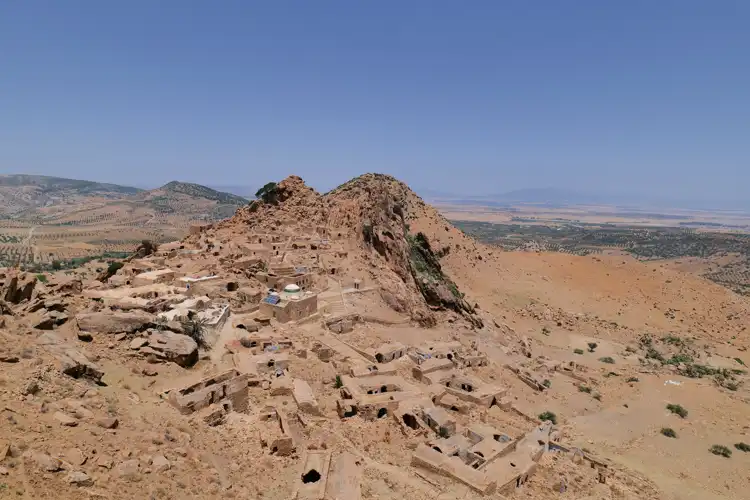
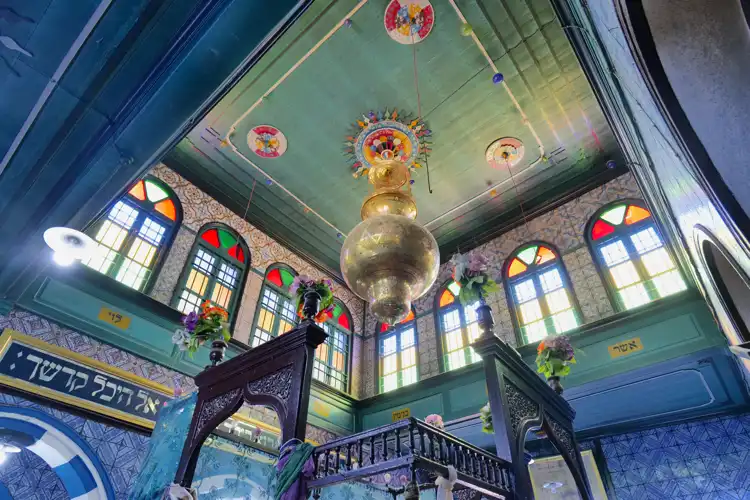
Base on Djerba for seafood, Guellala pottery, and the El Ghriba synagogue (crowded on festival days, quiet otherwise). Then chase the ksour and cave homes inland via louage; it works, but a rental car halves your day. Rooms are simple, cash rules, stars are free. Reward profile: architecture nerds and patient navigators who prefer tea with shepherds over poolside playlists.

Tozeur, Chott el Jerid & Mountain Oases

Long ride, big payoff. Tozeur’s brick medina is craftsmanship you can trace with a finger, while the salt pan at dawn makes your camera behave. Chebika–Tamerza get convoy traffic at noon; go late and let the cliffs quiet down. 4x4s are mandatory for sand tracks. Reward profile: early risers and light packers who negotiate camel prices without blushing.

Kairouan (interior hub)

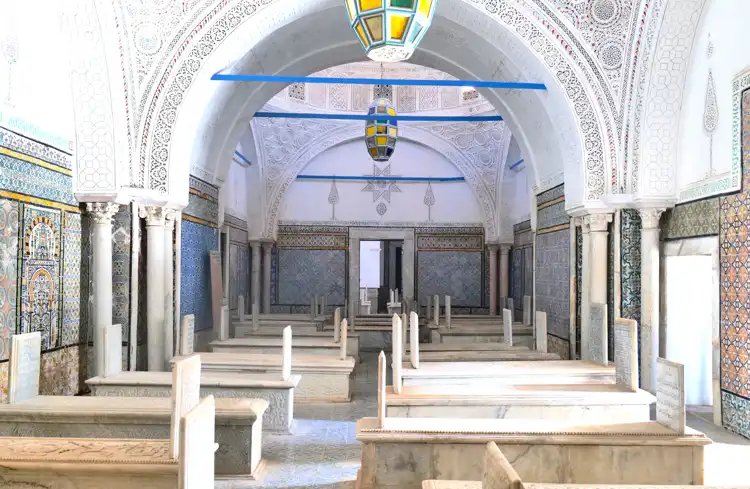
Come for the Great Mosque and stay for the silence before the tour buses. It’s conservative, shuts early, and rewards modest dress and morning starts. Carpet ateliers sell with charm and pressure; you can admire without buying. Louage links from Tunis and Sousse are painless. Reward profile: history-first travelers who like courtyards, calligraphy, and sleepy evenings.
Seeing the layout at a glance
Loading the map 🌍
CLICK TO FILTER
city
town
village
unique site
national park
hike
beach
attraction
festival
region
SHOW COUNTRY’S BESTSHOW ALL
film
0
0
0a
Bouhedma national parc
film
1
1
1a
El Feija
film
2
2
2a
Sidi Bou Said
film
3
3
3a
Carthage
film
4
4
4a
Tozeur
film
5
5
5a
Tataouine
film
6
6
6a
Tabarka
film
7
7
7a
Medina of Tunis
film
8
8
8a
Dougga, Thugga
film
9
9
9a
Chebika Oasis
film
10
10
10a
Bulla Regia
film
11
11
11a
Ez-Zitouna Mosque
film
12
12
12a
Ruins of Sufetula
film
13
13
13a
Kals’a Guermessa

Why go?Reasons people choose to visit

Low cost

Instagram sells blue doors; Tunisia sells relief to your budget. Louages whisk you across the country … read more 👉
Instagram sells blue doors; Tunisia sells relief to your budget. Louages whisk you across the country for coins, trains are modest, and set-menu lunches—brik, ojja, couscous—fill you for what a latte costs in Paris. Family-run guesthouses undercut resort towns; haggle with a smile. Alcohol is taxed and desert tours nudge the bill, but day to day you can cruise on roughly $25–35 per day without living like a monk. Skip Sidi Bou Said cafés if you’re counting. Eat where the workers eat, ride when the van is full, and let your wallet exhale.

People

You arrive expecting blue doors and tidy ruins; you get a chorus of “Marhba” and three different aunties … read more 👉
You arrive expecting blue doors and tidy ruins; you get a chorus of “Marhba” and three different aunties trying to feed you. Yes, you’ll be asked where you’re from a dozen times before lunch, and a taxi meter can suddenly “retire” unless you set the price first. But then the real stuff lands. Directions turn into an escort, with a detour for mint tea you didn’t order. Shopkeepers haggle like it’s theatre, then slip you an extra olive anyway. Strangers share oranges on the louage, joke about football, and insist you’re too skinny. It’s disarming, improvised, and very human.

Architecture

Come for the blue-and-white doors and the fantasy of having a Roman amphitheater to yourself. Reality: … read more 👉
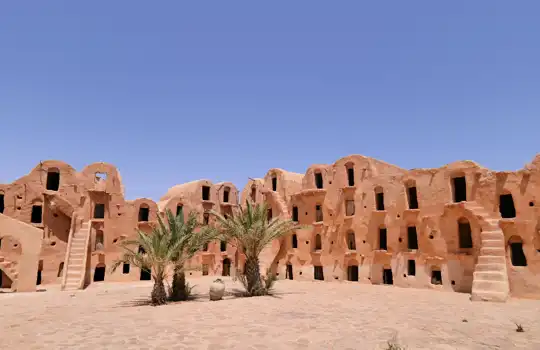
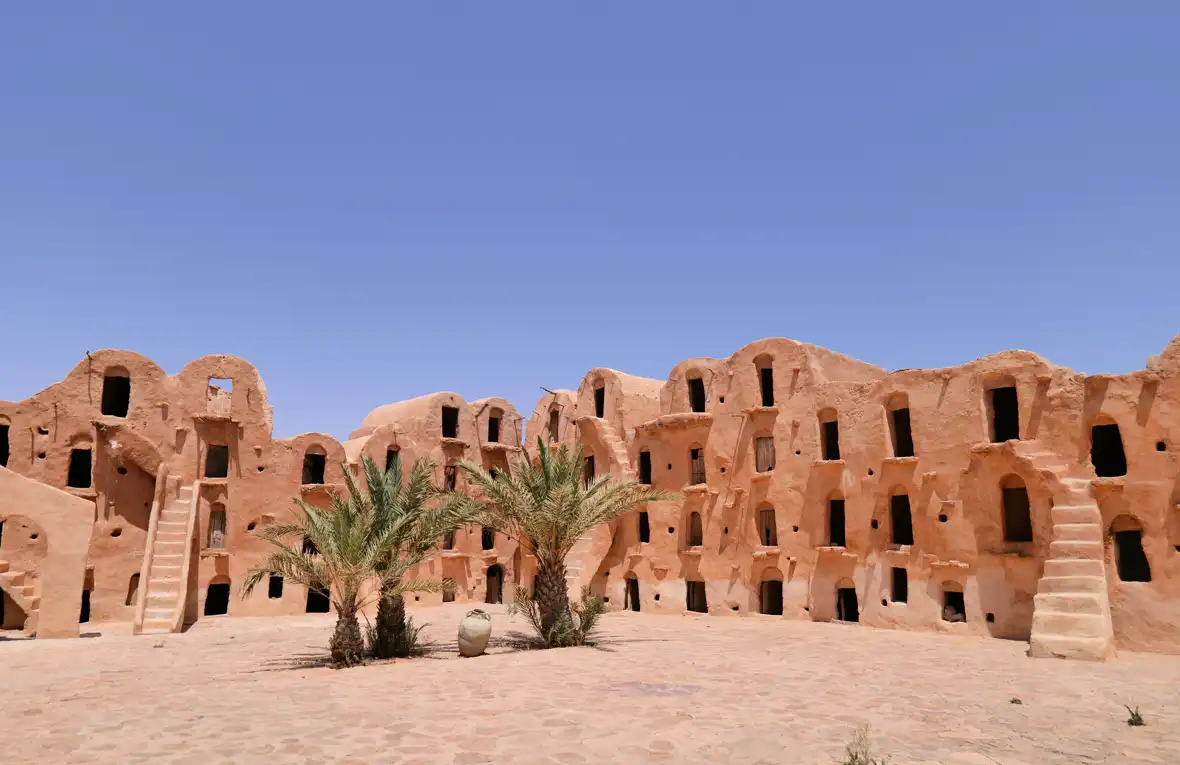
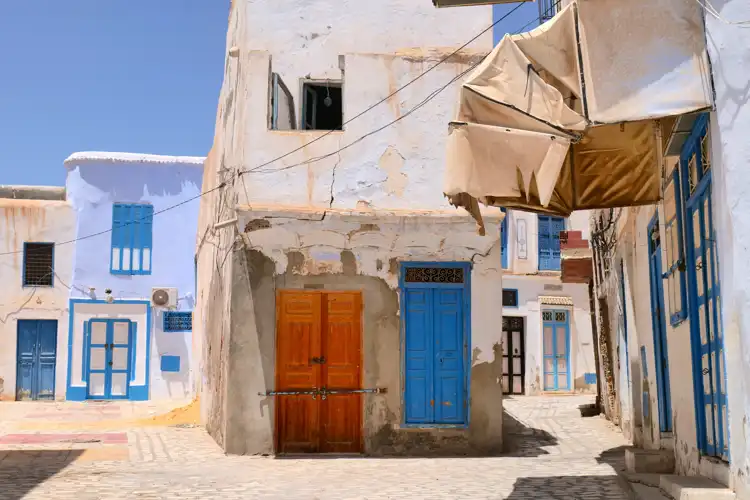
Come for the blue-and-white doors and the fantasy of having a Roman amphitheater to yourself. Reality: you’ll share El Jem with tour buses, and coffee in Sidi Bou Said is priced like coastal Spain. The payoff is elsewhere. Dougga drapes a hill of olive trees where the theater still carries birdsong. Kairouan’s Great Mosque turns noon light into geometry. I climb the ribats in Monastir and Sousse—stair-labyrinths that earn the sunset. In the south, ksour like Ouled Soltane stack grain like honeycomb, while dusty Matmata caves stay cool. Even Tunis throws in fearless concrete—the Hotel du Lac, a grounded starship.

Beach life

Come for the brochure breeze and pool floats; meet the real thing. Yes, August packs in package crowds, … read more 👉
Come for the brochure breeze and pool floats; meet the real thing. Yes, August packs in package crowds, loud jet skis, and sunbeds that “aren’t included” unless your wallet is. But Tunisia still wins on value next to Spain or Italy, and the payoff is off-peak and early. Dawn water is glass. Fishermen sell you sardines straight off the boat. Tea under tamarisk shade, then a lazy swim over rocky coves in Tabarka or long, warm shallows on Djerba and Kerkennah. Go May–June or September–October. Mornings before the wind. Watch for midsummer jellyfish. Then eat, nap, repeat.

Food

Come for the ruins and blue doors, stay for the food that stains your fingers red with harissa. Tunisia … read more 👉
Come for the ruins and blue doors, stay for the food that stains your fingers red with harissa. Tunisia isn’t curated; it’s fried, stewed, and grilled in alleys that smell like cumin. You’ll elbow through souks, get upsold on pottery, and pay rooftop-latte prices once, then the food pays you back: brik that shatters, fish couscous on the coast, lablabi that rescues cold mornings, smoky mechouia, octopus on Kerkennah, fricassé sandwiches. I chase mint tea with pine nuts and dates from Tozeur, then a market lunch that costs less than a Paris coffee. The reward lives in the bite.
Want the complete picture of Tunisia?
The offline Travel Guide brings everything together — routes, highlights & planning.

See what's included in the guide 👉

Get the Travel Guide -

⭐ HighlightsKey places and experiences

  • Tunis Medina: The maze is real, and yes, the “handmade” magnets look suspiciously similar from stall to stall. Coffee on the main drag costs triple what you’ll pay two alleys over, and you’ll earn the discount with your feet. The reward is the sound of brass hammers pinging off stone and the cumin-leather-air that clings to your clothes; stand by Zitouna’s courtyard and hear the call ricochet through wood-latticed balconies.
  • El Jem Amphitheatre: Midday, tour buses disgorge matching caps and selfie sticks; early morning, it’s just you and the doves. The arches are colossal, and entry is a fraction of Rome’s for the same gladiator-daydream effect. Slide a palm along the cool, pitted blocks in the shade and taste fine dust in the back of your throat—proof you took the cheap seats beneath history.
  • Dougga: Carthage gets the name recognition; Dougga gets the silence. It sprawls over a hill of olives and weeds, with a theater where a whisper carries. There’s little shade and less signage; bring
read more 👉
  • Tunis Medina: The maze is real, and yes, the “handmade” magnets look suspiciously similar from stall to stall. Coffee on the main drag costs triple what you’ll pay two alleys over, and you’ll earn the discount with your feet. The reward is the sound of brass hammers pinging off stone and the cumin-leather-air that clings to your clothes; stand by Zitouna’s courtyard and hear the call ricochet through wood-latticed balconies.
  • El Jem Amphitheatre: Midday, tour buses disgorge matching caps and selfie sticks; early morning, it’s just you and the doves. The arches are colossal, and entry is a fraction of Rome’s for the same gladiator-daydream effect. Slide a palm along the cool, pitted blocks in the shade and taste fine dust in the back of your throat—proof you took the cheap seats beneath history.
  • Dougga: Carthage gets the name recognition; Dougga gets the silence. It sprawls over a hill of olives and weeds, with a theater where a whisper carries. There’s little shade and less signage; bring water, ignore the grasshoppers vaulting at your shins, and let the wind shove the centuries in your ears while the limestone warms the soles of your shoes.
  • Kairouan’s Great Mosque: More pilgrimage than photo op, and the dress code isn’t a suggestion. The courtyard swallows footsteps, and when the muezzin starts, the city seems to pause mid-bargain. Skip the carpet hard sell by eating your way out: bite into a sticky, sesame-flecked makroudh and feel honey glue your fingers as the heat folds over the arcades.
  • Tozeur Oasis and Ong Jmel: Instagram swears it’s just you and the dunes; reality is a convoy of 4x4s and negotiated rates that shrink the moment you fill the back seat. Still—walk ten minutes past the tire tracks and the air goes thick with silence; break a date open and the sugar leaks onto your tongue while the wind combs the palms. If you want off the map: Kerkennah Islands’ slow ferries, Bulla Regia’s underground villas, and Cap Serrat’s wild headland deliver the quiet you were promised.
Spotted a mistake or missing a highlight? Contact us.

But Tunisia offers more...

Discover and compare all of its highlights per category

🧭 RoutesHow travelers typically move through the country

The 5-Day Northern Classics Route

The Vibe: A compact hit of Tunisia’s capital and coastal history, perfect if you want deep culture and easy logistics without long drives or desert heat. You’ll base yourself around Tunis and the northern shoreline, trading big distances for dense experiences.
The Highlights:
  • Getting lost in the alleyways and rooftop views of the Medina of Tunis.
  • Tracing ancient power at Carthage’s ruins and museum above the sea.
  • Café-hopping and strolling the clifftop lanes of Sidi Bou Said.
  • Unwinding with Mediterranean sunsets along the Cap Bon coast.
  • The 10-Day Coast-to-Desert Explorer

    The Vibe: A balanced loop that starts in the capital, rolls down the coast, then pushes inland for your first real taste of oases and salt flats. It’s ideal if you want variety—cities, ruins, beaches, and desert—without turning every day into a transfer day.
    The Highlights:
  • Three unhurried days soaking up Tunis, the medina, and Carthage.
  • Coastal time in Sousse and Monastir, mixing beaches with fortress
read more 👉

The 5-Day Northern Classics Route

The Vibe: A compact hit of Tunisia’s capital and coastal history, perfect if you want deep culture and easy logistics without long drives or desert heat. You’ll base yourself around Tunis and the northern shoreline, trading big distances for dense experiences.
The Highlights:
  • Getting lost in the alleyways and rooftop views of the Medina of Tunis.
  • Tracing ancient power at Carthage’s ruins and museum above the sea.
  • Café-hopping and strolling the clifftop lanes of Sidi Bou Said.
  • Unwinding with Mediterranean sunsets along the Cap Bon coast.
  • The 10-Day Coast-to-Desert Explorer

    The Vibe: A balanced loop that starts in the capital, rolls down the coast, then pushes inland for your first real taste of oases and salt flats. It’s ideal if you want variety—cities, ruins, beaches, and desert—without turning every day into a transfer day.
    The Highlights:
  • Three unhurried days soaking up Tunis, the medina, and Carthage.
  • Coastal time in Sousse and Monastir, mixing beaches with fortress walls.
  • Standing inside the colossal Roman amphitheatre of El Jem.
  • Day trips from Tozeur to palm oases and the shimmering Chott el Jerid.
  • The 15-Day Grand Tunisia Circuit

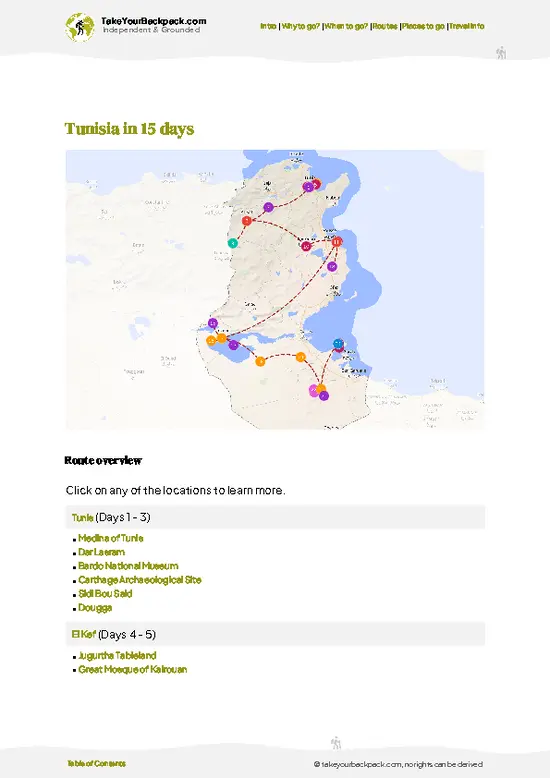
    The Vibe: A full-country adventure that strings together capital culture, Cap Bon beaches, central-coast history, high plateaus, and desert oases into one long, satisfying arc. It’s for travelers who want to go beyond the highlights and feel the regional shifts in landscape, food, and rhythm.
    The Highlights:
  • Deep dives into Tunis, the Bardo Museum, the medina, and Carthage.
  • Slow days on Hammamet, Sousse, and Mahdia’s beaches between historic sites.
  • Exploring Kairouan’s sacred architecture and the dramatic Jugurtha Tableland.
  • Ending among the palm groves of Tozeur, with side trips to Chebika Oasis and Chott el Jerid.
🌍 Want a ready-to-use travel plan for Tunisia?
The overview above compares different route options based on your travel time and style. The complete Travel Guide breaks each itinerary down in detail, including maps, stops, highlights, and transport information.

Explore all route details 👉

Get the Travel Guide -

🌤️ When to go?Best time to visit Tunisia

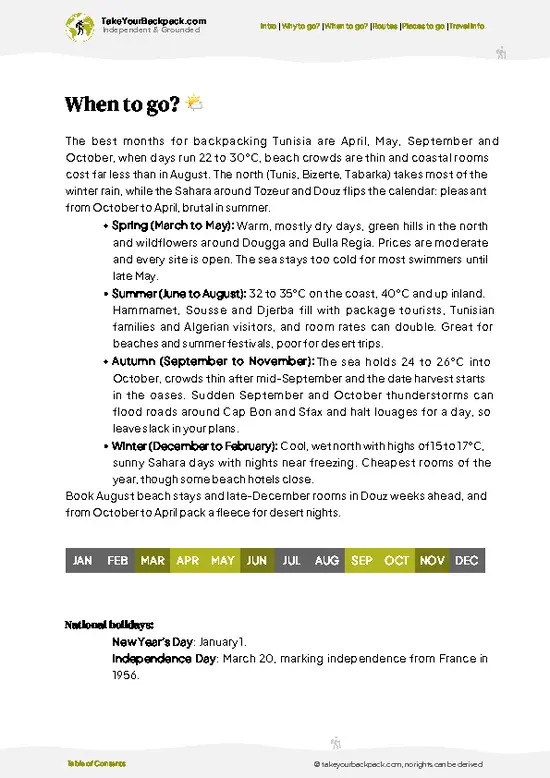
The sweet spot for Tunisia backpacking is mid-April to late May and late September to late October. Spring gives you green hills and Roman ruins without the school-holiday stampede; autumn hands you a still-warm sea and a Sahara you can actually walk in after breakfast. Prices ease back from summer’s package-tour surge, but buses, louages, and museums still run on full rhythm. Up north, rains haven’t started bullying the backroads; down south, nights are cool enough for a blanket, not a parka. You trade a few capricious winds and shorter daylight for room to breathe in medinas, saner hostel rates, and guides with time to talk.
  • Peak Heat (Jul-Aug): Expect sticker shock on the coast and elbows at the louage rank; sunrise swims in glassy water and late-night promenades are the payoff. Inland, midday feels like opening an oven—start at dawn, siesta hard, move again at sunset.
  • Shoulder Shift (Apr-May & Sep-Oct): Markets spill pomegranates and herbs, cafés drag chairs into the sun, and guides drift back to ksar trails. Trains and louages run often, beaches have space, and ruins like Dougga echo again. Spring’s wildcard is the sandy ghibli: a hot wind that smears the sky and can stall desert tracks for a day—pack a buff and wait it out.
  • Winter Lull (Nov-Mar): The interior goes quiet in the best way—oases hum, dunes whisper, and you get entire ksour to yourself. Coastal rain can snarl roads; some beach hotels hibernate; evening louages thin out. Survival hack: sleep in merino, chase the sun at midday, and accept that tea is a heat source.

Tactical tip: For the shoulder months, reserve desert 4x4/camp spots two weeks ahead and pack one item that punches above its weight—a light buff—for wind, sun, and impromptu mosque-appropriate face coverage.

source: climatestotravel.comJANJanuary: fair for travelingFEBFebruary: fair for travelingMARMarch: good for travelingAPRApril: excellent for travelingMAYMay: excellent for travelingJUNJune: good for travelingJULJuly: fair for travelingAUGAugust: fair for travelingSEPSeptember: excellent for travelingOCTOctober: excellent for travelingNOVNovember: good for travelingDECDecember: fair for traveling
📅 Traveling in a specific month?
Get a full month-by-month breakdown of weather, crowds, costs, festivals, and seasonal highlights in the complete travel guide.

Get full details when to go 👉

Get the Travel Guide -
!P1095043

💰 Costs (as of 2025)How expensive it really is

Expect 90-140 TND ($28-45) per day if you keep it lean; cheaper than Morocco for food and transport, but limited hostels and desert toys can spike the bill fast.
  • dorm accommodation: 25-45 TND in Tunis/Sousse/Djerba; 15-25 TND off-season or at state-run “Maisons des Jeunes.” Outside hubs, dorms thin—split a double for 60-100 TND. System tip: the youth-hostel network often wants a cheap membership card; bring passport photos, cash, and show up early—beds aren’t always online and curfews are a thing.
  • meals: Supermarket Survival: baguette + tuna + harissa + olives + fruit runs 6-10 TND/day and will keep you moving. Street food reality: brik 3-5 TND, fricassé 2-3 TND, lablabi 4-6 TND, merguez sandwich 5-8 TND; a proper sit-down grill or fish plate is 18-35 TND. Coffee 1-2 TND, fresh juice 2-4 TND. Cheaper than Morocco’s tourist centers, roughly on par with Egypt; eat where it’s busy and you’ll be fine.
  • local transport: The louage (shared taxi) unlocks the country: regional hops 5-12 TND; Tunis-Sousse 12-16 TND, Sousse-Sfax 10-14 TND, Tunis-Tozeur 30-40 TND. Trains can be a dinar or two cheaper but slower/less frequent. City tram/bus rides 0.6-1.2 TND; taxis are cheap if metered—insist, or
read more 👉
Expect 90-140 TND ($28-45) per day if you keep it lean; cheaper than Morocco for food and transport, but limited hostels and desert toys can spike the bill fast.
  • dorm accommodation: 25-45 TND in Tunis/Sousse/Djerba; 15-25 TND off-season or at state-run “Maisons des Jeunes.” Outside hubs, dorms thin—split a double for 60-100 TND. System tip: the youth-hostel network often wants a cheap membership card; bring passport photos, cash, and show up early—beds aren’t always online and curfews are a thing.
  • meals: Supermarket Survival: baguette + tuna + harissa + olives + fruit runs 6-10 TND/day and will keep you moving. Street food reality: brik 3-5 TND, fricassé 2-3 TND, lablabi 4-6 TND, merguez sandwich 5-8 TND; a proper sit-down grill or fish plate is 18-35 TND. Coffee 1-2 TND, fresh juice 2-4 TND. Cheaper than Morocco’s tourist centers, roughly on par with Egypt; eat where it’s busy and you’ll be fine.
  • local transport: The louage (shared taxi) unlocks the country: regional hops 5-12 TND; Tunis-Sousse 12-16 TND, Sousse-Sfax 10-14 TND, Tunis-Tozeur 30-40 TND. Trains can be a dinar or two cheaper but slower/less frequent. City tram/bus rides 0.6-1.2 TND; taxis are cheap if metered—insist, or walk. Relative value: faster/cheaper than Morocco’s buses and less chaotic than Egypt’s microbuses. Pro move: buy the last empty seat so the car leaves now, not “whenever.”
  • activities: Museums/ruins are the bargain: Bardo, Carthage, El Jem tickets 10-20 TND each (combo tickets sometimes 12-30 TND). Local guide 40-80 TND per half-day; hammam 8-20 TND. Cost driver is the desert: 4x4 day runs 120-200 TND per person shared (350-600 TND per vehicle private); overnight in dunes with dinner 150-250 TND. Generally cheaper than Morocco’s Sahara packages and miles cheaper than Europe’s museum days.
  • miscellaneous: Budget leaks: SIM (10-20 GB) 15-25 TND; ATM fees 5-12 TND—withdraw in chunks; hotel bed tax 1-3 TND pppn; occasional photo fees 1-3 TND; 1.5L water 0.8-1.5 TND. Alcohol is the wallet trap: limited outlets, hotel bars charge ~6-8 TND for a local beer and far more for spirits—pricier and harder to find than in Morocco or Egypt. Cash culture is strong; many small stays don’t take cards. Sunscreen is weirdly expensive—pack it from home.
⚠️ Prices can change and everyone travels differently, so take this as a rough guide. Hope it helps you plan your adventure!

✈️ The backpacker research shortcutTunisia Travel Guide

An offline-friendly backpacking guide with optimized travel routes, ranked highlights, transport advice, and the best areas to stay.
example page 0 from our offline Travel Guide for Tunisiaexample page 1 from our offline Travel Guide for Tunisiaexample page 2 from our offline Travel Guide for Tunisiaexample page 3 from our offline Travel Guide for Tunisiaexample page 4 from our offline Travel Guide for Tunisiaexample page 5 from our offline Travel Guide for Tunisiaexample page 6 from our offline Travel Guide for Tunisiaexample page 7 from our offline Travel Guide for Tunisia
The digital guide (372 pages) contains:
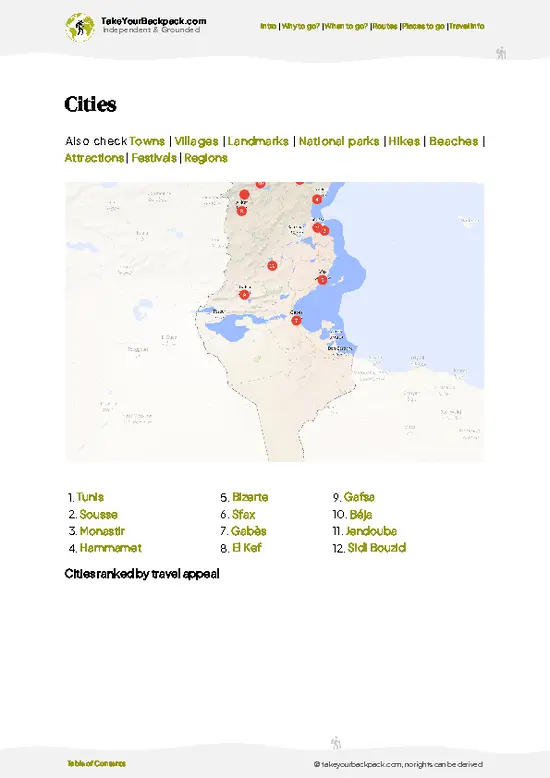
97 highlights, ranked by travel appeal
Optimized 5, 10 & 15-day travel routes
Cities, national parks, beaches, historical sites, ...
How to get around
Offline-friendly for travel without Wi-Fi
👉 Click to see all 30+ guide features

📅 Plan smarter in minutes, not weeks
Month by month travel advice
Festivals & national holidays
Budget expectations

🗺️ Go to the right places, skip the overrated ones
Honest pros & cons of destinations
Top hikes, parks & viewpoints
Lesser-known places most travelers miss
Clear “worth it vs skip it” guidance

🛏️ Travel smoothly without rookie mistakes
Best areas to stay
Transport systems explained simply
Common scams & safety advice
SIM cards, money & practical tips

🌍 Understand the country, not just visit it
Culture & traditions
52 Essential phrases & customs
Festivals worth planning around
Traveler-friendly historical context
Insights that make places more meaningful

📱 Built for real travel conditions
Fully downloadable PDF
Works completely offline
Optimized for phone use
Useful in remote areas & buses
Everything in one place
Save weeks of stressful planning
Get instant access to the full guide directly. 30-day money-back guarantee.


Sent to your inbox immediately after payment • 100% Secure Checkout
Best Backpacking Travel Advisor 2025 tourism awardBest Backpacking
Travel Advisor
2025
What others say about Take Your Backpack Guides:
⭐⭐⭐⭐⭐
Fantastic, amazing amount of information!
⭐⭐⭐⭐⭐
My goodness this is amazing, it's what I've been looking for hats off too you!
⭐⭐⭐⭐⭐
I think this is absolutely BRILLIANT
⭐⭐⭐⭐
Very complete and informative. It's still missing places, but I gotta to commend you
⭐⭐⭐⭐⭐
This is truly amazing, thank you, can't wait to explore it with my kids!
⭐⭐⭐⭐⭐
Awesome resource, thank you!
⭐⭐⭐⭐⭐
This is amazing! Can't wait to explore the ones I haven't seen
⭐⭐⭐⭐
I love this! Well done, great idea.
⭐⭐⭐⭐⭐
Thanks for taking the time to make this gem!
⭐⭐⭐⭐⭐
This might be the best website I've ever seen.
⭐⭐⭐⭐⭐
Congratulations, and thank you so much for your work; it's incredibly valuable.
⭐⭐⭐⭐
In all seriousness I think you did a great job pointing out the important spots
⭐⭐⭐⭐⭐
10/10 very good
⭐⭐⭐⭐⭐
As someone who's only just starting to visit regularly this is awesome, thank you.
⭐⭐⭐⭐
Thank you very much! I'm going to visit my dad, it's going to be very useful!
⭐⭐⭐⭐⭐
This is really cool! We'll be travelling for the first time and this definitely come in handy.
⭐⭐⭐⭐⭐
You are now our minister of culture, congratulations 👨‍💼
⭐⭐⭐⭐⭐
Just wanted to tell you that this is a pearl! Going to follow your recommendations.
⭐⭐⭐⭐⭐
This is so cool. I'll definitely be using the resource for my travels soon.
⭐⭐⭐⭐⭐
This is very impressive! Good work.
⭐⭐⭐⭐⭐
This is an amazing and informative site. Very well done!

🛏️ Where to stay?Best areas to base yourself

Yes — hostels and budget accommodation are widely available in Tunisia, concentrated in Tunis (Medina and Ville Nouvelle), Sousse (Medina and waterfront), Hammamet, Djerba, with smaller backpacker options in Tozeur and Kairouan.
Medina areas put you within historic highlights and cheap local food but expect narrow streets, basic rooms and limited nightlife; Ville Nouvelle and Sousse waterfront offer easier transport, more social hostels and livelier evenings at slightly higher rates; Hammamet and Djerba are quieter beach bases with seasonal service drops and fewer cheap beds outside high season. … read more 👉
Yes — hostels and budget accommodation are widely available in Tunisia, concentrated in Tunis (Medina and Ville Nouvelle), Sousse (Medina and waterfront), Hammamet, Djerba, with smaller backpacker options in Tozeur and Kairouan.
Medina areas put you within historic highlights and cheap local food but expect narrow streets, basic rooms and limited nightlife; Ville Nouvelle and Sousse waterfront offer easier transport, more social hostels and livelier evenings at slightly higher rates; Hammamet and Djerba are quieter beach bases with seasonal service drops and fewer cheap beds outside high season.
Budget places usually mean communal bathrooms, simple cleaning standards and crowded summer months, so book early in peak season, carry cash, and bring a light sleeping liner and mosquito protection to avoid common small-trip mistakes.

If you enjoy meeting fellow travelers, consider choosing hostels with high ratings for atmosphere. On the other hand, if you prefer having your own space, a hotel might be a better option.

🚌 Getting aroundPublic transport and other ways to get around

Tunisia runs on two clocks: the printed timetable and the driver’s gut. Trains more or less honor the first; everything else swears allegiance to the second. You can plan, but you also need instincts—like knowing that “ten minutes” means “after one more cigarette” and that the fastest route is the one with the fullest seats. Start early and the country hums; drift in at noon and you’ll watch shade, tea, and time embrace each other while you practice patience.
  • Louage shared minibuses The Efficiency
read more 👉
Tunisia runs on two clocks: the printed timetable and the driver’s gut. Trains more or less honor the first; everything else swears allegiance to the second. You can plan, but you also need instincts—like knowing that “ten minutes” means “after one more cigarette” and that the fastest route is the one with the fullest seats. Start early and the country hums; drift in at noon and you’ll watch shade, tea, and time embrace each other while you practice patience.
  • Louage shared minibuses The Efficiency Trade-off: this is the country’s bloodstream—fast, cheap, and only slightly indifferent to physics. They leave when full, so your “departure time” is a headcount. Price is usually a bit more than the train, speed is a lot more than the bus. Sit up front if you like seeing corners before you enter them. Pay the driver, hoist your pack low, and don’t expect AC to do anything but whisper. Show up early; by late afternoon, seats vanish and tempers warm.
  • SNCFT intercity trains The Budget Disruptor: along the Tunis-Sousse-Sfax-Gabès spine, second class slashes costs without turning your knees into folklore. You trade a little speed for certainty and a toilet that exists (bring paper). Tickets are bought at the window; conductors actually check them. The ride is steady, the views are olive and salt flats, and you roll into central stations instead of far-flung louage lots. Stitch the last leg by louage and you’ve hacked the “when-full” problem without paying taxi math.
  • Metro léger de Tunis and city buses The Social Fabric: lines here are more of a polite wedge. Let elders board first, give up your seat, and keep your backpack in front. Buy or validate a small paper ticket and keep it handy; inspectors appear like pop quizzes. Rush hour compresses everyone into a single shared breath, so hold the rail and your expectations. Drivers appreciate exact change and eye contact. If a bus door closes on your dignity, another bus is coming—probably bunched behind it.
  • Ferries to Kerkennah and Djerba The Geometric Unlock: water solves geometry better than road. Sfax-Kerkennah is ferry-or-nothing; Jorf-Ajim to Djerba cuts a long mainland loop into a short glide. Tickets are bought at docks; show up early for shade and a spot. Wind can pause sailings, and decks get slick with sea and work. It’s cheap, it’s direct, and it drops you where buses and trains can only point.

Master tip: Move like a spine-and-ribs diagram—train the coast at dawn, then louage inland—so you beat both the heat and the “leaves when full” lottery.
Distance: Tunis-Carthage Airport (TUN) is about 7 km (4.3 miles) from central Tunis (Medina/Place de Barcelone area).

Main public transport options
  • City bus (Transtu): Lines 35 (regular) and 635 (express) run between the airport and downtown (Place de Barcelone/central tram hub).
    • Time: 20-40 minutes depending on traffic.
    • Cost: about 1 TND (small change helps; pay onboard).
    • Frequency: roughly every 15-30 minutes in the day; service tapers in the evening.
    • Hours: approximately 06:00-21:00. After that, assume no buses.
    • Where to board: exit Arrivals and walk to the signed “Transtu” bus stop by the main road outside the terminal/parking.

    From Place de Barcelone you can hop on the Métro léger (tram) to other neighborhoods or walk 10-15 minutes to the Medina/Tunis Ville station.

Taxi options
  • Metered yellow taxi: 15-25 minutes to the center in light traffic.
    • Cost: typically 10-20 TND by day; 15-25 TND at night/holidays (includes small airport pickup and night surcharges).
    • Tips: insist on the meter (compteur); if the driver won’t use it, take another cab. Have some cash—cards are rarely accepted.


Notes
  • Traffic around rush hour can double the times above.
  • There’s no direct tram/train from the terminal; the bus is the only public transport link from the airport itself.
⚠️ Prices and routes can change, so take this as a rough guide and ask for local advice when you arrive.

🔒 Safety (risk Level: medium)Safety considerations for travelers

Safety for solo travelers, including women and LGBTQ+ individuals
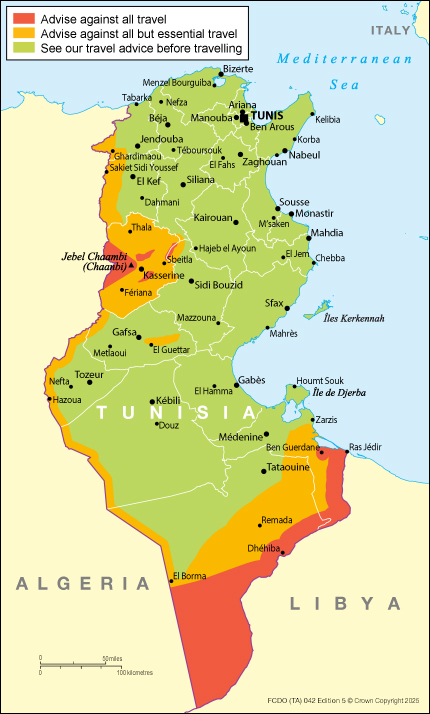
Tunisia is generally safe for solo travelers, but it’s wise to stay cautious, especially in crowded areas and at night. Women should dress modestly to respect local customs, and consider being cautious when traveling alone after dark. LGBTQ+ travelers may face societal challenges, so discretion is advised, particularly outside major cities. Always stay updated on local news and follow travel advisories for the latest safety information.


Full official government travel advisory (live updates)
View details 👉
safety image

source: www.gov.uk

✈️ VisaVisa requirements for Tunisia

Citizens of many countries, including the EU, US, and Canada, can enter Tunisia visa-free for up to 90 days. If you need a visa, apply through the Tunisian embassy or consulate in your home country. Check the official government website for the latest requirements, as they can change.
⚠️ Visa requirements can change over time, so always check the latest visa requirements with the official embassy or government website before you travel.

🎒 What to pack?What to pack for Tunisia

Tunisia’s got it all—beaches, deserts, and some cooler spots up in the mountains. The weather can be blazing hot in the summer, especially in the Sahara, so think lightweight and breathable clothes. However, it can get chilly at night in the desert or in higher altitudes, so pack layers. Tunisia leans conservative, so aim for modest clothing, especially if you’re heading to smaller towns or religious sites—ladies, a scarf can be super handy. Cities like Tunis are more relaxed, but it’s always good to be respectful of local norms.

Apart from this country specific advice, I have also crafted a general packing list that should help on any trip. authorOver the years, I've learned the importance of packing minimally. It's so much easier to jump on the back of a truck or squeeze yourself into the last spot of a minibus without that supersized backpack. If you're headed to a warm destination, leave your winter jacket at home; for colder regions, opt for thin thermal underlayers. Instead of packing your entire wardrobe, bring just three sets of clothes, as laundry facilities are available everywhere.
View the full list 👉
🎒 Planning the practical side of your trip?
Get detailed information on transport, daily budgets, internet access, local customs, food, language, and other essentials in the complete Travel Guide.

Get detailed practical information 👉

Get the Travel Guide -

🙋 FAQThings travelers often ask

Trip Planning


Personal tip: I normally search on good rating for atmosphere (for meeting people) and location (for easy exploring). Cleanliness as a bonus.


Travel Essentials

Routine vaccines like measles-mumps-rubella (MMR), diphtheria-tetanus-pertussis, varicella (chickenpox), polio, and your yearly flu shot are recommended for Tunisia. Consider vaccines for hepatitis A and B, typhoid, and rabies if you plan extended stays in rural areas or have specific exposure risks. Always consult a healthcare provider for personalized advice.


vaccination requirements
When I first started traveling, I often spent part of my first day in a new country hunting for a local SIM card. While this can still be slightly cheaper, it also takes time and planning.

These days, it's much simpler to install an eSIM before leaving home. Once you arrive in Tunisia, you can activate it immediately and have mobile data from the moment you land — which is especially useful for ordering transport or navigating away from busy airports.

There are many providers nowadays, and price differences are usually small. I personally go with Airalo, as it offers excellent network coverage throughout the country and strong global coverage, so you can manage multiple countries from a single app.


Get your e-sim for Tunisia

Culture & Customs

Dress modestly, especially in rural areas. Women should cover shoulders and knees. When greeting, a handshake is common but wait for a woman to extend her hand first. Avoid discussing politics or religion unless invited. Tipping is appreciated in restaurants and taxis; around 10% is customary.

Public displays of affection are frowned upon. LGBTQ+ travelers should be discreet, as homosexuality is illegal. Women may experience unwanted attention; traveling in groups or with a male companion can help alleviate this. Always ask permission before photographing people, especially in rural areas.
Trying traditional food is always a great way to experience the culture. Here are some must-try dishes for Tunisia.
  • Couscous: Often dubbed the national dish, this steamed semolina is typically served with a hearty stew of meat (usually lamb or chicken) and vegetables. It’s a staple at family gatherings and celebrations, reflecting its cultural significance.
  • Brik: A popular street food, brik is a thin pastry filled with egg, tuna, or minced meat, then deep-fried to crispy perfection. It’s a must-try for its satisfying crunch and the surprise of a runny egg yolk.
  • Lablabi: A spicy chickpea soup traditionally eaten for breakfast, especially in winter. Topped with harissa, lemon, and sometimes a poached egg, it’s a comfort food that’s both budget-friendly and filling.
  • Harissa: Though technically a condiment, this spicy chili paste is central to Tunisian cuisine. It’s served with almost everything, from grilled meats to bread, adding a fiery kick that locals love.
  • Tajine: Unlike the Moroccan version, Tunisian tajine is more like a frittata or quiche, made with eggs, meat, and cheese. It’s a versatile dish that showcases the creative use of spices and ingredients.
Tap water in Tunisia is generally safe for locals, but tourists are often advised to stick to bottled or filtered water to avoid any issues. While it’s treated, the mineral content and different bacteria might upset sensitive stomachs. Better safe than sorry, so grab a bottle if you’re unsure.
The main language in Tunisia is Arabic. Backpacking is way more rewarding if you know a bit of the local language, so I'd suggest brushing up on the basics just in case your Arabic skills have become a bit rusty.

Want to understand locals better?
The complete Travel Guide for Tunisia includes 52 essential words and phrases — greetings, thank-yous, ordering food, transport, numbers, and common local expressions you'll actually hear.

Get your local basic phrases 👉

Get the Travel Guide -


In Tunisia, English is not the primary language, but it is increasingly spoken, especially in tourist areas, hotels, and restaurants. Many young Tunisians, particularly those in urban centers like Tunis, are proficient in English due to education and exposure to global media. However, outside major cities and tourist hotspots, English speakers may be less common, and French often serves as a more widely understood second language due to Tunisia’s colonial history.

Travelers may encounter varying levels of English proficiency, with younger generations generally more fluent. In rural areas, communication might be more challenging, and basic French or Arabic phrases can be beneficial. Learning a few phrases in Arabic or French can enhance the travel experience and foster positive interactions with locals. Overall, while you can get by with English in many places, being prepared for limited proficiency in certain areas will help ensure a smoother journey.

Money & Payments

The local currency of Tunisia is TND (د.ت).

When backpacking in Tunisia, it’s a good idea to keep a mix of cash and cards. ATMs are common in urban areas, but not so much in rural spots, so always carry some cash for those less-connected regions. Tunisian Dinar is the local currency, and you’ll need it for most transactions, as USD and EUR aren’t widely accepted for payments.

ATMs: They’re available in cities and popular tourist areas. Stick to ATMs attached to banks to avoid any sketchy fees or security risks.

Cash: Always handy, especially for smaller markets, local eateries, and public transport. Keep smaller bills, as breaking larger ones can be tricky.

Cards: Credit and debit cards are accepted in larger hotels, restaurants, and shops, but don’t count on it everywhere. Visa and Mastercard are your best bet.

Currency Exchange: Exchange your money at banks or official exchange offices for the best rates. Hotels and airports often offer poor rates, so avoid them if you can.

Having a combo of cards and cash will keep you flexible and ready for anything Tunisia throws your way!

Tipping in Tunisia is appreciated but not mandatory. In restaurants, leaving around 10% of the bill is customary if service is good. For smaller services like taxi rides or hotel porters, rounding up or giving a small tip is a nice gesture.

🧩 Nearby countriesNearby backpacking alternatives

📸 PhotosWhat it looks like on the ground

Take your backpack - Tunisia - 0
Take your backpack - Tunisia - 1
Take your backpack - Tunisia - 2
Take your backpack - Tunisia - 3
Take your backpack - Tunisia - 4
Take your backpack - Tunisia - 5
Take your backpack - Tunisia - 6
Take your backpack - Tunisia - 7
Take your backpack - Tunisia - 8
Take your backpack - Tunisia - 9
Take your backpack - Tunisia - 10
Take your backpack - Tunisia - 11
Take your backpack - Tunisia - 12
Take your backpack - Tunisia - 13
Take your backpack - Tunisia - 14
Take your backpack - Tunisia - 15
Take your backpack - Tunisia - 16
Take your backpack - Tunisia - 17
Take your backpack - Tunisia - 18
Take your backpack - Tunisia - 19
Take your backpack - Tunisia - 20
Take your backpack - Tunisia - 21
Take your backpack - Tunisia - 22
Take your backpack - Tunisia - 23
Take your backpack - Tunisia - 24
Take your backpack - Tunisia - 25
Take your backpack - Tunisia - 26
Take your backpack - Tunisia - 27
Take your backpack - Tunisia - 28
Take your backpack - Tunisia - 29
Take your backpack - Tunisia - 30
Take your backpack - Tunisia - 31
Photographed by: Johan Kruseman

We 💚 feedbackIs Tunisia worth visiting?

Go for the density of real, touchable history and desert edges: Roman Africa you can wander without ropes, then date palms and salt flats a couple rides away—and your wallet survives. The drawback is getting between them isn’t slick—the louage leaves when full, trains nap mid-route, and the national timetable is a vibe, not a schedule. One lingering worry: safety. Tunisia isn’t the chaos headline; it’s mostly calm, police are obvious, and the hassle factor is mild—firm politeness goes far.

✍️ Help improve this page!
The information on this page is based on in-depth research, insights shared by experienced travelers, and feedback from the local travel community in Tunisia. While every effort is made to keep the information accurate and current, conditions can change — so if you spot anything incorrect or outdated, please get in touch.


🙋‍♂️ Give feedback

👋 Meet the founderWho’s Behind Take Your Backpack?

Johan, backpacker and founder of TakeYourBackpackHi, I’m Johan (Netherlands 🇳🇱), the creator of TakeYourBackpack. Over the past decade, I’ve backpacked through 80+ countries across six continents, gaining extensive experience with independent travel, long-term trips, and overland routes.

This site is built on a combination of firsthand travel experience and carefully curated insights from other backpackers. Many guides are based on places I’ve personally visited, while others bring together tips, observations, and practical advice shared by trusted travelers I’ve met along the way.

The goal is to provide realistic, experience-driven guidance — not generic itineraries — so you can explore destinations with better context, clearer expectations, and more confidence.

Get full Tunisia guide •
Instant download • 97 highlights • Full Offline guide