Trip Planning
The TakeYourBackpack guidebooks are your all-in-one travel companion, featuring the best cities, national parks, hikes, beaches, and unique sites, along with essential tips on when to go, how to get around, exchanging money, and even local phrases to get you started — everything you need for a smooth, unforgettable backpacking adventure.
Stop researching. Start exploring.Discover all 80 highlights,ranked
and organized into practical routes.
Get instant access
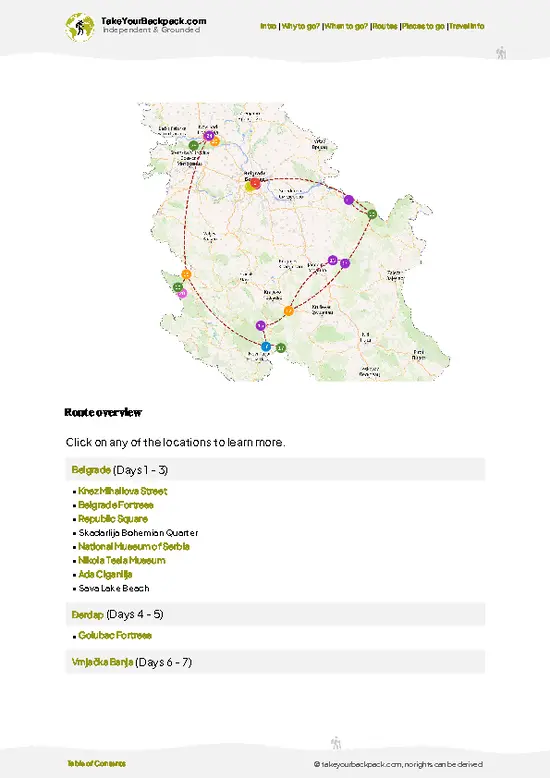
Planning a backpacking route through Serbia can be tricky — you need to balance must-see places, travel times, budget, and how long to stay in each destination. Our personalized Serbia itinerary planner creates a route based on your travel style, trip duration, and interests, so you can spend less time researching and more time exploring.
Personal tip: I normally search on good rating for atmosphere (for meeting people) and location (for easy exploring). Cleanliness as a bonus.
Travel Essentials
Routine vaccinations are generally sufficient for Serbia:
- **MMR (Measles, Mumps, Rubella)**
- **Diphtheria-Tetanus-Pertussis**
- **Varicella (Chickenpox)**
- **Polio**
- **Annual flu shot**
Consider **Hepatitis A** for contaminated food/water risks.
**Hepatitis B** is wise if you plan close contact with locals or healthcare services.
**Rabies** is optional, but a good idea if interacting with animals.
Consult a healthcare provider for personalized advice.
vaccination requirementsWhen I first started traveling, I often spent part of my first day in a new country hunting for a local SIM card. While this can still be slightly cheaper, it also takes time and planning.
These days, it's much simpler to install an eSIM before leaving home. Once you arrive in Serbia, you can activate it immediately and have mobile data from the moment you land — which is especially useful for ordering transport or navigating away from busy airports.
There are many providers nowadays, and price differences are usually small. I personally go with
Holafly, as it offers excellent network coverage throughout the country and strong global coverage, so you can manage multiple countries from a single app.
HolaFly eSimCulture & Customs
Respect is key in Serbia. Always greet with a firm handshake, eye contact, and a smile. Offer a small gift like wine or chocolates when visiting someone’s home. Dress modestly, especially in religious sites.
Do: Appreciate their food and try to learn a few basic Serbian phrases. Accept drinks if offered; saying ”cheers” (živeli) is a nice touch.
Don’t: Discuss politics or the Yugoslav Wars unless you know the person well. Avoid showing impatience; things can be leisurely.
LGBTQ+ travelers should be discreet in rural areas as attitudes can be conservative. Women travelers should feel generally safe but might encounter occasional unwanted attention; stay assertive and move on.
Trying traditional food is always a great way to experience the culture. Here are some must-try dishes for Serbia.
- Ćevapi: These are small, grilled minced meat sausages, usually served in a flatbread with chopped onions. A staple at any Serbian barbecue, they reflect the country’s love for hearty, meat-based dishes.
- Sarma: Cabbage leaves stuffed with minced meat and rice, simmered for hours. This dish is a cornerstone of Serbian comfort food, often appearing at family gatherings and festive occasions.
- Pljeskavica: A large, seasoned meat patty, often compared to a burger but packed with spices and flavor. It’s a popular street food and a must-try for meat lovers exploring Serbian cuisine.
- Ajvar: A spicy pepper and eggplant relish, often used as a condiment or spread. It’s beloved for its smoky flavor and its role in adding a kick to many dishes, embodying the rich agricultural roots of Serbia.
- Karađorđeva šnicla: A rolled steak filled with kajmak (a creamy dairy product) and then breaded and fried. Named after a Serbian prince, it’s a decadent dish representing the indulgent side of Serbian cuisine.
Tap water in Serbia is generally safe to drink, and locals consume it regularly. However, if you have a sensitive stomach or prefer to be cautious, bottled or filtered water is advisable, especially in rural areas. Always check local advice as quality can vary by region.
The main language in Serbia is
Serbian. Backpacking is way more rewarding if you know a bit of the local language, so I'd suggest brushing up on the basics just in case your Serbian skills have become a bit rusty.
Want to understand locals better?The complete Travel Guide for Serbia includes 52 essential words and phrases — greetings, thank-yous, ordering food, transport, numbers, and common local expressions you'll actually hear.
Get your local basic phrases 👉
Get the Travel Guide - In Serbia,
English proficiency varies by region and demographic. In urban areas like Belgrade and Novi Sad, many younger people, especially those in the hospitality and tourism sectors, speak English quite well. English is taught in schools, and the younger generation often uses it in social media and popular culture, leading to a generally positive attitude toward the language.
However, in rural areas, English speakers are less common, and communication may be more challenging. In these regions, older generations are less likely to speak English, as they may have learned Russian or other languages during the former Yugoslavia.
Overall, tourists can expect to find English speakers in major cities and tourist spots, while those venturing into less populated areas may benefit from learning a few basic Serbian phrases. Using translation apps can also help bridge the language gap.
Money & Payments
The local currency of Serbia is RSD (дин).
ATMs: You’ll find ATMs almost everywhere in Serbia, even in smaller towns. They usually accept major international cards. Stick to those attached to banks to avoid crazy fees.
Cash: Always have some Serbian dinars on you for small purchases and places that don’t accept cards. Cash is still king in rural areas and smaller shops.
Dollars/Euros: Don’t bother carrying USD or EUR for spending. They’re not accepted for transactions, but you can exchange them at banks or exchange offices (menjačnica), which are widely available and usually offer decent rates.
Card Acceptance: Cards are accepted in most urban areas, especially in Belgrade and Novi Sad. Restaurants, cafes, and larger shops are card-friendly, but always ask first.
Exchanging Money: Avoid airport exchange counters due to bad rates. Walk a few blocks into town and use local exchange offices or banks for better deals. Keep an eye out for places without commission fees.
In Serbia, tipping is appreciated but not obligatory. Typically, leaving a 10% tip in restaurants and cafés is a good practice if the service was satisfactory. Cab drivers and hotel staff might also expect a small tip for good service, but rounding up fares or leaving a few extra dinars is usually sufficient.
v2.webp)


 Best Backpacking
.jpg) Over the years, I've learned the importance of packing minimally. It's so much easier to jump on the back of a truck or squeeze yourself into the last spot of a minibus without that supersized backpack. If you're headed to a warm destination, leave your winter jacket at home; for colder regions, opt for thin thermal underlayers. Instead of packing your entire wardrobe, bring just three sets of clothes, as laundry facilities are available everywhere.
Over the years, I've learned the importance of packing minimally. It's so much easier to jump on the back of a truck or squeeze yourself into the last spot of a minibus without that supersized backpack. If you're headed to a warm destination, leave your winter jacket at home; for colder regions, opt for thin thermal underlayers. Instead of packing your entire wardrobe, bring just three sets of clothes, as laundry facilities are available everywhere.

.jpg) Hi, I’m Johan (Netherlands 🇳🇱), the creator of TakeYourBackpack. Over the past decade, I’ve backpacked through 80+ countries across six continents, gaining extensive experience with independent travel, long-term trips, and overland routes.
Hi, I’m Johan (Netherlands 🇳🇱), the creator of TakeYourBackpack. Over the past decade, I’ve backpacked through 80+ countries across six continents, gaining extensive experience with independent travel, long-term trips, and overland routes.