×
Sierra Leone 🇸🇱

backpacking Africa Sierra Leone 🇸🇱Move between wide beaches and forest roads.

Explore SeychellesExplore Somalia

Backpacking Sierra Leone in 2026

A complete guide including when and where to go, costs, transport, itineraries, and practical travel advice.
What a trip here is really like

Backpacking Sierra Leone
By Johan Kruseman 🇳🇱 | Updated May 31, 2026

Three truths on landing: the heat is honest, transport runs on patience, and cash plus goodwill beat rigid plans. Sea air hangs thick, roads bend through hills and checkpoints, and the lights cut out without apology. Relax into the rhythm and the country answers with quick laughs and real welcome.

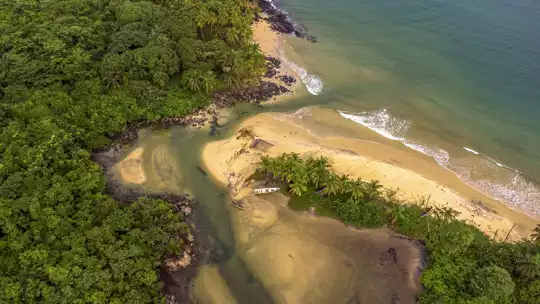
From the surfy crescents of Bureh and River No. 2 to the forested folds above Freetown where chimps call at Tacugama, Sierra Leone rewards sweat with salt and birdsong. You skim the estuary by boat, spray on your lips, then drift through palms to the Banana Islands and Bunce Island’s wind-worn fort. Markets haze with charcoal smoke and pepper soup; you drink sweet attaya or a cold Star in the shade. Rains can turn laterite to mush, mosquitoes nag, and poda-podas leave when full—but that friction sharpens the prize: the first ocean rinse after a dusty ride, drums kicking up after dark, sunrise pouring gold across a beach you earned.

Between Guinea’s highlands and Liberia’s surf, Sierra Leone blends both. For patient, curious travelers.

Freetown + the Peninsula Beaches

Land at Lungi, then skip the long road and take the water taxi to Aberdeen—spray in your face, 30–45 minutes when the swell is kind. Freetown climbs hard; traffic jams bake by mid-afternoon. Slide south along the peninsula for relief: Tacugama’s shaded trails, Bureh’s friendly surf, River No. 2’s glassy shallows. Nights are smoky grills and generators humming, a cold Star in your hand. Rewards social travelers and first-timers who want beaches without dropping off the map.

Banana Islands (off Kent)

You rattle to Kent by shared taxi, then a wooden skiff takes you 30–45 minutes over chop. Cash only. Patchy signal. Bucket showers and kerosene light after the generator cuts. Fishermen mend nets; the beach smells of woodsmoke and salt. Snorkel over coral patches and old anchors, eat grilled lobster, watch the water spark on black nights. Suits slow-time people who like hammocks and early tides.

Tiwai Island (Moa River)

From Bo or Kenema the laterite road shakes you for hours, then a dugout canoe slides you into deep green. Huts are basic; solar throws a dim pool of light. Dawn explodes with monkey calls; dusk belongs to the river. Pygmy hippos are long odds, but the forest gets under your skin. Best for patient wildlife listeners who don’t mind sweat and silence.

Kabala + Mount Bintumani (Loma Mountains)

Red-dust roads to Kabala, then 4x4s grind to villages like Sinekoro. The trek is two or three days of steep pasture, slick clay, and cold stream crossings. Nights bite; you cook on coals and sleep light. Sunrise washes the savanna and the ridge lifts out of the haze. Rewards hikers who like earning views and don’t need trail signs.

Outamba-Kilimi National Park (Northwest)

A dry-season push from Kamakwie on rough track puts you in a quiet mosaic of river and woodland. You walk elephant paths, read dung like a map, and paddle slow blackwater in a dugout. Camps are simple, stars are loud, and palm wine finds you anyway. For bush-camp lovers who prefer birdsong to bars and don’t mind 4x4 purgatory.
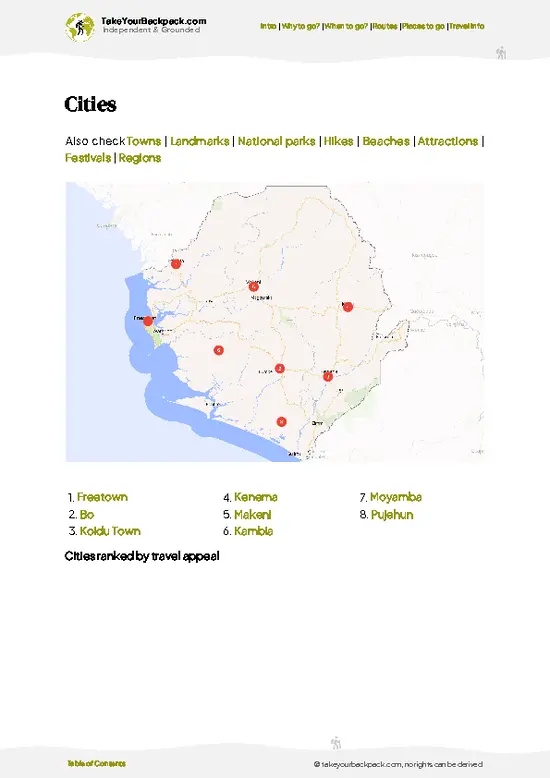
A visual overview of the country
Loading the map 🌍
CLICK TO FILTER
city
town
unique site
national park
hike
beach
attraction
festival
region
SHOW COUNTRY’S BESTSHOW ALL

Why go?Why Sierra Leone is worth visiting

Low cost

Backpacking Sierra Leone treats your wallet kindly. Poda-podas rattle along for coins, and okadas get … read more 👉
Backpacking Sierra Leone treats your wallet kindly. Poda-podas rattle along for coins, and okadas get you that last mile without a wince. Street bowls of rice and cassava leaves hit like a brick—in a good way—and cost less than bus snacks in Europe. Sleep in beachside rooms with bucket showers and a fan; they’re basic, but you’ll hear the surf. Shop local, skip imports, and you glide by on a daily average around $30. The heat, the dust, then a cold Star at sunset—cheap, earned, and perfect.

Scenery

Heat rises off the red-dirt roads and the bush taxi rattles your spine, but Sierra Leone pays in scenery. … read more 👉
Heat rises off the red-dirt roads and the bush taxi rattles your spine, but Sierra Leone pays in scenery. Mountains drop straight into a jade Atlantic on the Freetown Peninsula; at dawn the Gola rainforest breathes mist and birdsong. You sweat up Bintumani’s ridges and get a continent-wide view of savannah rolling north. Hippos cut quiet V’s across Outamba’s river, Lake Sonfon glows iron-brown after rain, and wave-carved caves echo on the Banana Islands. By dusk, sand in your cuffs, salt on your lips, a cold Star beer makes the whole day click.

Wildlife

Expect sweat-slick shirts, red dust in your teeth, and long canoe hauls across tea-brown rivers. In … read more 👉
Expect sweat-slick shirts, red dust in your teeth, and long canoe hauls across tea-brown rivers. In return, Sierra Leone hands you wildlife that feels close enough to touch. Dawn in Gola smells of wet leaf litter; hornbills thunder overhead, and Diana monkeys flick through canopy like sparks. Night on Tiwai is fireflies and the quiet push of something big—maybe a pygmy hippo—slipping by. Up north, Outamba’s gallery forest coughs up hippo eyes at dusk; along the peninsula, turtles and passing humpbacks ride the swell. Then the first cold Star beer, condensation tracking the day’s mud.

Uniqueness

You earn every mile here. Red dust in your teeth, potholed roads, the odd checkpoint where the sun stands … read more 👉
You earn every mile here. Red dust in your teeth, potholed roads, the odd checkpoint where the sun stands still. Poda‑podas jammed with buckets and goats, a diesel‑sweet water taxi across Freetown’s bay. Then the country opens: River No. 2’s pale sand and warm Atlantic, the Banana Islands’ black rock and rusted anchors, rain‑slick trails in Gola with hornbills clattering overhead. Camp below Bintumani and climb for a horizon of green that doesn’t end. Walk back tired, salt on your skin, and kill an ice‑cold Star on a plastic chair while the generator drones.
Want the complete picture of Sierra Leone?
The offline Travel Guide brings everything together — routes, highlights & planning.

See what's included in the guide 👉

Get the Travel Guide -

⭐ HighlightsHighlights of Sierra Leone

  • Bureh Beach: Dawn breaks over wet granite and the Atlantic starts breathing hard, pushing a clean left that feels heavier than it looks. Fishermen grunt through a seine net while smoke from a drum grill drifts along the palm line. You’ll come away with salt-dried eyebrows, wax under your nails, and a cold Star sweating in your hand.
  • Tacugama Chimpanzee Sanctuary: The access road is red clay and it clings to your boots, even dry season. Forest air hits damp and green, then the whoop-pant chorus rolls across the ravine and somebody drum-thumps a door like a bassline. A ranger’s feed bucket smells of ripe fruit; the reward is eye contact that feels uncomfortably human.
  • Tiwai Island Wildlife Sanctuary: A dugout noses through tea-colored water, the river warm on your calves as you hop out onto sand and leaf litter. Night brings a wall of cicadas, torchshine catching eyes in the canopy, and the thud of falling fruit. Morning repays the sticky sleep with Diana monkeys crossing like ghosts and hornbills
read more 👉
  • Bureh Beach: Dawn breaks over wet granite and the Atlantic starts breathing hard, pushing a clean left that feels heavier than it looks. Fishermen grunt through a seine net while smoke from a drum grill drifts along the palm line. You’ll come away with salt-dried eyebrows, wax under your nails, and a cold Star sweating in your hand.
  • Tacugama Chimpanzee Sanctuary: The access road is red clay and it clings to your boots, even dry season. Forest air hits damp and green, then the whoop-pant chorus rolls across the ravine and somebody drum-thumps a door like a bassline. A ranger’s feed bucket smells of ripe fruit; the reward is eye contact that feels uncomfortably human.
  • Tiwai Island Wildlife Sanctuary: A dugout noses through tea-colored water, the river warm on your calves as you hop out onto sand and leaf litter. Night brings a wall of cicadas, torchshine catching eyes in the canopy, and the thud of falling fruit. Morning repays the sticky sleep with Diana monkeys crossing like ghosts and hornbills winging low over the Moa.
  • Bunce Island: The boat ride up the Rokel is chop and diesel and mangrove breath, then the fort rises out of grass and silence. Lichen bites into brick, rust stains track down the cannon, and the air tastes metallic in the shade of the gate. You feel the weight in your ribs, then ride back with wind and spray rinsing your thoughts.
  • Mount Bintumani (Loma Mountains): Laterite roads rattle you to a village where the chief nods, a guide shoulders the load, and the path goes straight into wet grass and granite slabs. Sweat bees find you, leeches try their luck, but the summit wind is cold and big with ridgelines running into Guinea. You descend on noodle legs toward groundnut stew, a bucket wash, and a hard-earned beer; if you’ve got extra days, aim for Outamba-Kilimi’s river bends, the Banana Islands’ quiet coves off Ricketts, and the old hilltop village of Yagala above Kabala.
Spotted a mistake or missing a highlight? Contact us.

But Sierra Leone offers more...

Discover and compare all of its highlights per category

🧭 RoutesPlanning a route that makes sense

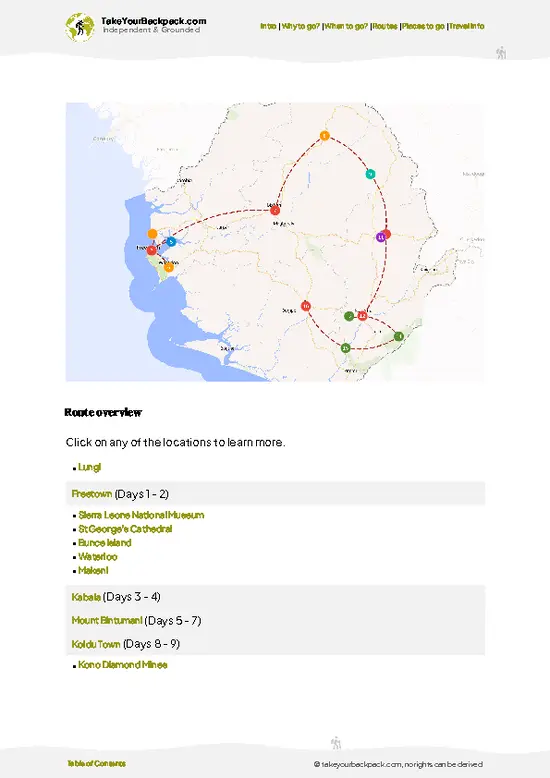
The 5-Day Freetown & Peninsula Taster

The Vibe: A relaxed, first-time-friendly loop that keeps you close to Freetown while still giving you real wildlife, history, and beach time without long travel days. You’ll lean on taxis and short transfers, trading big distances for deeper moments in a compact slice of the country.
The Highlights:
  • Historic streets, markets, and museums in Freetown’s old core
  • Chimpanzees and forest walks at Tacugama in the Western Area hills
  • Laid-back days on River No. 2 Beach and the Freetown Peninsula coast
  • Optional cultural evenings with drumming and dance in the capital

The 10-Day Coast & Rainforest Circuit

The Vibe: A balanced journey that links Freetown’s history with the beaches of the peninsula and the deep green of the southeast, moving at a steady but not rushed pace. Expect a mix of taxis, private car hires, and a couple of boat rides as you trade city noise for forest soundscapes.
The Highlights:
  • Time to really explore Freetown’s museums, markets, and Bunce Island
read more 👉

The 5-Day Freetown & Peninsula Taster

The Vibe: A relaxed, first-time-friendly loop that keeps you close to Freetown while still giving you real wildlife, history, and beach time without long travel days. You’ll lean on taxis and short transfers, trading big distances for deeper moments in a compact slice of the country.
The Highlights:
  • Historic streets, markets, and museums in Freetown’s old core
  • Chimpanzees and forest walks at Tacugama in the Western Area hills
  • Laid-back days on River No. 2 Beach and the Freetown Peninsula coast
  • Optional cultural evenings with drumming and dance in the capital

The 10-Day Coast & Rainforest Circuit

The Vibe: A balanced journey that links Freetown’s history with the beaches of the peninsula and the deep green of the southeast, moving at a steady but not rushed pace. Expect a mix of taxis, private car hires, and a couple of boat rides as you trade city noise for forest soundscapes.
The Highlights:
  • Time to really explore Freetown’s museums, markets, and Bunce Island story
  • Multiple days on River No. 2, Tokeh, and Lumley beaches along the Freetown Peninsula
  • Forest immersion and guided walks in Gola Rainforest National Park
  • River wildlife and island life at Tiwai Island Wildlife Sanctuary

The 15-Day Sierra Leone Grand Traverse

The Vibe: A full-country adventure that strings together capital, coast, rainforest, savanna, and highlands for travelers who want the big picture without sprinting. You’ll mix shared taxis with targeted car hires and boats, with enough two-night stops to keep the journey enjoyable.
The Highlights:
  • Deep-dive days in Freetown, from museums and markets to Bunce Island’s legacy
  • Extended downtime on River No. 2, Tokeh, and Lumley beaches plus Tacugama’s forested hills
  • Multi-day wildlife and forest experiences in Tiwai Island and Gola Rainforest National Park
  • Northern walking safaris in Outamba-Kilimi and highland hikes around Kabala and Mount Bintumani
🌍 Want a ready-to-use travel plan for Sierra Leone?
The overview above compares different route options based on your travel time and style. The complete Travel Guide breaks each itinerary down in detail, including maps, stops, highlights, and transport information.

Explore all route details 👉

Get the Travel Guide -

🌤️ When to go?When to go for the best experience

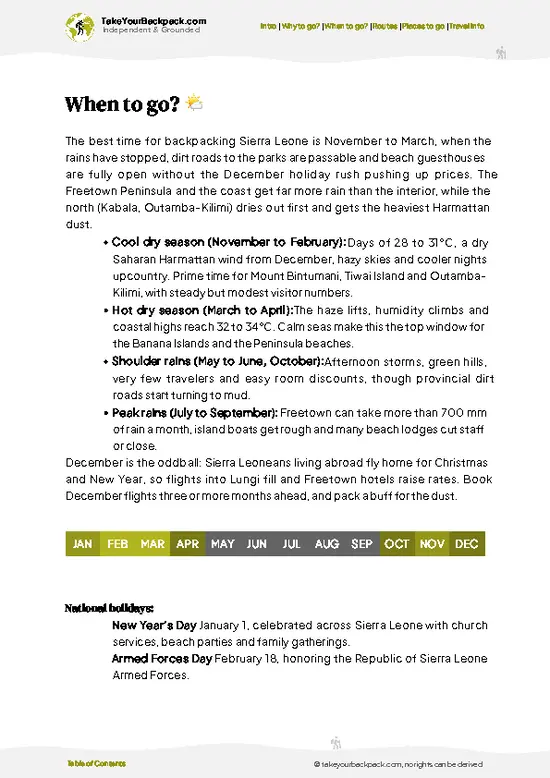
Late January to early March is the sweet spot. The rains have rinsed the red clay clean and firmed the roads, but the real furnace of April hasn’t switched on. Harmattan haze eases by February, so sunsets go from gauzy orange to sharp gold, and the Atlantic loses its murk. Diaspora crowds and holiday markups fall away; drivers start bargaining again; you get space on the poda-poda bench instead of a knee in your ribs. Trails around the Peninsula dry enough for grip, Tacugama’s hills stop sliding, and river crossings are still lively without being angry. Evenings settle at fan-level cool. You earn the first cold Star beer with salt still on your skin, and it tastes like you timed it right.
  • Peak Dry (mid-Dec-early Jan, plus Easter): Prices jump, Freetown traffic snarls toward the Peninsula, and beach bars thump till late; you put up with it because the surf’s clean at dawn, the drums are live, and a cold beer on Lumley comes with fire-orange light refracted through harmattan.
  • Shoulder Dry (Nov-mid Dec; late Jan-Mar): Tarps roll up, ferries calm down, and shop shutters clatter open earlier; you move faster, rooms come back to earth, and the country exhales as the dust literally settles and the sea turns glassy in the mornings.
  • Monsoon/Green (May-Sep; heaviest Jul-Aug): Tin roofs drum, hills glow electric green, and beaches go quiet; walk at first light between squalls, double-bag electronics, switch to sandals in mud then back to dry shoes, and plan interior travel right after a solid pause in the rain—oddly, October can pop busy on Bureh’s surf even while towns feel empty.

Tactical tip: For the late Jan-early Mar window, lock Peninsula weekends and the Lungi boat a few days ahead, and carry one light long-sleeve that does triple duty for sun, mosquitoes, and dusty rides.

source: climatestotravel.comJANJanuary: highly recommended for travelingFEBFebruary: excellent for travelingMARMarch: excellent for travelingAPRApril: good for travelingMAYMay: fair for travelingJUNJune: fair for travelingJULJuly: below average for travelingAUGAugust: below average for travelingSEPSeptember: fair for travelingOCTOctober: good for travelingNOVNovember: highly recommended for travelingDECDecember: good for traveling
📅 Traveling in a specific month?
Get a full month-by-month breakdown of weather, crowds, costs, festivals, and seasonal highlights in the complete travel guide.

Get full details when to go 👉

Get the Travel Guide -
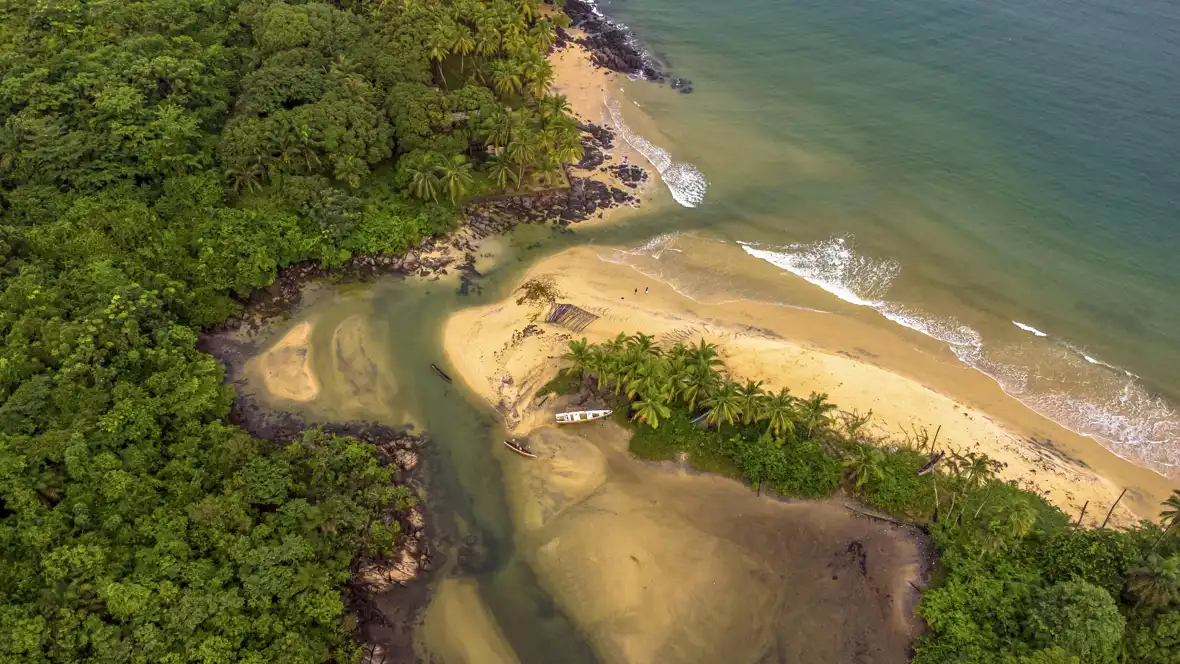
pixabay - sierra leone - coast-6508048

💰 Costs (as of 2026)How expensive it really is

$30-45 per day if you sleep in dorms, eat what locals eat, and ride poda-podas; more on beach weekends or if you insist on AC and water taxis.
  • dorm accommodation: $10-20 in Freetown and the beach towns (Bureh, Tokeh), $8-15 upcountry; basic guest rooms with a fan run $18-30. System tip: walk in, ask for the “fan rate,” and pay in leones to dodge the lazy USD markup; many places run generators only evenings, so confirm hours before you hand over cash and negotiate a weekly rate.
  • meals: Supermarket Survival: imports bite—cheese, cereal, and chocolate cost Ghana/Senegal prices; you’ll scrape by at $6-10/day on bread, eggs, sardines, and fruit. Street food reality: rice and plasas or groundnut stew $1-2, grilled fish with cassava $2-3, omelet-in-bread 50¢-$1, ginger drinks 30-50¢, beer (Star) $1.50-2.50. Cheaper than Senegal, a shade pricier than Guinea, and portions are heavy enough to carry you through the humidity.
  • local transport: Poda-podas and shared taxis unlock the country. In-city rides are 20-40¢; short okada hops 50¢-$1.50—agree the fare before you swing a leg over and don’t expect a helmet. Intercity shared cars run roughly $3-5 per 100 km; Freetown-Bo about $6-8 if you leave
read more 👉
$30-45 per day if you sleep in dorms, eat what locals eat, and ride poda-podas; more on beach weekends or if you insist on AC and water taxis.
  • dorm accommodation: $10-20 in Freetown and the beach towns (Bureh, Tokeh), $8-15 upcountry; basic guest rooms with a fan run $18-30. System tip: walk in, ask for the “fan rate,” and pay in leones to dodge the lazy USD markup; many places run generators only evenings, so confirm hours before you hand over cash and negotiate a weekly rate.
  • meals: Supermarket Survival: imports bite—cheese, cereal, and chocolate cost Ghana/Senegal prices; you’ll scrape by at $6-10/day on bread, eggs, sardines, and fruit. Street food reality: rice and plasas or groundnut stew $1-2, grilled fish with cassava $2-3, omelet-in-bread 50¢-$1, ginger drinks 30-50¢, beer (Star) $1.50-2.50. Cheaper than Senegal, a shade pricier than Guinea, and portions are heavy enough to carry you through the humidity.
  • local transport: Poda-podas and shared taxis unlock the country. In-city rides are 20-40¢; short okada hops 50¢-$1.50—agree the fare before you swing a leg over and don’t expect a helmet. Intercity shared cars run roughly $3-5 per 100 km; Freetown-Bo about $6-8 if you leave at first light. The budget trap is the Lungi crossing: public ferry and a shared ride totals a few bucks; the slick water taxi runs $35-45. Travel early to beat police checkpoints and rain-slowed roads. Overall cheaper than Ghana/Senegal, similar to Guinea.
  • activities: Costs spike when boats and guides enter the picture. Banana Islands transfers $8-15 each way if you find others; solo charter $40-60. Tiwai Island conservation fee $10-20 plus canoe $5-10 and a local guide. Tacugama Chimpanzee Sanctuary entry in the low teens. Beach “community fees” 50¢-$2 at River No. 2. Loma/Bintumani trekking is guide-and-okada territory—think $20-30/day for guiding plus fuel and food. Surfboard hire $5-10; anything “expat-run” doubles the price. Activities are cheaper than in Ghana, but logistics can quietly match them.
  • miscellaneous: Budget leaks: ATM fees ($5-10 a pull), poor exchange rates on USD small bills, laundry by the bucket $2-4, bottled water 70¢-$1.20 (sachets are pennies if your stomach tolerates them), data $2-4 for a few GB, weekend beach surcharges of 20-40%, and AC/generator surcharges $3-10/night. Airport transfers and visas can dwarf a day’s spend, so spread those costs over longer stays. Compared with neighbors, Sierra Leone sits between Guinea (cheaper, rougher) and Liberia (nicer roads, pricier), and discipline with transport and AC is what keeps your budget intact.
⚠️ Prices can change and everyone travels differently, so take this as a rough guide. Hope it helps you plan your adventure!

✈️ The backpacker research shortcutSierra Leone Travel Guide

An offline-friendly backpacking guide with optimized travel routes, ranked highlights, transport advice, and the best areas to stay.
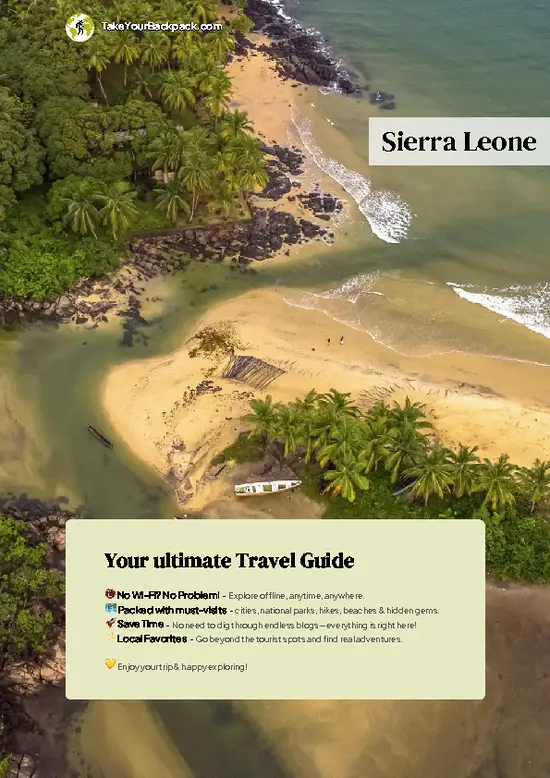
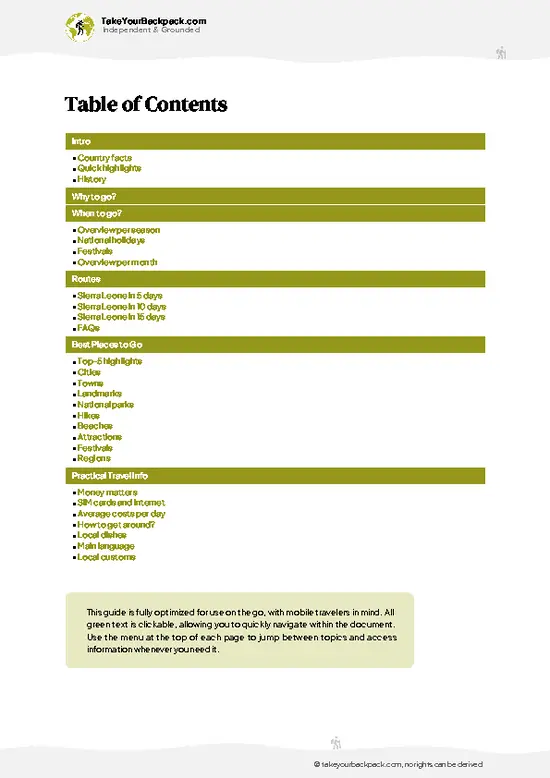
example page 0 from our offline Travel Guide for Sierra Leoneexample page 1 from our offline Travel Guide for Sierra Leoneexample page 2 from our offline Travel Guide for Sierra Leoneexample page 3 from our offline Travel Guide for Sierra Leoneexample page 4 from our offline Travel Guide for Sierra Leoneexample page 5 from our offline Travel Guide for Sierra Leoneexample page 6 from our offline Travel Guide for Sierra Leoneexample page 7 from our offline Travel Guide for Sierra Leone
The digital guide (293 pages) contains:
70 highlights, ranked by travel appeal
Optimized 5, 10 & 15-day travel routes
Cities, national parks, beaches, historical sites, ...
How to get around
Offline-friendly for travel without Wi-Fi
👉 Click to see all 30+ guide features

📅 Plan smarter in minutes, not weeks
Month by month travel advice
Festivals & national holidays
Budget expectations

🗺️ Go to the right places, skip the overrated ones
Honest pros & cons of destinations
Top hikes, parks & viewpoints
Lesser-known places most travelers miss
Clear “worth it vs skip it” guidance

🛏️ Travel smoothly without rookie mistakes
Best areas to stay
Transport systems explained simply
Common scams & safety advice
SIM cards, money & practical tips

🌍 Understand the country, not just visit it
Culture & traditions
52 Essential phrases & customs
Festivals worth planning around
Traveler-friendly historical context
Insights that make places more meaningful

📱 Built for real travel conditions
Fully downloadable PDF
Works completely offline
Optimized for phone use
Useful in remote areas & buses
Everything in one place
Save weeks of stressful planning
Get instant access to the full guide directly. 30-day money-back guarantee.


Sent to your inbox immediately after payment • 100% Secure Checkout
Best Backpacking Travel Advisor 2025 tourism awardBest Backpacking
Travel Advisor
2025
What others say about Take Your Backpack Guides:
⭐⭐⭐⭐⭐
Fantastic, amazing amount of information!
⭐⭐⭐⭐⭐
My goodness this is amazing, it's what I've been looking for hats off too you!
⭐⭐⭐⭐⭐
I think this is absolutely BRILLIANT
⭐⭐⭐⭐
Very complete and informative. It's still missing places, but I gotta to commend you
⭐⭐⭐⭐⭐
This is truly amazing, thank you, can't wait to explore it with my kids!
⭐⭐⭐⭐⭐
Awesome resource, thank you!
⭐⭐⭐⭐⭐
This is amazing! Can't wait to explore the ones I haven't seen
⭐⭐⭐⭐
I love this! Well done, great idea.
⭐⭐⭐⭐⭐
Thanks for taking the time to make this gem!
⭐⭐⭐⭐⭐
This might be the best website I've ever seen.
⭐⭐⭐⭐⭐
Congratulations, and thank you so much for your work; it's incredibly valuable.
⭐⭐⭐⭐
In all seriousness I think you did a great job pointing out the important spots
⭐⭐⭐⭐⭐
10/10 very good
⭐⭐⭐⭐⭐
As someone who's only just starting to visit regularly this is awesome, thank you.
⭐⭐⭐⭐
Thank you very much! I'm going to visit my dad, it's going to be very useful!
⭐⭐⭐⭐⭐
This is really cool! We'll be travelling for the first time and this definitely come in handy.
⭐⭐⭐⭐⭐
You are now our minister of culture, congratulations 👨‍💼
⭐⭐⭐⭐⭐
Just wanted to tell you that this is a pearl! Going to follow your recommendations.
⭐⭐⭐⭐⭐
This is so cool. I'll definitely be using the resource for my travels soon.
⭐⭐⭐⭐⭐
This is very impressive! Good work.
⭐⭐⭐⭐⭐
This is an amazing and informative site. Very well done!

🛏️ Where to stay?Best areas to base yourself

Yes — Sierra Leone has budget guesthouses and a handful of backpacker-style hostels concentrated in Freetown (notably Lumley Beach and Kingtom plus the Hill Station/Aberdeen area) with basic lodgings also in provincial hubs like Bo, Kenema and Makeni.
Lumley/Kingtom give beach access and nightlife but are noisier and often pricier; Hill Station/Aberdeen is quieter and closer to services but involves steep walks and frequent power or water interruptions; provincial towns are cheapest and best for regional travel links and markets but offer limited amenities, fewer booking options and uneven security … read more 👉
Yes — Sierra Leone has budget guesthouses and a handful of backpacker-style hostels concentrated in Freetown (notably Lumley Beach and Kingtom plus the Hill Station/Aberdeen area) with basic lodgings also in provincial hubs like Bo, Kenema and Makeni.
Lumley/Kingtom give beach access and nightlife but are noisier and often pricier; Hill Station/Aberdeen is quieter and closer to services but involves steep walks and frequent power or water interruptions; provincial towns are cheapest and best for regional travel links and markets but offer limited amenities, fewer booking options and uneven security after dark.

If you enjoy meeting fellow travelers, consider choosing hostels with high ratings for atmosphere. On the other hand, if you prefer having your own space, a hotel might be a better option.

🚌 Getting aroundHow to travel within the country

Sierra Leone moves on diesel breath and intuition, not timetables. Vehicles leave when they’re full, not a minute before, and the mood of the day bends around heat, rain, and the patience of the conductor. Dawn is the power window: engines coughing to life, sellers threading trays of biscuits and cold sachet water through the crush, police checkpoints still yawning awake. By noon the tar shimmers, tempers thin, and potholes feel bigger. Accept the ebb—queue, bargain, squeeze—and you’re paid back … read more 👉
Sierra Leone moves on diesel breath and intuition, not timetables. Vehicles leave when they’re full, not a minute before, and the mood of the day bends around heat, rain, and the patience of the conductor. Dawn is the power window: engines coughing to life, sellers threading trays of biscuits and cold sachet water through the crush, police checkpoints still yawning awake. By noon the tar shimmers, tempers thin, and potholes feel bigger. Accept the ebb—queue, bargain, squeeze—and you’re paid back in real miles: salt air off the estuary, a seat by an open window, that first cold beer after a long, red-dusted ride.
  • Shared intercity taxis The speed bargain is simple: pay more, leave sooner, arrive before the sun bullies the road. Bo, Kenema, Makeni—cars load at parks, fill front to back, then go hard. Pay for the front seat or buy an extra spot to avoid the shoulder-to-shoulder grind; it can halve the misery and shave an hour. Rain and roadworks make fools of optimists, but a driver who beats Masiaka before traffic usually buys you daylight.
  • Poda-poda minibuses This is the social engine room. Greet when you board, pass fares forward, and keep small notes ready for the apprentice who knows exactly who paid. Elders and mothers with babies get space without debate; you might get the flip-down jump seat if you show up late. Gospel bass, frying oil on the breeze, a hen underfoot, and jokes in Krio you’ll understand by the third ride. Complain and the whole bus sighs; help with a bucket and you’re family.
  • Water taxis and ferries across the Sierra Leone River The estuary rewrites geometry. Lungi sits an ocean away by road, but fifteen to thirty minutes by fast boat if the chop behaves. Spray in your teeth, fuel in the air, lifejacket on—bags tagged and stacked. The car ferries rumble slower and cheaper, a diesel lullaby with goats and suitcases, but both routes beat the long detour north. You step off with the city or the runway suddenly close.
  • Okadas (motorbike taxis) The cheap hack for hills, jams, and last miles. Negotiate before you swing a leg, insist on a helmet to dodge police grief, tuck your knees from the exhaust, and accept you’ll wear the road’s red dust. On Freetown’s climbs or laterite spurs to beaches beyond Lumley, bikes thread what cars can’t, often for half the price and a third the time.

Master tactical tip: Be at the park before first light, buy the seat you wish you had, route via hubs like Masiaka, carry small notes, wrap your bag in plastic for rain and roof racks, and move in daylight—early and decisive beats any schedule you’re promised.
Distance
Freetown International Airport (FNA) sits across the estuary at Lungi, about 17 km (11 miles) from central Freetown as the crow flies. By road (the long way around via Port Loko-Masiaka-Waterloo), it’s roughly 160-180 km (100-112 miles).

Main ways to get into the city (2025)

1) Fast boat (water taxi) - quickest and easiest
- Operators: Sea Coach Express and Seabird run frequent airport-Freetown services.
- Time: 25-35 minutes on the water. With shuttle transfers and check-in, plan on 45-60 minutes total to Aberdeen or Government Wharf.
- Cost: About US$40-60 one way per adult; discounts for kids. The airport-jetty shuttle is usually included.
- Notes: Boats generally align with flight times from early morning to late evening; very late arrivals sometimes have extra runs, but always check ahead. Book online or at the airport desk. Seas can be choppy in the rainy season; services may hold for weather.

2) Government ferry (Tagrin ↔ Kissy) - cheapest, but slowest
- How it works: Take a short taxi (10-15 minutes) from the airport to Tagrin Ferry Terminal, ride the ferry to Kissy in Freetown, then grab a taxi or shared minibus into town.
- Time: Ferry crossing is 30-45 minutes, but departures and loading can add long waits. Door to door is typically 1.5-3 hours depending on schedules and city traffic.
- Cost: Ferry foot passenger about US$1-2 (more if you opt for a VIP lounge when available). Airport-Tagrin taxi ~US$3-5. Kissy to the city center ~US$5-10 by taxi (less by shared transport).
- Notes: Daytime reliability is decent but expect occasional delays for tides, maintenance, or congestion. Keep an eye on your bags in crowds.

3) Overland by road all the way - only if you must avoid boats
- Route: Lungi → Port Loko → Masiaka → Waterloo → Freetown (no water crossing).
- Time: 4-6 hours, traffic and roadworks permitting.
- Cost: Private hire car typically US$120-180 one way. Piecing it together by shared taxis/minibuses is much cheaper (roughly US$10-20 total) but involves multiple changes and takes longer.
- Notes: This makes sense if boats/ferries are suspended or you’re moving bulky cargo and don’t mind the time.

Taxi options (at a glance)
- Airport → Tagrin jetty: about US$3-5.
- Kissy ferry terminal → city center (Cotton Tree area): about US$5-10; to Aberdeen/Lumley: about US$6-12.
- Full overland airport → city by private taxi (no boat/ferry): about US$120-180 depending on negotiation and vehicle.
- Tips: Agree the fare before you get in; most drivers prefer cash (USD or leones). Traffic into central Freetown can be heavy at rush hours, so add buffer time.

Prices and timings above are typical in 2025; they fluctuate with fuel costs, exchange rates, traffic, and weather.
⚠️ Prices and routes can change, so take this as a rough guide and ask for local advice when you arrive.

🔒 Safety (risk Level: medium)Common concerns and things to watch out for

Safety for solo travelers, including women and LGBTQ+ individuals
Sierra Leone is generally safe for solo travelers, but it’s essential to stay cautious, especially in crowded areas. Women should dress modestly and avoid walking alone at night. LGBTQ+ travelers may face cultural challenges, as attitudes can be conservative; discretion is advised. Always keep local emergency contacts handy and stay informed about any regional advisories.


Full official government travel advisory (live updates)
View details 👉

✈️ VisaVisa requirements for Sierra Leone

Most travelers to Sierra Leone require a visa, which can be obtained through the Sierra Leonean embassy or consulate in your country. Some nationalities can apply for an eVisa online through the official government portal. Always check the latest entry requirements as they can change frequently.

source: embassyofsierraleone.net
⚠️ Visa requirements can change over time, so always check the latest visa requirements with the official embassy or government website before you travel.

🎒 What to pack?What to wear and bring

Sierra Leone is a wild mix of beaches, jungle, and mountains, so be ready to sweat it out in the humid tropical climate. The rainy season is from May to November, so light, quick-dry clothes are your best friend. Don’t go too flashy or revealing—locals appreciate modesty, and you’ll blend in better. Hiking through lush jungles and rocky trails means sturdy footwear is a must. Keep cultural respect in mind, especially in rural areas and when visiting religious sites.

Apart from this country specific advice, I have also crafted a general packing list that should help on any trip. authorOver the years, I've learned the importance of packing minimally. It's so much easier to jump on the back of a truck or squeeze yourself into the last spot of a minibus without that supersized backpack. If you're headed to a warm destination, leave your winter jacket at home; for colder regions, opt for thin thermal underlayers. Instead of packing your entire wardrobe, bring just three sets of clothes, as laundry facilities are available everywhere.

View the full list 👉
🎒 Planning the practical side of your trip?
Get detailed information on transport, daily budgets, internet access, local customs, food, language, and other essentials in the complete Travel Guide.

Get detailed practical information 👉

Get the Travel Guide -

🙋 FAQCommon questions before visiting

Trip Planning


Personal tip: I normally search on good rating for atmosphere (for meeting people) and location (for easy exploring). Cleanliness as a bonus.


Travel Essentials

Yellow fever vaccination is required for entry into Sierra Leone. It’s also wise to be up-to-date on routine vaccines like MMR (measles, mumps, rubella), DPT (diphtheria, pertussis, tetanus), varicella (chickenpox), polio, and your yearly flu shot. Hepatitis A and B, typhoid, and meningitis vaccines are recommended. Consider rabies if you’ll be in contact with animals or venturing into remote areas. Always check with a healthcare provider for the latest recommendations.


vaccination requirements
When I first started traveling, I often spent part of my first day in a new country hunting for a local SIM card. While this can still be slightly cheaper, it also takes time and planning.

These days, it's much simpler to install an eSIM before leaving home. Once you arrive in Sierra Leone, you can activate it immediately and have mobile data from the moment you land — which is especially useful for ordering transport or navigating away from busy airports.

There are many providers nowadays, and price differences are usually small. I personally go with Airalo, as it offers excellent network coverage throughout the country and strong global coverage, so you can manage multiple countries from a single app.


Get your e-sim for Sierra Leone

Culture & Customs

Be polite and greet people with a handshake; it’s common courtesy. Dress modestly, especially in rural areas, to respect local customs. Always ask before taking photos of people. Avoid discussing politics openly, as it can be sensitive. LGBTQ+ travelers should be discreet, as same-sex relationships are illegal and societal attitudes can be conservative. Women should be cautious when traveling alone, especially after dark. Tipping is not obligatory but appreciated for good service.
Trying traditional food is always a great way to experience the culture. Here are some must-try dishes for Sierra Leone.
  • Jollof Rice: A flavorful one-pot dish made with rice, tomatoes, onions, and a mix of spices. Often served with chicken or fish, it’s a staple at parties and gatherings across West Africa, representing community and celebration.
  • Groundnut Stew: A rich and hearty stew featuring peanuts, meat (usually chicken or beef), and vegetables. It’s a comforting dish with deep flavors, showcasing the importance of peanuts in Sierra Leonean cuisine.
  • Fufu: A dough-like food made from boiled and pounded plantains or cassava. It’s served with soup or sauce and is crucial in many West African meals, symbolizing tradition and togetherness.
  • Plasas: Leafy green vegetable stews often made with cassava leaves, spinach, or potato leaves, cooked with palm oil and sometimes fish or meat. Plasas is essential to the Sierra Leonean diet, highlighting the use of local greens.
  • Kedjenou: Although originally from Ivory Coast, this spicy chicken stew is loved in Sierra Leone too, usually cooked in a sealed pot to lock in flavors. It emphasizes communal cooking and the blending of flavors.
Tap water in Sierra Leone is generally not safe for tourists, as it can contain bacteria and contaminants. While some locals may drink it, it’s best to stick to bottled or filtered water to avoid any health issues. Always ensure the seal on bottled water is intact before purchasing.
The main language in Sierra Leone is Krio. Backpacking is way more rewarding if you know a bit of the local language, so I'd suggest brushing up on the basics just in case your Krio skills have become a bit rusty.

Want to understand locals better?
The complete Travel Guide for Sierra Leone includes 52 essential words and phrases — greetings, thank-yous, ordering food, transport, numbers, and common local expressions you'll actually hear.

Get your local basic phrases 👉

Get the Travel Guide -


In Sierra Leone, English is the official language and is widely used in government, education, and media. However, the proficiency in English can vary significantly among the population. While urban areas, particularly the capital city Freetown, tend to have a higher percentage of English speakers, many rural communities primarily communicate in local languages such as Krio, Mende, and Temne.

In urban settings, you will find that many people, especially younger individuals and those in professional sectors, are comfortable conversing in English. However, in more remote areas, English may be less commonly spoken, and local languages dominate daily communication. Travelers might encounter some challenges in communication in these regions, but basic English is often understood.

Overall, English is a vital part of Sierra Leone’s cultural and educational landscape. Tourists and visitors can generally navigate the country with relative ease, especially in tourist hotspots and larger towns, while being mindful of the local languages and dialects that enrich the country’s cultural tapestry.

Money & Payments

The local currency of Sierra Leone is SLL (Leone).

When backpacking in Sierra Leone, don’t rely too heavily on ATMs. They’re mainly in Freetown and a few larger towns, and can be unreliable. Carry cash, preferably in US dollars, as euros might not be as widely accepted. Most places won’t take cards, so cash is king. When you’re in Freetown, you can exchange money at banks or forex bureaus. Avoid street changers unless you enjoy a bit of risk with your currency exchange. For safety, keep smaller denominations handy for day-to-day expenses and stash the rest securely. No need to carry a fortune; it’s a budget-friendly destination.

Tipping in Sierra Leone isn’t a strict requirement, but it is appreciated, especially in restaurants and for hotel staff. A tip of about 10% of the bill is generally acceptable if service isn’t included. For smaller services, like porters or taxi drivers, consider giving a small amount, like a few thousand Leones, as a gesture of appreciation.

🧩 Nearby countriesOther countries to combine with Sierra Leone

We 💚 feedbackKey takeaways from the trip

Freetown hums on steep hills; poda-poda conductors bark, red dust sticks, sea salt cuts the diesel. The payoff lands fast: glassy waves at Bureh, grilled barracuda under almond trees, that first cold Star as the heat finally loosens. Best surprise: real surf and rainforest meeting sand on the peninsula, plus chimps in cool shade at Tacugama. Small warning: night driving is foolish, and phones flash like lures. This place suits patient, curious travelers who trade polish for contact. It punishes clock-watchers and comfort hunters.

✍️ Help improve this page!
The information on this page is based on in-depth research, insights shared by experienced travelers, and feedback from the local travel community in Sierra Leone. While every effort is made to keep the information accurate and current, conditions can change — so if you spot anything incorrect or outdated, please get in touch.


🙋‍♂️ Give feedback

👋 Meet the founderWho’s Behind Take Your Backpack?

Johan, backpacker and founder of TakeYourBackpackHi, I’m Johan (Netherlands 🇳🇱), the creator of TakeYourBackpack. Over the past decade, I’ve backpacked through 80+ countries across six continents, gaining extensive experience with independent travel, long-term trips, and overland routes.

This site is built on a combination of firsthand travel experience and carefully curated insights from other backpackers. Many guides are based on places I’ve personally visited, while others bring together tips, observations, and practical advice shared by trusted travelers I’ve met along the way.

The goal is to provide realistic, experience-driven guidance — not generic itineraries — so you can explore destinations with better context, clearer expectations, and more confidence.

Get full country guide •
Instant download • 70 highlights • Full Offline guide