×
Iraq 🇮🇶

backpacking Asia Iraq 🇮🇶Trace ancient routes reshaping modern journeys today.

Explore IranExplore Israel

Backpacking Iraq in 2026

A complete guide including when and where to go, costs, transport, itineraries, and practical travel advice.
A first look at the country

Backpacking Iraq
By Johan Kruseman 🇳🇱 | Updated June 22, 2026

Security is a strategy, checkpoints run your day, and modesty—plus proper documents—keeps doors open. This isn’t a freestyle trip; it rewards preparation and reading the room. Iraq protects what it loves, and you’ll feel that in both rules and welcome.

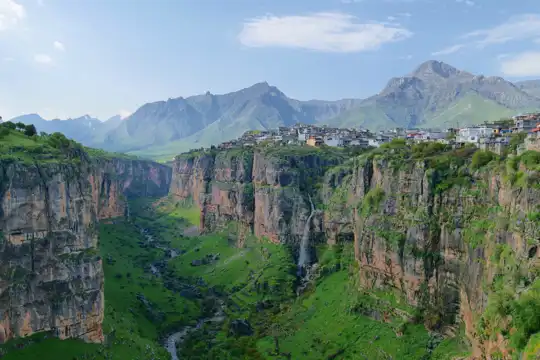
Come for the spine of the Tigris and Euphrates, the southern marshes where water buffalo wade at dawn, and the sun-baked ziggurat at Ur; stay for tea and books on Baghdad’s Mutanabbi Street, the blaze of Najaf and Karbala, and Kurdistan’s picnic-friendly mountains. Babylon, Hatra, and the Erbil Citadel aren’t museum pieces—they frame daily life, where masgouf smokes by the river and strangers press sweet tea into your hand. Heat, slow transport, and surprise roadblocks happen, but patience turns detours into invitations.

Compared with Turkey’s slick ease, Iran’s ritual polish, or Jordan’s packaged circuit, Iraq is raw and relational. Go if you’re street-smart, curious, and ready to trade convenience for connection and history under your boots.

👉 Get the 📖 Travel Guide of Iraq

Kurdistan (Erbil–Suli–Rawanduz)

Best soft entry. Erbil is airport-simple; shared taxis run to Soran and Rawanduz. Sulaymaniyah is social and easy. Trails and canyons demand legs, not money. You buy kebab and tea, then climb. Key gotcha: the KRI stamp doesn’t let you into Federal Iraq. Sort a visa before crossing that line. Near the Iranian border, some valleys need permits. Cash rules; Asiacell SIM is painless. Rewards hikers and first-timers after high return per hassle.

Baghdad & Tigris Spine (Baghdad–Samarra–Ctesiphon)

Baghdad hits hard. Museums, book market, river cafes—then checkpoints, traffic, and rules that change by the hour. Fly in, ride Careem or yellow cabs, keep cameras low near bridges and ministries. Day trips on the same spine: Ctesiphon arch south, Samarra shrine north if open. Hotels want passports and sometimes marriage proof for couples—don’t argue, just comply. Friday road closures can trap you; start early. Rewards city walkers with thick skin and curiosity.

Shrine Corridor (Karbala–Najaf–Hillah/Babylon)

This is devotion at scale. Buses and shared taxis run nonstop down the Baghdad–Euphrates highway. Prices jump during Arbaeen and hotel space vanishes; book or sleep rough. Dress modestly, stash your camera inside; tripods and big lenses get you bounced. At Babylon, the ruins are spread and sun-exposed, so bring water and a hat or you’ll pay for a driver’s “shade stops.” Rewards observers of ritual and patient note-takers.

South: Marshes & Basra

Humidity, boats, diesel. Base in Chibayish for reed-house runs; agree the route, duration, and fuel cost before the engine starts. Summer heat is punishing and steals your day by noon—go at dawn. In Basra, canals and date palms are real, but AT
Safety warning

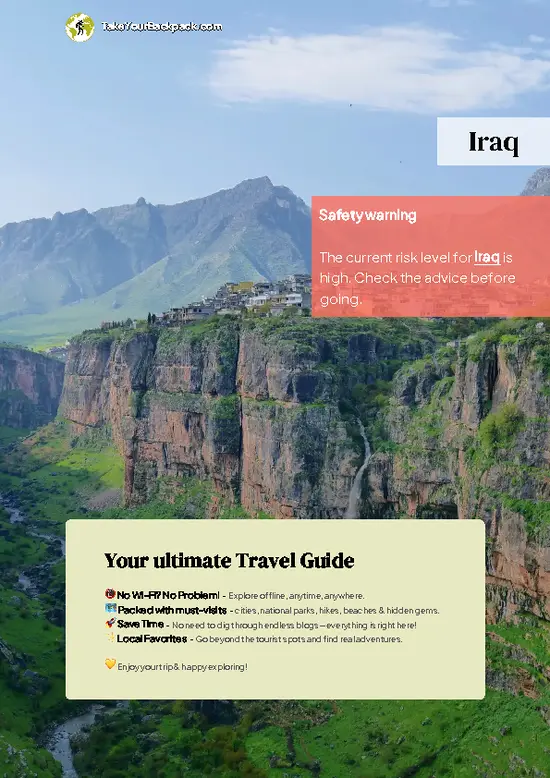
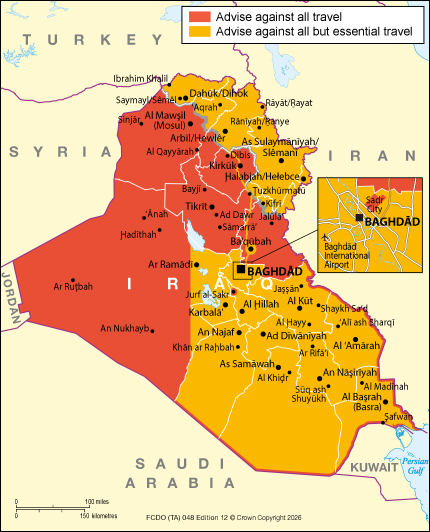
The current risk level for Iraq is high. Check the advice before going.
Get your Iraq guide
107 ranked highlights, routes & tips, works offline (375 pages)
A visual overview of the country
Loading the map 🌍
CLICK TO FILTER
cities
towns
landmarks
national parks
hikes
beaches
attractions
festivals
regions
SHOW COUNTRY’S BESTSHOW ALL

Why go?What makes this country worth the trip

Architecture

Iraq is the rare place where time stacks in brick and mud. You get the Ziggurat of Ur at sunrise, the Malwiya spiral in Samarra, the broken sweep of Hatra, and the impossible vault of Ctesiphon. Add Erbil’s hilltop citadel and … read more 👉
Iraq is the rare place where time stacks in brick and mud. You get the Ziggurat of Ur at sunrise, the Malwiya spiral in Samarra, the broken sweep of Hatra, and the impossible vault of Ctesiphon. Add Erbil’s hilltop citadel and Karbala’s gold domes, then the blunt modernism of Baghdad’s Martyr’s Monument. Not every site is polished. Some are scarred, fenced, or half scaffold. That’s the point. You see the bones. If you can handle checkpoints and dust, the architectural timeline here hits like a hammer.

Low cost

Iraq is one of the rare places where your money lasts. Think a daily average in the low double digits covers a bed, three solid meals, and long rides in shared taxis. Street food is hearty and cheap, hotels undercut anything … read more 👉
Iraq is one of the rare places where your money lasts. Think a daily average in the low double digits covers a bed, three solid meals, and long rides in shared taxis. Street food is hearty and cheap, hotels undercut anything in Jordan or Turkey, and most sights are free or cost pocket change. Watch the gotchas: the visa fee and flights dwarf your daily spend, ATMs are patchy so bring crisp cash, taxis lack meters—agree before doors shut. Kurdish cities run pricier but sane. Skip booze, drink tea. Use Careem. Save energy; spend on time, not bills.
Want the complete picture of Iraq?
The offline Travel Guide brings everything together — routes, highlights & planning.

See what's included in the guide 👉

Get the Travel Guide -

⭐ HighlightsHighlights of Iraq

💡 Not sure where to go?
Get a personalized backpacking itinerary for Iraq generated in under 10 seconds.

Generate my itinerary
  • Erbil Citadel: Step off the bazaar stairs and the wind hits you with dust, cumin smoke, and hot brick—ancient air that tastes mineral. Walk the ring lane; the views reel out over minarets and kebab grills. Gotchas: climb from the bazaar side (other gates are often shut), carry water, and expect cash-only entry; drones and flashy cameras draw guard attention and eat time you’d rather spend in the Textile Museum’s cool shade.
  • Babylon and Saddam’s Palace, Hillah: You run your fingers over bricks stamped with Nebuchadnezzar’s name, then catch a river breeze that smells of silt and sun-baked grass. The palace looms above—gaudy, yes, but the balcony frames the Euphrates like a timeline. Gotchas: bring a passport for checkpoints, hire an official guide or skip one entirely—touts pad routes and fees—and don’t underestimate the spread; it’s a long, shadeless walk with scant cold water inside.
  • Mesopotamian Marshes, Chibayish: Reed walls glide by and buffalo snort at your skiff; the boat’s two-stroke
read more 👉
  • Erbil Citadel: Step off the bazaar stairs and the wind hits you with dust, cumin smoke, and hot brick—ancient air that tastes mineral. Walk the ring lane; the views reel out over minarets and kebab grills. Gotchas: climb from the bazaar side (other gates are often shut), carry water, and expect cash-only entry; drones and flashy cameras draw guard attention and eat time you’d rather spend in the Textile Museum’s cool shade.
  • Babylon and Saddam’s Palace, Hillah: You run your fingers over bricks stamped with Nebuchadnezzar’s name, then catch a river breeze that smells of silt and sun-baked grass. The palace looms above—gaudy, yes, but the balcony frames the Euphrates like a timeline. Gotchas: bring a passport for checkpoints, hire an official guide or skip one entirely—touts pad routes and fees—and don’t underestimate the spread; it’s a long, shadeless walk with scant cold water inside.
  • Mesopotamian Marshes, Chibayish: Reed walls glide by and buffalo snort at your skiff; the boat’s two-stroke cough mixes diesel with sweet tea steam from a floating hut. Silence arrives in sheets. Gotchas: agree on price per hour, not per seat; life jackets are rare, midday sun is punishing, and mosquitoes spike at dusk—book through a local guesthouse, carry small bills, and keep your route simple to avoid “scenic detours” that burn fuel and cash.
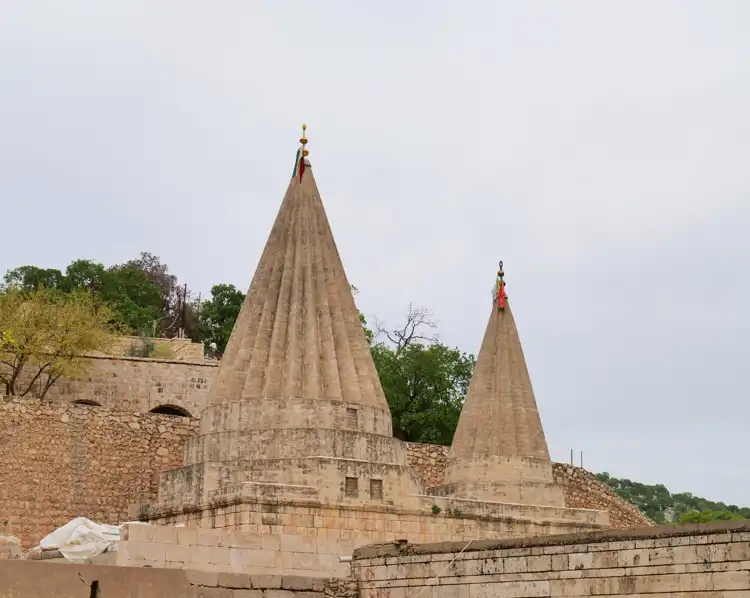
  • Lalish, Yazidi Sanctuary: Barefoot on warm black stone, you feel lamp oil and incense in the air, thick and old; the conical spires claw at the sky. It’s serene, and utterly human. Gotchas: shoes off before the gate, never step on thresholds, dress modestly (long sleeves/trousers; women cover hair), and keep cameras respectful—shoot buildings, not faces; holidays can crowd access roads and parking.
  • Mutanabbi Street and Shabandar Café, Baghdad: Ink on your fingertips, glass tea cups ringing, brass samovars hissing—literature and gossip stacked high as the paper. Friday morning is the pulse; by noon it softens. Gotchas: cash-only, no photos of checkpoints, set taxi prices before rolling, and mind your bag in the press. If you want off the map: the brick hulk of Al-Ukhaidir Fortress, the lone arch of Ctesiphon at Salman Pak, and the cliff-hugging Rabban Hormizd Monastery above Alqosh repay those who plan transport and keep expectations pragmatic.
Spotted a mistake or missing a highlight? Contact us.

But Iraq offers more...

Discover and compare all of its highlights per category

🧭 RoutesHow travelers typically move through the country

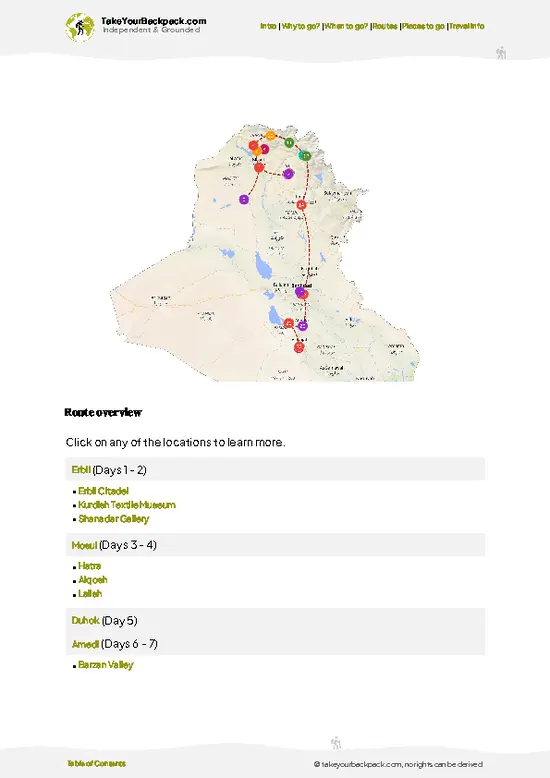
The 5-Day Erbil & Highlands Taster

The Vibe: A relaxed, mountain-leaning intro to Iraqi Kurdistan, built for travelers who want depth over distance and prefer tea houses and viewpoints to constant packing and unpacking. You’ll stick to short overland hops and day trips from a couple of easy bases.
The Highlights:
  • Wandering the lanes and ramparts of the Erbil Citadel.
  • Connecting museum pieces to place at the Erbil Citadel Archaeological Museum.
  • Day-tripping into Halgurd Sakran National Park and the wider Kurdistan Region.
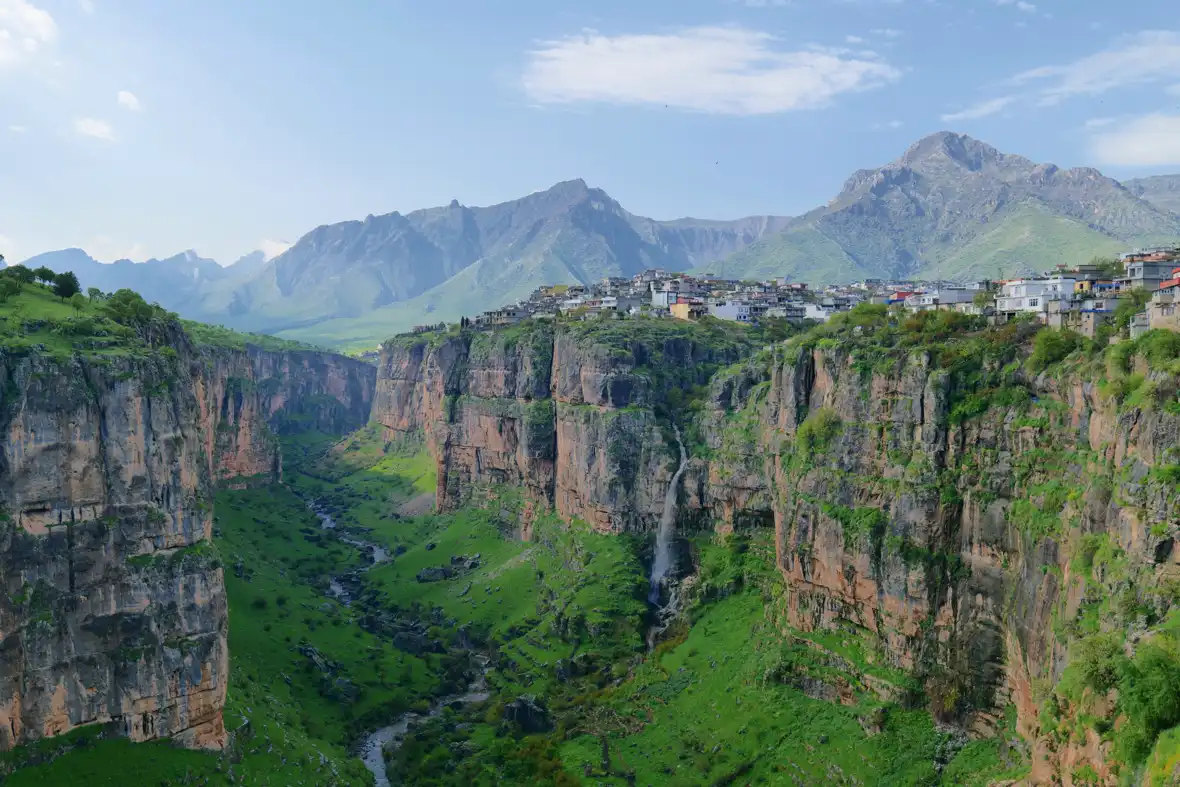
  • Soaking up big views in Rawanduz Canyon and the Amedi Valley.

The 10-Day Mesopotamian Heartland Route

The Vibe: A balanced first circuit through Iraq’s cultural core, mixing Baghdad’s museums, ancient capitals, and major Shia shrine cities with a soft landing in the Kurdish north. Expect a steady pace with a couple of longer travel days offset by multi-night stays.
The Highlights:
  • Tracing Iraq’s story from artifacts to modern art in Baghdad.
  • Walking the ruins of Babylon with time
read more 👉

The 5-Day Erbil & Highlands Taster

The Vibe: A relaxed, mountain-leaning intro to Iraqi Kurdistan, built for travelers who want depth over distance and prefer tea houses and viewpoints to constant packing and unpacking. You’ll stick to short overland hops and day trips from a couple of easy bases.
The Highlights:
  • Wandering the lanes and ramparts of the Erbil Citadel.
  • Connecting museum pieces to place at the Erbil Citadel Archaeological Museum.
  • Day-tripping into Halgurd Sakran National Park and the wider Kurdistan Region.
  • Soaking up big views in Rawanduz Canyon and the Amedi Valley.

The 10-Day Mesopotamian Heartland Route

The Vibe: A balanced first circuit through Iraq’s cultural core, mixing Baghdad’s museums, ancient capitals, and major Shia shrine cities with a soft landing in the Kurdish north. Expect a steady pace with a couple of longer travel days offset by multi-night stays.
The Highlights:
  • Tracing Iraq’s story from artifacts to modern art in Baghdad.
  • Walking the ruins of Babylon with time to linger, not rush.
  • Experiencing the devotional energy of Karbala and Najaf’s shrine complexes.
  • Cooling off in Erbil and the nearby highlands of Rawanduz and Halgurd Sakran.

The 15-Day Cross-Iraq Deep Dive

The Vibe: A full-length journey for travelers who want to see Iraq’s big contrasts—Baghdad to Basra, marshes to mountains—without turning it into a sprint. You’ll weave together long overland legs and at least one flight to keep the route ambitious but humane.
The Highlights:
  • Three unhurried days in Baghdad’s museums, memorials, and riverfront neighborhoods.
  • Linking Samarra, Babylon, Karbala, and Najaf into a coherent historical and spiritual arc.
  • Exploring Basra, the Mesopotamian Marshes, and the Gulf edge around Al-Faw Beach.
  • Closing out in Erbil and the Kurdish highlands, from the citadel to Rawanduz Canyon and Halgurd Sakran National Park.
🧭 Looking for a route that fits your  trip?
Get a personalized Iraq backpacking itinerary based on your trip length, interests, and start location—in under 10 seconds.

Generate my itinerary

🌤️ When to go?A month-by-month overview

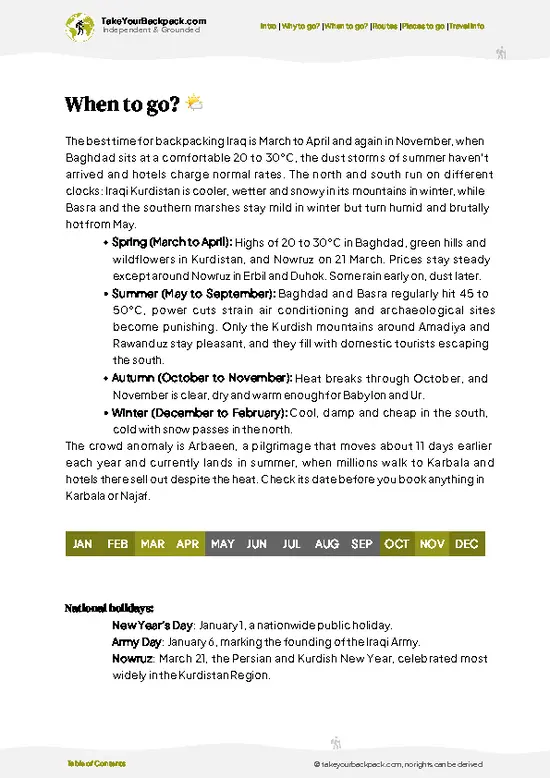
The sweet spot for Iraq is late March to mid-April and late October to mid-November. Days are warm enough to move, nights cool enough to sleep without fighting the fan. Hotels don’t surge, drivers quote sane rates, and you can actually find a seat on shared taxis. Spring brings green hills in Kurdistan and tolerable walking in Baghdad and Najaf before the furnace flips on; autumn cools the plains while mountain passes are still open. Two caveats: Nowruz week in late March packs the north, and the Arba’een period in early autumn detonates prices and crowds around Karbala and Najaf.
  • The Crowd/Heat Peak: Late September-October. Pilgrim season swells like a tide: packed roads, surge pricing, zero vacancy near Karbala. It’s a grind—long waits, hot buses—but sharing tea at a mawkib and watching the shrine lights burn through the dusk will etch itself into you.
  • The Transition/Shoulder: April and early November. Markets roll their shutters up, tea trays clink, checkpoints wave you through faster. Trails in Kurdistan firm up, riverfronts wake. Momentum builds daily. Note the anomaly: Nowruz week in March turns Sulaymaniyah and Erbil into a street party with scarce rooms.
  • The Off-Peak/Extreme: June-August. The south bakes. Streets empty at noon, the air wobbles. Travel at dawn, retreat by midday to real AC (not an evaporative toy), re-emerge after sunset. Freeze water bottles; add salt to everything.
  • Winter Window: December-February. Quiet lanes, mist over the marshes, snow on high passes. Rain turns alleys slick and bus timetables loose. Layer hard shells over wool, and carry dry socks—you’ll thank yourself in Mosul’s slush.

Tactic: For the spring and autumn window, lock cancellable rooms 10-14 days out and spend saved cash on one non-negotiable—proper AC in the south or a real down layer in the north.

source: climatestotravel.comJANJanuary: good for travelingFEBFebruary: good for travelingMARMarch: highly recommended for travelingAPRApril: highly recommended for travelingMAYMay: fair for travelingJUNJune: below average for travelingJULJuly: below average for travelingAUGAugust: below average for travelingSEPSeptember: fair for travelingOCTOctober: good for travelingNOVNovember: highly recommended for travelingDECDecember: good for traveling
📅 Traveling in a specific month?
Get a full month-by-month breakdown of weather, crowds, costs, festivals, and seasonal highlights in the complete travel guide.

Get full details when to go 👉

Get the Travel Guide -
!P1072393

💰 Costs (as of 2026)Prices, expenses, and money tips

$35-55/day in federal Iraq is realistic for a tight budget; add 20-30% in Kurdistan where taxis and beds run higher.
  • dorm accommodation: $8-15 per bed in Baghdad, Najaf, Basra; $12-20 in Erbil/Sulaymaniyah. Basic privates start around $20-35 if you split. System tip: message hostels/guesthouses on WhatsApp the day before and ask for the “local cash rate” in IQD—walk-in prices quoted in USD are almost always higher; pay in dinar and arrive before dusk to dodge “security excuse” surcharges.
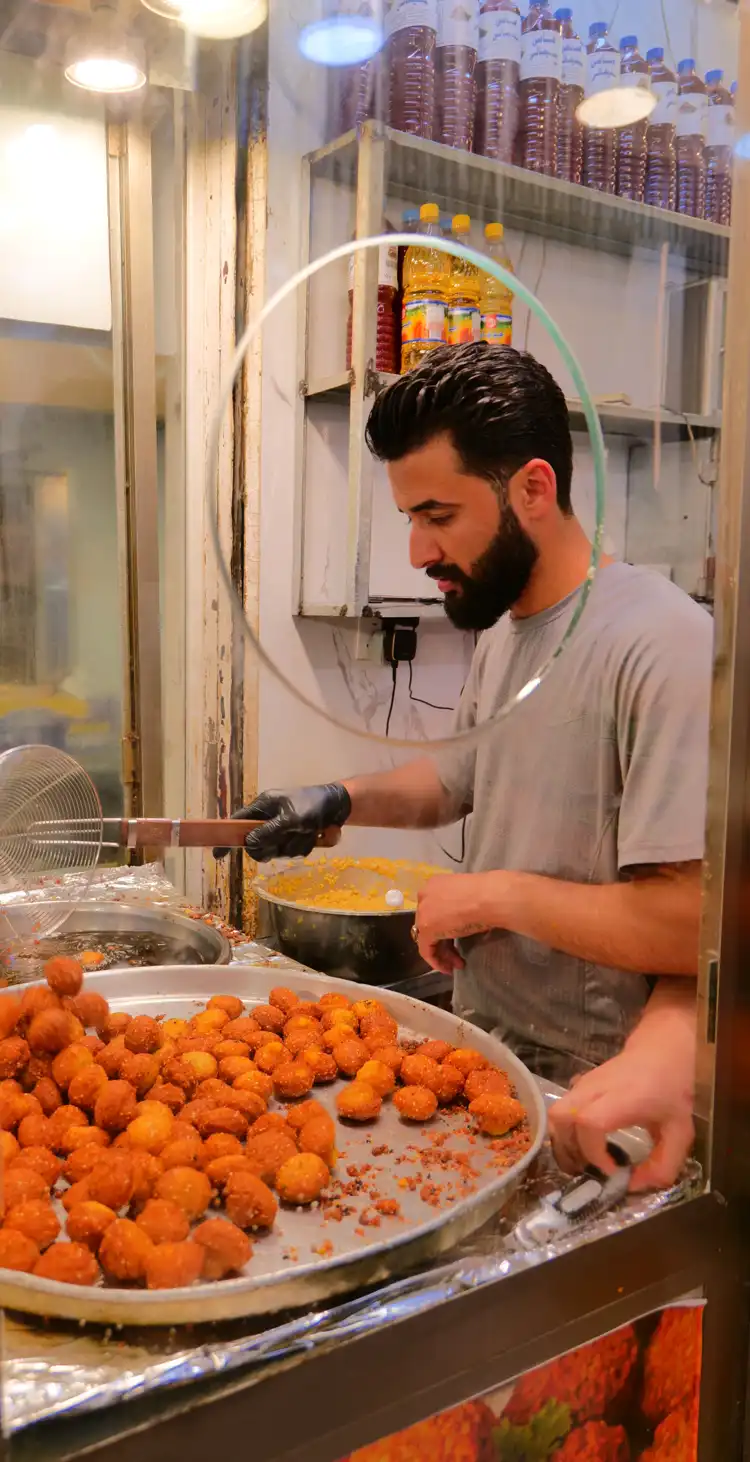
  • meals: Supermarket Survival: flatbread, cheese, tomatoes, tins of tuna, fruit—$3-5/day if you actually eat what locals buy and skip imported snacks. Street food reality: falafel/egg sandwiches $0.50-1.00, kebab plates $2-4, tea is pocket change, coffee is foreign-priced. Sit-down grills and fish (masgouf) explode your budget ($10-20+). Compared to Jordan or the Gulf, you eat well here for half the price; Kurdistan is closer to eastern Turkey on costs.
  • local transport: The cheapest way to unlock the country is shared taxis and minibuses from city “garaj” stands—set fares, you wait until full, and you’re moving fast without private-hire markup. City buses/minibuses: 500-1,000 IQD. Typical shared taxi legs:
read more 👉
$35-55/day in federal Iraq is realistic for a tight budget; add 20-30% in Kurdistan where taxis and beds run higher.
  • dorm accommodation: $8-15 per bed in Baghdad, Najaf, Basra; $12-20 in Erbil/Sulaymaniyah. Basic privates start around $20-35 if you split. System tip: message hostels/guesthouses on WhatsApp the day before and ask for the “local cash rate” in IQD—walk-in prices quoted in USD are almost always higher; pay in dinar and arrive before dusk to dodge “security excuse” surcharges.
  • meals: Supermarket Survival: flatbread, cheese, tomatoes, tins of tuna, fruit—$3-5/day if you actually eat what locals buy and skip imported snacks. Street food reality: falafel/egg sandwiches $0.50-1.00, kebab plates $2-4, tea is pocket change, coffee is foreign-priced. Sit-down grills and fish (masgouf) explode your budget ($10-20+). Compared to Jordan or the Gulf, you eat well here for half the price; Kurdistan is closer to eastern Turkey on costs.
  • local transport: The cheapest way to unlock the country is shared taxis and minibuses from city “garaj” stands—set fares, you wait until full, and you’re moving fast without private-hire markup. City buses/minibuses: 500-1,000 IQD. Typical shared taxi legs: Baghdad-Karbala/Najaf $6-10, Baghdad-Basra $12-18, Erbil-Duhok $4-7. Use inDriver/Careem inside big cities to avoid the “tourist price.” Domestic flights drain money and time; buses are cheaper and almost as quick once you factor airport faff.
  • activities: Major cost drivers are distance and boats, not tickets. Many shrines and ruins are free or a couple of dollars; Baghdad Museum/forts/ziggurats are modest fees with occasional camera charges. Mesopotamian Marshes boat tours run roughly $15-30 per boat—fill seats to split. Remote ruins (Hatra, Ur, Assyrian sites) get pricey if you need a car/driver; pair up with other travelers and negotiate by the kilometer. Versus Jordan, you’ll spend less on entry but more on moving between places.
  • miscellaneous: Budget leaks: airport currency exchange spreads (swap small only, then use town exchangers), ATMs with fat foreign fees or no foreign cards (carry crisp USD as backup), data SIMs that expire fast if you buy tiny bundles (get 10-20 GB; 10-20k IQD), “final-mile” taxis from out-of-town stations, bottled water bought one-by-one (buy 6-packs), coffee chains that charge Dubai prices, and holiday spikes in Najaf/Karbala beds during pilgrimages. Always quote/confirm in IQD, not USD—this alone saves 10-15% over a week.
⚠️ Prices can change and everyone travels differently, so take this as a rough guide. Hope it helps you plan your adventure!

✈️ The backpacker research shortcutIraq Travel Guide

An offline-friendly backpacking guide with optimized travel routes, ranked highlights, transport advice, and the best areas to stay.
example page 0 from our offline Travel Guide for Iraqexample page 1 from our offline Travel Guide for Iraqexample page 2 from our offline Travel Guide for Iraqexample page 3 from our offline Travel Guide for Iraqexample page 4 from our offline Travel Guide for Iraqexample page 5 from our offline Travel Guide for Iraqexample page 6 from our offline Travel Guide for Iraqexample page 7 from our offline Travel Guide for Iraq
The digital guide (375 pages) contains:
107 highlights, ranked by travel appeal
Optimized 5, 10 & 15-day travel routes
Cities, national parks, landmarks, beaches
How to get around
Offline-friendly for travel without Wi-Fi
👉 Click to see all 30+ guide features

📅 Plan smarter in minutes, not weeks
Month by month travel advice
Festivals & national holidays
Budget expectations

🗺️ Go to the right places, skip the overrated ones
Honest pros & cons of destinations
Top hikes, parks & viewpoints
Lesser-known places most travelers miss
Clear “worth it vs skip it” guidance

🛏️ Travel smoothly without rookie mistakes
Best areas to stay
Transport systems explained simply
Common scams & safety advice
SIM cards, money & practical tips

🌍 Understand the country, not just visit it
Culture & traditions
52 Essential phrases & customs
Festivals worth planning around
Traveler-friendly historical context
Insights that make places more meaningful

📱 Built for real travel conditions
Fully downloadable PDF
Works completely offline
Optimized for phone use
Useful in remote areas & buses
Everything in one place
Save weeks of stressful planning
Get instant access to your full guide. 30‑day money-back guarantee.


By proceeding you agree to our terms.
Sent to your inbox immediately after payment • 100% Secure Checkout
Best Backpacking Travel Advisor 2025 tourism awardBest Backpacking
Travel Advisor
2025
What others say about Take Your Backpack Guides:
⭐⭐⭐⭐⭐
Fantastic, amazing amount of information!
⭐⭐⭐⭐⭐
My goodness this is amazing, it's what I've been looking for hats off too you!
⭐⭐⭐⭐⭐
I think this is absolutely BRILLIANT
⭐⭐⭐⭐
Very complete and informative. It's still missing places, but I gotta to commend you
⭐⭐⭐⭐⭐
This is truly amazing, thank you, can't wait to explore it with my kids!
⭐⭐⭐⭐⭐
Awesome resource, thank you!
⭐⭐⭐⭐⭐
This is amazing! Can't wait to explore the ones I haven't seen
⭐⭐⭐⭐
I love this! Well done, great idea.
⭐⭐⭐⭐⭐
Thanks for taking the time to make this gem!
⭐⭐⭐⭐⭐
This might be the best website I've ever seen.
⭐⭐⭐⭐⭐
Congratulations, and thank you so much for your work; it's incredibly valuable.
⭐⭐⭐⭐
In all seriousness I think you did a great job pointing out the important spots
⭐⭐⭐⭐⭐
10/10 very good
⭐⭐⭐⭐⭐
As someone who's only just starting to visit regularly this is awesome, thank you.
⭐⭐⭐⭐
Thank you very much! I'm going to visit my dad, it's going to be very useful!
⭐⭐⭐⭐⭐
This is really cool! We'll be travelling for the first time and this definitely come in handy.
⭐⭐⭐⭐⭐
You are now our minister of culture, congratulations 👨‍💼
⭐⭐⭐⭐⭐
Just wanted to tell you that this is a pearl! Going to follow your recommendations.
⭐⭐⭐⭐⭐
This is so cool. I'll definitely be using the resource for my travels soon.
⭐⭐⭐⭐⭐
This is very impressive! Good work.
⭐⭐⭐⭐⭐
This is an amazing and informative site. Very well done!

🛏️ Where to stay?Best areas to base yourself

Yes — hostels and cheap guesthouses exist in Iraq but they’re concentrated and limited: the best and safest budget options are in Iraqi Kurdistan (Erbil city centre and the Ankawa suburb, and Sulaymaniyah centre), pilgrim hubs (Najaf and Karbala) offer many low-cost guesthouses, while Baghdad (Karrada and Mansour) and Basra tend to have a few budget hotels rather than backpacker hostels.

Erbil/Ankawa — safer and more tourist-friendly with cafes, nightlife and easier hostel availability but slightly pricier and routine ID/security checks; Sulaymaniyah — lively, affordable local guesthouses with … read more 👉
Yes — hostels and cheap guesthouses exist in Iraq but they’re concentrated and limited: the best and safest budget options are in Iraqi Kurdistan (Erbil city centre and the Ankawa suburb, and Sulaymaniyah centre), pilgrim hubs (Najaf and Karbala) offer many low-cost guesthouses, while Baghdad (Karrada and Mansour) and Basra tend to have a few budget hotels rather than backpacker hostels.

Erbil/Ankawa — safer and more tourist-friendly with cafes, nightlife and easier hostel availability but slightly pricier and routine ID/security checks; Sulaymaniyah — lively, affordable local guesthouses with fewer international services; Najaf/Karbala — very cheap and abundant near shrines but often overcrowded during pilgrimage seasons and socially conservative; Baghdad (Karrada/Mansour) — central access to museums and restaurants but sparse hostel options and visible security measures; Basra — limited, basic hotels and variable conditions.

If you enjoy meeting fellow travelers, consider choosing hostels with high ratings for atmosphere. On the other hand, if you prefer having your own space, a hotel might be a better option.

🚌 Getting aroundHow to travel within the country

Iraq moves on the logic of the full seat, not the clock. Things leave when they’re ready, routes bend around checkpoints and tea breaks, and a driver’s cousin can be more reliable than any printed timetable. You can fight it and burn energy, or lean in and surf the flow: start early, carry small bills, accept detours, and you’ll get where you’re going with enough left in the tank to actually enjoy being there.
  • Shared intercity taxi The fastest way between big cities, but you pay for speed with dinars
read more 👉
Iraq moves on the logic of the full seat, not the clock. Things leave when they’re ready, routes bend around checkpoints and tea breaks, and a driver’s cousin can be more reliable than any printed timetable. You can fight it and burn energy, or lean in and surf the flow: start early, carry small bills, accept detours, and you’ll get where you’re going with enough left in the tank to actually enjoy being there.
  • Shared intercity taxi The fastest way between big cities, but you pay for speed with dinars and nerves. Seats price per person and cars leave when four bodies fill them; paying for the empty seat buys you a head start. A Baghdad-Basra run is usually 25,000-40,000 IQD per seat and 6-7 hours if checkpoints behave; buses cost less but can add two hours. AC might wheeze, trunk space is rationed (expect a 2-5k IQD “bag fee”), and night driving isn’t worth the risk. Sit front if you want leg room, carry photocopies of your passport for stops, and never film at checkpoints. Friday mid-day slows; pre-dawn moves.
  • City minibus (Kia/Coaster) This is the bloodstream of Baghdad, Basra, and the shrine cities. Routes are semi-fixed, stops are wherever a hand goes up, and you pay by passing a 500-1,500 IQD note forward with a quick “min fadhlak.” Keep coins and small bills; big notes stall the whole bus. Families get priority on the front row, men slide back without complaint, and you give your seat to elders without being asked. Say “nazzil” when you want off, stash bags on your lap, and don’t argue politics with the driver—weather and football are safer. After dark, frequency drops and prices creep.
  • Tigris/Shatt water boats Bridges choke. Boats don’t. Short hops on the Tigris in Baghdad or skiffs in Basra cut 45 minutes of gridlock to a five-minute glide for roughly 1,000-5,000 IQD. Agree price before you step in, sit center to balance, and protect your phone; wakes can be surprising. Heading to the marshes around Chibayish, the only way to reach reed villages is by boat—go early for calm water and to dodge the noon blaze.
  • Iraqi Railways night train The hack that undercuts taxis. Baghdad-Basra sleepers are cheap (think a simple dinner’s price), slower on paper but efficient in reality: you sleep, skip a hotel bill, and the rails breeze past highway hassles. Buy at Baghdad Central, bring ID, expect fluorescent lights, basic bathrooms, and arrival that can be an hour late without anyone apologizing. On pilgrimage weeks it sells out; on normal days you can often walk up. Lock your bag, keep your shoes near your pillow, and let the carriage do the work.

Master tip: Pick your garage at first light—Allawi for south/west (Karbala, Najaf, Basra), Al-Nahda for north/east—and pay for the extra seat on the first taxi out; that one move buys back a full day across Iraq.
Baghdad International Airport (BGW) sits about 22 km (14 mi) west of the city center (around Tahrir Square).

Public transport is limited. There’s no train/metro, and city buses don’t come into the terminal because of security. Your cheapest option is to reach the airport gate and continue from there, or use a ride-hailing app.
  • Local minibus/shared taxi from the airport gate (cheapest): Take the airport shuttle to the outer gate by Abbas Ibn Firnas Square, then hop on a minibus or shared taxi toward Mansour, Bab Al-Muadham/Tahrir, or Karrada.

    Time: 45-75 minutes door to door, depending on traffic and waiting.

    Cost: 1,000-2,500 IQD per seat (about US$0.75-$2). The internal shuttle to the gate may run free or for a small nominal fee when operating.
  • Ride-hailing apps (e.g., Careem): Usually allowed to pick up at the car park/outer area—follow the app’s pickup pin or ask security where ride-hail pickups wait. Airport Wi-Fi works long enough to book.

    Time: 30-60 minutes, longer at rush hour.

    Cost: 15,000-30,000 IQD off-peak; up to 35,000-40,000 IQD in heavy traffic or late at night.

Taxis: Official airport taxis wait outside arrivals and quote fixed rates by zone. To central Baghdad (Tahrir/Karrada/Mansour), expect around 25,000-45,000 IQD (roughly US$19-$35), depending on time of day and traffic. Agree the price before you ride; meters are uncommon.

Notes: Traffic can be slow at peak hours (roughly 07:00-10:00 and 15:00-19:00), and checkpoints may add a few minutes. Have small IQD bills for minibuses and shared taxis.
⚠️ Prices and routes can change, so take this as a rough guide and ask for local advice when you arrive.
🚀 Don’t waste time on the road.
We’ll generate a route that minimizes unnecessary travel and fits your available days.

Generate my itinerary

🔒 Safety (risk Level: high)Staying safe while traveling

Safety for solo travelers, including women and LGBTQ+ individuals
Iraq’s safety for solo travelers, including women and LGBTQ+ individuals, varies greatly by region. Kurdistan in the north is relatively safer, but the rest of Iraq remains unpredictable due to security concerns and cultural norms. Women should dress conservatively and be cautious, while LGBTQ+ travelers must be discreet as same-sex relationships are not widely accepted. Always check the latest travel advisories and connect with locals or expat communities for up-to-date advice.


Full official government travel advisory (live updates)
View details 👉
safety image

source: www.gov.uk

✈️ VisaEntry requirements and paperwork

Most travelers need a visa to visit Iraq. You can apply for an e-visa online through the official Iraq e-visa portal or visit an Iraqi consulate or embassy in your country. Always check the latest requirements as they can change often.

source: mofa.gov.iq
⚠️ Visa requirements can change over time, so always check the latest visa requirements with the official embassy or government website before you travel.

🎒 What to pack?What to wear and bring

Iraq’s climate swings between scorchingly hot summers and surprisingly chilly winters, especially in the north, so pack with layers in mind. The terrain varies from the desert to the lush mountains of Kurdistan, so sturdy, breathable footwear is a must. Cultural norms lean toward modest dress, so keep shoulders and knees covered, especially when visiting mosques or more conservative areas. Women might want to carry a light scarf for head-covering when needed. Always have a sunhat and sunscreen at the ready for those unrelenting sunny days.

Apart from this country specific advice, I have also crafted a general packing list that should help on any trip. authorOver the years, I've learned the importance of packing minimally. It's so much easier to jump on the back of a truck or squeeze yourself into the last spot of a minibus without that supersized backpack. If you're headed to a warm destination, leave your winter jacket at home; for colder regions, opt for thin thermal underlayers. Instead of packing your entire wardrobe, bring just three sets of clothes, as laundry facilities are available everywhere.

View the full list 👉
🎒 Planning the practical side of your trip?
Get detailed information on transport, daily budgets, internet access, local customs, food, language, and other essentials in the complete Travel Guide.

Get detailed practical information 👉

Get the Travel Guide -

🙋 FAQQuick answers to practical concerns

Trip Planning

Planning a backpacking route through Iraq can be tricky — you need to balance must-see places, travel times, budget, and how long to stay in each destination. Our personalized Iraq itinerary planner creates a route based on your travel style, trip duration, and interests, so you can spend less time researching and more time exploring.


Personal tip: I normally search on good rating for atmosphere (for meeting people) and location (for easy exploring). Cleanliness as a bonus.


Travel Essentials

Hepatitis A and B, typhoid, and routine vaccines (MMR, diphtheria-tetanus-pertussis, polio) are recommended for travel to Iraq. Consider rabies if you’re planning outdoor activities. Malaria risk is low but check with a healthcare provider for the latest advice. Ensure you’re up-to-date on COVID-19 vaccinations. Always consult a healthcare professional before traveling.


vaccination requirements
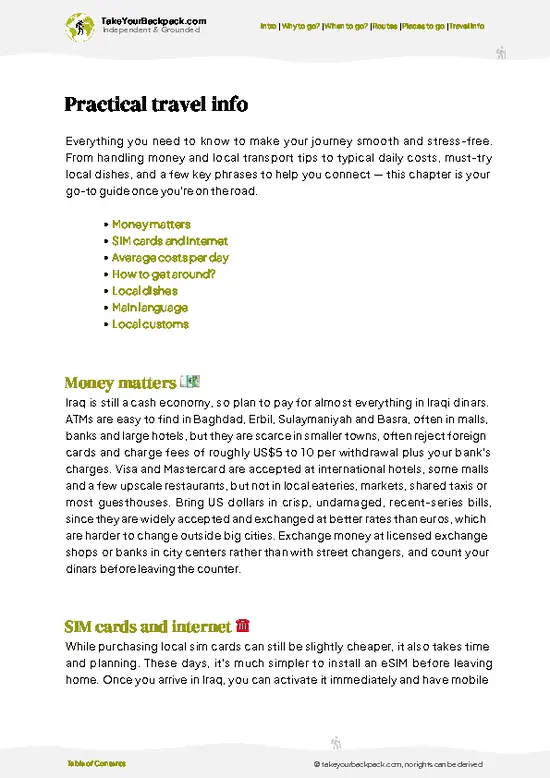
When I first started traveling, I often spent part of my first day in a new country hunting for a local SIM card. While this can still be slightly cheaper, it also takes time and planning.

These days, it's much simpler to install an eSIM before leaving home. Once you arrive in Iraq, you can activate it immediately and have mobile data from the moment you land — which is especially useful for ordering transport or navigating away from busy airports.

There are many providers nowadays, and price differences are usually small. I personally go with Airalo, as it offers excellent network coverage throughout the country and strong global coverage, so you can manage multiple countries from a single app.


Get your e-sim for Iraq

Culture & Customs

Dress modestly; both men and women should cover shoulders and knees. Women might consider wearing a headscarf in more conservative areas. Public displays of affection are frowned upon. Always use your right hand for eating and greeting, as the left is considered unclean. Remove shoes when entering someone’s home.

For LGBTQ+ travelers, discretion is advised due to conservative societal norms. Women should be cautious when traveling alone and may consider group travel for added safety. Always ask permission before taking photos of people, especially women and children.
Trying traditional food is always a great way to experience the culture. Here are some must-try dishes for Iraq.
  • Masgouf: Often dubbed the national dish of Iraq, Masgouf is a slow-grilled fish, typically carp, that’s been marinated with olive oil, salt, and tamarind. It’s a cultural staple, frequently enjoyed alongside family and friends, making it as much about the experience as the taste.
  • Kubba (Kibbeh): These are deep-fried bulgur shells stuffed with spiced minced meat and onions. Popular for their crunchy exterior and flavorful filling, Kubba is a go-to comfort food that’s usually served at gatherings, highlighting its cultural importance.
  • Dolma: A mix of vegetables like peppers, onions, and grape leaves stuffed with rice, herbs, and sometimes meat. This dish is a staple at family meals and celebrations, showcasing the communal and festive aspect of Iraqi dining.
  • Biryani: An Iraqi twist on the classic rice dish, this version is loaded with spices, nuts, raisins, and a choice of meat, usually chicken or lamb. It’s a favorite for its rich flavors and is a centerpiece at many festive occasions and family gatherings.
  • Tepsi Baytinijan: A hearty casserole made with eggplants, tomatoes, potatoes, and minced meat, all baked together. Loved for its comforting layers and flavors, it’s a dish that reflects the Iraqi knack for blending simple ingredients into something special.
Tap water in Iraq isn’t recommended for tourists; locals often drink it, but their stomachs are more accustomed to it. Stick to bottled or filtered water to avoid any potential issues. Always check the seal on bottled water to ensure it’s intact.
The main language in Iraq is Arabic. Backpacking is way more rewarding if you know a bit of the local language, so I'd suggest brushing up on the basics just in case your Arabic skills have become a bit rusty.

Want to understand locals better?
The complete Travel Guide for Iraq includes 52 essential words and phrases — greetings, thank-yous, ordering food, transport, numbers, and common local expressions you'll actually hear.

Get your local basic phrases 👉

Get the Travel Guide -


English proficiency in Iraq varies significantly by region and demographic. In urban areas like Baghdad and Erbil, especially among younger generations and professionals, English is more commonly spoken due to educational systems and exposure to Western media. Many university students and those working in tourism, hospitality, and international business may have a good command of the language.

However, in rural areas and among older populations, English is less prevalent, and communication may rely more on Arabic or Kurdish. While many signs in cities may be bilingual, travelers should not assume widespread English understanding.

It’s advisable for visitors to learn basic Arabic phrases or carry a translation app to facilitate communication. Engaging with locals often leads to warm interactions, even with language barriers. Overall, while English is spoken in Iraq, especially in certain contexts, it is not universally understood, so preparation is essential for effective communication.

Money & Payments

The local currency of Iraq is IQD (ع.د).

When backpacking in Iraq, it’s best to plan ahead regarding money. ATMs are not evenly distributed; you’ll find them in bigger cities like Baghdad and Erbil, but they can be scarce in rural areas. Always have a plan B for cash access.

Carry a decent amount of cash, as cards aren’t widely accepted outside of major hotels and some upscale restaurants. US dollars are more commonly accepted than euros, so stash a good supply, but make sure the bills are in good condition (no tears or marks).

For exchanging money, use official exchange offices or banks in cities for the safest rates. Avoid street exchangers to dodge scams. Keep in mind that exchange rates fluctuate, so check before changing large amounts.

Bottom line: have a mix of US dollars and Iraqi dinars, and don’t rely solely on your card. Keep your cash safe and split it up in different places on your person and in your gear. Safe travels!

Tipping in Iraq isn’t mandatory, but it’s appreciated. In restaurants, leaving around 10% is a nice gesture if service was decent. For taxi drivers and hotel staff, rounding up or giving small tips shows gratitude.

🧩 Nearby countriesSimilar backpacking destinations

📸 PhotosMoments captured along the way

Take your backpack - Iraq - 0
Take your backpack - Iraq - 1
Take your backpack - Iraq - 2
Take your backpack - Iraq - 3
Take your backpack - Iraq - 4
Take your backpack - Iraq - 5
Take your backpack - Iraq - 6
Take your backpack - Iraq - 7
Take your backpack - Iraq - 8
Take your backpack - Iraq - 9
Take your backpack - Iraq - 10
Take your backpack - Iraq - 11
Take your backpack - Iraq - 12
Take your backpack - Iraq - 13
Take your backpack - Iraq - 14
Take your backpack - Iraq - 15
Photographed by: Johan Kruseman

We 💚 feedbackIs Iraq worth visiting?

Go to Iraq for the feeling of history under your boots: Ur’s ziggurat at sunrise, Karbala’s pilgrims, and the Kurdish highlands with tea forced into your hand. The catch: logistics punch above their weight. Checkpoints, sudden closures, and scarce public transport mean private cars and time buffers, which quietly drain cash and patience. It rewards steady, adaptable travelers who pack modesty, offline maps, and a long fuse. It’s not for clock-watchers, hostel-hoppers, or anyone needing comfort or nightlife on demand.

✍️ Help improve this page!
The information on this page is based on in-depth research, insights shared by experienced travelers, and feedback from the local travel community in Iraq. While every effort is made to keep the information accurate and current, conditions can change — so if you spot anything incorrect or outdated, please get in touch.


🙋‍♂️ Give feedback

👋 Meet the founderWho’s Behind Take Your Backpack?

Johan, backpacker and founder of TakeYourBackpackHi, I’m Johan (Netherlands 🇳🇱), the creator of TakeYourBackpack. Over the past decade, I’ve backpacked through 80+ countries across six continents, gaining extensive experience with independent travel, long-term trips, and overland routes.

This site is built on a combination of firsthand travel experience and carefully curated insights from other backpackers. Many guides are based on places I’ve personally visited, while others bring together tips, observations, and practical advice shared by trusted travelers I’ve met along the way.

The goal is to provide realistic, experience-driven guidance — not generic itineraries — so you can explore destinations with better context, clearer expectations, and more confidence.

Get full Iraq guide •
Instant download • 107 highlights • Full Offline guide