×

Equatorial Guinea🇬🇶 | best national parksTop-Rated 6 national parks in Equatorial Guinea

National parks in Equatorial Guinea are few, lightly visited and equipped with very little visitor infrastructure. The mainland region of Río Muni holds inland rainforest reached by long road transfers, while Bioko island has volcanic highlands and black-sand coasts within reach of Malabo. Costs run high for Central Africa and crowds are almost nonexistent. Backpacking here is possible, but it depends on permits, a local guide and patience.

By Johan Kruseman 🇳🇱 | Updated October 9, 2026
Explore the best hikes in Equatorial Guinea

Why go?Key Factors That Shape the Experience

Equatorial Guinea suits protected-area travel because so much of it is still forest. Low population density, a small land area and decades of limited tourism have left large stretches of rainforest, mountain and coast with little pressure from visitors. The country’s oil income has funded roads and airports, but not a tourism industry, so the experience is undeveloped rather than polished.

Before choosing it, know that a visa is required and must be arranged ahead, and that proof of yellow fever vaccination is expected at entry. Trails are often unmarked, accommodation near protected areas is basic or absent, and park access is usually organized through the environment authorities or local operators rather than at a gate. Spanish is the main working language, with French and Portuguese also … read more 👉
Equatorial Guinea suits protected-area travel because so much of it is still forest. Low population density, a small land area and decades of limited tourism have left large stretches of rainforest, mountain and coast with little pressure from visitors. The country’s oil income has funded roads and airports, but not a tourism industry, so the experience is undeveloped rather than polished.

Before choosing it, know that a visa is required and must be arranged ahead, and that proof of yellow fever vaccination is expected at entry. Trails are often unmarked, accommodation near protected areas is basic or absent, and park access is usually organized through the environment authorities or local operators rather than at a gate. Spanish is the main working language, with French and Portuguese also official. Prices are set by an oil economy, so budget well above what neighboring countries cost.
Evaluating the Top Choices
The list of best national parks in Equatorial Guinea is created based on landscapes, wildlife, adventure opportunities, facilities, and overall experience. If you feel a national park is missing in this list, please let us know.

When to go?Seasonal Guide to Visiting

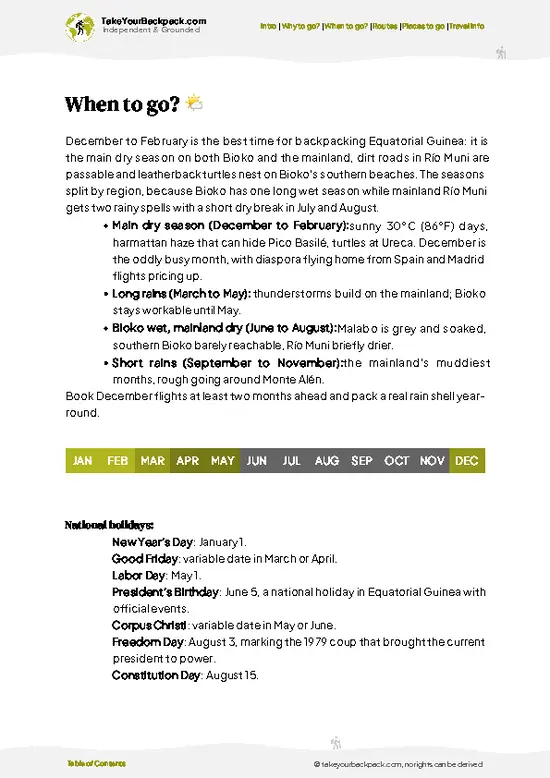
Best months: The best months are December to February, when the main dry season lowers rainfall and makes forest tracks passable. Lowland temperatures stay around 22 to 31°C all year, so rain, not heat, decides timing.
Regional differences: On the mainland coast and inland, there is a second shorter dry spell from June to August, with the wettest months in March to May and September to November. On Bioko, the wet season runs roughly April to October, and the southern end can receive several thousand millimeters a year, so dry months matter more there. Sea turtle nesting on the island’s southern beaches runs from about November to February, which overlaps the best weather.
Crowds and prices: Crowds are negligible in every month. Flights and hotels in Malabo and Bata cost the same across seasons, … read more 👉
Best months: The best months are December to February, when the main dry season lowers rainfall and makes forest tracks passable. Lowland temperatures stay around 22 to 31°C all year, so rain, not heat, decides timing.
Regional differences: On the mainland coast and inland, there is a second shorter dry spell from June to August, with the wettest months in March to May and September to November. On Bioko, the wet season runs roughly April to October, and the southern end can receive several thousand millimeters a year, so dry months matter more there. Sea turtle nesting on the island’s southern beaches runs from about November to February, which overlaps the best weather.
Crowds and prices: Crowds are negligible in every month. Flights and hotels in Malabo and Bata cost the same across seasons, but guides and vehicles are easier to book in the dry months.

national park hoppingHow to Combine national parks Into One Trip

Time needed: A trip combining several national parks in Equatorial Guinea needs 7 to 10 days, because transfers are slow and some days will be lost to weather or paperwork.
Grouping and direction: Treat Bioko and Río Muni as two separate blocks. Bioko works from Malabo, with the south reached on a road of roughly 2 to 4 hours depending on conditions. Río Muni works from Bata, with inland stops usually 2 to 5 hours away by road. Start on Bioko, then fly Malabo to Bata (about 1 hour) and finish on the mainland, where delays are more likely. Allow 2 to 3 days per stop.
Planning mistakes: Travelers often book tight flight connections, even though schedules shift. Leave a buffer day on each side. Many also underestimate road times in the rains, so add several hours. Arrange permits and guides before … read more 👉
Time needed: A trip combining several national parks in Equatorial Guinea needs 7 to 10 days, because transfers are slow and some days will be lost to weather or paperwork.
Grouping and direction: Treat Bioko and Río Muni as two separate blocks. Bioko works from Malabo, with the south reached on a road of roughly 2 to 4 hours depending on conditions. Río Muni works from Bata, with inland stops usually 2 to 5 hours away by road. Start on Bioko, then fly Malabo to Bata (about 1 hour) and finish on the mainland, where delays are more likely. Allow 2 to 3 days per stop.
Planning mistakes: Travelers often book tight flight connections, even though schedules shift. Leave a buffer day on each side. Many also underestimate road times in the rains, so add several hours. Arrange permits and guides before leaving the capital, not on arrival at a trailhead.

The ListHighly Recommended national parks of Equatorial Guinea

1 Parque Nacional de Monte Alén

jungle trails, forest elephants, cascading rivers, remote camps

Venture deep into thick rainforest, crossing rivers and tracking wildlife in a park known for its challenging terrain and biodiversity.

2 Pico Basile National Park

highest peak, panoramic views, montane forest, volcanic rock formations

Ascend winding paths to Equatorial Guinea’s highest summit, passing through cool forests and rocky outcrops with sweeping island vistas.

3 Gran Caldera Scientific Reserve

ancient volcanic crater, dense cloud forest, rare primates, endemic birds

Hike through misty forests where elusive drill monkeys and unique birdlife thrive in the shadow of a vast volcanic caldera.

equatorial-guinea-national-park-gran-caldera-scientific-reserve
© Google |

4 Altos de Nsork National Park

rolling hills, river valleys, chimpanzee habitat, remote savanna

Traverse undulating hills and river valleys, watching for chimpanzees and exploring the transition between forest and open savanna.

5 Reserva Natural de Moka

highland grasslands, crater lakes, butterfly species, traditional villages

Walk open highlands dotted with lakes and butterflies, then visit nearby villages to glimpse local life in Bioko’s interior.

6 Iladyi National Park

coastal rainforest, mangrove swamps, marine turtles, tidal estuaries

Follow forest trails to tidal estuaries where mangroves meet the sea and marine turtles nest along quiet, undeveloped beaches.

equatorial-guinea-national-park-iladyi-national-park
© Google |
Loading the map 🌍

Expert viewInsights from Locals and Experts

How many to visit: Plan on two national parks, one on Bioko and one on the mainland. Access takes up most of each trip, permits and guides are arranged per visit, and weather can remove a day. A third stop usually means rushing three long transfers for little extra time on the ground.
Which kind to prioritize: Choose mainland rainforest for primate and bird-focused trekking with camping, and expect basic conditions. Choose Bioko for shorter, easier trips from Malabo, with highland hiking and, in season, beach-based turtle watching. Travelers short on time or comfort should stay with Bioko.
What it costs: Equatorial Guinea is expensive. Budget US$100 to 200 a day (about 60,000 to 120,000 XAF), mostly for lodging. Malabo and Bata hotels run US$70 to 150 a night, and guesthouses near parks cost … read more 👉
How many to visit: Plan on two national parks, one on Bioko and one on the mainland. Access takes up most of each trip, permits and guides are arranged per visit, and weather can remove a day. A third stop usually means rushing three long transfers for little extra time on the ground.
Which kind to prioritize: Choose mainland rainforest for primate and bird-focused trekking with camping, and expect basic conditions. Choose Bioko for shorter, easier trips from Malabo, with highland hiking and, in season, beach-based turtle watching. Travelers short on time or comfort should stay with Bioko.
What it costs: Equatorial Guinea is expensive. Budget US$100 to 200 a day (about 60,000 to 120,000 XAF), mostly for lodging. Malabo and Bata hotels run US$70 to 150 a night, and guesthouses near parks cost less when available. Park permits and entry fees are modest, roughly US$10 to 30 per visit, while a guide costs US$30 to 60 a day and a 4x4 with driver US$100 to 200 a day. Domestic flights between Malabo and Bata cost roughly US$100 to 200 return. A single park visit of two to three days typically totals US$300 to 700 including transport. Carry cash in XAF, as cards and ATMs are unreliable outside the cities.
Safety and conduct: Expect police and military checkpoints on roads. Carry your passport, visa and vaccination certificate, or clear copies, and stay patient and polite. Photographing government buildings, airports and officials can cause serious problems, so ask first. Malaria is present nationwide, so take prophylaxis and cover up at dusk. Hike with a guide, since trails are poorly marked and forest navigation is hard. Villages near protected areas are mostly Fang on the mainland and Bubi on Bioko, so greet the village head on arrival and ask before photographing people. Do not buy or eat bushmeat, which is sold openly but threatens the forests you came to see.

✈️ The backpacker research shortcutEquatorial Guinea Travel Guide

An offline-friendly backpacking guide with optimized travel routes, ranked highlights, transport advice, and the best areas to stay.
example page 0 from our offline Travel Guide for Equatorial Guinea
example page 1 from our offline Travel Guide for Equatorial Guinea
example page 2 from our offline Travel Guide for Equatorial Guinea
example page 3 from our offline Travel Guide for Equatorial Guinea
example page 4 from our offline Travel Guide for Equatorial Guinea
example page 5 from our offline Travel Guide for Equatorial Guinea
example page 6 from our offline Travel Guide for Equatorial Guinea
example page 7 from our offline Travel Guide for Equatorial Guinea
The digital guide (199 pages) contains:
✅ 48 highlights, ranked by travel appeal
✅ Optimized 2, 3 & 5-day travel routes
✅ Cities, national parks, landmarks, beaches
✅ How to get around
✅ Offline-friendly for travel without Wi-Fi
👉 Click to see all 30+ guide features

📅 Plan smarter in minutes, not weeks
✅ Month by month travel advice
✅ Festivals & national holidays
✅ Budget expectations

🗺️ Go to the right places, skip the overrated ones
✅ Honest pros & cons of destinations
✅ Top hikes, parks & viewpoints
✅ Lesser-known places most travelers miss
✅ Clear “worth it vs skip it” guidance

🛏️ Travel smoothly without rookie mistakes
✅ Best areas to stay
✅ Transport systems explained simply
✅ Common scams & safety advice
✅ SIM cards, money & practical tips

🌍 Understand the country, not just visit it
✅ Culture & traditions
✅ 52 Essential phrases & customs
✅ Festivals worth planning around
✅ Traveler-friendly historical context
✅ Insights that make places more meaningful

📱 Built for real travel conditions
✅ Fully downloadable PDF
✅ Works completely offline
✅ Optimized for phone use
✅ Useful in remote areas & buses
✅ Everything in one place
Save weeks of stressful planning
Get instant access to your full guide. 30‑day money-back guarantee.
+ Add another guide for just

By proceeding you agree to our terms.
Sent to your inbox immediately after payment • 100% Secure Checkout
Best Backpacking Travel Advisor 2025 tourism awardBest Backpacking
Travel Advisor
2025
What others say about Take Your Backpack Guides:
⭐⭐⭐⭐⭐
Fantastic, amazing amount of information!
⭐⭐⭐⭐⭐
My goodness this is amazing, it's what I've been looking for hats off too you!
⭐⭐⭐⭐⭐
I think this is absolutely BRILLIANT
⭐⭐⭐⭐
Very complete and informative. It's still missing places, but I gotta to commend you
⭐⭐⭐⭐⭐
This is truly amazing, thank you, can't wait to explore it with my kids!
⭐⭐⭐⭐⭐
Awesome resource, thank you!
⭐⭐⭐⭐⭐
This is amazing! Can't wait to explore the ones I haven't seen
⭐⭐⭐⭐
I love this! Well done, great idea.
⭐⭐⭐⭐⭐
Thanks for taking the time to make this gem!
⭐⭐⭐⭐⭐
This might be the best website I've ever seen.
⭐⭐⭐⭐⭐
Congratulations, and thank you so much for your work; it's incredibly valuable.
⭐⭐⭐⭐
In all seriousness I think you did a great job pointing out the important spots
⭐⭐⭐⭐⭐
10/10 very good
⭐⭐⭐⭐⭐
As someone who's only just starting to visit regularly this is awesome, thank you.
⭐⭐⭐⭐
Thank you very much! I'm going to visit my dad, it's going to be very useful!
⭐⭐⭐⭐⭐
This is really cool! We'll be travelling for the first time and this definitely come in handy.
⭐⭐⭐⭐⭐
You are now our minister of culture, congratulations 👨‍💼
⭐⭐⭐⭐⭐
Just wanted to tell you that this is a pearl! Going to follow your recommendations.
⭐⭐⭐⭐⭐
This is so cool. I'll definitely be using the resource for my travels soon.
⭐⭐⭐⭐⭐
This is very impressive! Good work.
⭐⭐⭐⭐⭐
This is an amazing and informative site. Very well done!

🛏️ Where to stay?Where to Base Yourself

Equatorial Guinea has almost no backpacker hostels, so budget accommodation means simple guesthouses and small hotels at roughly XAF 25,000 to 45,000 (US$40 to 75) a night. In Malabo, the old center around the cathedral and Ela Nguema offers the most affordable rooms within walking distance of the seafront and evening bars, though streets get noisy, while Malabo II is calmer and safer-feeling but pricier and car-dependent. In Bata, the center near the seafront promenade puts you close to restaurants, nightlife and shared-taxi stations, with quieter options found in the residential streets further inland.

If you enjoy meeting fellow travelers, consider choosing hostels with high ratings for atmosphere. … read more 👉
Equatorial Guinea has almost no backpacker hostels, so budget accommodation means simple guesthouses and small hotels at roughly XAF 25,000 to 45,000 (US$40 to 75) a night. In Malabo, the old center around the cathedral and Ela Nguema offers the most affordable rooms within walking distance of the seafront and evening bars, though streets get noisy, while Malabo II is calmer and safer-feeling but pricier and car-dependent. In Bata, the center near the seafront promenade puts you close to restaurants, nightlife and shared-taxi stations, with quieter options found in the residential streets further inland.

If you enjoy meeting fellow travelers, consider choosing hostels with high ratings for atmosphere. On the other hand, if you prefer having your own space, a hotel might be a better option.

Equatorial GuineaExpand Your Journey

👋 Meet the founderWho’s Behind Take Your Backpack?

Johan, backpacker and founder of TakeYourBackpackHi, I’m Johan (Netherlands 🇳🇱), the creator of TakeYourBackpack. Over the past 3 decades, I’ve backpacked through 90+ countries across six continents, gaining extensive experience with independent travel, long-term trips, and overland routes.

This site is built on a combination of firsthand travel experience and carefully curated insights from other backpackers. Many guides are based on places I’ve personally visited, while others bring together tips, observations, and practical advice shared by trusted travelers I’ve met along the way.

The goal is to provide realistic, experience-driven guidance — not generic itineraries — so you can explore destinations with better context, clearer expectations, and more confidence.