×
Guadeloupe 🇬🇵

backpacking North America Guadeloupe 🇬🇵
Shift easily between beaches and lush rainforest trails.

Explore GrenadaExplore Guatemala

Backpacking Guadeloupe in 2026

A complete guide including when and where to go, costs, transport, itineraries, and practical travel advice.
The big picture before you go

Backpacking Guadeloupe
By Johan Kruseman 🇳🇱 | Updated June 2, 2026

I saved €30 skipping the rental car and spent two hot hours chasing buses to reach an empty beach. Here, distance is counted in minutes, sweat, and rum stops—book wheels or time ferries right and you win.

Come for the split personality: Grande-Terre’s pale lagoons and breeze, Basse-Terre’s rainforest spine, waterfalls, and the warm breath of La Soufrière. Catch the 7 a.m. ferry to Les Saintes for cliff walks, dive the Cousteau Reserve with turtles, then sip ti’ punch on Marie-Galante. Markets spice the air, gwo-ka drums roll after dark, bokit grease blesses your fingers. You’ll dodge sargassum, quick showers, and the odd French-only shrug—solve it with a small car, leeward beaches, early starts, and bonjour/merci.

Compared with Martinique’s polish, Guadeloupe feels looser and more varied; versus Dominica’s raw hikes, it adds real beaches; against Antigua’s resort sheen, it gives character at self-catering prices. It’s for independent travelers who like to drive, dive, hike, and eat—not for sealed all-inclusives.

👉 Get the 📖 Travel Guide of Guadeloupe

Grande-Terre (Le Gosier–Sainte-Anne–Saint-François)

Base here when you want beach time without burning days in the car. Airport to sand in 15–40 minutes. It costs more (food, lodging), but you trade cash for convenience and nightlife. Park by 10:00, use the N4 early, and sleep in Sainte-Anne to hit the market and quick busier-calm beaches at dawn. Reward: short stays, swimmers, people who want options after sunset.

Basse-Terre West Coast (Malendure–Bouillante)

Water-first, slower pace. The Cousteau Reserve is worth the hour-plus drive over the Route de la Traversée. Roads are twisty; parking is scarce after 9:30. Rent a kayak at 7:30, bring cash for boat shuttles, soak in the roadside hot springs after dinner. Reward: snorkelers and divers. Cost: time and patience, but meals run cheaper and crowds thin at night.

La Soufrière & Rainforest Ridge (Saint-Claude–Route de la Traversée)

Rugged and wet. You pay in sweat, not euros. Start the Soufrière climb by 6:00 to beat clouds; pack a shell and a dry shirt. Chutes du Carbet and Cascade aux Écrevisses are doable in a single day if you keep moving. Reward: hikers who like volcanic steam and mud. Comfort takes the hit.

Les Saintes (Terre-de-Haut)

High-reward day if you plan it tight. First ferry from Trois-Rivières, last ferry back. Rent a scooter in 10 minutes, loop to Pain de Sucre before 11:00, Fort Napoléon during the midday heat. Costs: tickets and rentals; sun exposure is real. Avoid the mid-morning swarm; buy return seats in advance.

Marie-Galante

The quiet, spread-out island. One-hour ferry, then you need wheels; distances are longer than they look. Shops nap at lunch, fuel up early. Do a counterclockwise loop: Grand-Bourg market, rum distillery, Gueule Grand Gouffre, then late beach. Reward: slow travelers who trade a day (or better, a night) for space and low-key shores.
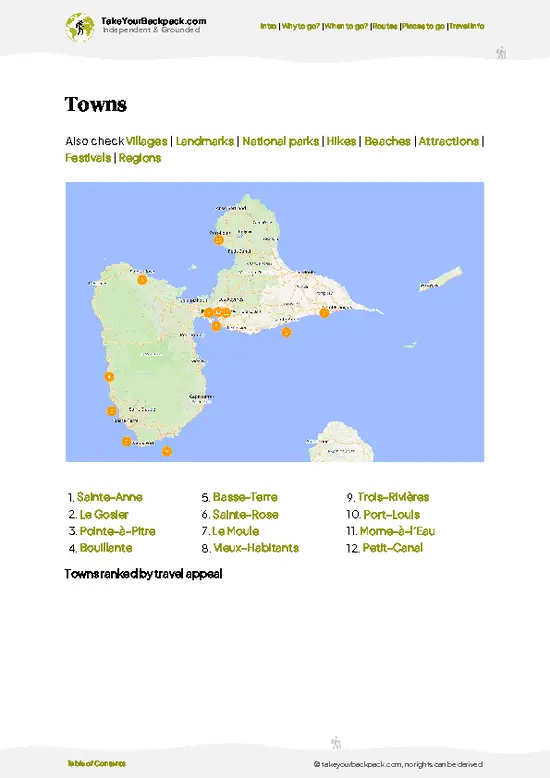
Seeing the layout at a glance
Loading the map 🌍
CLICK TO FILTER
town
village
unique site
national park
hike
beach
attraction
festival
region
SHOW COUNTRY’S BESTSHOW ALL
film
0
0
0a
Memorial ACTe
film
1
1
1a
Distillerie Damoiseau
film
2
2
2a
Maison du Cacao
film
3
3
3a
Musée Saint-John Perse
film
4
4
4a
Musée Schoelcher
film
5
5
5a
Plage de la Caravelle
film
6
6
6a
Plage de Sainte-Anne
Stephanie Spriet
film
7
7
7a
Plage de la Perle
Szabados Tamás
film
8
8
8a
Plage de Malendure
Aurelie Gregoire
film
9
9
9a
Plage Du Souffleur
film
10
10
10a
Anse des Châteaux
Eric
film
11
11
11a
Anse Tarare
film
12
12
12a
Anse des Rochers
film
13
13
13a
Anse à la Barque
H H
film
14
14
14a
La Soufrière
Camille Godonaise
film
15
15
15a
Les Chutes du Carbet
Eliott Morisset
film
16
16
16a
La Route de la Traversée
Valérie “val67” Eckert
film
17
17
17a
Grande Anse to Petit Anse
Alice Matijevic
film
18
18
18a
Jacques Cousteau Underwater Reserve
Fabien Bouvet
film
19
19
19a
Grand Cul-de-Sac Marin Natural Reserve
Thierry Marinault
film
20
20
20a
Îles de la Petite Terre Nature Reserve
David Santini Magicien
film
21
21
21a
Pointe des Châteaux
Virgile Fontaine
film
22
22
22a
Réserve Naturelle de Saint-Martin
film
23
23
23a
Basse-Terre Mountains
Happyman Photography
film
24
24
24a
La Désirade
Happyman Photography
film
25
25
25a
Îlet du Gosier
film
26
26
26a
Ilet Caret
Rémy Barthès
film
27
27
27a
Sainte-Anne
film
28
28
28a
Le Gosier
Happyman Photography
film
29
29
29a
Pointe-à-Pitre
Xavier Adonis
film
30
30
30a
Bouillante
film
31
31
31a
Basse-Terre
film
32
32
32a
Vieux-Habitants
film
33
33
33a
Trois-Rivières
film
34
34
34a
Les Saintes
Fr3 Nesie²
film
35
35
35a
La Grivelière
Habitation La Grivelière
film
36
36
36a
Pointe de la grande vigie
film
37
37
37a
Cimetière de Morne-À-l’Eau
film
38
38
38a
Grotte de l’Anse à la Barque
Ph Francisque
film
39
39
39a
Les Marches Aux Esclaves

Why go?What draws travelers here

Beach life

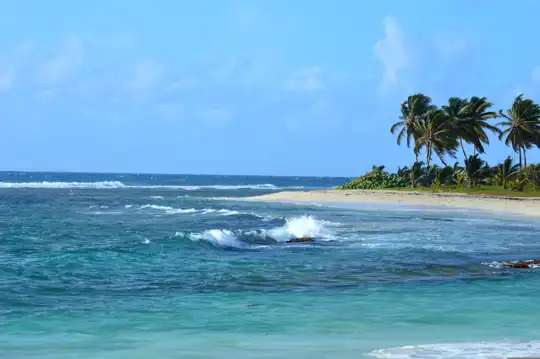
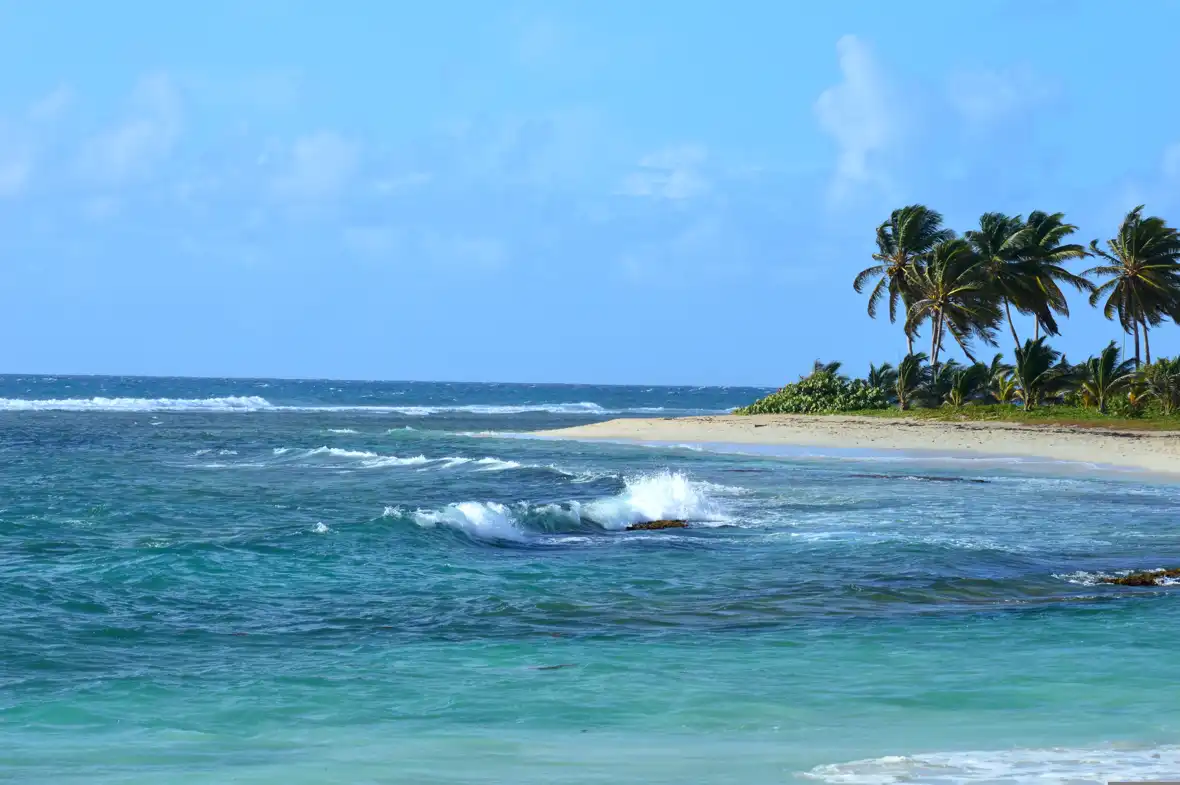
Guadeloupe is beach country with range: chalk‑white arcs on Grande‑Terre for lazy swims, Malendure’s Cousteau Reserve for turtles and walls, and quick ferry hops to Les Saintes or Marie‑Galante when you want space. Daylight is for fins and rum shacks; night folds into Gosier clubs and seaside grills. Warm water, trade winds, zero pretense.
Want the complete picture of Guadeloupe?
The offline Travel Guide brings everything together — routes, highlights & planning.

See what's included in the guide 👉

Get the Travel Guide -

⭐ HighlightsStandout locations across the country

  • La Soufrière volcano: Start from Bains Jaunes at 6:00 and you’ll beat the clouds that swallow the crater by 10; it’s four muddy, wind-whipped hours that cost you dry socks, not cash, and pay back with hissing vents and the metallic sting of sulfur in your nose. Off-map detours: La Citerne rim trail, Saut d’Acomat plunge pool, Sofaïa sulfur baths.
  • Réserve Cousteau (Pigeon Islets), Malendure: Be on the beach by 8:00, rent a kayak in cash, and you’ll slip onto empty mooring buoys while the glass-bottom boats are still idling; the reef crackles like frying bacon, and you’ll taste salt on the snorkel mouthpiece for hours. Off-map follow-ups: Bain chaud de Thomas (seaside hot spring), Petite Anse (turtles at dawn), Anse Caraïbe for a quiet lunch.
  • Terre-de-Haut, Les Saintes: Take the first ferry from Trois-Rivières, rent a scooter instead of melting on those hills, and trade euros for time so you can hit Pain de Sucre before crowds and lick coconut sorbet off your wrist in the shade of Fort Napoléon.
read more 👉
  • La Soufrière volcano: Start from Bains Jaunes at 6:00 and you’ll beat the clouds that swallow the crater by 10; it’s four muddy, wind-whipped hours that cost you dry socks, not cash, and pay back with hissing vents and the metallic sting of sulfur in your nose. Off-map detours: La Citerne rim trail, Saut d’Acomat plunge pool, Sofaïa sulfur baths.
  • Réserve Cousteau (Pigeon Islets), Malendure: Be on the beach by 8:00, rent a kayak in cash, and you’ll slip onto empty mooring buoys while the glass-bottom boats are still idling; the reef crackles like frying bacon, and you’ll taste salt on the snorkel mouthpiece for hours. Off-map follow-ups: Bain chaud de Thomas (seaside hot spring), Petite Anse (turtles at dawn), Anse Caraïbe for a quiet lunch.
  • Terre-de-Haut, Les Saintes: Take the first ferry from Trois-Rivières, rent a scooter instead of melting on those hills, and trade euros for time so you can hit Pain de Sucre before crowds and lick coconut sorbet off your wrist in the shade of Fort Napoléon. Off-map angles: Terre-de-Bas hiking loops, Anse Rodrigue’s soft sand, Crawen’s raw bay.
  • Pointe des Châteaux: Sunrise is the play—free, fierce wind, and no tour buses—so you climb 20 minutes to the cross while Atlantic spray salts your sunglasses and sand needles your shins; arrive late and you’re paying with heat and patience. Off-map pockets: Anse à la Gourde tide pools, wild Pointe Tarare, Anse des Châteaux coves.
  • Chutes du Carbet: Hit the gate at opening and take the path to the Second Fall; a small fee, slick stairs, 60-90 minutes round trip, and your shirt will cling from mist as the roar drowns conversation—skip it after heavy rain when trails close. Off-map water fixes: Cascade aux Écrevisses, Saut de Gendarme, Bras de Fort canyon.
Spotted a mistake or missing a highlight? Contact us.

But Guadeloupe offers more...

Discover and compare all of its highlights per category

🧭 RoutesHow travelers typically move through the country

The 2-Day Soft Landing on Grande-Terre

The Vibe: A relaxed coastal sampler built for a long weekend, mixing one powerful museum visit with easy beach time and short hops by taxi or bus. You stay mostly on the south coast of Grande-Terre so you can actually swim, stroll, and snack instead of chasing the next viewpoint.
The Highlights:
  • Context-rich visit to Memorial ACTe in Pointe-à-Pitre
  • Sunset swims and boat hop to Îlet du Gosier
  • Classic white-sand time at Plage de la Caravelle
  • Market browsing and seaside snacks in Sainte-Anne

The 3-Day Culture, Rum & Beach Triangle

The Vibe: A balanced loop for first-timers who want more than just a beach chair, blending history, rum tasting, and shoreline wandering at an easygoing pace with a rental car. You’ll connect the dots between Guadeloupe’s past and present while still logging plenty of hours in the water.
The Highlights:
  • Urban wander and museum stop in Pointe-à-Pitre with Memorial ACTe
  • Rum education and tasting at Distillerie Damoiseau near Le Moule
  • Laid-back
read more 👉

The 2-Day Soft Landing on Grande-Terre

The Vibe: A relaxed coastal sampler built for a long weekend, mixing one powerful museum visit with easy beach time and short hops by taxi or bus. You stay mostly on the south coast of Grande-Terre so you can actually swim, stroll, and snack instead of chasing the next viewpoint.
The Highlights:
  • Context-rich visit to Memorial ACTe in Pointe-à-Pitre
  • Sunset swims and boat hop to Îlet du Gosier
  • Classic white-sand time at Plage de la Caravelle
  • Market browsing and seaside snacks in Sainte-Anne

The 3-Day Culture, Rum & Beach Triangle

The Vibe: A balanced loop for first-timers who want more than just a beach chair, blending history, rum tasting, and shoreline wandering at an easygoing pace with a rental car. You’ll connect the dots between Guadeloupe’s past and present while still logging plenty of hours in the water.
The Highlights:
  • Urban wander and museum stop in Pointe-à-Pitre with Memorial ACTe
  • Rum education and tasting at Distillerie Damoiseau near Le Moule
  • Laid-back coastal base in Le Gosier with quick access to Îlet du Gosier
  • Soft-sand finale on the beaches around Sainte-Anne and Plage de la Caravelle

The 5-Day Mountains, Reefs & Coastal Circuit

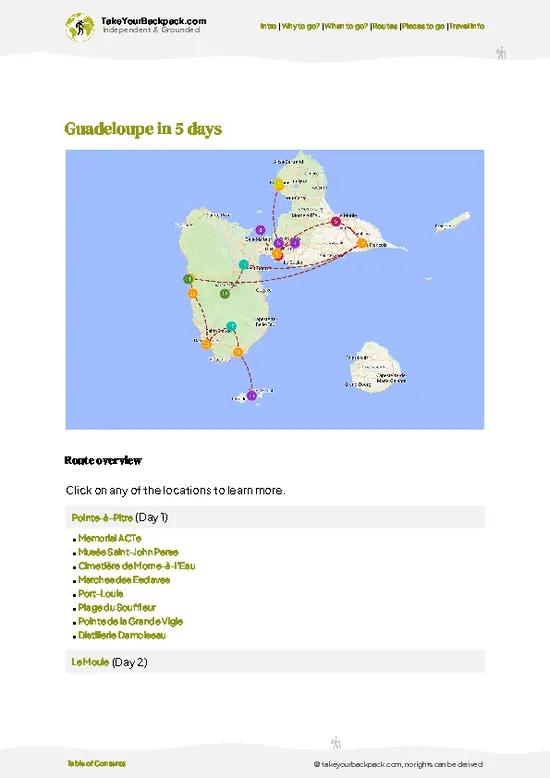
The Vibe: A fuller island circuit for travelers who want both the Caribbean postcard and the wilder edges, using a rental car and a couple of short boat rides to link beaches, cliffs, rainforest, and reef. The pace is steady but not rushed, with two main bases so you can unpack and really explore each side.
The Highlights:
  • South Grande-Terre classics around Le Gosier, Sainte-Anne, and Saint-François
  • Dramatic Atlantic views at Pointe de la grande vigie and the quieter village feel of Anse-Betrand
  • Rainforest and volcanic landscapes in Parc National de la Guadeloupe, including La Soufrière or Les Chutes du Carbet
  • Snorkeling or diving in the Jacques Cousteau Underwater Reserve off Plage de Malendure, based in Bouillante
🌍 Want a ready-to-use travel plan for Guadeloupe?
The overview above compares different route options based on your travel time and style. The complete Travel Guide breaks each itinerary down in detail, including maps, stops, highlights, and transport information.

Explore all route details 👉

Get the Travel Guide -

🌤️ When to go?Choosing the right months to travel

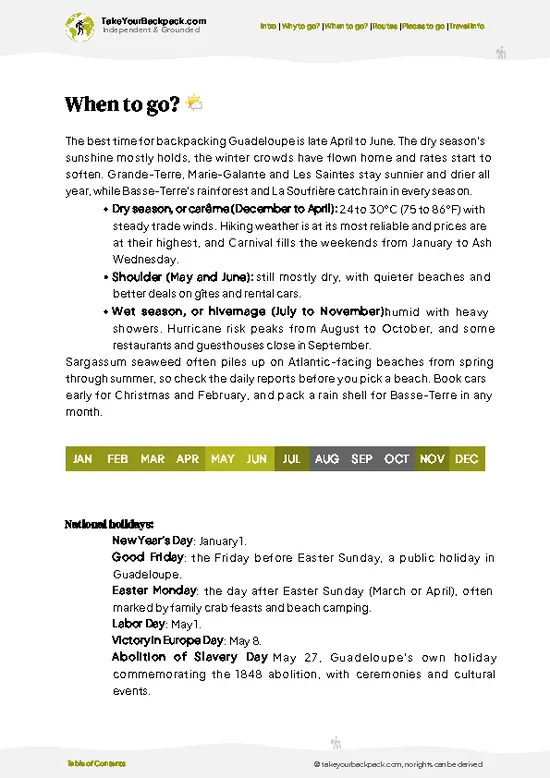
I time it for late April to early June: trades still steady, rain mostly quick bursts, water warm and clear, post-Easter rates soften, crowds thin. Trails on Basse-Terre keep grip without August mud, ferries have seats, and hurricane odds remain low. You move; locals have time.
  • High Season (Dec-Mar): Prices and car hires spike, Sainte-Anne jams, dive boats fill. The payoff: crisp trade-wind days, carnival drums, Pigeon clarity, sunrise Soufrière horizons.
  • Shoulder (Late Apr-Jun): Shops exhale, mango trucks roll, crowds thin. Showers pop and pass. Sargassum can choke east beaches; pivot west to Malendure/Deshaies or ferry to Les Saintes.
  • Wet/Hurricane (Aug-Oct): Sky broods, jungle hums, trails empty. Waterfalls roar. Survive it: dawn starts, half-days between squalls, dry bag and sandals. Route de la Traversée can close after slides.

Book the car 3-4 weeks out; buses thin outside towns.

source: climatestotravel.comJANJanuary: highly recommended for travelingFEBFebruary: highly recommended for travelingMARMarch: highly recommended for travelingAPRApril: highly recommended for travelingMAYMay: excellent for travelingJUNJune: excellent for travelingJULJuly: good for travelingAUGAugust: fair for travelingSEPSeptember: fair for travelingOCTOctober: fair for travelingNOVNovember: good for travelingDECDecember: highly recommended for traveling
📅 Traveling in a specific month?
Get a full month-by-month breakdown of weather, crowds, costs, festivals, and seasonal highlights in the complete travel guide.

Get full details when to go 👉

Get the Travel Guide -
guadeloupe-pixabay

💰 Costs (as of 2026)Typical budget expectations

€60-70 per day if you self-cater, ride buses, and only pay for wheels or ferries when they actually open doors.
  • dorm accommodation: €25-45 per night in low season; add €10-15 in Dec-April. Hostels are thin on the ground, so you’ll see “gîtes” and shared rooms more than classic bunks. System tip: search “chambre chez l’habitant” and message for weekly rates—20-30% off beats nightly. Base along the Karu’lis corridor (Pointe-à-Pitre-Le Gosier-Sainte-Anne) to cut transport waste. Price level is similar to Martinique, higher than the Dominican Republic, well below Barbados.
  • meals: Supermarket Survival: €8-12/day—baguette, tuna, tomatoes, fruit stands, yogurt; French basics are fair value, imports sting. Street food reality: bokit or agoulou €5-9, accras cones €3-5, “lolos” plates €8-12; sit-down mains jump to €18-25. Relative value: street eats beat restaurants by half, but still pricier than the DR; similar to Martinique.
  • local transport: Cheapest unlock: buses + strategic hitch + shared rental. Karu’lis rides run ~€1.20-2 with a reloadable card (cash fares creep higher), but taper after 18:00 and are skeletal Sundays. Split a compact car at €25-40/day plus fuel and you see twice as much
read more 👉
€60-70 per day if you self-cater, ride buses, and only pay for wheels or ferries when they actually open doors.
  • dorm accommodation: €25-45 per night in low season; add €10-15 in Dec-April. Hostels are thin on the ground, so you’ll see “gîtes” and shared rooms more than classic bunks. System tip: search “chambre chez l’habitant” and message for weekly rates—20-30% off beats nightly. Base along the Karu’lis corridor (Pointe-à-Pitre-Le Gosier-Sainte-Anne) to cut transport waste. Price level is similar to Martinique, higher than the Dominican Republic, well below Barbados.
  • meals: Supermarket Survival: €8-12/day—baguette, tuna, tomatoes, fruit stands, yogurt; French basics are fair value, imports sting. Street food reality: bokit or agoulou €5-9, accras cones €3-5, “lolos” plates €8-12; sit-down mains jump to €18-25. Relative value: street eats beat restaurants by half, but still pricier than the DR; similar to Martinique.
  • local transport: Cheapest unlock: buses + strategic hitch + shared rental. Karu’lis rides run ~€1.20-2 with a reloadable card (cash fares creep higher), but taper after 18:00 and are skeletal Sundays. Split a compact car at €25-40/day plus fuel and you see twice as much for the same cash. Ferries: €20-35 return to Les Saintes/Marie-Galante—worth it once, not every day. Avoid taxis; meters start painful and balloon fast.
  • activities: Free wins: national park hikes, waterfalls, beaches. Cost drivers: boat snorkel trips €30-50, dives €70-110, canyoning €55-75, scooter on Les Saintes €20-25/day. Hack: bring your own mask; Malendure shore snorkel is free, kayak only if you want the islets (€15-20 half-day). Museums/forts usually €3-8; distillery tastings often free.
  • miscellaneous: Budget leaks: linen/cleaning fees on rentals, airport taxis, Sunday closures forcing restaurant prices, sunscreen/repellent markups, ferry luggage surcharges, car insurance add-ons. ATMs + FX fees add up if your card is weak. Compared to neighbors, leaks bite harder than in Dominica/DR; on par with Martinique.
⚠️ Prices can change and everyone travels differently, so take this as a rough guide. Hope it helps you plan your adventure!

✈️ The backpacker research shortcutGuadeloupe Travel Guide

An offline-friendly backpacking guide with optimized travel routes, ranked highlights, transport advice, and the best areas to stay.
example page 0 from our offline Travel Guide for Guadeloupeexample page 1 from our offline Travel Guide for Guadeloupeexample page 2 from our offline Travel Guide for Guadeloupeexample page 3 from our offline Travel Guide for Guadeloupeexample page 4 from our offline Travel Guide for Guadeloupeexample page 5 from our offline Travel Guide for Guadeloupeexample page 6 from our offline Travel Guide for Guadeloupeexample page 7 from our offline Travel Guide for Guadeloupe
The digital guide (229 pages) contains:
59 highlights, ranked by travel appeal
Optimized 2, 3 & 5-day travel routes
Cities, national parks, beaches, historical sites, ...
How to get around
Offline-friendly for travel without Wi-Fi
👉 Click to see all 30+ guide features

📅 Plan smarter in minutes, not weeks
Month by month travel advice
Festivals & national holidays
Budget expectations

🗺️ Go to the right places, skip the overrated ones
Honest pros & cons of destinations
Top hikes, parks & viewpoints
Lesser-known places most travelers miss
Clear “worth it vs skip it” guidance

🛏️ Travel smoothly without rookie mistakes
Best areas to stay
Transport systems explained simply
Common scams & safety advice
SIM cards, money & practical tips

🌍 Understand the country, not just visit it
Culture & traditions
52 Essential phrases & customs
Festivals worth planning around
Traveler-friendly historical context
Insights that make places more meaningful

📱 Built for real travel conditions
Fully downloadable PDF
Works completely offline
Optimized for phone use
Useful in remote areas & buses
Everything in one place
Save weeks of stressful planning
Get instant access to the full guide directly. 30-day money-back guarantee.


Sent to your inbox immediately after payment • 100% Secure Checkout
Best Backpacking Travel Advisor 2025 tourism awardBest Backpacking
Travel Advisor
2025
What others say about Take Your Backpack Guides:
⭐⭐⭐⭐⭐
Fantastic, amazing amount of information!
⭐⭐⭐⭐⭐
My goodness this is amazing, it's what I've been looking for hats off too you!
⭐⭐⭐⭐⭐
I think this is absolutely BRILLIANT
⭐⭐⭐⭐
Very complete and informative. It's still missing places, but I gotta to commend you
⭐⭐⭐⭐⭐
This is truly amazing, thank you, can't wait to explore it with my kids!
⭐⭐⭐⭐⭐
Awesome resource, thank you!
⭐⭐⭐⭐⭐
This is amazing! Can't wait to explore the ones I haven't seen
⭐⭐⭐⭐
I love this! Well done, great idea.
⭐⭐⭐⭐⭐
Thanks for taking the time to make this gem!
⭐⭐⭐⭐⭐
This might be the best website I've ever seen.
⭐⭐⭐⭐⭐
Congratulations, and thank you so much for your work; it's incredibly valuable.
⭐⭐⭐⭐
In all seriousness I think you did a great job pointing out the important spots
⭐⭐⭐⭐⭐
10/10 very good
⭐⭐⭐⭐⭐
As someone who's only just starting to visit regularly this is awesome, thank you.
⭐⭐⭐⭐
Thank you very much! I'm going to visit my dad, it's going to be very useful!
⭐⭐⭐⭐⭐
This is really cool! We'll be travelling for the first time and this definitely come in handy.
⭐⭐⭐⭐⭐
You are now our minister of culture, congratulations 👨‍💼
⭐⭐⭐⭐⭐
Just wanted to tell you that this is a pearl! Going to follow your recommendations.
⭐⭐⭐⭐⭐
This is so cool. I'll definitely be using the resource for my travels soon.
⭐⭐⭐⭐⭐
This is very impressive! Good work.
⭐⭐⭐⭐⭐
This is an amazing and informative site. Very well done!

🛏️ Where to stay?Where to stay in Guadeloupe

Yes — Guadeloupe has some hostels and mainly budget accommodation in the form of guesthouses and gîtes, but true backpacker hostels are limited and scattered so expect basic facilities rather than full-service dorms.
Most options concentrate on Grande‑Terre around Pointe‑à‑Pitre (transport hub and airport access but fewer cheap beds), Le Gosier and Sainte‑Anne (best for beaches, restaurants and nightlife with more tourist-friendly budget rooms), and on Basse‑Terre around Deshaies and Bouillante (quieter, best for hiking, diving and national-park access but with sparse public transport and fewer … read more 👉
Yes — Guadeloupe has some hostels and mainly budget accommodation in the form of guesthouses and gîtes, but true backpacker hostels are limited and scattered so expect basic facilities rather than full-service dorms.
Most options concentrate on Grande‑Terre around Pointe‑à‑Pitre (transport hub and airport access but fewer cheap beds), Le Gosier and Sainte‑Anne (best for beaches, restaurants and nightlife with more tourist-friendly budget rooms), and on Basse‑Terre around Deshaies and Bouillante (quieter, best for hiking, diving and national-park access but with sparse public transport and fewer low-cost choices).
Bring a rental car or be ready for limited buses, book ahead in high season, expect simple amenities and occasional hot‑water or power quirks, pick Grande‑Terre for ease of transport and nightlife, and pick Basse‑Terre for quieter nature access.

If you enjoy meeting fellow travelers, consider choosing hostels with high ratings for atmosphere. On the other hand, if you prefer having your own space, a hotel might be a better option.

🚌 Getting aroundPublic transport and other ways to get around

Guadeloupe runs on French rules with Caribbean timing. Ferries click like watches; buses move when the driver decides there are enough bodies. Miss the morning pulse and the island gets sticky—heat, traffic, and timetables that shrug. Nail the first moves and you ride the day like a trade wind.
  • Intercity Buses (Grande-Terre ↔ Basse-Terre) The Efficiency Trade-off: cheapest way to span the wings, usually a few euros a leg, but you pay in waiting and stops. Buses trace the coastal ring; 10-40 minutes
read more 👉
Guadeloupe runs on French rules with Caribbean timing. Ferries click like watches; buses move when the driver decides there are enough bodies. Miss the morning pulse and the island gets sticky—heat, traffic, and timetables that shrug. Nail the first moves and you ride the day like a trade wind.
  • Intercity Buses (Grande-Terre ↔ Basse-Terre) The Efficiency Trade-off: cheapest way to span the wings, usually a few euros a leg, but you pay in waiting and stops. Buses trace the coastal ring; 10-40 minutes can pass between runs, longer at lunch, and the last reliable ones roll 16:00-18:00, almost nothing on Sunday. They’ll pull over anywhere you flag, and they’ll also detour for school crowds. If you must make a ferry, ride the first departures or you’ll be budgeting for a taxi.
  • Collectif Vans The Social Fabric: stick your arm out, palm down, quick wag. “Bonjour” to the driver, pack on your lap, exact change if you can. Say your stop early—buttons are optional; voices work. Music is loud, AC is a coin flip, and the vibe is neighborly but brisk. Don’t sprawl, don’t eat fried food, and hop out fast—the next rider’s already climbing in.
  • Island Ferries The Geometric Unlock: water beats asphalt. Trois-Rivières to Les Saintes is the short, stomach-friendly hop; Pointe-à-Pitre to Marie-Galante and Saint-François to La Désirade run in 20-60 minutes for roughly day-trip money. Morning sailings are calmer and on time; sit aft if you’re queasy. Buses don’t always match sailings, so sleep near the terminal or accept a dawn taxi.
  • Hitchhiking (faire du stop) The Budget Disruptor: when buses fade after 4 p.m., a cardboard “Bouillante” sign and a good pull-out beat standing at a random pole. Daylight only, single pack, smile; don’t offer cash unless asked. Best on Basse-Terre’s coastal road, slower in Pointe-à-Pitre sprawl. It turns dead time into movement.

Master move: treat 3 p.m. as curfew—ride the first bus, anchor your day to the earliest ferry, and plan your last leg by hitch or shared van before the island slams the brakes.
Quick note: Basse-Terre doesn’t have a commercial airport. The small Baillif airfield (Aérodrome de Basse-Terre-Baillif, code BBR) sits just south of town and sees no scheduled flights. Most visitors land at Guadeloupe Pôle Caraïbes Airport (PTP) near Pointe-à-Pitre and then travel to Basse-Terre. Details for both are below (updated 2025).

If you’re arriving at Baillif airfield (BBR)
Distance to Basse-Terre city center: about 4 km (2.5 miles).
  • Taxi: 8-12 minutes. Typical fare €15-€25 (daytime); a bit more evenings/Sundays. There’s no taxi rank on site, so you’ll likely need to call ahead.
  • Local bus: 10-20 minutes. Minibuses running along the N2 sometimes stop near the aerodrome entrance and go to Basse-Terre’s gare routière. Expect €1.50-€3. Service is daytime only, infrequent, and very limited on Sundays/holidays.
  • On foot: 40-50 minutes via the N2. Sidewalks/shoulders are patchy; not great with luggage or in rain.

If you’re landing at Guadeloupe Pôle Caraïbes Airport (PTP)
Distance to Basse-Terre city center: about 60 km (37 miles).
  • Bus (airport area to Pointe-à-Pitre) + intercity bus to Basse-Terre:

    • Airport area to Pointe-à-Pitre bus station (Karu’Lis urban network): 15-25 minutes, roughly €1.50-€2.

    • Pointe-à-Pitre to Basse-Terre (intercity “car”/minibus): 75-110 minutes, about €6-€8.

    Total: 90-150 minutes, €7.50-€10. Buses run mainly Mon-Sat daytimes; very limited late evenings and on Sundays/holidays. Pay the driver in cash; schedules can be approximate.
  • Shared minivan (taxi collectif): Usually depart from around the Pointe-à-Pitre bus/ferry area when full. 70-100 minutes, €8-€12 per seat. Cash only; frequency tapers off late afternoon and on Sundays.
  • Car rental/self-drive: 60-90 minutes via the N1/N2 (no tolls). Daily rentals typically €35-€60+; fuel for the trip ~€8-€12 depending on traffic and vehicle.
  • Taxi or private transfer: 60-90 minutes. Standard taxi from the airport arrivals rank is typically €120-€160 in daytime; expect ~25-40% more at night, on Sundays, or holidays (€150-€200). Luggage surcharges may apply; not all drivers take cards—ask before you go.

Good to know
  • No trains or ride-hailing apps here. It’s buses, shared vans, taxis, or a rental car.
  • Traffic can be heavy at rush hour; add extra time if you’re catching a ferry or tour.
  • For buses, aim for weekday mornings to early afternoon; services thin out later in the day.
⚠️ Prices and routes can change, so take this as a rough guide and ask for local advice when you arrive.

🔒 Safety (risk Level: low)What first-time visitors should know

Safety for solo travelers, including women and LGBTQ+ individuals
Guadeloupe is generally safe for solo travelers, including women and LGBTQ+ individuals, but like any destination, it’s crucial to stay aware of your surroundings. Petty crime, such as pickpocketing, can occur, especially in crowded areas, so keep your belongings secure. While Guadeloupe is relatively open-minded, LGBTQ+ travelers might want to exercise discretion in more rural areas. Trust your instincts, stick to well-lit and populated areas at night, and you’ll likely have a great experience.

✈️ VisaWhat travelers should know about visas

Most travelers from the EU, US, Canada, and Australia can visit Guadeloupe without a visa for up to 90 days. If you’re from a country that requires a visa, apply through the French embassy or consulate in your area. Check the French visa website for detailed requirements and to start your application online.
⚠️ Visa requirements can change over time, so always check the latest visa requirements with the official embassy or government website before you travel.

🎒 What to pack?Packing essentials for the trip

Guadeloupe’s got a tropical climate, so plan for hot, humid weather and surprise rain showers. Lightweight, breathable clothing is your friend, but don’t forget something modest for visiting small towns or religious sites. The terrain is a mix of beaches, jungle, and mountains, so versatile shoes you can hike and stroll in are a must. Locals appreciate a laid-back style, but it’s good to be a bit more covered when away from the beach. Stay sun-smart with gear that’ll keep you cool and protected.

Apart from this country specific advice, I have also crafted a general packing list that should help on any trip. authorOver the years, I've learned the importance of packing minimally. It's so much easier to jump on the back of a truck or squeeze yourself into the last spot of a minibus without that supersized backpack. If you're headed to a warm destination, leave your winter jacket at home; for colder regions, opt for thin thermal underlayers. Instead of packing your entire wardrobe, bring just three sets of clothes, as laundry facilities are available everywhere.
View the full list 👉
🎒 Planning the practical side of your trip?
Get detailed information on transport, daily budgets, internet access, local customs, food, language, and other essentials in the complete Travel Guide.

Get detailed practical information 👉

Get the Travel Guide -

🙋 FAQFrequently asked questions

Trip Planning


Personal tip: I normally search on good rating for atmosphere (for meeting people) and location (for easy exploring). Cleanliness as a bonus.


Travel Essentials

Routine vaccinations like MMR (measles, mumps, rubella), DTP (diphtheria, tetanus, pertussis), and varicella (chickenpox) are recommended. Also, consider hepatitis A and B vaccines. If you’re traveling from a country with yellow fever risk, a yellow fever vaccination is required. Always check the latest health guidelines.


vaccination requirements
When I first started traveling, I often spent part of my first day in a new country hunting for a local SIM card. While this can still be slightly cheaper, it also takes time and planning.

These days, it's much simpler to install an eSIM before leaving home. Once you arrive in Guadeloupe, you can activate it immediately and have mobile data from the moment you land — which is especially useful for ordering transport or navigating away from busy airports.

There are many providers nowadays, and price differences are usually small. I personally go with Airalo, as it offers excellent network coverage throughout the country and strong global coverage, so you can manage multiple countries from a single app.


Get your e-sim for Guadeloupe

Culture & Customs

Respect the French influence: locals appreciate politeness, so always greet with “Bonjour” before starting a conversation. Dress modestly, especially in religious settings. Tipping is appreciated but not mandatory; rounding up the bill is common. **Do** try local Creole cuisine, but be mindful of spice levels. **Don’t** photograph people without permission; it’s considered rude. LGBTQ+ travelers should generally feel safe, but discretion is advised in rural areas. Women might encounter catcalling; a firm but polite response usually works. Sundays are quiet, with many businesses closed, so plan accordingly.
Trying traditional food is always a great way to experience the culture. Here are some must-try dishes for Guadeloupe.
  • Colombo de Poulet: This is Guadeloupe’s take on curry, with chicken slow-cooked in a blend of spices like turmeric and coriander. It’s a nod to the island’s Indian influences and is usually served with rice.
  • Bokit: A deep-fried sandwich that’s a street food favorite. Made from a simple dough, it’s filled with anything from codfish to chicken, and it’s perfect for a quick, satisfying bite on the go.
  • Accras de Morue: These are savory cod fritters that are crispy on the outside and soft on the inside. They’re a popular snack to enjoy with a cold drink, often served as an appetizer.
  • Boudin Créole: A type of blood sausage seasoned with spices and herbs. It’s a staple during festivals and celebrations, showcasing the island’s Creole roots.
  • Tourment d’Amour: A sweet treat made with a flaky pastry, filled with coconut, and sometimes other tropical fruits. It’s a dessert that captures the island’s love for rich, comforting flavors.
Tap water in Guadeloupe is generally safe to drink, and locals consume it without issues. However, travelers with sensitive stomachs might prefer bottled or filtered water, just to be cautious. If you’re uncertain, grab a reusable bottle with a built-in filter to stay on the safe side.
The main language in Guadeloupe is French. Backpacking is way more rewarding if you know a bit of the local language, so I'd suggest brushing up on the basics just in case your French skills have become a bit rusty.

Want to understand locals better?
The complete Travel Guide for Guadeloupe includes 52 essential words and phrases — greetings, thank-yous, ordering food, transport, numbers, and common local expressions you'll actually hear.

Get your local basic phrases 👉

Get the Travel Guide -


In Guadeloupe, English is not widely spoken, as the official language is French. While many locals understand basic English, especially in tourist areas, proficiency can vary significantly. In larger cities and popular tourist destinations, you may find some hospitality workers, shopkeepers, and tour guides who can communicate in English. However, outside these areas, English speakers may be less common.

It’s advisable for travelers to familiarize themselves with some basic French phrases to enhance their experience and facilitate interactions. This can also show respect for the local culture, which is predominantly French-speaking. In addition, many signs and menus may be in French, so having a translation app or phrasebook can be helpful.

Overall, while English is not the primary language, with a bit of effort and patience, travelers can navigate Guadeloupe’s beautiful landscapes and rich culture effectively.

Money & Payments

The local currency of Guadeloupe is EUR (€).

In Guadeloupe, the currency is the Euro (€), so you’ll want to avoid bringing U.S. dollars unless you enjoy paying for exchange rates twice. ATMs are available in towns and larger villages, and they generally accept international cards—just inform your bank beforehand to dodge any surprises. It’s smart to carry some cash, especially if you’re venturing to smaller islands or rural areas, as not every place is card-friendly. When it comes to exchange, the airport and banks offer the most reliable rates; however, money exchange services are pretty scarce, so plan accordingly. Lastly, be cautious of fees when withdrawing cash; they can sneakily add up, so consider larger withdrawals if your bank charges per transaction.

Tipping in Guadeloupe is not mandatory, as service charges are often included in restaurant bills. However, leaving a few euros for exceptional service is appreciated. In taxis, rounding up the fare is a nice gesture but not obligatory.

🧩 Nearby countriesSimilar backpacking destinations

We 💚 feedbackKey takeaways from the trip

Go for the compact contrast: hike La Soufrière at dawn, rinse off in a river, then mask up in the Cousteau Reserve before lunch. That mix in one day is the payoff. The catch is movement. Buses are thin, rentals cost real Euro money, and Sundays go quiet. Your trade: time (wait), money (car), or comfort (hitchhike—common, safe by day). Don’t stress the language. Basic French and a smile get rides and directions. Worried about seaweed? Stick to the leeward west or hop to Les Saintes.

✍️ Help improve this page!
The information on this page is based on in-depth research, insights shared by experienced travelers, and feedback from the local travel community in Guadeloupe. While every effort is made to keep the information accurate and current, conditions can change — so if you spot anything incorrect or outdated, please get in touch.


🙋‍♂️ Give feedback

👋 Meet the founderWho’s Behind Take Your Backpack?

Johan, backpacker and founder of TakeYourBackpackHi, I’m Johan (Netherlands 🇳🇱), the creator of TakeYourBackpack. Over the past decade, I’ve backpacked through 80+ countries across six continents, gaining extensive experience with independent travel, long-term trips, and overland routes.

This site is built on a combination of firsthand travel experience and carefully curated insights from other backpackers. Many guides are based on places I’ve personally visited, while others bring together tips, observations, and practical advice shared by trusted travelers I’ve met along the way.

The goal is to provide realistic, experience-driven guidance — not generic itineraries — so you can explore destinations with better context, clearer expectations, and more confidence.

Get full Guadeloupe guide •
Instant download • 59 highlights • Full Offline guide