×
Solomon Islands 🇸🇧

backpacking Oceania Solomon Islands 🇸🇧
Navigate ocean distances defining isolation and connection.

Explore SamoaExplore Timor-Leste

Backpacking Solomon Islands in 2026

A complete guide including when and where to go, costs, transport, itineraries, and practical travel advice.
What a trip here is really like

Backpacking Solomon Islands
By Johan Kruseman 🇳🇱 | Updated May 21, 2026

In the Solomons, you swap speed and comfort for raw access. Flights bite, boats dawdle, and the best bits start where the road quits. That friction fits the place: village-first, ocean-led, and proudly unscripted.

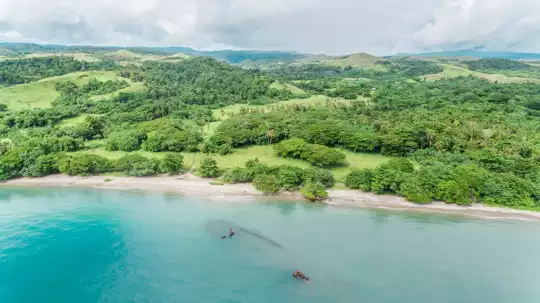
Dawn lays a mirror over Marovo Lagoon and you paddle past leaf-house villages while breakfast smoke hangs low; by noon you’re finning over WWII wrecks at Bonegi, rifles and ribs softened in gin-clear blue; by dusk, panpipes float across water as Kolombangara’s cone rises clean out of the sea. Mantas sweep channels off Munda and Uepi, tank-sized parrotfish chew coral, and Guadalcanal’s waterfalls sluice off salt and heat until skin prickles. Reality check: ferries cancel in squalls, muddy tracks eat flip-flops, power flickers, cash runs tense, and malaria planning matters. But the wait on a jetty, the extra day in a village, the long outboard run—each stretches time until that first cold SolBrew hits and the reward lands in your bones.

Compared with Fiji’s polish, Vanuatu’s packaged thrills, and PNG’s intensity, the Solomons stay quieter and more diffuse—home to some of the world’s densest WWII wrecks and reefs that feel empty. Go if you’re a diver, paddler, or history hound with patience to trade; if you prize community over convenience and wild water over Wi‑Fi, this place fits.

Guadalcanal & Honiara

Heat bounces off the tarmac, betel nut spit stains the curb, and the market smells like diesel, smoke fish, and lime. Base here because flights, ATMs, and spares are real. Hike Bloody Ridge or scramble to Mataniko Falls; you’ll earn the plunge. WWII relics sit in tall grass; no fences, just history. The payoff is a cold SolBrew at sunset by the Yacht Club pier while freighters crawl across Iron Bottom Sound.

Western Province: Gizo – Munda – Marovo (one boat/air spine)

This is the reef run. Small planes get you to Gizo or Munda; after that it’s outboards and fuel jerrycans. Fuel will be your biggest expense after flights. Expect chop, wet bags, and sandflies at dusk. You’re rewarded with easy-access WWII wrecks, Skull Island rituals, and dawn paddles on glassy Marovo Lagoon. Basic lodges, bucket showers, fresh crayfish—divers and DIY snorkelers thrive here.

Central Province: Tulagi & Nggela (Florida Islands)

A short but punchy crossing from Honiara—go early before the wind stacks the Sound. Tulagi is slow streets, old piers, strong tea, and dive boats hunting wrecks and manta passes when tides line up. Cash only, power cuts normal, guesthouses plain. It suits patient divers who can sit out weather and jump when conditions go green-light.

Malaita: Auki, Langa Langa & Lau Lagoons

Hard miles reward cultural grit. Fly or ride the overnight ship—crowded decks, loud hymns, and tinned fish at 2 a.m. In the lagoons, shell-money makers tap nacre like metronomes; artificial-island villages rise from coral rubble. Protocol matters; ask, dress modestly, pay fairly. The trade wind hum and panpipes at dusk repay the sweat and mosquitoes.

Rennell (East Rennell & Lake Tegano)

Remote means rationed. Fly to Tingoa, rattle in a pickup over jagged coral, then skim a brackish lake to homestays on rock platforms. Power is solar, food is what was speared or baked. Swim with care—locals know where. Night brings heavy quiet and starfields that feel close enough to touch. For birders and stoics.
Map of Solomon Islands
Loading the map 🌍
CLICK TO FILTER
town
village
unique site
national park
hike
beach
attraction
festival
region
SHOW COUNTRY‘S BESTSHOW ALL
film
0
0
0a
Bonegi I & II Wreck Dive Sites
film
1
1
1a
Kennedy Island WWII Site
film
2
2
2a
Tulagi World War II Wrecks
film
3
3
3a
Vilu War Museum
film
4
4
4a
American War Memorial
film
5
5
5a
Japanese War Memorial
film
6
6
6a
Tulagi Beach
film
7
7
7a
Mbabanga Island Beach
film
8
8
8a
Turtle Reef
film
9
9
9a
Mataniko Falls
Joel Rooskov
film
10
10
10a
Tenaru Falls
Noa Nadeem
film
11
11
11a
Tetepare Island
Trisha Dwyer
film
12
12
12a
Lake Tegano
Kevin Tago Ina Moana
film
13
13
13a
Kolombangara Island
Penikera Namusu
film
14
14
14a
Arnavon Islands
Deni Mcc

Why go?Why Solomon Islands is worth visiting

Beach life

The Solomon Islands make you earn your beach time. You bounce across chop in an open skiff, clothes … read more 👉
The Solomon Islands make you earn your beach time. You bounce across chop in an open skiff, clothes salted, gear never quite dry, sandflies going for your ankles at dusk. Then the payoff hits: Marovo’s lagoon goes mirror-smooth, reef flats light up like stained glass, and a WWII wreck lies in five meters, swarmed by reef fish while a manta ghosts the channel. Beaches range from chalk-white coral cays to warm black sand. Nightlife isn’t clubs—it’s a cold SolBrew from an esky, generator hum, and guitars drifting down a jetty.

People

At the wharf, diesel in the air and betel-nut red on the concrete, you’ll hear “Halo, fren” before you’ve … read more 👉
At the wharf, diesel in the air and betel-nut red on the concrete, you’ll hear “Halo, fren” before you’ve found your balance. People rib you gently, laugh when you slip in the mud, then grip your forearm and pull you upright like it’s nothing. Handshakes are soft; time is softer. Directions come wrapped in a story, and someone usually walks with you anyway. A woman might press a green buai into your palm; a kid trots ahead carrying your lighter bag. Thanks are simple—phone credit, fuel coins, a shared tin of fish. You leave with “lukim iu” hanging in the salty heat.

Uniqueness

Solomon Islands makes you earn every view. Honiara hits first: diesel-sour minibuses, betel nut red … read more 👉
Solomon Islands makes you earn every view. Honiara hits first: diesel-sour minibuses, betel nut red on pavement, heat that soaks your pack straps. Schedules bend to weather, so you wait, then cram into a banana boat and take chop across Iron Bottom Sound, knuckles salty. Villages mean leaf houses, kerosene light, and reef fish cooked in coconut. The reward is specific: WWII guns in the jungle, Bonegi wrecks in 30‑meter clarity, dawn in Marovo as dugouts crease green water, and a cold SolBrew on a creaking jetty while fruit bats lift like smoke.

Scenery

Solomon Islands rewards those who can sweat for their view. Honiara’s heat sticks, the buses wheeze, … read more 👉
Solomon Islands rewards those who can sweat for their view. Honiara’s heat sticks, the buses wheeze, and jungle paths grab at your shins. Then the country opens: Marovo Lagoon’s mirror-flat channels at dawn; the black cone of Kolombangara rising from its own ring of cloud; Lake Tegano’s fossil coral cliffs; karst caves cool as stone cellars; the sun-baked savannah on Guadalcanal giving way to dripping cloud forest on Popomanaseu. You end with salt on your skin, mud on your boots, and a cold SolBrew on a timber wharf while the light goes gold.

Wildlife

Wildlife in the Solomons isn’t staged; it just happens around you. You ride low in an aluminum skiff, … read more 👉
Wildlife in the Solomons isn’t staged; it just happens around you. You ride low in an aluminum skiff, salt spray in your face, outboards droning, and then drop into water so clear you hear your own bubbles while reef sharks slide past and bumphead parrotfish crunch coral. On Savo, the sand is hot with volcano heat and megapodes fuss over buried eggs, sulfur on the breeze. At dusk, flying foxes lift from mangroves and a sea eagle patrols the lagoon. You rinse off the salt, crack a cold SolBrew on a timber jetty, and let it sink in.
Want the complete picture of Solomon Islands?
The offline Travel Guide brings everything together — routes, highlights & planning.

See what's included in the guide 👉

Get the Travel Guide -

⭐ HighlightsUnmissable destinations

  • Honiara Central Market: Humidity sits on your shoulders as you sidestep puddles and betel-nut spit, the air a mix of diesel, smoked fish, and overripe pawpaw. Vendors call out prices over the thud of cassava hitting the table. Earn the noise and heat, then take a cold SolBrew by Point Cruz as the sun drops behind Iron Bottom Sound.
  • Mataniko Falls, Guadalcanal: The trail is slick with red clay, doglegging through kunai grass and breadfruit trees, then into limestone where the river vanishes under rock. Bats stir in the dim and the guano smell sticks in your throat. You scramble, wet to the chest, until the waterfall’s spray hits like rain—shock-cold, honest, perfect.
  • Bonegi I & II Wrecks (Iron Bottom Sound): The black sand burns bare feet; shore break slaps your shins. Kick past soft coral and the ship’s ribs rise from the gloom, a metal skeleton fuzzed with anemones and the click of shrimp. On the surface, salt-crusted and grinning, you crush a green coconut opened with a bush knife under
read more 👉
  • Honiara Central Market: Humidity sits on your shoulders as you sidestep puddles and betel-nut spit, the air a mix of diesel, smoked fish, and overripe pawpaw. Vendors call out prices over the thud of cassava hitting the table. Earn the noise and heat, then take a cold SolBrew by Point Cruz as the sun drops behind Iron Bottom Sound.
  • Mataniko Falls, Guadalcanal: The trail is slick with red clay, doglegging through kunai grass and breadfruit trees, then into limestone where the river vanishes under rock. Bats stir in the dim and the guano smell sticks in your throat. You scramble, wet to the chest, until the waterfall’s spray hits like rain—shock-cold, honest, perfect.
  • Bonegi I & II Wrecks (Iron Bottom Sound): The black sand burns bare feet; shore break slaps your shins. Kick past soft coral and the ship’s ribs rise from the gloom, a metal skeleton fuzzed with anemones and the click of shrimp. On the surface, salt-crusted and grinning, you crush a green coconut opened with a bush knife under the palms.
  • Marovo Lagoon: A mirror of jade broken by reef passes and the slap of paddles. Smoke from cooking fires drifts off tiny islets where carvers in Mbili polish ebony and pearl shell. Drift in the channels at slack tide and sharks ghost by, unbothered; at dusk, fishermen beat the water and the light goes copper and soft.
  • Skull Island, Roviana Lagoon: The tinny hum of a 40-horse outboard cuts and you step onto coral sand, paying the caretaker before entering the shrine. Banyan roots clutch a stone altar stacked with weathered skulls, quiet except for wind in the leaves. History sits heavy, then it’s back to the boat and the hard clap of timber oars; if you want to push further, Tetepare Island’s turtle beaches, the rim path on Kolombangara volcano, and East Rennell’s Lake Tegano reward patience and stubborn feet.
Spotted a mistake or missing a highlight? Contact us.

But Solomon Islands offers more...

Discover and compare all of its highlights per category

🧭 RoutesSuggested travel routes through Solomon Islands

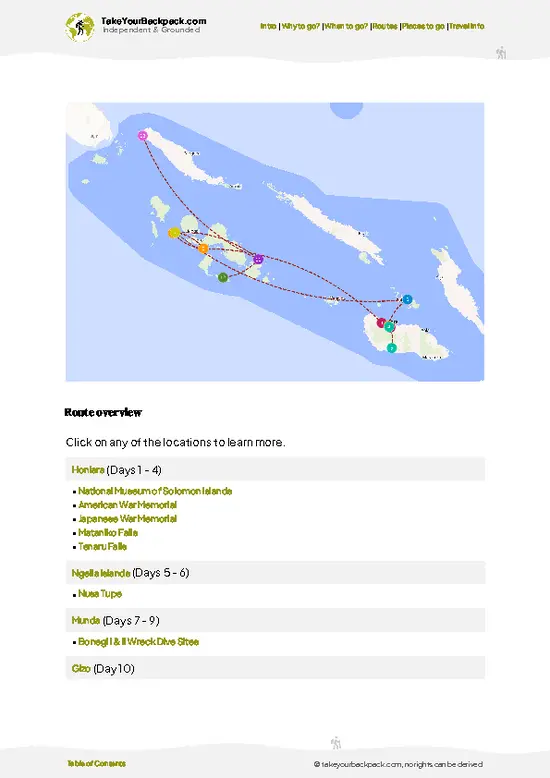
The 5-Day Iron Bottom Sound Escape

The Vibe: A relaxed, low-logistics intro to the Solomons built around Honiara and nearby islands, mixing waterfalls, light WWII history, and easy lagoon time. You stay mostly in one region, using short boat rides instead of long flights so you can actually swim and wander instead of packing and unpacking.The Highlights:
  • Base days in Honiara with a visit to the National Museum of Solomon Islands.
  • Jungle hiking and river pools at Mataniko Falls.
  • Island-hopping into the Ngella Islands for village life and calm waters.
  • Laid-back snorkel and beach time around Nusa Tupe.

The 10-Day Western Lagoons & War Stories Route

The Vibe: A balanced loop for travelers who want both history and heavy reef time, linking Honiara’s WWII sites with Western Province’s lagoons and small towns. You’ll use a couple of domestic flights and boat hops, but with enough two- and three-night stays that it never feels rushed.The Highlights:
  • WWII context in Honiara at the National Museum and hilltop
read more 👉

The 5-Day Iron Bottom Sound Escape

The Vibe: A relaxed, low-logistics intro to the Solomons built around Honiara and nearby islands, mixing waterfalls, light WWII history, and easy lagoon time. You stay mostly in one region, using short boat rides instead of long flights so you can actually swim and wander instead of packing and unpacking.The Highlights:
  • Base days in Honiara with a visit to the National Museum of Solomon Islands.
  • Jungle hiking and river pools at Mataniko Falls.
  • Island-hopping into the Ngella Islands for village life and calm waters.
  • Laid-back snorkel and beach time around Nusa Tupe.

The 10-Day Western Lagoons & War Stories Route

The Vibe: A balanced loop for travelers who want both history and heavy reef time, linking Honiara’s WWII sites with Western Province’s lagoons and small towns. You’ll use a couple of domestic flights and boat hops, but with enough two- and three-night stays that it never feels rushed.The Highlights:
  • WWII context in Honiara at the National Museum and hilltop memorials.
  • Jungle hiking to Mataniko Falls before heading west.
  • Time in Munda as a relaxed base for wreck dives at Bonegi I & II.
  • Days out in Marovo Lagoon with a wilderness side trip to Tetepare Island.

The 15-Day Deep Solomon Islands Circuit

The Vibe: A full-on exploration for travelers who want to go beyond the usual, combining waterfalls, wrecks, lagoons, and remote village life across multiple provinces. The pace is adventurous but measured, with a mix of flights and boat rides that turn the journey itself into part of the story.The Highlights:
  • Multi-day stay in Honiara for museums, memorials, and hikes to Mataniko and Tenaru Falls.
  • Island time in the Ngella Islands and Nusa Tupe before heading west.
  • Western Province swing through Munda and Gizo, including Bonegi wreck dives and reef days.
  • Extended immersion in Marovo Lagoon with a conservation-focused visit to Tetepare Island and a far-north finale on Taro Island.
🌍 Want a ready-to-use travel plan for Solomon Islands?
The overview above compares different route options based on your travel time and style. The complete Travel Guide breaks each itinerary down in detail, including maps, stops, highlights, and transport information.

Explore all route details 👉

Get the Travel Guide -

🌤️ When to go?A month-by-month overview

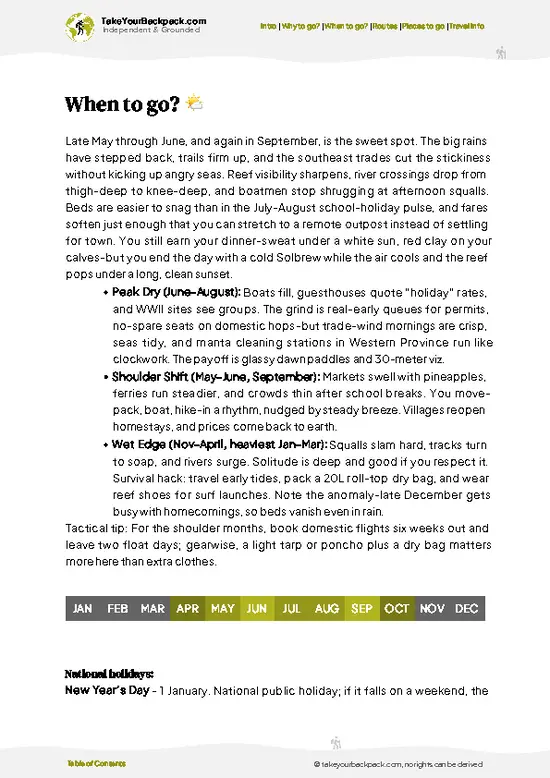
Late May through June, and again in September, is the sweet spot. The big rains have stepped back, trails firm up, and the southeast trades cut the stickiness without kicking up angry seas. Reef visibility sharpens, river crossings drop from thigh-deep to knee-deep, and boatmen stop shrugging at afternoon squalls. Beds are easier to snag than in the July-August school-holiday pulse, and fares soften just enough that you can stretch to a remote outpost instead of settling for town. You still earn your dinner—sweat under a white sun, red clay on your calves—but you end the day with a cold Solbrew while the air cools and the reef pops under a long, clean sunset.
  • Peak Dry (June-August): Boats fill, guesthouses quote “holiday” rates, and WWII sites see groups. The grind is real—early queues for permits, no-spare seats on domestic hops—but trade-wind mornings are crisp, seas tidy, and manta cleaning stations in Western Province run like clockwork. The payoff is glassy dawn paddles and 30-meter viz.
  • Shoulder Shift (May-June, September): Markets swell with pineapples, ferries run steadier, and crowds thin after school breaks. You move—pack, boat, hike—in a rhythm, nudged by steady breeze. Villages reopen homestays, and prices come back to earth.
  • Wet Edge (Nov-April, heaviest Jan-Mar): Squalls slam hard, tracks turn to soap, and rivers surge. Solitude is deep and good if you respect it. Survival hack: travel early tides, pack a 20L roll-top dry bag, and wear reef shoes for surf launches. Note the anomaly—late December gets busy with homecomings, so beds vanish even in rain.

Tactical tip: For the shoulder months, book domestic flights six weeks out and leave two float days; gearwise, a light tarp or poncho plus a dry bag matters more here than extra clothes.

source: climatestotravel.comJANJanuary: fair for travelingFEBFebruary: fair for travelingMARMarch: fair for travelingAPRApril: good for travelingMAYMay: highly recommended for travelingJUNJune: excellent for travelingJULJuly: highly recommended for travelingAUGAugust: highly recommended for travelingSEPSeptember: excellent for travelingOCTOctober: good for travelingNOVNovember: fair for travelingDECDecember: fair for traveling
📅 Traveling in a specific month?
Get a full month-by-month breakdown of weather, crowds, costs, festivals, and seasonal highlights in the complete travel guide.

Get full details when to go 👉

Get the Travel Guide -
solomon-islands- -gilly-tanabose-o7oV-rGy53Y-unsplash

💰 Costs (as of 2025)Prices, expenses, and money tips

Expect SBD 350-550 a day (USD 40-65) if you move slow, eat like a local, and treat distance as the enemy; travel days spike to 700+.
  • dorm accommodation: Honiara has a few bunks at SBD 160-250; outside the capital, think church rest houses or village huts at SBD 120-300 per person, often with cold bucket showers and roosters for alarms. System tip: ask for “rest house” at the church or provincial office, pay in cash, and negotiate dinner/breakfast bundled; you’ll beat resort rates by half. Compared to Fiji, beds are scarcer and a touch pricier for what you get; similar to outer-island Vanuatu.
  • meals: Supermarket Survival = rice, tinned tuna, noodles, bananas from the market: SBD 60-100/day if you’ve got a kitchen or don’t mind cold meals. Street food reality = there isn’t much; aim for the market lunch crowd: fish and rice, cassava, pumpkin leaves, SBD 20-50 a plate, or Chinese cafes at SBD 60-120. Imported snacks and cheese bleed you fast. Versus Fiji, you’ll spend more because budget eateries are thin on the ground.
  • local transport: Honiara minibuses are SBD 3-5 a hop; shared taxis 10-20. On big islands, ride the back of public trucks for SBD 10-30. To unlock the country cheaply, take
read more 👉
Expect SBD 350-550 a day (USD 40-65) if you move slow, eat like a local, and treat distance as the enemy; travel days spike to 700+.
  • dorm accommodation: Honiara has a few bunks at SBD 160-250; outside the capital, think church rest houses or village huts at SBD 120-300 per person, often with cold bucket showers and roosters for alarms. System tip: ask for “rest house” at the church or provincial office, pay in cash, and negotiate dinner/breakfast bundled; you’ll beat resort rates by half. Compared to Fiji, beds are scarcer and a touch pricier for what you get; similar to outer-island Vanuatu.
  • meals: Supermarket Survival = rice, tinned tuna, noodles, bananas from the market: SBD 60-100/day if you’ve got a kitchen or don’t mind cold meals. Street food reality = there isn’t much; aim for the market lunch crowd: fish and rice, cassava, pumpkin leaves, SBD 20-50 a plate, or Chinese cafes at SBD 60-120. Imported snacks and cheese bleed you fast. Versus Fiji, you’ll spend more because budget eateries are thin on the ground.
  • local transport: Honiara minibuses are SBD 3-5 a hop; shared taxis 10-20. On big islands, ride the back of public trucks for SBD 10-30. To unlock the country cheaply, take passenger ferries/cargo boats: deck class SBD 200-800 depending on distance—slow, sweaty, and worth it at sunrise when the islands slide past like dark teeth. Banana boats are faster but priced by fuel; buy a seat, leave early for calmer seas, wear a drybag. Domestic flights save time but torch budgets (often 800-1,500+ one-way). Cheaper than PNG flights; pricier and rougher than Fiji’s bus-ferry web.
  • activities: The wallet killers are motors and bubbles. Diving Iron Bottom Sound, Gizo, or Marovo runs roughly SBD 800-1,500 per dive with gear. Boat charters for snorkeling or village visits climb on fuel; expect SBD 400-1,000 split across the boat. Village access fees for waterfalls/WWII sites: SBD 20-100. Local guides SBD 150-300/day plus their food. Compared to Vanuatu, similar dive prices; surf charters (if you find one) sit in Fiji money.
  • miscellaneous: Budget leaks: ATM fees (SBD 50-80 a hit), mobile data (SBD 30-50/GB), bottled water (SBD 10-15 for 1.5L), sunscreen and repellent (import markups), laundry by bucket unless you pay hotel rates. Beer: SolBrew SBD 15-25 in shops, 30-40 in bars—cold pays for the heat and diesel stench you’ll inhale getting there. Sunday closures force you into hotel kitchens—plan ahead. Change is scarce; keep small bills to avoid “no change” markups.
⚠️ Prices can change and everyone travels differently, so take this as a rough guide. Hope it helps you plan your adventure!

✈️ The backpacker research shortcutSolomon Islands Travel Guide

An offline-friendly backpacking guide with optimized travel routes, ranked highlights, transport advice, and the best areas to stay.
example page 0 from our offline Travel Guide for Solomon Islandsexample page 1 from our offline Travel Guide for Solomon Islandsexample page 2 from our offline Travel Guide for Solomon Islandsexample page 3 from our offline Travel Guide for Solomon Islandsexample page 4 from our offline Travel Guide for Solomon Islandsexample page 5 from our offline Travel Guide for Solomon Islandsexample page 6 from our offline Travel Guide for Solomon Islandsexample page 7 from our offline Travel Guide for Solomon Islands
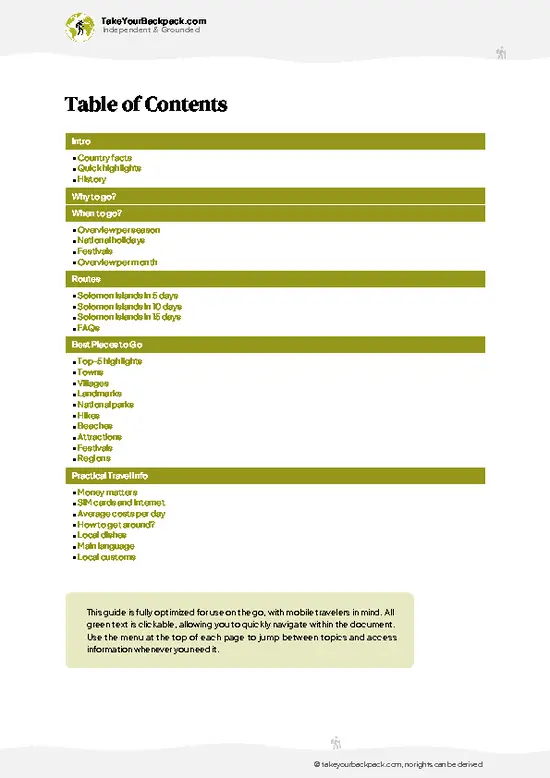
The digital guide (196 pages) contains:
45 highlights, ranked by travel appeal
Optimized 5, 10 & 15-day travel routes
Best neighborhoods to stay
How to get around
Offline-friendly for travel without Wi-Fi
👉 See all 30+ guide features

📅 Plan smarter in minutes, not weeks
Month by month travel advice
Festivals & national holidays
Budget expectations

🗺️ Go to the right places, skip the overrated ones
Honest pros & cons of destinations
Top hikes, parks & viewpoints
Lesser-known places most travelers miss
Clear “worth it vs skip it” guidance

🛏️ Travel smoothly without rookie mistakes
Best areas to stay
Transport systems explained simply
Common scams & safety advice
SIM cards, money & practical tips

🌍 Understand the country, not just visit it
Culture & traditions
52 Essential phrases & customs
Festivals worth planning around
Traveler-friendly historical context
Insights that make places more meaningful

📱 Built for real travel conditions
Fully downloadable PDF
Works completely offline
Optimized for phone use
Useful in remote areas & buses
Everything in one place
Save weeks of stressful planning
Get instant access to the full guide directly. 30-day money-back guarantee.


Sent to your inbox immediately after payment • 100% Secure Checkout
Best Backpacking Travel Advisor 2025 tourism awardBest Backpacking
Travel Advisor
2025
What others say about Take Your Backpack Guides:
⭐⭐⭐⭐⭐
Fantastic, amazing amount of information!
⭐⭐⭐⭐⭐
My goodness this is amazing, it's what I've been looking for hats off too you!
⭐⭐⭐⭐⭐
I think this is absolutely BRILLIANT
⭐⭐⭐⭐
Very complete and informative. It's still missing places, but I gotta to commend you
⭐⭐⭐⭐⭐
This is truly amazing, thank you, can't wait to explore it with my kids!
⭐⭐⭐⭐⭐
Awesome resource, thank you!
⭐⭐⭐⭐⭐
This is amazing! Can't wait to explore the ones I haven't seen
⭐⭐⭐⭐
I love this! Well done, great idea.
⭐⭐⭐⭐⭐
Thanks for taking the time to make this gem!
⭐⭐⭐⭐⭐
This might be the best website I've ever seen.
⭐⭐⭐⭐⭐
Congratulations, and thank you so much for your work; it's incredibly valuable.
⭐⭐⭐⭐
In all seriousness I think you did a great job pointing out the important spots
⭐⭐⭐⭐⭐
10/10 very good
⭐⭐⭐⭐⭐
As someone who's only just starting to visit regularly this is awesome, thank you.
⭐⭐⭐⭐
Thank you very much! I'm going to visit my dad, it's going to be very useful!
⭐⭐⭐⭐⭐
This is really cool! We'll be travelling for the first time and this definitely come in handy.
⭐⭐⭐⭐⭐
You are now our minister of culture, congratulations 👨‍💼
⭐⭐⭐⭐⭐
Just wanted to tell you that this is a pearl! Going to follow your recommendations.
⭐⭐⭐⭐⭐
This is so cool. I'll definitely be using the resource for my travels soon.
⭐⭐⭐⭐⭐
This is very impressive! Good work.
⭐⭐⭐⭐⭐
This is an amazing and informative site. Very well done!

🛏️ Where to stay?Best areas to base yourself

Yes — there are hostels and budget guesthouses in the Solomon Islands, but they are mainly in Honiara on Guadalcanal while other islands have only a few basic low-cost options, so plan to base in Honiara for the best cheap-bed availability and use inter-island transport to reach outer islands.
Within Honiara the central business district/Town has the most choices and best access to markets, museums and transport (better for nightlife but busy and noisier); Point Cruz is handy for ferries and short tours but more touristy and sometimes pricier; residential areas like Kukum and Panatina are quieter … read more 👉
Yes — there are hostels and budget guesthouses in the Solomon Islands, but they are mainly in Honiara on Guadalcanal while other islands have only a few basic low-cost options, so plan to base in Honiara for the best cheap-bed availability and use inter-island transport to reach outer islands.
Within Honiara the central business district/Town has the most choices and best access to markets, museums and transport (better for nightlife but busy and noisier); Point Cruz is handy for ferries and short tours but more touristy and sometimes pricier; residential areas like Kukum and Panatina are quieter and often cheaper yet need taxis for evening services; White River and outer islands offer very basic budget stays with limited amenities and emergency infrastructure.

If you enjoy meeting fellow travelers, consider choosing hostels with high ratings for atmosphere. On the other hand, if you prefer having your own space, a hotel might be a better option.

🚌 Getting aroundPublic transport and other ways to get around

The Solomons move on tide and rumor. Schedules are chalk on wet concrete; the day starts when the rooster and the diesel both wake. At Point Cruz the air tastes of salt and copra smoke, men sling sacks, horns cough twice, and a ship that “leaves at nine” slides out near eleven—unless the rain pins it down. You don’t outmuscle the flow; you read it. Wait where engines idle, keep small cash ready, jump when the hull or the minibus door opens. The payoff is real: a dawn deck, coffee in a dented mug, … read more 👉
The Solomons move on tide and rumor. Schedules are chalk on wet concrete; the day starts when the rooster and the diesel both wake. At Point Cruz the air tastes of salt and copra smoke, men sling sacks, horns cough twice, and a ship that “leaves at nine” slides out near eleven—unless the rain pins it down. You don’t outmuscle the flow; you read it. Wait where engines idle, keep small cash ready, jump when the hull or the minibus door opens. The payoff is real: a dawn deck, coffee in a dented mug, green islands unrolling like shark fins while flying fish spark off the bow.
  • Provincial ships (cargo-passenger ferries) The speed-cost trade is brutal and fair: one day and one night on a steel deck for a sliver of the price of a one-hour flight. Board early at the wharf, claim shade upwind of the toilets, lash your pack to a pipe, and lay out a mat or hammock. The hold stinks of copra and diesel; roaches appear after dark; stops happen at 2 a.m. with no announcement—watch the cargo crew to gauge your port. Seas through The Slot can thump, but sunrise over lagoon water erases the stiffness in your back.
  • Minibuses (Honiara/Gizo town runs) This is the social heartbeat on wheels: flag with a low palm, tell the conductor your landmark, pass coins forward, and keep change small. Music swings between island gospel and reggae; knees touch; no one complains if you’re polite. Packs go on laps, not in aisles. Tap the roof or say “next corner” to get off. Offer your seat to elders. Services thin after dark and vanish in heavy rain, so move while the city hums.
  • Banana boats (outboard canoes) Water unlocks the map—reefs, villages, surf points—places the big ships ignore and roads don’t reach. Skippers cluster at market jetties at first light when the sea lies flatter; by afternoon the trades slap. Agree the fare before fuel is poured from jerrycans, bag your pack double, and sit aft for less hammering. Lifejackets are rare; bring your own if you care about arriving dry and alive. The spray is warm, the horizon wide, and kids wave from stilt houses as you thread the mangroves.
  • Back-of-truck rides (one-ton pickups) The cheap hack where roads exist: stand in the tray with copra sacks and church ladies, pay a coin-on-the-palm when you hop off, and burn past taxi quotes by an order of magnitude. It’s dusty in the dry, wet in the wet; a sarong works as dust mask or rain cape. Drivers run when full or when the church bell says it’s time. Hold on and keep fingers off the rails when branches whip by.

Master tactic: Fly one long hop to position yourself, then ride ships and banana boats back toward Honiara at first light—fast where it counts, cheap for the miles that don’t.
Distance: Honiara International Airport (HIR, Henderson) is about 13 km (8 miles) east of the city center (Point Cruz).

Main ways to get into town
  • Public minibus (cheapest)

    Catch one on the main road right outside the terminal (Kukum Highway) heading toward “Town”/Point Cruz. They run frequently from early morning until evening, with fewer services late at night.

    Time: 30-60 minutes, depending on stops and traffic.

    Cost (as of 2025): SBD 5-10 per person. Pay the conductor in cash; have small notes. Big luggage may be refused or you might be asked to pay for an extra seat.
  • Taxi

    Readily available outside arrivals. Most aren’t metered—agree the fare before you get in (or ask to use the meter if fitted).

    Time: 20-35 minutes in normal traffic; longer at peak times (roughly 8-9am, 4-6:30pm) or after heavy rain.

    Typical cost (as of 2025): SBD 150-250 to central Honiara; up to ~SBD 300 late at night or in heavy traffic. Cash only.
  • Hotel transfer (pre-booked)

    Some midrange and upscale hotels offer airport transfers; a few include it for guests.

    Time: Similar to a taxi (20-35 minutes).

    Cost (as of 2025): Often SBD 80-150 per person; sometimes free if bundled with your booking.

There’s no dedicated airport bus or train. If you’re arriving after dark or carrying bulky bags, a taxi or pre-booked hotel transfer is the most straightforward option. Traffic moves along one main coastal road, so travel times can swing a bit—budget extra time if you’ve got a tight schedule.
⚠️ Prices and routes can change, so take this as a rough guide and ask for local advice when you arrive.

🔒 Safety (risk Level: low)Staying safe while traveling

Safety for solo travelers, including women and LGBTQ+ individuals
Solo travelers, including women and LGBTQ+ individuals, can generally find the Solomon Islands safe but should remain cautious. Petty crime, like pickpocketing, can occur, so keep an eye on your belongings. For LGBTQ+ travelers, the culture is conservative; discretion is advised as same-sex relationships are not widely accepted. Always stay informed about local customs and seek advice from other travelers or locals.


Full official government travel advisory (live updates)
View details 👉

✈️ VisaDo you need a visa to visit?

Most travelers to the Solomon Islands can obtain a visa on arrival for stays up to 30 days. Ensure your passport is valid for at least six months and have proof of onward travel. Check the latest entry requirements, as policies can change.
⚠️ Visa requirements can change over time, so always check the latest visa requirements with the official embassy or government website before you travel.

🎒 What to pack?A practical packing list

Expect a tropical vibe in the Solomon Islands with hot and humid weather year-round, plus a fair bit of rain depending on the season. Pack for beach days and jungle treks, but also remember that modest clothing is appreciated in villages. Lightweight, breathable fabrics are your friends, and don’t forget something to cover your shoulders and knees when visiting local communities. Sturdy sandals or hiking shoes will be useful for the varied terrain, from sandy beaches to lush, sometimes muddy paths. Keep it simple and respectful, and you’ll fit right in.

Apart from this country specific advice, I have also crafted a general packing list that should help on any trip. authorOver the years, I've learned the importance of packing minimally. It's so much easier to jump on the back of a truck or squeeze yourself into the last spot of a minibus without that supersized backpack. If you're headed to a warm destination, leave your winter jacket at home; for colder regions, opt for thin thermal underlayers. Instead of packing your entire wardrobe, bring just three sets of clothes, as laundry facilities are available everywhere.

View the full list 👉
🎒 Planning the practical side of your trip?
Get detailed information on transport, daily budgets, internet access, local customs, food, language, and other essentials in the complete Travel Guide.

Get detailed practical information 👉

Get the Travel Guide -

🙋 FAQQuick answers to practical concerns

Trip Planning


Personal tip: I normally search on good rating for atmosphere (for meeting people) and location (for easy exploring). Cleanliness as a bonus.


Travel Essentials

Hepatitis A and Typhoid vaccines are recommended for all travelers to the Solomon Islands. Hepatitis B is advised if you plan on close contact with locals or extended stays. For those trekking or visiting rural areas, consider the Japanese Encephalitis and Rabies vaccines. Malaria is a risk, so take preventive measures. Always check the latest health advisories before travel.


vaccination requirements
When I first started traveling, I often spent part of my first day in a new country hunting for a local SIM card. While this can still be slightly cheaper, it also takes time and planning.

These days, it's much simpler to install an eSIM before leaving home. Once you arrive in Solomon Islands, you can activate it immediately and have mobile data from the moment you land — which is especially useful for ordering transport or navigating away from busy airports.

There are many providers nowadays, and price differences are usually small. I personally go with Airalo, as it offers excellent network coverage throughout the country and strong global coverage, so you can manage multiple countries from a single app.


Get your e-sim for Solomon Islands

Culture & Customs

Dress modestly, especially in rural areas. Avoid wearing swimsuits beyond the beach. Always ask for permission before taking photos of people or their property. Handshakes are common greetings, but touching heads is considered disrespectful. Sundays are for church and rest; avoid planning activities or meetings on this day.

For LGBTQ+ travelers, be discreet. Homosexuality is illegal, and public displays of affection can attract negative attention. Women should be cautious and may prefer to travel in groups, especially at night. Always respect local customs and be polite.
Trying traditional food is always a great way to experience the culture. Here are some must-try dishes for Solomon Islands.
  • Poi: This pudding-like dish is made from fermented taro root and is a staple in many Pacific island diets. It’s a bit of an acquired taste but trying it gives you insight into traditional island food preservation and preparation.
  • Coconut Crab: Known locally as ”kakamora,” this massive, coconut-eating crab is famous for its sweet, rich meat. It’s not just a culinary experience but also a cultural one, as these crabs are often featured in local folklore.
  • Ulu: This is breadfruit, which is often roasted or boiled. It’s a cornerstone of many meals and reflects the importance of breadfruit in local agriculture and daily life.
  • Palusami: A dish of taro leaves filled with coconut cream and sometimes meat or fish, baked until tender. It’s a classic example of how locals combine simple, available ingredients into something delicious and comforting.
  • Sweet Potato Pudding: Sweet potatoes are abundant in the Solomon Islands, and this dish uses them in a sweet, baked pudding form. It shows the islanders’ knack for making the most of their root vegetables.
Tap water in the Solomon Islands is not consistently safe for tourists to drink, as treatment standards can vary and locals often boil water before consumption. It’s best to stick to bottled or filtered water during your visit to avoid any risk of waterborne illnesses. If you want to be extra cautious, consider bringing a portable water filter for added safety.
The main language in Solomon Islands is Solomon Islands Pijin. Backpacking is way more rewarding if you know a bit of the local language, so I'd suggest brushing up on the basics just in case your Solomon Islands Pijin skills have become a bit rusty.

Want to understand locals better?
The complete Travel Guide for Solomon Islands includes 52 essential words and phrases — greetings, thank-yous, ordering food, transport, numbers, and common local expressions you'll actually hear.

Get your local basic phrases 👉

Get the Travel Guide -


English is widely spoken in the Solomon Islands, primarily as a second language. It serves as the official language, used in government, education, and formal communication. However, the proficiency levels can vary significantly, especially in rural areas where local languages and dialects dominate daily conversations.

In urban centers like Honiara, you will find a higher percentage of English speakers, including professionals and those in the tourism industry. Many locals, particularly younger generations and those involved in education, are quite fluent. However, in more remote villages, English may be limited, and you might encounter challenges in communication.

Most Solomon Islanders are multilingual, often speaking their indigenous languages alongside Pijin, a creole language that is more commonly used in informal settings. Pijin is generally easier to understand and is a practical alternative for communication with locals.

Overall, while you can get by with English in the Solomon Islands, learning a few phrases in Pijin or the local dialects can enhance your travel experience and help you connect with the friendly locals.

Money & Payments

The local currency of Solomon Islands is SBD ($).

When backpacking in the Solomon Islands, it’s crucial to plan your finances ahead. ATMs are primarily found in Honiara and a few major towns, so don’t bank on finding one in remote islands. Always carry some cash, as many places don’t accept cards. The local currency is the Solomon Islands Dollar (SBD), and it’s best to have it on hand.

For currency exchange, stick to banks or official exchange offices. You’ll get better rates in Honiara than at the airport. US dollars are more widely accepted than euros for exchange, but it’s always better to have local currency.

Most of the smaller shops and local eateries only accept cash. Credit cards are mainly accepted in larger hotels or tourist-centric businesses, and even then, you’ll often encounter a surcharge. Keep a mix of small and large denominations, as change can be an issue in more remote areas.

Tipping in the Solomon Islands isn’t customary, and it’s not expected in most situations. If you receive exceptional service and want to show appreciation, a small tip won’t be refused but is more appreciated when given as a gesture of thanks rather than a standard practice. In local markets and small eateries, tipping is generally unnecessary.

🧩 Nearby countriesSimilar backpacking destinations

We 💚 feedbackFinal notes for travelers

Solomons pay you back slowly. You wade through heat, betel‑nut spit on the pavement, sweaty minibus rides, and boat timetables that laugh at plans. But the moment hits: dusk on a village jetty, reef fish flicking silver below, a cold SolBrew sweating in your hand. It’s gold for time‑rich travelers—divers, paddlers, and anyone who values quiet over convenience. Not great if you need hostels, fast Wi‑Fi, or tight schedules; inter‑island flights cost more than meals for a week, and Honiara demands street sense after dark.

✍️ Help improve this page!
The information on this page is based on in-depth research, insights shared by experienced travelers, and feedback from the local travel community in Solomon Islands. While every effort is made to keep the information accurate and current, conditions can change — so if you spot anything incorrect or outdated, please get in touch.


🙋‍♂️ Give feedback

👋 Meet the founderWho’s Behind Take Your Backpack?

Johan, backpacker and founder of TakeYourBackpackHi, I’m Johan (Netherlands 🇳🇱), the creator of TakeYourBackpack. Over the past decade, I’ve backpacked through 80+ countries across six continents, gaining extensive experience with independent travel, long-term trips, and overland routes.

This site is built on a combination of firsthand travel experience and carefully curated insights from other backpackers. Many guides are based on places I’ve personally visited, while others bring together tips, observations, and practical advice shared by trusted travelers I’ve met along the way.

The goal is to provide realistic, experience-driven guidance — not generic itineraries — so you can explore destinations with better context, clearer expectations, and more confidence.

Get Full Country Guide |
Instant download • 45 highlights • Full Offline guide